Management of Head
Injuries
Sumit Sinha
M.S; D.N.B; M.N.A.M.S; M.Ch
Asstt. Professor
Department of Neurosurgery
JPNATC, AIIMS, New Delhi
■ Major Health Hazard, 2 million injured and 1
million die/rehab/ year in India
■ 16,000 per year in Delhi.
■ Leading cause of death in multiple injured
patient.
■ Tops the list of killers in young
■ Man-made preventable calamity
Head Injury
Large number die of non-
availability of timely treatment.
Head Injury
Head Injury
Definition
Injury to HEAD AND
BRAIN
Head Injury
Etiology
■ Road traffic accidents
■ Fall from height
■ Assault
Head Injury
Alcohol involved in 20%
50% fatal injury occur because of alcohol.
■ Reflexes and reaction time delayed
■ Euphoria
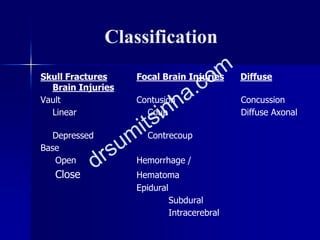
Classification
Skull Fractures Focal Brain Injuries Diffuse
Brain Injuries
Vault Contusion Concussion
Linear Coup Diffuse Axonal
Depressed Contrecoup
Base
Open Hemorrhage /
Close Hematoma
Epidural
Subdural
Intracerebral
Head Injury- Neurological
Examination
HISTORY
■ Careful and precise
■ Time of injury and mechanism-
Acceleration/ Impact injuries
■ Accident scene reconstruction
■ H/o LOC or seizures
■ h/o drug or alcohol intake
Head Injury- Examination
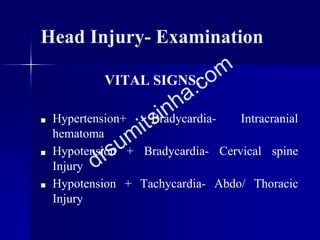
VITAL SIGNS:
■ Hypertension+ Bradycardia- Intracranial
hematoma
■ Hypotension + Bradycardia- Cervical spine
Injury
■ Hypotension + Tachycardia- Abdo/ Thoracic
Injury
Head Injury- Examination
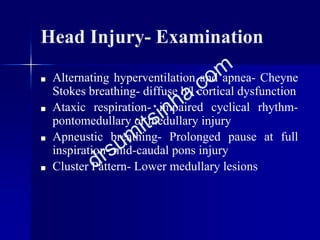
■ Alternating hyperventilation and apnea- Cheyne
Stokes breathing- diffuse b/l cortical dysfunction
■ Ataxic respiration- impaired cyclical rhythm-
pontomedullary or medullary injury
■ Apneustic breathing- Prolonged pause at full
inspiration- mid-caudal pons injury
■ Cluster Pattern- Lower medullary lesions
Head Injury- Examination
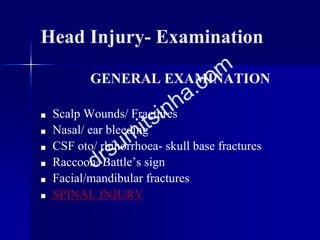
GENERAL EXAMINATION
■ Scalp Wounds/ Fractures
■ Nasal/ ear bleeding
■ CSF oto/ rhinorrhoea- skull base fractures
■ Raccoon/ Battle’s sign
■ Facial/mandibular fractures
■ SPINAL INJURY
Head Injury- Examination
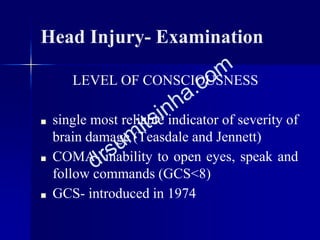
LEVEL OF CONSCIOUSNESS
■ single most reliable indicator of severity of
brain damage (Teasdale and Jennett)
■ COMA- inability to open eyes, speak and
follow commands (GCS<8)
■ GCS- introduced in 1974
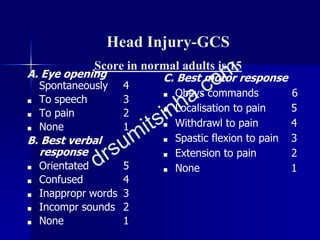
Head Injury-GCS
Score in normal adults is 15
A. Eye opening
Spontaneously 4
■ To speech 3
■ To pain 2
■ None 1
B. Best verbal
response
■ Orientated 5
■ Confused 4
■ Inappropr words 3
■ Incompr sounds 2
■ None 1
C. Best motor response
■ Obeys commands 6
■ Localisation to pain 5
■ Withdrawl to pain 4
■ Spastic flexion to pain 3
■ Extension to pain 2
■ None 1
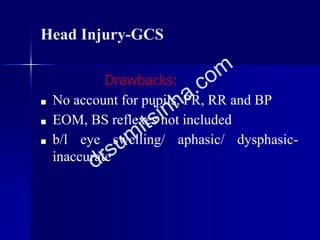
Head Injury-GCS
Drawbacks:
■ No account for pupils, PR, RR and BP
■ EOM, BS reflexes not included
■ b/l eye swelling/ aphasic/ dysphasic-
inaccurate
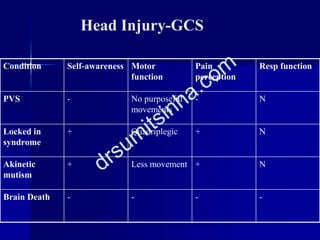
Head Injury-GCS
Condition Self-awareness Motor
function
Pain
perception
Resp function
PVS - No purposeful
movements
- N
Locked in
syndrome
+ Quadriplegic + N
Akinetic
mutism
+ Less movement + N
Brain Death - - - -
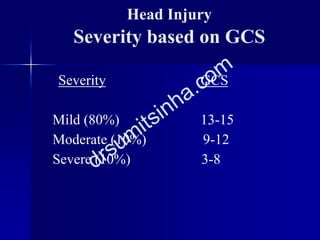
Head Injury
Severity based on GCS
Severity GCS
Mild (80%) 13-15
Moderate (10%) 9-12
Severe (10%) 3-8
Head Injury- Examination
MEMORY
■ Immediate
■ Recent - hippocampal fornicial mamillo-
thalamic tracts
■ Remote- cerebral cortex
Head Injury- Examination
■ AGA-inability to lay down new memories
following TBI
■ RGA – memory loss to events prior to
injury
■ PTA- time from injury to return of
memory process- same as RGA
■ PTA- directly related to severity of injury
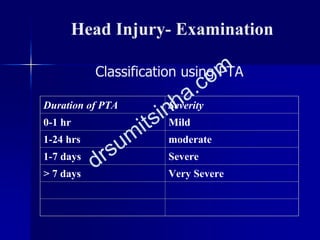
Duration of PTA Severity
0-1 hr Mild
1-24 hrs moderate
1-7 days Severe
> 7 days Very Severe
Head Injury- Examination
Classification using PTA
Head Injury- Examination
PUPILS
UNILATERAL NONREACIVE
DILATATION- TRANSTENTORIAL
HERNIATION
HUTCHINSON’S PUPILS
Head Injury- Examination
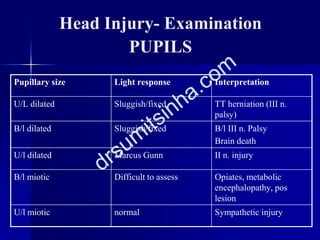
PUPILS
Pupillary size Light response Interpretation
U/L dilated Sluggish/fixed TT herniation (III n.
palsy)
B/l dilated Sluggish/fixed B/l III n. Palsy
Brain death
U/l dilated Marcus Gunn II n. injury
B/l miotic Difficult to assess Opiates, metabolic
encephalopathy, pos
lesion
U/l miotic normal Sympathetic injury
Head Injury- Examination
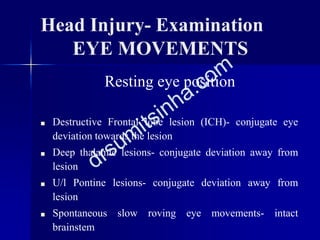
EYE MOVEMENTS
Resting eye position
■ Destructive Frontal lobe lesion (ICH)- conjugate eye
deviation towards the lesion
■ Deep thalamic lesions- conjugate deviation away from
lesion
■ U/l Pontine lesions- conjugate deviation away from
lesion
■ Spontaneous slow roving eye movements- intact
brainstem
Head Injury- Examination
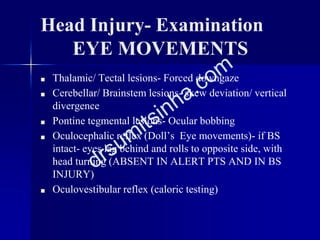
EYE MOVEMENTS
■ Thalamic/ Tectal lesions- Forced downgaze
■ Cerebellar/ Brainstem lesions- skew deviation/ vertical
divergence
■ Pontine tegmental lesions- Ocular bobbing
■ Oculocephalic reflex (Doll’s Eye movements)- if BS
intact- eyes lag behind and rolls to opposite side, with
head turning (ABSENT IN ALERT PTS AND IN BS
INJURY)
■ Oculovestibular reflex (caloric testing)
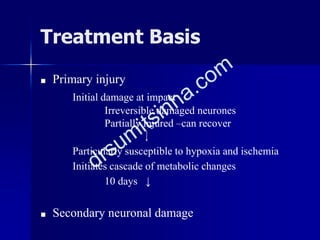
Treatment Basis
■ Primary injury
Initial damage at impact
Irreversible damaged neurones
Partially injured –can recover
Particularly susceptible to hypoxia and ischemia
Initiates cascade of metabolic changes
10 days ↓
■ Secondary neuronal damage
AIM
Provide optimum circumstances for
recovery from damage already
sustained.
Prevent Secondary injury
Head Injury Management
■ Secondary Injury
■ (Golden hour)
– Hypoxia
– Hypotension – ischaemia
– hematoma
Early episodes of hypotension or
hypoxia greatly increase morbidity
and mortality from severe head injury
Head Injury Management
Impaired consciousness with ALCOHOL
intake -- manage along head injury lines --
rather than assuming due to alcohol
Head Injury Management
Initial Management
■ A. Airway
■ B. Breathing
■ C. Circulation
■ D. Diagnosis
Head Injury Management
AIRWAY
Protection of airway patency from vomit, blood
FB, loose teeth
Intubate if
■ Airway or ventilation is inadequate
■ Patient remains unresponsive (cannot protect airway)
■ Soft tissue swelling of face/neck
Aspirated /lung contusion/ pneumo/ hemothorax
Suspect cervical spine injury – careful during intubation
Head Injury Management
BREATHING
Controlled ventilation (PCO 2 : 30 to 35)
– Ensures normal O2 supply to brain
– Prevents atelact. – expands collapsed alveoli
– Combats restlessness – ↓ exhaust. resp. work.
– IV Midazolam / Synchronizes Resp. with
vent.
– CT without artifact
Head Injury Management
■ At least two IV lines
– 0.9% NS
– Maintain BP> 100
■ Shock is usually not related to head injury
Infants
Terminal situations
Suspect Cervical spine injury
■ Look for other injury-
viscera, # femur
CIRCULATION
Head Injury Management
Initial Assessment in < 2 mts.
Define problems requiring urgent
diagnostic / therapeutic action
■ Level of Consciousness (GCS)
■ Pupillary size, reaction
■ Focal Neurologic Deficits
Head Injury Management
■ Transportation- Cont. ABC
■ Treatment of life threatening emergency-
pneumothorax etc.
■ Goal of emergency room T/T- prevent
secondary insult from systemic
abnormality or primary CNS injury.
Head Injury Management
■ Quick re-assessment
■ CT Scan
– Conservative
– Surgery
Indications for Surgery
■ Open compound wounds – CSF leak, brain come out
■ ↑ICP -in conjunction with clinical condition
hematoma EDH
SDH craniotomy
ICH
contusion
refractory edema-
decompressive
craniotomy
Avoided or Corrected
■ Hypoxia
■ Hypovolemia
■ Hypotension
■ Acidosis
■ ↑ ICP
■ Seizures
■ Edema
■ Pyrexia
■ Hypo/hypernatremia
■ Hyperglycemia
■ Anaemia
Head Injury Management
General Treatment
■ Normothermia / Mild hypothermia (340C)
■ Correct anemia – low Hb raises CBF
■ Control serum glucose
■ Maintain normal BP
■ Correct electrolyte – Hyponatremia
Conservative Treatment in cases with no
hematoma or post op.
■ Prevention of infection – antibiotics
■ Control of pain and restlessness
■ Bladder and bowel care
■ Control of ↑ ICP
■ Anticonvulsants
Head Injury Treatment
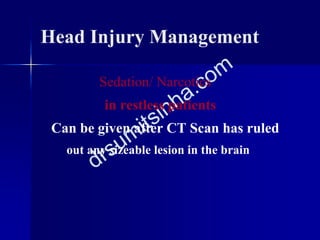
Sedation/ Narcotics
in restless patients
Can be given after CT Scan has ruled
out any sizeable lesion in the brain
Head Injury Management
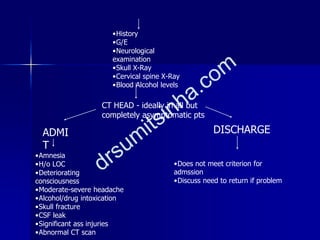
•History
•G/E
•Neurological
examination
•Skull X-Ray
•Cervical spine X-Ray
•Blood Alcohol levels
CT HEAD - ideally in all but
completely asymptomatic pts
ADMI
T
DISCHARGE
•Amnesia
•H/o LOC
•Deteriorating
consciousness
•Moderate-severe headache
•Alcohol/drug intoxication
•Skull fracture
•CSF leak
•Significant ass injuries
•Abnormal CT scan
•Does not meet criterion for
admssion
•Discuss need to return if problem
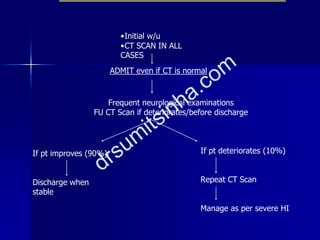
•Initial w/u
•CT SCAN IN ALL
CASES
ADMIT even if CT is normal
Frequent neurological examinations
FU CT Scan if deteriorates/before discharge
If pt improves (90%)
Discharge when
stable
If pt deteriorates (10%)
Repeat CT Scan
Manage as per severe HI
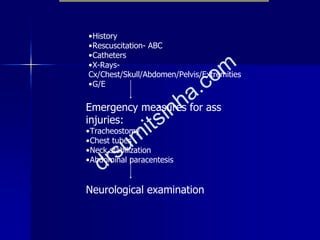
•History
•Rescuscitation- ABC
•Catheters
•X-Rays-
Cx/Chest/Skull/Abdomen/Pelvis/Extremities
•G/E
Emergency measures for ass
injuries:
•Tracheostomy
•Chest tubes
•Neck stabilization
•Abdominal paracentesis
Neurological examination
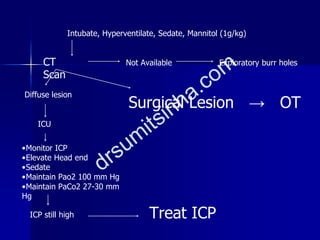
Intubate, Hyperventilate, Sedate, Mannitol (1g/kg)
CT
Scan
Diffuse lesion
Not Available Exploratory burr holes
ICU
•Monitor ICP
•Elevate Head end
•Sedate
•Maintain Pao2 100 mm Hg
•Maintain PaCo2 27-30 mm
Hg
ICP still high Treat ICP
Surgical Lesion → OT
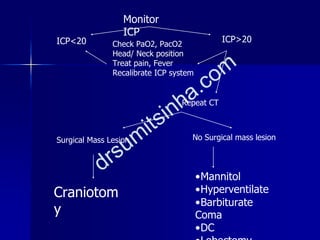
Monitor
ICP
ICP<20 ICP>20Check PaO2, PacO2
Head/ Neck position
Treat pain, Fever
Recalibrate ICP system
Repeat CT
Surgical Mass Lesion
Craniotom
y
No Surgical mass lesion
•Mannitol
•Hyperventilate
•Barbiturate
Coma
•DC
Head Injury Management
SPECIFIC HEAD
INJURIES
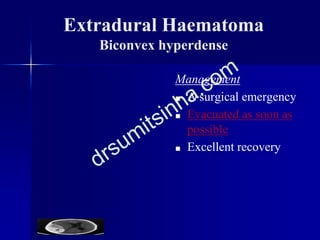
Extradural Haematoma
Biconvex hyperdense
Management
■ A surgical emergency
■ Evacuated as soon as
possible
■ Excellent recovery
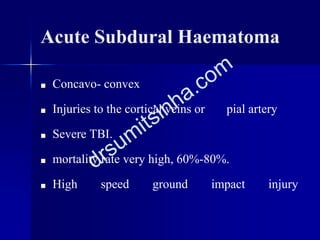
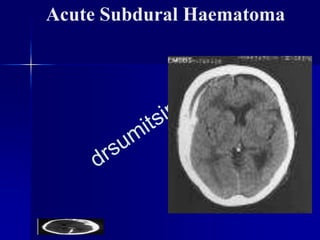
Acute Subdural Haematoma
■ Concavo- convex
■ Injuries to the cortical veins or pial artery
■ Severe TBI.
■ mortality rate very high, 60%-80%.
■ High speed ground impact injury
Acute Subdural Haematoma
Chronic Subdural Haematoma
■ Presents several weeks
after a trivial trauma.
■ A simple burr hole
evacuation curative.
■ May present to physician
as stroke
■ May be B/L isodense
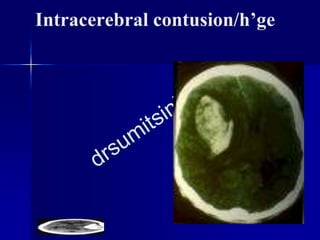
Intracerebral contusion/h’ge
■ If deep, small or multiple
observation
ICP monitoring
surgery for the largest lesion
■ If large
surgical evacuation.
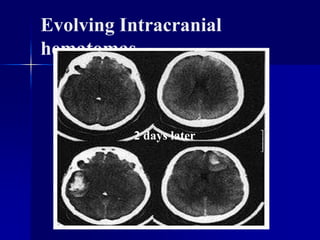
■ May deteriorate after several days because of increase
in the size / edema
Intracerebral contusion/h’ge
Evolving Intracranial
hematomas
2 days later
Diffuse Axonal Injury
Non-operable
lesion
PRIMARY BRAIN STEM INJURY
■ 5-10% of all serious HI
■ True (Primary)/As part of DAI
■ Rent/tear/laceration/ Transection-
Spinomedullary junction
Pontomedullary junction
Mesencephalo – pontine junction
PRIMARY BRAIN STEM INJURY
■ Clinical features –
– Low GCS at admission
– Immediate unconsciousness after accident
– Persistant vegetative state
– ICP < 20
■ CT
– Hemorrhage in ambient cistern
– Blood along tent
Conclusion
■ Treatment should be PROMPT (within
golden hour) so that secondary brain
damage can be avoided.
■ Doctors in periphery have a responsible
job.
Conclusion
■ Management should be done by a
dedicated neurosurgical team with inputs
from other specialities if required.
■ The best management plan would be a
goal towards avoiding head injury.
Conclusion
– Enforcement of traffic rules and laws
– Improved illumination, vehicle design,
road conditions
– Not mixing drink and driving – delays
reflexes and judgment
Head injury management lecture.ppt (1)

Head injury management lecture.ppt (1)

  • 1.
    Management of Head Injuries SumitSinha M.S; D.N.B; M.N.A.M.S; M.Ch Asstt. Professor Department of Neurosurgery JPNATC, AIIMS, New Delhi
  • 2.
    ■ Major HealthHazard, 2 million injured and 1 million die/rehab/ year in India ■ 16,000 per year in Delhi. ■ Leading cause of death in multiple injured patient. ■ Tops the list of killers in young ■ Man-made preventable calamity Head Injury
  • 3.
    Large number dieof non- availability of timely treatment. Head Injury
  • 4.
  • 5.
    Head Injury Etiology ■ Roadtraffic accidents ■ Fall from height ■ Assault
  • 6.
    Head Injury Alcohol involvedin 20% 50% fatal injury occur because of alcohol. ■ Reflexes and reaction time delayed ■ Euphoria
  • 7.
    Classification Skull Fractures FocalBrain Injuries Diffuse Brain Injuries Vault Contusion Concussion Linear Coup Diffuse Axonal Depressed Contrecoup Base Open Hemorrhage / Close Hematoma Epidural Subdural Intracerebral
  • 8.
    Head Injury- Neurological Examination HISTORY ■Careful and precise ■ Time of injury and mechanism- Acceleration/ Impact injuries ■ Accident scene reconstruction ■ H/o LOC or seizures ■ h/o drug or alcohol intake
  • 9.
    Head Injury- Examination VITALSIGNS: ■ Hypertension+ Bradycardia- Intracranial hematoma ■ Hypotension + Bradycardia- Cervical spine Injury ■ Hypotension + Tachycardia- Abdo/ Thoracic Injury
  • 10.
    Head Injury- Examination ■Alternating hyperventilation and apnea- Cheyne Stokes breathing- diffuse b/l cortical dysfunction ■ Ataxic respiration- impaired cyclical rhythm- pontomedullary or medullary injury ■ Apneustic breathing- Prolonged pause at full inspiration- mid-caudal pons injury ■ Cluster Pattern- Lower medullary lesions
  • 11.
    Head Injury- Examination GENERALEXAMINATION ■ Scalp Wounds/ Fractures ■ Nasal/ ear bleeding ■ CSF oto/ rhinorrhoea- skull base fractures ■ Raccoon/ Battle’s sign ■ Facial/mandibular fractures ■ SPINAL INJURY
  • 12.
    Head Injury- Examination LEVELOF CONSCIOUSNESS ■ single most reliable indicator of severity of brain damage (Teasdale and Jennett) ■ COMA- inability to open eyes, speak and follow commands (GCS<8) ■ GCS- introduced in 1974
  • 13.
    Head Injury-GCS Score innormal adults is 15 A. Eye opening Spontaneously 4 ■ To speech 3 ■ To pain 2 ■ None 1 B. Best verbal response ■ Orientated 5 ■ Confused 4 ■ Inappropr words 3 ■ Incompr sounds 2 ■ None 1 C. Best motor response ■ Obeys commands 6 ■ Localisation to pain 5 ■ Withdrawl to pain 4 ■ Spastic flexion to pain 3 ■ Extension to pain 2 ■ None 1
  • 14.
    Head Injury-GCS Drawbacks: ■ Noaccount for pupils, PR, RR and BP ■ EOM, BS reflexes not included ■ b/l eye swelling/ aphasic/ dysphasic- inaccurate
  • 15.
    Head Injury-GCS Condition Self-awarenessMotor function Pain perception Resp function PVS - No purposeful movements - N Locked in syndrome + Quadriplegic + N Akinetic mutism + Less movement + N Brain Death - - - -
  • 16.
    Head Injury Severity basedon GCS Severity GCS Mild (80%) 13-15 Moderate (10%) 9-12 Severe (10%) 3-8
  • 17.
    Head Injury- Examination MEMORY ■Immediate ■ Recent - hippocampal fornicial mamillo- thalamic tracts ■ Remote- cerebral cortex
  • 18.
    Head Injury- Examination ■AGA-inability to lay down new memories following TBI ■ RGA – memory loss to events prior to injury ■ PTA- time from injury to return of memory process- same as RGA ■ PTA- directly related to severity of injury
  • 19.
    Duration of PTASeverity 0-1 hr Mild 1-24 hrs moderate 1-7 days Severe > 7 days Very Severe Head Injury- Examination Classification using PTA
  • 20.
    Head Injury- Examination PUPILS UNILATERALNONREACIVE DILATATION- TRANSTENTORIAL HERNIATION HUTCHINSON’S PUPILS
  • 21.
    Head Injury- Examination PUPILS Pupillarysize Light response Interpretation U/L dilated Sluggish/fixed TT herniation (III n. palsy) B/l dilated Sluggish/fixed B/l III n. Palsy Brain death U/l dilated Marcus Gunn II n. injury B/l miotic Difficult to assess Opiates, metabolic encephalopathy, pos lesion U/l miotic normal Sympathetic injury
  • 22.
    Head Injury- Examination EYEMOVEMENTS Resting eye position ■ Destructive Frontal lobe lesion (ICH)- conjugate eye deviation towards the lesion ■ Deep thalamic lesions- conjugate deviation away from lesion ■ U/l Pontine lesions- conjugate deviation away from lesion ■ Spontaneous slow roving eye movements- intact brainstem
  • 23.
    Head Injury- Examination EYEMOVEMENTS ■ Thalamic/ Tectal lesions- Forced downgaze ■ Cerebellar/ Brainstem lesions- skew deviation/ vertical divergence ■ Pontine tegmental lesions- Ocular bobbing ■ Oculocephalic reflex (Doll’s Eye movements)- if BS intact- eyes lag behind and rolls to opposite side, with head turning (ABSENT IN ALERT PTS AND IN BS INJURY) ■ Oculovestibular reflex (caloric testing)
  • 24.
    Treatment Basis ■ Primaryinjury Initial damage at impact Irreversible damaged neurones Partially injured –can recover Particularly susceptible to hypoxia and ischemia Initiates cascade of metabolic changes 10 days ↓ ■ Secondary neuronal damage
  • 25.
    AIM Provide optimum circumstancesfor recovery from damage already sustained. Prevent Secondary injury Head Injury Management
  • 26.
    Head Injury Management ■Secondary Injury ■ (Golden hour) – Hypoxia – Hypotension – ischaemia – hematoma
  • 27.
    Early episodes ofhypotension or hypoxia greatly increase morbidity and mortality from severe head injury Head Injury Management
  • 28.
    Impaired consciousness withALCOHOL intake -- manage along head injury lines -- rather than assuming due to alcohol Head Injury Management
  • 29.
    Initial Management ■ A.Airway ■ B. Breathing ■ C. Circulation ■ D. Diagnosis
  • 30.
    Head Injury Management AIRWAY Protectionof airway patency from vomit, blood FB, loose teeth Intubate if ■ Airway or ventilation is inadequate ■ Patient remains unresponsive (cannot protect airway) ■ Soft tissue swelling of face/neck Aspirated /lung contusion/ pneumo/ hemothorax Suspect cervical spine injury – careful during intubation
  • 31.
    Head Injury Management BREATHING Controlledventilation (PCO 2 : 30 to 35) – Ensures normal O2 supply to brain – Prevents atelact. – expands collapsed alveoli – Combats restlessness – ↓ exhaust. resp. work. – IV Midazolam / Synchronizes Resp. with vent. – CT without artifact
  • 32.
    Head Injury Management ■At least two IV lines – 0.9% NS – Maintain BP> 100 ■ Shock is usually not related to head injury Infants Terminal situations Suspect Cervical spine injury ■ Look for other injury- viscera, # femur CIRCULATION
  • 33.
    Head Injury Management InitialAssessment in < 2 mts. Define problems requiring urgent diagnostic / therapeutic action ■ Level of Consciousness (GCS) ■ Pupillary size, reaction ■ Focal Neurologic Deficits
  • 34.
    Head Injury Management ■Transportation- Cont. ABC ■ Treatment of life threatening emergency- pneumothorax etc. ■ Goal of emergency room T/T- prevent secondary insult from systemic abnormality or primary CNS injury.
  • 35.
    Head Injury Management ■Quick re-assessment ■ CT Scan – Conservative – Surgery
  • 36.
    Indications for Surgery ■Open compound wounds – CSF leak, brain come out ■ ↑ICP -in conjunction with clinical condition hematoma EDH SDH craniotomy ICH contusion refractory edema- decompressive craniotomy
  • 37.
    Avoided or Corrected ■Hypoxia ■ Hypovolemia ■ Hypotension ■ Acidosis ■ ↑ ICP ■ Seizures ■ Edema ■ Pyrexia ■ Hypo/hypernatremia ■ Hyperglycemia ■ Anaemia
  • 38.
    Head Injury Management GeneralTreatment ■ Normothermia / Mild hypothermia (340C) ■ Correct anemia – low Hb raises CBF ■ Control serum glucose ■ Maintain normal BP ■ Correct electrolyte – Hyponatremia
  • 39.
    Conservative Treatment incases with no hematoma or post op. ■ Prevention of infection – antibiotics ■ Control of pain and restlessness ■ Bladder and bowel care ■ Control of ↑ ICP ■ Anticonvulsants Head Injury Treatment
  • 40.
    Sedation/ Narcotics in restlesspatients Can be given after CT Scan has ruled out any sizeable lesion in the brain Head Injury Management
  • 41.
    •History •G/E •Neurological examination •Skull X-Ray •Cervical spineX-Ray •Blood Alcohol levels CT HEAD - ideally in all but completely asymptomatic pts ADMI T DISCHARGE •Amnesia •H/o LOC •Deteriorating consciousness •Moderate-severe headache •Alcohol/drug intoxication •Skull fracture •CSF leak •Significant ass injuries •Abnormal CT scan •Does not meet criterion for admssion •Discuss need to return if problem
  • 42.
    •Initial w/u •CT SCANIN ALL CASES ADMIT even if CT is normal Frequent neurological examinations FU CT Scan if deteriorates/before discharge If pt improves (90%) Discharge when stable If pt deteriorates (10%) Repeat CT Scan Manage as per severe HI
  • 43.
    •History •Rescuscitation- ABC •Catheters •X-Rays- Cx/Chest/Skull/Abdomen/Pelvis/Extremities •G/E Emergency measuresfor ass injuries: •Tracheostomy •Chest tubes •Neck stabilization •Abdominal paracentesis Neurological examination
  • 44.
    Intubate, Hyperventilate, Sedate,Mannitol (1g/kg) CT Scan Diffuse lesion Not Available Exploratory burr holes ICU •Monitor ICP •Elevate Head end •Sedate •Maintain Pao2 100 mm Hg •Maintain PaCo2 27-30 mm Hg ICP still high Treat ICP Surgical Lesion → OT
  • 45.
    Monitor ICP ICP<20 ICP>20Check PaO2,PacO2 Head/ Neck position Treat pain, Fever Recalibrate ICP system Repeat CT Surgical Mass Lesion Craniotom y No Surgical mass lesion •Mannitol •Hyperventilate •Barbiturate Coma •DC
  • 47.
  • 48.
    Extradural Haematoma Biconvex hyperdense Management ■A surgical emergency ■ Evacuated as soon as possible ■ Excellent recovery
  • 49.
    Acute Subdural Haematoma ■Concavo- convex ■ Injuries to the cortical veins or pial artery ■ Severe TBI. ■ mortality rate very high, 60%-80%. ■ High speed ground impact injury
  • 50.
  • 51.
    Chronic Subdural Haematoma ■Presents several weeks after a trivial trauma. ■ A simple burr hole evacuation curative. ■ May present to physician as stroke ■ May be B/L isodense
  • 52.
    Intracerebral contusion/h’ge ■ Ifdeep, small or multiple observation ICP monitoring surgery for the largest lesion ■ If large surgical evacuation. ■ May deteriorate after several days because of increase in the size / edema
  • 53.
  • 54.
  • 55.
  • 56.
    PRIMARY BRAIN STEMINJURY ■ 5-10% of all serious HI ■ True (Primary)/As part of DAI ■ Rent/tear/laceration/ Transection- Spinomedullary junction Pontomedullary junction Mesencephalo – pontine junction
  • 57.
    PRIMARY BRAIN STEMINJURY ■ Clinical features – – Low GCS at admission – Immediate unconsciousness after accident – Persistant vegetative state – ICP < 20 ■ CT – Hemorrhage in ambient cistern – Blood along tent
  • 58.
    Conclusion ■ Treatment shouldbe PROMPT (within golden hour) so that secondary brain damage can be avoided. ■ Doctors in periphery have a responsible job.
  • 59.
    Conclusion ■ Management shouldbe done by a dedicated neurosurgical team with inputs from other specialities if required. ■ The best management plan would be a goal towards avoiding head injury.
  • 60.
    Conclusion – Enforcement oftraffic rules and laws – Improved illumination, vehicle design, road conditions – Not mixing drink and driving – delays reflexes and judgment