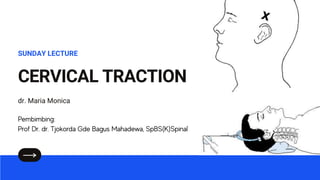
CERVICAL TRACTION
SUNDAY LECTURE
dr. Maria Monica
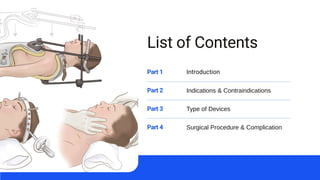
List of Contents
Introduction
Indications & Contraindications
Type of Devices
Surgical Procedure & Complication
Part 1
Part 2
Part 3
Part 4
Workman, Matthew & Kruger, Nicholas. (2019). A survey of the use of traction for the reduction of cervical dislocations. SA Orthopaedic Journal. 18.
10.17159/2309-8309/2019/v18n2a2.
Only 67% of specialists would perform urgent reduction in the most urgent of case scenarios.
Why perform
Cervical
Traction?
To reduce fracture-dislocations -->
decompresses the spinal cord and roots,
facilitate bone healing
Maintain normal alignment
Immobilize the cervical spine to prevent further
spinal cord injury
Mark S. Greenberg. Handbook of Neurosurgery. 9th ed. New York: Thieme
• Easy and rapid application
• May eliminate the need for surgical
procedure
• An awake patient responds to
interval neurologic examinations
• May be supplemented with
subsequent fixation if necessary
Advantages
• Does not allow investigation of the
foramina and exiting nerve roots
• Does not allow direct manipulation of the
joint
• Fails to reduce some facet dislocations
• Does not provide segmental fixation for
unstable injuries
Advantages vs Disadvantages
Disadvantages
Vaccaro, A. Spine Surgery: Tricks of the Trade. 3rd ed. New York: Thieme
Richard G. Fessler. Atlas of Neurosurgical Techniques. 2nd ed. New York : Thieme
Indications for
Cervical
Traction
Unilateral/ Bilateral Facet Dislocation
Cervical Spine Misalignment from Dislocation
or Fracture
Compression on Spinal Cord or Nerve Roots
Non traumatic cervical spine conditions that
cause instability and deformity
Mark S. Greenberg. Handbook of Neurosurgery. 9th ed. New York: Thieme
Vaccaro, A. Spine Surgery: Tricks of the Trade. 3rd ed. New York: Thieme.
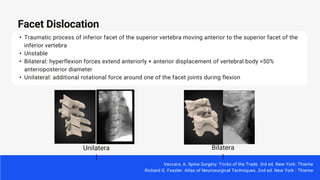
• Traumatic process of inferior facet of the superior vertebra moving anterior to the superior facet of the
inferior vertebra
• Unstable
• Bilateral: hyperflexion forces extend anteriorly + anterior displacement of vertebral body >50%
anterioposterior diameter
• Unilateral: additional rotational force around one of the facet joints during flexion
Facet Dislocation
Vaccaro, A. Spine Surgery: Tricks of the Trade. 3rd ed. New York: Thieme
Richard G. Fessler. Atlas of Neurosurgical Techniques. 2nd ed. New York : Thieme
Unilatera
l
Bilatera
l
• Not alert and cannot participate in neurologic
examination
• Atlantooccipital dislocation --> If desired, use no more
than ≈ 4 lbs ~ 1.8 kg
• Types IIA or III hangman’s fracture
• Skull defect/fracture at anticipated pin site --> alternate
pin site
• Use with caution in age ≤ 3 yrsor very elderly patients
• Demineralized skull: elderly patients, osteogenesis
imperfecta
• Patients with an additional rostral injury
• Patients with movement disorders: constant motion
may cause pin erosion through the skull
Contraindications
Mark S. Greenberg. Handbook of Neurosurgery. 9th ed. New York: Thieme
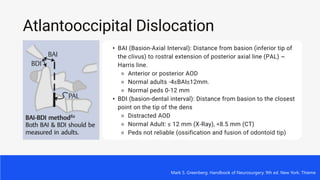
Atlantooccipital Dislocation
• Type 1: Anterior dislocation of occiput relative to the atlas
• Type 2: Longitudinal dislocation (distraction)
• Type 3: Posterior Dislocation of basion
Mark S. Greenberg. Handbook of Neurosurgery. 9th ed. New York: Thieme
Atlantooccipital Dislocation
• BAI (Basion-Axial Interval): Distance from basion (inferior tip of
the clivus) to rostral extension of posterior axial line (PAL) ~
Harris line.
⚬ Anterior or posterior AOD
⚬ Normal adults -4≤BAI≤12mm.
⚬ Normal peds 0-12 mm
• BDI (basion-dental interval): Distance from basion to the closest
point on the tip of the dens
⚬ Distracted AOD
⚬ Normal Adult: ≤ 12 mm (X-Ray), <8.5 mm (CT)
⚬ Peds not reliable (ossification and fusion of odontoid tip)
Mark S. Greenberg. Handbook of Neurosurgery. 9th ed. New York: Thieme
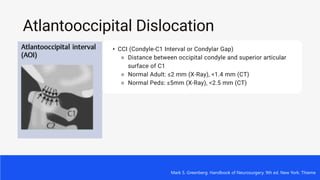
Atlantooccipital Dislocation
• CCI (Condyle-C1 Interval or Condylar Gap)
⚬ Distance between occipital condyle and superior articular
surface of C1
⚬ Normal Adult: ≤2 mm (X-Ray), <1.4 mm (CT)
⚬ Normal Peds: ≤5mm (X-Ray), <2.5 mm (CT)
Mark S. Greenberg. Handbook of Neurosurgery. 9th ed. New York: Thieme
Atlantooccipital Dislocation
• Powers’ ratio
⚬ Cannot be used with fractures of C1 or foramen magnum.
⚬ Only for anterior AOD
⚬ Identification of 4 reference points: B = basion, A = anterior
arch of C1, C = posterior arch of C1, O = opisthione
⚬ Normal Adult <1
⚬ Normal Peds <0.9
• Dublin Measure
⚬ Normal Mandible to Anterior Atlas ≤ 13 mm
⚬ Normal Posterior mandible to dens ≤ 20 mm
Mark S. Greenberg. Handbook of Neurosurgery. 9th ed. New York: Thieme
Atlantooccipital Dislocation
• Occipital-Axial Lines
⚬ C2O line: from the posteroinferior corner of axis body to the
opisthione. Should intersect tangentially with the highest
point on the C1 spinolaminar line
⚬ BC2SL line: from the basion to a point midway on the C2
spinolaminar line. Should intersect tangentially with the
posterosuperior dens
Mark S. Greenberg. Handbook of Neurosurgery. 9th ed. New York: Thieme
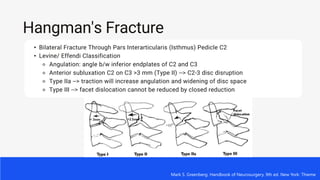
Hangman's Fracture
• Bilateral Fracture Through Pars Interarticularis (Isthmus) Pedicle C2
• Levine/ Effendi Classification
⚬ Angulation: angle b/w inferior endplates of C2 and C3
⚬ Anterior subluxation C2 on C3 >3 mm (Type II) --> C2-3 disc disruption
⚬ Type IIa --> traction will increase angulation and widening of disc space
⚬ Type III --> facet dislocation cannot be reduced by closed reduction
Mark S. Greenberg. Handbook of Neurosurgery. 9th ed. New York: Thieme
Special Considerations
• Lateral Cervical Spine X-Ray (including Swimmer's view) to visualize lower cervical spine
• CT is performed to identify anatomical abnormalities when X-rays are inadequare
• MRI controversial
⚬ Determine disk herniation to prevent further spinal cord damage
⚬ Increased time to reduction?
⚬ Patient unstable for transport (position and haemodynamic)
• Prompt reduction without MRI in awake patients with a cervical fracture or dislocation
and a significant neurologic deficit (ASIA A/B/C)
• After reduction to facilitate surgical planning --> MRI
Vaccaro, A. Spine Surgery: Tricks of the Trade. 3rd ed. New York: Thieme.
Type of Devices for Closed Reduction
Crutchfield
tongs
Gardner-Wells
tongs
Crown
Halo
Mark S. Greenberg. Handbook of Neurosurgery. 9th ed. New York: Thieme
What Should Be Prepared?
• Supplies: gloves, local anesthetic (1% lidocaine with epinephrine), betadine ointment, razor
or hair clipper, scalpel
• Preparation:
⚬ Placed patient supine on a gurney or bed
⚬ Shave hair around proposed pin sites
⚬ Betadine skin prep
⚬ Infiltrate local anesthetic
Mark S. Greenberg. Handbook of Neurosurgery. 9th ed. New York: Thieme
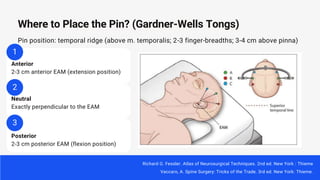
Anterior
2-3 cm anterior EAM (extension position)
1
Neutral
Exactly perpendicular to the EAM
2
Posterior
2-3 cm posterior EAM (flexion position)
3
Pin position: temporal ridge (above m. temporalis; 2-3 finger-breadths; 3-4 cm above pinna)
Where to Place the Pin? (Gardner-Wells Tongs)
Richard G. Fessler. Atlas of Neurosurgical Techniques. 2nd ed. New York : Thieme
Vaccaro, A. Spine Surgery: Tricks of the Trade. 3rd ed. New York: Thieme.
Anterior
Subluxation of Cervical Spine
1
Neutral
Most common, aim for immobilization
2
Posterior
Locked Facet and Flexion Head Position
3
Pin position: temporal ridge (above m. temporalis; 2-3 finger-breadths; 3-4 cm above pinna)
Where to Place the Pin? (Gardner-Wells Tongs)
Richard G. Fessler. Atlas of Neurosurgical Techniques. 2nd ed. New York : Thieme
Vaccaro, A. Spine Surgery: Tricks of the Trade. 3rd ed. New York: Thieme.
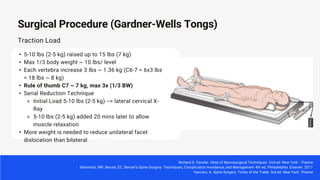
• 5-10 lbs (2-5 kg) raised up to 15 lbs (7 kg)
• Max 1/3 body weight ~ 10 lbs/ level
• Each vertebra increase 3 lbs ~ 1.36 kg (C6-7 = 6x3 lbs
= 18 lbs ~ 8 kg)
• Rule of thumb C7 ~ 7 kg, max 3x (1/3 BW)
• Serial Reduction Technique
⚬ Initial Load 5-10 lbs (2-5 kg) --> lateral cervical X-
Ray
⚬ 5-10 lbs (2-5 kg) added 20 mins later to allow
muscle relaxation
• More weight is needed to reduce unilateral facet
dislocation than bilateral
Traction Load
Surgical Procedure (Gardner-Wells Tongs)
Richard G. Fessler. Atlas of Neurosurgical Techniques. 2nd ed. New York : Thieme
Steinmetz, MP, Benzel, EC. Benzel’s Spine Surgery: Techniques, Complication Avoidance, and Management 4th ed. Philadelphia: Elsevier. 2017
Vaccaro, A. Spine Surgery: Tricks of the Trade. 3rd ed. New York: Thieme
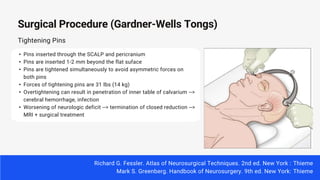
• Pins inserted through the SCALP and pericranium
• Pins are inserted 1-2 mm beyond the flat suface
• Pins are tightened simultaneously to avoid asymmetric forces on
both pins
• Forces of tightening pins are 31 lbs (14 kg)
• Overtightening can result in penetration of inner table of calvarium -->
cerebral hemorrhage, infection
• Worsening of neurologic deficit --> termination of closed reduction -->
MRI + surgical treatment
Tightening Pins
Surgical Procedure (Gardner-Wells Tongs)
Richard G. Fessler. Atlas of Neurosurgical Techniques. 2nd ed. New York : Thieme
Mark S. Greenberg. Handbook of Neurosurgery. 9th ed. New York: Thieme
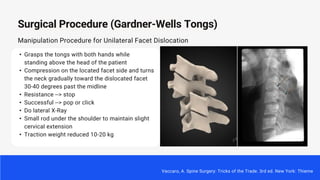
• Grasps the tongs with both hands while
standing above the head of the patient
• Compression on the located facet side and turns
the neck gradually toward the dislocated facet
30-40 degrees past the midline
• Resistance --> stop
• Successful --> pop or click
• Do lateral X-Ray
• Small rod under the shoulder to maintain slight
cervical extension
• Traction weight reduced 10-20 kg
Manipulation Procedure for Unilateral Facet Dislocation
Surgical Procedure (Gardner-Wells Tongs)
Vaccaro, A. Spine Surgery: Tricks of the Trade. 3rd ed. New York: Thieme
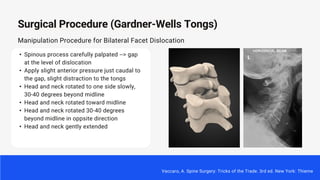
• Spinous process carefully palpated --> gap
at the level of dislocation
• Apply slight anterior pressure just caudal to
the gap, slight distraction to the tongs
• Head and neck rotated to one side slowly,
30-40 degrees beyond midline
• Head and neck rotated toward midline
• Head and neck rotated 30-40 degrees
beyond midline in oppsite direction
• Head and neck gently extended
Manipulation Procedure for Bilateral Facet Dislocation
Surgical Procedure (Gardner-Wells Tongs)
Vaccaro, A. Spine Surgery: Tricks of the Trade. 3rd ed. New York: Thieme
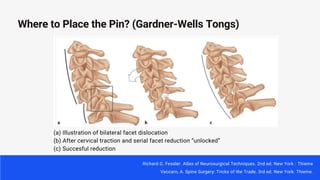
Where to Place the Pin? (Gardner-Wells Tongs)
Richard G. Fessler. Atlas of Neurosurgical Techniques. 2nd ed. New York : Thieme
Vaccaro, A. Spine Surgery: Tricks of the Trade. 3rd ed. New York: Thieme.
(a) Illustration of bilateral facet dislocation
(b) After cervical traction and serial facet reduction “unlocked”
(c) Succesful reduction
Success Rate
Adeolu, Augustine & Ukachukwu, Alvan & Adeolu, Josephine & Adeleye, Amos & Ogbole, Godwin & Malomo, Adefolarin & Shokunbi, Matthew. (2019). Clinical
outcome of closed reduction of cervical spine injuries in a cohort of Nigerians. Spinal Cord Series and Cases. 5. 17. 10.1038 /s41394-019-0158-z.
Reduction was satisfactory in 67.6% and failed in
32.4%. In all, 81.1% of patients remained
neurologically the same, while 18.9% improved.
• Temporary longitudinal traction
• Rapid reduction of cervical
dislocation
• Do not provide immobilization of
the spine --> bed rest
Gardner-Wells Tongs
Gardner-Wells Tongs vs Halo Ring
• Optimum head control with
circumferential pin fixation while
decreasing the distribution of pin
load
• Pullout strength double of Gardner-
Wells tongs --> opportunity for
more weights
• Stability for safe transporation and
positioning in operating room
Halo Ring
Ring Size
1-2 cm gap between scalp and ring
1
Ring Position
Placed at or just below the widest portion of the
skull --> 1 cm above orbital rim, 1 cm above pinna
2
Posterior
2-3 cm posterior EAM (flexion position)
3
Four-pin fixation perpendicularly applied directly to the skull with low holding power
Preparing for Halo Ring
Richard G. Fessler. Atlas of Neurosurgical Techniques. 2nd ed. New York : Thieme
Mark S. Greenberg. Handbook of Neurosurgery. 9th ed. New York: Thieme
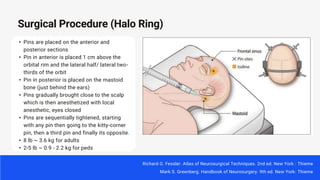
• Pins are placed on the anterior and
posterior sections
• Pin in anterior is placed 1 cm above the
orbital rim and the lateral half/ lateral two-
thirds of the orbit
• Pin in posterior is placed on the mastoid
bone (just behind the ears)
• Pins gradually brought close to the scalp
which is then anesthetized with local
anesthetic, eyes closed
• Pins are sequentially tightened, starting
with any pin then going to the kitty-corner
pin, then a third pin and finally its opposite.
• 8 lb ~ 3.6 kg for adults
• 2-5 lb ~ 0.9 - 2.2 kg for peds
Surgical Procedure (Halo Ring)
Richard G. Fessler. Atlas of Neurosurgical Techniques. 2nd ed. New York : Thieme
Mark S. Greenberg. Handbook of Neurosurgery. 9th ed. New York: Thieme
• Halo ring is connected to the halo
vest
• Halo vest has anterior and posterior
parts
• X-ray performed after insertion,
repeated 3 days later
Surgical Procedure (Halo Ring)
Richard G. Fessler. Atlas of Neurosurgical Techniques. 2nd ed. New York : Thieme
Mark S. Greenberg. Handbook of Neurosurgery. 9th ed. New York: Thieme
• Patients typically receive traction for 3–8 weeks
at 30%– 50% of their BW
• Traction weight was based on BW (kg) and
etiology, represented as
%BW: ([traction weight/BW] × 100%)
• One to two pounds (0.45–0.91 kg) of weight
was added daily until goal %BW was achieved
• The mean absolute correction for kyphosis
deformity was 35° ± 16.3° (range 18°–68°)
How Long?
Verhofste BP, Glotzbecker MP, Birch CM, O'Neill NP, Hedequist DJ. Halo-gravity traction for the treatment of pediatric cervical spine disorders. J
Neurosurg Pediatr. 2019 Dec 27:1-10. doi: 10.3171/2019.10.PEDS19513. Epub ahead of print. PMID: 31881541.
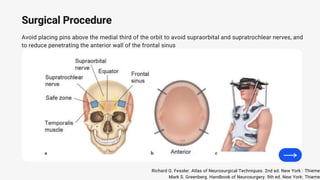
Avoid placing pins above the medial third of the orbit to avoid supraorbital and supratrochlear nerves, and
to reduce penetrating the anterior wall of the frontal sinus
Surgical Procedure
Richard G. Fessler. Atlas of Neurosurgical Techniques. 2nd ed. New York : Thieme
Mark S. Greenberg. Handbook of Neurosurgery. 9th ed. New York: Thieme
Post-Operative Care
• Lateral C-Spine X-rays immediately after application of traction and at regular intervals and
after every change in weights and every move from bed
⚬ Check alignment and rule out overdistraction at any level
⚬ Avoid atlantooccipital dislocation (BDI ≤ 12 mm)
• Weight: traction for only stabilization --> use 5 lbs for upper C-spine or 10 lbs for lower level
• Pin tightening:
⚬ Pins are re-torqued in 24 hours
⚬ Additional tightening the day after that
⚬ Avoid further tightenings which can penetrate the skull
• Pin care:
⚬ Clean (e.g. half strength hydrogen peroxide), then apply povidone-iodine ointment
⚬ Frequency: in hospital: q shift
⚬ At home following discharge: twice daily (simple cleaning with soap and water)
Mark S. Greenberg. Handbook of Neurosurgery. 9th ed. New York: Thieme
Complications
Skull penetration by
pins
• pins torqued too
tightly
• pins placed over
thin bone: temporal
squamosa or over
frontal sinus
• elderly patients,
pediatric patients,
or those with an
osteoporotic skull
• invasion of bone
with tumor: e.g.
multiple myeloma
• fracture at pin site
Neurologic
deterioration due to
reduction of
cervical
dislocations
--> MRI or CT
immediately
Overdistraction
from excessive
weight and Pin
Migration
Infection
• Osteomyelitis
• Subdural
Empyema
Chronic Pain
Mark S. Greenberg. Handbook of Neurosurgery. 9th ed. New York: Thieme
Predictors of Success
• Sample: All patients aged 15 to 80 years with the possibility of subaxial cervical spine injury and provide
appropriate radiological features requiring cervical traction action coming to Hasan Sadikin Hospital,
Bandung, from 2012 to 2016, and agreed to do series lateral cervical X-ray
• Success: Cervical spine realignment being evaluated based on the evaluation of the series lateral cervical
spine X-ray
Dahlan, Rully & Ompusunggu, Sevline & Yudoyono, Farid & Malau, Lukas & Ramani, Premanand. (2018). Predictive Factors of Cervical Traction based on
Cervical Spine Realignment shown by Series Lateral Cervical X-ray in Subaxial Cervical Spine Injury Patients. The Journal of Spinal Surgery. 5. 48-51.
10.5005/jp-journals-10039-1169.
Not significant
Significant Not significant
Predictors of Success
• Most dominant factor associated with traction efficacy, seen from the evaluation of series lateral cervical X-Ray,
was FL, indicating cervical traction failure 3.8 times higher in the presence of FL, than patients not present with
FL
• With the presence of a FL, it is estimated that traction failure increased to 26% and mortality to 7% and
unilateral FL has a trend of higher traction failure compared with bilateral FL
• In the treatment of subaxial cervical injuries >24 hours, there need to be informed consent to traction failure
•
Dahlan, Rully & Ompusunggu, Sevline & Yudoyono, Farid & Malau, Lukas & Ramani, Premanand. (2018). Predictive Factors of Cervical Traction based on
Cervical Spine Realignment shown by Series Lateral Cervical X-ray in Subaxial Cervical Spine Injury Patients. The Journal of Spinal Surgery. 5. 48-51.
10.5005/jp-journals-10039-1169.
Not significant Not significant
Not significant
Significant
Thank You!

Cervical Traction.pptx

  • 1.
  • 2.
    List of Contents Introduction Indications& Contraindications Type of Devices Surgical Procedure & Complication Part 1 Part 2 Part 3 Part 4
  • 3.
    Workman, Matthew &Kruger, Nicholas. (2019). A survey of the use of traction for the reduction of cervical dislocations. SA Orthopaedic Journal. 18. 10.17159/2309-8309/2019/v18n2a2. Only 67% of specialists would perform urgent reduction in the most urgent of case scenarios.
  • 4.
    Why perform Cervical Traction? To reducefracture-dislocations --> decompresses the spinal cord and roots, facilitate bone healing Maintain normal alignment Immobilize the cervical spine to prevent further spinal cord injury Mark S. Greenberg. Handbook of Neurosurgery. 9th ed. New York: Thieme
  • 5.
    • Easy andrapid application • May eliminate the need for surgical procedure • An awake patient responds to interval neurologic examinations • May be supplemented with subsequent fixation if necessary Advantages • Does not allow investigation of the foramina and exiting nerve roots • Does not allow direct manipulation of the joint • Fails to reduce some facet dislocations • Does not provide segmental fixation for unstable injuries Advantages vs Disadvantages Disadvantages Vaccaro, A. Spine Surgery: Tricks of the Trade. 3rd ed. New York: Thieme Richard G. Fessler. Atlas of Neurosurgical Techniques. 2nd ed. New York : Thieme
  • 6.
    Indications for Cervical Traction Unilateral/ BilateralFacet Dislocation Cervical Spine Misalignment from Dislocation or Fracture Compression on Spinal Cord or Nerve Roots Non traumatic cervical spine conditions that cause instability and deformity Mark S. Greenberg. Handbook of Neurosurgery. 9th ed. New York: Thieme Vaccaro, A. Spine Surgery: Tricks of the Trade. 3rd ed. New York: Thieme.
  • 7.
    • Traumatic processof inferior facet of the superior vertebra moving anterior to the superior facet of the inferior vertebra • Unstable • Bilateral: hyperflexion forces extend anteriorly + anterior displacement of vertebral body >50% anterioposterior diameter • Unilateral: additional rotational force around one of the facet joints during flexion Facet Dislocation Vaccaro, A. Spine Surgery: Tricks of the Trade. 3rd ed. New York: Thieme Richard G. Fessler. Atlas of Neurosurgical Techniques. 2nd ed. New York : Thieme Unilatera l Bilatera l
  • 8.
    • Not alertand cannot participate in neurologic examination • Atlantooccipital dislocation --> If desired, use no more than ≈ 4 lbs ~ 1.8 kg • Types IIA or III hangman’s fracture • Skull defect/fracture at anticipated pin site --> alternate pin site • Use with caution in age ≤ 3 yrsor very elderly patients • Demineralized skull: elderly patients, osteogenesis imperfecta • Patients with an additional rostral injury • Patients with movement disorders: constant motion may cause pin erosion through the skull Contraindications Mark S. Greenberg. Handbook of Neurosurgery. 9th ed. New York: Thieme
  • 9.
    Atlantooccipital Dislocation • Type1: Anterior dislocation of occiput relative to the atlas • Type 2: Longitudinal dislocation (distraction) • Type 3: Posterior Dislocation of basion Mark S. Greenberg. Handbook of Neurosurgery. 9th ed. New York: Thieme
  • 10.
    Atlantooccipital Dislocation • BAI(Basion-Axial Interval): Distance from basion (inferior tip of the clivus) to rostral extension of posterior axial line (PAL) ~ Harris line. ⚬ Anterior or posterior AOD ⚬ Normal adults -4≤BAI≤12mm. ⚬ Normal peds 0-12 mm • BDI (basion-dental interval): Distance from basion to the closest point on the tip of the dens ⚬ Distracted AOD ⚬ Normal Adult: ≤ 12 mm (X-Ray), <8.5 mm (CT) ⚬ Peds not reliable (ossification and fusion of odontoid tip) Mark S. Greenberg. Handbook of Neurosurgery. 9th ed. New York: Thieme
  • 11.
    Atlantooccipital Dislocation • CCI(Condyle-C1 Interval or Condylar Gap) ⚬ Distance between occipital condyle and superior articular surface of C1 ⚬ Normal Adult: ≤2 mm (X-Ray), <1.4 mm (CT) ⚬ Normal Peds: ≤5mm (X-Ray), <2.5 mm (CT) Mark S. Greenberg. Handbook of Neurosurgery. 9th ed. New York: Thieme
  • 12.
    Atlantooccipital Dislocation • Powers’ratio ⚬ Cannot be used with fractures of C1 or foramen magnum. ⚬ Only for anterior AOD ⚬ Identification of 4 reference points: B = basion, A = anterior arch of C1, C = posterior arch of C1, O = opisthione ⚬ Normal Adult <1 ⚬ Normal Peds <0.9 • Dublin Measure ⚬ Normal Mandible to Anterior Atlas ≤ 13 mm ⚬ Normal Posterior mandible to dens ≤ 20 mm Mark S. Greenberg. Handbook of Neurosurgery. 9th ed. New York: Thieme
  • 13.
    Atlantooccipital Dislocation • Occipital-AxialLines ⚬ C2O line: from the posteroinferior corner of axis body to the opisthione. Should intersect tangentially with the highest point on the C1 spinolaminar line ⚬ BC2SL line: from the basion to a point midway on the C2 spinolaminar line. Should intersect tangentially with the posterosuperior dens Mark S. Greenberg. Handbook of Neurosurgery. 9th ed. New York: Thieme
  • 14.
    Hangman's Fracture • BilateralFracture Through Pars Interarticularis (Isthmus) Pedicle C2 • Levine/ Effendi Classification ⚬ Angulation: angle b/w inferior endplates of C2 and C3 ⚬ Anterior subluxation C2 on C3 >3 mm (Type II) --> C2-3 disc disruption ⚬ Type IIa --> traction will increase angulation and widening of disc space ⚬ Type III --> facet dislocation cannot be reduced by closed reduction Mark S. Greenberg. Handbook of Neurosurgery. 9th ed. New York: Thieme
  • 15.
    Special Considerations • LateralCervical Spine X-Ray (including Swimmer's view) to visualize lower cervical spine • CT is performed to identify anatomical abnormalities when X-rays are inadequare • MRI controversial ⚬ Determine disk herniation to prevent further spinal cord damage ⚬ Increased time to reduction? ⚬ Patient unstable for transport (position and haemodynamic) • Prompt reduction without MRI in awake patients with a cervical fracture or dislocation and a significant neurologic deficit (ASIA A/B/C) • After reduction to facilitate surgical planning --> MRI Vaccaro, A. Spine Surgery: Tricks of the Trade. 3rd ed. New York: Thieme.
  • 16.
    Type of Devicesfor Closed Reduction Crutchfield tongs Gardner-Wells tongs Crown Halo Mark S. Greenberg. Handbook of Neurosurgery. 9th ed. New York: Thieme
  • 17.
    What Should BePrepared? • Supplies: gloves, local anesthetic (1% lidocaine with epinephrine), betadine ointment, razor or hair clipper, scalpel • Preparation: ⚬ Placed patient supine on a gurney or bed ⚬ Shave hair around proposed pin sites ⚬ Betadine skin prep ⚬ Infiltrate local anesthetic Mark S. Greenberg. Handbook of Neurosurgery. 9th ed. New York: Thieme
  • 18.
    Anterior 2-3 cm anteriorEAM (extension position) 1 Neutral Exactly perpendicular to the EAM 2 Posterior 2-3 cm posterior EAM (flexion position) 3 Pin position: temporal ridge (above m. temporalis; 2-3 finger-breadths; 3-4 cm above pinna) Where to Place the Pin? (Gardner-Wells Tongs) Richard G. Fessler. Atlas of Neurosurgical Techniques. 2nd ed. New York : Thieme Vaccaro, A. Spine Surgery: Tricks of the Trade. 3rd ed. New York: Thieme.
  • 19.
    Anterior Subluxation of CervicalSpine 1 Neutral Most common, aim for immobilization 2 Posterior Locked Facet and Flexion Head Position 3 Pin position: temporal ridge (above m. temporalis; 2-3 finger-breadths; 3-4 cm above pinna) Where to Place the Pin? (Gardner-Wells Tongs) Richard G. Fessler. Atlas of Neurosurgical Techniques. 2nd ed. New York : Thieme Vaccaro, A. Spine Surgery: Tricks of the Trade. 3rd ed. New York: Thieme.
  • 20.
    • 5-10 lbs(2-5 kg) raised up to 15 lbs (7 kg) • Max 1/3 body weight ~ 10 lbs/ level • Each vertebra increase 3 lbs ~ 1.36 kg (C6-7 = 6x3 lbs = 18 lbs ~ 8 kg) • Rule of thumb C7 ~ 7 kg, max 3x (1/3 BW) • Serial Reduction Technique ⚬ Initial Load 5-10 lbs (2-5 kg) --> lateral cervical X- Ray ⚬ 5-10 lbs (2-5 kg) added 20 mins later to allow muscle relaxation • More weight is needed to reduce unilateral facet dislocation than bilateral Traction Load Surgical Procedure (Gardner-Wells Tongs) Richard G. Fessler. Atlas of Neurosurgical Techniques. 2nd ed. New York : Thieme Steinmetz, MP, Benzel, EC. Benzel’s Spine Surgery: Techniques, Complication Avoidance, and Management 4th ed. Philadelphia: Elsevier. 2017 Vaccaro, A. Spine Surgery: Tricks of the Trade. 3rd ed. New York: Thieme
  • 21.
    • Pins insertedthrough the SCALP and pericranium • Pins are inserted 1-2 mm beyond the flat suface • Pins are tightened simultaneously to avoid asymmetric forces on both pins • Forces of tightening pins are 31 lbs (14 kg) • Overtightening can result in penetration of inner table of calvarium --> cerebral hemorrhage, infection • Worsening of neurologic deficit --> termination of closed reduction --> MRI + surgical treatment Tightening Pins Surgical Procedure (Gardner-Wells Tongs) Richard G. Fessler. Atlas of Neurosurgical Techniques. 2nd ed. New York : Thieme Mark S. Greenberg. Handbook of Neurosurgery. 9th ed. New York: Thieme
  • 22.
    • Grasps thetongs with both hands while standing above the head of the patient • Compression on the located facet side and turns the neck gradually toward the dislocated facet 30-40 degrees past the midline • Resistance --> stop • Successful --> pop or click • Do lateral X-Ray • Small rod under the shoulder to maintain slight cervical extension • Traction weight reduced 10-20 kg Manipulation Procedure for Unilateral Facet Dislocation Surgical Procedure (Gardner-Wells Tongs) Vaccaro, A. Spine Surgery: Tricks of the Trade. 3rd ed. New York: Thieme
  • 23.
    • Spinous processcarefully palpated --> gap at the level of dislocation • Apply slight anterior pressure just caudal to the gap, slight distraction to the tongs • Head and neck rotated to one side slowly, 30-40 degrees beyond midline • Head and neck rotated toward midline • Head and neck rotated 30-40 degrees beyond midline in oppsite direction • Head and neck gently extended Manipulation Procedure for Bilateral Facet Dislocation Surgical Procedure (Gardner-Wells Tongs) Vaccaro, A. Spine Surgery: Tricks of the Trade. 3rd ed. New York: Thieme
  • 24.
    Where to Placethe Pin? (Gardner-Wells Tongs) Richard G. Fessler. Atlas of Neurosurgical Techniques. 2nd ed. New York : Thieme Vaccaro, A. Spine Surgery: Tricks of the Trade. 3rd ed. New York: Thieme. (a) Illustration of bilateral facet dislocation (b) After cervical traction and serial facet reduction “unlocked” (c) Succesful reduction
  • 25.
    Success Rate Adeolu, Augustine& Ukachukwu, Alvan & Adeolu, Josephine & Adeleye, Amos & Ogbole, Godwin & Malomo, Adefolarin & Shokunbi, Matthew. (2019). Clinical outcome of closed reduction of cervical spine injuries in a cohort of Nigerians. Spinal Cord Series and Cases. 5. 17. 10.1038 /s41394-019-0158-z. Reduction was satisfactory in 67.6% and failed in 32.4%. In all, 81.1% of patients remained neurologically the same, while 18.9% improved.
  • 26.
    • Temporary longitudinaltraction • Rapid reduction of cervical dislocation • Do not provide immobilization of the spine --> bed rest Gardner-Wells Tongs Gardner-Wells Tongs vs Halo Ring • Optimum head control with circumferential pin fixation while decreasing the distribution of pin load • Pullout strength double of Gardner- Wells tongs --> opportunity for more weights • Stability for safe transporation and positioning in operating room Halo Ring
  • 27.
    Ring Size 1-2 cmgap between scalp and ring 1 Ring Position Placed at or just below the widest portion of the skull --> 1 cm above orbital rim, 1 cm above pinna 2 Posterior 2-3 cm posterior EAM (flexion position) 3 Four-pin fixation perpendicularly applied directly to the skull with low holding power Preparing for Halo Ring Richard G. Fessler. Atlas of Neurosurgical Techniques. 2nd ed. New York : Thieme Mark S. Greenberg. Handbook of Neurosurgery. 9th ed. New York: Thieme
  • 28.
    • Pins areplaced on the anterior and posterior sections • Pin in anterior is placed 1 cm above the orbital rim and the lateral half/ lateral two- thirds of the orbit • Pin in posterior is placed on the mastoid bone (just behind the ears) • Pins gradually brought close to the scalp which is then anesthetized with local anesthetic, eyes closed • Pins are sequentially tightened, starting with any pin then going to the kitty-corner pin, then a third pin and finally its opposite. • 8 lb ~ 3.6 kg for adults • 2-5 lb ~ 0.9 - 2.2 kg for peds Surgical Procedure (Halo Ring) Richard G. Fessler. Atlas of Neurosurgical Techniques. 2nd ed. New York : Thieme Mark S. Greenberg. Handbook of Neurosurgery. 9th ed. New York: Thieme
  • 29.
    • Halo ringis connected to the halo vest • Halo vest has anterior and posterior parts • X-ray performed after insertion, repeated 3 days later Surgical Procedure (Halo Ring) Richard G. Fessler. Atlas of Neurosurgical Techniques. 2nd ed. New York : Thieme Mark S. Greenberg. Handbook of Neurosurgery. 9th ed. New York: Thieme
  • 30.
    • Patients typicallyreceive traction for 3–8 weeks at 30%– 50% of their BW • Traction weight was based on BW (kg) and etiology, represented as %BW: ([traction weight/BW] × 100%) • One to two pounds (0.45–0.91 kg) of weight was added daily until goal %BW was achieved • The mean absolute correction for kyphosis deformity was 35° ± 16.3° (range 18°–68°) How Long? Verhofste BP, Glotzbecker MP, Birch CM, O'Neill NP, Hedequist DJ. Halo-gravity traction for the treatment of pediatric cervical spine disorders. J Neurosurg Pediatr. 2019 Dec 27:1-10. doi: 10.3171/2019.10.PEDS19513. Epub ahead of print. PMID: 31881541.
  • 31.
    Avoid placing pinsabove the medial third of the orbit to avoid supraorbital and supratrochlear nerves, and to reduce penetrating the anterior wall of the frontal sinus Surgical Procedure Richard G. Fessler. Atlas of Neurosurgical Techniques. 2nd ed. New York : Thieme Mark S. Greenberg. Handbook of Neurosurgery. 9th ed. New York: Thieme
  • 32.
    Post-Operative Care • LateralC-Spine X-rays immediately after application of traction and at regular intervals and after every change in weights and every move from bed ⚬ Check alignment and rule out overdistraction at any level ⚬ Avoid atlantooccipital dislocation (BDI ≤ 12 mm) • Weight: traction for only stabilization --> use 5 lbs for upper C-spine or 10 lbs for lower level • Pin tightening: ⚬ Pins are re-torqued in 24 hours ⚬ Additional tightening the day after that ⚬ Avoid further tightenings which can penetrate the skull • Pin care: ⚬ Clean (e.g. half strength hydrogen peroxide), then apply povidone-iodine ointment ⚬ Frequency: in hospital: q shift ⚬ At home following discharge: twice daily (simple cleaning with soap and water) Mark S. Greenberg. Handbook of Neurosurgery. 9th ed. New York: Thieme
  • 33.
    Complications Skull penetration by pins •pins torqued too tightly • pins placed over thin bone: temporal squamosa or over frontal sinus • elderly patients, pediatric patients, or those with an osteoporotic skull • invasion of bone with tumor: e.g. multiple myeloma • fracture at pin site Neurologic deterioration due to reduction of cervical dislocations --> MRI or CT immediately Overdistraction from excessive weight and Pin Migration Infection • Osteomyelitis • Subdural Empyema Chronic Pain Mark S. Greenberg. Handbook of Neurosurgery. 9th ed. New York: Thieme
  • 34.
    Predictors of Success •Sample: All patients aged 15 to 80 years with the possibility of subaxial cervical spine injury and provide appropriate radiological features requiring cervical traction action coming to Hasan Sadikin Hospital, Bandung, from 2012 to 2016, and agreed to do series lateral cervical X-ray • Success: Cervical spine realignment being evaluated based on the evaluation of the series lateral cervical spine X-ray Dahlan, Rully & Ompusunggu, Sevline & Yudoyono, Farid & Malau, Lukas & Ramani, Premanand. (2018). Predictive Factors of Cervical Traction based on Cervical Spine Realignment shown by Series Lateral Cervical X-ray in Subaxial Cervical Spine Injury Patients. The Journal of Spinal Surgery. 5. 48-51. 10.5005/jp-journals-10039-1169. Not significant Significant Not significant
  • 35.
    Predictors of Success •Most dominant factor associated with traction efficacy, seen from the evaluation of series lateral cervical X-Ray, was FL, indicating cervical traction failure 3.8 times higher in the presence of FL, than patients not present with FL • With the presence of a FL, it is estimated that traction failure increased to 26% and mortality to 7% and unilateral FL has a trend of higher traction failure compared with bilateral FL • In the treatment of subaxial cervical injuries >24 hours, there need to be informed consent to traction failure • Dahlan, Rully & Ompusunggu, Sevline & Yudoyono, Farid & Malau, Lukas & Ramani, Premanand. (2018). Predictive Factors of Cervical Traction based on Cervical Spine Realignment shown by Series Lateral Cervical X-ray in Subaxial Cervical Spine Injury Patients. The Journal of Spinal Surgery. 5. 48-51. 10.5005/jp-journals-10039-1169. Not significant Not significant Not significant Significant
  • 36.