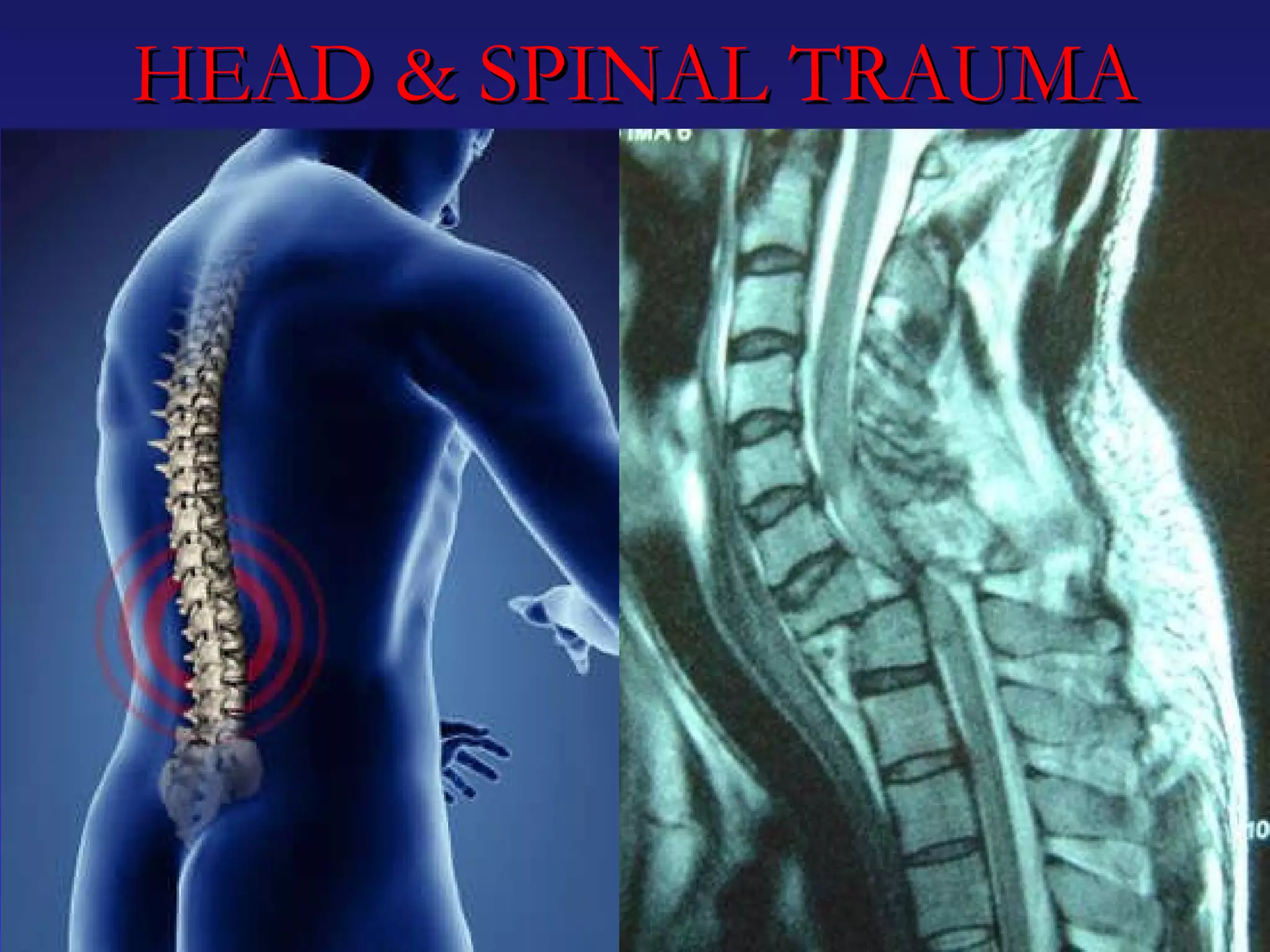
HEAD & SPINAL TRAUMA


Head Trauma Objectives To understand the structured approach to the patient with head trauma To learn how to identify serious and life-threatening head injuries
Head Trauma Accounts for 1/3-1/2 of trauma deaths Good outcomes are possible without CT scans and neurosurgeons Aim to avoid any further injury to the brain Hypoxia and hypotension double mortality
Head Trauma Approach A irway B reathing C irculation
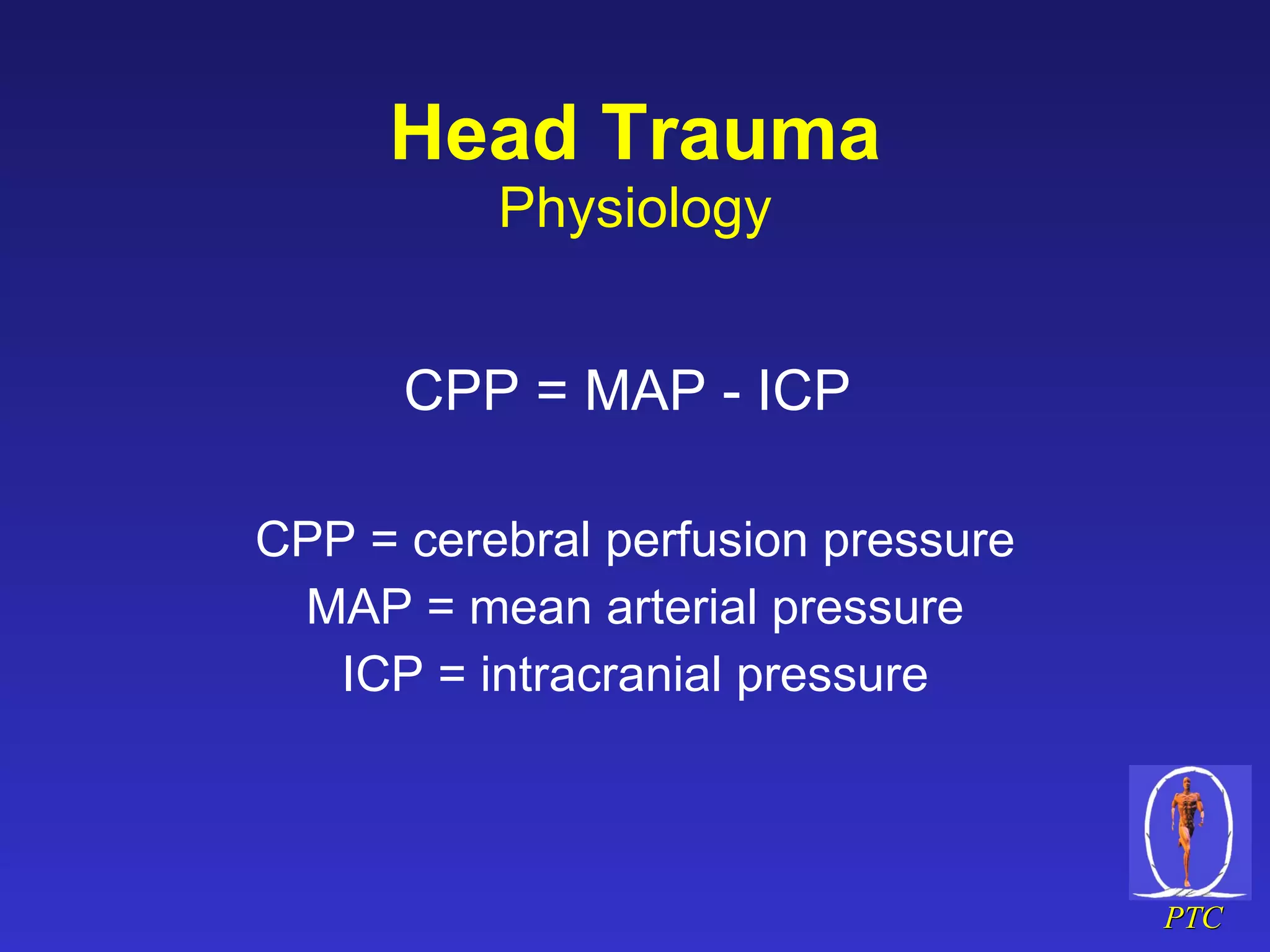
Head Trauma Physiology CPP = MAP - ICP  CPP = cerebral perfusion pressure MAP = mean arterial pressure ICP = intracranial pressure
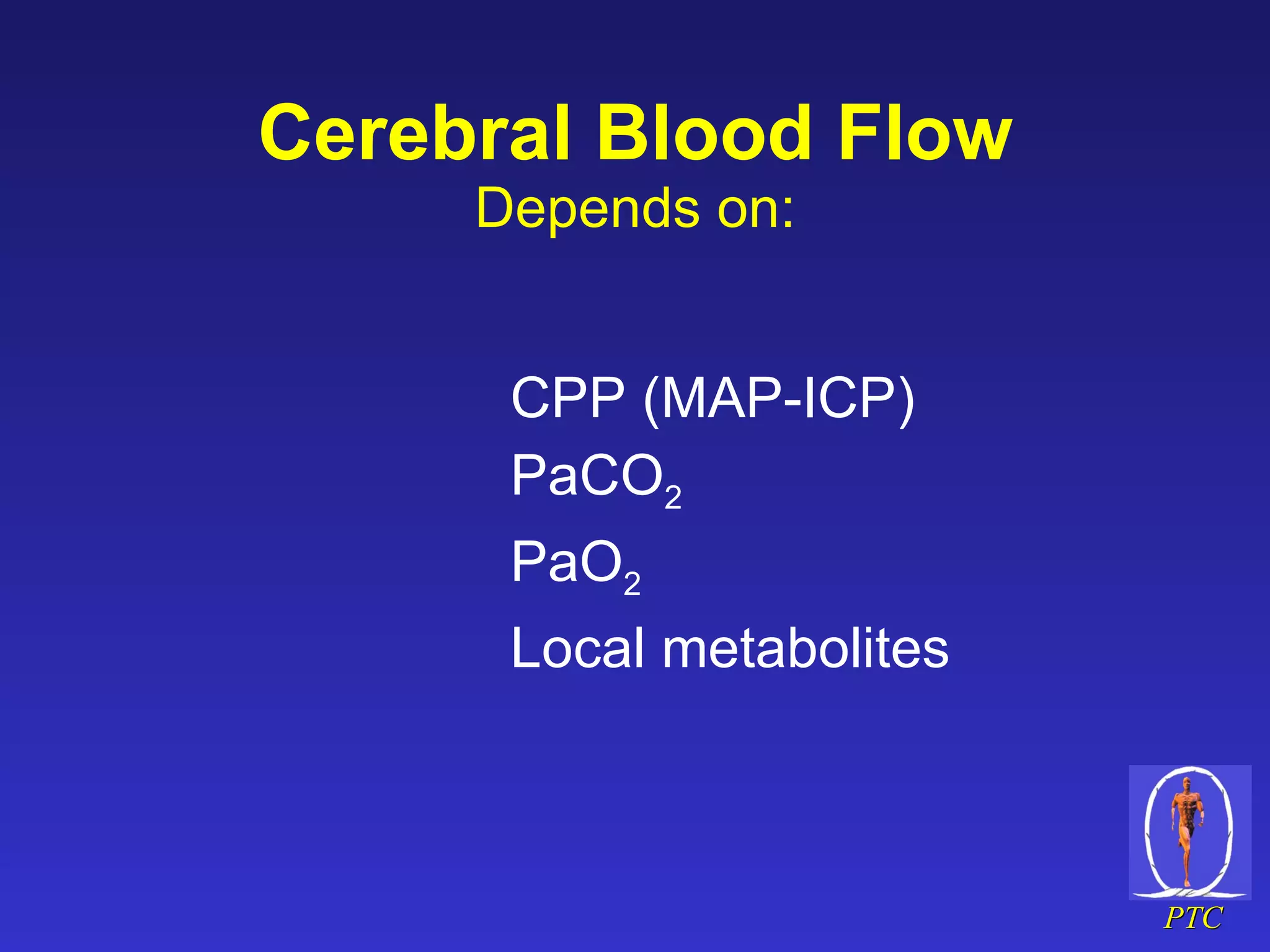
Cerebral Blood Flow Depends on: CPP (MAP-ICP) PaCO 2 PaO 2 Local metabolites
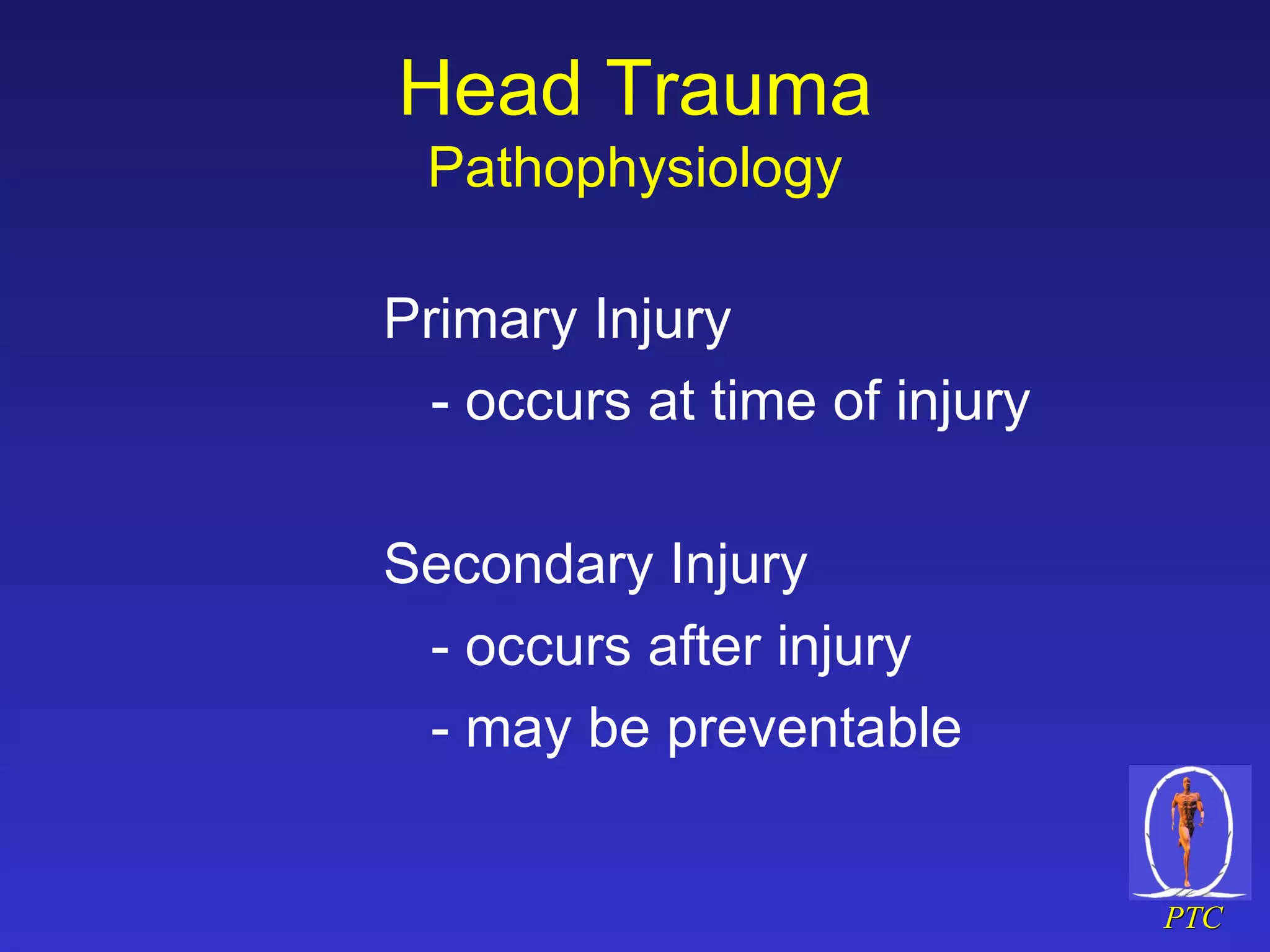
Head Trauma Pathophysiology Primary Injury  - occurs at time of injury Secondary Injury  - occurs after injury - may be preventable
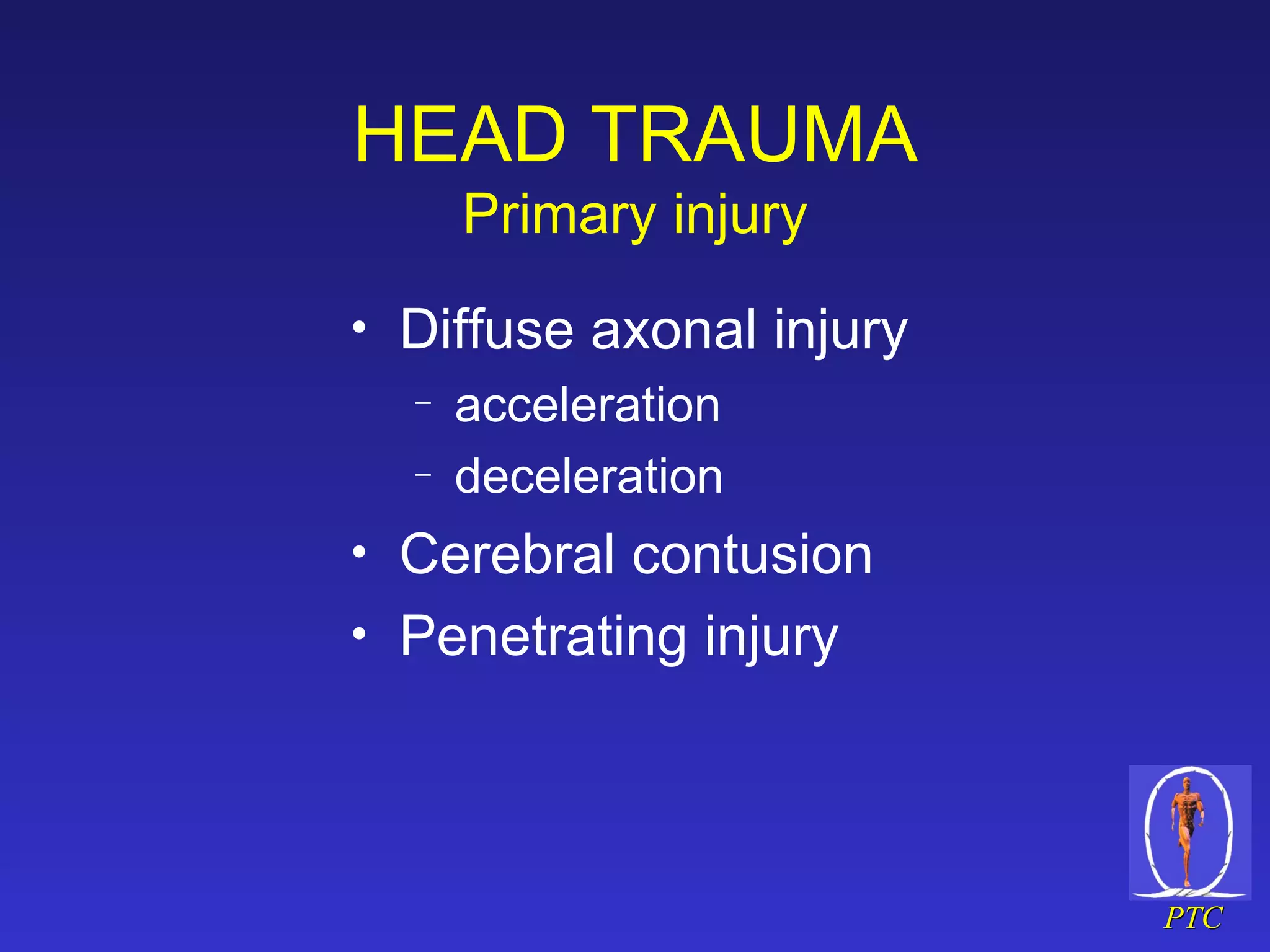
HEAD TRAUMA Primary injury Diffuse axonal injury acceleration deceleration Cerebral contusion Penetrating injury
HEAD TRAUMA  Secondary injury Hypoxia Hypoperfusion  (  ICP,   MAP) Hypoglycaemia Hyperthermia (fever) Seizures
Head Trauma Initial assessment A irway (+ C-spine) B reathing C irculation D isability (AVPU, pupils) E xposure
Head Trauma   Examination Glasgow Coma Score Pupils Corneal reflex Eye position  Fundi
Head Trauma   Examination Tympanic membrane Scalp and skull Respiratory Pattern Muscle tone Posture Tendon reflexes
Head Trauma   Glasgow Coma Score (GCS) Grades severity of head injury Score out of 15 Subject to inter-observer  variation Trend of GCS over time very useful Important to describe responses also
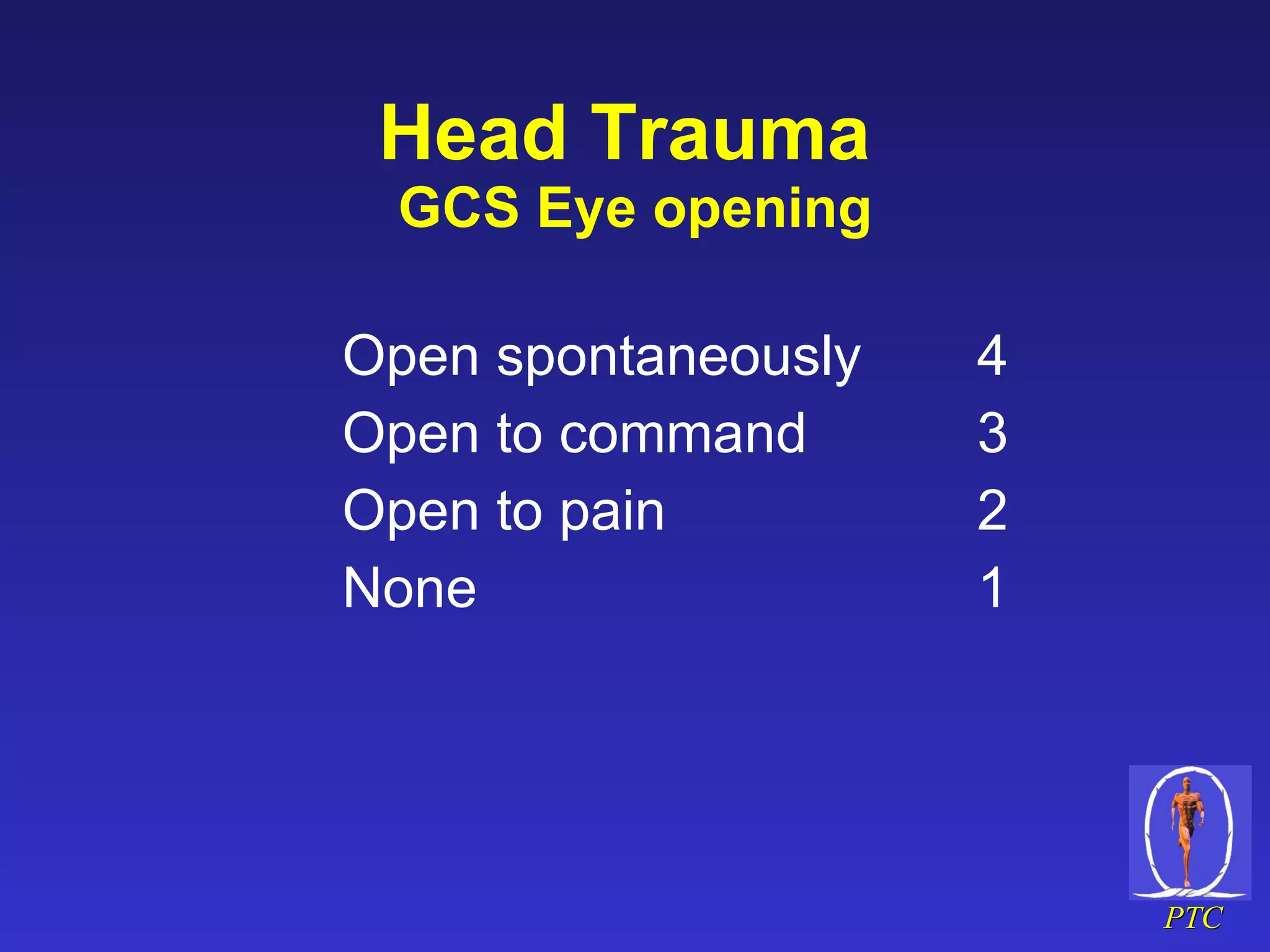
Head Trauma  GCS Eye opening Open spontaneously 4 Open to command 3 Open to pain 2 None 1
Head Trauma  GCS   Best Verbal Response   Oriented 5 Confused 4 Inappropriate words 3 Inappropriate sounds 2 None 1
Head Trauma  GCS   Best Motor Response Obeys command 6 Localises to pain 5 Withdraws to pain 4 Abnormal flexion 3 Extensor response 2 None 1
Head Trauma  Severity of Head Injury Severe GCS <8 Moderate GCS 9-12 Minor GCS 13-15
Head Trauma  Pupillary signs Size Reactivity Equality
Head Trauma  Pupillary responses Fixed, dilated, unresponsive Severe hypoxia Hypothermia Seizures
Head Trauma  Pupillary responses Unilateral, dilated, unresponsive Expanding lesion on same side Tentorial herniation Seizures
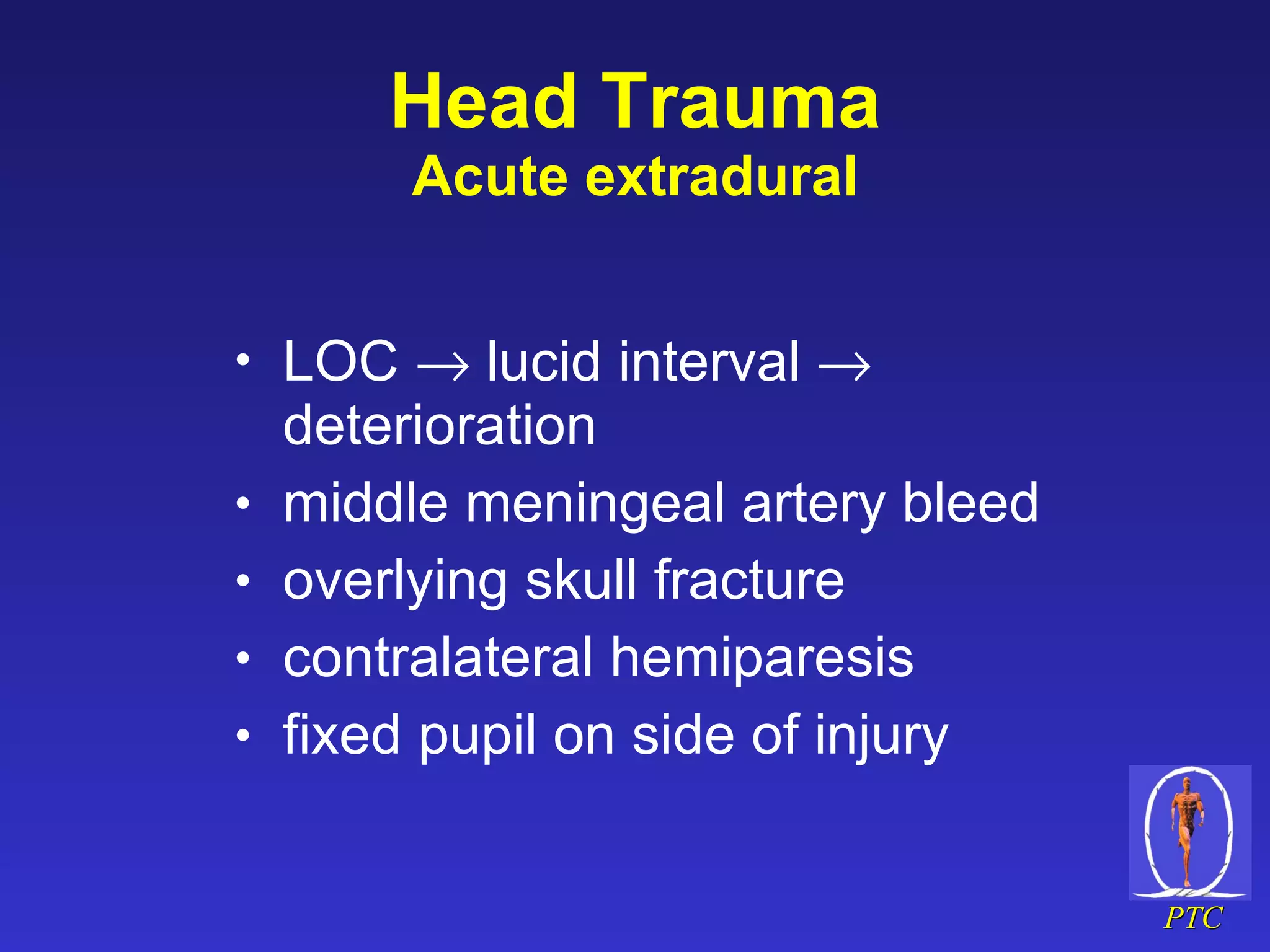
Head Trauma Acute extradural Acute subdural potentially life-threatening immediate recognition essential require burr-hole decompression
Head Trauma Acute extradural LOC    lucid interval    deterioration middle meningeal artery bleed overlying skull fracture contralateral hemiparesis fixed pupil on side of injury
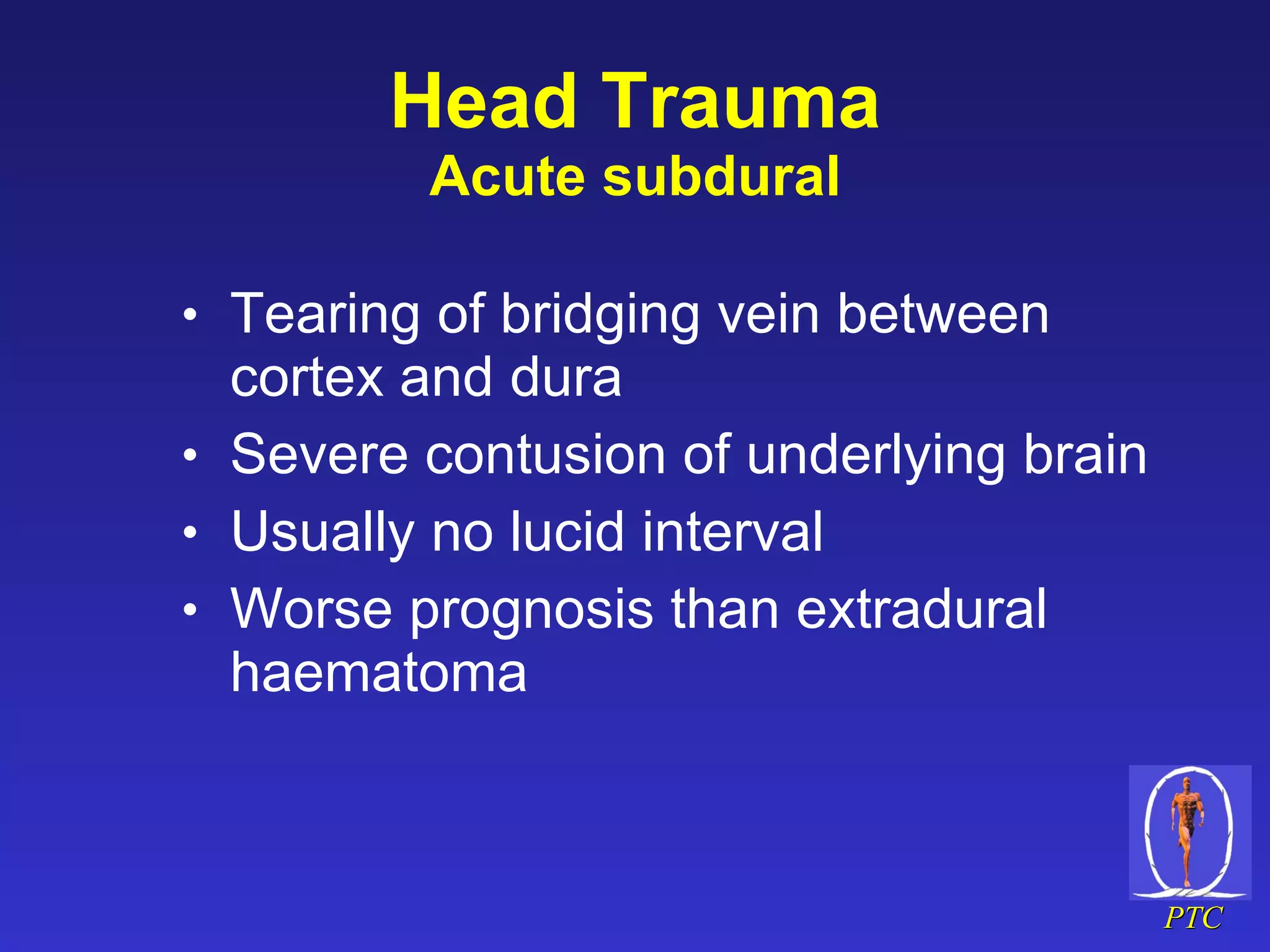
Head Trauma Acute subdural Tearing of bridging vein between cortex and dura Severe contusion of underlying brain Usually no lucid interval Worse prognosis than extradural haematoma
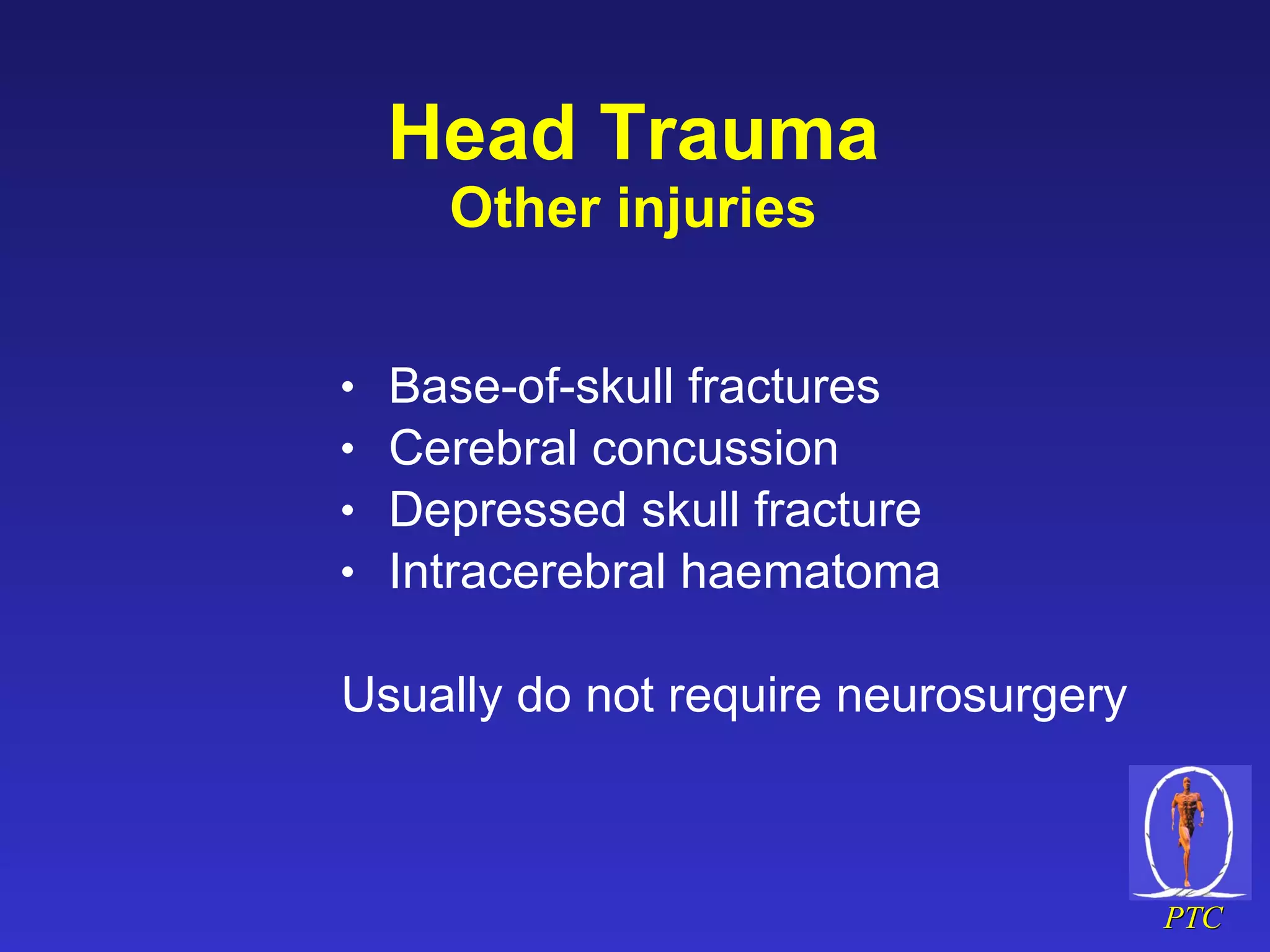
Head Trauma Other injuries Base-of-skull fractures Cerebral concussion Depressed skull fracture Intracerebral haematoma Usually do not require neurosurgery
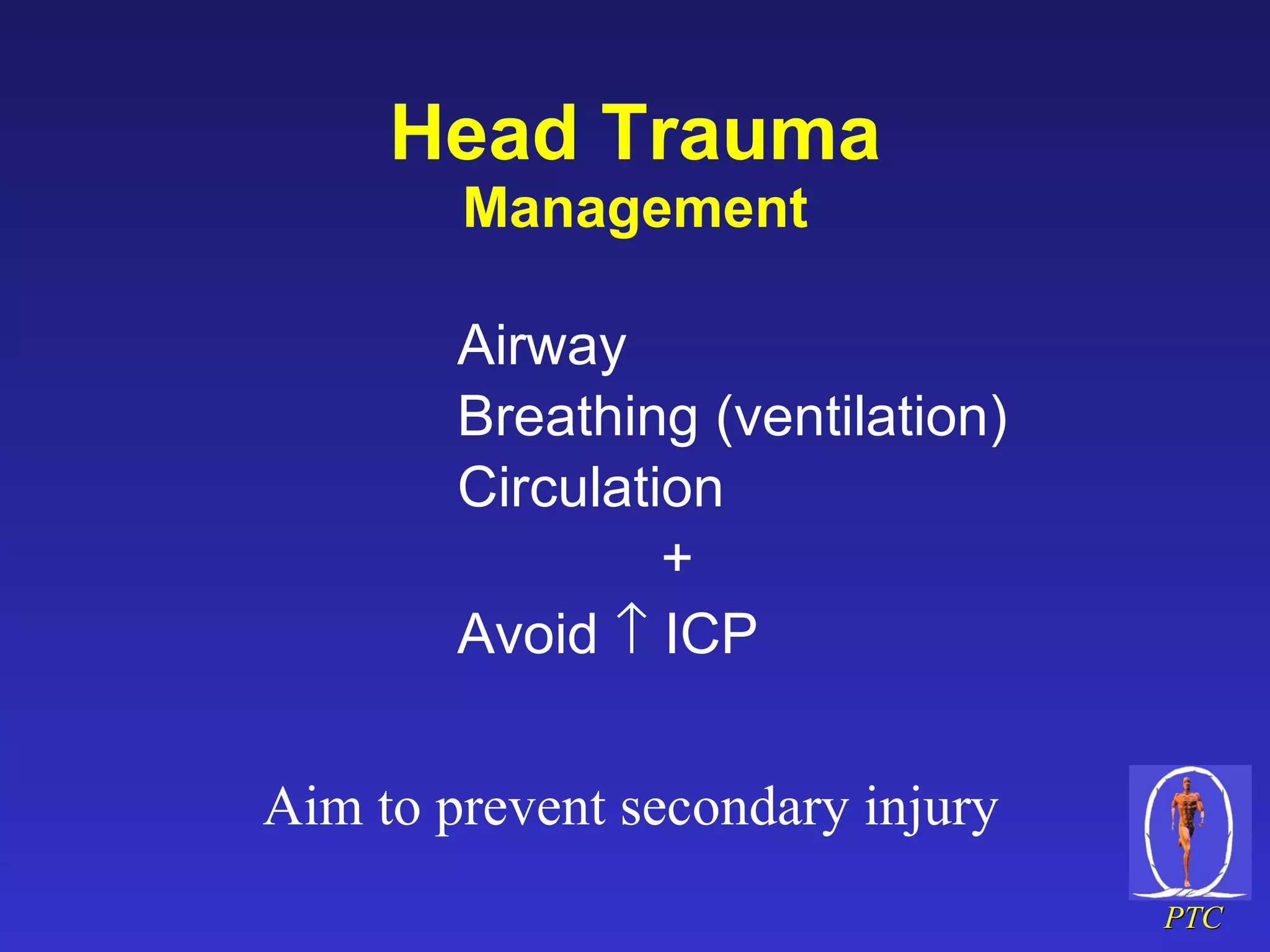
Airway Breathing (ventilation) Circulation +  Avoid    ICP Head Trauma Management Aim to prevent secondary injury
Head Trauma Severe (GCS<8) Intubate Normal CO 2 Treat hypotension with fluid  Sedation +/- paralysis
Head Trauma Severe (GCS<8) Nurse head up 20 o Prevent hyperthermia Complete secondary survey Reassess frequently
Head Trauma Beware Deteriorating conscious state Penetrating injury Focal neurological signs - unequal, dilated pupils - seizures - posturing
Head Trauma ?
Head Trauma Summary ABCs Prevent secondary injury Isolated head trauma doesn’t cause hypotension  Look for other injuries Deterioration    reassess
Spinal Trauma
 
Spinal Trauma Objectives To understand the structured approach to the patient with spinal trauma To learn how to identify serious and life-threatening spinal injuries
Spinal Trauma Primary survey A irway + Cervical spine Breathing Circulation Disability Exposure
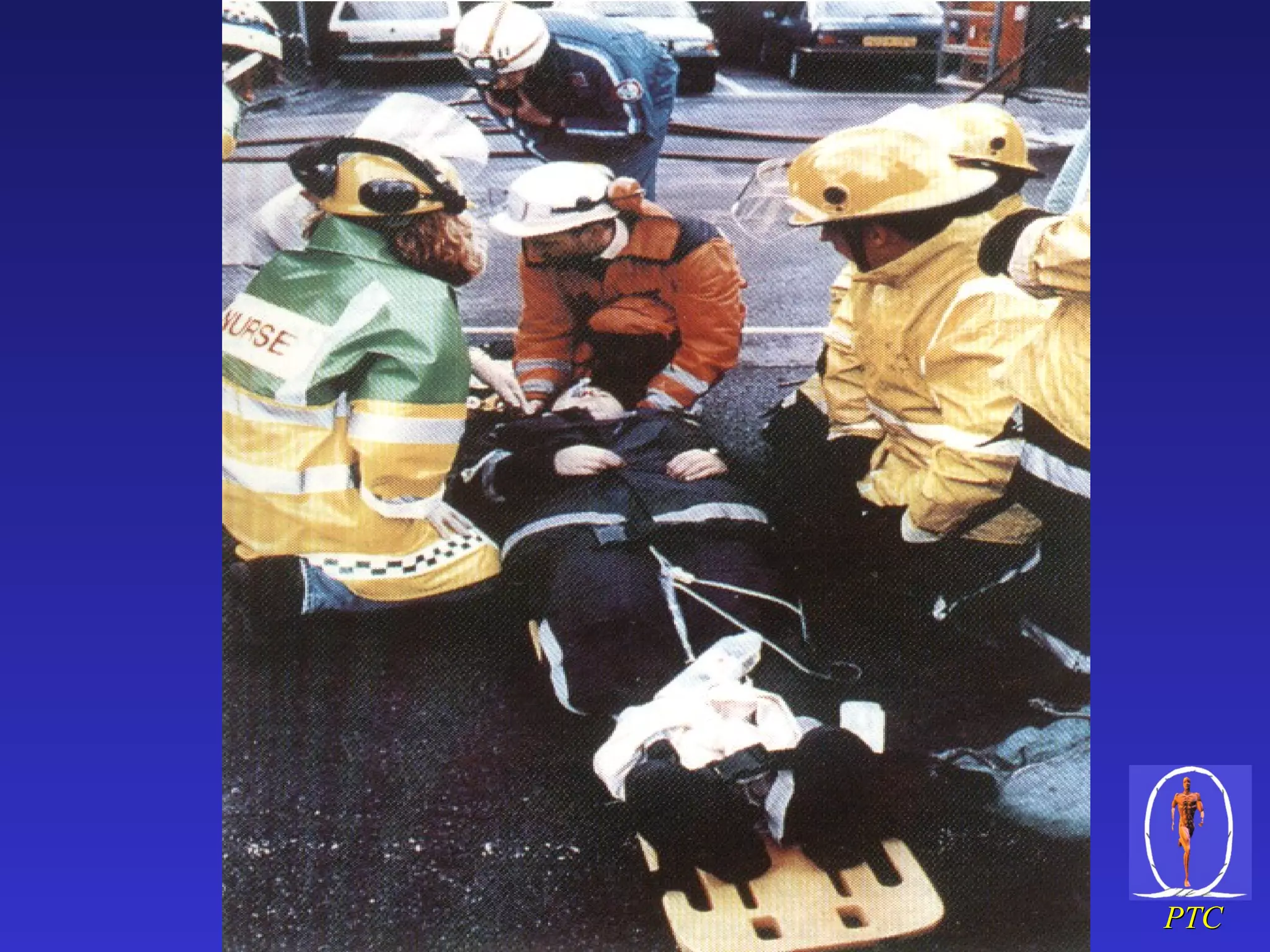
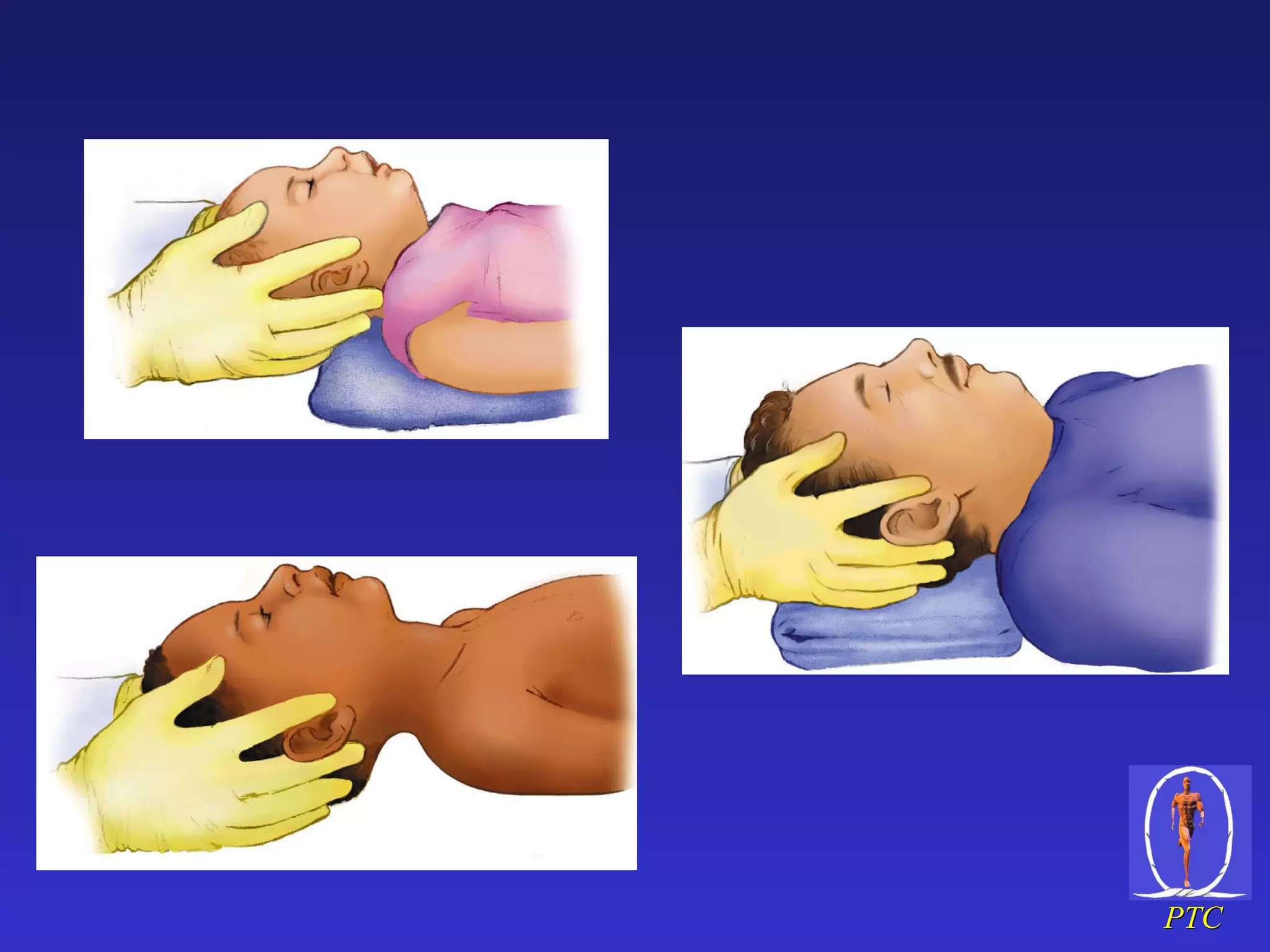
Spinal Trauma Secondary  survey Immobilise - stiff neck collar - sandbags + tapes - in-line immobilisation Examine in neutral position Log-roll to examine back
Spinal Trauma   Secondary  survey Local tenderness Swelling Deformity and stepping
Spinal Trauma  Assessment of level Motor response Sensory response especially sacral sparing Reflexes Autonomic function - bowel control - bladder control
Spinal Trauma  High risk for C-spine Head injury Paradoxical (diaphragmatic) breathing Flaccid limbs No reflexes (check rectal sphincter) Hypotension (+bradycardia)
Spinal Trauma Transport Never transport in sitting or prone position STABILISE SPINE PRIOR TO MOVEMENT Log roll for transfer
If spine is protected, its further examination and evaluation can be safely deferred until other life threatening emergencies are dealt with.
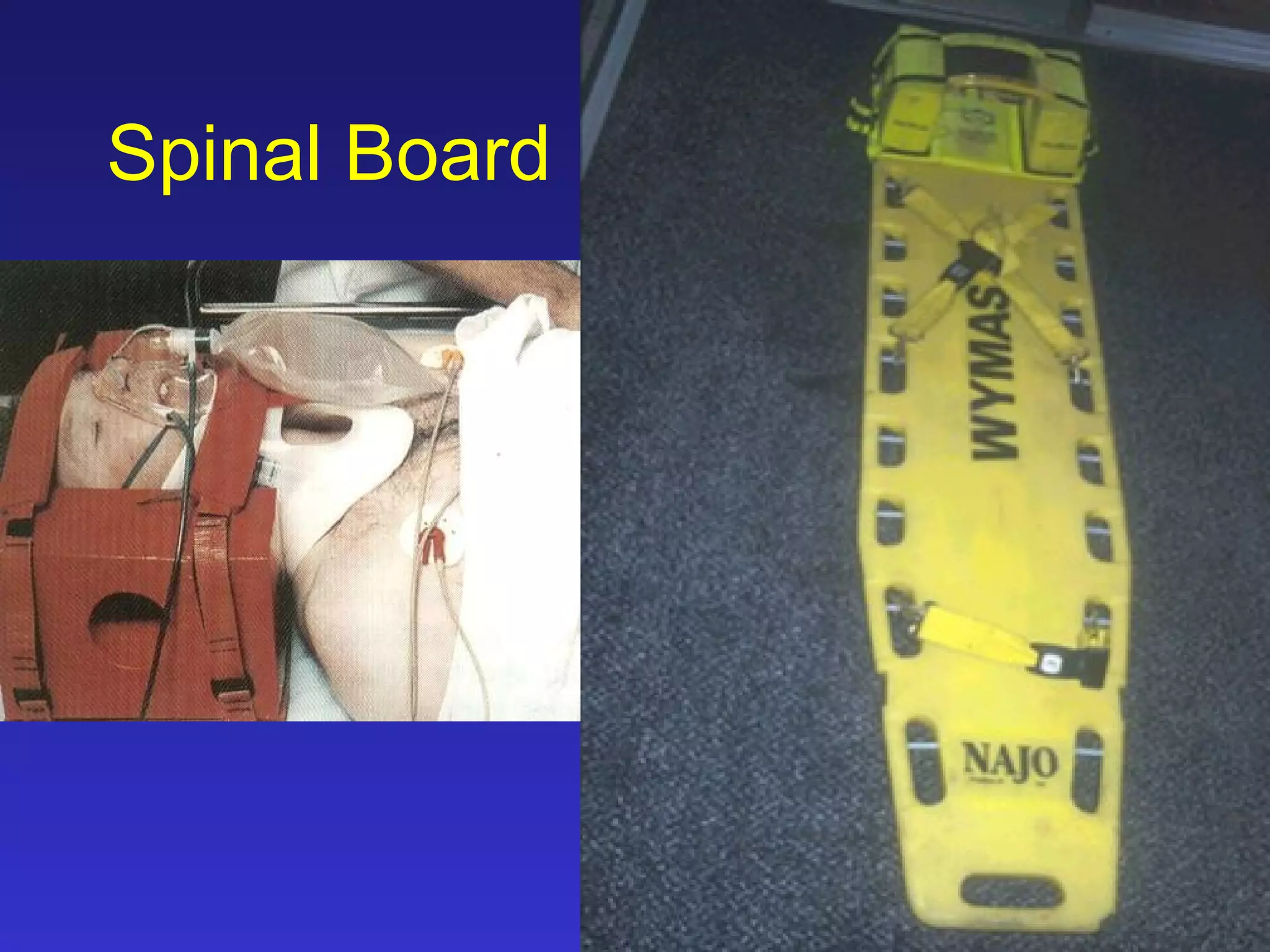
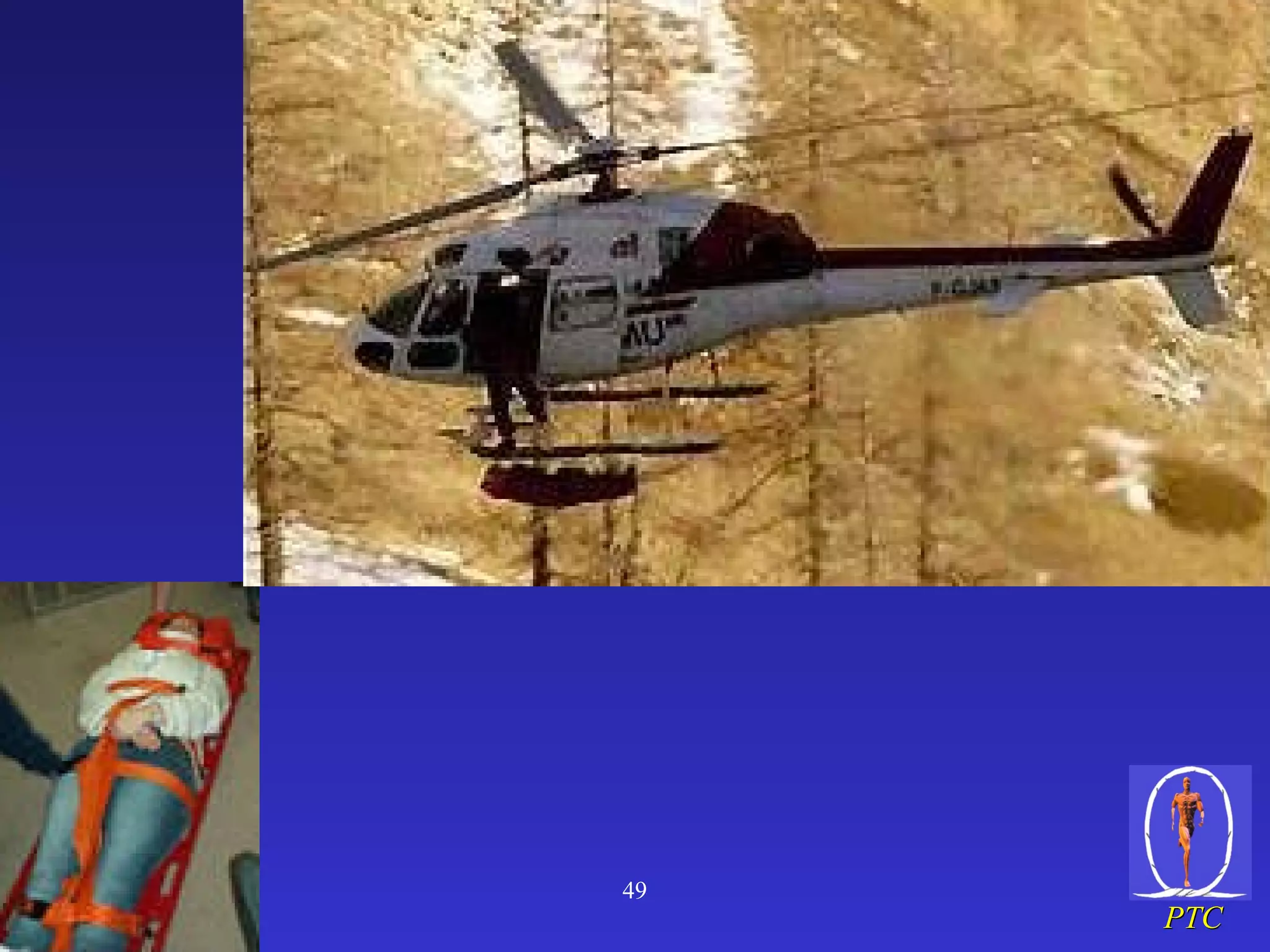
How spine can be protected? Manual in line traction Roll of newspapers Collars KED/ RED Spinal board Four point fixation of cervical spine Log roll Spinal lift Scoop stretcher
Cervical Collars
Spinal Board
LOG ROLLING LOG ROLL AND PROTECTION
 
Spinal Lift & Log-roll
 
Primary Survey and Resuscitation A irway with cervical spine control Assess – Clear –  No head tilt  – Definitive Airway B reathing: Oxygenation – Ventilation High spinal injury and paralysis of respiratory mls C irculation with haemorrhage control Neurgenic shock – bradycarida + hypotension  don’t overload, use inotropes D isability: Brief neurologic examination Paraplegia, tetraplegia, radiculopathy E xposure and environmental control Logroll, undress, examine spine, check bulbocavernuous reflex
Secondary Survey and Neurological Assessment AMPLE HISTORY ATTITUDE GCS AND PUPILS SENSORY EXAMINATION MOTOR EXAMINATION REFLEXES A LLERGIES M EDICATIONS P AST HISTORY/ PREGNANCY L AST MEAL E NVIRONMENT/ EVENTS –  MECHANISM OF SPINAL INJURY
HOW TO RULE OUT SPINAL INJURY?
NO NECK PAIN   NO NEUROLOGICAL DEFICIT Unlikely to have acute c/spine injury Remove collar Palpate spine, if non-tender Ask to move neck from side to side Ask to flex and extend neck Active movements normal = spine is cleared     No x-rays needed
NECK PAIN IS PRESENT  NO NEUROLOGICAL DEFICIT X-rays – cross table lat/ AP/ open mouth Flexion/extension views if above are normal CT if still in doubt
NEUROLOGICAL DEFICIT  (PARA OR TETRAPLEGIA) Presumptive evidence of spinal injury Keep spine protected Appropriate x-rays Take these patients off spinal board within 2hrs otherwise high chance of pressure sores
COMATOSED OR ALTERED LEVEL OF CONSCIOUSNESS OR  TOO YOUNG TO DESCRIBE THEIR SYMPTOMS X-rays – cross table lat/ AP/ open mouth (if possible) Flexion/extension views if above are normal CT if still in doubt Review by Neuro/Ortho/Spinal surgeon
Incidence Stability 90% are stable injuries and 10% are unstable Neurological deficit 75% unstable injuries have neurological deficit Spinal Cord Injury (< 5% of all spinal column fractures) 50/Million/Yr (USA), 15/Million/Yr (UK) Sex 4M:1F Age Average age is 30 Yrs MISSED INJURIES 1/3 CASES OF C/SPINE INJURY ARE MISSED INITIALLY
Fracture Level CERVICAL SPINE  40% MOST COMMON FRACTURE IS OF C5 MOST COMMON SUBLUXATION IS C5/6 Thoracic spine (T1-T9) 15% Thoracolumbar spine (T10-L5) 30% Most common fracture is of L1 Multi level 15%
ASSOCIATED INJURIES •  HEAD AND FACE INJURY 26 % •  Major chest injury 16 % •  Major abdominal injury 10%  •  Long bone/pelvic fracture 8%
Levels of Spinal Injury SKELETAL: level of bony injury NEUROLOGICAL: sensory & motor level with totally preserved function. Sensory & motor levels may be different on the same as well as on the opposite sides hence 4 levels) LEVEL OF PARTIAL PRESERVATION: presence of partial function below the neurological level,e.g sacral sparing.
Other systems CHEST Hypoventilation Intercostals T1-T12 Diaphragm C3-C5 Paradoxical breathing ABDOMEN Inability to perceive pain may mask features of acute abdomen Reliance on indirect features like referred pain in shoulders or investigations like DPL, USG, CT and MRI
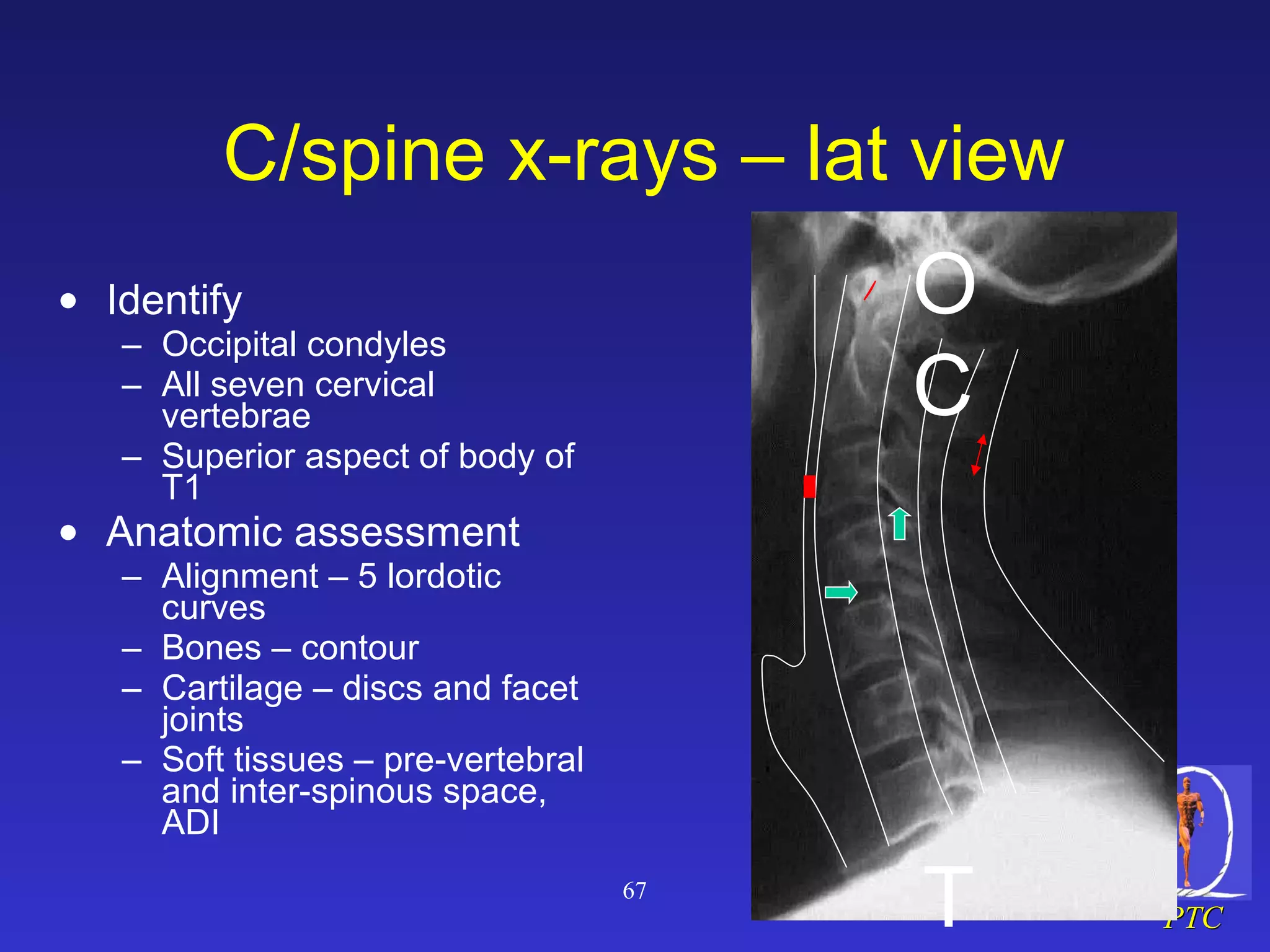
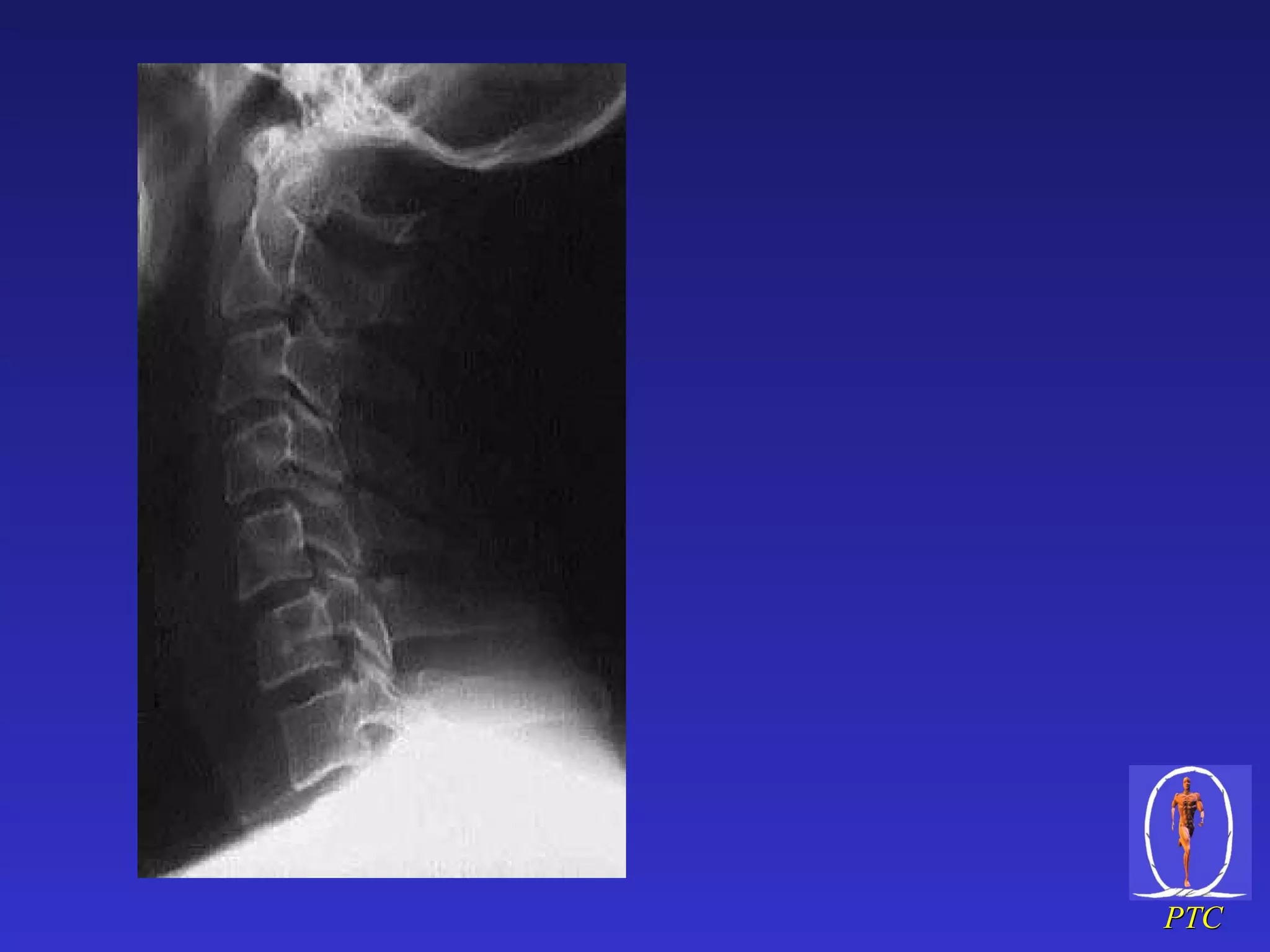
C/ spine  x-rays – lat view Identify Occipital condyles All seven cervical vertebrae Superior aspect of body of T1 Anatomic assessment Alignment – 5 lordotic curves Bones – contour Cartilage – discs and facet joints Soft tissues – pre-vertebral and inter-spinous space, ADI OC T1
Open Mouth & AP Views Occipital condyle Lat mass C1 Lat mass C2 Odontoid Peg Bifid spinous process Unco-vertebral joint C7 T1
Other investigations CT SCAN Indications To define a suspicious fracture on x-rays Inability to see lower cervical spine MRI Indications Neurological deficit Facet dislocations
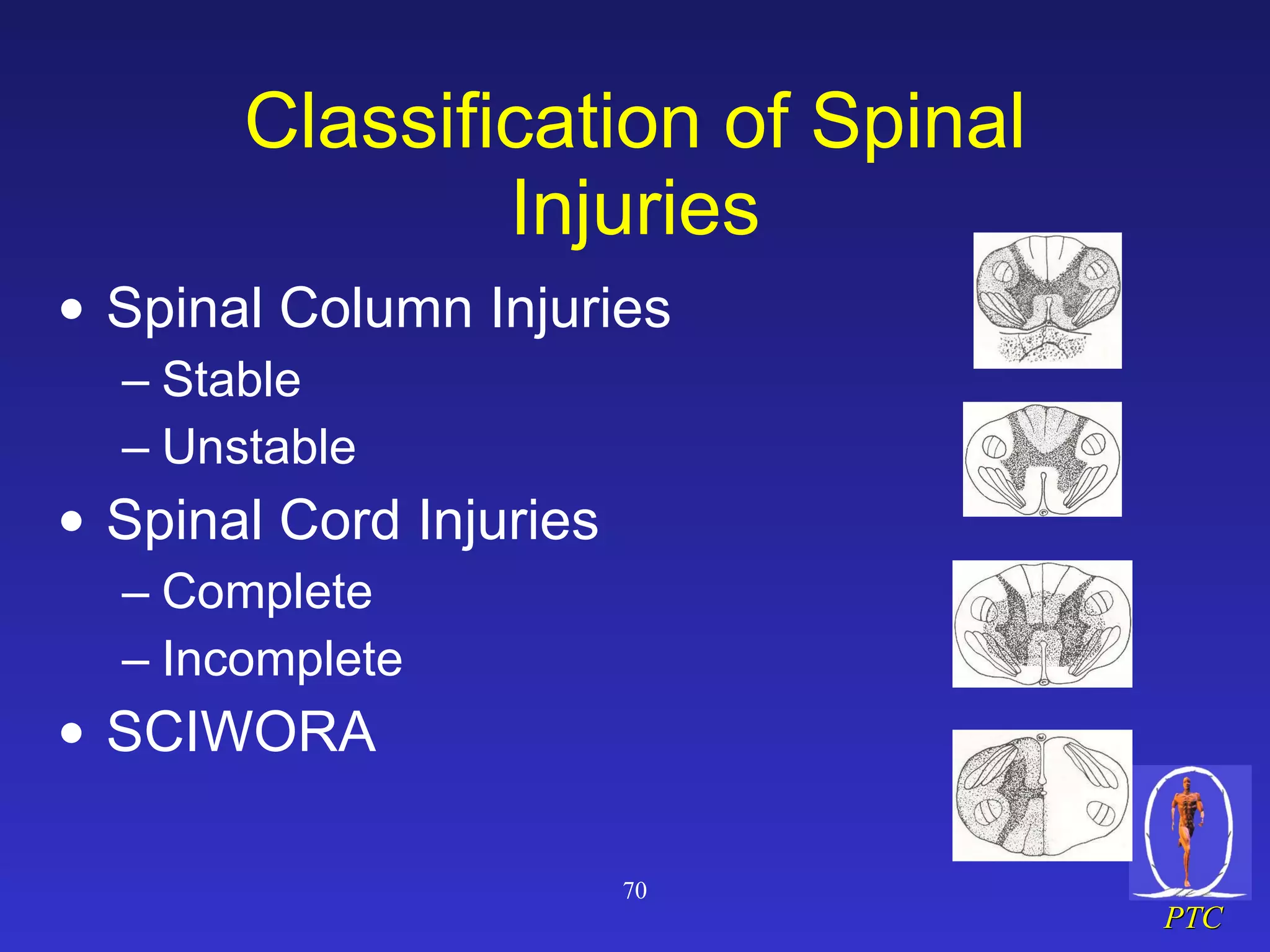
Classification of Spinal Injuries Spinal Column Injuries Stable Unstable Spinal Cord Injuries Complete Incomplete SCIWORA
Management of spinal injuries Stable injuries Symptomatic. Bed rest. Splinting. Mobilisation Unstable injuries without neurological deficit Adequate immobilisation. Cervical spine (hard collar, sand bags, tape). Thoracolumbar spine (spinal board). Logroll. Spinal lift Dislocations and fracture dislocation should be reduced as soon as possible  Closed reduction. Cervical spine (Halo traction, Gardner Wells tongs). Thoracolumbar spine (postural) ORIF Beware of disc prolapse in dislocations. MRI/ anterior approach Unstable injuries with neurological deficit Adequate Immobilisation Decompression High-dose steroids MSP start in first 8 hrs only. 30mg/kg in 15min. Wait for 45 min. 5.4mg/kg/hr/23hrs Establish as soon as possible whether injury is complete or incomplete Care of bladder, bowel, lungs and skin Haemodynamics – brady cardia/ hypotension – don’t over transfuse – atropine/inotropes
Medical Management of SCI Methylprednisolone (MPS) (Solumedrol) start only in the first 8 hrs of injury 30mg/kg IV in 15mins, wait for 45mins, 5.4mg/kg/hr for next 23hrs Analgesia Atropine If heart rate <50/min IV fluids and inotropes for hypotension Bladder/ Bowel/ Skin care/ Take pt off spinal board asap (max 2hrs if paralysed)
1
29 YEAR OLD REFRIGERATOR ENGINEER HAD BEEN OUT HORSE-RIDING, WHEN HIS HORSE HAD BOLTED AND HE WAS  THROWN OFF, HITTING HIS HEAD ON THE BRANCH OF A TREE.  THE PARAMEDICS HAVE HIM IMMOBILISED ON A SPINAL BOARD WITH A RIGID CERVICAL COLLAR IN PLACE. ACCORDING TO THEM THERE WAS  NO LOSS OF CONSCIOUSNESS  AT ANY TIME, AND HE IS RESPONDING APPROPRIATELY TO COMMANDS. HE IS COMPLAINING OF  MILD NECK PAIN AND TINGLING IN BOTH ARMS .  ON GPE U FIND  WEAKNESS IN BOTH ARMS, PROXIMALLY MORE THAN DISTALLY, WITH SOME ASSOCIATED LOSS OF LIGHT TOUCH AND PAIN SENSATION . WITH AN ASSISTANT MANUALLY STABILISING HIS NECK, YOU REMOVE THE COLLAR AND EXAMINE THE PATIENT. THERE IS  NO BONY TENDERNESS, DEFORMITY OR DEFECT. HIS NECK IS NOT TENDER TO PALPATION .
Can you clear this man's cervical spine clinically?
 
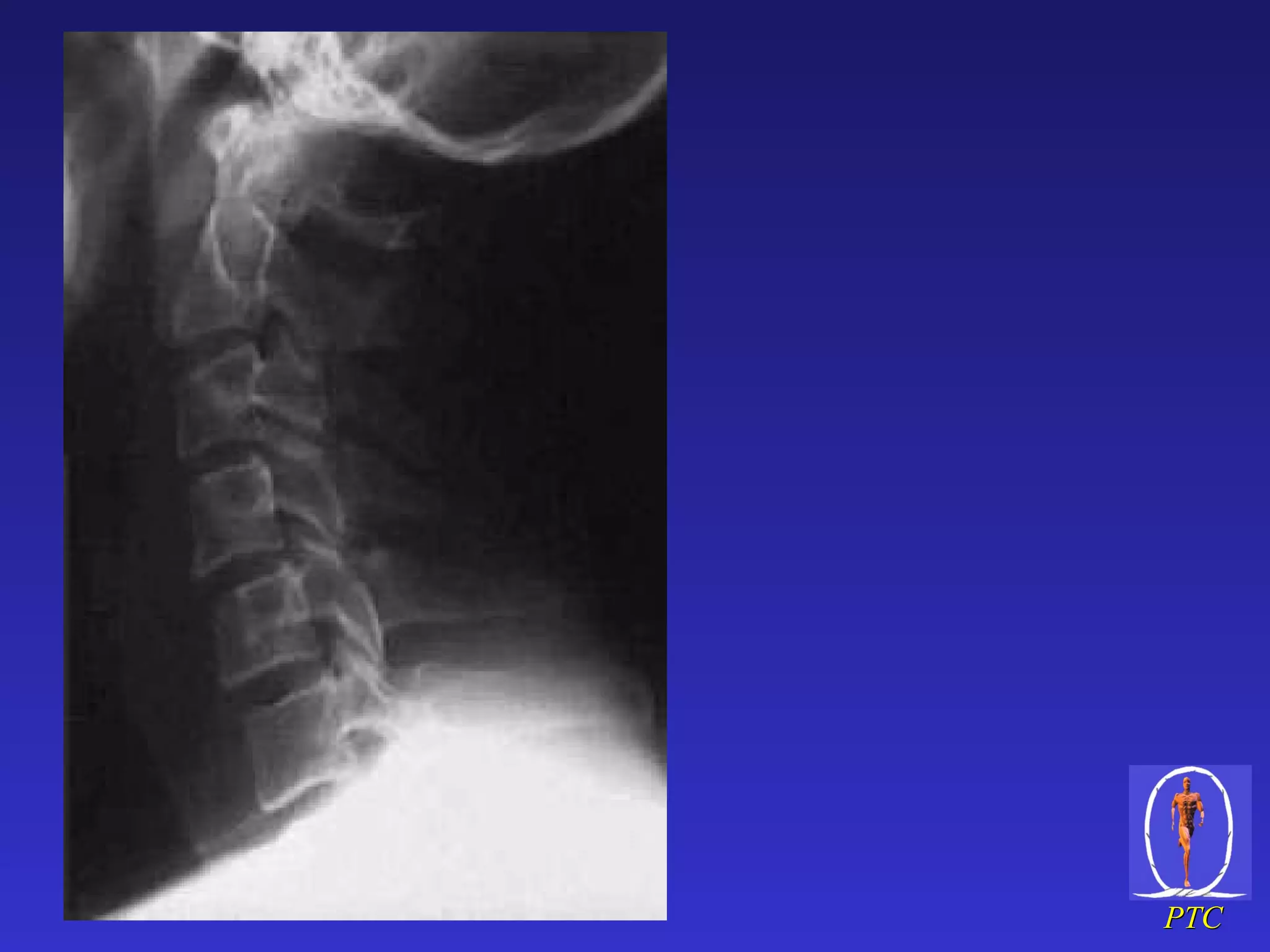
SO YOU'VE SUCCESSFULLY INTERPRETED THE LATERAL FILM AS A NORMAL LATERAL CERVICAL SPINE. DO YOU HAVE ENOUGH PLAIN FILMS OR ARE YOU GOING TO TROUBLE THE RADIOGRAPHER FOR MORE VIEWS?
 
AP and Open mouth views are normal as well. What next?
YOU SEND THE PT OFF FOR AN MRI SCAN AND YOU GET THE RESULTS BACK -  A  CENTRAL CORD HAEMATOMA - CONSISTENT WITH THE CENTRAL CORD SYNDROME   YOU FOUND ON EXAMINATION.  YOU PACK THE PT OFF TO THE SPINAL UNIT WHERE, YOU LATER LEARNED, HE REGAINED FULL FUNCTION AND WAS DISCHARGED.
2
YOUR PATIENT, JAMES COOK, A 32 YEAR OLD TRAVEL WRITER  CAME OFF HIS MOTORCYCLE WHICH SKIDDED ON SOME ICE . THE PARAMEDICS HAVE HIM IMMOBILISED ON A SPINAL BOARD WITH A RIGID CERVICAL COLLAR IN PLACE. ACCORDING TO THEM THERE WAS  NO LOSS OF CONSCIOUSNESS AT ANY TIME ,  AND HE IS RESPONDING APPROPRIATELY TO COMMANDS. HE IS  NOT COMPLAINING OF ANY NECK PAIN .  ON GENERAL EXAMINATION YOU FIND  NO NEUROLOGY AND NO EVIDENCE OF OTHER INJUR Y . WITH AN ASSISTANT MANUALLY STABILISING HIS NECK, YOU REMOVE THE COLLAR AND EXAMINE THE PATIENT. THERE IS NO BONY TENDERNESS, DEFORMITY OR DEFECT.  THINK YOU CAN HANDLE THIS ONE?
YOU REMOVE MR. COOK'S SPINAL IMMOBILISATION AND HARD COLLAR. HE LOOKS BETTER ALREADY! YOU RE-EXAMINE HIM OUT OF HIS COLLAR, AND FIND NO NEW SIGNS. HE HAS FULL AND PAIN FREE RANGE OF MOVEMENTS.  YOU DISCHARGE MR. COOK WITH ADVICE TO CHANGE HIS MOTORCYCLE FOR A BUS PASS, AND TO 'STAY OUT OF TROUBLE' .
3
YOUR PATIENT IS MR. HORATIO NELSON, A SURPRISINGLY SHORT 19 YEAR OLD, WHO HAS  FALLEN OUT OF A SINGLE STOREY WINDOW  WHILE AT A PARTY. HIS MATE ASSURES YOU THAT APART FROM  QUITE A LOT OF ALCOHOL  HORATIO ONLY TOOK  2 OR 3 ECSTASY TABLETS  (THOUGH HORATIO LOOKS BLOODY MISERABLE AT THE MOMENT).  SPINAL IMMOBILISATION AND A RIGID CERVICAL COLLAR ARE IN PLACE. ON EXAMINATION YOU ONLY FIND SOME  BRUISING AROUND ONE EYE AND A BROKEN HUMERUS . HIS  NECK IS CLINICALLY NOT TENDER, WITH NO DEFORMITY OR DEFECT, AND HE HAS NO OBVIOUS NEUROLOGY .  Can you clear this man's cervical spine clinically?
 
YOU PASSEDA MR. NELSON'S LATERAL CERVICAL SPINE AS NORMAL. ARE YOU GOING TO DISCHARGE HIM?
YOU ORDER THE OPEN MOUTH AND AP FILMS FOR HORATIO, WHO IS NOW REALLY GETTING A LITTLE BIT MUCH. HE'S NOW OFFERING TO SINK BATTLESHIPS AND MOVE WHOLE ARMIES FOR YOU.  HIS OTHER X-RAYS ARE ALSO NORMAL. YOU REMOVE HIS HARD COLLAR AND EXAMINE HIS NECK GENTLY. HE COMPLAINS OF NO PAIN OR TENDERNESS.
What are your plans?
YOU RECOGNISE THAT YOUR PHYSICAL EXAM, WHILE REASSURING, IS NOT RELIABLE GIVEN THE COCKTAIL OF DRUGS AND ALCOHOL HE HAS TAKEN. SO YOU ADMIT HIM. BY MORNING HE HAS SOBERED UP AND PREDICTABLY HE LOOKS TERRIBLE. HIS PHYSICAL EXAMINATION IS ENTIRELY NORMAL AND YOU DISCHARGE HIM INTO HARDY'S CARE WITH ADVICE.
4
MR. CHARLES DARWIN IS A 42 YEAR OLD WHOSE CAR VEERED OFF THE ROAD.  HE WAS  UNCONSCIOUS ON SCENE AND REQUIRED EXTRACTION FROM THE VEHICLE .  ACCORDING TO THE PARAMEDICS HE WAS  HAEMODYNAMICALLY STABLE THROUGHOUT, WITH A GLASGOW COMA SCORE OF 6 INITIALLY .  BOTH PUPILS ARE EQUAL AND REACTIVE . THEY  INTUBATED HIM ON SCENE .  HIS ONLY EXTERNAL INJURIES APPEAR TO BE  BRUISING AND CUTS TO HIS FOREHEAD . SPINAL IMMOBILISATION IS IN PLACE.
YOU WISELY DECIDE THAT MR. DARWIN NEEDS HIS COLLAR AT THE MOMENT. EXAMINING HIM YOU CONFIRM THE PARAMEDICS FINDINGS. HE IS INTUBATED AND VENTILATED, HAEMODYNAMICALLY STABLE WITH A GCS NOW OF 4 AND EQUAL, REACTIVE PUPILS. YOU NEED TO MOVE QUICKLY AS HE MAY HAVE AN EVOLVING BRAIN INJURY.  YOU ORDER A LATERAL CERVICAL SPINE FILM.


MR. DARWIN REMAINS STABLE BOTH HAEMODYNAMICALLY AND NEUROLOGICALLY WHILE YOU FINISH YOUR INITIAL ASSESSMENT AND RESUSCITATION. APART FROM HIS HEAD INJURY YOU FIND NOTHING ELSE.  HIS OTHER CERVICAL SPINE X-RAYS ARE ALSO NORMAL. CHEST AND PELVIC X-RAYS ALSO NORMAL AND ABDOMINAL ULTRASOUND DID NOT SHOW ANY FREE INTRAPERITONEAL FLUID.
What's your plan?
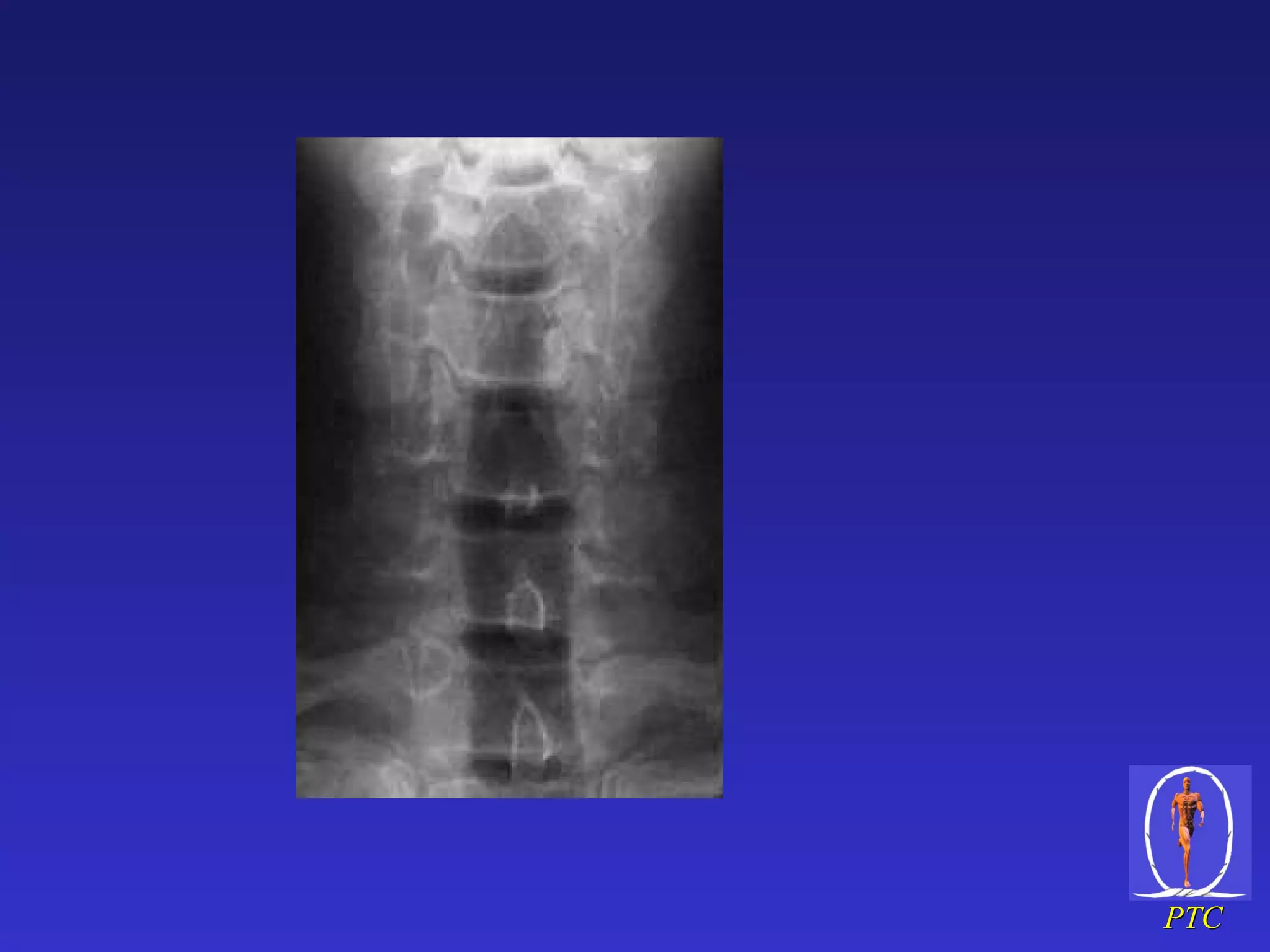
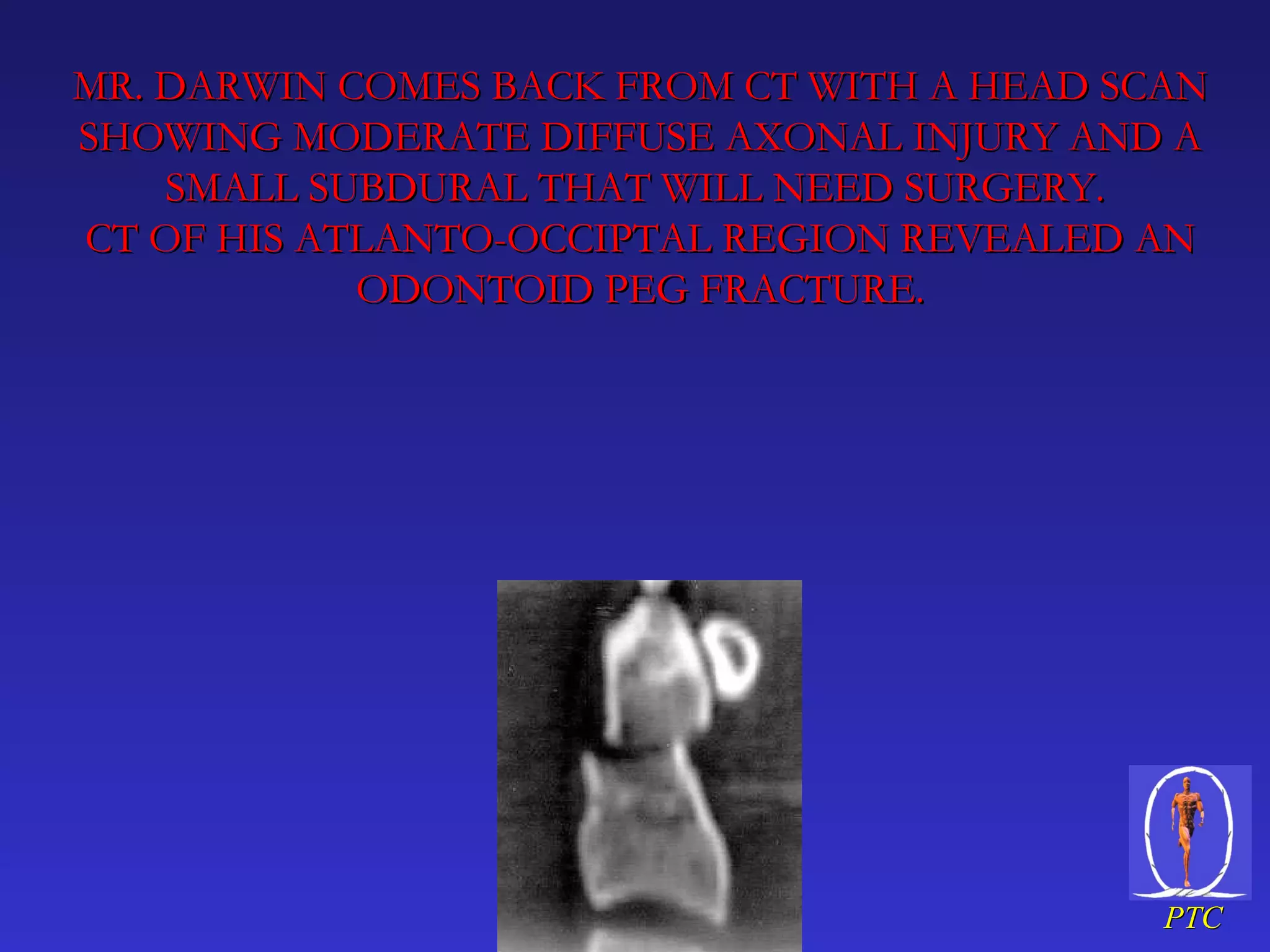
MR. DARWIN COMES BACK FROM CT WITH A HEAD SCAN SHOWING MODERATE DIFFUSE AXONAL INJURY AND A SMALL SUBDURAL THAT WILL NEED SURGERY.  CT OF HIS ATLANTO-OCCIPTAL REGION REVEALED AN ODONTOID PEG FRACTURE.
You send Mr. Darwin up to theatre for his craniotomy, and arrange for his admission to the intensive care unit. The spinal surgeons can decide whether they want an MRI or not in this case, it's not going to add much to his immediate management.
QUESTIONS?
Spinal Trauma Summary Immobilise until injury is excluded Initial management is ABC Thorough neurological examination

HEAD & SPINAL TRAUMA

  • 1.
  • 2.
  • 3.
  • 4.
  • 5.
  • 6.
    Head Trauma ObjectivesTo understand the structured approach to the patient with head trauma To learn how to identify serious and life-threatening head injuries
  • 7.
    Head Trauma Accountsfor 1/3-1/2 of trauma deaths Good outcomes are possible without CT scans and neurosurgeons Aim to avoid any further injury to the brain Hypoxia and hypotension double mortality
  • 8.
    Head Trauma ApproachA irway B reathing C irculation
  • 9.
    Head Trauma PhysiologyCPP = MAP - ICP CPP = cerebral perfusion pressure MAP = mean arterial pressure ICP = intracranial pressure
  • 10.
    Cerebral Blood FlowDepends on: CPP (MAP-ICP) PaCO 2 PaO 2 Local metabolites
  • 11.
    Head Trauma PathophysiologyPrimary Injury - occurs at time of injury Secondary Injury - occurs after injury - may be preventable
  • 12.
    HEAD TRAUMA Primaryinjury Diffuse axonal injury acceleration deceleration Cerebral contusion Penetrating injury
  • 13.
    HEAD TRAUMA Secondary injury Hypoxia Hypoperfusion (  ICP,  MAP) Hypoglycaemia Hyperthermia (fever) Seizures
  • 14.
    Head Trauma Initialassessment A irway (+ C-spine) B reathing C irculation D isability (AVPU, pupils) E xposure
  • 15.
    Head Trauma Examination Glasgow Coma Score Pupils Corneal reflex Eye position Fundi
  • 16.
    Head Trauma Examination Tympanic membrane Scalp and skull Respiratory Pattern Muscle tone Posture Tendon reflexes
  • 17.
    Head Trauma Glasgow Coma Score (GCS) Grades severity of head injury Score out of 15 Subject to inter-observer variation Trend of GCS over time very useful Important to describe responses also
  • 18.
    Head Trauma GCS Eye opening Open spontaneously 4 Open to command 3 Open to pain 2 None 1
  • 19.
    Head Trauma GCS Best Verbal Response Oriented 5 Confused 4 Inappropriate words 3 Inappropriate sounds 2 None 1
  • 20.
    Head Trauma GCS Best Motor Response Obeys command 6 Localises to pain 5 Withdraws to pain 4 Abnormal flexion 3 Extensor response 2 None 1
  • 21.
    Head Trauma Severity of Head Injury Severe GCS <8 Moderate GCS 9-12 Minor GCS 13-15
  • 22.
    Head Trauma Pupillary signs Size Reactivity Equality
  • 23.
    Head Trauma Pupillary responses Fixed, dilated, unresponsive Severe hypoxia Hypothermia Seizures
  • 24.
    Head Trauma Pupillary responses Unilateral, dilated, unresponsive Expanding lesion on same side Tentorial herniation Seizures
  • 25.
    Head Trauma Acuteextradural Acute subdural potentially life-threatening immediate recognition essential require burr-hole decompression
  • 26.
    Head Trauma Acuteextradural LOC  lucid interval  deterioration middle meningeal artery bleed overlying skull fracture contralateral hemiparesis fixed pupil on side of injury
  • 27.
    Head Trauma Acutesubdural Tearing of bridging vein between cortex and dura Severe contusion of underlying brain Usually no lucid interval Worse prognosis than extradural haematoma
  • 28.
    Head Trauma Otherinjuries Base-of-skull fractures Cerebral concussion Depressed skull fracture Intracerebral haematoma Usually do not require neurosurgery
  • 29.
    Airway Breathing (ventilation)Circulation + Avoid  ICP Head Trauma Management Aim to prevent secondary injury
  • 30.
    Head Trauma Severe(GCS<8) Intubate Normal CO 2 Treat hypotension with fluid Sedation +/- paralysis
  • 31.
    Head Trauma Severe(GCS<8) Nurse head up 20 o Prevent hyperthermia Complete secondary survey Reassess frequently
  • 32.
    Head Trauma BewareDeteriorating conscious state Penetrating injury Focal neurological signs - unequal, dilated pupils - seizures - posturing
  • 33.
  • 34.
    Head Trauma SummaryABCs Prevent secondary injury Isolated head trauma doesn’t cause hypotension Look for other injuries Deterioration  reassess
  • 35.
  • 37.
  • 38.
    Spinal Trauma ObjectivesTo understand the structured approach to the patient with spinal trauma To learn how to identify serious and life-threatening spinal injuries
  • 39.
    Spinal Trauma Primarysurvey A irway + Cervical spine Breathing Circulation Disability Exposure
  • 40.
    Spinal Trauma Secondary survey Immobilise - stiff neck collar - sandbags + tapes - in-line immobilisation Examine in neutral position Log-roll to examine back
  • 41.
    Spinal Trauma Secondary survey Local tenderness Swelling Deformity and stepping
  • 42.
    Spinal Trauma Assessment of level Motor response Sensory response especially sacral sparing Reflexes Autonomic function - bowel control - bladder control
  • 43.
    Spinal Trauma High risk for C-spine Head injury Paradoxical (diaphragmatic) breathing Flaccid limbs No reflexes (check rectal sphincter) Hypotension (+bradycardia)
  • 44.
    Spinal Trauma TransportNever transport in sitting or prone position STABILISE SPINE PRIOR TO MOVEMENT Log roll for transfer
  • 45.
    If spine isprotected, its further examination and evaluation can be safely deferred until other life threatening emergencies are dealt with.
  • 46.
    How spine canbe protected? Manual in line traction Roll of newspapers Collars KED/ RED Spinal board Four point fixation of cervical spine Log roll Spinal lift Scoop stretcher
  • 47.
  • 48.
  • 50.
    LOG ROLLING LOGROLL AND PROTECTION
  • 51.
  • 52.
    Spinal Lift &Log-roll
  • 53.
  • 55.
    Primary Survey andResuscitation A irway with cervical spine control Assess – Clear – No head tilt – Definitive Airway B reathing: Oxygenation – Ventilation High spinal injury and paralysis of respiratory mls C irculation with haemorrhage control Neurgenic shock – bradycarida + hypotension don’t overload, use inotropes D isability: Brief neurologic examination Paraplegia, tetraplegia, radiculopathy E xposure and environmental control Logroll, undress, examine spine, check bulbocavernuous reflex
  • 56.
    Secondary Survey andNeurological Assessment AMPLE HISTORY ATTITUDE GCS AND PUPILS SENSORY EXAMINATION MOTOR EXAMINATION REFLEXES A LLERGIES M EDICATIONS P AST HISTORY/ PREGNANCY L AST MEAL E NVIRONMENT/ EVENTS – MECHANISM OF SPINAL INJURY
  • 57.
    HOW TO RULEOUT SPINAL INJURY?
  • 58.
    NO NECK PAIN NO NEUROLOGICAL DEFICIT Unlikely to have acute c/spine injury Remove collar Palpate spine, if non-tender Ask to move neck from side to side Ask to flex and extend neck Active movements normal = spine is cleared  No x-rays needed
  • 59.
    NECK PAIN ISPRESENT NO NEUROLOGICAL DEFICIT X-rays – cross table lat/ AP/ open mouth Flexion/extension views if above are normal CT if still in doubt
  • 60.
    NEUROLOGICAL DEFICIT (PARA OR TETRAPLEGIA) Presumptive evidence of spinal injury Keep spine protected Appropriate x-rays Take these patients off spinal board within 2hrs otherwise high chance of pressure sores
  • 61.
    COMATOSED OR ALTEREDLEVEL OF CONSCIOUSNESS OR TOO YOUNG TO DESCRIBE THEIR SYMPTOMS X-rays – cross table lat/ AP/ open mouth (if possible) Flexion/extension views if above are normal CT if still in doubt Review by Neuro/Ortho/Spinal surgeon
  • 62.
    Incidence Stability 90%are stable injuries and 10% are unstable Neurological deficit 75% unstable injuries have neurological deficit Spinal Cord Injury (< 5% of all spinal column fractures) 50/Million/Yr (USA), 15/Million/Yr (UK) Sex 4M:1F Age Average age is 30 Yrs MISSED INJURIES 1/3 CASES OF C/SPINE INJURY ARE MISSED INITIALLY
  • 63.
    Fracture Level CERVICALSPINE 40% MOST COMMON FRACTURE IS OF C5 MOST COMMON SUBLUXATION IS C5/6 Thoracic spine (T1-T9) 15% Thoracolumbar spine (T10-L5) 30% Most common fracture is of L1 Multi level 15%
  • 64.
    ASSOCIATED INJURIES • HEAD AND FACE INJURY 26 % • Major chest injury 16 % • Major abdominal injury 10% • Long bone/pelvic fracture 8%
  • 65.
    Levels of SpinalInjury SKELETAL: level of bony injury NEUROLOGICAL: sensory & motor level with totally preserved function. Sensory & motor levels may be different on the same as well as on the opposite sides hence 4 levels) LEVEL OF PARTIAL PRESERVATION: presence of partial function below the neurological level,e.g sacral sparing.
  • 66.
    Other systems CHESTHypoventilation Intercostals T1-T12 Diaphragm C3-C5 Paradoxical breathing ABDOMEN Inability to perceive pain may mask features of acute abdomen Reliance on indirect features like referred pain in shoulders or investigations like DPL, USG, CT and MRI
  • 67.
    C/ spine x-rays – lat view Identify Occipital condyles All seven cervical vertebrae Superior aspect of body of T1 Anatomic assessment Alignment – 5 lordotic curves Bones – contour Cartilage – discs and facet joints Soft tissues – pre-vertebral and inter-spinous space, ADI OC T1
  • 68.
    Open Mouth &AP Views Occipital condyle Lat mass C1 Lat mass C2 Odontoid Peg Bifid spinous process Unco-vertebral joint C7 T1
  • 69.
    Other investigations CTSCAN Indications To define a suspicious fracture on x-rays Inability to see lower cervical spine MRI Indications Neurological deficit Facet dislocations
  • 70.
    Classification of SpinalInjuries Spinal Column Injuries Stable Unstable Spinal Cord Injuries Complete Incomplete SCIWORA
  • 71.
    Management of spinalinjuries Stable injuries Symptomatic. Bed rest. Splinting. Mobilisation Unstable injuries without neurological deficit Adequate immobilisation. Cervical spine (hard collar, sand bags, tape). Thoracolumbar spine (spinal board). Logroll. Spinal lift Dislocations and fracture dislocation should be reduced as soon as possible Closed reduction. Cervical spine (Halo traction, Gardner Wells tongs). Thoracolumbar spine (postural) ORIF Beware of disc prolapse in dislocations. MRI/ anterior approach Unstable injuries with neurological deficit Adequate Immobilisation Decompression High-dose steroids MSP start in first 8 hrs only. 30mg/kg in 15min. Wait for 45 min. 5.4mg/kg/hr/23hrs Establish as soon as possible whether injury is complete or incomplete Care of bladder, bowel, lungs and skin Haemodynamics – brady cardia/ hypotension – don’t over transfuse – atropine/inotropes
  • 72.
    Medical Management ofSCI Methylprednisolone (MPS) (Solumedrol) start only in the first 8 hrs of injury 30mg/kg IV in 15mins, wait for 45mins, 5.4mg/kg/hr for next 23hrs Analgesia Atropine If heart rate <50/min IV fluids and inotropes for hypotension Bladder/ Bowel/ Skin care/ Take pt off spinal board asap (max 2hrs if paralysed)
  • 73.
  • 74.
    29 YEAR OLDREFRIGERATOR ENGINEER HAD BEEN OUT HORSE-RIDING, WHEN HIS HORSE HAD BOLTED AND HE WAS THROWN OFF, HITTING HIS HEAD ON THE BRANCH OF A TREE. THE PARAMEDICS HAVE HIM IMMOBILISED ON A SPINAL BOARD WITH A RIGID CERVICAL COLLAR IN PLACE. ACCORDING TO THEM THERE WAS NO LOSS OF CONSCIOUSNESS AT ANY TIME, AND HE IS RESPONDING APPROPRIATELY TO COMMANDS. HE IS COMPLAINING OF MILD NECK PAIN AND TINGLING IN BOTH ARMS . ON GPE U FIND WEAKNESS IN BOTH ARMS, PROXIMALLY MORE THAN DISTALLY, WITH SOME ASSOCIATED LOSS OF LIGHT TOUCH AND PAIN SENSATION . WITH AN ASSISTANT MANUALLY STABILISING HIS NECK, YOU REMOVE THE COLLAR AND EXAMINE THE PATIENT. THERE IS NO BONY TENDERNESS, DEFORMITY OR DEFECT. HIS NECK IS NOT TENDER TO PALPATION .
  • 75.
    Can you clearthis man's cervical spine clinically?
  • 76.
  • 77.
    SO YOU'VE SUCCESSFULLYINTERPRETED THE LATERAL FILM AS A NORMAL LATERAL CERVICAL SPINE. DO YOU HAVE ENOUGH PLAIN FILMS OR ARE YOU GOING TO TROUBLE THE RADIOGRAPHER FOR MORE VIEWS?
  • 78.
  • 79.
    AP and Openmouth views are normal as well. What next?
  • 80.
    YOU SEND THEPT OFF FOR AN MRI SCAN AND YOU GET THE RESULTS BACK - A CENTRAL CORD HAEMATOMA - CONSISTENT WITH THE CENTRAL CORD SYNDROME YOU FOUND ON EXAMINATION. YOU PACK THE PT OFF TO THE SPINAL UNIT WHERE, YOU LATER LEARNED, HE REGAINED FULL FUNCTION AND WAS DISCHARGED.
  • 81.
  • 82.
    YOUR PATIENT, JAMESCOOK, A 32 YEAR OLD TRAVEL WRITER CAME OFF HIS MOTORCYCLE WHICH SKIDDED ON SOME ICE . THE PARAMEDICS HAVE HIM IMMOBILISED ON A SPINAL BOARD WITH A RIGID CERVICAL COLLAR IN PLACE. ACCORDING TO THEM THERE WAS NO LOSS OF CONSCIOUSNESS AT ANY TIME , AND HE IS RESPONDING APPROPRIATELY TO COMMANDS. HE IS NOT COMPLAINING OF ANY NECK PAIN . ON GENERAL EXAMINATION YOU FIND NO NEUROLOGY AND NO EVIDENCE OF OTHER INJUR Y . WITH AN ASSISTANT MANUALLY STABILISING HIS NECK, YOU REMOVE THE COLLAR AND EXAMINE THE PATIENT. THERE IS NO BONY TENDERNESS, DEFORMITY OR DEFECT. THINK YOU CAN HANDLE THIS ONE?
  • 83.
    YOU REMOVE MR.COOK'S SPINAL IMMOBILISATION AND HARD COLLAR. HE LOOKS BETTER ALREADY! YOU RE-EXAMINE HIM OUT OF HIS COLLAR, AND FIND NO NEW SIGNS. HE HAS FULL AND PAIN FREE RANGE OF MOVEMENTS. YOU DISCHARGE MR. COOK WITH ADVICE TO CHANGE HIS MOTORCYCLE FOR A BUS PASS, AND TO 'STAY OUT OF TROUBLE' .
  • 84.
  • 85.
    YOUR PATIENT ISMR. HORATIO NELSON, A SURPRISINGLY SHORT 19 YEAR OLD, WHO HAS FALLEN OUT OF A SINGLE STOREY WINDOW WHILE AT A PARTY. HIS MATE ASSURES YOU THAT APART FROM QUITE A LOT OF ALCOHOL HORATIO ONLY TOOK 2 OR 3 ECSTASY TABLETS (THOUGH HORATIO LOOKS BLOODY MISERABLE AT THE MOMENT). SPINAL IMMOBILISATION AND A RIGID CERVICAL COLLAR ARE IN PLACE. ON EXAMINATION YOU ONLY FIND SOME BRUISING AROUND ONE EYE AND A BROKEN HUMERUS . HIS NECK IS CLINICALLY NOT TENDER, WITH NO DEFORMITY OR DEFECT, AND HE HAS NO OBVIOUS NEUROLOGY . Can you clear this man's cervical spine clinically?
  • 86.
  • 87.
    YOU PASSEDA MR.NELSON'S LATERAL CERVICAL SPINE AS NORMAL. ARE YOU GOING TO DISCHARGE HIM?
  • 88.
    YOU ORDER THEOPEN MOUTH AND AP FILMS FOR HORATIO, WHO IS NOW REALLY GETTING A LITTLE BIT MUCH. HE'S NOW OFFERING TO SINK BATTLESHIPS AND MOVE WHOLE ARMIES FOR YOU. HIS OTHER X-RAYS ARE ALSO NORMAL. YOU REMOVE HIS HARD COLLAR AND EXAMINE HIS NECK GENTLY. HE COMPLAINS OF NO PAIN OR TENDERNESS.
  • 89.
  • 90.
    YOU RECOGNISE THATYOUR PHYSICAL EXAM, WHILE REASSURING, IS NOT RELIABLE GIVEN THE COCKTAIL OF DRUGS AND ALCOHOL HE HAS TAKEN. SO YOU ADMIT HIM. BY MORNING HE HAS SOBERED UP AND PREDICTABLY HE LOOKS TERRIBLE. HIS PHYSICAL EXAMINATION IS ENTIRELY NORMAL AND YOU DISCHARGE HIM INTO HARDY'S CARE WITH ADVICE.
  • 91.
  • 92.
    MR. CHARLES DARWINIS A 42 YEAR OLD WHOSE CAR VEERED OFF THE ROAD. HE WAS UNCONSCIOUS ON SCENE AND REQUIRED EXTRACTION FROM THE VEHICLE . ACCORDING TO THE PARAMEDICS HE WAS HAEMODYNAMICALLY STABLE THROUGHOUT, WITH A GLASGOW COMA SCORE OF 6 INITIALLY . BOTH PUPILS ARE EQUAL AND REACTIVE . THEY INTUBATED HIM ON SCENE . HIS ONLY EXTERNAL INJURIES APPEAR TO BE BRUISING AND CUTS TO HIS FOREHEAD . SPINAL IMMOBILISATION IS IN PLACE.
  • 93.
    YOU WISELY DECIDETHAT MR. DARWIN NEEDS HIS COLLAR AT THE MOMENT. EXAMINING HIM YOU CONFIRM THE PARAMEDICS FINDINGS. HE IS INTUBATED AND VENTILATED, HAEMODYNAMICALLY STABLE WITH A GCS NOW OF 4 AND EQUAL, REACTIVE PUPILS. YOU NEED TO MOVE QUICKLY AS HE MAY HAVE AN EVOLVING BRAIN INJURY. YOU ORDER A LATERAL CERVICAL SPINE FILM.
  • 94.
  • 95.
  • 96.
  • 97.
    MR. DARWIN REMAINSSTABLE BOTH HAEMODYNAMICALLY AND NEUROLOGICALLY WHILE YOU FINISH YOUR INITIAL ASSESSMENT AND RESUSCITATION. APART FROM HIS HEAD INJURY YOU FIND NOTHING ELSE. HIS OTHER CERVICAL SPINE X-RAYS ARE ALSO NORMAL. CHEST AND PELVIC X-RAYS ALSO NORMAL AND ABDOMINAL ULTRASOUND DID NOT SHOW ANY FREE INTRAPERITONEAL FLUID.
  • 98.
  • 99.
    MR. DARWIN COMESBACK FROM CT WITH A HEAD SCAN SHOWING MODERATE DIFFUSE AXONAL INJURY AND A SMALL SUBDURAL THAT WILL NEED SURGERY. CT OF HIS ATLANTO-OCCIPTAL REGION REVEALED AN ODONTOID PEG FRACTURE.
  • 100.
    You send Mr.Darwin up to theatre for his craniotomy, and arrange for his admission to the intensive care unit. The spinal surgeons can decide whether they want an MRI or not in this case, it's not going to add much to his immediate management.
  • 101.
  • 102.
    Spinal Trauma SummaryImmobilise until injury is excluded Initial management is ABC Thorough neurological examination

Editor's Notes

  • #48 Philadelphia collar comes in original and tracheostomy designs. Sizes: Circumferences: infant = 6-8”, paediatric = 8-11”, small = 10-13”, medium = 13-16”, large 16-19”, x-large 19”-up. Small, med and large and x-large come in four heights 2 ¼, 3 ¼, 4 ¼, 5 ¼.