
Madan Kumar
M.A.,M.A.,B.Ed.,M.Phil.,M.B.A.,
introduction
• Punjab, Haryana and Himachal Pradesh
prosper in agriculture and horticulture.
• Maharashtra and Gujarat are industrially more
advanced than other
• Kerala has excellent in Literacy, health,
sanitation and tourism
• Karnataka attract many multinational
companies
Madan Kumar
M.A.,M.A.,B.Ed.,M.Phil.,M.B.A.,
Meaning
• Infrastructure refers to those basic elements of
economic and social aspects which provide support to
the production activity in the economy.
• These services are very important for economic and
social growth of the nation
• Infrastructure is defined as the physical framework of
those facilities and services through which goods and
services are produced for the consumers.
• These service help in promoting production directly
(economic infrastructure like power, transport etc.,)
and indirectly (social infrastructure like schools,
hospitals etc.,)
Madan Kumar
M.A.,M.A.,B.Ed.,M.Phil.,M.B.A.,
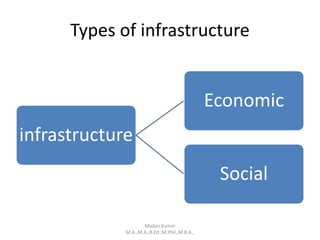
Types of infrastructure
infrastructure
Economic
Social
Madan Kumar
M.A.,M.A.,B.Ed.,M.Phil.,M.B.A.,
Economic infrastructure
• It includes those basic aspects of economic
system which provide support to the process
of economic development
• Supports the economic system directly.
• Efficiency of physical capital
• Improves the physical capital stock
• Promotes economic development
Madan Kumar
M.A.,M.A.,B.Ed.,M.Phil.,M.B.A.,
Social infrastructure
• Support to the process of social development
• Economic system directly.
• Increases efficiency of human capital stock
• Promotes social development
Madan Kumar
M.A.,M.A.,B.Ed.,M.Phil.,M.B.A.,
Importance/ Relevance of
infrastructure
• Infrastructure promotes development
• Infrastructure develops agriculture
• Infrastructure facilities smooth functioning of the
economy.
• Infrastructure enhances quality of life
• Infrastructure expands market size
• Infrastructure promotes capital formation and
investment.
• Infrastructure facilitates outsourcing
• Infrastructure promotes interdependence and linkages
in production.
Madan Kumar
M.A.,M.A.,B.Ed.,M.Phil.,M.B.A.,
State of infrastructure in India
• Traditionally, the government has been solely responsible
for developing the country’s infrastructure, but this was
inadequate to meet the growing demand of infrastructural
development.
• Now the private sector by itself and also in joint
partnership with the government sector, plays a very
important role in the development of the infrastructure
• Despite so much technical progress in the world, women in
the rural areas are still using bio-fuels such as crop
residues, dung and fuel wood to meet their energy
requirement about 90% of the rural households use bio-
fuels for cooking
Madan Kumar
M.A.,M.A.,B.Ed.,M.Phil.,M.B.A.,
• Rural households walk long-distances to fetch
fuel, water and other basic needs.
• They lack very basic facilities of life(43% of them
still use kerosene).
• Water supply is limited to very limited places
• Tap water availability is limited to only 24%
• About 76% of the rural households use open
sources of water.
• Access to improved sanitation in rural areas is
only 20%
Madan Kumar
M.A.,M.A.,B.Ed.,M.Phil.,M.B.A.,
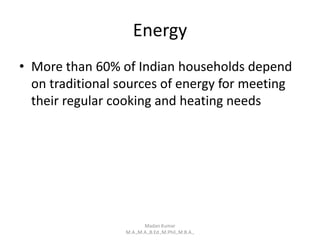
Energy
• More than 60% of Indian households depend
on traditional sources of energy for meeting
their regular cooking and heating needs
Madan Kumar
M.A.,M.A.,B.Ed.,M.Phil.,M.B.A.,
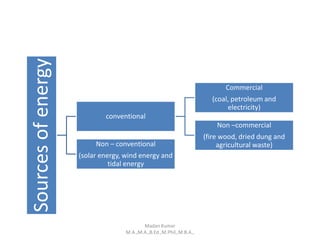
Sourcesofenergy
conventional
Commercial
(coal, petroleum and
electricity)
Non –commercial
(fire wood, dried dung and
agricultural waste)Non – conventional
(solar energy, wind energy and
tidal energy
Madan Kumar
M.A.,M.A.,B.Ed.,M.Phil.,M.B.A.,
Consumption pattern of energy in
India
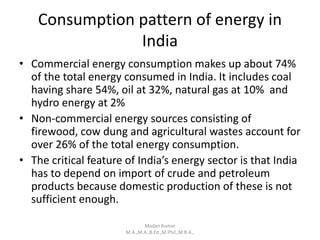
• Commercial energy consumption makes up about 74%
of the total energy consumed in India. It includes coal
having share 54%, oil at 32%, natural gas at 10% and
hydro energy at 2%
• Non-commercial energy sources consisting of
firewood, cow dung and agricultural wastes account for
over 26% of the total energy consumption.
• The critical feature of India’s energy sector is that India
has to depend on import of crude and petroleum
products because domestic production of these is not
sufficient enough.
Madan Kumar
M.A.,M.A.,B.Ed.,M.Phil.,M.B.A.,
Sources of power
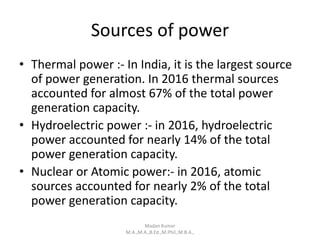
• Thermal power :- In India, it is the largest source
of power generation. In 2016 thermal sources
accounted for almost 67% of the total power
generation capacity.
• Hydroelectric power :- in 2016, hydroelectric
power accounted for nearly 14% of the total
power generation capacity.
• Nuclear or Atomic power:- in 2016, atomic
sources accounted for nearly 2% of the total
power generation capacity.
Madan Kumar
M.A.,M.A.,B.Ed.,M.Phil.,M.B.A.,
Challenges in the power sector
• Insufficiency of electricity generation
• Poor performance of state electricity boards
• Lack of investment
• Public unrest
• Shortage of raw materials
Madan Kumar
M.A.,M.A.,B.Ed.,M.Phil.,M.B.A.,
Measures to solve the energy crisis
• Increase in plant load factor
• Increase in supply of electricity
• Check on transmission and distribution losses
• Increase in investment
• Exploration of renewable sources
• Improve the performance of State Electricity
Boards
Madan Kumar
M.A.,M.A.,B.Ed.,M.Phil.,M.B.A.,
Green bonds
• A green bond is very similar, the only
difference is that the issuer of a green bond
publicly states that capital is being raised to
fund green project, which typically include
those relating to renewable energy, emission
reductions and so on.
Madan Kumar
M.A.,M.A.,B.Ed.,M.Phil.,M.B.A.,
Health
• Health is the holistic process related to the
overall growth and development of the nation.
• Health of people is assessed by taking into
account indicators like infant mortality rate, life
expectancy and nutritional levels along with
incidence of communicable and non-
communicable diseases.
• The government of India has evolved a national
health policy which takes into account the
preventive, promotive and rehabilitative aspects
of health.
Madan Kumar
M.A.,M.A.,B.Ed.,M.Phil.,M.B.A.,
• Primary health care:- it includes identification,
prevention and control of prevailing health
problems. It also includes promotion of adequate
supply water, food supply and proper nutrition,
material and child health care, mental health,
promotion of immunization against infectious
diseases.
• ANM Auxiliary Nursing Midwife
• PHC Primary health Care
• CHC Community Health Centers.
Madan Kumar
M.A.,M.A.,B.Ed.,M.Phil.,M.B.A.,
• Secondary health care.:-they function as both
as PHC provider and also provider better
health care facilities. When health conditions
of patients’ is not managed by PHCs they are
referred to secondary or tertiary sector.
• Tertiary health care:- these include hospitals
which are equipped with advanced machines
and techniques to handle emergency and
complicated diseases. AIIMS
Madan Kumar
M.A.,M.A.,B.Ed.,M.Phil.,M.B.A.,
Public sector health infrastructure
• The Union Government evolves broad policies
and plans through the Central Council of
Health and Family Welfare.
• It collects information and renders financial
and technical assistance to all the bodies of
government .
Madan Kumar
M.A.,M.A.,B.Ed.,M.Phil.,M.B.A.,
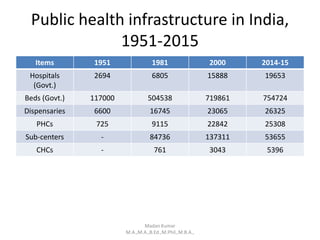
Public health infrastructure in India,
1951-2015
Items 1951 1981 2000 2014-15
Hospitals
(Govt.)
2694 6805 15888 19653
Beds (Govt.) 117000 504538 719861 754724
Dispensaries 6600 16745 23065 26325
PHCs 725 9115 22842 25308
Sub-centers - 84736 137311 53655
CHCs - 761 3043 5396
Madan Kumar
M.A.,M.A.,B.Ed.,M.Phil.,M.B.A.,
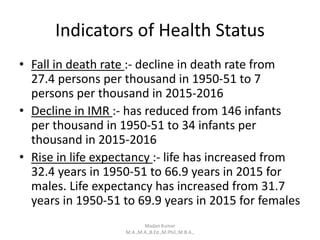
Indicators of Health Status
• Fall in death rate :- decline in death rate from
27.4 persons per thousand in 1950-51 to 7
persons per thousand in 2015-2016
• Decline in IMR :- has reduced from 146 infants
per thousand in 1950-51 to 34 infants per
thousand in 2015-2016
• Rise in life expectancy :- life has increased from
32.4 years in 1950-51 to 66.9 years in 2015 for
males. Life expectancy has increased from 31.7
years in 1950-51 to 69.9 years in 2015 for females
Madan Kumar
M.A.,M.A.,B.Ed.,M.Phil.,M.B.A.,
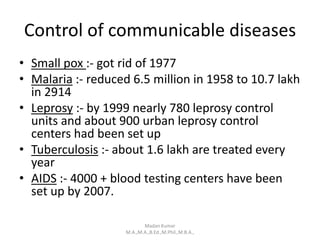
Control of communicable diseases
• Small pox :- got rid of 1977
• Malaria :- reduced 6.5 million in 1958 to 10.7 lakh
in 2914
• Leprosy :- by 1999 nearly 780 leprosy control
units and about 900 urban leprosy control
centers had been set up
• Tuberculosis :- about 1.6 lakh are treated every
year
• AIDS :- 4000 + blood testing centers have been
set up by 2007.
Madan Kumar
M.A.,M.A.,B.Ed.,M.Phil.,M.B.A.,
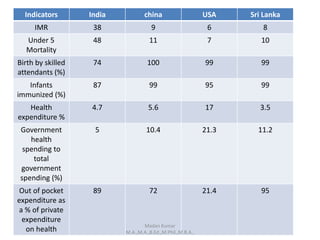
Indicators India china USA Sri Lanka
IMR 38 9 6 8
Under 5
Mortality
48 11 7 10
Birth by skilled
attendants (%)
74 100 99 99
Infants
immunized (%)
87 99 95 99
Health
expenditure %
4.7 5.6 17 3.5
Government
health
spending to
total
government
spending (%)
5 10.4 21.3 11.2
Out of pocket
expenditure as
a % of private
expenditure
on health
89 72 21.4 95
Madan Kumar
M.A.,M.A.,B.Ed.,M.Phil.,M.B.A.,
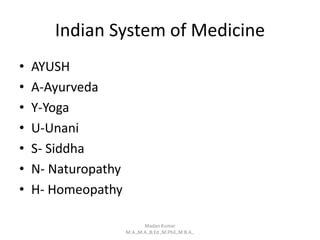
Indian System of Medicine
• AYUSH
• A-Ayurveda
• Y-Yoga
• U-Unani
• S- Siddha
• N- Naturopathy
• H- Homeopathy
Madan Kumar
M.A.,M.A.,B.Ed.,M.Phil.,M.B.A.,
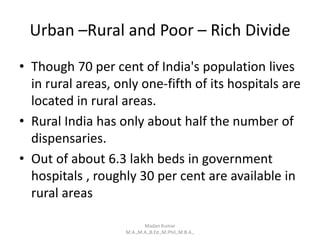
Urban –Rural and Poor – Rich Divide
• Though 70 per cent of India's population lives
in rural areas, only one-fifth of its hospitals are
located in rural areas.
• Rural India has only about half the number of
dispensaries.
• Out of about 6.3 lakh beds in government
hospitals , roughly 30 per cent are available in
rural areas
Madan Kumar
M.A.,M.A.,B.Ed.,M.Phil.,M.B.A.,
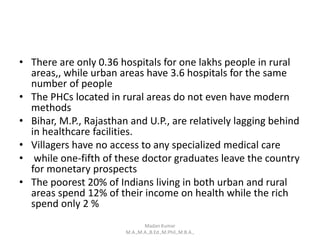
• There are only 0.36 hospitals for one lakhs people in rural
areas,, while urban areas have 3.6 hospitals for the same
number of people
• The PHCs located in rural areas do not even have modern
methods
• Bihar, M.P., Rajasthan and U.P., are relatively lagging behind
in healthcare facilities.
• Villagers have no access to any specialized medical care
• while one-fifth of these doctor graduates leave the country
for monetary prospects
• The poorest 20% of Indians living in both urban and rural
areas spend 12% of their income on health while the rich
spend only 2 %
Madan Kumar
M.A.,M.A.,B.Ed.,M.Phil.,M.B.A.,
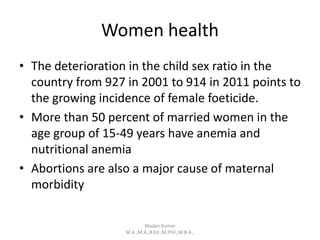
Women health
• The deterioration in the child sex ratio in the
country from 927 in 2001 to 914 in 2011 points to
the growing incidence of female foeticide.
• More than 50 percent of married women in the
age group of 15-49 years have anemia and
nutritional anemia
• Abortions are also a major cause of maternal
morbidity
Madan Kumar
M.A.,M.A.,B.Ed.,M.Phil.,M.B.A.,
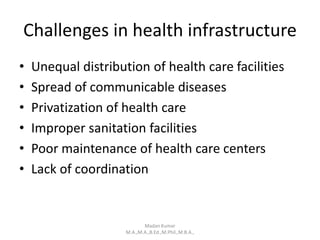
Challenges in health infrastructure
• Unequal distribution of health care facilities
• Spread of communicable diseases
• Privatization of health care
• Improper sanitation facilities
• Poor maintenance of health care centers
• Lack of coordination
Madan Kumar
M.A.,M.A.,B.Ed.,M.Phil.,M.B.A.,
Measures
• Decentralization of public health services
• Creating awareness
• Effectiveness of primary health care
• Reduction in urban-rural divide
• Easy access to health care facilities
• Increase in investment.
Madan Kumar
M.A.,M.A.,B.Ed.,M.Phil.,M.B.A.,
Madan Kumar
M.A.,M.A.,B.Ed.,M.Phil.,M.B.A.,

Infrastructure

  • 1.
  • 2.
    introduction • Punjab, Haryanaand Himachal Pradesh prosper in agriculture and horticulture. • Maharashtra and Gujarat are industrially more advanced than other • Kerala has excellent in Literacy, health, sanitation and tourism • Karnataka attract many multinational companies Madan Kumar M.A.,M.A.,B.Ed.,M.Phil.,M.B.A.,
  • 3.
    Meaning • Infrastructure refersto those basic elements of economic and social aspects which provide support to the production activity in the economy. • These services are very important for economic and social growth of the nation • Infrastructure is defined as the physical framework of those facilities and services through which goods and services are produced for the consumers. • These service help in promoting production directly (economic infrastructure like power, transport etc.,) and indirectly (social infrastructure like schools, hospitals etc.,) Madan Kumar M.A.,M.A.,B.Ed.,M.Phil.,M.B.A.,
  • 4.
  • 5.
    Economic infrastructure • Itincludes those basic aspects of economic system which provide support to the process of economic development • Supports the economic system directly. • Efficiency of physical capital • Improves the physical capital stock • Promotes economic development Madan Kumar M.A.,M.A.,B.Ed.,M.Phil.,M.B.A.,
  • 6.
    Social infrastructure • Supportto the process of social development • Economic system directly. • Increases efficiency of human capital stock • Promotes social development Madan Kumar M.A.,M.A.,B.Ed.,M.Phil.,M.B.A.,
  • 7.
    Importance/ Relevance of infrastructure •Infrastructure promotes development • Infrastructure develops agriculture • Infrastructure facilities smooth functioning of the economy. • Infrastructure enhances quality of life • Infrastructure expands market size • Infrastructure promotes capital formation and investment. • Infrastructure facilitates outsourcing • Infrastructure promotes interdependence and linkages in production. Madan Kumar M.A.,M.A.,B.Ed.,M.Phil.,M.B.A.,
  • 8.
    State of infrastructurein India • Traditionally, the government has been solely responsible for developing the country’s infrastructure, but this was inadequate to meet the growing demand of infrastructural development. • Now the private sector by itself and also in joint partnership with the government sector, plays a very important role in the development of the infrastructure • Despite so much technical progress in the world, women in the rural areas are still using bio-fuels such as crop residues, dung and fuel wood to meet their energy requirement about 90% of the rural households use bio- fuels for cooking Madan Kumar M.A.,M.A.,B.Ed.,M.Phil.,M.B.A.,
  • 9.
    • Rural householdswalk long-distances to fetch fuel, water and other basic needs. • They lack very basic facilities of life(43% of them still use kerosene). • Water supply is limited to very limited places • Tap water availability is limited to only 24% • About 76% of the rural households use open sources of water. • Access to improved sanitation in rural areas is only 20% Madan Kumar M.A.,M.A.,B.Ed.,M.Phil.,M.B.A.,
  • 10.
    Energy • More than60% of Indian households depend on traditional sources of energy for meeting their regular cooking and heating needs Madan Kumar M.A.,M.A.,B.Ed.,M.Phil.,M.B.A.,
  • 11.
    Sourcesofenergy conventional Commercial (coal, petroleum and electricity) Non–commercial (fire wood, dried dung and agricultural waste)Non – conventional (solar energy, wind energy and tidal energy Madan Kumar M.A.,M.A.,B.Ed.,M.Phil.,M.B.A.,
  • 12.
    Consumption pattern ofenergy in India • Commercial energy consumption makes up about 74% of the total energy consumed in India. It includes coal having share 54%, oil at 32%, natural gas at 10% and hydro energy at 2% • Non-commercial energy sources consisting of firewood, cow dung and agricultural wastes account for over 26% of the total energy consumption. • The critical feature of India’s energy sector is that India has to depend on import of crude and petroleum products because domestic production of these is not sufficient enough. Madan Kumar M.A.,M.A.,B.Ed.,M.Phil.,M.B.A.,
  • 13.
    Sources of power •Thermal power :- In India, it is the largest source of power generation. In 2016 thermal sources accounted for almost 67% of the total power generation capacity. • Hydroelectric power :- in 2016, hydroelectric power accounted for nearly 14% of the total power generation capacity. • Nuclear or Atomic power:- in 2016, atomic sources accounted for nearly 2% of the total power generation capacity. Madan Kumar M.A.,M.A.,B.Ed.,M.Phil.,M.B.A.,
  • 14.
    Challenges in thepower sector • Insufficiency of electricity generation • Poor performance of state electricity boards • Lack of investment • Public unrest • Shortage of raw materials Madan Kumar M.A.,M.A.,B.Ed.,M.Phil.,M.B.A.,
  • 15.
    Measures to solvethe energy crisis • Increase in plant load factor • Increase in supply of electricity • Check on transmission and distribution losses • Increase in investment • Exploration of renewable sources • Improve the performance of State Electricity Boards Madan Kumar M.A.,M.A.,B.Ed.,M.Phil.,M.B.A.,
  • 16.
    Green bonds • Agreen bond is very similar, the only difference is that the issuer of a green bond publicly states that capital is being raised to fund green project, which typically include those relating to renewable energy, emission reductions and so on. Madan Kumar M.A.,M.A.,B.Ed.,M.Phil.,M.B.A.,
  • 17.
    Health • Health isthe holistic process related to the overall growth and development of the nation. • Health of people is assessed by taking into account indicators like infant mortality rate, life expectancy and nutritional levels along with incidence of communicable and non- communicable diseases. • The government of India has evolved a national health policy which takes into account the preventive, promotive and rehabilitative aspects of health. Madan Kumar M.A.,M.A.,B.Ed.,M.Phil.,M.B.A.,
  • 18.
    • Primary healthcare:- it includes identification, prevention and control of prevailing health problems. It also includes promotion of adequate supply water, food supply and proper nutrition, material and child health care, mental health, promotion of immunization against infectious diseases. • ANM Auxiliary Nursing Midwife • PHC Primary health Care • CHC Community Health Centers. Madan Kumar M.A.,M.A.,B.Ed.,M.Phil.,M.B.A.,
  • 19.
    • Secondary healthcare.:-they function as both as PHC provider and also provider better health care facilities. When health conditions of patients’ is not managed by PHCs they are referred to secondary or tertiary sector. • Tertiary health care:- these include hospitals which are equipped with advanced machines and techniques to handle emergency and complicated diseases. AIIMS Madan Kumar M.A.,M.A.,B.Ed.,M.Phil.,M.B.A.,
  • 20.
    Public sector healthinfrastructure • The Union Government evolves broad policies and plans through the Central Council of Health and Family Welfare. • It collects information and renders financial and technical assistance to all the bodies of government . Madan Kumar M.A.,M.A.,B.Ed.,M.Phil.,M.B.A.,
  • 21.
    Public health infrastructurein India, 1951-2015 Items 1951 1981 2000 2014-15 Hospitals (Govt.) 2694 6805 15888 19653 Beds (Govt.) 117000 504538 719861 754724 Dispensaries 6600 16745 23065 26325 PHCs 725 9115 22842 25308 Sub-centers - 84736 137311 53655 CHCs - 761 3043 5396 Madan Kumar M.A.,M.A.,B.Ed.,M.Phil.,M.B.A.,
  • 22.
    Indicators of HealthStatus • Fall in death rate :- decline in death rate from 27.4 persons per thousand in 1950-51 to 7 persons per thousand in 2015-2016 • Decline in IMR :- has reduced from 146 infants per thousand in 1950-51 to 34 infants per thousand in 2015-2016 • Rise in life expectancy :- life has increased from 32.4 years in 1950-51 to 66.9 years in 2015 for males. Life expectancy has increased from 31.7 years in 1950-51 to 69.9 years in 2015 for females Madan Kumar M.A.,M.A.,B.Ed.,M.Phil.,M.B.A.,
  • 23.
    Control of communicablediseases • Small pox :- got rid of 1977 • Malaria :- reduced 6.5 million in 1958 to 10.7 lakh in 2914 • Leprosy :- by 1999 nearly 780 leprosy control units and about 900 urban leprosy control centers had been set up • Tuberculosis :- about 1.6 lakh are treated every year • AIDS :- 4000 + blood testing centers have been set up by 2007. Madan Kumar M.A.,M.A.,B.Ed.,M.Phil.,M.B.A.,
  • 24.
    Indicators India chinaUSA Sri Lanka IMR 38 9 6 8 Under 5 Mortality 48 11 7 10 Birth by skilled attendants (%) 74 100 99 99 Infants immunized (%) 87 99 95 99 Health expenditure % 4.7 5.6 17 3.5 Government health spending to total government spending (%) 5 10.4 21.3 11.2 Out of pocket expenditure as a % of private expenditure on health 89 72 21.4 95 Madan Kumar M.A.,M.A.,B.Ed.,M.Phil.,M.B.A.,
  • 25.
    Indian System ofMedicine • AYUSH • A-Ayurveda • Y-Yoga • U-Unani • S- Siddha • N- Naturopathy • H- Homeopathy Madan Kumar M.A.,M.A.,B.Ed.,M.Phil.,M.B.A.,
  • 26.
    Urban –Rural andPoor – Rich Divide • Though 70 per cent of India's population lives in rural areas, only one-fifth of its hospitals are located in rural areas. • Rural India has only about half the number of dispensaries. • Out of about 6.3 lakh beds in government hospitals , roughly 30 per cent are available in rural areas Madan Kumar M.A.,M.A.,B.Ed.,M.Phil.,M.B.A.,
  • 27.
    • There areonly 0.36 hospitals for one lakhs people in rural areas,, while urban areas have 3.6 hospitals for the same number of people • The PHCs located in rural areas do not even have modern methods • Bihar, M.P., Rajasthan and U.P., are relatively lagging behind in healthcare facilities. • Villagers have no access to any specialized medical care • while one-fifth of these doctor graduates leave the country for monetary prospects • The poorest 20% of Indians living in both urban and rural areas spend 12% of their income on health while the rich spend only 2 % Madan Kumar M.A.,M.A.,B.Ed.,M.Phil.,M.B.A.,
  • 28.
    Women health • Thedeterioration in the child sex ratio in the country from 927 in 2001 to 914 in 2011 points to the growing incidence of female foeticide. • More than 50 percent of married women in the age group of 15-49 years have anemia and nutritional anemia • Abortions are also a major cause of maternal morbidity Madan Kumar M.A.,M.A.,B.Ed.,M.Phil.,M.B.A.,
  • 29.
    Challenges in healthinfrastructure • Unequal distribution of health care facilities • Spread of communicable diseases • Privatization of health care • Improper sanitation facilities • Poor maintenance of health care centers • Lack of coordination Madan Kumar M.A.,M.A.,B.Ed.,M.Phil.,M.B.A.,
  • 30.
    Measures • Decentralization ofpublic health services • Creating awareness • Effectiveness of primary health care • Reduction in urban-rural divide • Easy access to health care facilities • Increase in investment. Madan Kumar M.A.,M.A.,B.Ed.,M.Phil.,M.B.A.,
  • 31.