History of trade and
commerce in India
•
Madan Kumar M.A.,M.A.,B.Ed.,M.Phil.,M.B.A.,
• During ancient times, Indiana's were the masters of the
seaborne trade of Europe, Asia and Africa.
• Large extent its supplies of fine cotton and silk fabric,
spices, indigo, sugar, drugs, precious stones and many
curious works of art from India in exchange of gold and
silver.
Madan Kumar M.A.,M.A.,B.Ed.,M.Phil.,M.B.A.,
Indigenous Banking
system
• An indigenous banker or bank is defined as an individual
or private firm which receive deposits, deals in hundies or
engages itself in lending money.
• Advent of British had an adverse impact in their business
• Nationalization of banks and emergence of modern
commercial banks are the important reasons of decline in
indigenous banking in India.
Madan Kumar M.A.,M.A.,B.Ed.,M.Phil.,M.B.A.,
Types of indigenous
banks
1. Gujarat shroffs
2. Shikarpuri or Multani shroffs
3. Chettiars of south
4. Marwari kayas of Assam.
Madan Kumar M.A.,M.A.,B.Ed.,M.Phil.,M.B.A.,
Functions of indigenous
banks
1. Accepting deposits
2. Advancing loans
3. Discounting Hundis
4. Speculation
5. Financing inland trade .
Madan Kumar M.A.,M.A.,B.Ed.,M.Phil.,M.B.A.,
Rise of intermediaries
• A financial intermediary is an institution or an individual
that acts as a middleman to facilitate the channel of funds
between lenders and borrowers.
Madan Kumar M.A.,M.A.,B.Ed.,M.Phil.,M.B.A.,
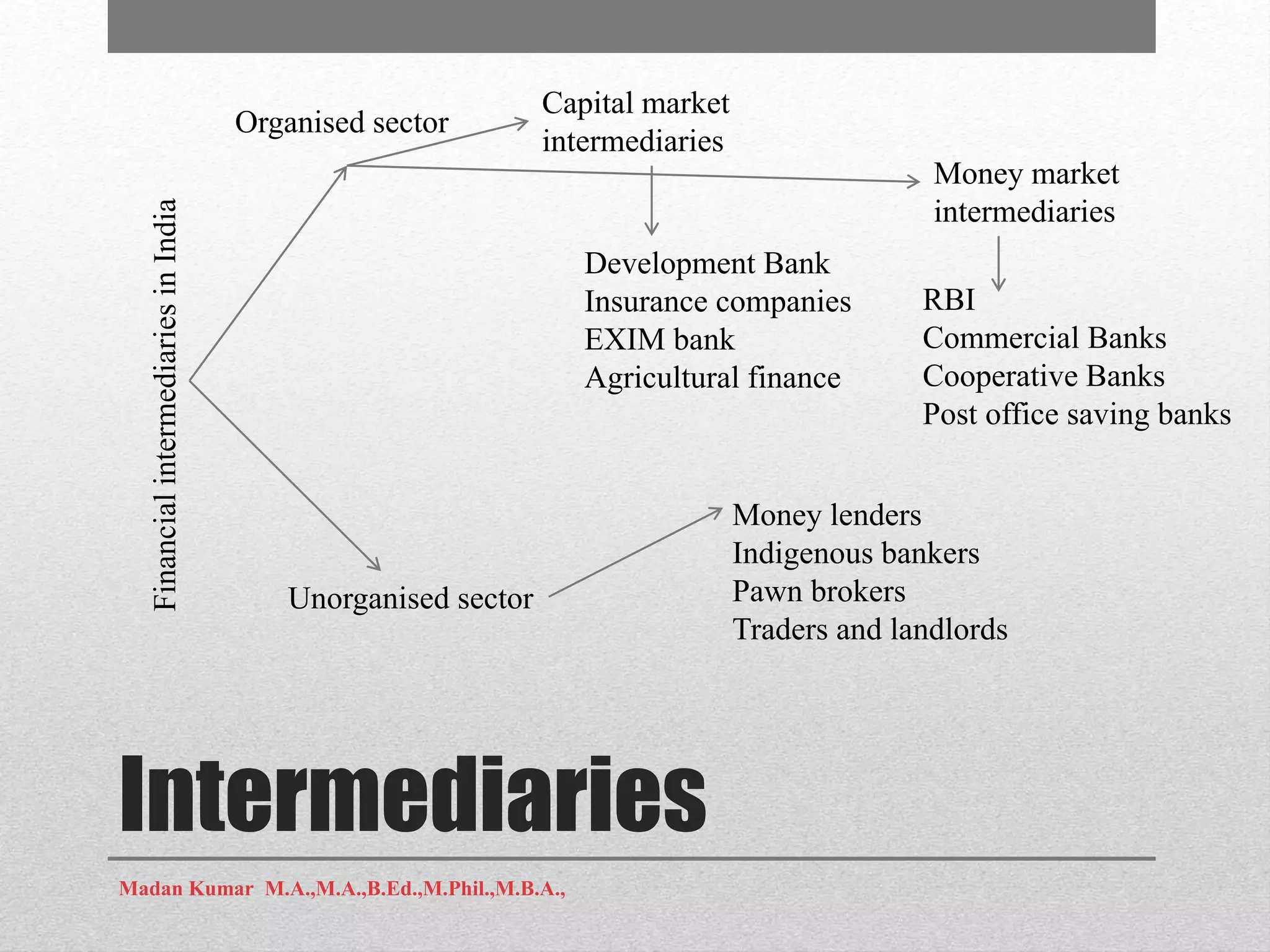
Intermediaries
Madan Kumar M.A.,M.A.,B.Ed.,M.Phil.,M.B.A.,
FinancialintermediariesinIndia
Organised sector
Unorganised sector
Capital market
intermediaries
Money market
intermediaries
Development Bank
Insurance companies
EXIM bank
Agricultural finance
RBI
Commercial Banks
Cooperative Banks
Post office saving banks
Money lenders
Indigenous bankers
Pawn brokers
Traders and landlords
Organised sector
• It is registered sector of financial intermediaries
• The intermediaries have to follow certain norms and
policy
Madan Kumar M.A.,M.A.,B.Ed.,M.Phil.,M.B.A.,
Capital market
intermediaries
• Capital market is a market for medium and long term
• Example – the Bombay Stock Exchange (1875) , and
some developmental banks …..
Madan Kumar M.A.,M.A.,B.Ed.,M.Phil.,M.B.A.,
Money market
• The money market is a market for short-term funds which
deals in monetary assets
• Example – commercial banks, P.O….
Madan Kumar M.A.,M.A.,B.Ed.,M.Phil.,M.B.A.,
Unorganised sector
• This sector is not directly controlled by the RBI
• There is a case of entry
• Smaller scale of operation
• Local ownership
• Flexible interest rate .
Madan Kumar M.A.,M.A.,B.Ed.,M.Phil.,M.B.A.,
Role of financial
intermediaries
• Liability Asset transformation
• Size transformation
• Maturity transformation
• Risk transformation
Madan Kumar M.A.,M.A.,B.Ed.,M.Phil.,M.B.A.,
Transport
• Since 1990s, India's growing economy has witnessed a
rise in demand for transport infrastructure and services.
Madan Kumar M.A.,M.A.,B.Ed.,M.Phil.,M.B.A.,
Mode of Transport
Road transport
1. India has one of largest road network in the world with total length of
about 42.3 lakh km.
2. About 85% passenger and 70% of freight traffic are carried by roads
3. Sher Shah Suri built GT road in 16th century
4. National Highways Authority of India (NHAI) has ben role in the
development and maintance of road transport
5. Golden Quadrilateral – 5846 km long, 4/6lanes , Delhi –Mumbai-
Chennai-Kolkata.
6. North South Corridor – 4,076 km long , Srinagar (J&K)-Kanyakumari
(TN)
7. East West Corridor – 3,640 km long, Silchar(Assam)-
Porbandar(Gujarat)
Madan Kumar M.A.,M.A.,B.Ed.,M.Phil.,M.B.A.,
Mode of Transport
Rail Transport
1. Railways was introduced to India in 1853(Bombay to
Thane) for 34 km
2. The total length of Indian railways network if 64460 km
(2011)
3. In September 2016, Indian government signed a
contract with japan to laid the foundation of Bullet train
project between Mumbai and Ahmedabad
4. Indian railways is one of the largest employment
provider in India with over 13.6 lakhs employees
Madan Kumar M.A.,M.A.,B.Ed.,M.Phil.,M.B.A.,
Mode of Transport
Water transport
1. It can be divided into two major categories – Inland
waterways and Oceanic waterways.
2. India has 14,500 km of navigable waterways.
3. Currently 5685 km of major rivers is navigable by
mechanized flat bottom vessels.
4. roughly 95% of Indian's foreign trade by volume and
75% by value moves through ocean routes.
5. Allahabad-Haldia is the major waterways covers 1,620
km.
Madan Kumar M.A.,M.A.,B.Ed.,M.Phil.,M.B.A.,
Mode of Transport
Air transport
1. Air transport was started in 1911, with the
commencement of airmail over a little distance of 10 km
between Allahabad and Naini.
2. The Airport Authority of India (1995) is accountable for
providing good Indian air space
3. Indigo, Jet Airways and Jetline, Spice jet and Air India
are the major airlines of India.
Madan Kumar M.A.,M.A.,B.Ed.,M.Phil.,M.B.A.,
Trading Communities
• Wholesale trader, known as ‘Seth’ or ‘Bohra’
• Retail traders, known as ‘Beoparies’ or Banik’
• ‘Chettis’ community in South India
• ‘Banjaras’
• The Sarrafs are specilaised in chaning money.
Madan Kumar M.A.,M.A.,B.Ed.,M.Phil.,M.B.A.,
Merchant corporations
• Merchant corporation is a frim involved in wholesale
trade, especially one dealing with foreign countries of
suppling goods to a particular trade
Madan Kumar M.A.,M.A.,B.Ed.,M.Phil.,M.B.A.,
Major trade centers
• A trade centre of a country, is a place which facilitates
exports, and imports of goods, services, finance and
technology
Madan Kumar M.A.,M.A.,B.Ed.,M.Phil.,M.B.A.,
Major imports and
exports
Madan Kumar M.A.,M.A.,B.Ed.,M.Phil.,M.B.A.,
Composition of Imports
• Indian government restricted imports immediately after
independent to attain self sufficiency
• But second five year plan, government allowed imports
of capital goods for industrial development
• In 1960s India's import comprised capital goods
Madan Kumar M.A.,M.A.,B.Ed.,M.Phil.,M.B.A.,
Direction of Imports
• India's major import partners were USA, China, UK,
Germany, Japan, Iran, France, Russia, Belgium and Saudi
Arabia…
Madan Kumar M.A.,M.A.,B.Ed.,M.Phil.,M.B.A.,
Composition of Exports
• India's export was largely agro-based
• In 1970s government finally gave a definite shape to
country's export policy
Madan Kumar M.A.,M.A.,B.Ed.,M.Phil.,M.B.A.,
Direction of Exports
• UK, US . Soviet, Japan, Russia, Germany,
Madan Kumar M.A.,M.A.,B.Ed.,M.Phil.,M.B.A.,
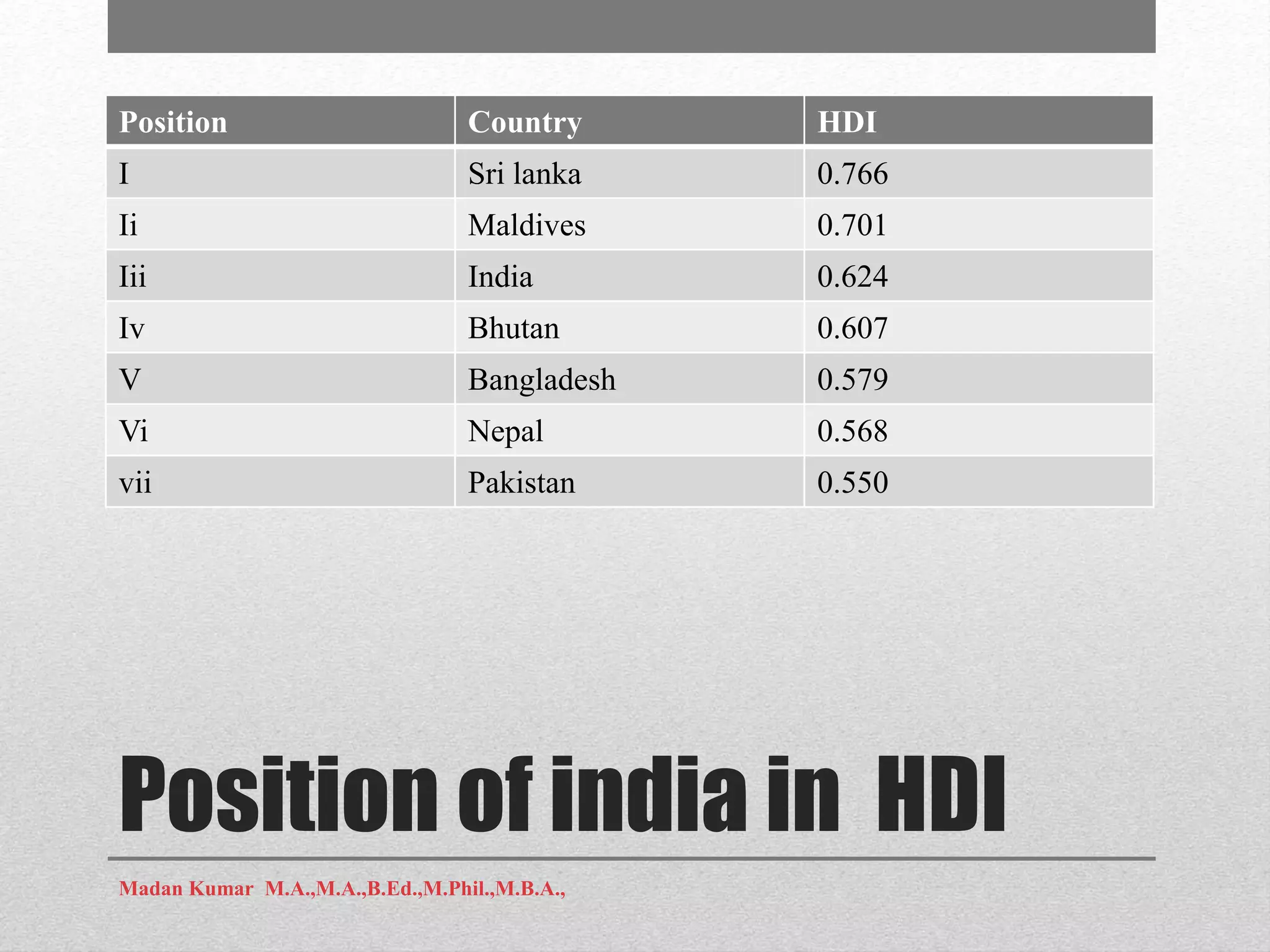
Position of india in HDI
Position Country HDI
I Sri lanka 0.766
Ii Maldives 0.701
Iii India 0.624
Iv Bhutan 0.607
V Bangladesh 0.579
Vi Nepal 0.568
vii Pakistan 0.550
Madan Kumar M.A.,M.A.,B.Ed.,M.Phil.,M.B.A.,

History of trade and commerce

  • 1.
    History of tradeand commerce in India • Madan Kumar M.A.,M.A.,B.Ed.,M.Phil.,M.B.A.,
  • 2.
    • During ancienttimes, Indiana's were the masters of the seaborne trade of Europe, Asia and Africa. • Large extent its supplies of fine cotton and silk fabric, spices, indigo, sugar, drugs, precious stones and many curious works of art from India in exchange of gold and silver. Madan Kumar M.A.,M.A.,B.Ed.,M.Phil.,M.B.A.,
  • 3.
    Indigenous Banking system • Anindigenous banker or bank is defined as an individual or private firm which receive deposits, deals in hundies or engages itself in lending money. • Advent of British had an adverse impact in their business • Nationalization of banks and emergence of modern commercial banks are the important reasons of decline in indigenous banking in India. Madan Kumar M.A.,M.A.,B.Ed.,M.Phil.,M.B.A.,
  • 4.
    Types of indigenous banks 1.Gujarat shroffs 2. Shikarpuri or Multani shroffs 3. Chettiars of south 4. Marwari kayas of Assam. Madan Kumar M.A.,M.A.,B.Ed.,M.Phil.,M.B.A.,
  • 5.
    Functions of indigenous banks 1.Accepting deposits 2. Advancing loans 3. Discounting Hundis 4. Speculation 5. Financing inland trade . Madan Kumar M.A.,M.A.,B.Ed.,M.Phil.,M.B.A.,
  • 6.
    Rise of intermediaries •A financial intermediary is an institution or an individual that acts as a middleman to facilitate the channel of funds between lenders and borrowers. Madan Kumar M.A.,M.A.,B.Ed.,M.Phil.,M.B.A.,
  • 7.
    Intermediaries Madan Kumar M.A.,M.A.,B.Ed.,M.Phil.,M.B.A., FinancialintermediariesinIndia Organisedsector Unorganised sector Capital market intermediaries Money market intermediaries Development Bank Insurance companies EXIM bank Agricultural finance RBI Commercial Banks Cooperative Banks Post office saving banks Money lenders Indigenous bankers Pawn brokers Traders and landlords
  • 8.
    Organised sector • Itis registered sector of financial intermediaries • The intermediaries have to follow certain norms and policy Madan Kumar M.A.,M.A.,B.Ed.,M.Phil.,M.B.A.,
  • 9.
    Capital market intermediaries • Capitalmarket is a market for medium and long term • Example – the Bombay Stock Exchange (1875) , and some developmental banks ….. Madan Kumar M.A.,M.A.,B.Ed.,M.Phil.,M.B.A.,
  • 10.
    Money market • Themoney market is a market for short-term funds which deals in monetary assets • Example – commercial banks, P.O…. Madan Kumar M.A.,M.A.,B.Ed.,M.Phil.,M.B.A.,
  • 11.
    Unorganised sector • Thissector is not directly controlled by the RBI • There is a case of entry • Smaller scale of operation • Local ownership • Flexible interest rate . Madan Kumar M.A.,M.A.,B.Ed.,M.Phil.,M.B.A.,
  • 12.
    Role of financial intermediaries •Liability Asset transformation • Size transformation • Maturity transformation • Risk transformation Madan Kumar M.A.,M.A.,B.Ed.,M.Phil.,M.B.A.,
  • 13.
    Transport • Since 1990s,India's growing economy has witnessed a rise in demand for transport infrastructure and services. Madan Kumar M.A.,M.A.,B.Ed.,M.Phil.,M.B.A.,
  • 14.
    Mode of Transport Roadtransport 1. India has one of largest road network in the world with total length of about 42.3 lakh km. 2. About 85% passenger and 70% of freight traffic are carried by roads 3. Sher Shah Suri built GT road in 16th century 4. National Highways Authority of India (NHAI) has ben role in the development and maintance of road transport 5. Golden Quadrilateral – 5846 km long, 4/6lanes , Delhi –Mumbai- Chennai-Kolkata. 6. North South Corridor – 4,076 km long , Srinagar (J&K)-Kanyakumari (TN) 7. East West Corridor – 3,640 km long, Silchar(Assam)- Porbandar(Gujarat) Madan Kumar M.A.,M.A.,B.Ed.,M.Phil.,M.B.A.,
  • 15.
    Mode of Transport RailTransport 1. Railways was introduced to India in 1853(Bombay to Thane) for 34 km 2. The total length of Indian railways network if 64460 km (2011) 3. In September 2016, Indian government signed a contract with japan to laid the foundation of Bullet train project between Mumbai and Ahmedabad 4. Indian railways is one of the largest employment provider in India with over 13.6 lakhs employees Madan Kumar M.A.,M.A.,B.Ed.,M.Phil.,M.B.A.,
  • 16.
    Mode of Transport Watertransport 1. It can be divided into two major categories – Inland waterways and Oceanic waterways. 2. India has 14,500 km of navigable waterways. 3. Currently 5685 km of major rivers is navigable by mechanized flat bottom vessels. 4. roughly 95% of Indian's foreign trade by volume and 75% by value moves through ocean routes. 5. Allahabad-Haldia is the major waterways covers 1,620 km. Madan Kumar M.A.,M.A.,B.Ed.,M.Phil.,M.B.A.,
  • 17.
    Mode of Transport Airtransport 1. Air transport was started in 1911, with the commencement of airmail over a little distance of 10 km between Allahabad and Naini. 2. The Airport Authority of India (1995) is accountable for providing good Indian air space 3. Indigo, Jet Airways and Jetline, Spice jet and Air India are the major airlines of India. Madan Kumar M.A.,M.A.,B.Ed.,M.Phil.,M.B.A.,
  • 18.
    Trading Communities • Wholesaletrader, known as ‘Seth’ or ‘Bohra’ • Retail traders, known as ‘Beoparies’ or Banik’ • ‘Chettis’ community in South India • ‘Banjaras’ • The Sarrafs are specilaised in chaning money. Madan Kumar M.A.,M.A.,B.Ed.,M.Phil.,M.B.A.,
  • 19.
    Merchant corporations • Merchantcorporation is a frim involved in wholesale trade, especially one dealing with foreign countries of suppling goods to a particular trade Madan Kumar M.A.,M.A.,B.Ed.,M.Phil.,M.B.A.,
  • 20.
    Major trade centers •A trade centre of a country, is a place which facilitates exports, and imports of goods, services, finance and technology Madan Kumar M.A.,M.A.,B.Ed.,M.Phil.,M.B.A.,
  • 21.
    Major imports and exports MadanKumar M.A.,M.A.,B.Ed.,M.Phil.,M.B.A.,
  • 22.
    Composition of Imports •Indian government restricted imports immediately after independent to attain self sufficiency • But second five year plan, government allowed imports of capital goods for industrial development • In 1960s India's import comprised capital goods Madan Kumar M.A.,M.A.,B.Ed.,M.Phil.,M.B.A.,
  • 23.
    Direction of Imports •India's major import partners were USA, China, UK, Germany, Japan, Iran, France, Russia, Belgium and Saudi Arabia… Madan Kumar M.A.,M.A.,B.Ed.,M.Phil.,M.B.A.,
  • 24.
    Composition of Exports •India's export was largely agro-based • In 1970s government finally gave a definite shape to country's export policy Madan Kumar M.A.,M.A.,B.Ed.,M.Phil.,M.B.A.,
  • 25.
    Direction of Exports •UK, US . Soviet, Japan, Russia, Germany, Madan Kumar M.A.,M.A.,B.Ed.,M.Phil.,M.B.A.,
  • 26.
    Position of indiain HDI Position Country HDI I Sri lanka 0.766 Ii Maldives 0.701 Iii India 0.624 Iv Bhutan 0.607 V Bangladesh 0.579 Vi Nepal 0.568 vii Pakistan 0.550 Madan Kumar M.A.,M.A.,B.Ed.,M.Phil.,M.B.A.,
  • 27.