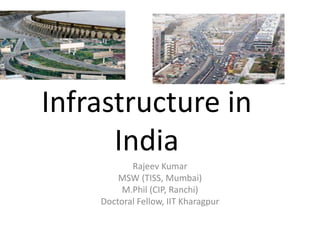

Infrastructure in
India
Rajeev Kumar
MSW (TISS, Mumbai)
M.Phil (CIP, Ranchi)
Doctoral Fellow, IIT Kharagpur
Infrastructure
• Infrastructure is basic physical and organizational structures
needed for the operation of a society or enterprise or reproductive
system , or the services and facilities necessary for an economy to
function. It can be generally defined as the set of interconnected
structural elements that provide framework supporting an entire
structure of development. It is an important term for judging a
country or region's development.
• Keynesian economics, the word infrastructure was exclusively
used to describe public assets that facilitate production, but not
private assets of the same purpose..
• Infrastructure plays an important role in the
economic development of an economy .
• It can quicken or impede the development of an
economy .
Infrastructure in India
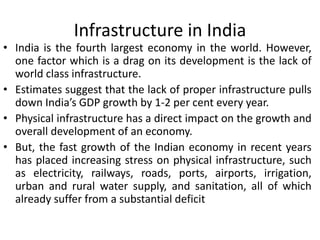
• India is the fourth largest economy in the world. However,
one factor which is a drag on its development is the lack of
world class infrastructure.
• Estimates suggest that the lack of proper infrastructure pulls
down India’s GDP growth by 1-2 per cent every year.
• Physical infrastructure has a direct impact on the growth and
overall development of an economy.
• But, the fast growth of the Indian economy in recent years
has placed increasing stress on physical infrastructure, such
as electricity, railways, roads, ports, airports, irrigation,
urban and rural water supply, and sanitation, all of which
already suffer from a substantial deficit
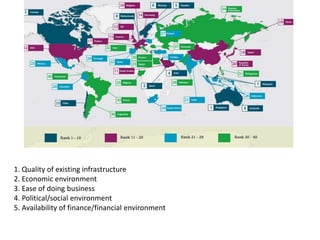
1. Quality of existing infrastructure
2. Economic environment
3. Ease of doing business
4. Political/social environment
5. Availability of finance/financial environment
Core Sector of Infrastructure
• Energy
• Transport
• Communication
• Education
• Health
Economic Benefit of Infrastructure
Role of Infrastructure in development
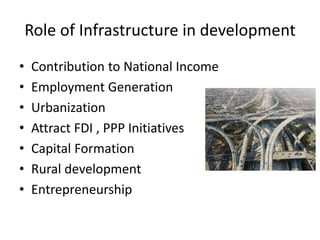
• Contribution to National Income
• Employment Generation
• Urbanization
• Attract FDI , PPP Initiatives
• Capital Formation
• Rural development
• Entrepreneurship
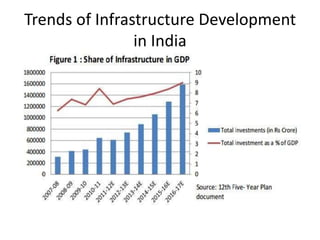
Trends of Infrastructure Development
in India
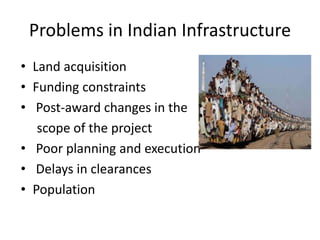
Problems in Indian Infrastructure
• Land acquisition
• Funding constraints
• Post-award changes in the
scope of the project
• Poor planning and execution
• Delays in clearances
• Population
India Vs China
• India expects to invest about $500 bn in infrastructure, mainly in power,
telecommunication, roads, railways and oil pipelines, in the five years ending March
2012.
• India will need to spend more than $1 trillion on infrastructure from 2010 to 2019, with
roads requiring $427 billion, power $288 billion and railways $281 billion, according to
Goldman Sachs.
• 7.5 percent of GDP is invested in infrastructure, with plans to increase that to about 10
percent at the end of the 2008-2012 five-year plan.
• Private investment is likely contribute 36 percent to total infrastructure investment by
2008-2012 five-year plan, up from 25 percent from the 2002-2007 period
India will issue tax-free infrastructure bonds with a minimum tenure of 10 years, which
will have the potential to raise about $6.5 billion in fiscal year 2010/11
•
• China's Infrastructure
• China spends 11% of its GDP on infrastructure.
• Spending on infrastructure has been increasing at rate of around 25 percent a year in
recent years.
• 38% of China's huge 2008-9 economic stimulus package will go towards public
infrastructure projects, including railway, road, irrigation, and airport construction.
• China budgeted 80 billion yuan (US$11.8 billion) on transportation infrastructure in 2010.
• 170 new mass-transit systems could be built in China by 2025.
Recent Infrastructure Development
• Government approved National Telecom Policy (NTP) 2012
• Increase rural tele-density from the current level of around
39 to 70 by the year 2017 and 100 by the year 2020
• Metro Rail Projects
• PPP initiatives
• Delhi-Mumbai and Delhi-Howrah Freight Corridors.
Task Force on Financing Plan for
• Airports.
Inter-Ministerial Groups on Custom
Procedures and Functioning of Container
FreightStation and Ports
Conclusion
• India needs to urgently bridge the infrastructure
gaps that industry and people face every day. The
slow pace of infrastructure development is quite
evident from the list of eleventh plan targets that
are unmet.
• MSMEs that provide employment to 60 million
people in the country are the worst-hit by the
delay.
• Lack of adequate power supply and transport
infrastructure proves to be a deterrent to the
growth of this sector.
Thank
You

3. infrastructure in india

  • 1.
    Infrastructure in India Rajeev Kumar MSW(TISS, Mumbai) M.Phil (CIP, Ranchi) Doctoral Fellow, IIT Kharagpur
  • 2.
    Infrastructure • Infrastructure isbasic physical and organizational structures needed for the operation of a society or enterprise or reproductive system , or the services and facilities necessary for an economy to function. It can be generally defined as the set of interconnected structural elements that provide framework supporting an entire structure of development. It is an important term for judging a country or region's development. • Keynesian economics, the word infrastructure was exclusively used to describe public assets that facilitate production, but not private assets of the same purpose.. • Infrastructure plays an important role in the economic development of an economy . • It can quicken or impede the development of an economy .
  • 3.
    Infrastructure in India •India is the fourth largest economy in the world. However, one factor which is a drag on its development is the lack of world class infrastructure. • Estimates suggest that the lack of proper infrastructure pulls down India’s GDP growth by 1-2 per cent every year. • Physical infrastructure has a direct impact on the growth and overall development of an economy. • But, the fast growth of the Indian economy in recent years has placed increasing stress on physical infrastructure, such as electricity, railways, roads, ports, airports, irrigation, urban and rural water supply, and sanitation, all of which already suffer from a substantial deficit
  • 4.
    1. Quality ofexisting infrastructure 2. Economic environment 3. Ease of doing business 4. Political/social environment 5. Availability of finance/financial environment
  • 5.
    Core Sector ofInfrastructure • Energy • Transport • Communication • Education • Health
  • 6.
    Economic Benefit ofInfrastructure
  • 7.
    Role of Infrastructurein development • Contribution to National Income • Employment Generation • Urbanization • Attract FDI , PPP Initiatives • Capital Formation • Rural development • Entrepreneurship
  • 8.
    Trends of InfrastructureDevelopment in India
  • 9.
    Problems in IndianInfrastructure • Land acquisition • Funding constraints • Post-award changes in the scope of the project • Poor planning and execution • Delays in clearances • Population
  • 10.
    India Vs China •India expects to invest about $500 bn in infrastructure, mainly in power, telecommunication, roads, railways and oil pipelines, in the five years ending March 2012. • India will need to spend more than $1 trillion on infrastructure from 2010 to 2019, with roads requiring $427 billion, power $288 billion and railways $281 billion, according to Goldman Sachs. • 7.5 percent of GDP is invested in infrastructure, with plans to increase that to about 10 percent at the end of the 2008-2012 five-year plan. • Private investment is likely contribute 36 percent to total infrastructure investment by 2008-2012 five-year plan, up from 25 percent from the 2002-2007 period India will issue tax-free infrastructure bonds with a minimum tenure of 10 years, which will have the potential to raise about $6.5 billion in fiscal year 2010/11 • • China's Infrastructure • China spends 11% of its GDP on infrastructure. • Spending on infrastructure has been increasing at rate of around 25 percent a year in recent years. • 38% of China's huge 2008-9 economic stimulus package will go towards public infrastructure projects, including railway, road, irrigation, and airport construction. • China budgeted 80 billion yuan (US$11.8 billion) on transportation infrastructure in 2010. • 170 new mass-transit systems could be built in China by 2025.
  • 11.
    Recent Infrastructure Development •Government approved National Telecom Policy (NTP) 2012 • Increase rural tele-density from the current level of around 39 to 70 by the year 2017 and 100 by the year 2020 • Metro Rail Projects • PPP initiatives • Delhi-Mumbai and Delhi-Howrah Freight Corridors. Task Force on Financing Plan for • Airports. Inter-Ministerial Groups on Custom Procedures and Functioning of Container FreightStation and Ports
  • 12.
    Conclusion • India needsto urgently bridge the infrastructure gaps that industry and people face every day. The slow pace of infrastructure development is quite evident from the list of eleventh plan targets that are unmet. • MSMEs that provide employment to 60 million people in the country are the worst-hit by the delay. • Lack of adequate power supply and transport infrastructure proves to be a deterrent to the growth of this sector.
  • 14.