Julie Humpton 
INFRASTRUCTURE
INTRODUCTION ????
Have you ever thought why some states in India are
performing much better than others in certain areas? Why
do Punjab , Haryana , and Himachal Pradesh prosper in
agriculture and horticulture? Why are Maharashtra and
Gujarat industrially more advanced than others? How
come Kerala , popularly known as ‘God’s own country’
has excelled in literacy , health care and sanitation and
also attracts tourists in such a large number? Why does
Karnataka's
information technology industry attracts world attention ?
 Infrastructure provides supporting services in the
main areas of industrial and agricultural
production, domestic and foreign trade and
commerce.
 These services include roads , railways, ports,
airports, dams, power stations, oil and gas pipelines,
telecommunication facilities, educational system,
health system and monetary system.
ECONOMIC AND
SOCIAL
INFRASTRUCTURE ASSOCIATED WITH
ENERGY,TRANSPORTATION AND
COMMUNICATION ARE INCLUDED IN THE
FORMER CATEGORYWHEREAS THOSE
RELATED TO EDUCATION HEALTH AND
HOUSING ARE UNCLUDED IN THE LATTER.
 Infrastructure contributes to economic development of a
country both by increasing the productivity of the factors of
production and improving the quality of life of its people.
Inadequate infrastructure can have multiple adverse effects
on health. Improvements in water supply and sanitation
have a large impact by reducing morbidity from major
water borne diseases and reducing the severity of disease
when it occurs. In addition to the obvious linkage between
water and sanitation and health, the quality of transport and
communication infrastructure can affect access to health
care.
 A majority of our people live in rural areas. Despite so
much technical progress in the world , rural women
are still using bio fuels such as crop residues, dung
and fuel wood to meet their energy requirement.
They walk long distances to fetch fuel, water and
other basic needs. The census 2001 shows that in
rural India only 56 per cent households have an
electricity connection and 43 per cent still use
kerosene. About 90 per cent of the rural households
use bio fuels for cooking. Tap water availability is
limited to only 24 per cent rural households. About
76 per cent of the population drinks water from open
sources such as wells, tanks, ponds, lakes, rivers ,
canals etc. Access to improved sanitation in rural
areas was only 20 per cent.
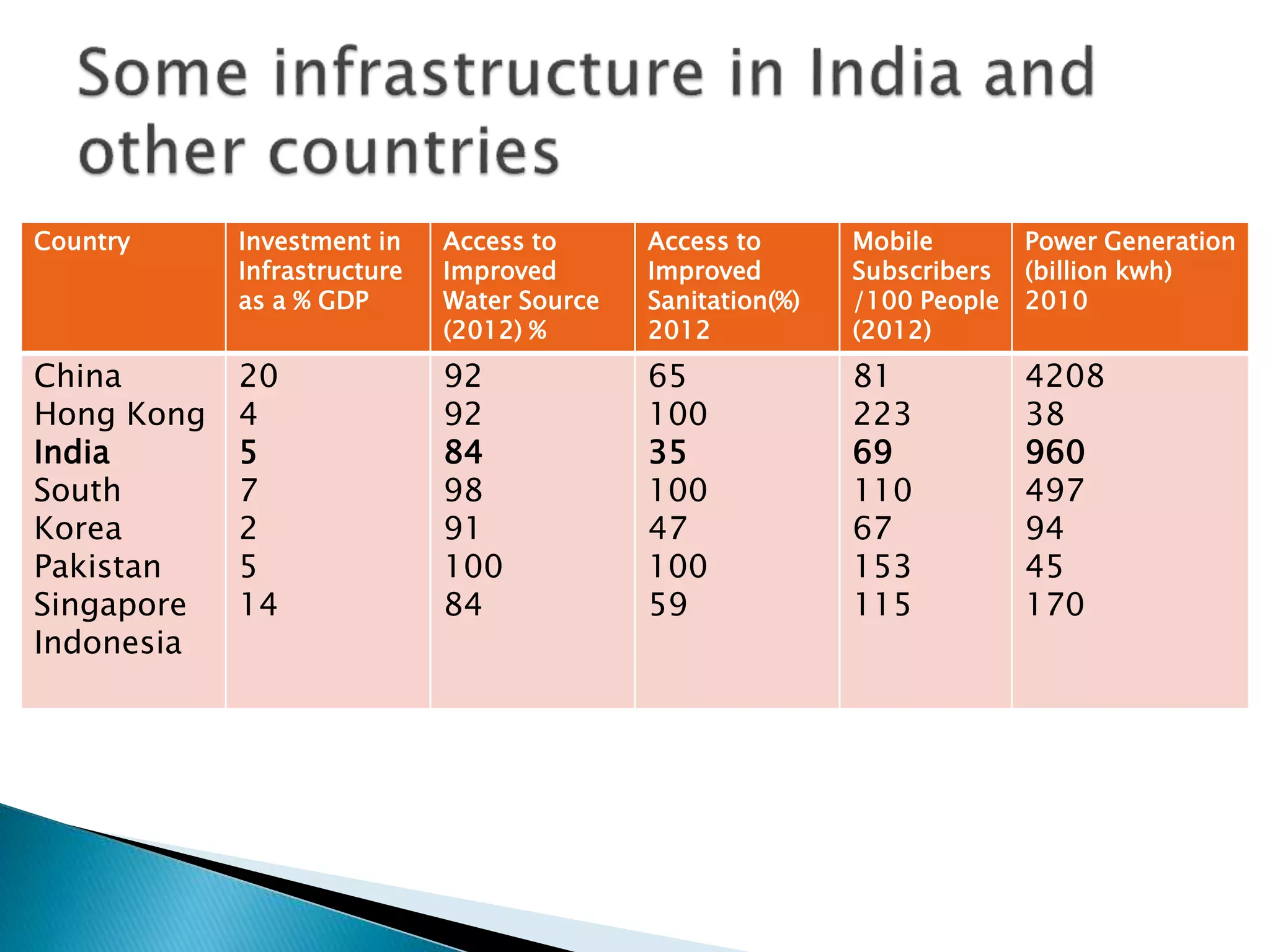
Some infrastructure in India and other countries.
Country Investment in
infrastructure
as GDP [2003]
Access to
water source
[2012] [%]
Access to
Improved
Sanitation
Mobile
subscribers
/100 people
Power
generation
billion kwh
China 20 92 65 81 4208
Hong
Kong
4 92 100 223 38
India 5 84 35 69 960
South
Korea
7 98 100 110 497
Pakistan 2 91 47 67 94
Singapore 5 100 100 153 45
Indonesia 14 84 59 115 170
Country Investment in
Infrastructure
as a % GDP
Access to
Improved
Water Source
(2012) %
Access to
Improved
Sanitation(%)
2012
Mobile
Subscribers
/100 People
(2012)
Power Generation
(billion kwh)
2010
China
Hong Kong
India
South
Korea
Pakistan
Singapore
Indonesia
20
4
5
7
2
5
14
92
92
84
98
91
100
84
65
100
35
100
47
100
59
81
223
69
110
67
153
115
4208
38
960
497
94
45
170
 Energy is a critical aspect of the
development process of a nation. It is, of
course, essential for industries.
 It is used on a large scale in agriculture and
related areas like production and
transportation of fertilisers , pesticides and
farm equipment. It is required in houses for
cooking, household lighting and heating.
 There are commercial and non-commercial sources of
energy.
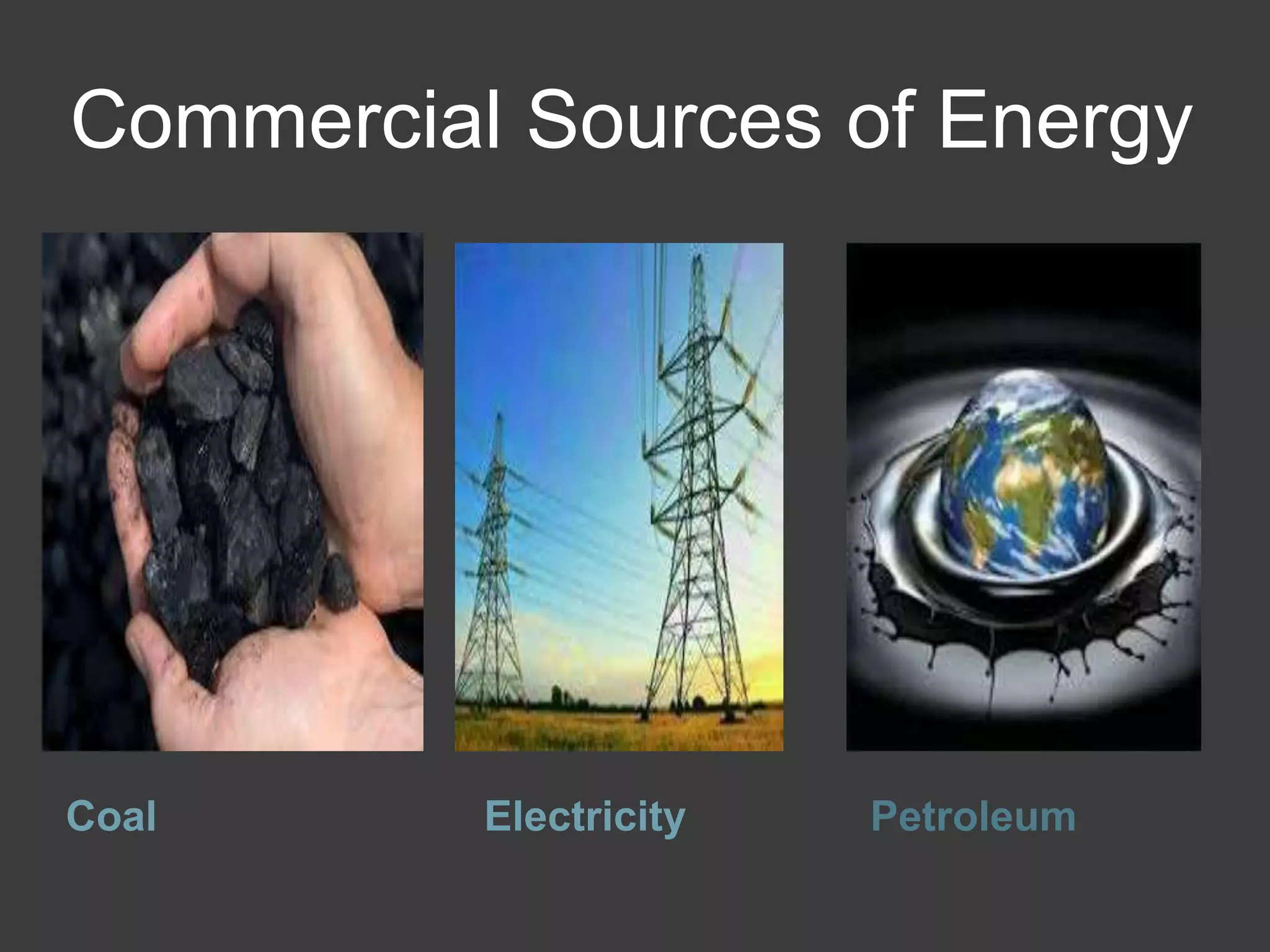
 Commercial sources are coal, petroleum and electricity
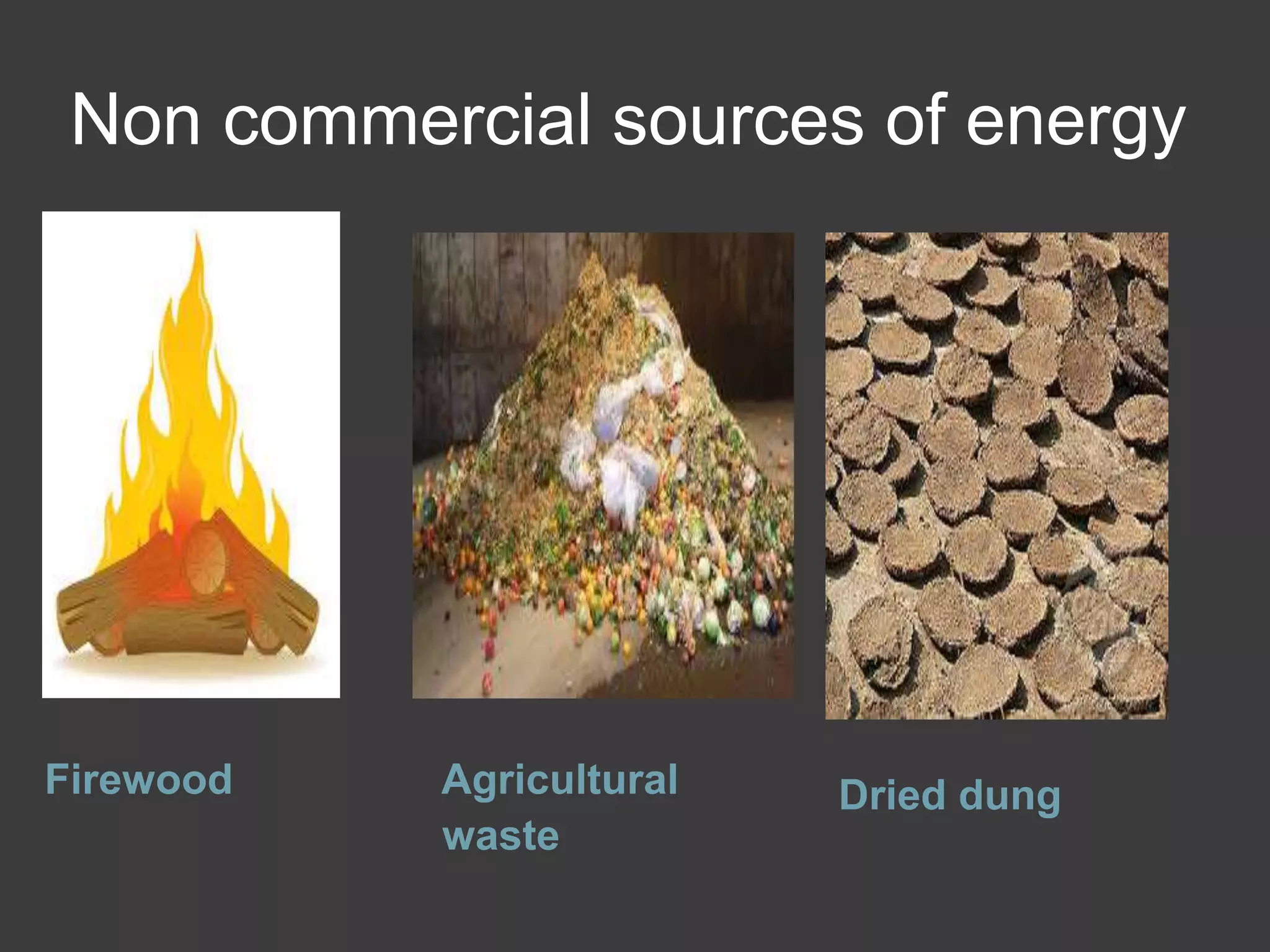
as they are bought and sold. Non-commercial sources
of energy are firewood, agricultural waste and dried
dung. These are non-commercial as they are found in
nature/forests.
 While commercial sources of energy are generally
exhaustible, non- commercial are generally renewable.
Commercial Sources of Energy
Coal Electricity Petroleum
Non commercial sources of energy
Firewood Agricultural
waste
Dried dung
 Both commercial and non commercial sources of
energy are known as conventional sources of
energy.
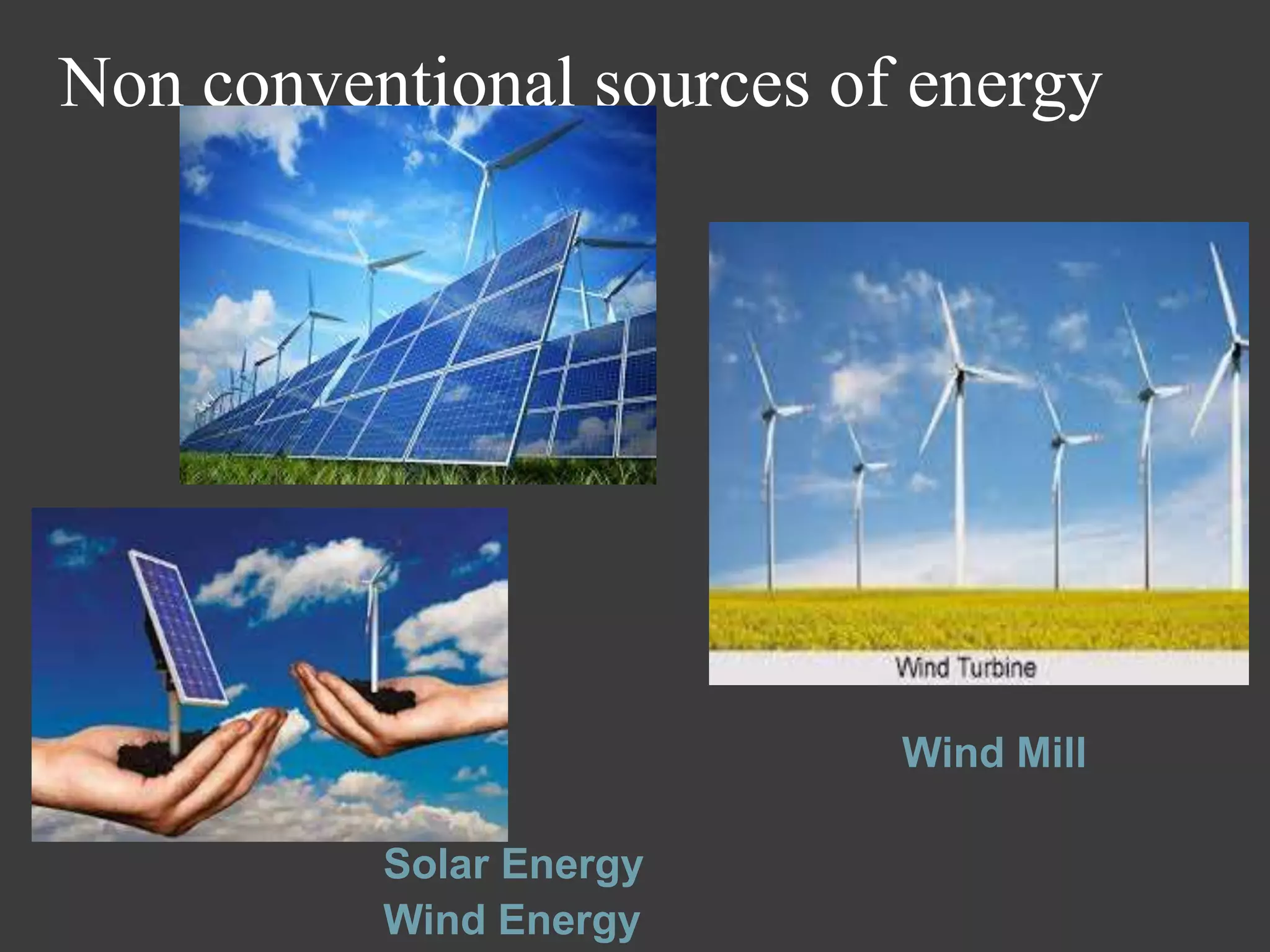
 There are three other sources of energy which
are commonly termed as non conventional
source – solar energy, wind energy and tidal
energy.
 Being a tropical country, India has almost
unlimited potential for producing all three types
of energy if some appropriate cost effect
technologies that are already available are used.
Even cheaper technologies can be developed.
Non conventional sources of energy
Solar Energy
Wind Energy
Wind Mill
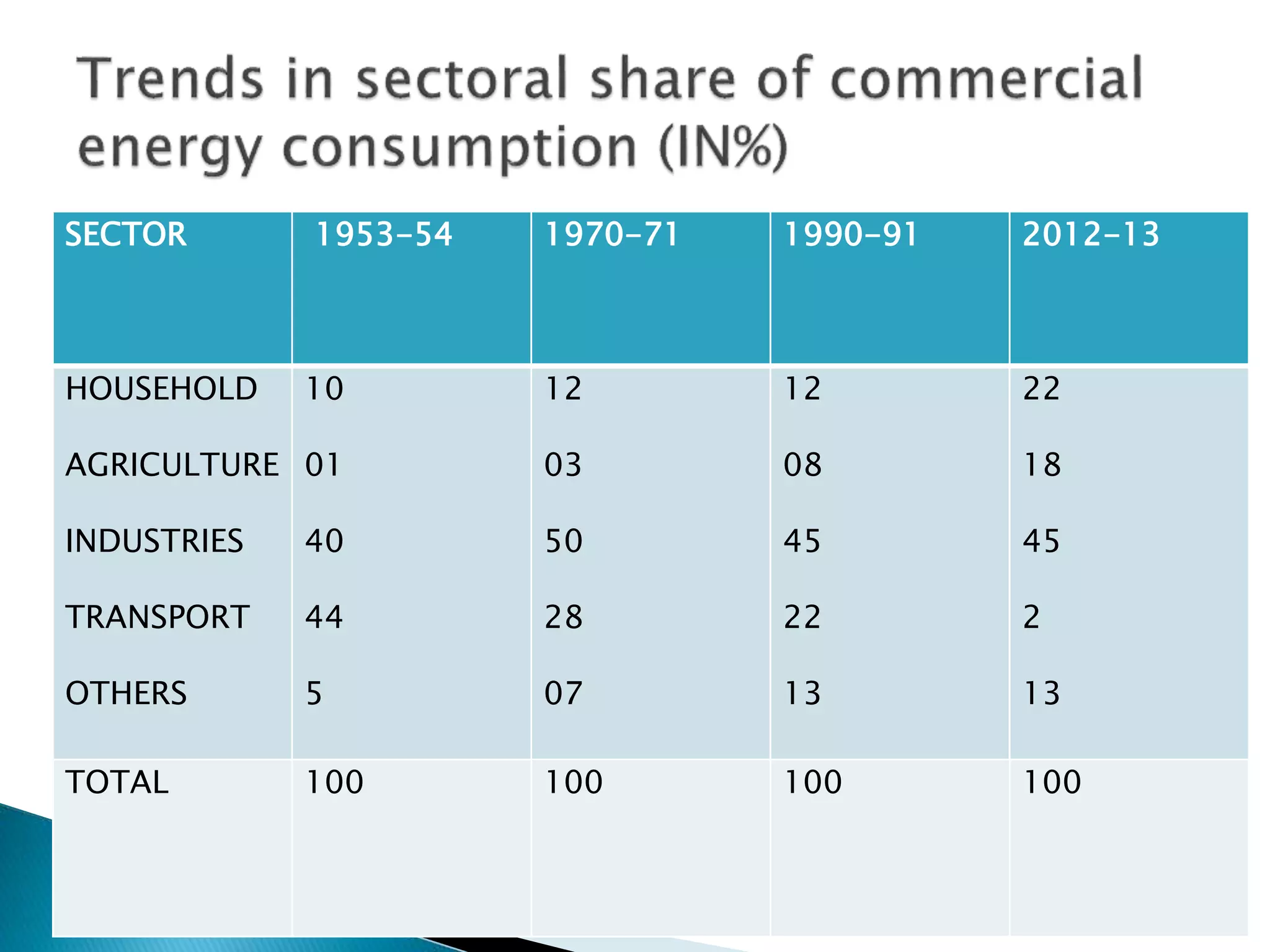
SECTOR 1953-54 1970-71 1990-91 2012-13
HOUSEHOLD
AGRICULTURE
INDUSTRIES
TRANSPORT
OTHERS
10
01
40
44
5
12
03
50
28
07
12
08
45
22
13
22
18
45
2
13
TOTAL 100 100 100 100
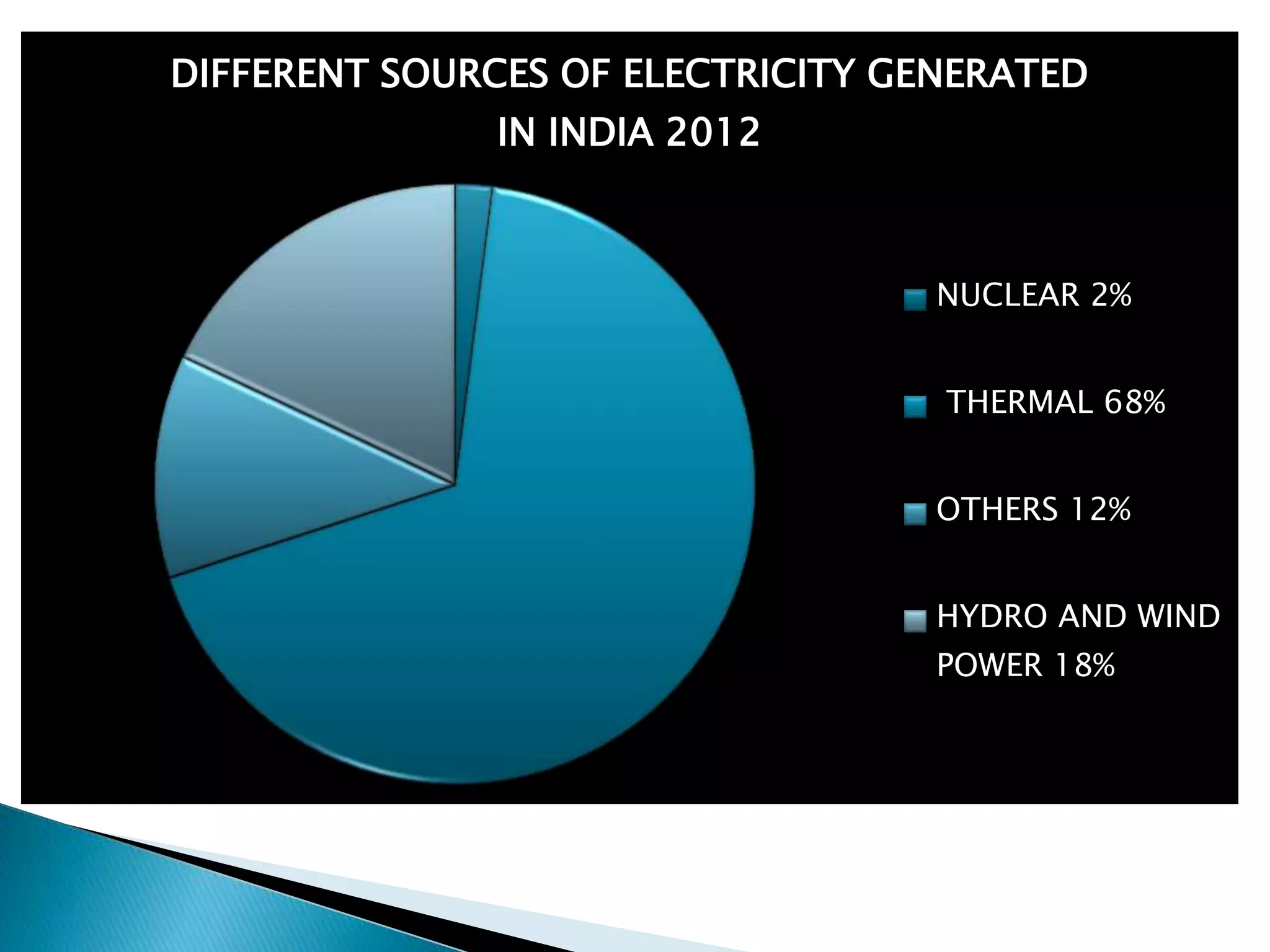
DIFFERENT SOURCES OF ELECTRICITY GENERATED
IN INDIA 2012
NUCLEAR 2%
THERMAL 68%
OTHERS 12%
HYDRO AND WIND
POWER 18%
The most visible form of energy, which is often
identified with progress in modern civilization, is
power, commonly called electricity. It is a critical
component of infrastructure that determines the economic
development of a country. The growth rate of demand for
power is generally higher than GDP growth rate.
 India’s installed capacity to generate electricity is not
sufficient to feed an annual economic growth of 7-8
percent. In order to meet the growing demand for
electricity, India’s commercial energy supply needs to
grow at about 7 percent. At present, India is able to add
only 20000MW a year. Even the installed capacity is
under- utilised because plants are not run properly
 State Electricity Boards (SEBs), which distribute electricity,
incur losses which exceed Rs 500 billion. This is due to
transmission and distribution losses, wrong pricing of
electricity and other inefficiencies. Some scholars also say
that distribution of electricity to farmers is the main reason
for losses; electricity is also stolen in different areas which
also adds to the woes of SEBs.
 Private sector power generators are yet to play their role in
a major way; same is the case with foreign investors.
 There is general public unrest due to high power tariffs
and prolonged power cuts in different parts of the
country.
 Thermal power plants which are the mainstay of India’s
power sector are facing shortage of raw materials and
coal supplies.
HEALTH
Contents
State of health infrastructure
Private Sector health
infrastructure
Indian System of Medicine ISM
Indicators of health and health
infrastructure – A critical
appraisal
Women’s Health
 Health is not only absence of disease but also the ability to
realize one’s potential. It is a yardstick of one’s potential.
 Scholars assess people’s health by taking into account indicator’s
like infant mortality and maternal mortality rates, life expectancy
and nutrition levels, along with the incidence of communicable
and non-communicable diseases.
 Health infrastructure includes hospitals, doctors, nurses and other
para-medical professionals, beds, equipment required in hospitals
and a well developed pharmaceutical industry.
 The government has the constitutional obligation and
regulate all health related issues such as medical
education, adulteration of food, drugs and poisons,
medical profession, vital statistics, mental deficiency
and lunacy. The Union Government evolves broad
policies and plans through the Central Council Of
Health and Family Welfare.
 Over the years, India has built up a vast health
infrastructure and manpower at different levels. At the
village level, a variety of hospitals technically known
as Primary Health Centers (PHCs) have been set up by
the government. India also has a large number of
hospitals run by voluntary agencies and the private
sector. These hospitals are manned by professionals and
para-medical professionals trained in medical,
pharmacy and nursing colleges.
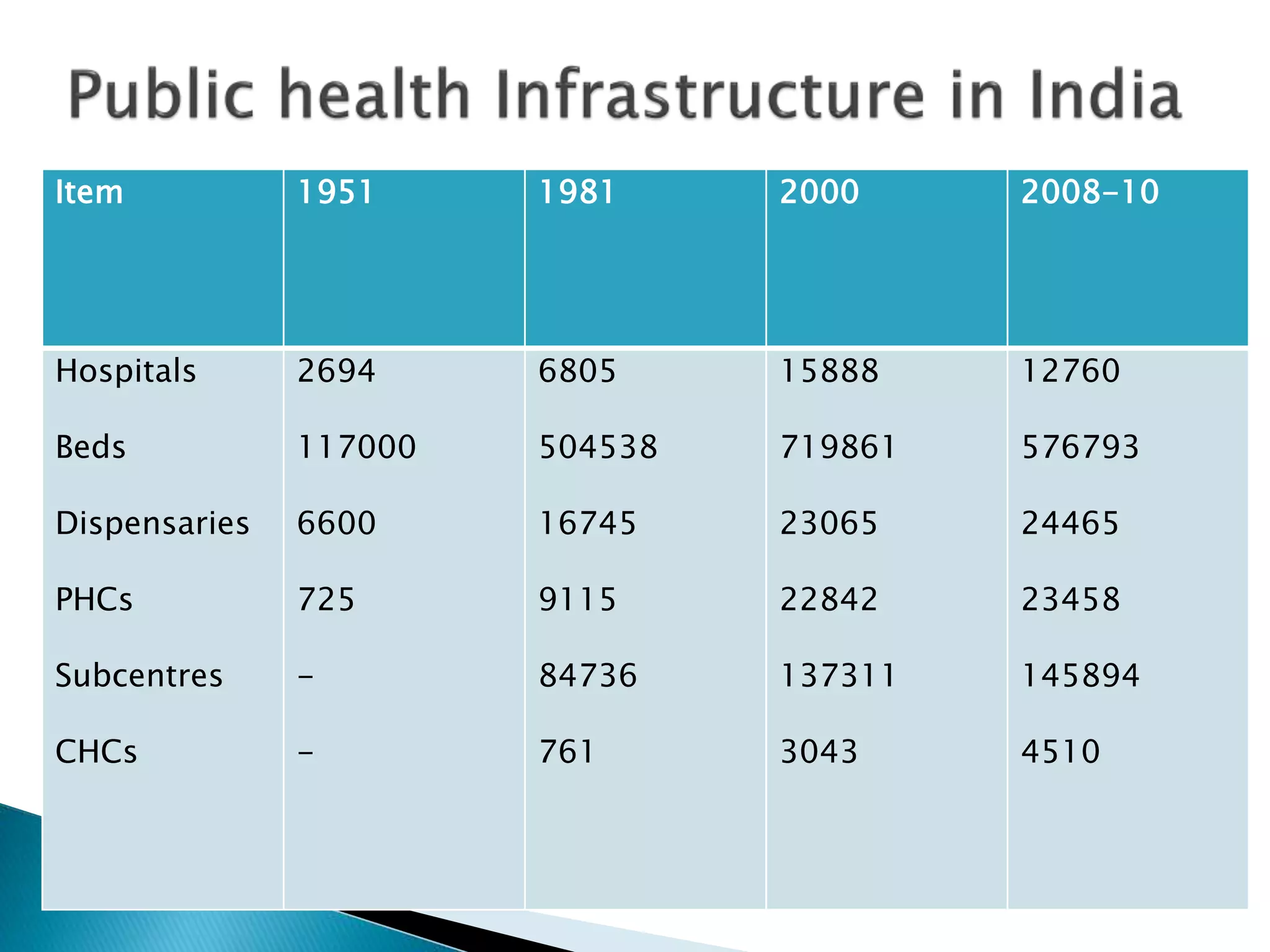
Item 1951 1981 2000 2008-10
Hospitals
Beds
Dispensaries
PHCs
Subcentres
CHCs
2694
117000
6600
725
-
-
6805
504538
16745
9115
84736
761
15888
719861
23065
22842
137311
3043
12760
576793
24465
23458
145894
4510
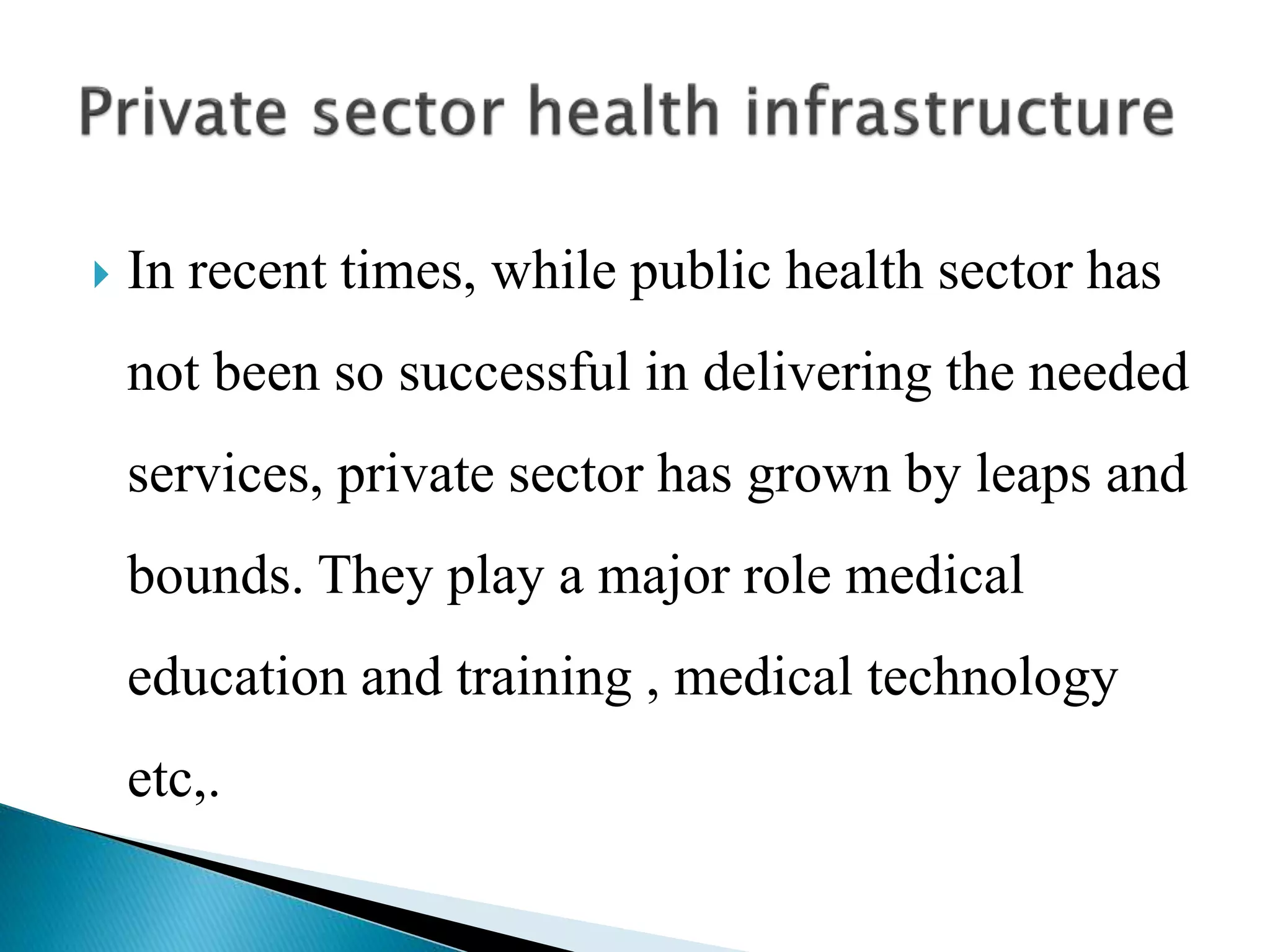
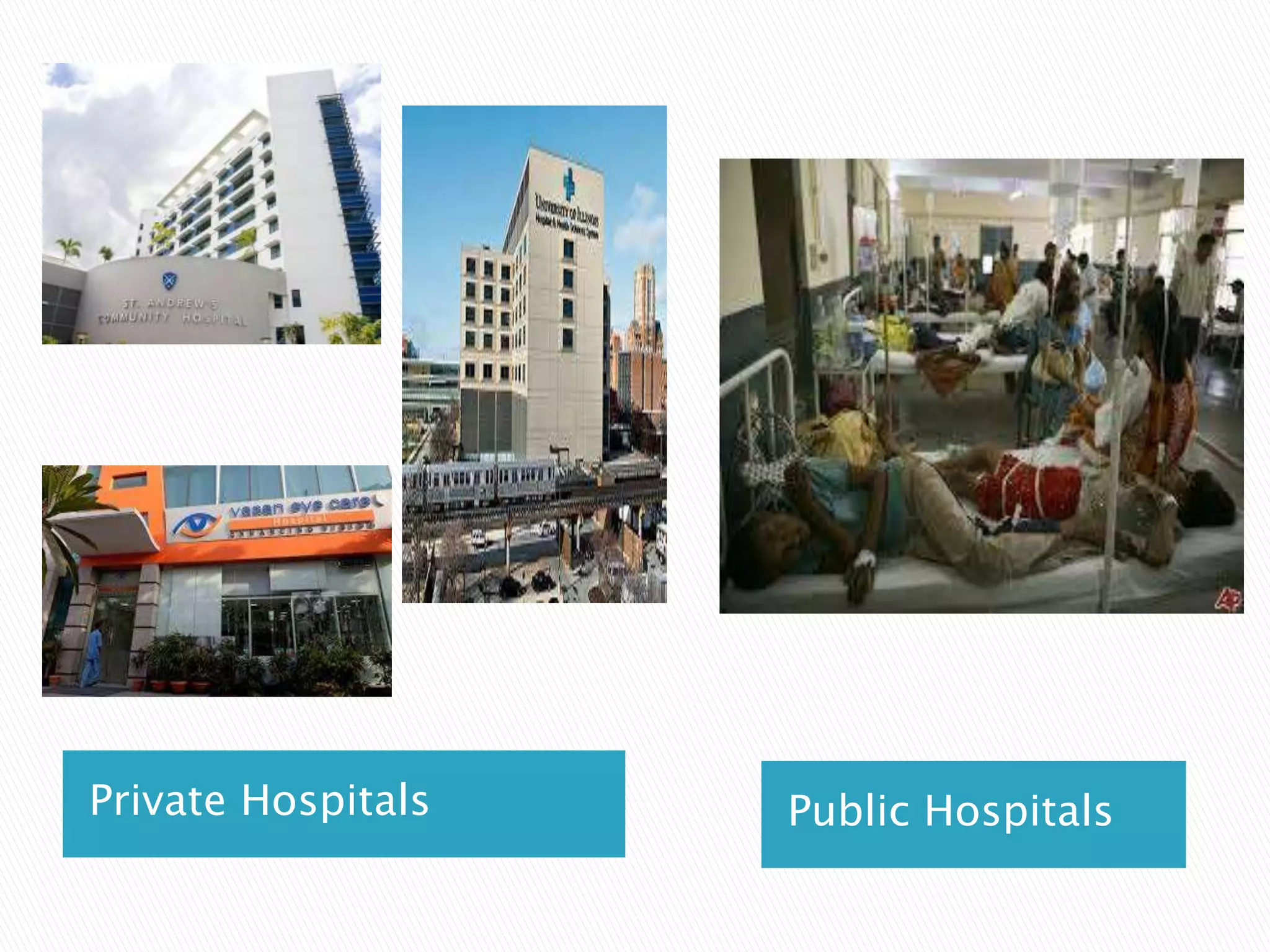
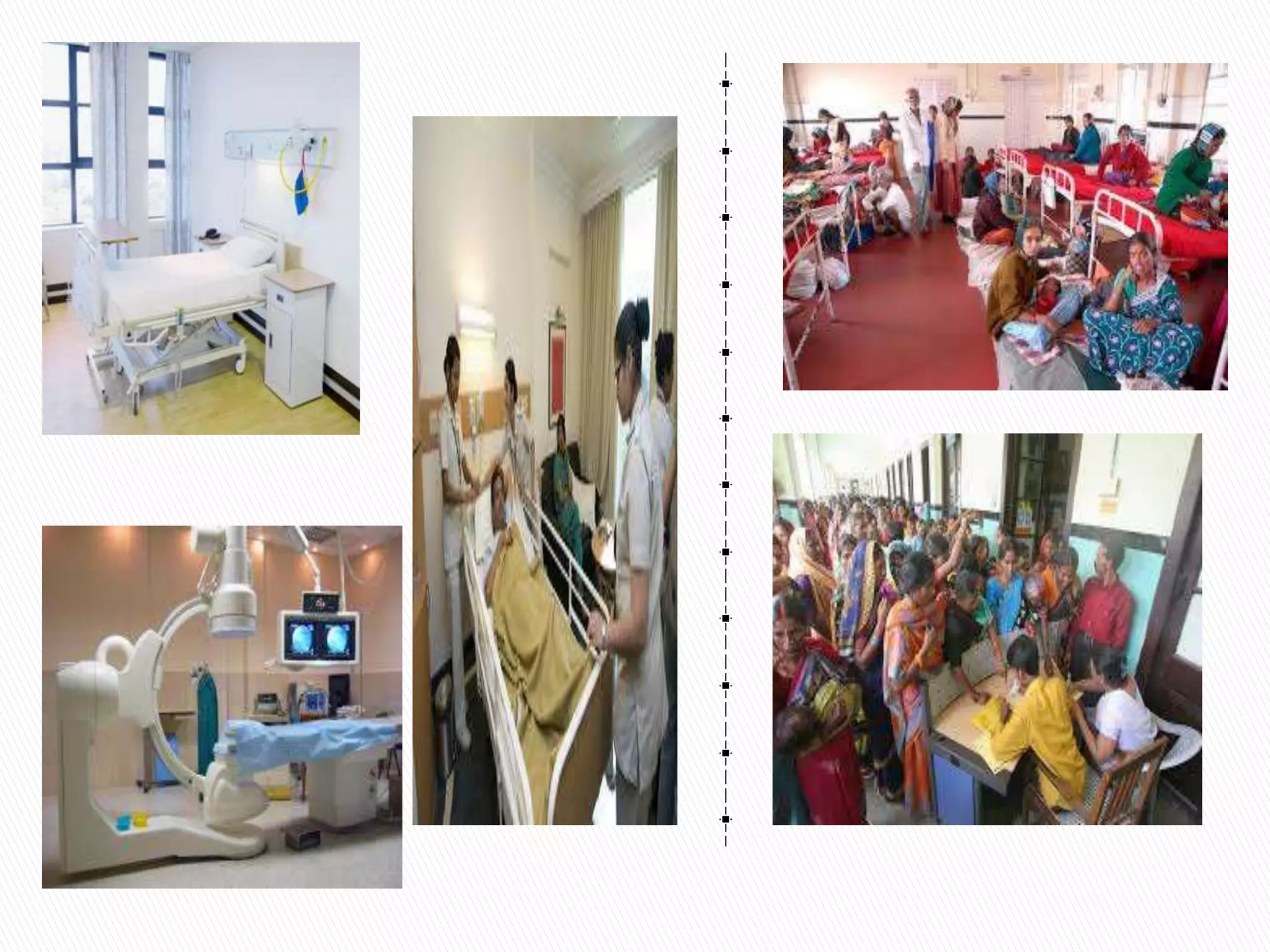
 In recent times, while public health sector has
not been so successful in delivering the needed
services, private sector has grown by leaps and
bounds. They play a major role medical
education and training , medical technology
etc,.
Private Hospitals Public Hospitals
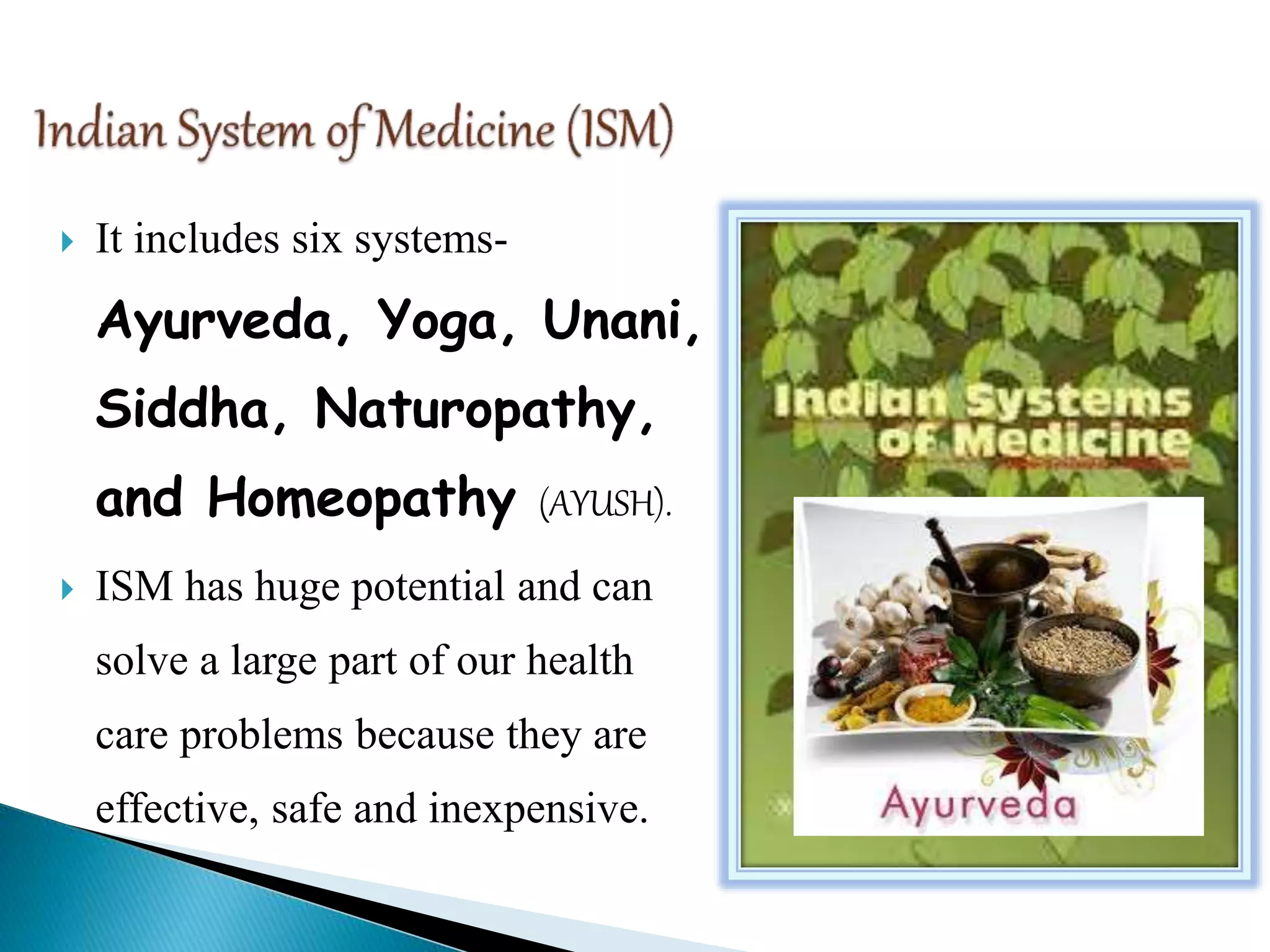
 It includes six systems-
Ayurveda, Yoga, Unani,
Siddha, Naturopathy,
and Homeopathy (AYUSH).
 ISM has huge potential and can
solve a large part of our health
care problems because they are
effective, safe and inexpensive.
 Though 70 per cent of India’s population lives in rural areas,
only one-fifth of its hospitals are located in rural areas. Rural
India has only about half the number of dispensaries.
 People living in rural areas do not have sufficient medical
infrastructure. This has led to difference in the health status
of people.
 The PHCs located in rural areas do not offer even X-ray or
blood testing facilities which, for a city dweller, constitutes
basic healthcare
 Villagers have no access to any specialised medical care like
pediatrics, gynaecology, anesthesia and obstetrics.
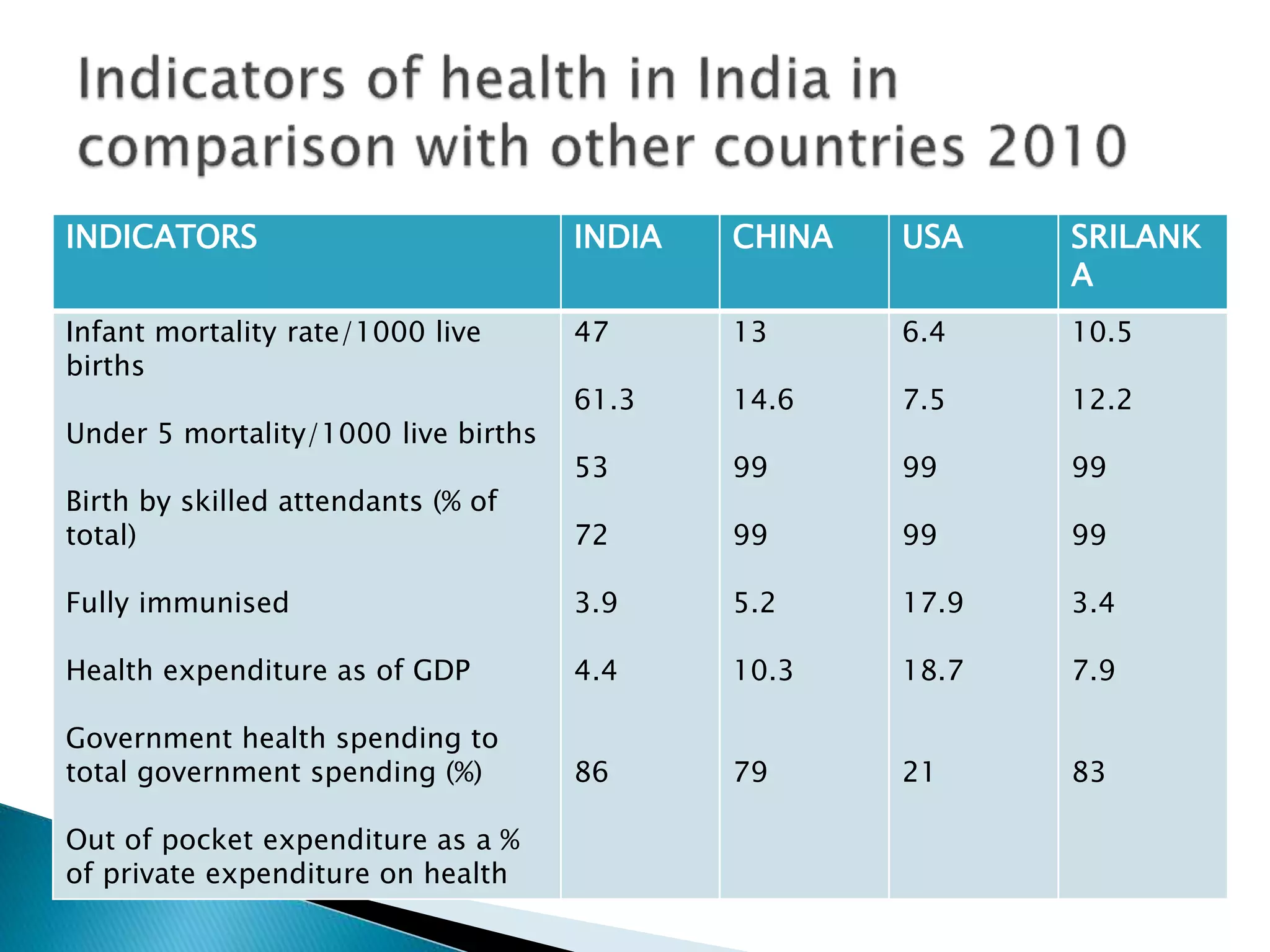
INDICATORS INDIA CHINA USA SRILANK
A
Infant mortality rate/1000 live
births
Under 5 mortality/1000 live births
Birth by skilled attendants (% of
total)
Fully immunised
Health expenditure as of GDP
Government health spending to
total government spending (%)
Out of pocket expenditure as a %
of private expenditure on health
47
61.3
53
72
3.9
4.4
86
13
14.6
99
99
5.2
10.3
79
6.4
7.5
99
99
17.9
18.7
21
10.5
12.2
99
99
3.4
7.9
83
WOMEN’S HEALTH
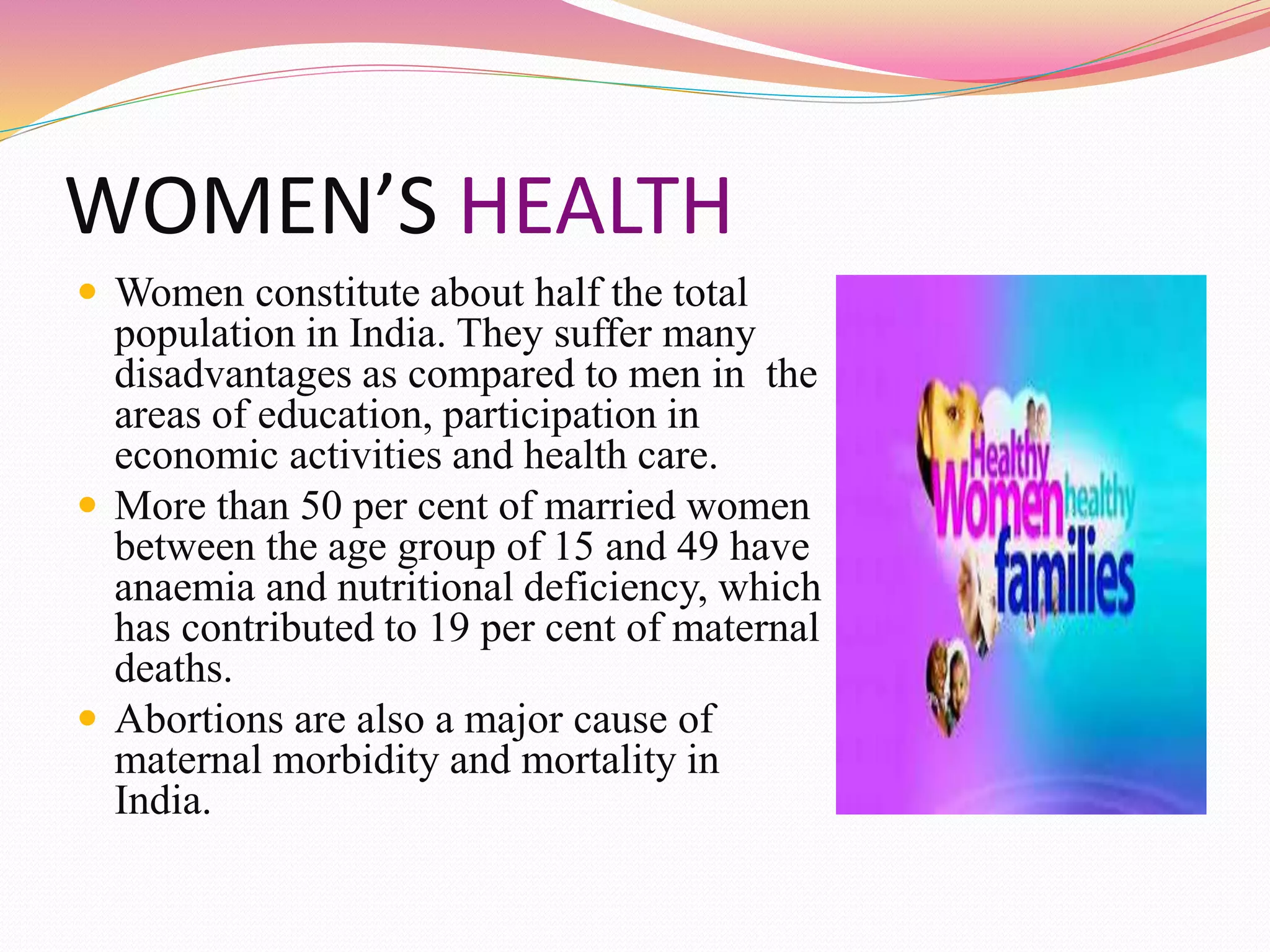
 Women constitute about half the total
population in India. They suffer many
disadvantages as compared to men in the
areas of education, participation in
economic activities and health care.
 More than 50 per cent of married women
between the age group of 15 and 49 have
anaemia and nutritional deficiency, which
has contributed to 19 per cent of maternal
deaths.
 Abortions are also a major cause of
maternal morbidity and mortality in
India.
A woman's health is her total well-being, not
determined solely by biological factors and
reproduction, but also by effects of work load,
nutrition, stress, war and migration, among others?
Women's health issues have attained higher
international visibility and renewed political
commitment in recent decades. While targeted policies
and programs have enabled women to lead healthier
lives, significant gender-based health disparities
remain in many countries. With limited access to
education or employment, high illiteracy rates and
increasing poverty levels are making health
improvements for women exceedingly difficult.
Health-related challenges continue. Many of the modest gains in women's health
realized in recent decades are now threatened or have been reversed due to war,
economic instability and the HIV/AIDS pandemic. Basic health care, family
planning and obstetric services are essential for women ,yet they remain
unavailable to millions. Gender-equitable approaches to health are needed to
enable women's full participation in the planning and delivery of health services.
The health of families and communities are tied to the health of women ? the
illness or death of a woman has serious and far-reaching consequences for the
health of her children, family and community.
The slogan, Healthy Women, Healthy World embodies the fact that as custodians
of family health, women play a critical role in maintaining the health and well
being of their communities.
CONCLUSION
 Infrastructure, both economic and social, is
essential for the development of a country. It
directly influence all economic activities.
 While accessing the 2 infrastructure –energy
and health- it is clear that there is a scope for
equal access to infrastructure for all.
Infrastructure of India Seminar

Infrastructure of India Seminar

  • 1.
  • 2.
  • 3.
    INTRODUCTION ???? Have youever thought why some states in India are performing much better than others in certain areas? Why do Punjab , Haryana , and Himachal Pradesh prosper in agriculture and horticulture? Why are Maharashtra and Gujarat industrially more advanced than others? How come Kerala , popularly known as ‘God’s own country’ has excelled in literacy , health care and sanitation and also attracts tourists in such a large number? Why does Karnataka's information technology industry attracts world attention ?
  • 4.
     Infrastructure providessupporting services in the main areas of industrial and agricultural production, domestic and foreign trade and commerce.  These services include roads , railways, ports, airports, dams, power stations, oil and gas pipelines, telecommunication facilities, educational system, health system and monetary system.
  • 5.
    ECONOMIC AND SOCIAL INFRASTRUCTURE ASSOCIATEDWITH ENERGY,TRANSPORTATION AND COMMUNICATION ARE INCLUDED IN THE FORMER CATEGORYWHEREAS THOSE RELATED TO EDUCATION HEALTH AND HOUSING ARE UNCLUDED IN THE LATTER.
  • 6.
     Infrastructure contributesto economic development of a country both by increasing the productivity of the factors of production and improving the quality of life of its people. Inadequate infrastructure can have multiple adverse effects on health. Improvements in water supply and sanitation have a large impact by reducing morbidity from major water borne diseases and reducing the severity of disease when it occurs. In addition to the obvious linkage between water and sanitation and health, the quality of transport and communication infrastructure can affect access to health care.
  • 7.
     A majorityof our people live in rural areas. Despite so much technical progress in the world , rural women are still using bio fuels such as crop residues, dung and fuel wood to meet their energy requirement. They walk long distances to fetch fuel, water and other basic needs. The census 2001 shows that in rural India only 56 per cent households have an electricity connection and 43 per cent still use kerosene. About 90 per cent of the rural households use bio fuels for cooking. Tap water availability is limited to only 24 per cent rural households. About 76 per cent of the population drinks water from open sources such as wells, tanks, ponds, lakes, rivers , canals etc. Access to improved sanitation in rural areas was only 20 per cent.
  • 8.
    Some infrastructure inIndia and other countries. Country Investment in infrastructure as GDP [2003] Access to water source [2012] [%] Access to Improved Sanitation Mobile subscribers /100 people Power generation billion kwh China 20 92 65 81 4208 Hong Kong 4 92 100 223 38 India 5 84 35 69 960 South Korea 7 98 100 110 497 Pakistan 2 91 47 67 94 Singapore 5 100 100 153 45 Indonesia 14 84 59 115 170
  • 9.
    Country Investment in Infrastructure asa % GDP Access to Improved Water Source (2012) % Access to Improved Sanitation(%) 2012 Mobile Subscribers /100 People (2012) Power Generation (billion kwh) 2010 China Hong Kong India South Korea Pakistan Singapore Indonesia 20 4 5 7 2 5 14 92 92 84 98 91 100 84 65 100 35 100 47 100 59 81 223 69 110 67 153 115 4208 38 960 497 94 45 170
  • 11.
     Energy isa critical aspect of the development process of a nation. It is, of course, essential for industries.  It is used on a large scale in agriculture and related areas like production and transportation of fertilisers , pesticides and farm equipment. It is required in houses for cooking, household lighting and heating.
  • 12.
     There arecommercial and non-commercial sources of energy.  Commercial sources are coal, petroleum and electricity as they are bought and sold. Non-commercial sources of energy are firewood, agricultural waste and dried dung. These are non-commercial as they are found in nature/forests.  While commercial sources of energy are generally exhaustible, non- commercial are generally renewable.
  • 13.
    Commercial Sources ofEnergy Coal Electricity Petroleum
  • 14.
    Non commercial sourcesof energy Firewood Agricultural waste Dried dung
  • 15.
     Both commercialand non commercial sources of energy are known as conventional sources of energy.  There are three other sources of energy which are commonly termed as non conventional source – solar energy, wind energy and tidal energy.  Being a tropical country, India has almost unlimited potential for producing all three types of energy if some appropriate cost effect technologies that are already available are used. Even cheaper technologies can be developed.
  • 16.
    Non conventional sourcesof energy Solar Energy Wind Energy Wind Mill
  • 17.
    SECTOR 1953-54 1970-711990-91 2012-13 HOUSEHOLD AGRICULTURE INDUSTRIES TRANSPORT OTHERS 10 01 40 44 5 12 03 50 28 07 12 08 45 22 13 22 18 45 2 13 TOTAL 100 100 100 100
  • 18.
    DIFFERENT SOURCES OFELECTRICITY GENERATED IN INDIA 2012 NUCLEAR 2% THERMAL 68% OTHERS 12% HYDRO AND WIND POWER 18%
  • 19.
    The most visibleform of energy, which is often identified with progress in modern civilization, is power, commonly called electricity. It is a critical component of infrastructure that determines the economic development of a country. The growth rate of demand for power is generally higher than GDP growth rate.
  • 20.
     India’s installedcapacity to generate electricity is not sufficient to feed an annual economic growth of 7-8 percent. In order to meet the growing demand for electricity, India’s commercial energy supply needs to grow at about 7 percent. At present, India is able to add only 20000MW a year. Even the installed capacity is under- utilised because plants are not run properly
  • 21.
     State ElectricityBoards (SEBs), which distribute electricity, incur losses which exceed Rs 500 billion. This is due to transmission and distribution losses, wrong pricing of electricity and other inefficiencies. Some scholars also say that distribution of electricity to farmers is the main reason for losses; electricity is also stolen in different areas which also adds to the woes of SEBs.  Private sector power generators are yet to play their role in a major way; same is the case with foreign investors.
  • 22.
     There isgeneral public unrest due to high power tariffs and prolonged power cuts in different parts of the country.  Thermal power plants which are the mainstay of India’s power sector are facing shortage of raw materials and coal supplies.
  • 23.
    HEALTH Contents State of healthinfrastructure Private Sector health infrastructure Indian System of Medicine ISM Indicators of health and health infrastructure – A critical appraisal Women’s Health
  • 24.
     Health isnot only absence of disease but also the ability to realize one’s potential. It is a yardstick of one’s potential.  Scholars assess people’s health by taking into account indicator’s like infant mortality and maternal mortality rates, life expectancy and nutrition levels, along with the incidence of communicable and non-communicable diseases.  Health infrastructure includes hospitals, doctors, nurses and other para-medical professionals, beds, equipment required in hospitals and a well developed pharmaceutical industry.
  • 25.
     The governmenthas the constitutional obligation and regulate all health related issues such as medical education, adulteration of food, drugs and poisons, medical profession, vital statistics, mental deficiency and lunacy. The Union Government evolves broad policies and plans through the Central Council Of Health and Family Welfare.
  • 26.
     Over theyears, India has built up a vast health infrastructure and manpower at different levels. At the village level, a variety of hospitals technically known as Primary Health Centers (PHCs) have been set up by the government. India also has a large number of hospitals run by voluntary agencies and the private sector. These hospitals are manned by professionals and para-medical professionals trained in medical, pharmacy and nursing colleges.
  • 27.
    Item 1951 19812000 2008-10 Hospitals Beds Dispensaries PHCs Subcentres CHCs 2694 117000 6600 725 - - 6805 504538 16745 9115 84736 761 15888 719861 23065 22842 137311 3043 12760 576793 24465 23458 145894 4510
  • 28.
     In recenttimes, while public health sector has not been so successful in delivering the needed services, private sector has grown by leaps and bounds. They play a major role medical education and training , medical technology etc,.
  • 29.
  • 31.
     It includessix systems- Ayurveda, Yoga, Unani, Siddha, Naturopathy, and Homeopathy (AYUSH).  ISM has huge potential and can solve a large part of our health care problems because they are effective, safe and inexpensive.
  • 33.
     Though 70per cent of India’s population lives in rural areas, only one-fifth of its hospitals are located in rural areas. Rural India has only about half the number of dispensaries.  People living in rural areas do not have sufficient medical infrastructure. This has led to difference in the health status of people.  The PHCs located in rural areas do not offer even X-ray or blood testing facilities which, for a city dweller, constitutes basic healthcare  Villagers have no access to any specialised medical care like pediatrics, gynaecology, anesthesia and obstetrics.
  • 34.
    INDICATORS INDIA CHINAUSA SRILANK A Infant mortality rate/1000 live births Under 5 mortality/1000 live births Birth by skilled attendants (% of total) Fully immunised Health expenditure as of GDP Government health spending to total government spending (%) Out of pocket expenditure as a % of private expenditure on health 47 61.3 53 72 3.9 4.4 86 13 14.6 99 99 5.2 10.3 79 6.4 7.5 99 99 17.9 18.7 21 10.5 12.2 99 99 3.4 7.9 83
  • 36.
    WOMEN’S HEALTH  Womenconstitute about half the total population in India. They suffer many disadvantages as compared to men in the areas of education, participation in economic activities and health care.  More than 50 per cent of married women between the age group of 15 and 49 have anaemia and nutritional deficiency, which has contributed to 19 per cent of maternal deaths.  Abortions are also a major cause of maternal morbidity and mortality in India.
  • 37.
    A woman's healthis her total well-being, not determined solely by biological factors and reproduction, but also by effects of work load, nutrition, stress, war and migration, among others? Women's health issues have attained higher international visibility and renewed political commitment in recent decades. While targeted policies and programs have enabled women to lead healthier lives, significant gender-based health disparities remain in many countries. With limited access to education or employment, high illiteracy rates and increasing poverty levels are making health improvements for women exceedingly difficult.
  • 38.
    Health-related challenges continue.Many of the modest gains in women's health realized in recent decades are now threatened or have been reversed due to war, economic instability and the HIV/AIDS pandemic. Basic health care, family planning and obstetric services are essential for women ,yet they remain unavailable to millions. Gender-equitable approaches to health are needed to enable women's full participation in the planning and delivery of health services. The health of families and communities are tied to the health of women ? the illness or death of a woman has serious and far-reaching consequences for the health of her children, family and community. The slogan, Healthy Women, Healthy World embodies the fact that as custodians of family health, women play a critical role in maintaining the health and well being of their communities.
  • 39.
    CONCLUSION  Infrastructure, botheconomic and social, is essential for the development of a country. It directly influence all economic activities.  While accessing the 2 infrastructure –energy and health- it is clear that there is a scope for equal access to infrastructure for all.