



















































Business
Studies
Private, Public and
Global Enterprises
Chapter - 3
Private Sector
Enterprises
Private Sector Enterprises
Firms owned, controlled and managed by
private businessmen
The main object of such undertaking is profit
making
Private Sector Enterprises
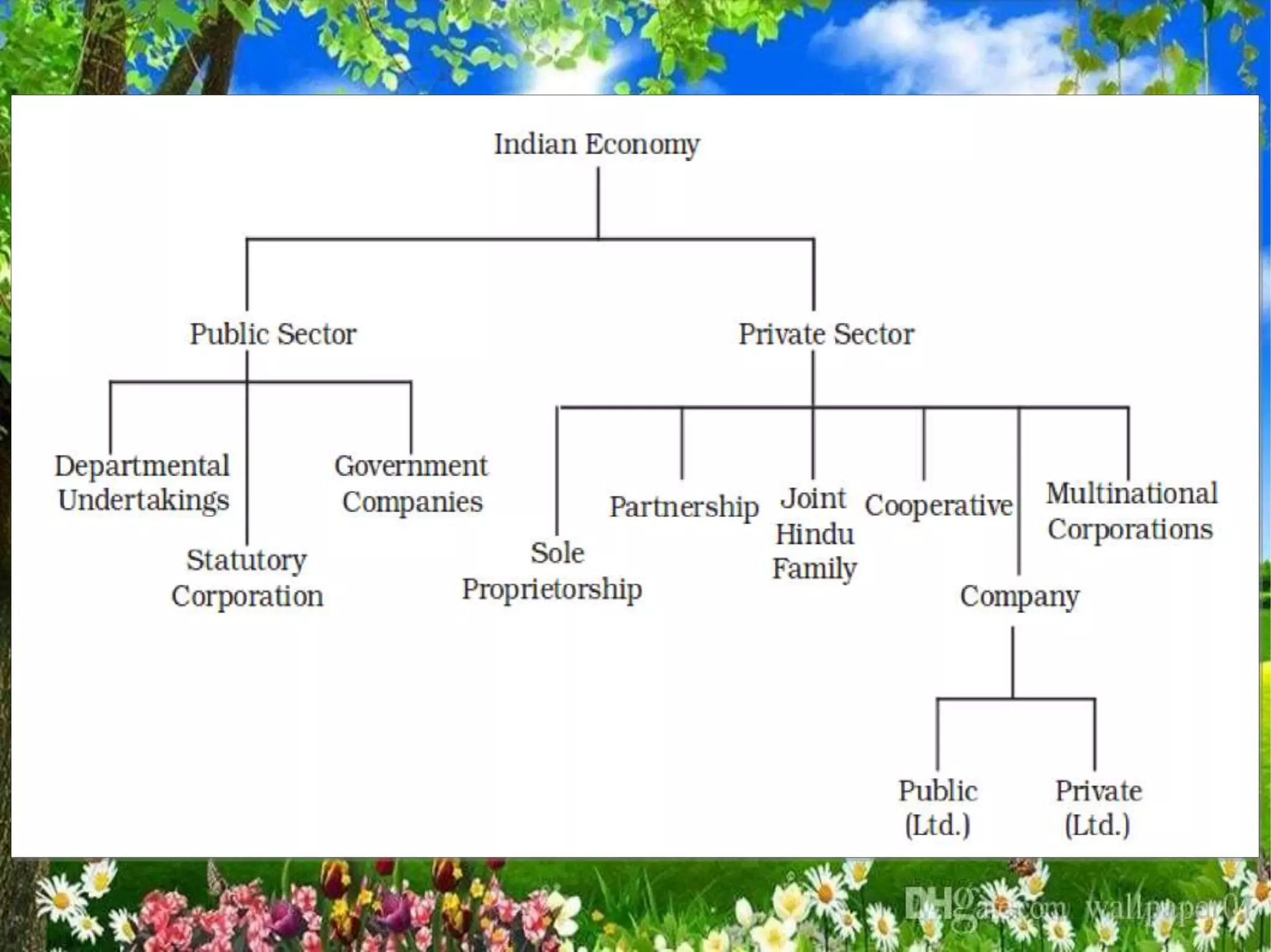
Types of Private Sector Enterprises
Sole Proprietorship Concerns
Hindu Undivided Family Business
Partnership Business Organizations
Co-operative Societies
Joint Stock Companies
Public Sector
Enterprises
Public Sector Enterprises
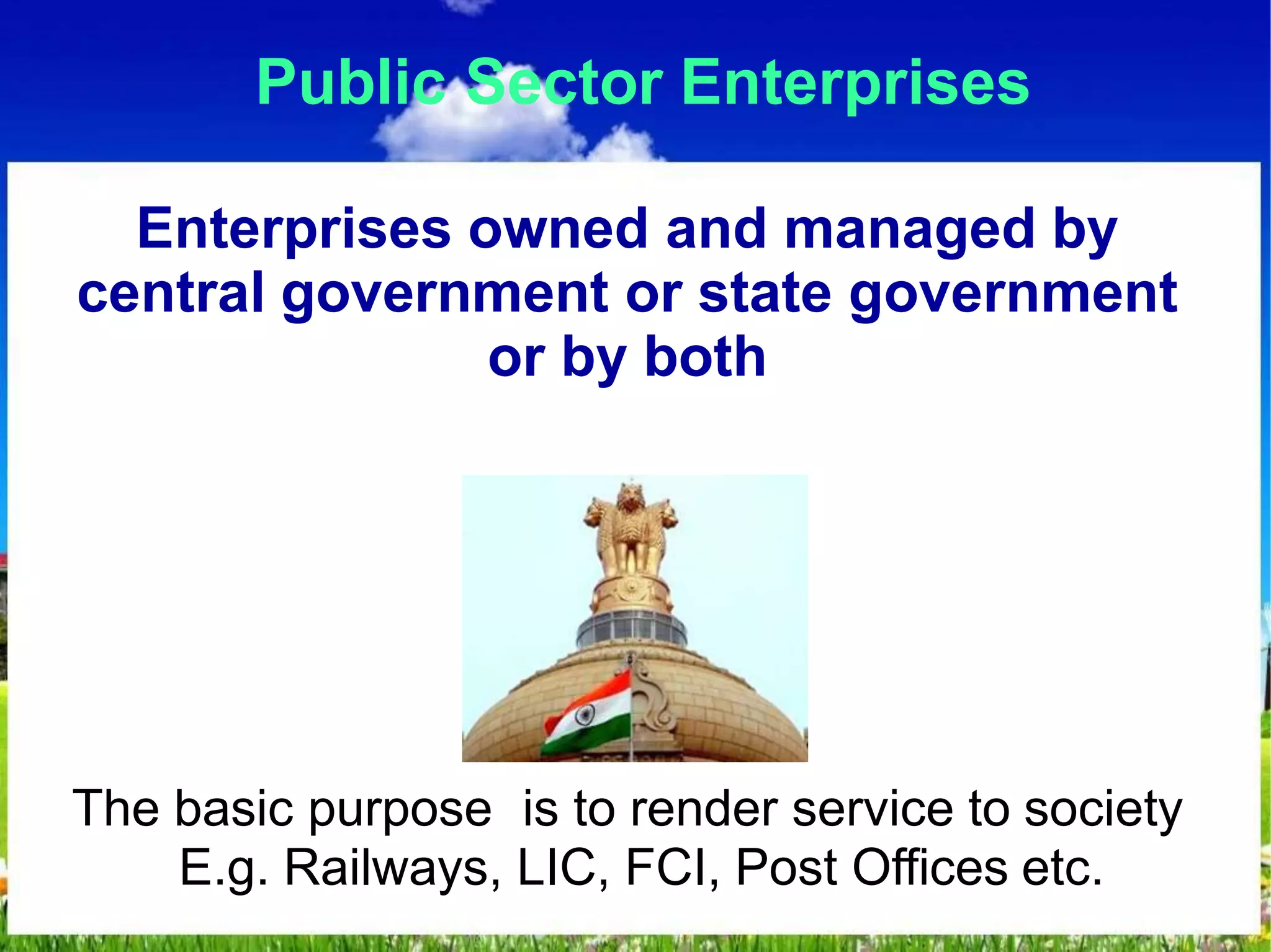
Enterprises owned and managed by
central government or state government
or by both
The basic purpose is to render service to society
E.g. Railways, LIC, FCI, Post Offices etc.
Forms of
Public Sector
Enterprises
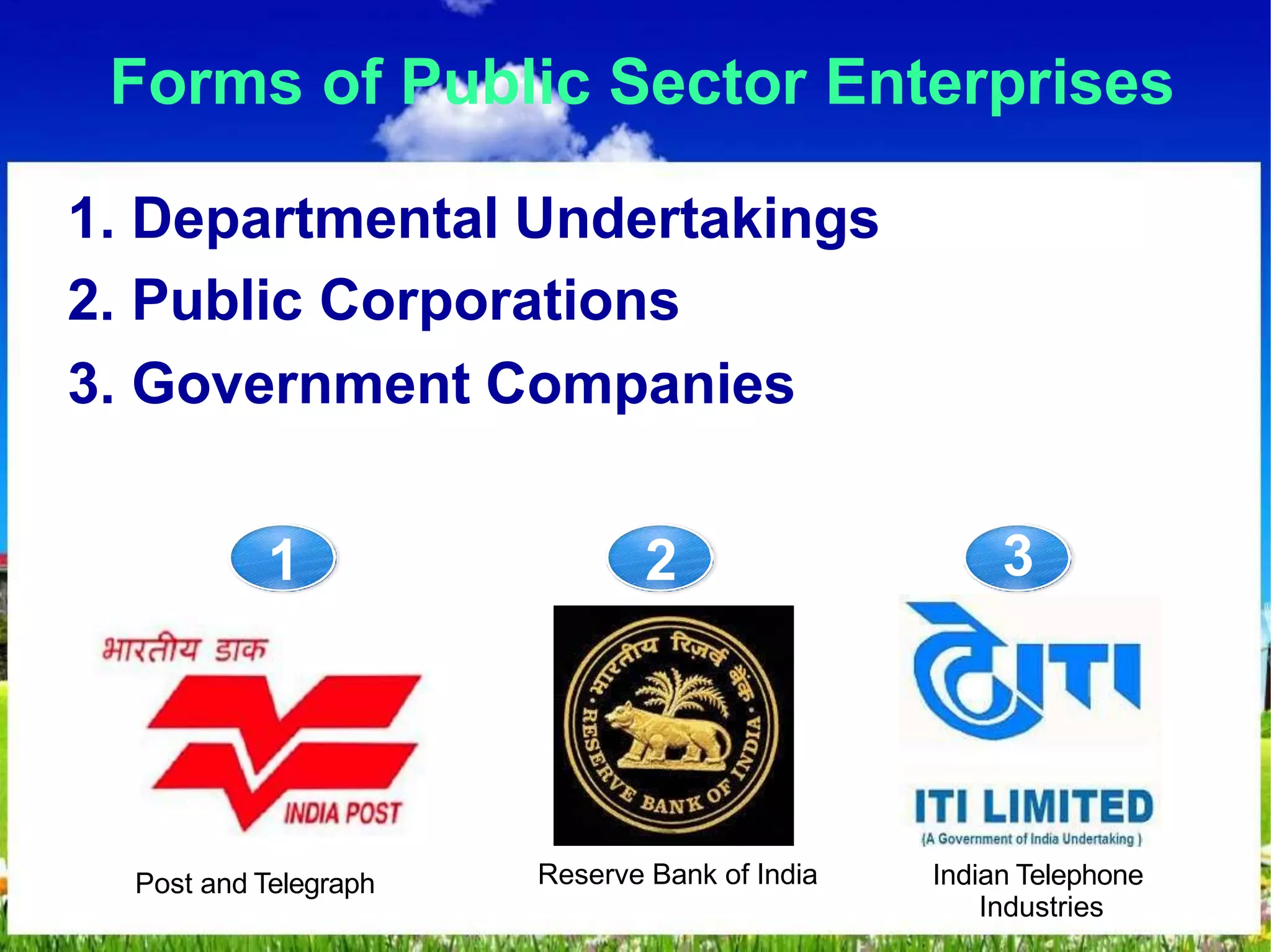
Forms of Public Sector Enterprises
Post and Telegraph Reserve Bank of India Indian Telephone
Industries
1. Departmental Undertakings
2. Public Corporations
3. Government Companies
1 2 3
Departmental
Undertakings
Departmental Undertakings
✔ Undertakings created by government
✔ Financed and controlled by government
✔ Managed by government officials
✔ Under the control of a minister
Departmental Undertakings
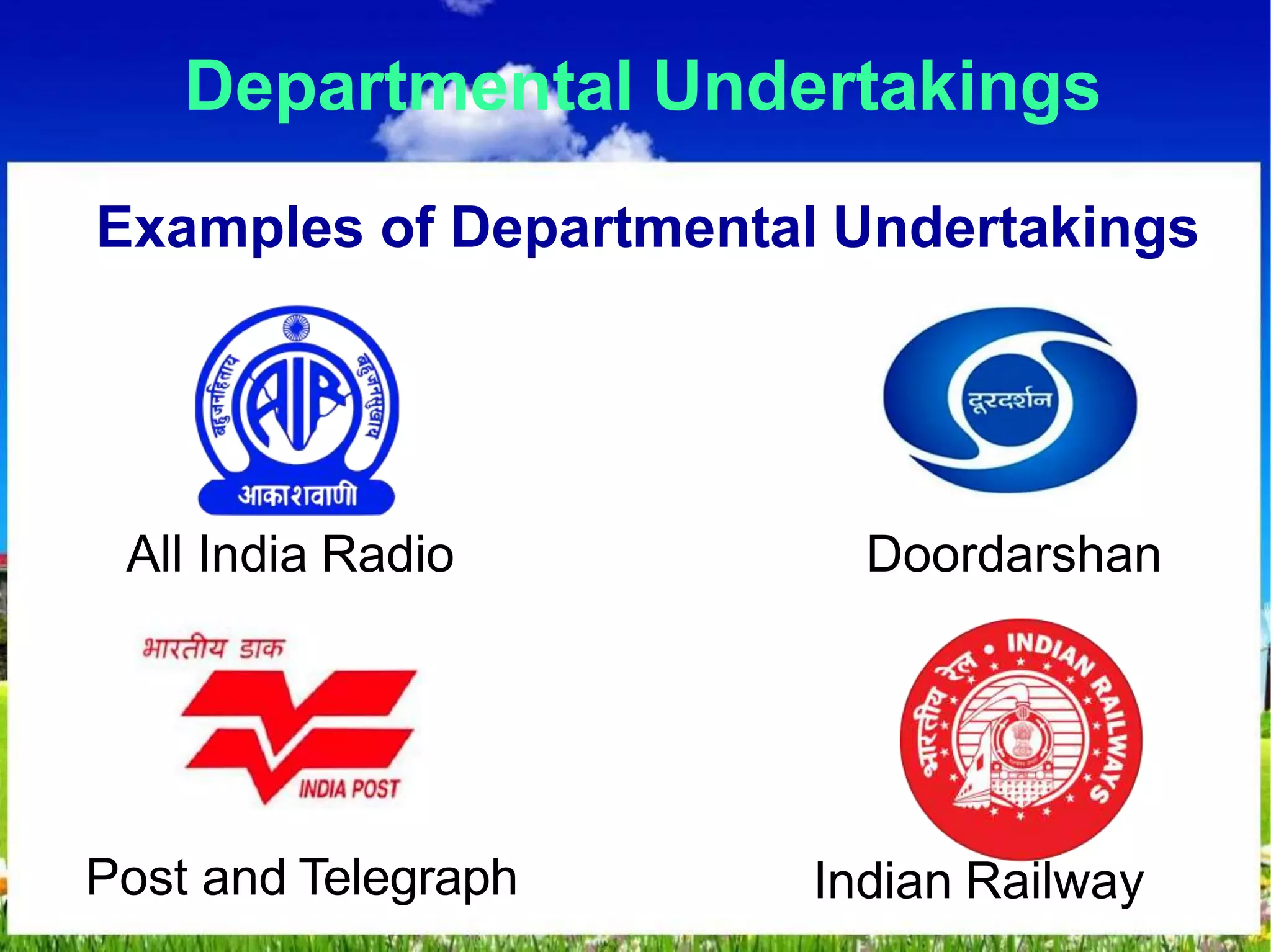
Examples of Departmental Undertakings
Indian RailwayPost and Telegraph
DoordarshanAll India Radio
Features of
Departmental
Undertakings
Features of Departmental Undertakings
Funding
Financed through budget allocation
a
Features of Departmental Undertakings
Audit and Control
They are subject to Government audit
b
Features of Departmental Undertakings
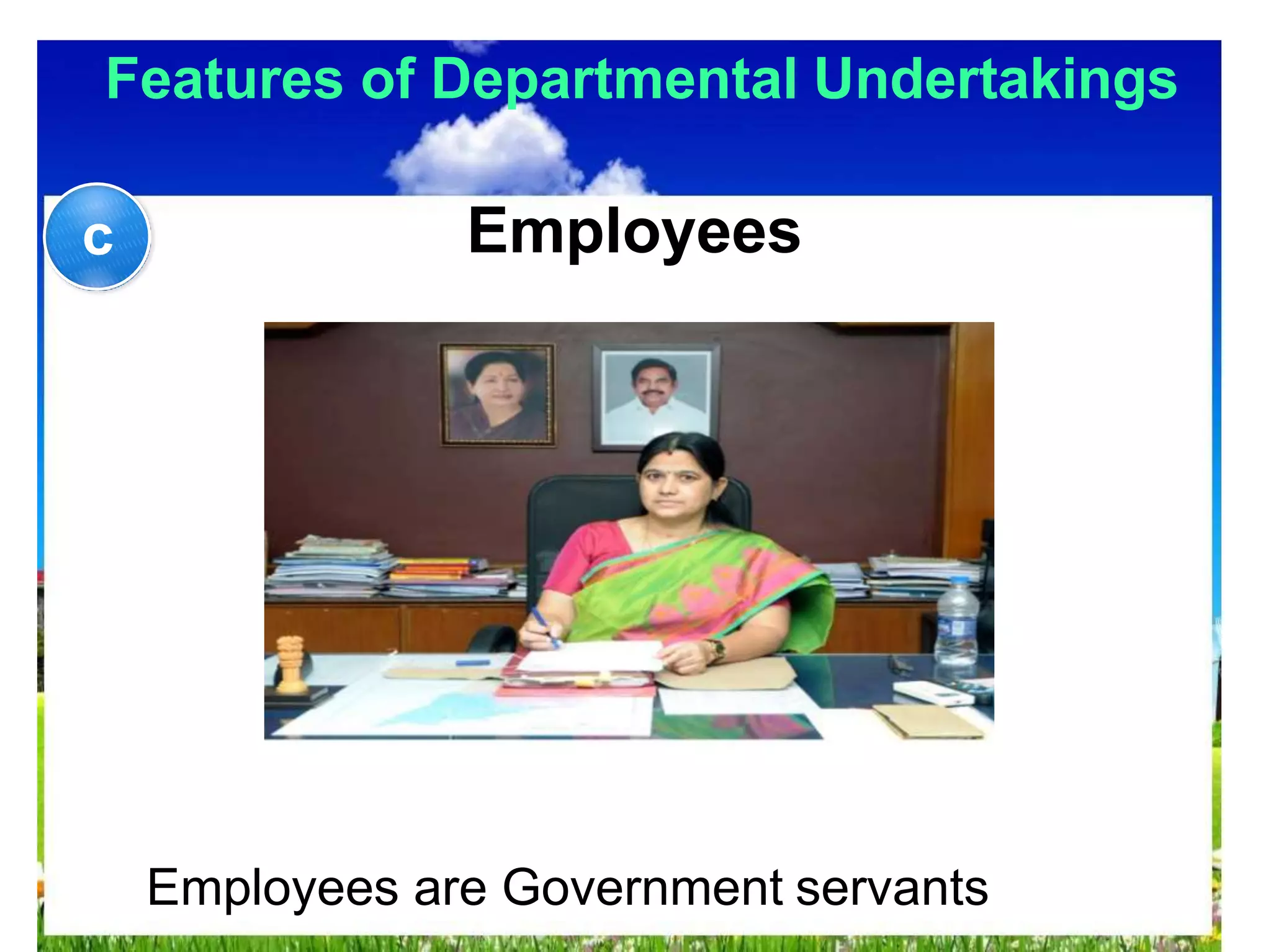
Employees
Employees are Government servants
c
Features of Departmental Undertakings
Control
Subject to direct control by the concerned ministry
d
Features of Departmental Undertakings
Accountability
Accountable to the ministry and the government
e
Merits of
Departmental
Undertakings
Merits of Departmental Undertakings
Control of parliament
Better control over funds and operations as it is
controlled by the ministry
a
Merits of Departmental Undertakings
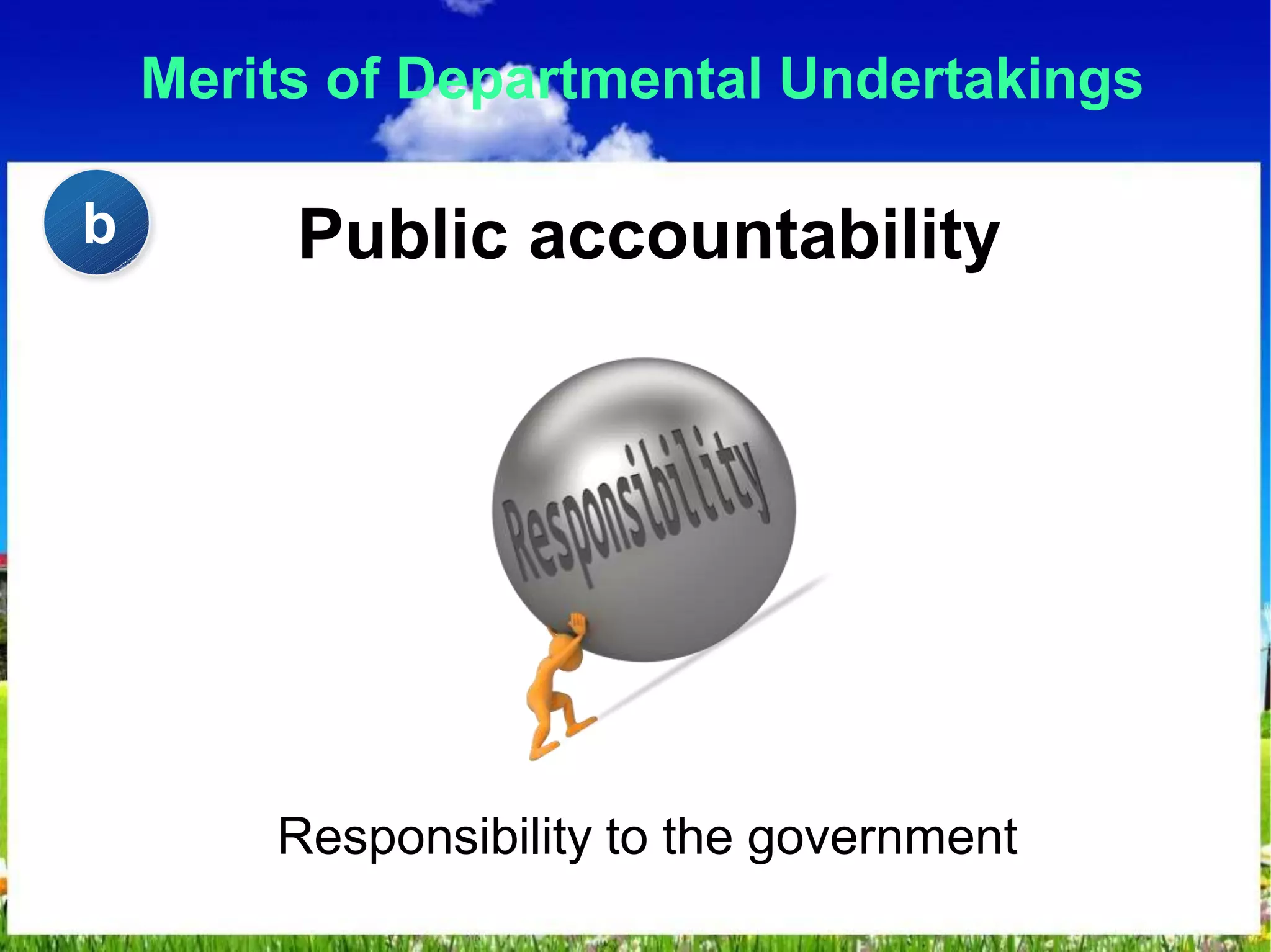
Public accountability
Responsibility to the government
b
Merits of Departmental Undertakings
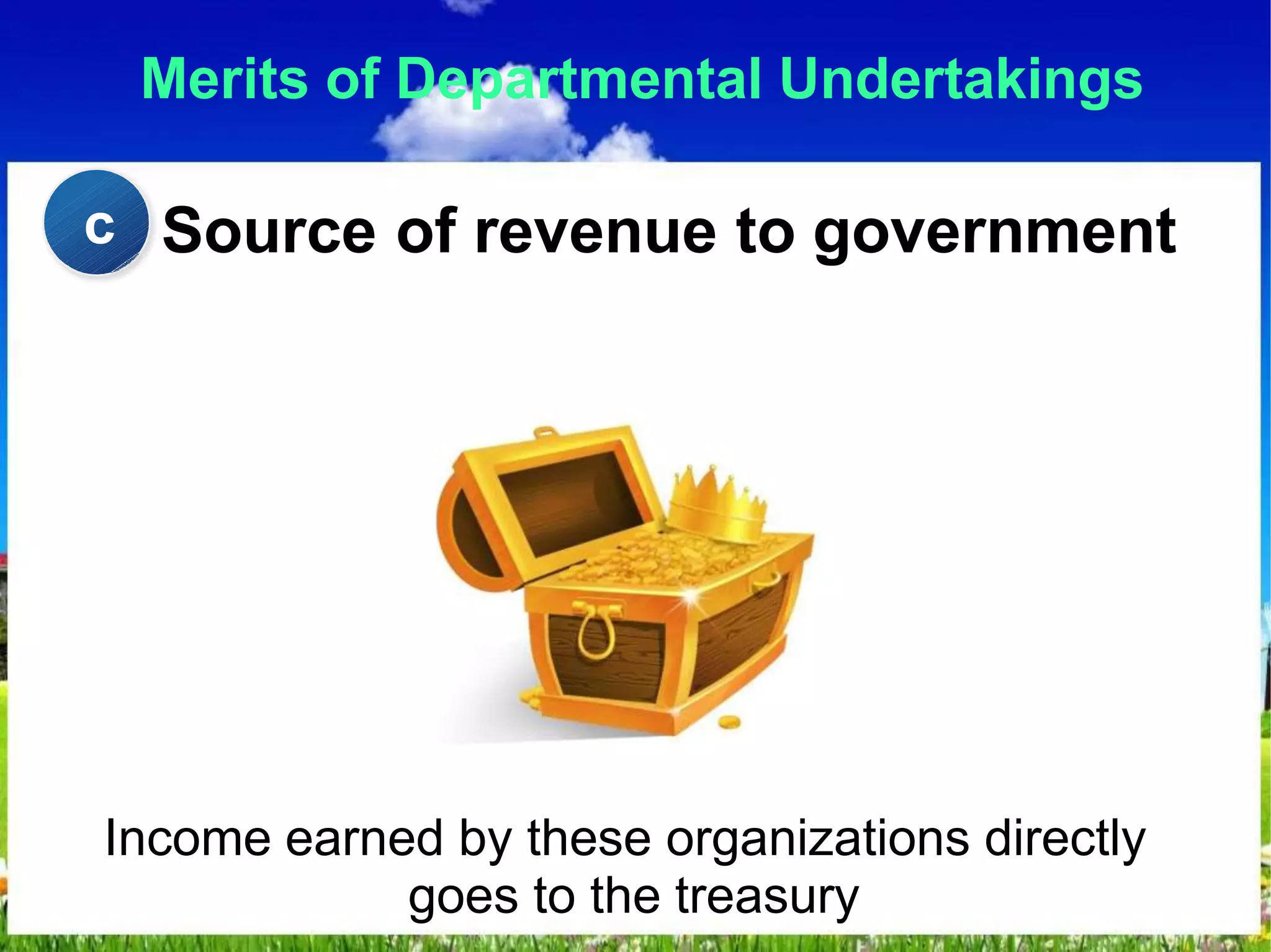
Source of revenue to government
Income earned by these organizations directly
goes to the treasury
c
Merits of Departmental Undertakings
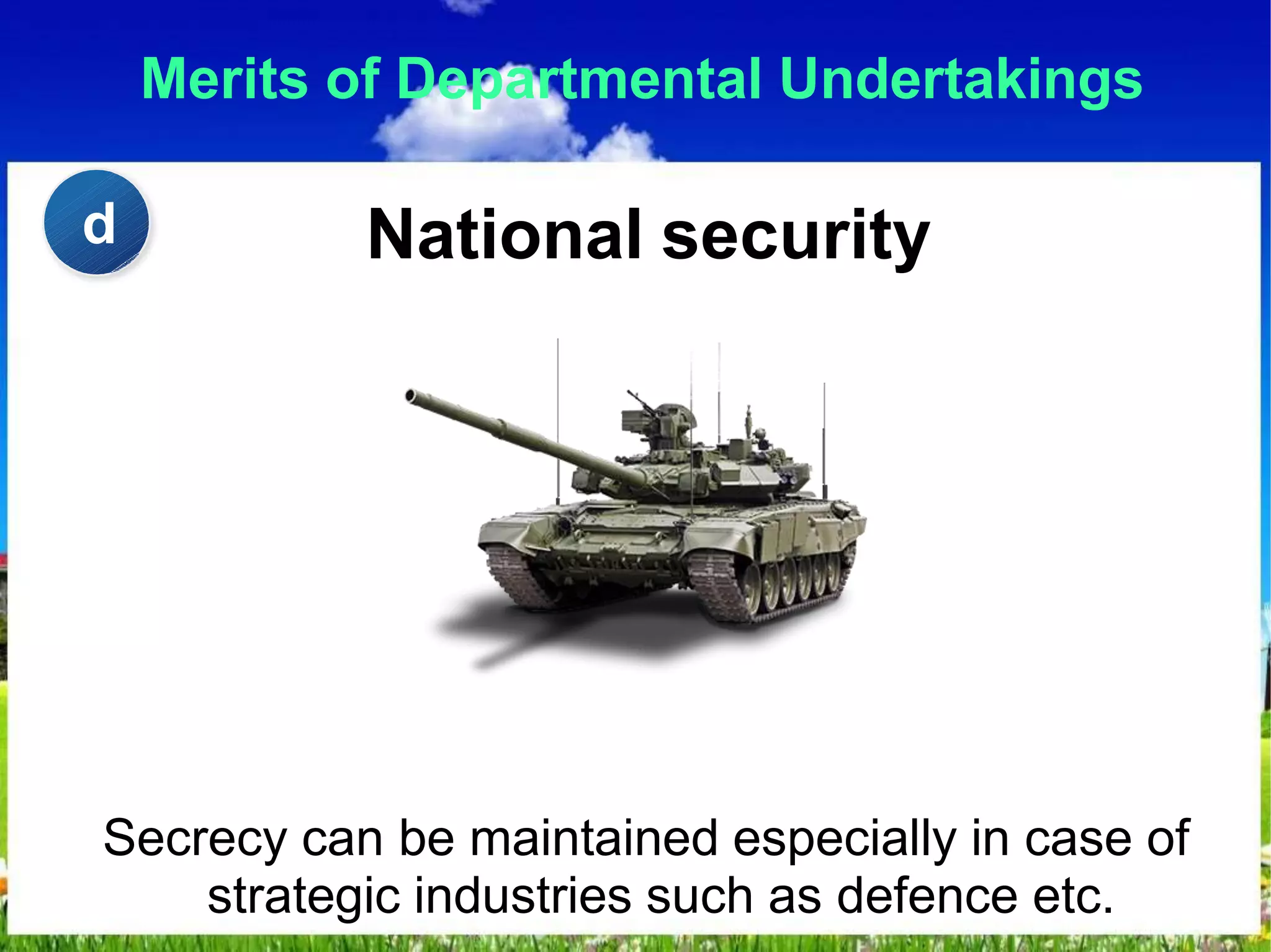
National security
Secrecy can be maintained especially in case of
strategic industries such as defence etc.
d
Limitations of
Departmental
Undertakings
Limitations of Departmental Undertakings
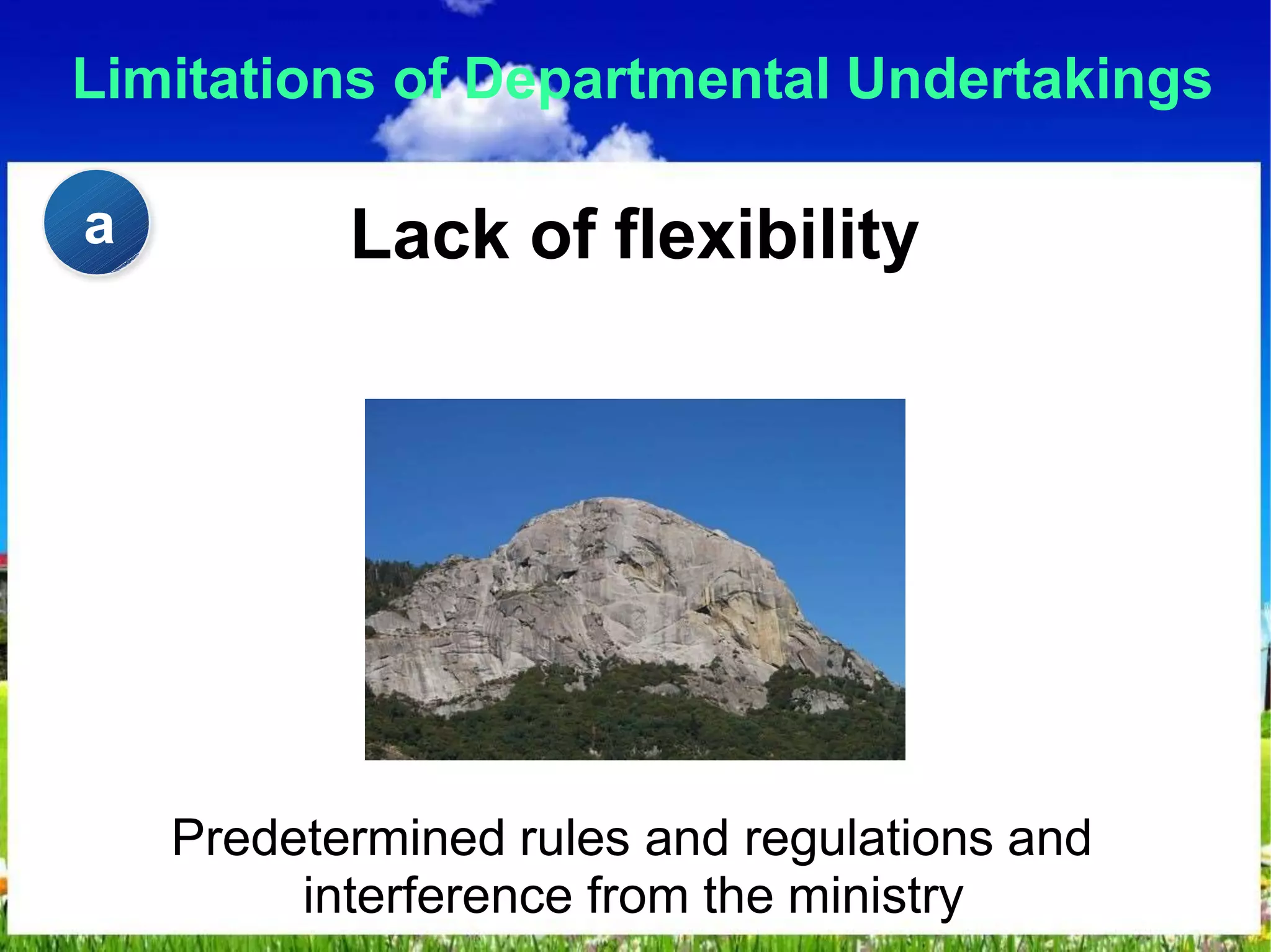
Lack of flexibility
Predetermined rules and regulations and
interference from the ministry
a
Limitations of Departmental Undertakings
Delay in decisions
Approval from the government is necessary
to take decisions
b
Limitations of Departmental Undertakings
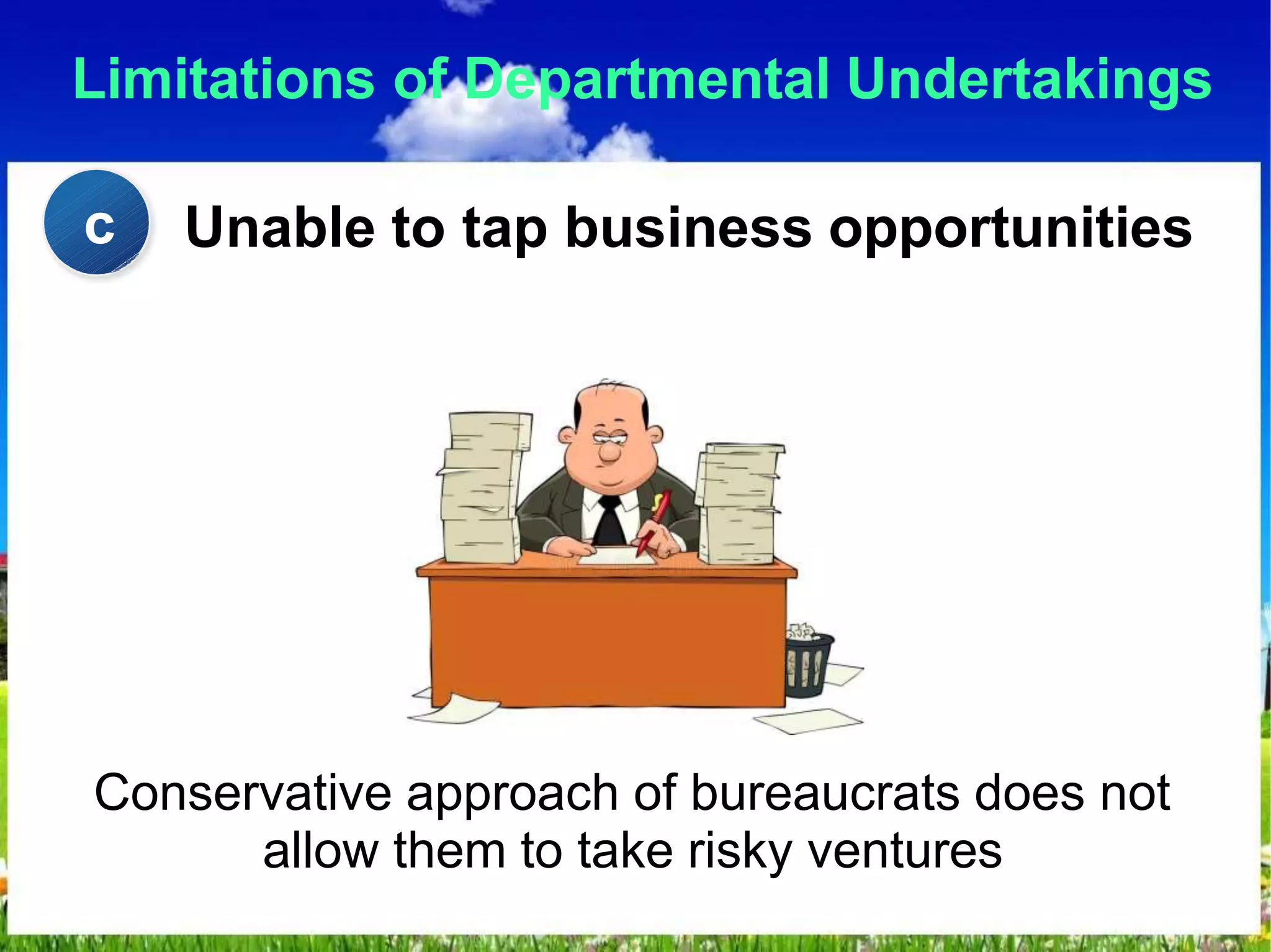
Unable to tap business opportunities
Conservative approach of bureaucrats does not
allow them to take risky ventures
c
Limitations of Departmental Undertakings
Red tapism and bureaucracy
Results delay in decision making and operations
d
Limitations of Departmental Undertakings
Political interference
These enterprises are subject political interference
through the ministry
e
Limitations of Departmental Undertakings
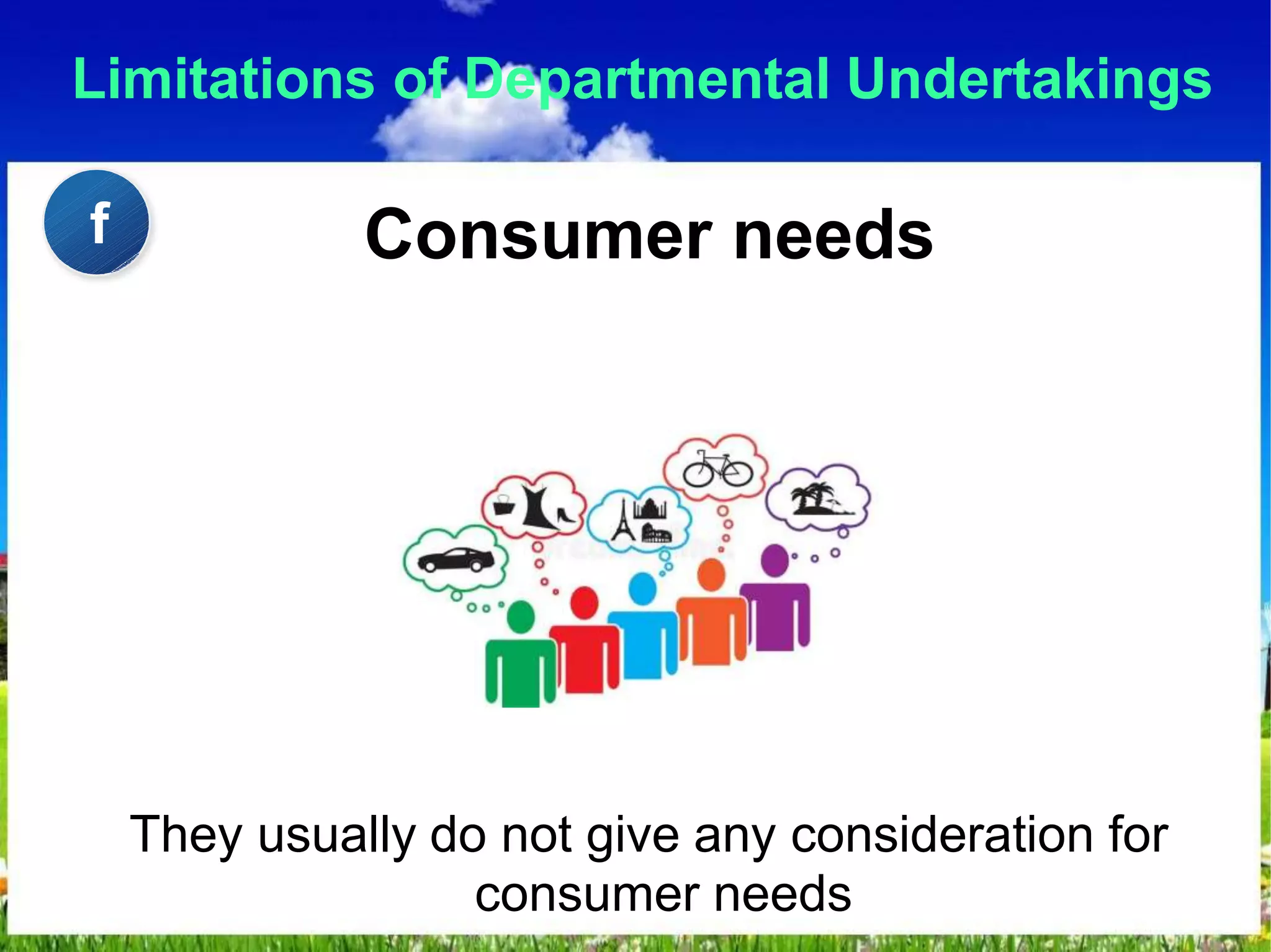
Consumer needs
They usually do not give any consideration for
consumer needs
f
Statutory Corporations
or
Public Corporations
Public Corporations
It is generally created as an autonomous
institution by passing a Special Act in
the Parliament or State Legislature
As a body corporate, it is a separate entity for legal
purposes and can sue and be sued, enter into
contracts and acquire property in its own name
Public Corporations
Some Important Public Corporations
KSRTCLife Insurance Corporation
Indian Airlines CorporationReserve Bank of India
Features of
Public Corporations
Features of Public Corporations
Formed by special Act
Created under a special Act of Parliament or
State Assembly
a
Features of Public Corporations
Ownership
Owned by the Government
b
Features of Public Corporations
Separate legal existence
It has a separate legal entity, so that it can own
properties and enter into contract in its own name
c
Features of Public Corporations
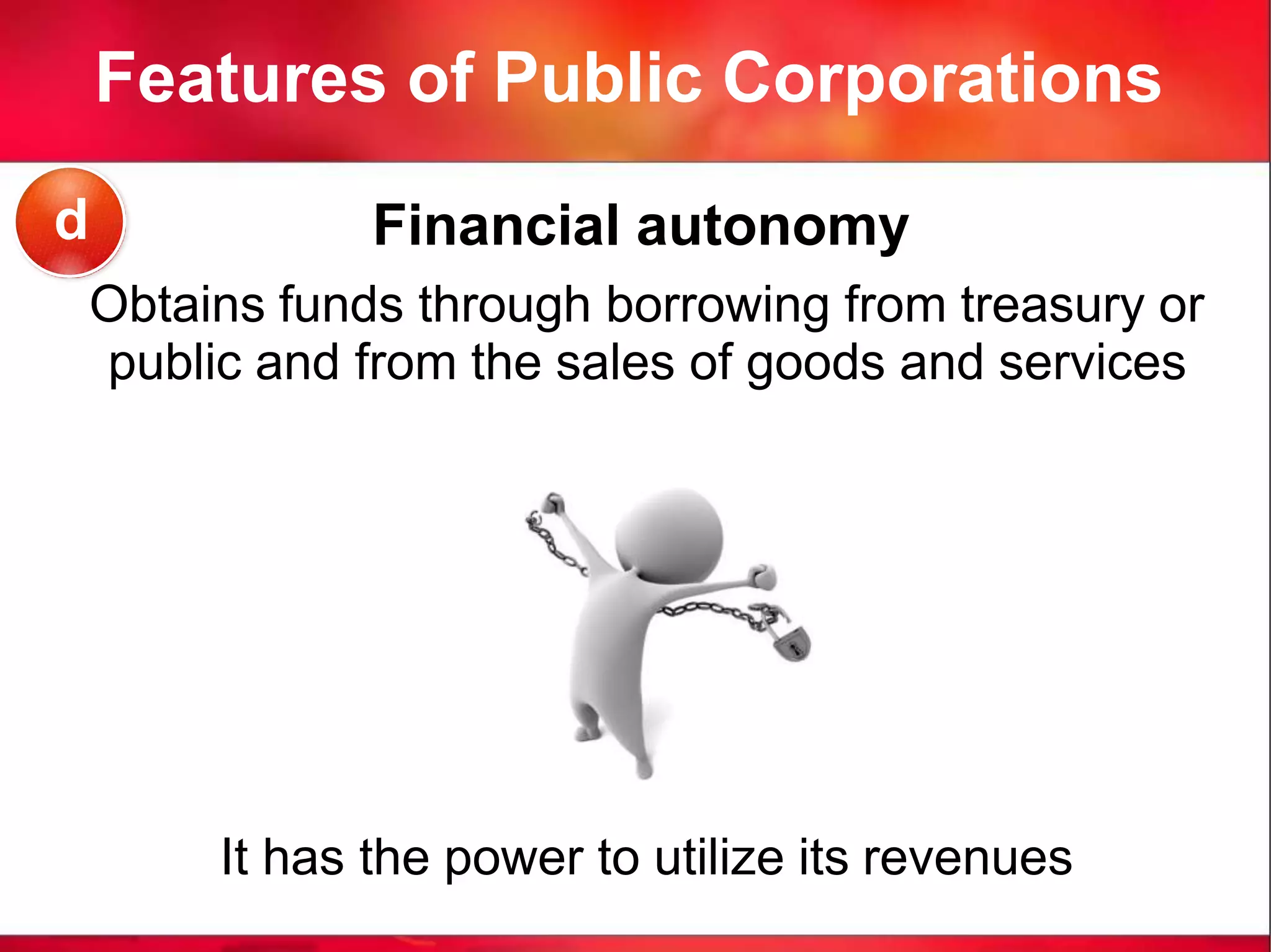
Financial autonomy
It has the power to utilize its revenues
d
Obtains funds through borrowing from treasury or
public and from the sales of goods and services
Features of Public Corporations
Employees
Appointed as per the terms and conditions of the
corporation and they are not to be treated as
government servants
e
Features of Public Corporations
Independent accounting and audit
It has its own accounting and audit, but not subject
to government audit and budget allocation
f
Merits of
Public Corporations
Merits of Public Corporations
High degree of flexibility
It enjoys flexibility of operations and financial and
managerial freedom since it is free from undesirable
government control
a
Merits of Public Corporations
Least government interference
As there is no budget allocation for funds from
government there is no much government control
b
Merits of Public Corporations
Autonomous status
They can frame their own policies and procedure
within the purview of the Act
c
Merits of Public Corporations
Helps in economic development
It contributes towards economic development in a
big way
d
Merits of Public Corporations
Stability
Since they are not subject to political changes, they
can take long term business policies
e
Limitations of
Public Corporations
Limitations of Public Corporations
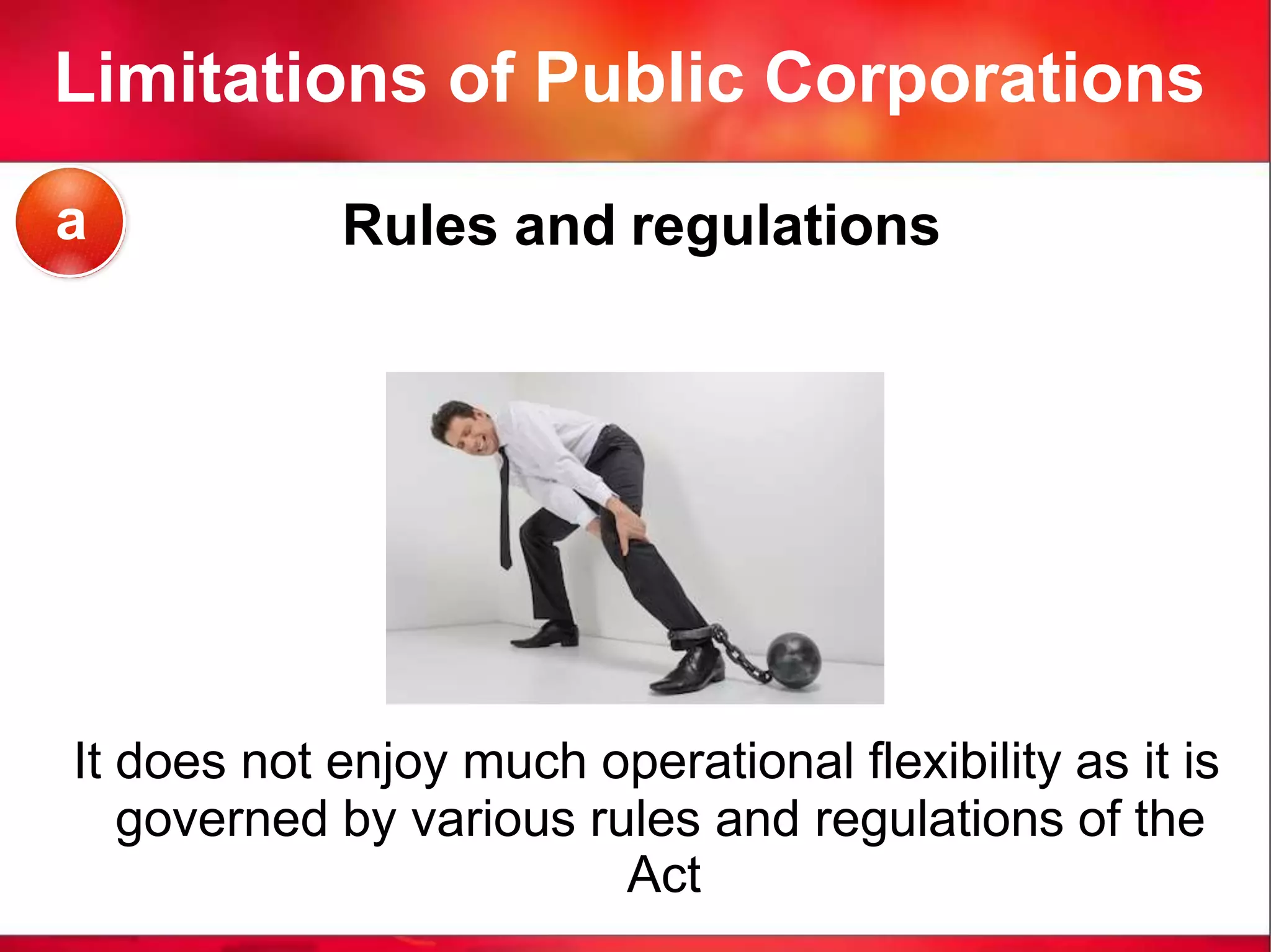
Rules and regulations
It does not enjoy much operational flexibility as it is
governed by various rules and regulations of the
Act
a
Limitations of Public Corporations
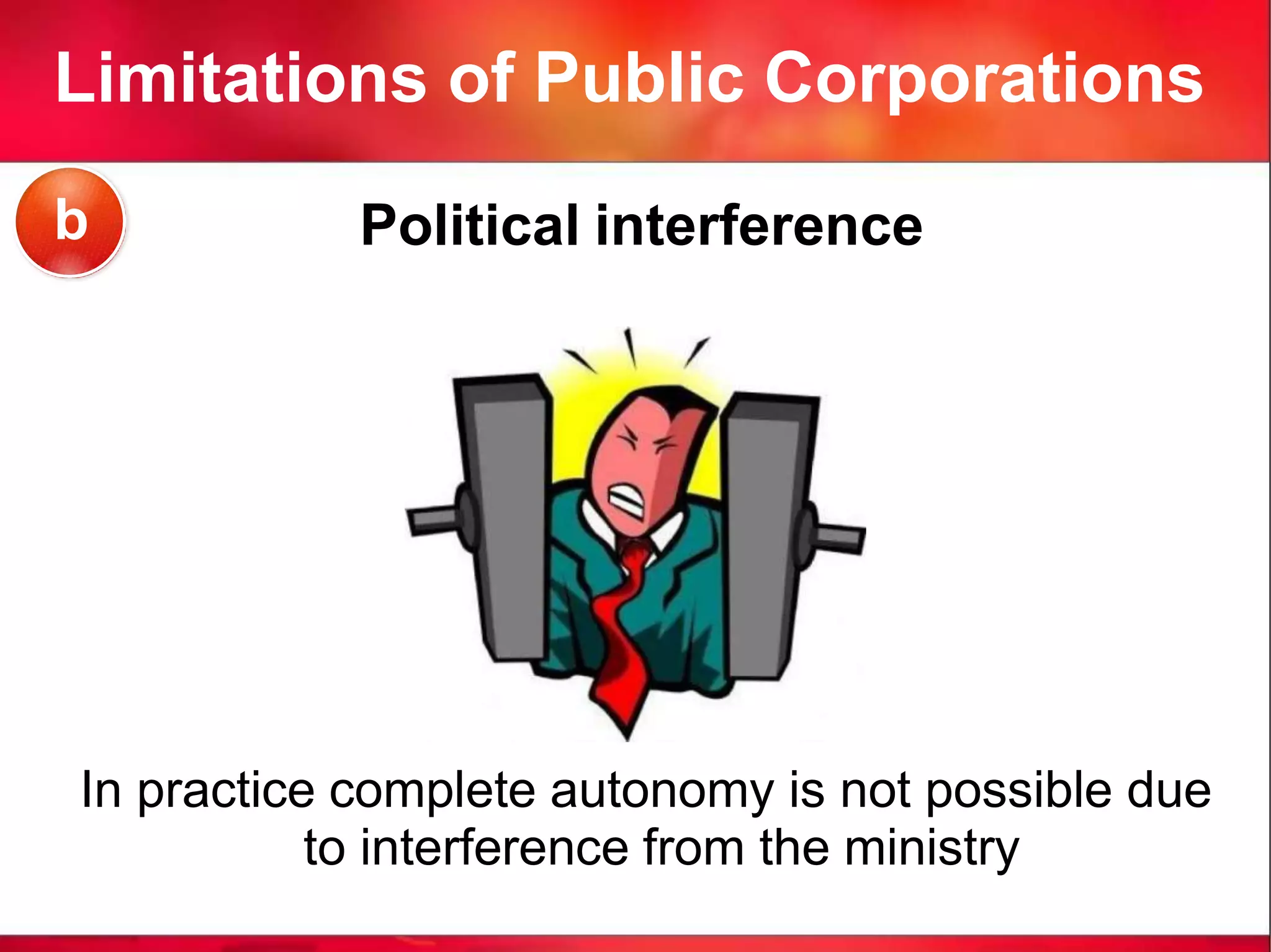
Political interference
In practice complete autonomy is not possible due
to interference from the ministry
b
Limitations of Public Corporations
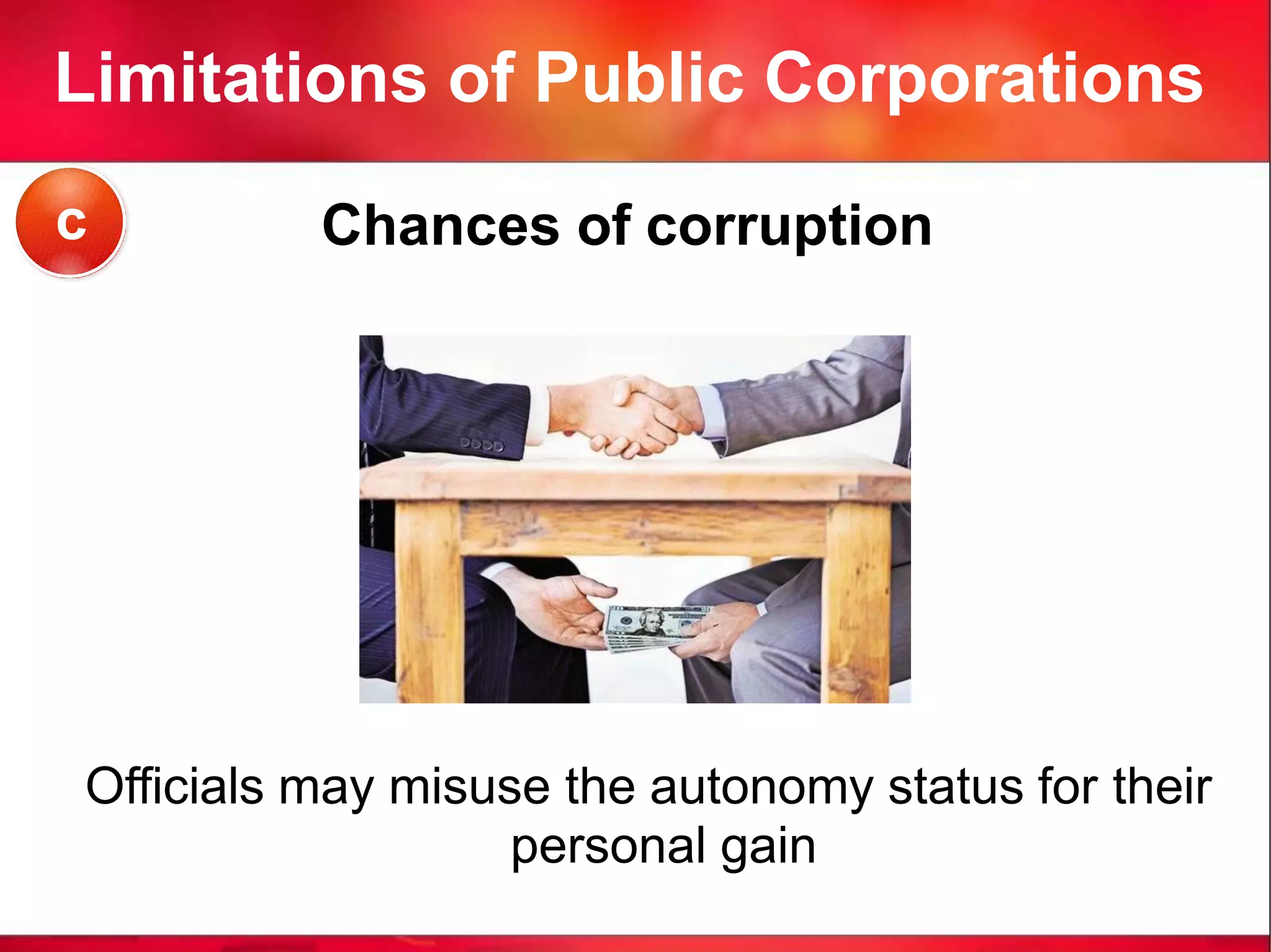
Chances of corruption
Officials may misuse the autonomy status for their
personal gain
c
Limitations of Public Corporations
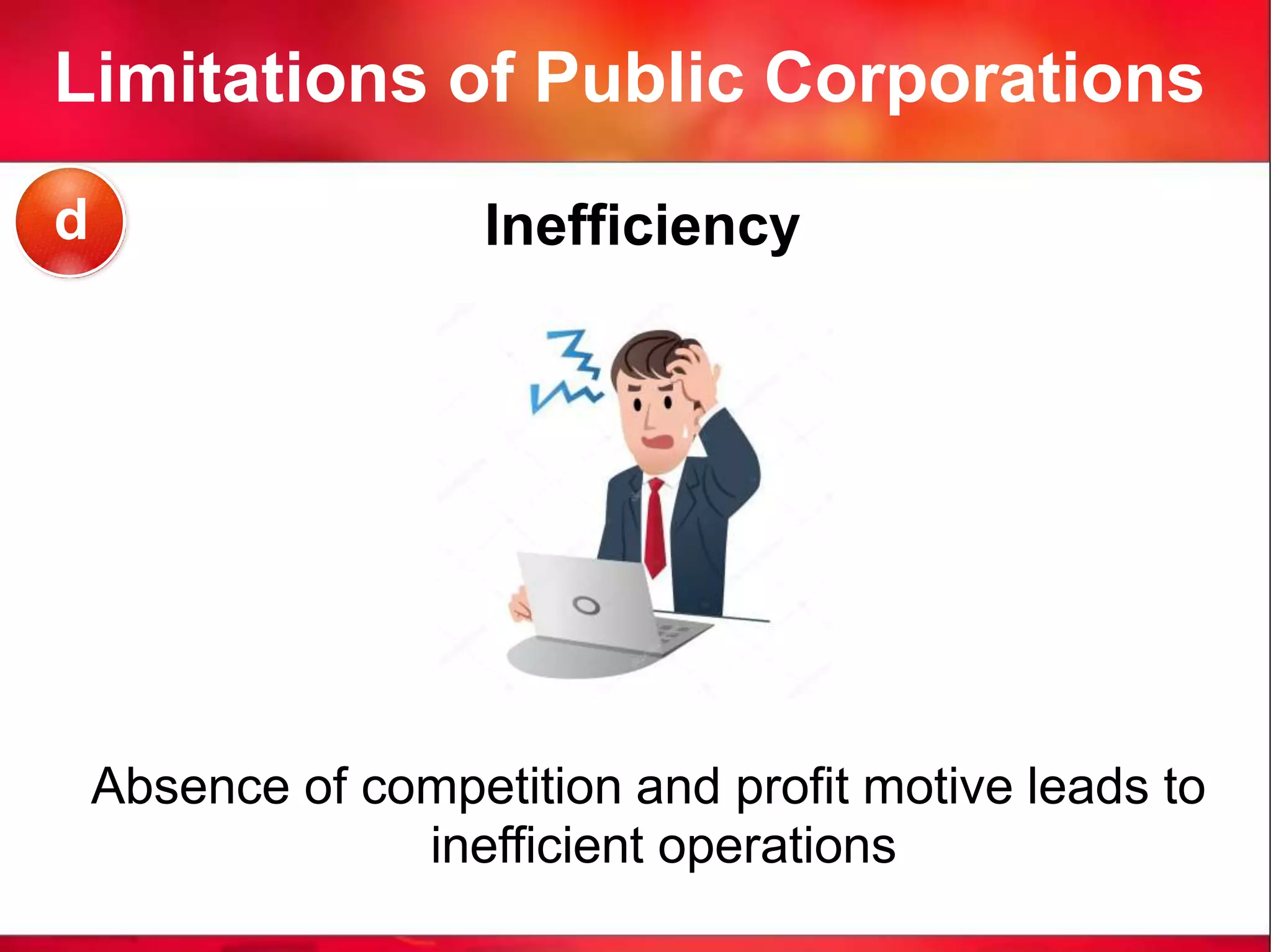
Inefficiency
Absence of competition and profit motive leads to
inefficient operations
d
Limitations of Public Corporations
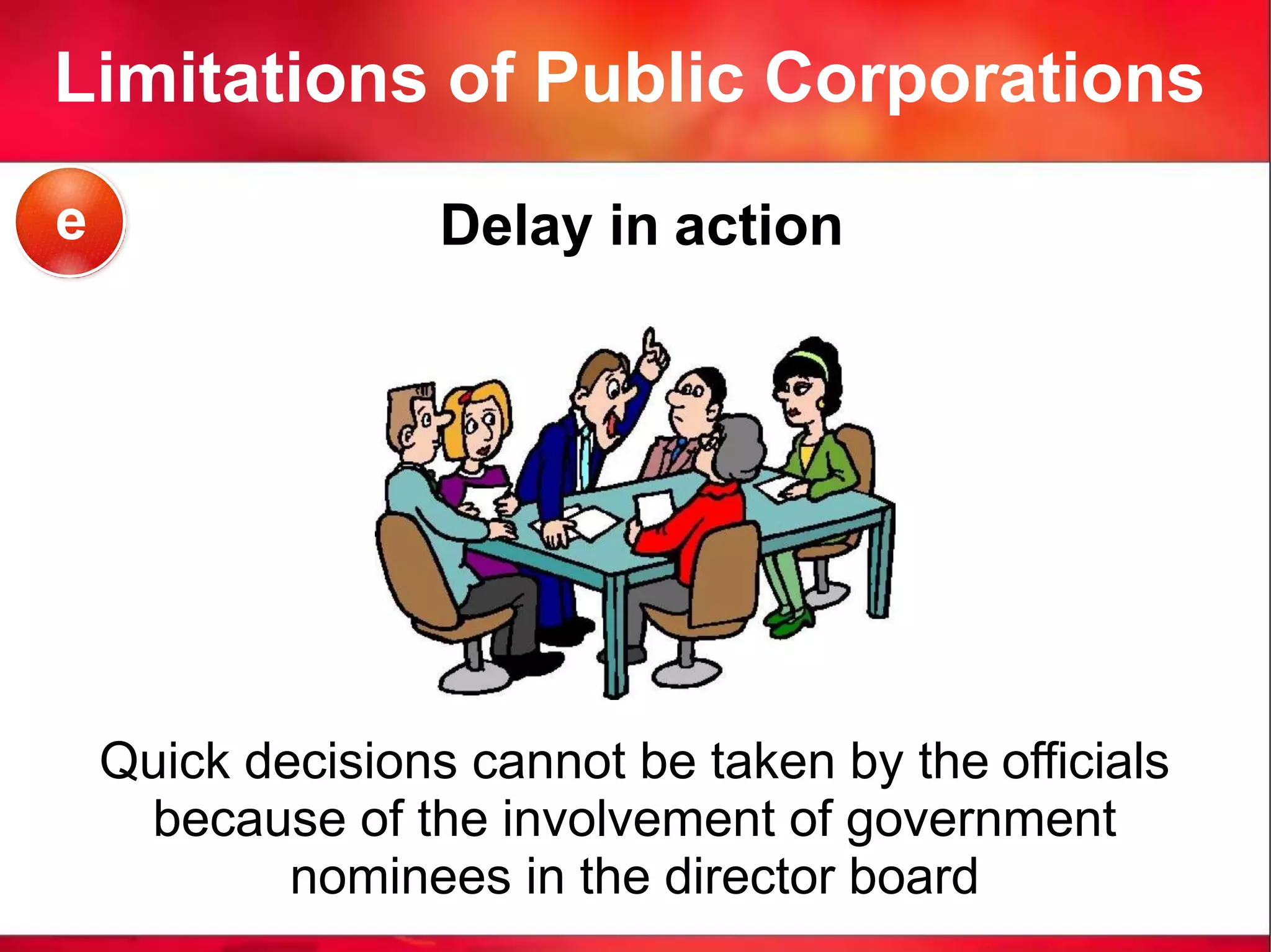
Delay in action
Quick decisions cannot be taken by the officials
because of the involvement of government
nominees in the director board
e
Government
Company
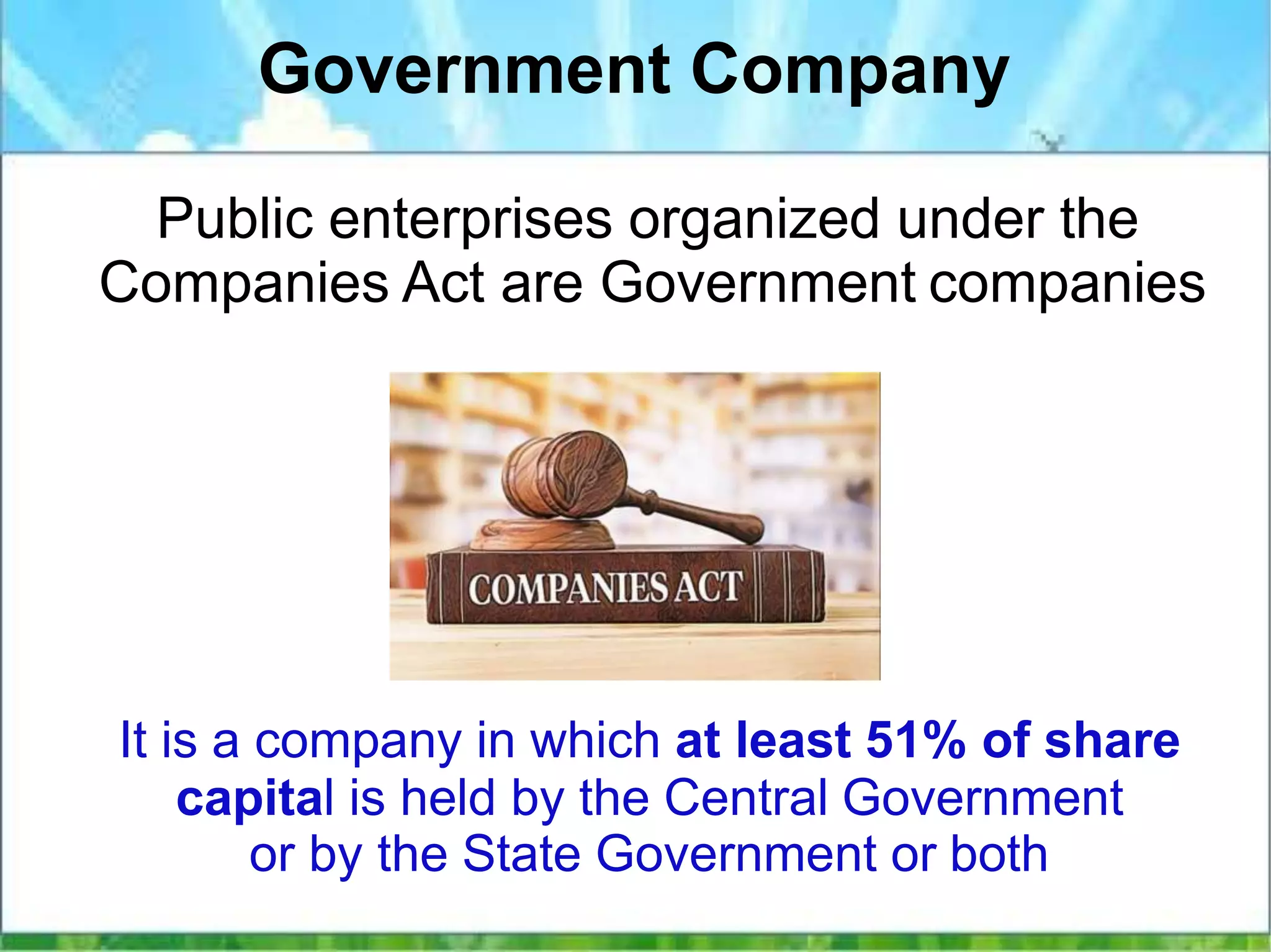
Government Company
Public enterprises organized under the
Companies Act are Government companies
It is a company in which at least 51% of share
capital is held by the Central Government
or by the State Government or both
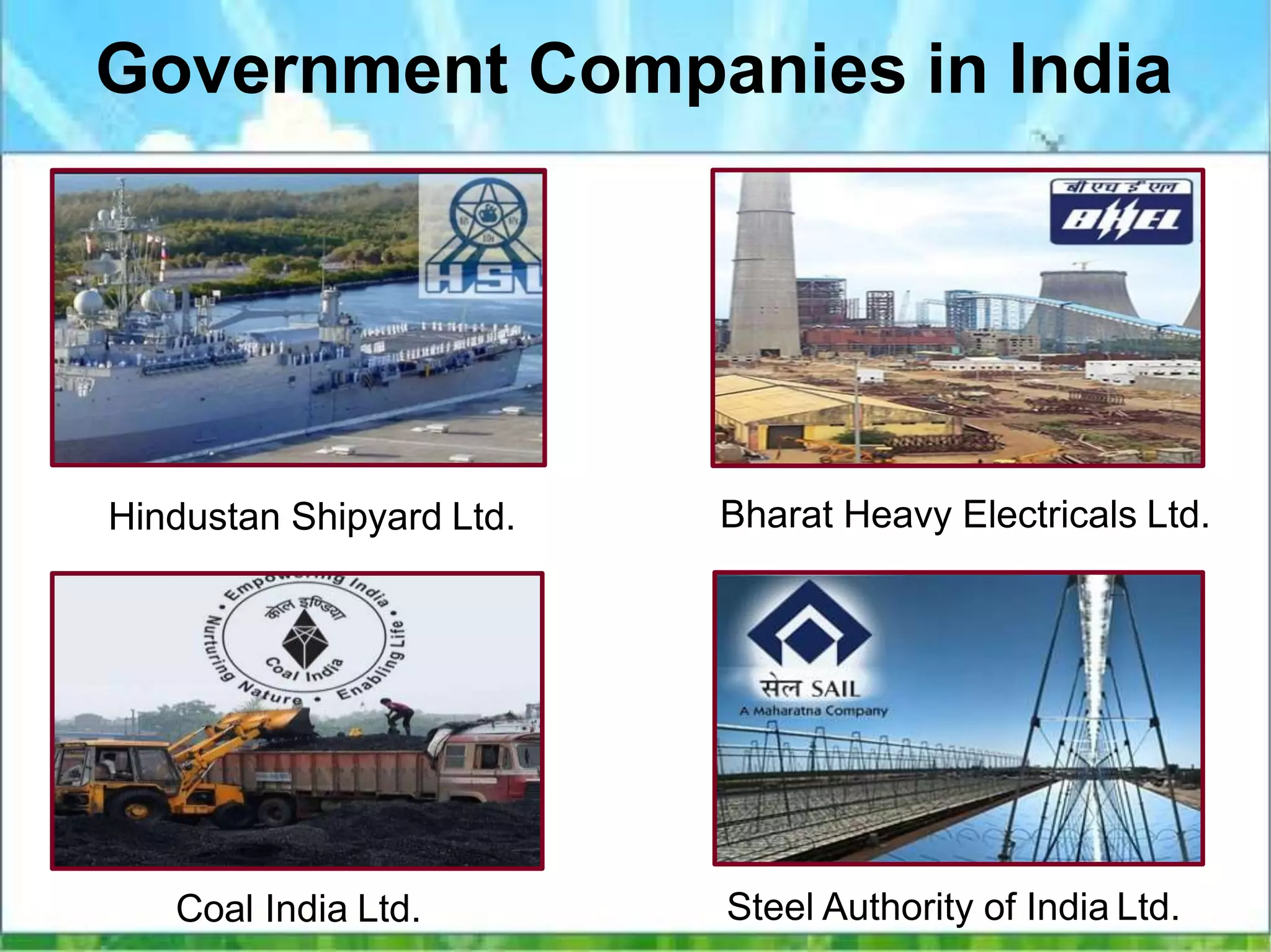
Government Companies in India
Steel Authority of India Ltd.
Bharat Heavy Electricals Ltd.Hindustan Shipyard Ltd.
Coal India Ltd.
Features of
Government Company
Features of Government Company
Incorporation
It is incorporated under Companies Act
a
Features of Government Company
Separate legal entity
It can own properties, enter into contracts, sue and
be sued in its own name
b
Features of Government Company
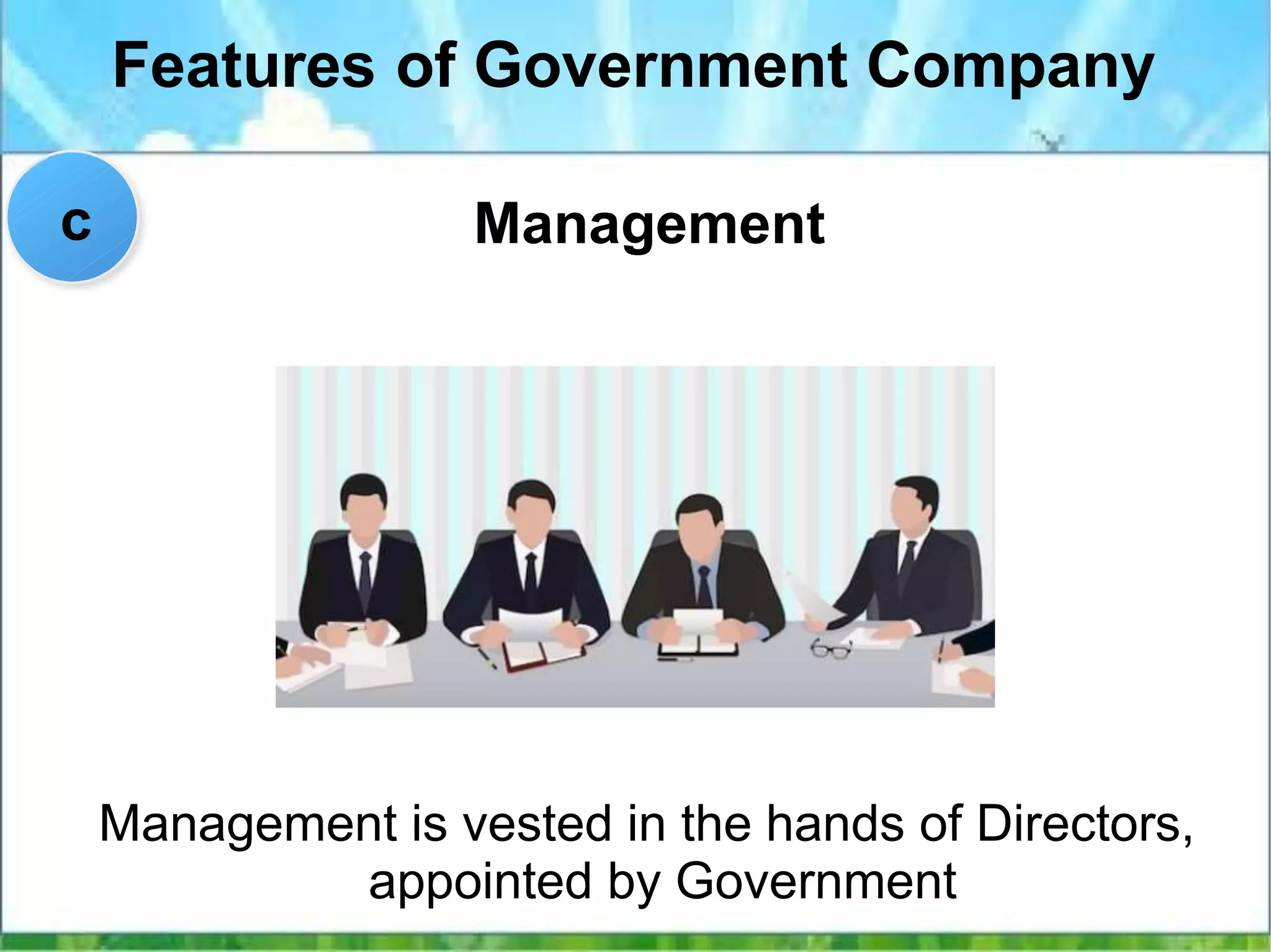
Management
Management is vested in the hands of Directors,
appointed by Government
c
Features of Government Company
Memorandum and Articles ofAssociation
Objects of the company and its rules and
regulations are contained in these documents
d
Features of Government Company
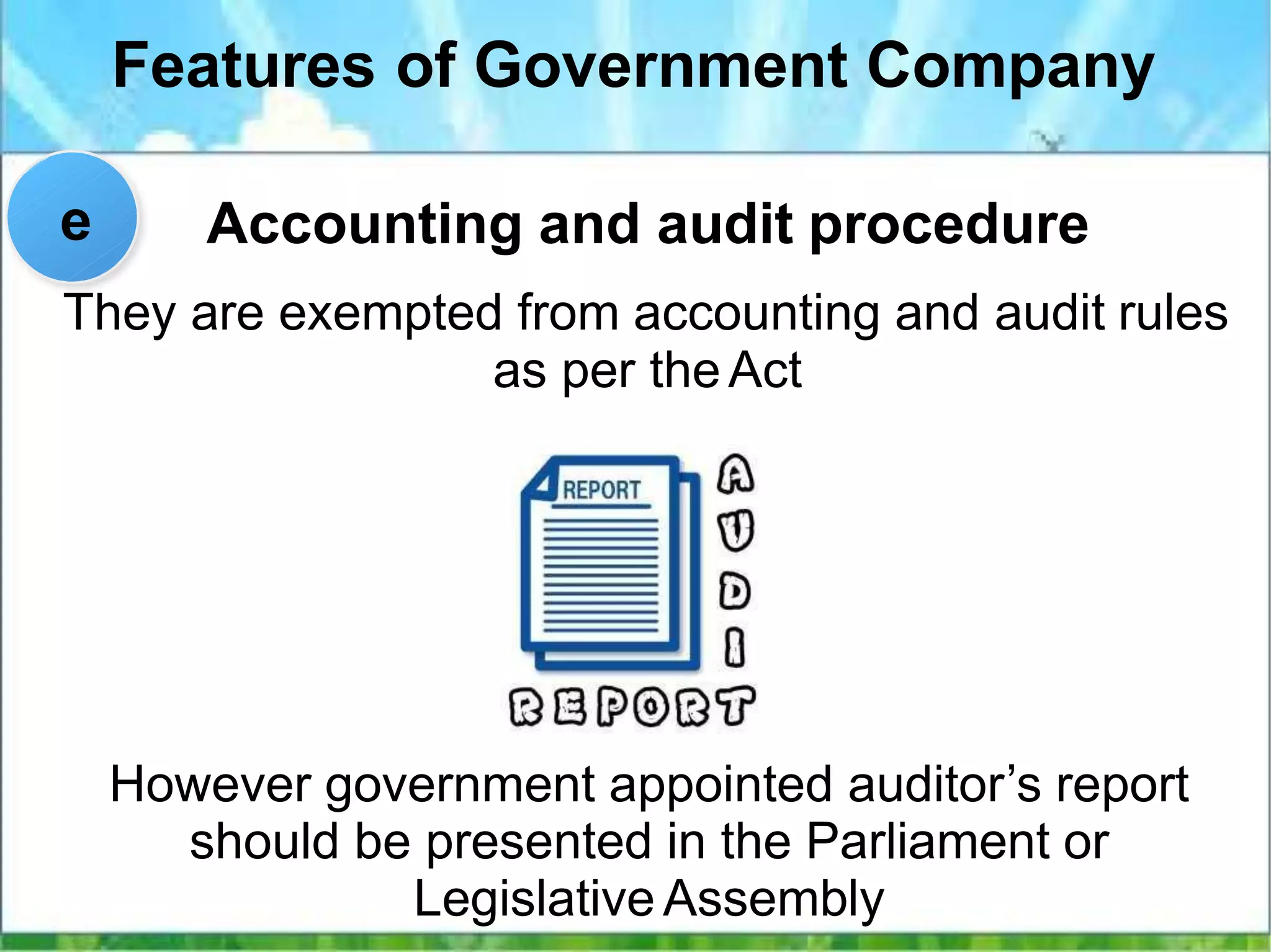
Accounting and audit procedure
However government appointed auditor’s report
should be presented in the Parliament or
Legislative Assembly
e
They are exempted from accounting and audit rules
as per theAct
Features of Government Company
Funds
Investment in government companies is raised by
government shareholdings and from private
shareholders
f
Merits of
Government Company
Merits of Government Company
Easy formation by registration
No need of enactment of special Act in Parliament
a
Merits of Government Company
Separate legal entity
It has separate existence apart from the government
b
Merits of Government Company
Quick decisions
Prompt decisions in time as it has autonomy power
c
Merits of Government Company
Prevents unhealthy business
It can control unhealthy business practices by
providing goods and services at a reasonable price
d
Limitations of
Government Company
Limitations of Government Company
Autonomy is just for name sake
Since the government is the only shareholder in
some companies, provisions of Companies Act have
no relevance.
a
Limitations of Government Company
No accountability
Even though major investment is made by the
government, it is not answerable to the Parliament
b
Limitations of Government Company
Main purpose is not served
It defeats the main purpose by registering like other
companies
c
Being the major shareholder, government controls
the affairs of the company
Changing Role of
Public Sector
Changing Role of Public Sector
Public sector plays an important role in India’s
economic development
The most important objective of public sector is
economic growth with social justice and providing
service to the society
Importance of
Public Sector
Importance of Public Sector
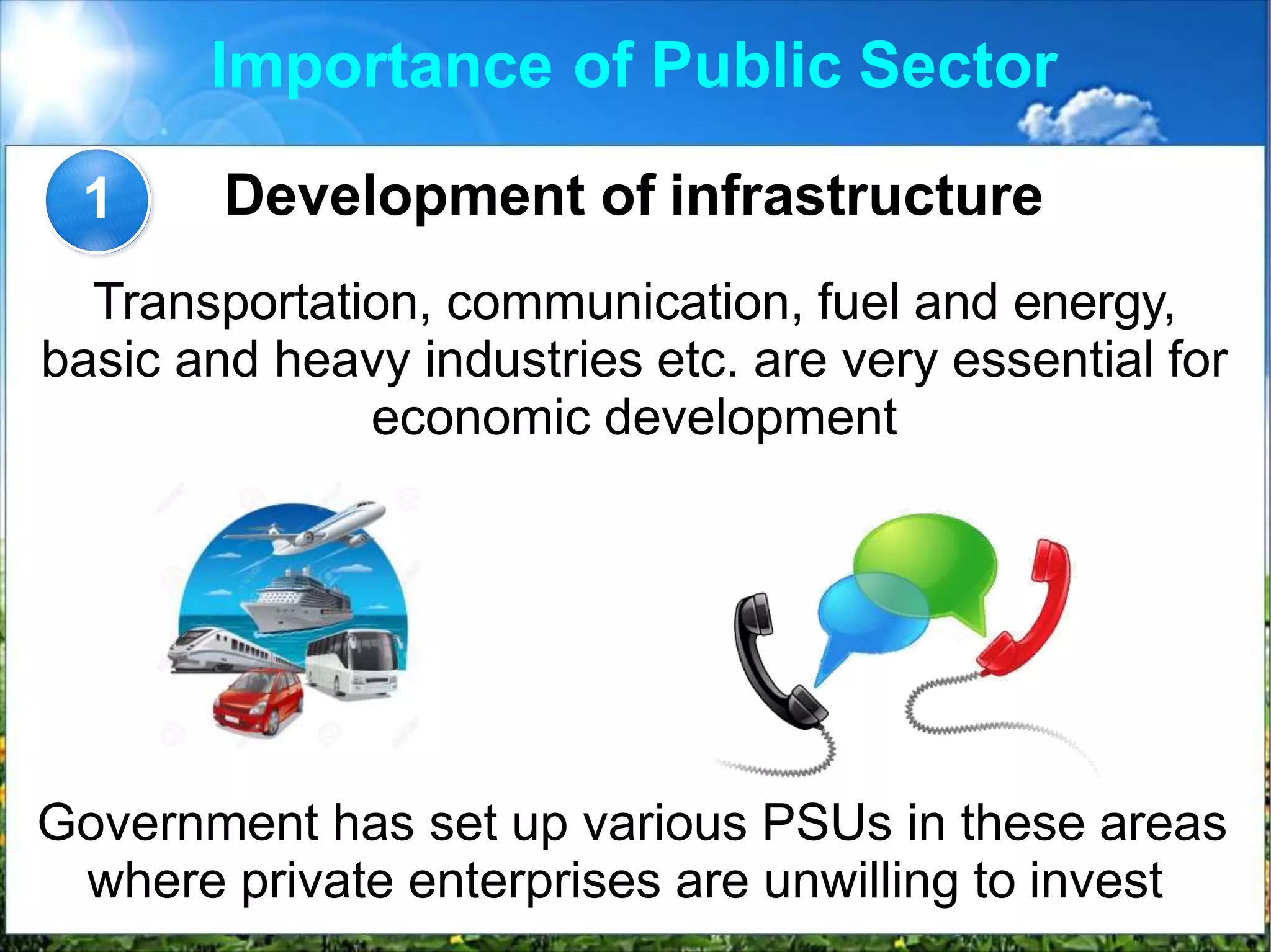
Development of infrastructure
Transportation, communication, fuel and energy,
basic and heavy industries etc. are very essential for
economic development
1
Government has set up various PSUs in these areas
where private enterprises are unwilling to invest
Importance of Public Sector
Regional balance
To maintain balanced regional development the
government has taken initiative to start a number of
public sector units in backward areas
2
Importance of Public Sector
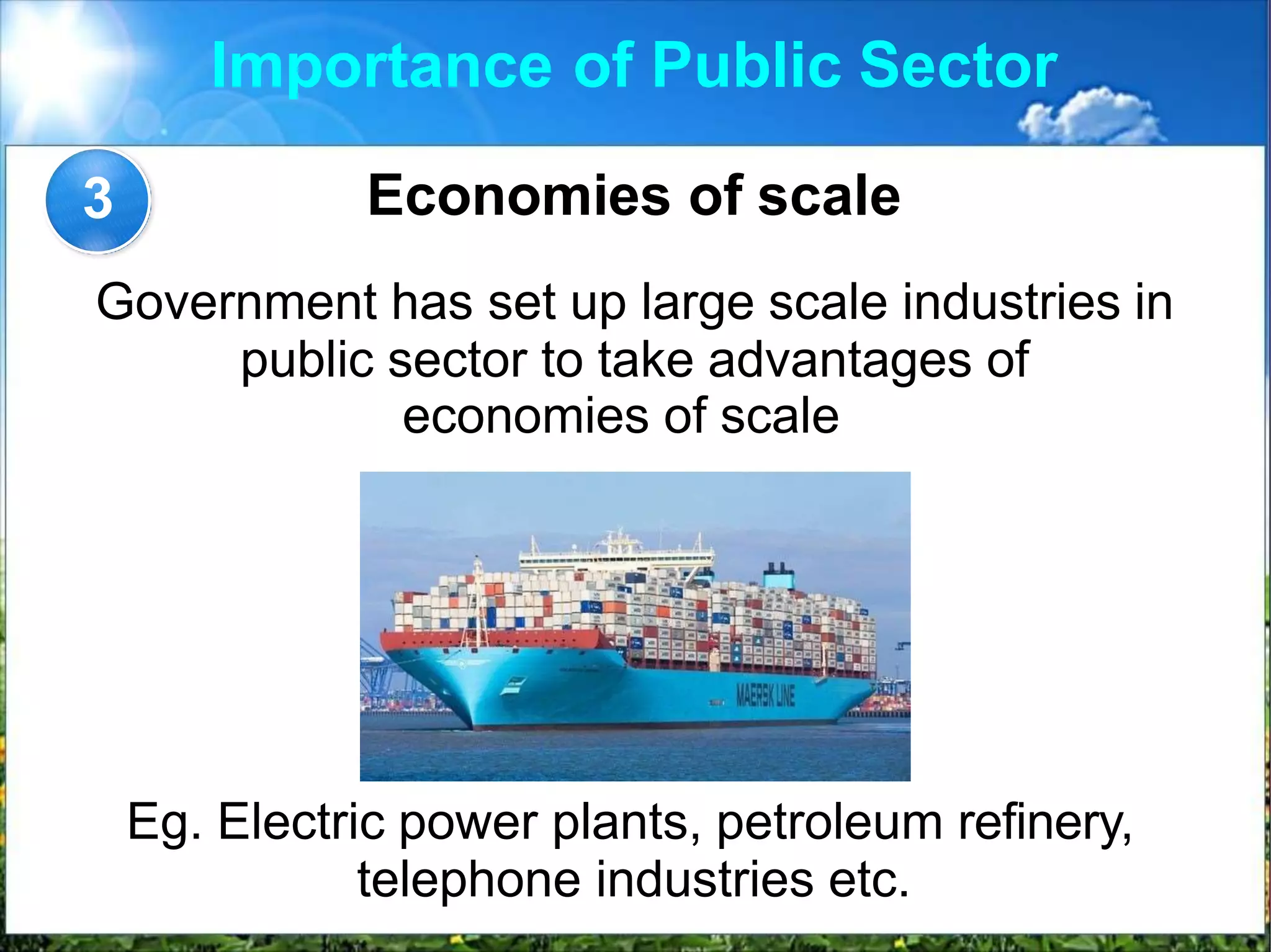
Economies of scale
Government has set up large scale industries in
public sector to take advantages of
economies of scale
3
Eg. Electric power plants, petroleum refinery,
telephone industries etc.
Importance of Public Sector
Check over concentration of economic power
The flow of economic resources to the private sector
entrepreneurs can be controlled up to a
certain extent
4
Importance of Public Sector
Import substitution
Government set up public sector units for production
of capital goods which were imported earlier
5
Several public sector companies are producing goods
on a large scale, thus playing an important role in
expanding exports of the country also
Government Policy
Towards
Public Sector
Government of India introduced four major
reforms in the public sector thorough the
Industrial Policy in 1991
Government Policy
a
Restructure and revive potentially viable
Public Sector Undertakings (PSUs)
Government Policy
b
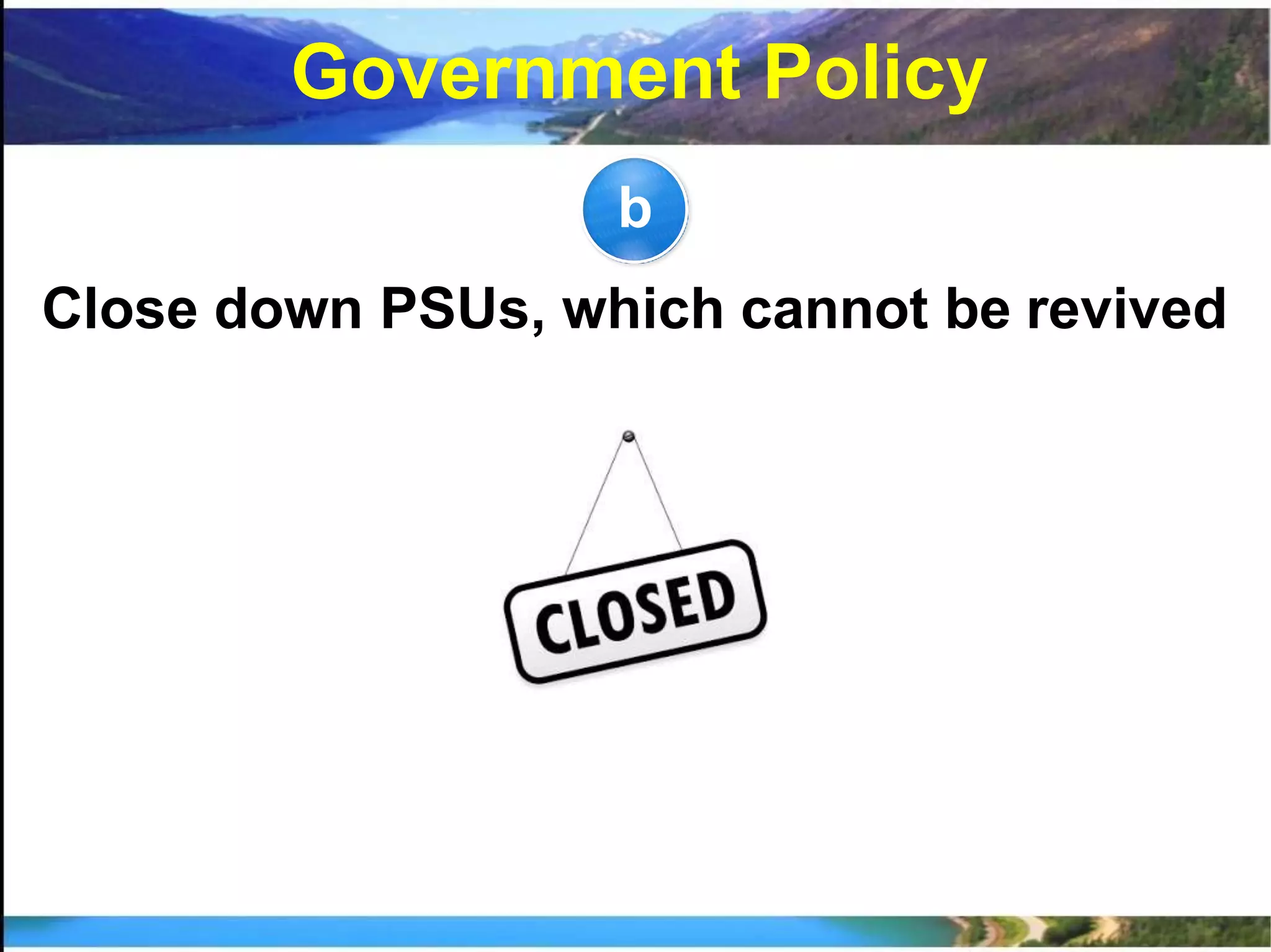
Close down PSUs, which cannot be revived
Government Policy
c
Bring down government equity
in all non-strategic PSUs to 26% or
lower if necessary
Government Policy
d
Protect the interest of workers
Government Policy
Measures Taken by
Govt. to Reform
Public Sector
Measures Taken by Govt.a
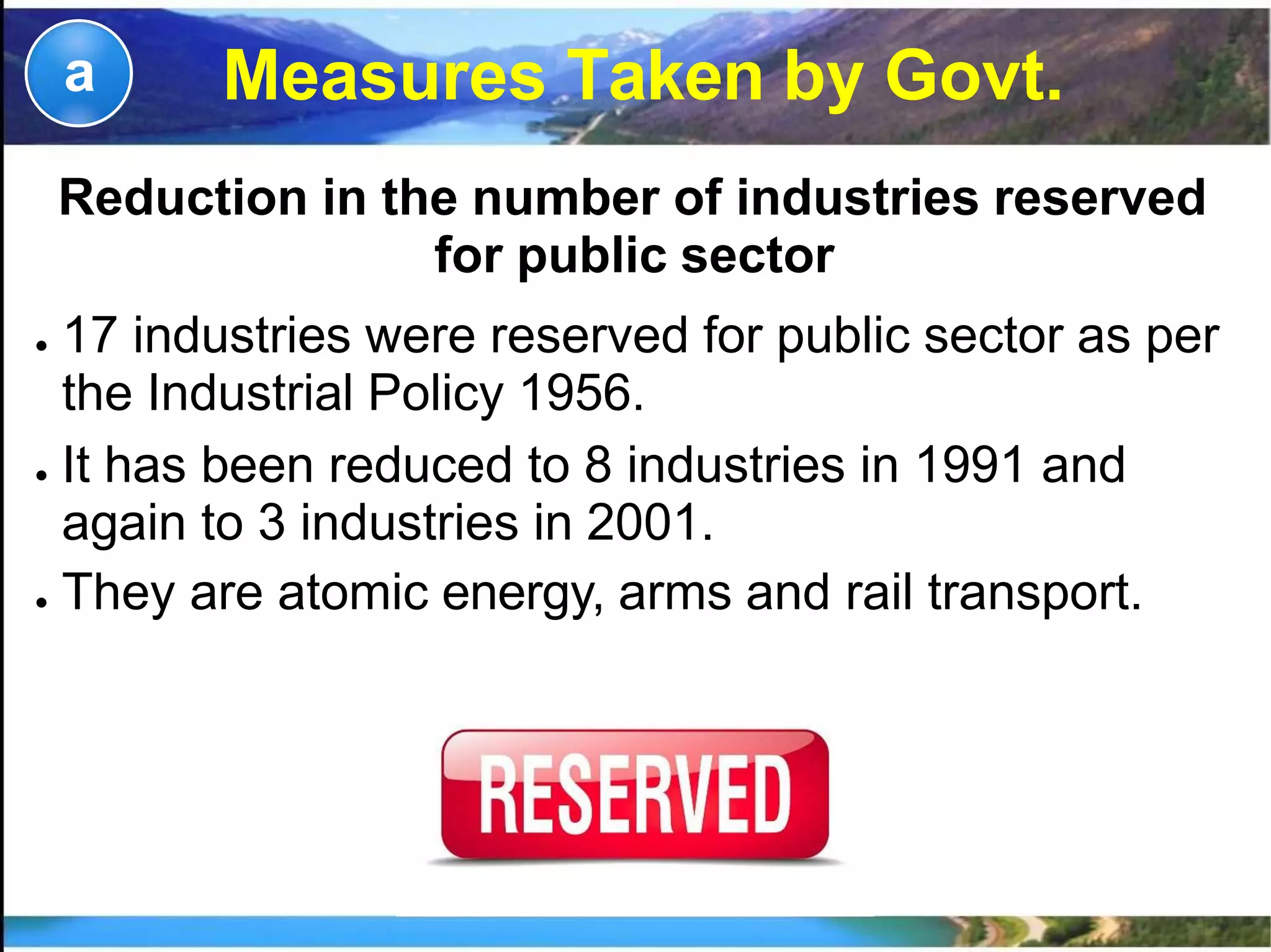
Reduction in the number of industries reserved
for public sector
● 17 industries were reserved for public sector as per
the Industrial Policy 1956.
● It has been reduced to 8 industries in 1991 and
again to 3 industries in 2001.
● They are atomic energy, arms and rail transport.
Measures Taken by Govt.
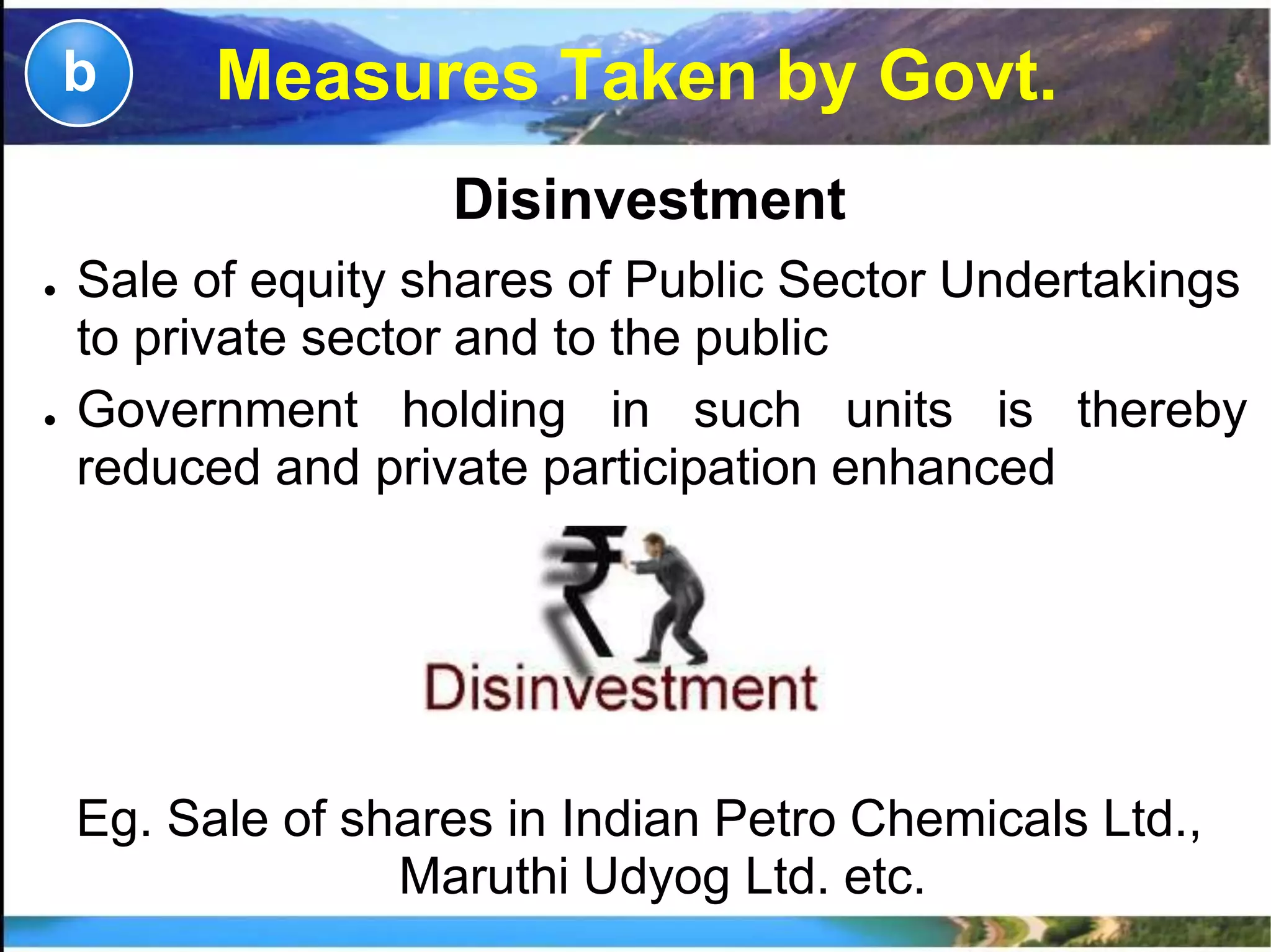
Disinvestment
● Sale of equity shares of Public Sector Undertakings
to private sector and to the public
● Government holding in such units is thereby
reduced and private participation enhanced
Eg. Sale of shares in Indian Petro Chemicals Ltd.,
Maruthi Udyog Ltd. etc.
b
Measures Taken by Govt.c
Protection of sick units
Highly sick public enterprises which are unlikely to
be revived will be referred to the Board for Industrial
and Financial Reconstruction (BIFR) for
rehabilitation
Measures Taken by Govt.d
Memorandum of understanding (MOU)
● To improve the performance of PSUs, government
introduced MOU system by giving clear target and
operational autonomy to achieve those targets
● Here PSUs are accountable for specified results
Global Enterprises
or
Multinational
Companies
Multinational Companies
● Company carrying on business in two or more
countries
● Company that operates in several countries
● Company has factories, branches or offices in
more than one country
● Branches are also called Majority Owned
Foreign Affiliates (MOFA)
Global Enterprises
Multinational Companies
It is also known as Multinational corporation,
Transnational Corporation, Global Giant, World
Enterprise, International Enterprise, MNCs etc.
Global Enterprises
Multinational Companies – Examples
Global Enterprises
Features of
Global Enterprises
Huge capital
They have large capital investment as they are
running large scale business units
a
Investors and financial institutions of the host
country will be ready to invest in MNCs because
of their credibility
Features of Global Enterprises
Foreign collaboration
Global enterprises usually collaborate with Indian
companies, both private and public sector, by this
both the parties will be benefited by sharing
technology, brand name etc.
b Features of Global Enterprises
Advanced technology
MNCs are able to provide world class products
of international standards by using advanced
technology in the areas of production,
marketing etc.
c Features of Global Enterprises
Marketing strategies
They adopt aggressive marketing techniques
to increase the sales in a short period
d
They have advanced marketing information
system, advertising and sales promotion
techniques and a good brand name
Features of Global Enterprises
Expansion of market territory
They can extent their markets very easily to
the foreign countries as they are running the
branches in various nations
e Features of Global Enterprises
Product innovation
Their products are always highly innovative as they
are running their own research and development
wing for developing new products and superior
designs for existing products
f Features of Global Enterprises
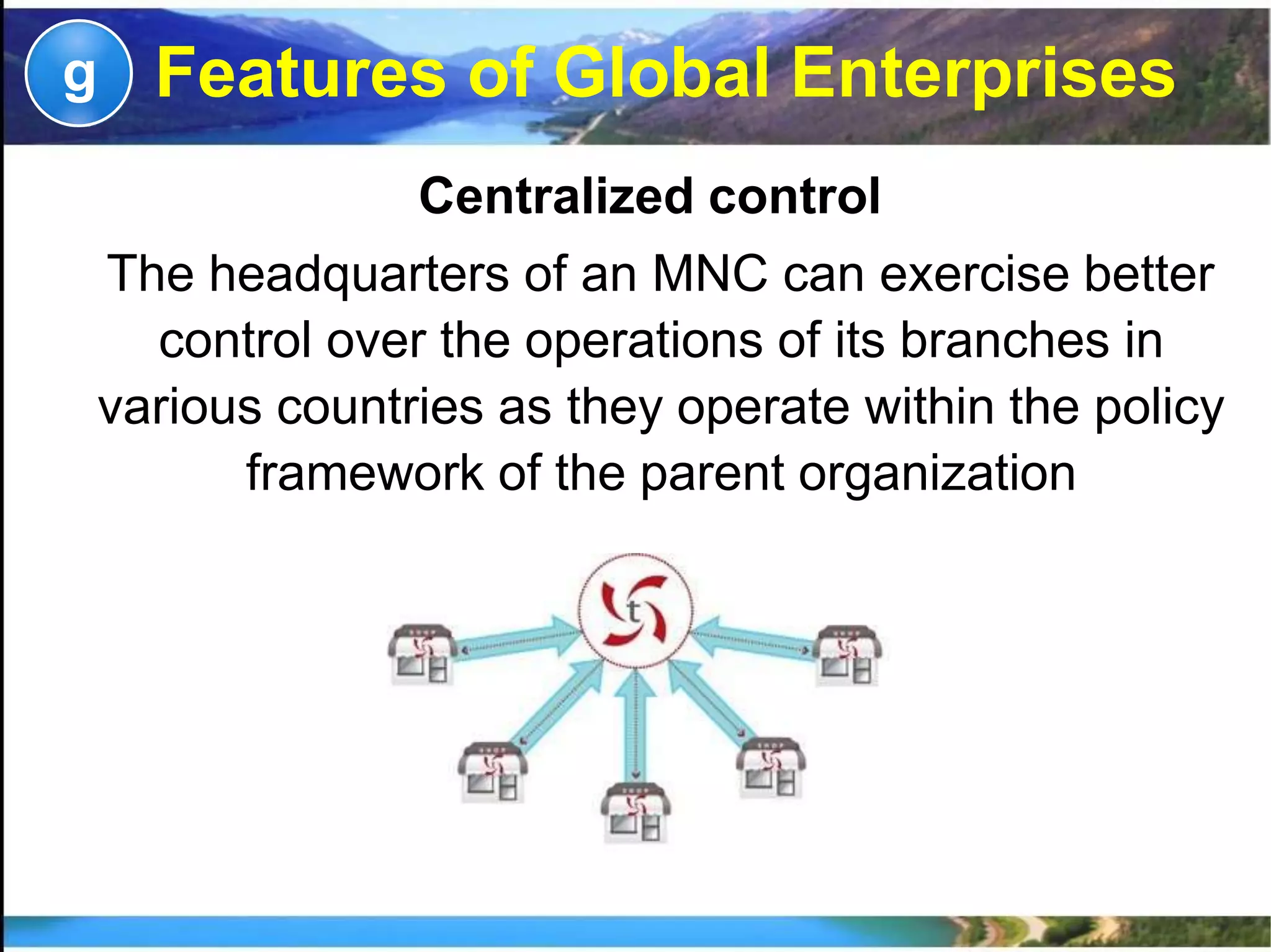
Centralized control
The headquarters of an MNC can exercise better
control over the operations of its branches in
various countries as they operate within the policy
framework of the parent organization
g Features of Global Enterprises
Joint Ventures
JVs
An association of two or more individuals or
organizations formed by agreement for a common
purpose or mutual benefit is called a joint venture
These organizations may be private, government or
a foreign company
Joint Ventures
Usually JVs are formed to share strengths,
minimize risks and to increase competitive
advantage in the market place
Eg. Bajaj Allianze Insurance Co., Mahindra –
Renault Ltd, Air Asia India, Maruthi andSuzuki,
Yamaha and Mahindra.
Joint Ventures
Benefits of a
Joint Venture
Business
1 Increased resources and capacity
JVs can easily expand their business and they are
able to face market challenges, reap the benefits of
economies of scale
Benefits of Joint Ventures
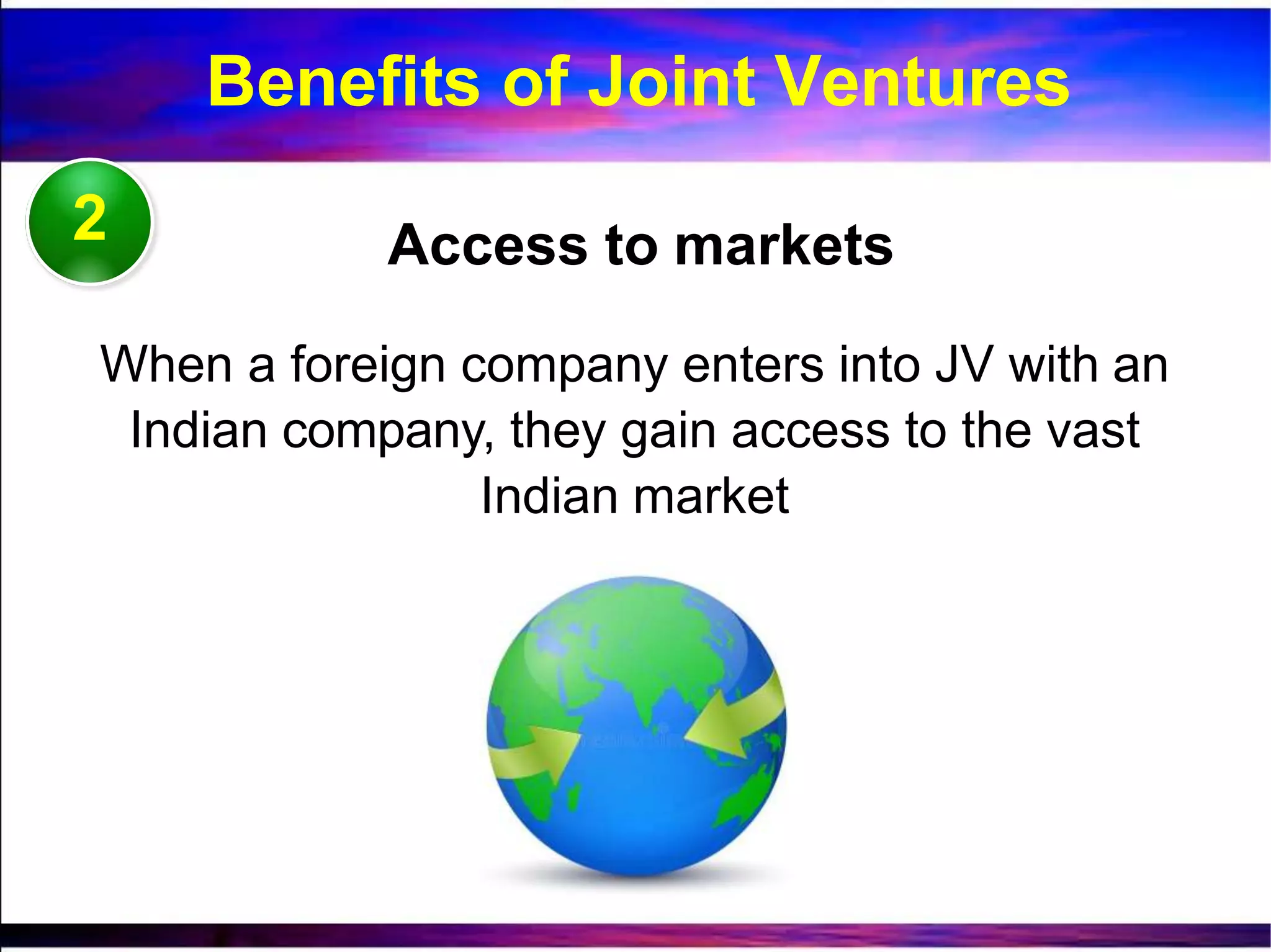
2 Access to markets
When a foreign company enters into JV with an
Indian company, they gain access to the vast
Indian market
Benefits of Joint Ventures
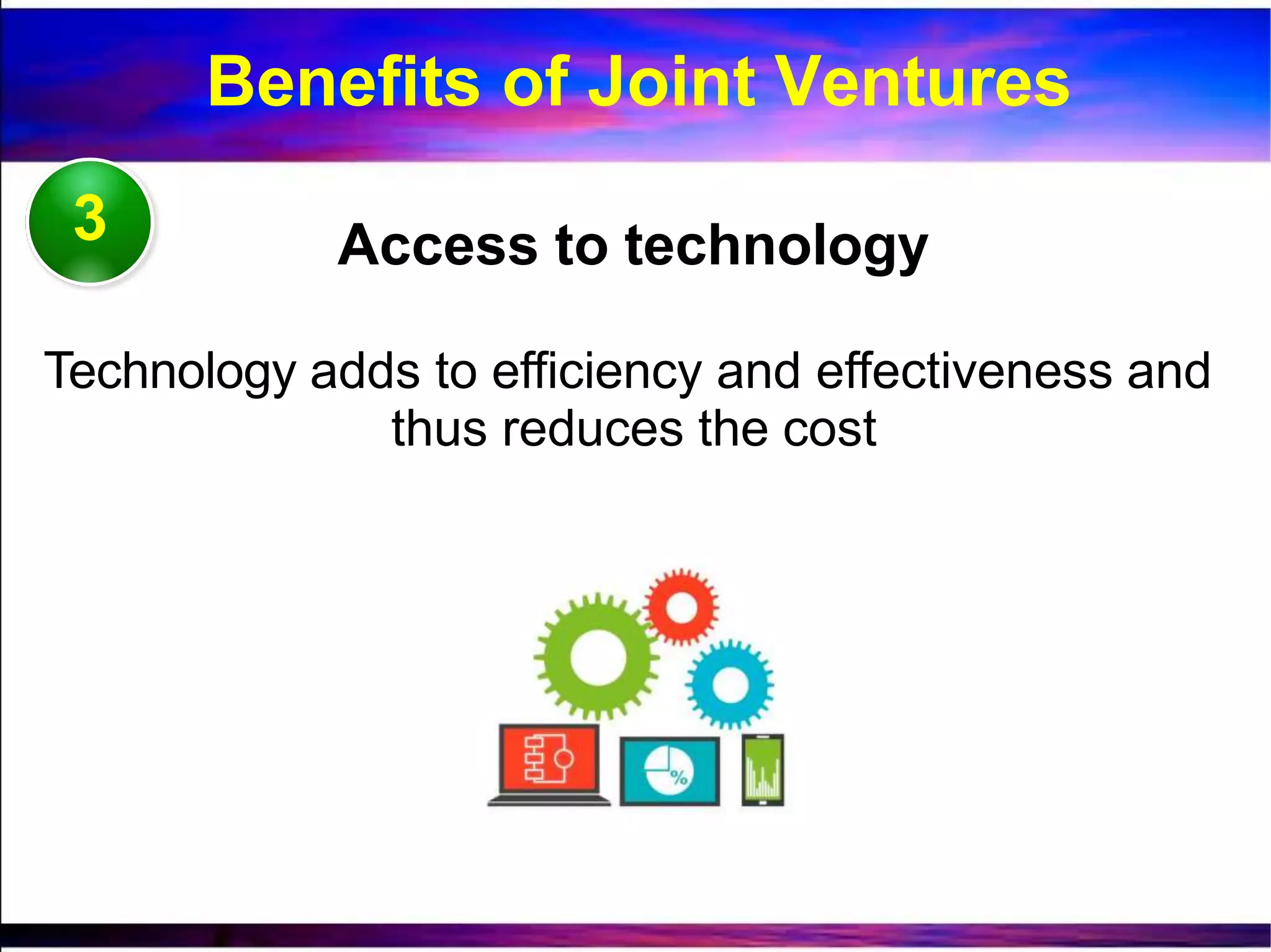
3 Access to technology
Technology adds to efficiency and effectiveness and
thus reduces the cost
Benefits of Joint Ventures
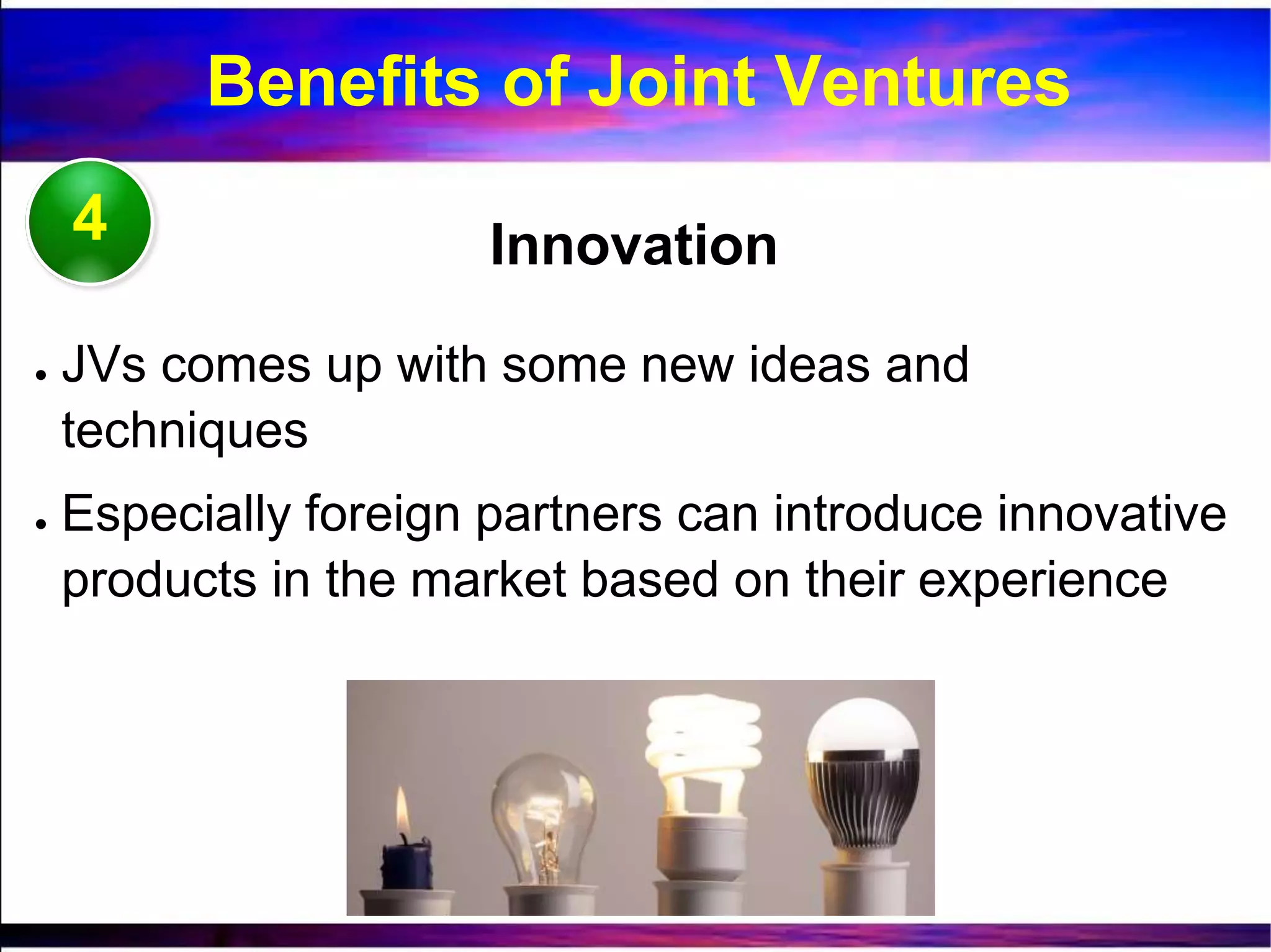
4 Innovation
● JVs comes up with some new ideas and
techniques
● Especially foreign partners can introduce innovative
products in the market based on their experience
Benefits of Joint Ventures
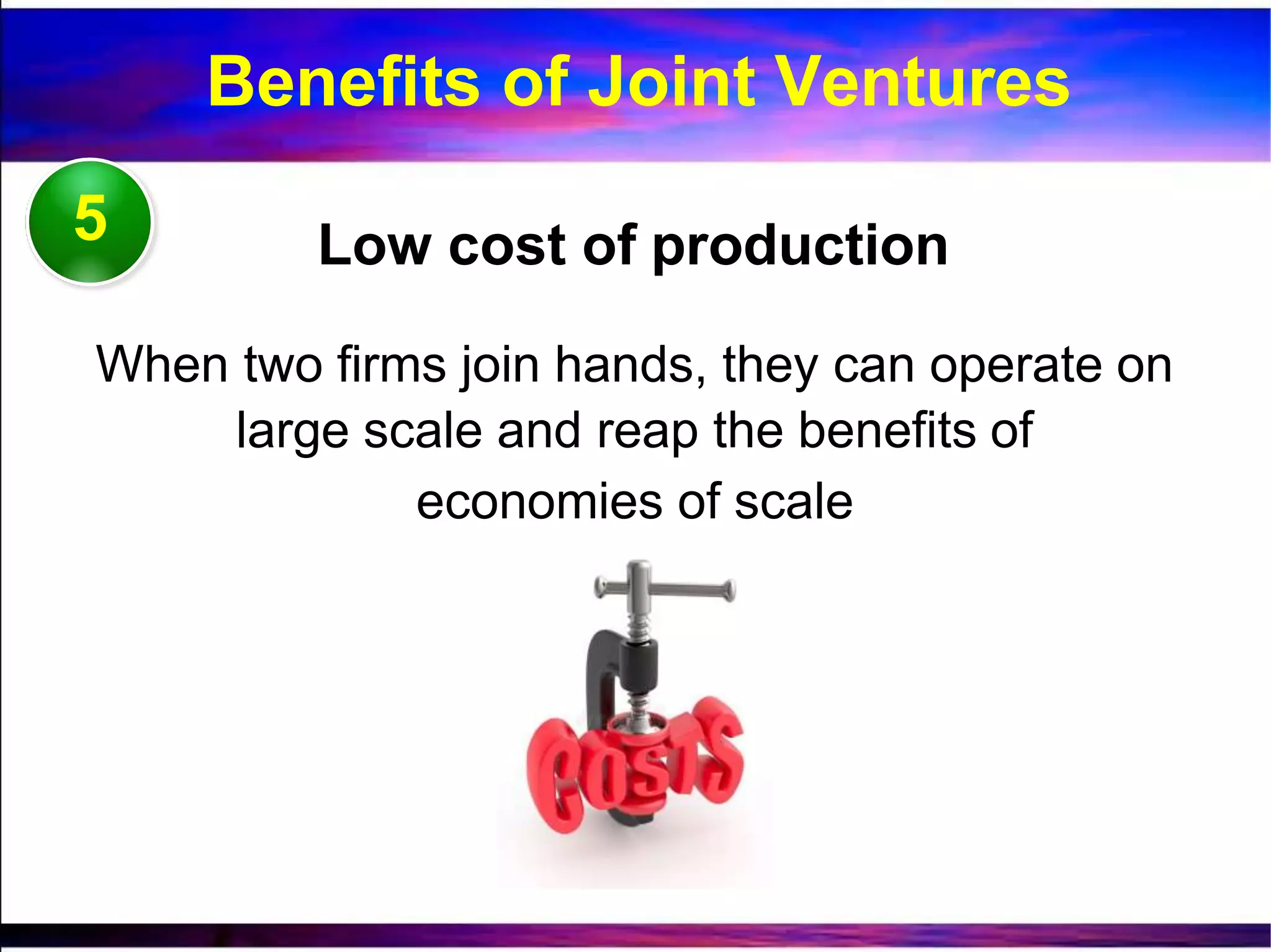
5 Low cost of production
When two firms join hands, they can operate on
large scale and reap the benefits of
economies of scale
Benefits of Joint Ventures
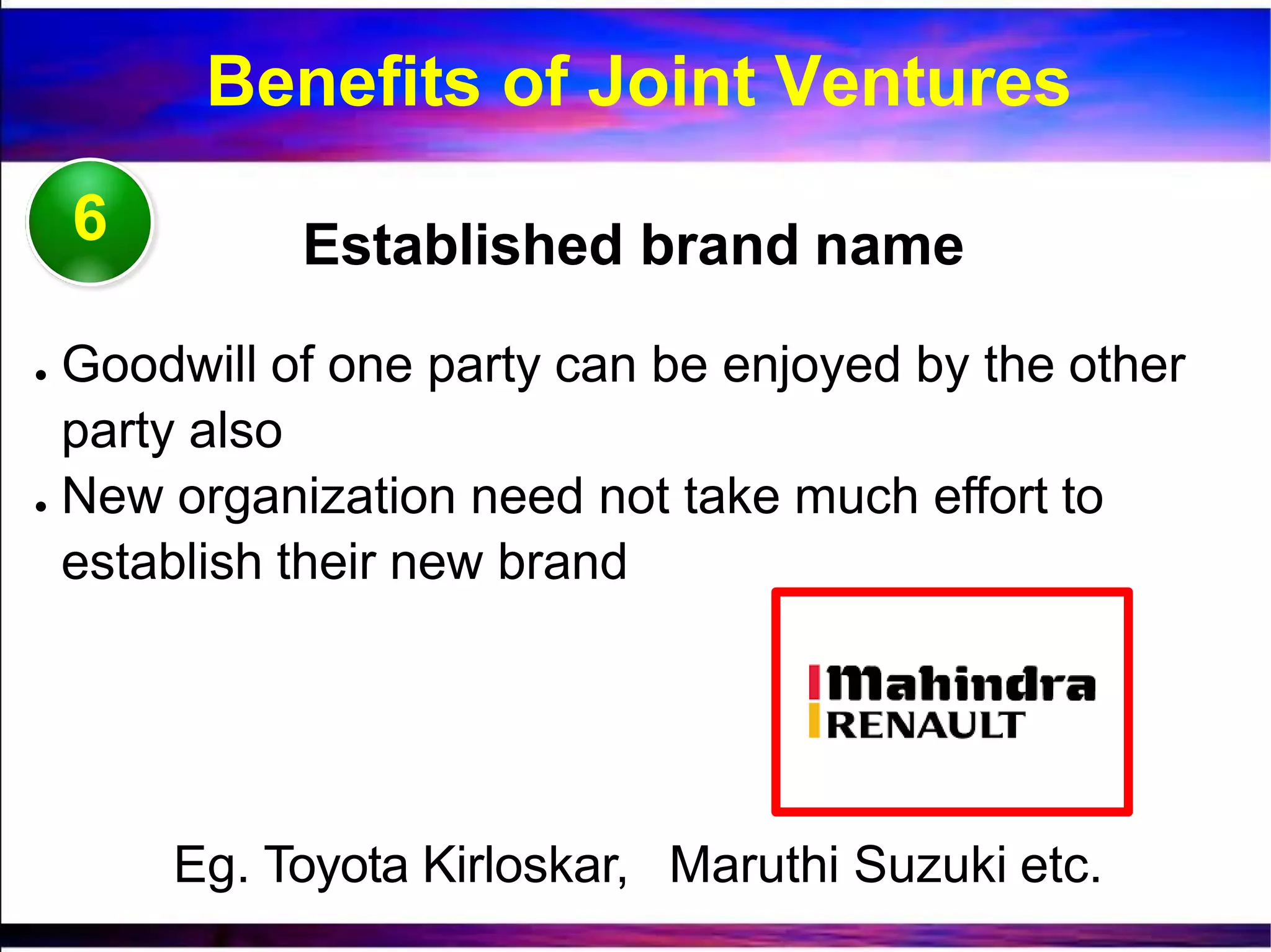
6 Established brand name
● Goodwill of one party can be enjoyed by the other
party also
● New organization need not take much effort to
establish their new brand
Eg. Toyota Kirloskar, Maruthi Suzuki etc.
Benefits of Joint Ventures
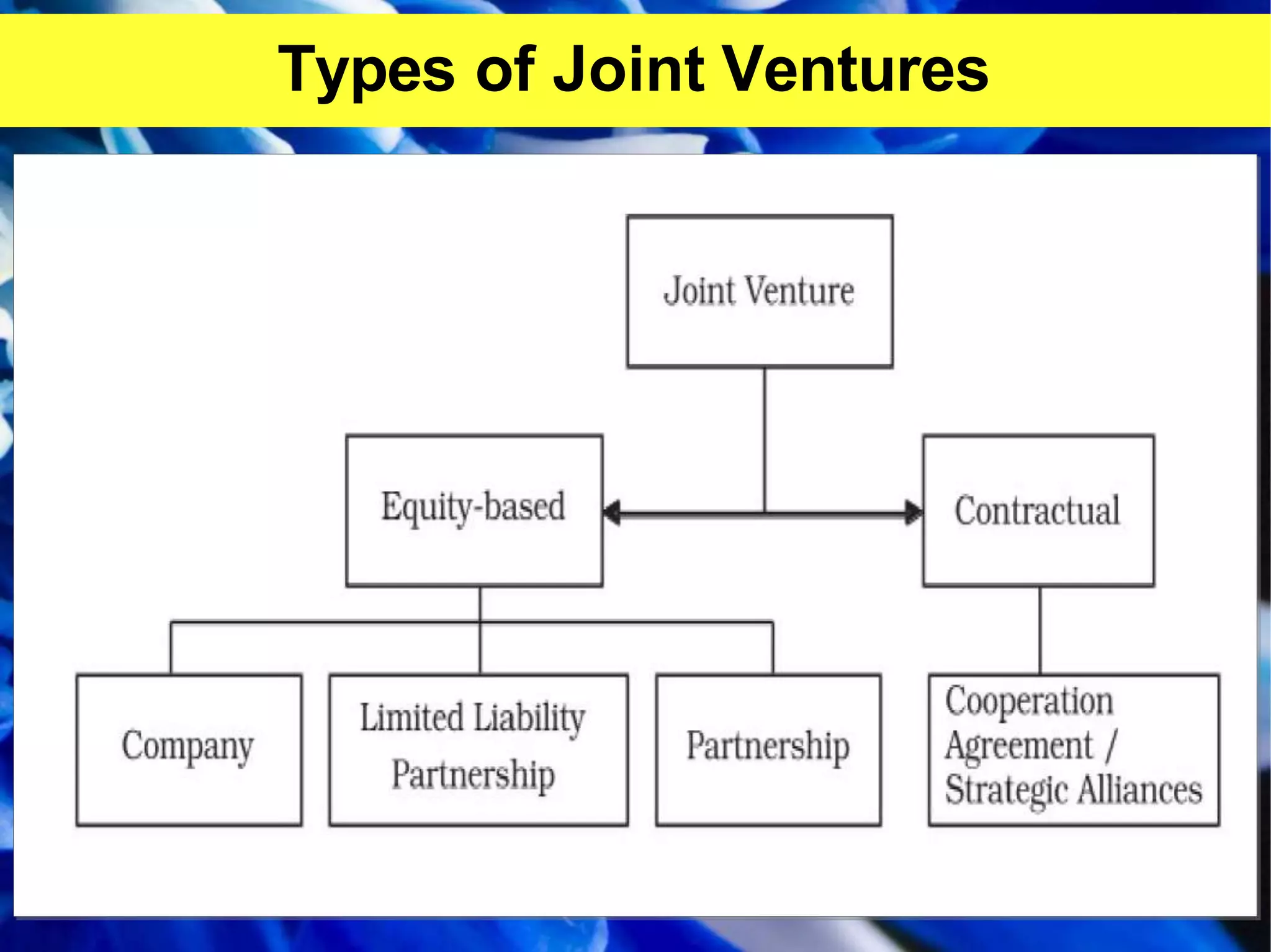
Types of Joint Ventures
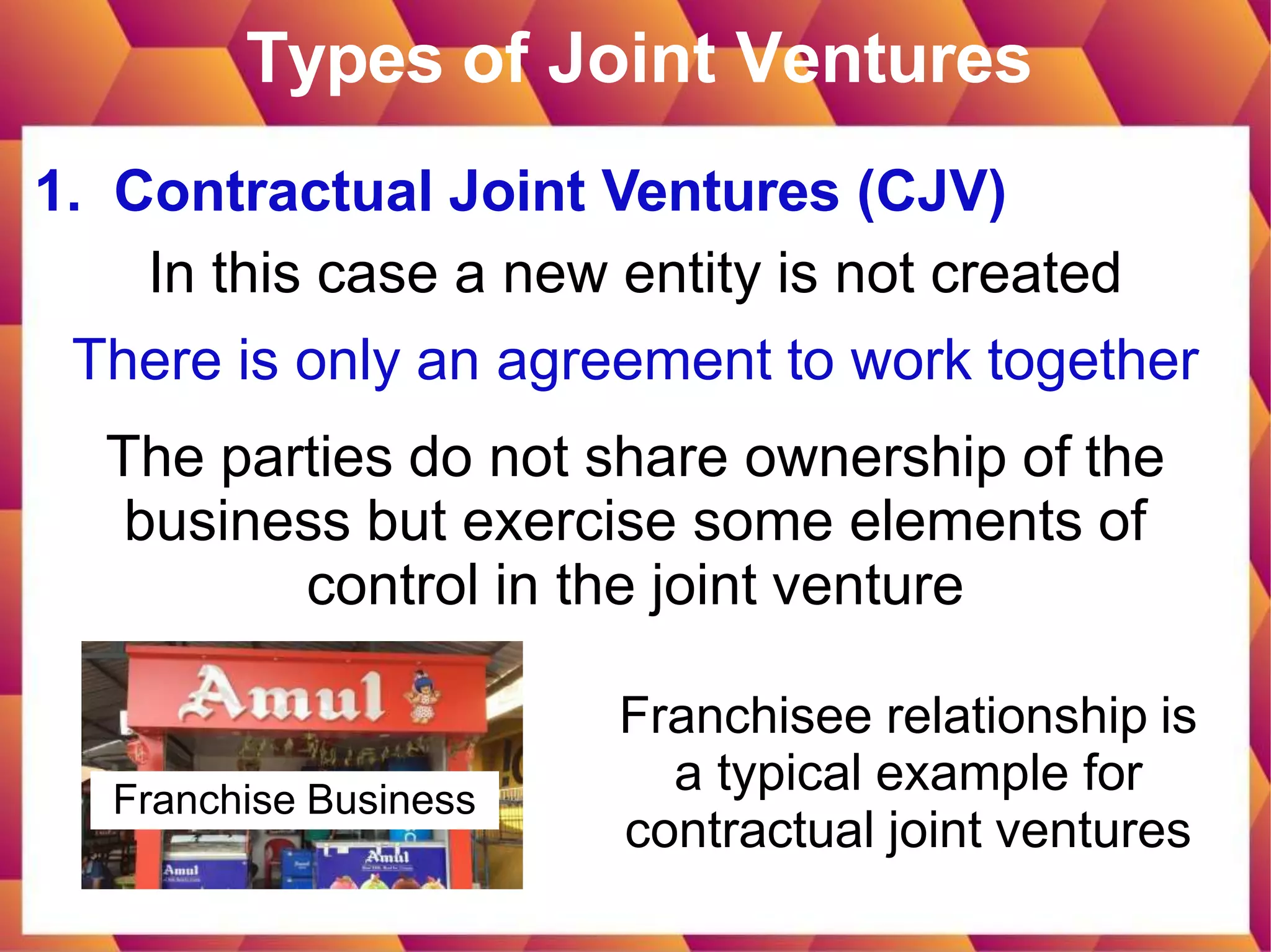
1. Contractual Joint Ventures (CJV)
In this case a new entity is not created
There is only an agreement to work together
The parties do not share ownership of the
business but exercise some elements of
control in the joint venture
Franchisee relationship is
a typical example for
contractual joint ventures
Franchise Business
Types of Joint Ventures
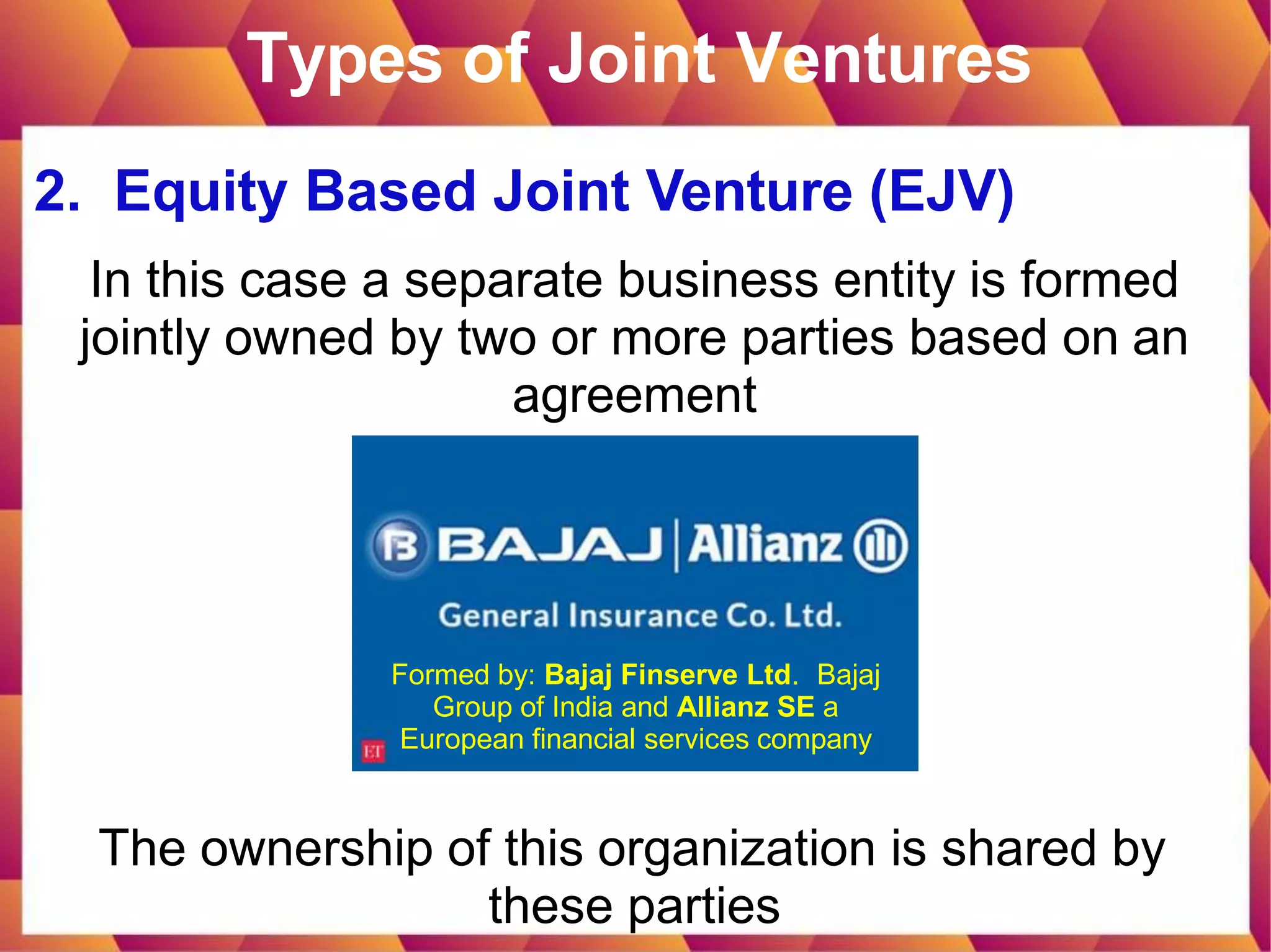
2. Equity Based Joint Venture (EJV)
In this case a separate business entity is formed
jointly owned by two or more parties based on an
agreement
The ownership of this organization is shared by
these parties
Formed by: Bajaj Finserve Ltd. Bajaj
Group of India and Allianz SE a
European financial services company
Examples of JVs
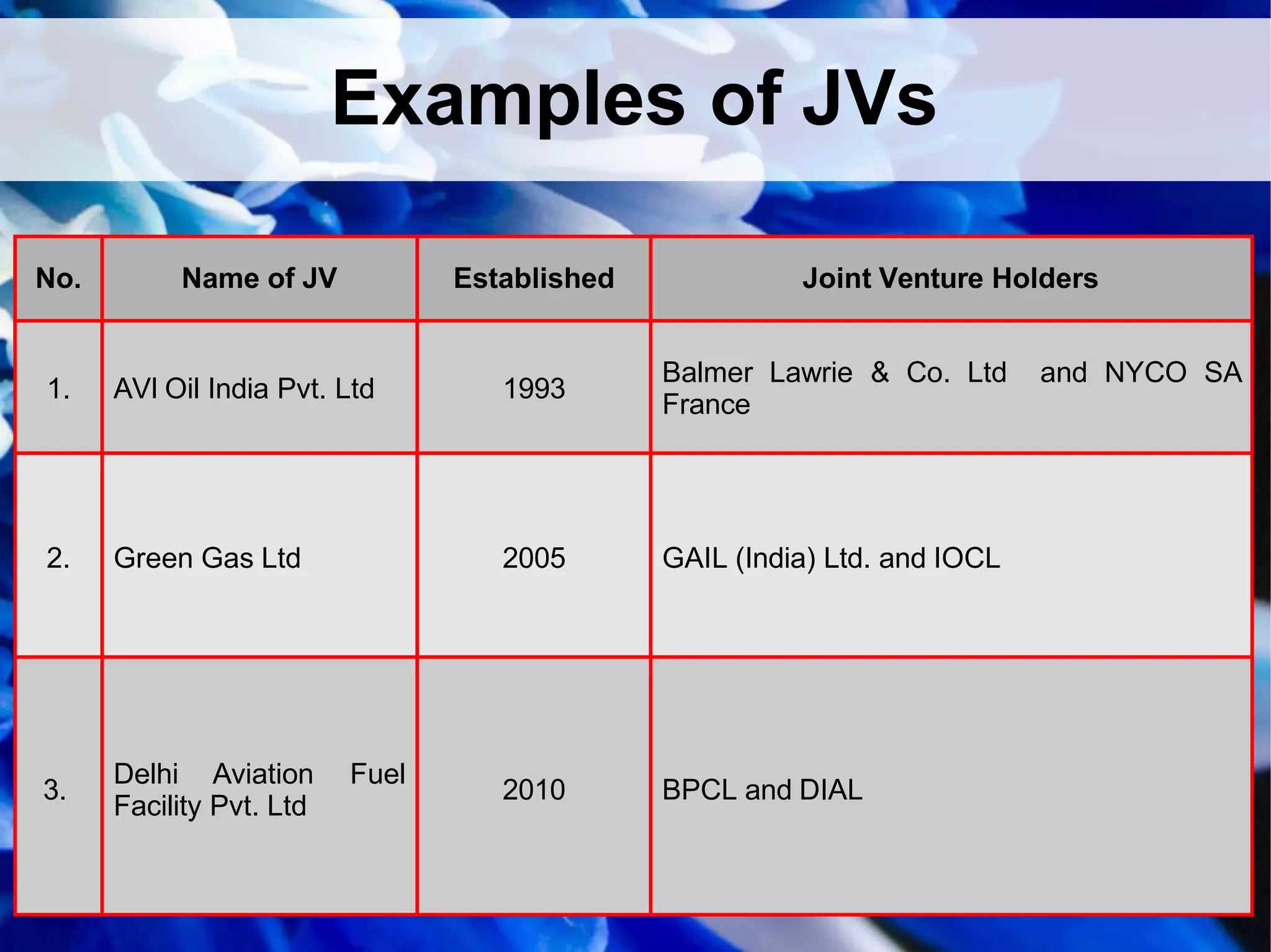
No. Name of JV Established Joint Venture Holders
1. AVI Oil India Pvt. Ltd 1993
Balmer Lawrie & Co. Ltd and NYCO SA
France
2. Green Gas Ltd 2005 GAIL (India) Ltd. and IOCL
3.
Delhi Aviation Fuel
Facility Pvt. Ltd
2010 BPCL and DIAL
Private Public Partnership
P P P
Private Public Partnership
It is a relationship between public and private
entities in the context of infrastructure and
other services
Private Public Partnership
Under PPP model public sector plays an
important role and ensures that the social
obligations are fulfilled and public investments
are successfully met
The public partners in PPP are Government
entities like ministries, government
departments, municipalities etc
Private Public Partnership
The government’s contribution to PPP is in the
form of capital for investment and transfer of
assets that support the partnership
Expertise
The role of private sector is to make use of its
expertise in operation, managing tasks and
innovation to run the business efficiently
Private Public Partnership
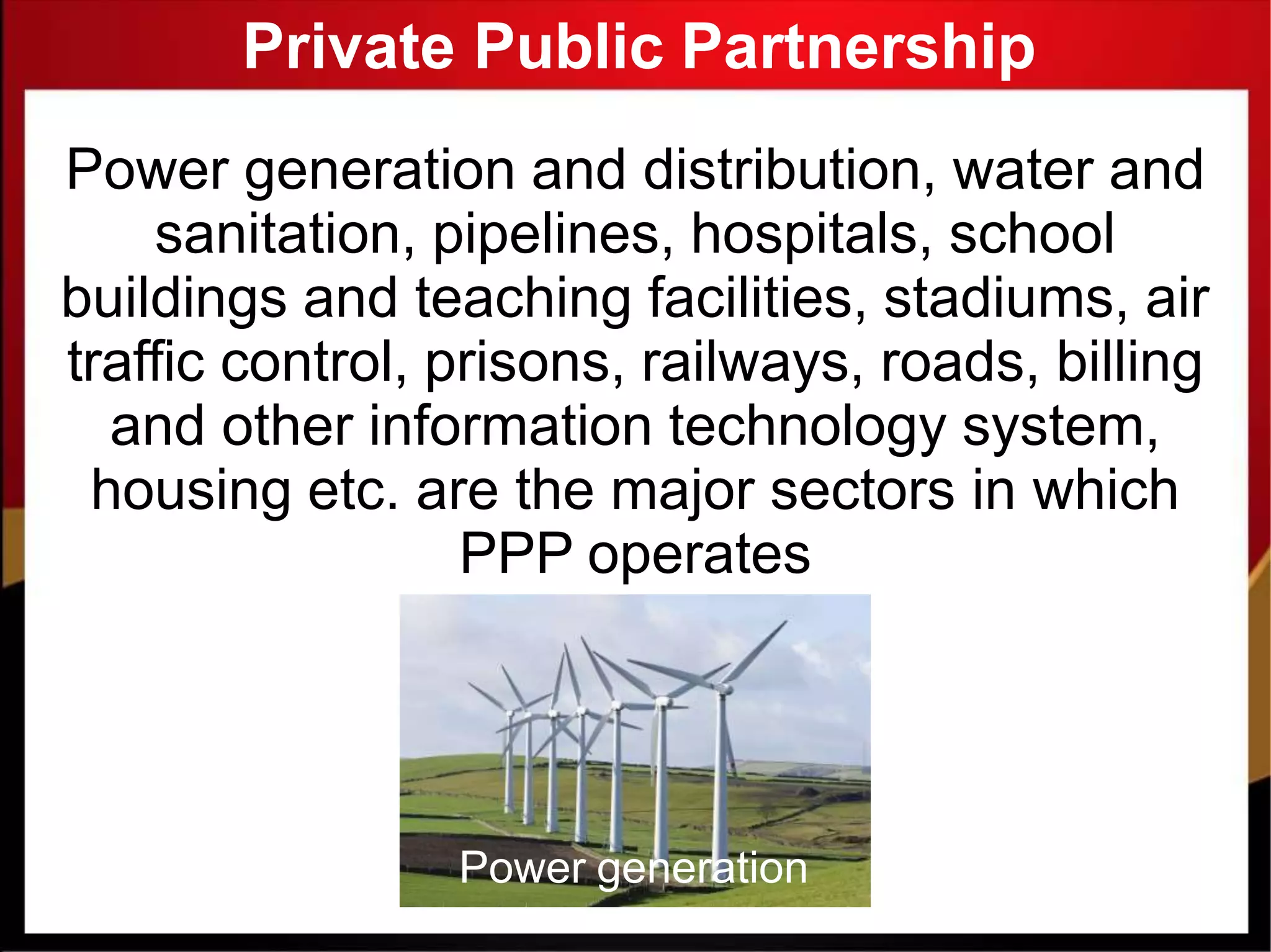
Power generation and distribution, water and
sanitation, pipelines, hospitals, school
buildings and teaching facilities, stadiums, air
traffic control, prisons, railways, roads, billing
and other information technology system,
housing etc. are the major sectors in which
PPP operates
Power generation
Chapter 3 private, public... 1.4 converted

Chapter 3 private, public... 1.4 converted

  • 1.
  • 2.
    Private, Public and GlobalEnterprises Chapter - 3
  • 4.
  • 5.
    Private Sector Enterprises Firmsowned, controlled and managed by private businessmen The main object of such undertaking is profit making
  • 6.
    Private Sector Enterprises Typesof Private Sector Enterprises Sole Proprietorship Concerns Hindu Undivided Family Business Partnership Business Organizations Co-operative Societies Joint Stock Companies
  • 7.
  • 8.
    Public Sector Enterprises Enterprisesowned and managed by central government or state government or by both The basic purpose is to render service to society E.g. Railways, LIC, FCI, Post Offices etc.
  • 9.
  • 10.
    Forms of PublicSector Enterprises Post and Telegraph Reserve Bank of India Indian Telephone Industries 1. Departmental Undertakings 2. Public Corporations 3. Government Companies 1 2 3
  • 11.
  • 12.
    Departmental Undertakings ✔ Undertakingscreated by government ✔ Financed and controlled by government ✔ Managed by government officials ✔ Under the control of a minister
  • 13.
    Departmental Undertakings Examples ofDepartmental Undertakings Indian RailwayPost and Telegraph DoordarshanAll India Radio
  • 14.
  • 15.
    Features of DepartmentalUndertakings Funding Financed through budget allocation a
  • 16.
    Features of DepartmentalUndertakings Audit and Control They are subject to Government audit b
  • 17.
    Features of DepartmentalUndertakings Employees Employees are Government servants c
  • 18.
    Features of DepartmentalUndertakings Control Subject to direct control by the concerned ministry d
  • 19.
    Features of DepartmentalUndertakings Accountability Accountable to the ministry and the government e
  • 20.
  • 21.
    Merits of DepartmentalUndertakings Control of parliament Better control over funds and operations as it is controlled by the ministry a
  • 22.
    Merits of DepartmentalUndertakings Public accountability Responsibility to the government b
  • 23.
    Merits of DepartmentalUndertakings Source of revenue to government Income earned by these organizations directly goes to the treasury c
  • 24.
    Merits of DepartmentalUndertakings National security Secrecy can be maintained especially in case of strategic industries such as defence etc. d
  • 25.
  • 26.
    Limitations of DepartmentalUndertakings Lack of flexibility Predetermined rules and regulations and interference from the ministry a
  • 27.
    Limitations of DepartmentalUndertakings Delay in decisions Approval from the government is necessary to take decisions b
  • 28.
    Limitations of DepartmentalUndertakings Unable to tap business opportunities Conservative approach of bureaucrats does not allow them to take risky ventures c
  • 29.
    Limitations of DepartmentalUndertakings Red tapism and bureaucracy Results delay in decision making and operations d
  • 30.
    Limitations of DepartmentalUndertakings Political interference These enterprises are subject political interference through the ministry e
  • 31.
    Limitations of DepartmentalUndertakings Consumer needs They usually do not give any consideration for consumer needs f
  • 32.
  • 33.
    Public Corporations It isgenerally created as an autonomous institution by passing a Special Act in the Parliament or State Legislature As a body corporate, it is a separate entity for legal purposes and can sue and be sued, enter into contracts and acquire property in its own name
  • 34.
    Public Corporations Some ImportantPublic Corporations KSRTCLife Insurance Corporation Indian Airlines CorporationReserve Bank of India
  • 35.
  • 36.
    Features of PublicCorporations Formed by special Act Created under a special Act of Parliament or State Assembly a
  • 37.
    Features of PublicCorporations Ownership Owned by the Government b
  • 38.
    Features of PublicCorporations Separate legal existence It has a separate legal entity, so that it can own properties and enter into contract in its own name c
  • 39.
    Features of PublicCorporations Financial autonomy It has the power to utilize its revenues d Obtains funds through borrowing from treasury or public and from the sales of goods and services
  • 40.
    Features of PublicCorporations Employees Appointed as per the terms and conditions of the corporation and they are not to be treated as government servants e
  • 41.
    Features of PublicCorporations Independent accounting and audit It has its own accounting and audit, but not subject to government audit and budget allocation f
  • 42.
  • 43.
    Merits of PublicCorporations High degree of flexibility It enjoys flexibility of operations and financial and managerial freedom since it is free from undesirable government control a
  • 44.
    Merits of PublicCorporations Least government interference As there is no budget allocation for funds from government there is no much government control b
  • 45.
    Merits of PublicCorporations Autonomous status They can frame their own policies and procedure within the purview of the Act c
  • 46.
    Merits of PublicCorporations Helps in economic development It contributes towards economic development in a big way d
  • 47.
    Merits of PublicCorporations Stability Since they are not subject to political changes, they can take long term business policies e
  • 48.
  • 49.
    Limitations of PublicCorporations Rules and regulations It does not enjoy much operational flexibility as it is governed by various rules and regulations of the Act a
  • 50.
    Limitations of PublicCorporations Political interference In practice complete autonomy is not possible due to interference from the ministry b
  • 51.
    Limitations of PublicCorporations Chances of corruption Officials may misuse the autonomy status for their personal gain c
  • 52.
    Limitations of PublicCorporations Inefficiency Absence of competition and profit motive leads to inefficient operations d
  • 53.
    Limitations of PublicCorporations Delay in action Quick decisions cannot be taken by the officials because of the involvement of government nominees in the director board e
  • 54.
  • 55.
    Government Company Public enterprisesorganized under the Companies Act are Government companies It is a company in which at least 51% of share capital is held by the Central Government or by the State Government or both
  • 56.
    Government Companies inIndia Steel Authority of India Ltd. Bharat Heavy Electricals Ltd.Hindustan Shipyard Ltd. Coal India Ltd.
  • 57.
  • 58.
    Features of GovernmentCompany Incorporation It is incorporated under Companies Act a
  • 59.
    Features of GovernmentCompany Separate legal entity It can own properties, enter into contracts, sue and be sued in its own name b
  • 60.
    Features of GovernmentCompany Management Management is vested in the hands of Directors, appointed by Government c
  • 61.
    Features of GovernmentCompany Memorandum and Articles ofAssociation Objects of the company and its rules and regulations are contained in these documents d
  • 62.
    Features of GovernmentCompany Accounting and audit procedure However government appointed auditor’s report should be presented in the Parliament or Legislative Assembly e They are exempted from accounting and audit rules as per theAct
  • 63.
    Features of GovernmentCompany Funds Investment in government companies is raised by government shareholdings and from private shareholders f
  • 64.
  • 65.
    Merits of GovernmentCompany Easy formation by registration No need of enactment of special Act in Parliament a
  • 66.
    Merits of GovernmentCompany Separate legal entity It has separate existence apart from the government b
  • 67.
    Merits of GovernmentCompany Quick decisions Prompt decisions in time as it has autonomy power c
  • 68.
    Merits of GovernmentCompany Prevents unhealthy business It can control unhealthy business practices by providing goods and services at a reasonable price d
  • 69.
  • 70.
    Limitations of GovernmentCompany Autonomy is just for name sake Since the government is the only shareholder in some companies, provisions of Companies Act have no relevance. a
  • 71.
    Limitations of GovernmentCompany No accountability Even though major investment is made by the government, it is not answerable to the Parliament b
  • 72.
    Limitations of GovernmentCompany Main purpose is not served It defeats the main purpose by registering like other companies c Being the major shareholder, government controls the affairs of the company
  • 73.
  • 74.
    Changing Role ofPublic Sector Public sector plays an important role in India’s economic development The most important objective of public sector is economic growth with social justice and providing service to the society
  • 75.
  • 76.
    Importance of PublicSector Development of infrastructure Transportation, communication, fuel and energy, basic and heavy industries etc. are very essential for economic development 1 Government has set up various PSUs in these areas where private enterprises are unwilling to invest
  • 77.
    Importance of PublicSector Regional balance To maintain balanced regional development the government has taken initiative to start a number of public sector units in backward areas 2
  • 78.
    Importance of PublicSector Economies of scale Government has set up large scale industries in public sector to take advantages of economies of scale 3 Eg. Electric power plants, petroleum refinery, telephone industries etc.
  • 79.
    Importance of PublicSector Check over concentration of economic power The flow of economic resources to the private sector entrepreneurs can be controlled up to a certain extent 4
  • 80.
    Importance of PublicSector Import substitution Government set up public sector units for production of capital goods which were imported earlier 5 Several public sector companies are producing goods on a large scale, thus playing an important role in expanding exports of the country also
  • 81.
  • 82.
    Government of Indiaintroduced four major reforms in the public sector thorough the Industrial Policy in 1991 Government Policy
  • 83.
    a Restructure and revivepotentially viable Public Sector Undertakings (PSUs) Government Policy
  • 84.
    b Close down PSUs,which cannot be revived Government Policy
  • 85.
    c Bring down governmentequity in all non-strategic PSUs to 26% or lower if necessary Government Policy
  • 86.
    d Protect the interestof workers Government Policy
  • 87.
    Measures Taken by Govt.to Reform Public Sector
  • 88.
    Measures Taken byGovt.a Reduction in the number of industries reserved for public sector ● 17 industries were reserved for public sector as per the Industrial Policy 1956. ● It has been reduced to 8 industries in 1991 and again to 3 industries in 2001. ● They are atomic energy, arms and rail transport.
  • 89.
    Measures Taken byGovt. Disinvestment ● Sale of equity shares of Public Sector Undertakings to private sector and to the public ● Government holding in such units is thereby reduced and private participation enhanced Eg. Sale of shares in Indian Petro Chemicals Ltd., Maruthi Udyog Ltd. etc. b
  • 90.
    Measures Taken byGovt.c Protection of sick units Highly sick public enterprises which are unlikely to be revived will be referred to the Board for Industrial and Financial Reconstruction (BIFR) for rehabilitation
  • 91.
    Measures Taken byGovt.d Memorandum of understanding (MOU) ● To improve the performance of PSUs, government introduced MOU system by giving clear target and operational autonomy to achieve those targets ● Here PSUs are accountable for specified results
  • 92.
  • 93.
    Multinational Companies ● Companycarrying on business in two or more countries ● Company that operates in several countries ● Company has factories, branches or offices in more than one country ● Branches are also called Majority Owned Foreign Affiliates (MOFA) Global Enterprises
  • 94.
    Multinational Companies It isalso known as Multinational corporation, Transnational Corporation, Global Giant, World Enterprise, International Enterprise, MNCs etc. Global Enterprises
  • 95.
    Multinational Companies –Examples Global Enterprises
  • 96.
  • 97.
    Huge capital They havelarge capital investment as they are running large scale business units a Investors and financial institutions of the host country will be ready to invest in MNCs because of their credibility Features of Global Enterprises
  • 98.
    Foreign collaboration Global enterprisesusually collaborate with Indian companies, both private and public sector, by this both the parties will be benefited by sharing technology, brand name etc. b Features of Global Enterprises
  • 99.
    Advanced technology MNCs areable to provide world class products of international standards by using advanced technology in the areas of production, marketing etc. c Features of Global Enterprises
  • 100.
    Marketing strategies They adoptaggressive marketing techniques to increase the sales in a short period d They have advanced marketing information system, advertising and sales promotion techniques and a good brand name Features of Global Enterprises
  • 101.
    Expansion of marketterritory They can extent their markets very easily to the foreign countries as they are running the branches in various nations e Features of Global Enterprises
  • 102.
    Product innovation Their productsare always highly innovative as they are running their own research and development wing for developing new products and superior designs for existing products f Features of Global Enterprises
  • 103.
    Centralized control The headquartersof an MNC can exercise better control over the operations of its branches in various countries as they operate within the policy framework of the parent organization g Features of Global Enterprises
  • 104.
  • 105.
    An association oftwo or more individuals or organizations formed by agreement for a common purpose or mutual benefit is called a joint venture These organizations may be private, government or a foreign company Joint Ventures
  • 106.
    Usually JVs areformed to share strengths, minimize risks and to increase competitive advantage in the market place Eg. Bajaj Allianze Insurance Co., Mahindra – Renault Ltd, Air Asia India, Maruthi andSuzuki, Yamaha and Mahindra. Joint Ventures
  • 107.
    Benefits of a JointVenture Business
  • 108.
    1 Increased resourcesand capacity JVs can easily expand their business and they are able to face market challenges, reap the benefits of economies of scale Benefits of Joint Ventures
  • 109.
    2 Access tomarkets When a foreign company enters into JV with an Indian company, they gain access to the vast Indian market Benefits of Joint Ventures
  • 110.
    3 Access totechnology Technology adds to efficiency and effectiveness and thus reduces the cost Benefits of Joint Ventures
  • 111.
    4 Innovation ● JVscomes up with some new ideas and techniques ● Especially foreign partners can introduce innovative products in the market based on their experience Benefits of Joint Ventures
  • 112.
    5 Low costof production When two firms join hands, they can operate on large scale and reap the benefits of economies of scale Benefits of Joint Ventures
  • 113.
    6 Established brandname ● Goodwill of one party can be enjoyed by the other party also ● New organization need not take much effort to establish their new brand Eg. Toyota Kirloskar, Maruthi Suzuki etc. Benefits of Joint Ventures
  • 114.
  • 115.
  • 116.
    Types of JointVentures 1. Contractual Joint Ventures (CJV) In this case a new entity is not created There is only an agreement to work together The parties do not share ownership of the business but exercise some elements of control in the joint venture Franchisee relationship is a typical example for contractual joint ventures Franchise Business
  • 117.
    Types of JointVentures 2. Equity Based Joint Venture (EJV) In this case a separate business entity is formed jointly owned by two or more parties based on an agreement The ownership of this organization is shared by these parties Formed by: Bajaj Finserve Ltd. Bajaj Group of India and Allianz SE a European financial services company
  • 118.
    Examples of JVs No.Name of JV Established Joint Venture Holders 1. AVI Oil India Pvt. Ltd 1993 Balmer Lawrie & Co. Ltd and NYCO SA France 2. Green Gas Ltd 2005 GAIL (India) Ltd. and IOCL 3. Delhi Aviation Fuel Facility Pvt. Ltd 2010 BPCL and DIAL
  • 119.
  • 120.
    Private Public Partnership Itis a relationship between public and private entities in the context of infrastructure and other services
  • 121.
    Private Public Partnership UnderPPP model public sector plays an important role and ensures that the social obligations are fulfilled and public investments are successfully met The public partners in PPP are Government entities like ministries, government departments, municipalities etc
  • 122.
    Private Public Partnership Thegovernment’s contribution to PPP is in the form of capital for investment and transfer of assets that support the partnership Expertise The role of private sector is to make use of its expertise in operation, managing tasks and innovation to run the business efficiently
  • 123.
    Private Public Partnership Powergeneration and distribution, water and sanitation, pipelines, hospitals, school buildings and teaching facilities, stadiums, air traffic control, prisons, railways, roads, billing and other information technology system, housing etc. are the major sectors in which PPP operates Power generation