ROLE OF MAKE IN
INDIA IN ECONOMIC
DEVELOPMENT
PRESENTED BY
NEETHU S JAYAN
AN OVERVIEW
Make in India is an initiative launched by the Government of India to encourage
multi-national as well as national companies to manufacture their products in India.
It was launched by Prime Minister NarendraModi on 25 September 2014, in a
function at the Vigyan Bhavan, in New Delhi.
The hall thronged with attendees.
Leading entrepreneurs and the CEOs of about 3000 companies from across 30
countries were invited to attend the launch.
India emerged, after initiation of the programme in 2015 as the top destination
globally for Foreign Direct Investment (FDI), surpassing the United States of America
as well as the People’s Republic of China.
CONT…..
The logo for the Make In India campaign is an elegant lion inspired by the Ashoka
Chakra and designed to represent India’s success in all spheres.
The campaign was dedicated by the Prime Minister to the eminent patriot, philosopher
and political personality, Pandit Deen Dayal Upadhyaya who had been born on the
same date in 1916.
The initiative also aims at high quality standards and minimizing the impact on the
environment.
The initiative hopes to attract capital and technological investment in India.
The campaign was designed by Weiden+Kennedy.
Under the initiative, brochures on the 25 sectors and a web portal were released.
THE MAKE IN INDIA VISION
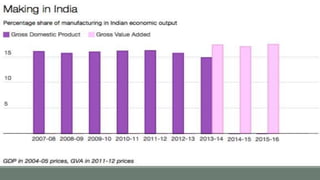
Manufacturing currently contributes just over 15% to the national GDP.
The aim of this campaign is to grow this as to 25% contribution as seen with other
developing nations of Asia.
In the process, the government expects to generate jobs, attract much foreign direct
investment, and transform India into a manufacturing hub around the globe.
“Zero defect zero effect” is a key phrase which has come to be associated with the
Make in India campaign.
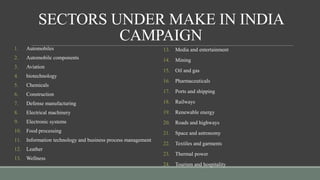
SECTORS UNDER MAKE IN INDIA
CAMPAIGN
1. Automobiles
2. Automobile components
3. Aviation
4. biotechnology
5. Chemicals
6. Construction
7. Defense manufacturing
8. Electrical machinery
9. Electronic systems
10. Food processing
11. Information technology and business process management
12. Leather
13. Wellness
13. Media and entertainment
14. Mining
15. Oil and gas
16. Pharmaceuticals
17. Ports and shipping
18. Railways
19. Renewable energy
20. Roads and highways
21. Space and astronomy
22. Textiles and garments
23. Thermal power
24. Tourism and hospitality
PILLARS OF MAKE IN INDIA
CAMPAIGN
1. NEW PRROCESSES
The government is introducing several reforms to create possibilities
for getting Foreign Direct Investment (FDI) and foster business
partnerships.
Some initiatives have already been undertaken to alleviate the
business environment from outdated policies and regulations.
This reform is also aligned with parameters of World Bank’s ‘Ease
of Doing Business’ index to improve India’s ranking on it.
2. NEW INFRASTRUCTURE
Infrastructure is integral to the growth of an industry.
The government intends to develop industrial corridors and build
smart cities with state-of-the-art technology and high speed
communication.
Innovation and research activities are supported by a fast paced
registration system and improved infrastructure for Intellectual
Property Rights (IPR) registrations.
 Along with the development of infrastructure, the training for the
skilled workforce for the sectors is also being addressed.
3. NEW SECTORS
 ‘Make In India has identified 25 sectors to promote with the
detailed information being shared through an interactive web portal.
The Government has allowed 100% FDI in Railways and removed
restrictions in Construction.
It has also recently increased the cap of FDI to 100% in Defense and
Pharmaceutical.
4. NEW MINDSET
 Government in India has always been seen as a regulator and not a
facilitator.
 This initiative intends to change tis by bringing a paradigm shift in
the way Government interacts with various industries.
 It will focus on acting as a partner in the economic development of
the country alongside the corporate sector.
HIGHLIGHTS OF MAKE IN
INDIA CAMPAIGN
Skill development programs would be launched especially for people
from rural and poor ones from urban cities.
25 key sectors have been short listed such as telecommunications, power,
automobile, tourism, pharmaceuticals, and others.
Individuals aged 15-35 years would get high quality training in the
following key areas such as welding, masonries, painting, nursing to help
elder people.
Skill certification would be given to make training process, a standard..
Currently manufacturing in India suffers due to low productivity
rigid laws and poor infrastructure resulting in India suffers due to low
quality products getting manufactured.
Over 1000 training centers would be opened across India in the next
2 years.
The e-biz portal would be soon launched which would be real time
and available 24/7
IMPACT OF MAKE IN INDIA
CAMPAIGN
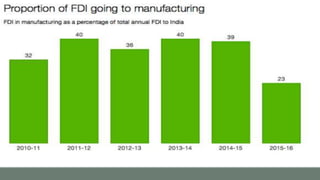
1. IMPACT ON MANUFACTURING SECTOR
The aim was to increase the contribution of the manufacturing sector up to 25%
in the Gross Domestic Product of the country’s economy. Earlier, the contribution
was limited up to 15% but the impact of Make in India has increased the
contribution by 7.6% in 2015-16.
The poor and the unemployed will get a chance to get involved in this sector.
The employment will generate income and that in turn will increase the
purchasing power of the people.
IMPACT ON CONSTRUCTION
SECTOR
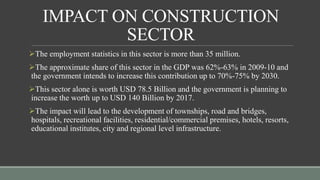
The employment statistics in this sector is more than 35 million.
The approximate share of this sector in the GDP was 62%-63% in 2009-10 and
the government intends to increase this contribution up to 70%-75% by 2030.
This sector alone is worth USD 78.5 Billion and the government is planning to
increase the worth up to USD 140 Billion by 2017.
The impact will lead to the development of townships, road and bridges,
hospitals, recreational facilities, residential/commercial premises, hotels, resorts,
educational institutes, city and regional level infrastructure.
IMPACT ON TOURISM AND
HOSPITALITY SECTOR
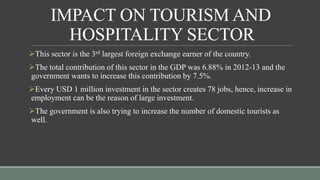
This sector is the 3rd largest foreign exchange earner of the country.
The total contribution of this sector in the GDP was 6.88% in 2012-13 and the
government wants to increase this contribution by 7.5%.
Every USD 1 million investment in the sector creates 78 jobs, hence, increase in
employment can be the reason of large investment.
The government is also trying to increase the number of domestic tourists as
well.
IMPACT ON IT SECTOR
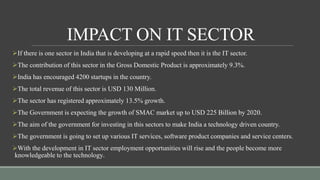
If there is one sector in India that is developing at a rapid speed then it is the IT sector.
The contribution of this sector in the Gross Domestic Product is approximately 9.3%.
India has encouraged 4200 startups in the country.
The total revenue of this sector is USD 130 Million.
The sector has registered approximately 13.5% growth.
The Government is expecting the growth of SMAC market up to USD 225 Billion by 2020.
The aim of the government for investing in this sectors to make India a technology driven country.
The government is going to set up various IT services, software product companies and service centers.
With the development in IT sector employment opportunities will rise and the people become more
knowledgeable to the technology.
IMPACT ON AUTOMOBILE SECTOR
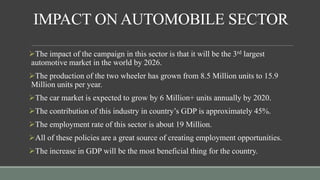
The impact of the campaign in this sector is that it will be the 3rd largest
automotive market in the world by 2026.
The production of the two wheeler has grown from 8.5 Million units to 15.9
Million units per year.
The car market is expected to grow by 6 Million+ units annually by 2020.
The contribution of this industry in country’s GDP is approximately 45%.
The employment rate of this sector is about 19 Million.
All of these policies are a great source of creating employment opportunities.
The increase in GDP will be the most beneficial thing for the country.
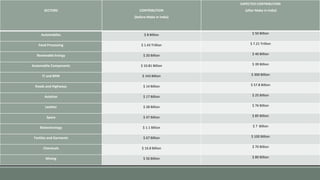
SECTORS CONTRIBUTION
(before Make in India)
EXPECTED CONTRIBUTION
(after Make in India)
Automobiles $ 8 Billion $ 50 Billion
Food Processing $ 1.43 Trillion $ 7.21 Trillion
Renewable Energy $ 20 Billion $ 40 Billion
Automobile Components $ 10.81 Billion $ 39 Billion
IT and BPM $ 143 Billion $ 300 Billion
Roads and Highways $ 14 Billion $ 57.8 Billion
Aviation $ 17 Billion $ 25 Billion
Leather $ 28 Billion $ 76 Billion
Space $ 47 Billion $ 85 Billion
Biotechnology $ 1.1 Billion $ 7 Billion
Textiles and Garments $ 67 Billion $ 100 Billion
Chemicals $ 16.8 Billion $ 70 Billion
Mining $ 56 Billion $ 80 Billion
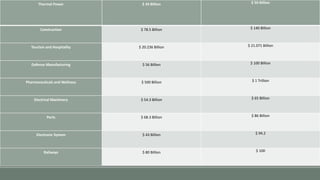
Thermal Power $ 34 Billion $ 50 Billion
Construction $ 78.5 Billion $ 140 Billion
Tourism and Hospitality $ 20.236 Billion $ 21.071 Billion
Defense Manufacturing $ 56 Billion $ 100 Billion
Pharmaceuticals and Wellness $ 500 Billion $ 1 Trillion
Electrical Machinery $ 54.3 Billion $ 65 Billion
Ports $ 68.3 Billion $ 86 Billion
Electronic System $ 43 Billion $ 94.2
Railways $ 80 Billion $ 100
MAKE IN INDIAAND
ECONOMIC DEVELOPMENT
1. DEVELOP JOB OPPORTUNITY
One of the main purposes of Make in India crusade, is to be provide job
opportunities for as many citizens of India as possible.
It has targeted the young generation of the country as its prime beneficiary.
The investments in the targeted sectors, that is telecommunications,
pharmaceuticals, tourism, etc.; will encourage he young entrepreneurs to come
forth with their innovative ideas without worrying about the source of
speculation.
2. AMELIORATE THE VICINITY
In order to manufacture in India a particular industry requires a promising
location to set up machinery as well as factories.
To fulfill this requirement, not only the areas chosen would be improved but
also the neighboring locations will be highly benefitted.
For a developing nation, such as ours’ an initiative of this kind is extremely
crucial.
In addition, the labor hired, from the locality would also improve the financial
status of the families living nearby.
3. EXPAND GDP
Due to the manufacturing of products in India, economic growth is inevitable,
which will not only boost the trade sector but also will increase the GDP of
Indian economy as with the setting up of new factories and various investments
being speculated in the Indian commercial sectors the flow of income will be
humongous.
Various sectors such as exportation, architecture, textiles, and
telecommunications etc.; are likely to flourish inevitably, strengthening the
Indian economy which is already the 7th largest in the world
4. FORTIFY THE RUPEE
The emergence of the manufacturing industries would automatically
convert India in to a hub for the fabrication of various commercial
products; as a result, there would be a grant collection of the FDI,
which, in turn, would strengthen the rupee against the domination of
American dollar.
5. INCREASE IN BRAND VALUE
Most of the urban population prefers international brands rather than putting
their fate in Indian retailers.
As a result, the small manufacturing companies suffer extreme loss in the
market.
Due to the Make in India campaign, such small manufactures will be provide
with a real shot at business.
With, companies investing in such small time retailers from all around the
world, the brand value of Indian merchandise will increase dramatically.
6. UPGRADATION OF TECHNOLOGY
India being an under developed country obviously lack various latest
mechanization, which, is a big hurdle in the path to development of the nation.
Hence, with myriad of countries coming forth by the Mae in India crusade,
India will be given the opportunity to make use of the latest technology these
countries bring along.
Not only will India benefit from the knowledge and the use of the technology
but also, the concerned nations will be provided with a skill and erudite labour.
7. EASE OF BUSINESS
India is a nation which ranked 1/3th on the ease of doing business scale.
But with the open invitation given to the entire world to manufacture their
products in India, the various restrictions opposed over the entrepreneurs will be
lifted and aspiring businessmen from all over the globe could invest in India with
no stress at all.
8. AVAILABILITY OF YOUNG MINDS
Most of the young generation of India plans to move out of the country in the
hope of a better feature.
Due to the lack of young labour, India has always of deprived of innovative and
new ideas.
With the Make in India campaign, the young population would not only be
provided with employment but also their young and fresh minds would take the
industrial sector to new heights.
Making it a win win situation for the India as well as the concerned countries.
9. DEVELOPMENT OF RURAL AREAS
It is a well-known fact that a factory set up not only improves a particular area
but also provides for the locals with the employment, thus the quality of life of
people would automatically enhance.
Amenities like schools hospitals and other public conveniences will be
developed for the betterment of the public.
10. ATTRACT MORE FDI
It will welcome more FDI.
Since the government has promised to improve the ease of running
businesses in India, it is going to attract many FDI.
11. FLOW OF CAPITAL
Since the beginning of capitalization, the Indian currency is being spent on the
foreign countries with the introduction of Make in India, the capital will not only
remain in India, but also the foreign currency will be provided to the nation as
well.
In a nutshell, India will not spend on foreign countries, but the foreign countries
will spend on India in the form of investments and wages.
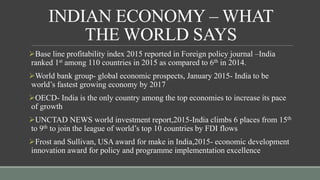
INDIAN ECONOMY – WHAT
THE WORLD SAYS
Base line profitability index 2015 reported in Foreign policy journal –India
ranked 1st among 110 countries in 2015 as compared to 6th in 2014.
World bank group- global economic prospects, January 2015- India to be
world’s fastest growing economy by 2017
OECD- India is the only country among the top economies to increase its pace
of growth
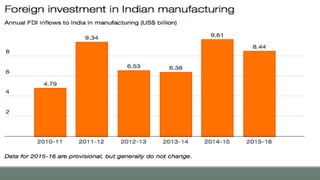
UNCTAD NEWS world investment report,2015-India climbs 6 places from 15th
to 9th to join the league of world’s top 10 countries by FDI flows
Frost and Sullivan, USA award for make in India,2015- economic development
innovation award for policy and programme implementation excellence
ADVERSE EFFECTS OF MAKE IN INDIA
IN ECONOMIC DEVELOPMENT
1. NEGLIGENCE OF AGRICULTURE
The most negative impact of the Make in India campaign will be on the
agricultural sector of India.
It is a well-known fact that India territories has 61% of cultivable land.
With the introduction of industrial sectors the agriculture in India will be
neglected some what.
2. DEPLETION OF NATURAL RESOURCES
Since Make in India is primarily based on manufacturing industries, it demands
the set up of various factories.
Usually such projects consume the natural resources such as water, land etc.; on
a large scale.
With the rapid devouring of such precious resources, India might be left with
zero opportunities to replenish from threatening the survival of such a large
population in near future.
3. DISRUPTION OF LAND
As stated above India is very rich in the agricultural sector.
About 60%of the Indian soil is arable.
With the emphasis being given to the Make in India campaign, thousands of
companies would come forth to set up their factories on land which could be used
for cultivation.
Eventually this set up of manufacturing factories would lead to the permanent
disruption of the agrarian land in the near nature.
4. LOSS FOR SMALL ENTREPRENEURS
The Make in India campaign, welcomes foreign countries to manufacture in
India with open arms, this automatically eases up the various restrictions over
trade with foreign countries, inviting attention of international commercial
companies.
However, these companies will not only seduce the Indian population but also
would dominate the small local entrepreneurs and force them out of business.
5. MAUFACTURING WASTE ECONOMY
Indian economy is one of the largest economies in the world.
It constitutes of 3 sectors i.e.; agriculture, industry and services.
Now the Indian economy majors up from the service sector which contributed
up to 57% of GDP
But with the introduction of Make in India campaign, the economy is likely to
rely completely on the manufacturing and exporting while the import industry
will remain static. This eventually will be a huge loss for the other sectors and
would automatically reduce the advancement of Make in India.
6. INTEREST IN INTERNATIONAL BRANDS
As stated earlier, the brand value of Indian merchandise will definitely increase.
But the India upper class, which can actually afford such merchandise, is
addicted with foreign labour.
This will eventually become a big hurdle for the local entrepreneurs as a great
level of promotion is required to build the confidence of people in the local
brands.
7. POLLUTION
One of the biggest problems which is prevailing in India is pollution.
According to statistics, India has a pollution index of 76.50.
With the Make in India movement, this pollution level is likely to arise in a
couple of years.
Eventually, making the condition in India worse.
Hence, Make in India might be economically but it will have an inverse effect
ecologically.
8. BAD REALTIONS WITH CHINA
The Indo-China relation is already a problematic cause for the country with the
initiation of the Make in India crusade, India stands as one of the most promising
rivals for China.
This automatically has worsen the India’s long term feud with China, gradually
with success of Make in India, it is possible for the situation to become worse
among the two economically growing countries because India has the advantage
of young and skilled work force over China which will expectedly take Make in
India to new heights in the near future.
CONCLUSION
India is a country is rich in natural resources.
But the irony is that was a nation are not able to extract those resources
judiciously so that we could develop our manufacturing belt like China,
Germany and other western countries.
The vision behind this initiative by our P.M is to use India’s own potential
to develop its industrial sectors.
Labour is plenty and skilled labour is easily available due to the high
rates of unemployment in the educated class of the country.
With Asia becoming the manufacturing hub India will soon become the
preferred manufacturing destination of most investors across the globe.
The areas were we should improve ourselves are some of our rigid policies and
regulations and labour laws in the country which are not conductive to carry business
in India.
India ranks low on the ease of doing business and we need to improve this if we
have to make this mission and campaign successful.
Make in India is an initiative taken by the Modi government to boost the Indian
economy and the long term vision is to make India an industrially developed nation.
So we can conclude that Make In India is not a brand nor it is a slogan, it is a new
national movement as it covers the whole spectrum of our government, society and
business.
THANK YOU