Information Architecture: Putting the  I  back in IT April 26, 2007 Louis Rosenfeld www.louisrosenfeld.com
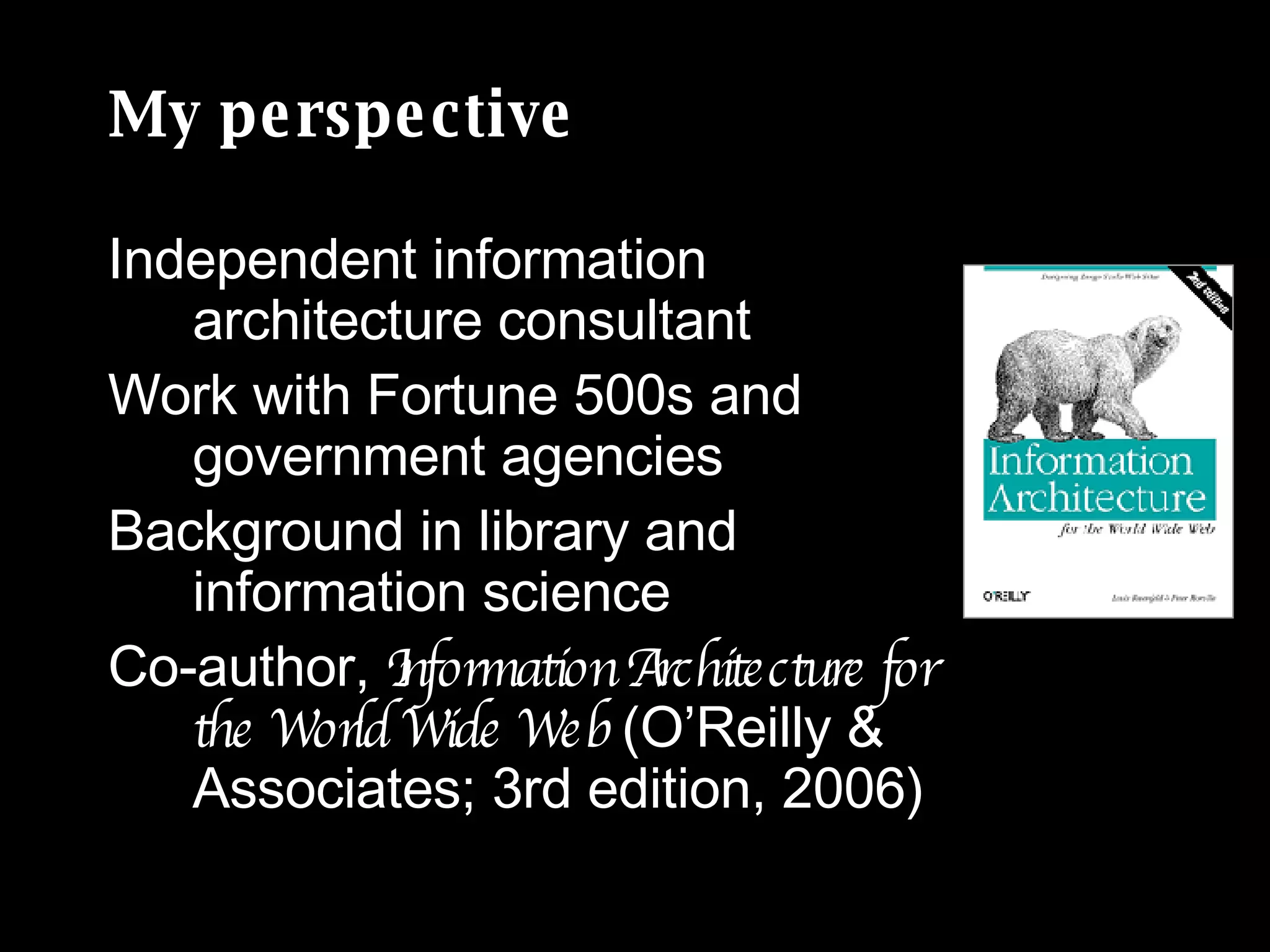
My perspective Independent information architecture consultant  Work with Fortune 500s and government agencies Background in library and information science Co-author,  Information Architecture for the World Wide Web  (O’Reilly & Associates; 3rd edition, 2006)
What I’m going to cover IT managers are excluded from corporate strategy Information architects can help get IT managers a seat at the table (and how) Information architecture briefly introduced  Examples of concrete benefits from information architecture Can we be friends?
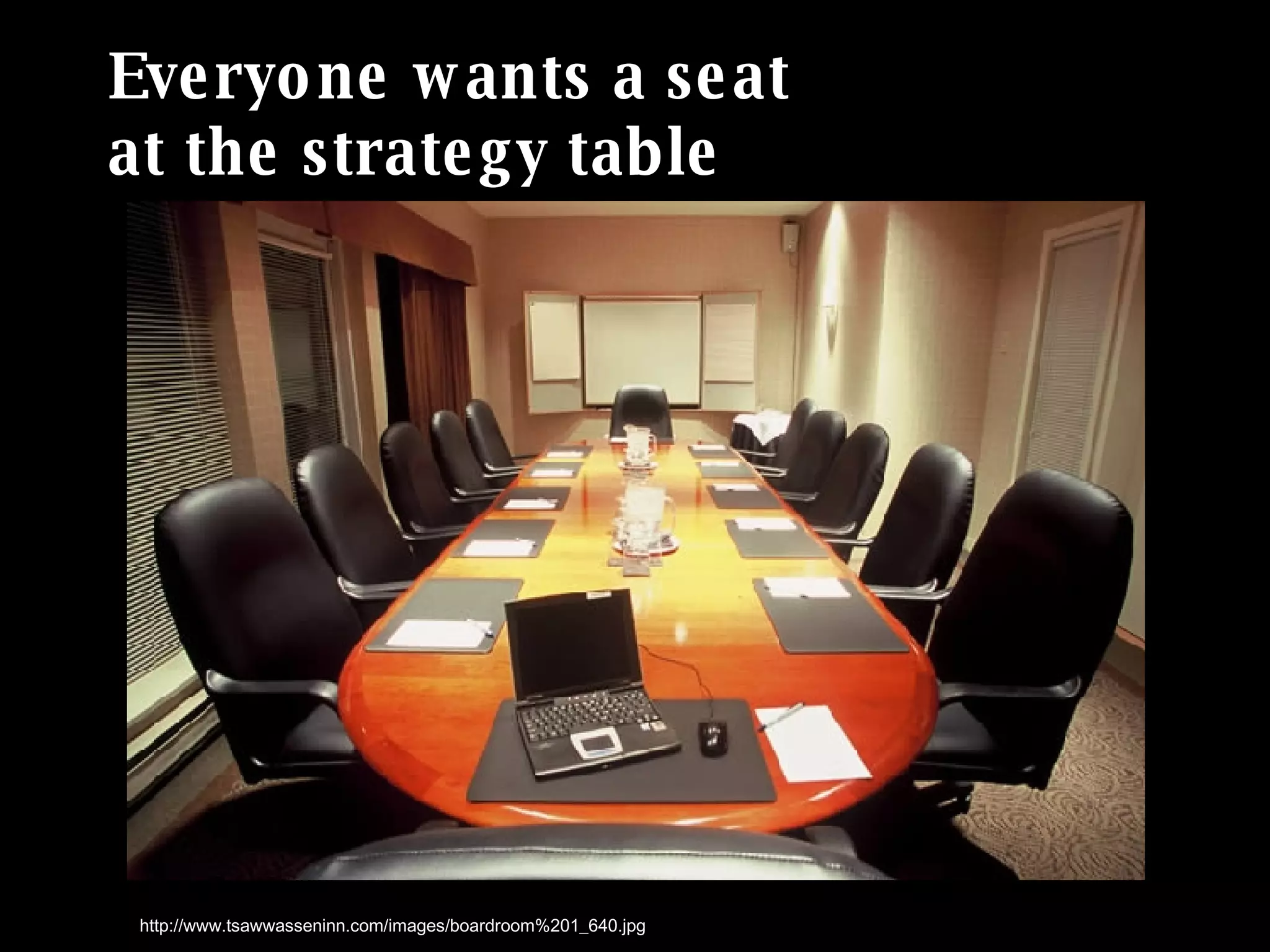
Everyone wants a seat  at the strategy table http://www.tsawwasseninn.com/images/boardroom%201_640.jpg
Why there’s no seat for IT managers “Keep those lights on!” Growing pressures to commoditize IT services  Difficult to break out of reaction mode Getting beyond commodities Business side doesn't understand technology and its possibilities Lack of common language quashes dialogue Result:  IT cut out of strategic decision-making
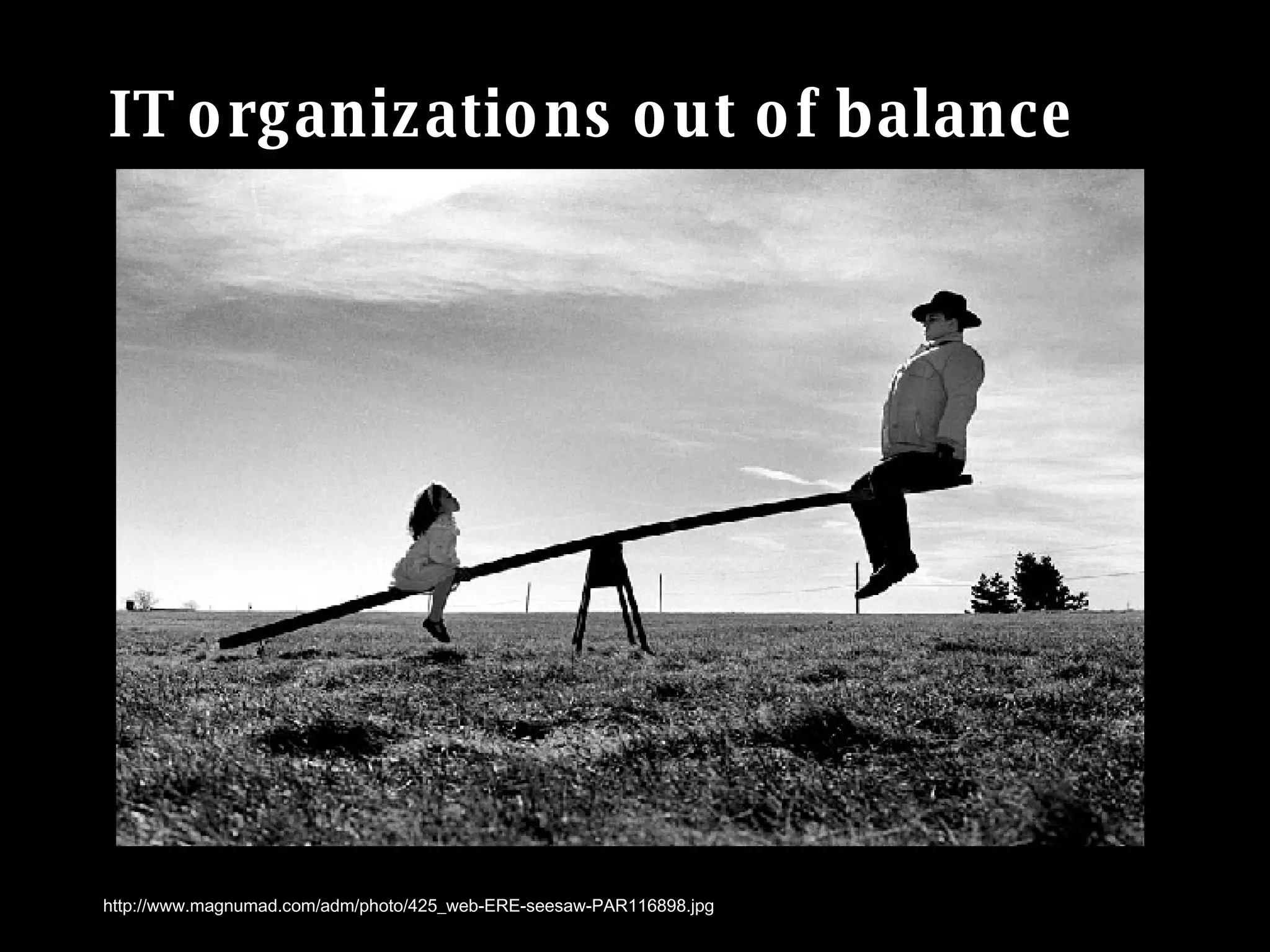
IT organizations out of balance http://www.magnumad.com/adm/photo/425_web-ERE-seesaw-PAR116898.jpg
What’s out of whack? Structured data versus semi-structured content  Centralization versus autonomy  Traditional, formal approaches versus emergent, informal approaches Build it versus buy it Customers versus business
How exactly does one commoditize IT when facing these issues? Imbalances (as previously noted) Tidal wave of unstructured information Deriving actual value from enterprise applications Globalization, localization, and internationalization  Content resident in user-hostile enterprise  silos
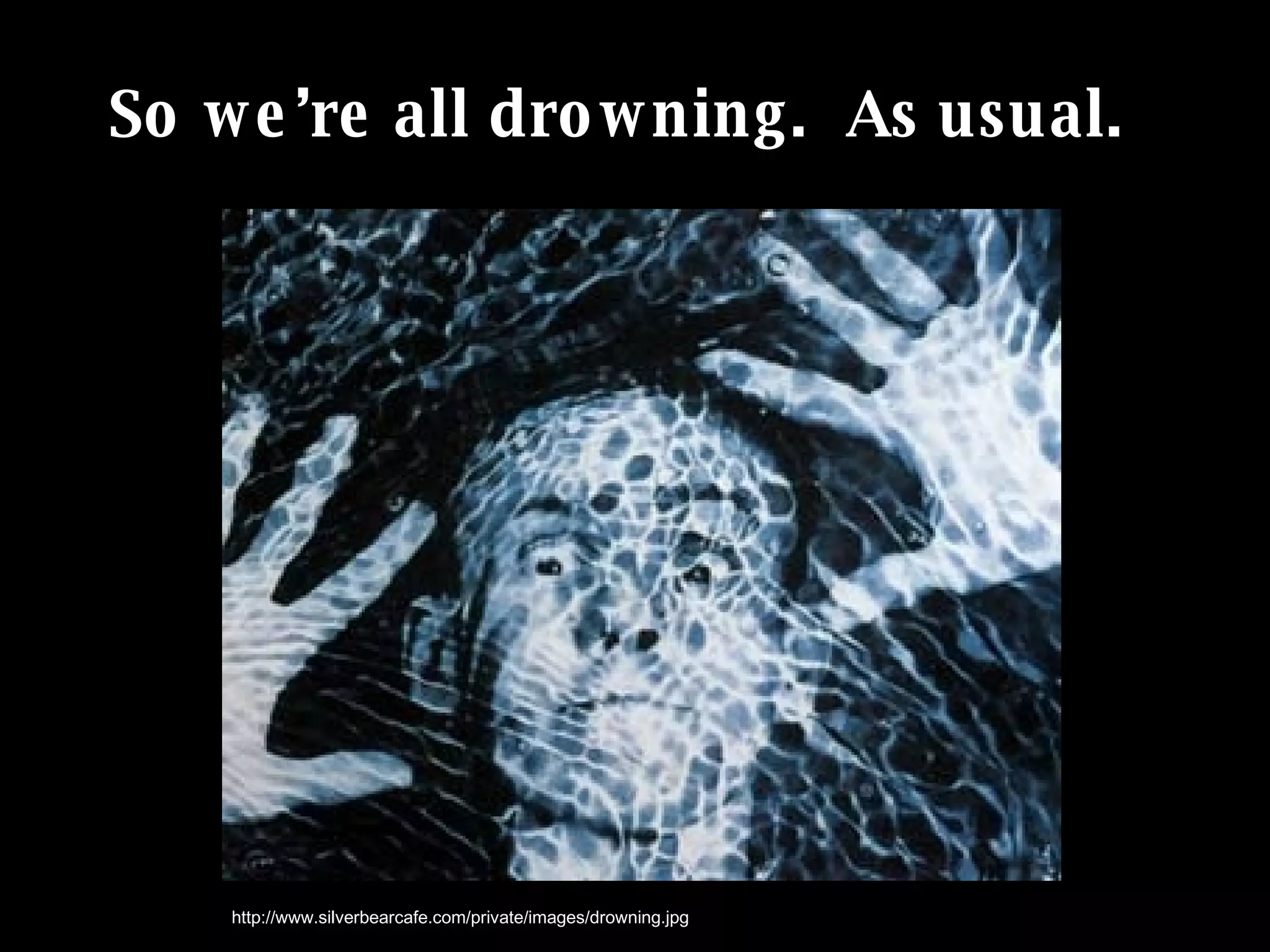
So we’re all drowning.  As usual. http://www.silverbearcafe.com/private/images/drowning.jpg
Do you agree? “If you understand how the web site should be organized to serve your customers, then you know how the company should be organized.” --Anonymous information architect, IBM Key phrases:  serve customers,  company organized
Should IT managers be involved in organizing the company? If “information is strategic,” then of course! Information should be organized around needs of customers/users IT provides the infrastructure for creating and managing information Business side not always able to understand implications of information systems How can IT  not  be involved? How is this  not  strategic work?
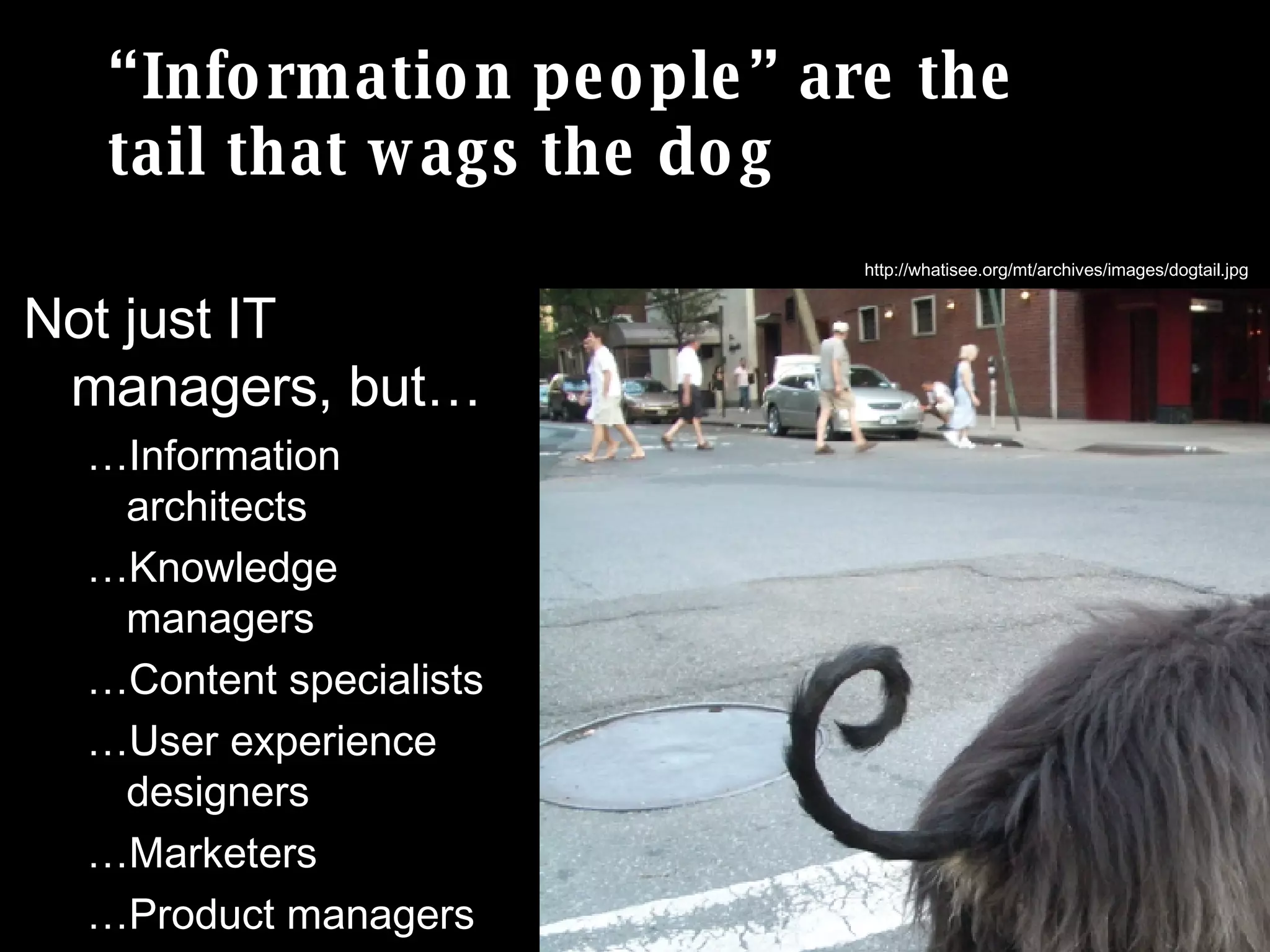
“Information people” are the  tail that wags the dog Not just IT managers, but… … Information architects … Knowledge managers … Content specialists … User experience designers … Marketers … Product managers … Etc… http://whatisee.org/mt/archives/images/dogtail.jpg
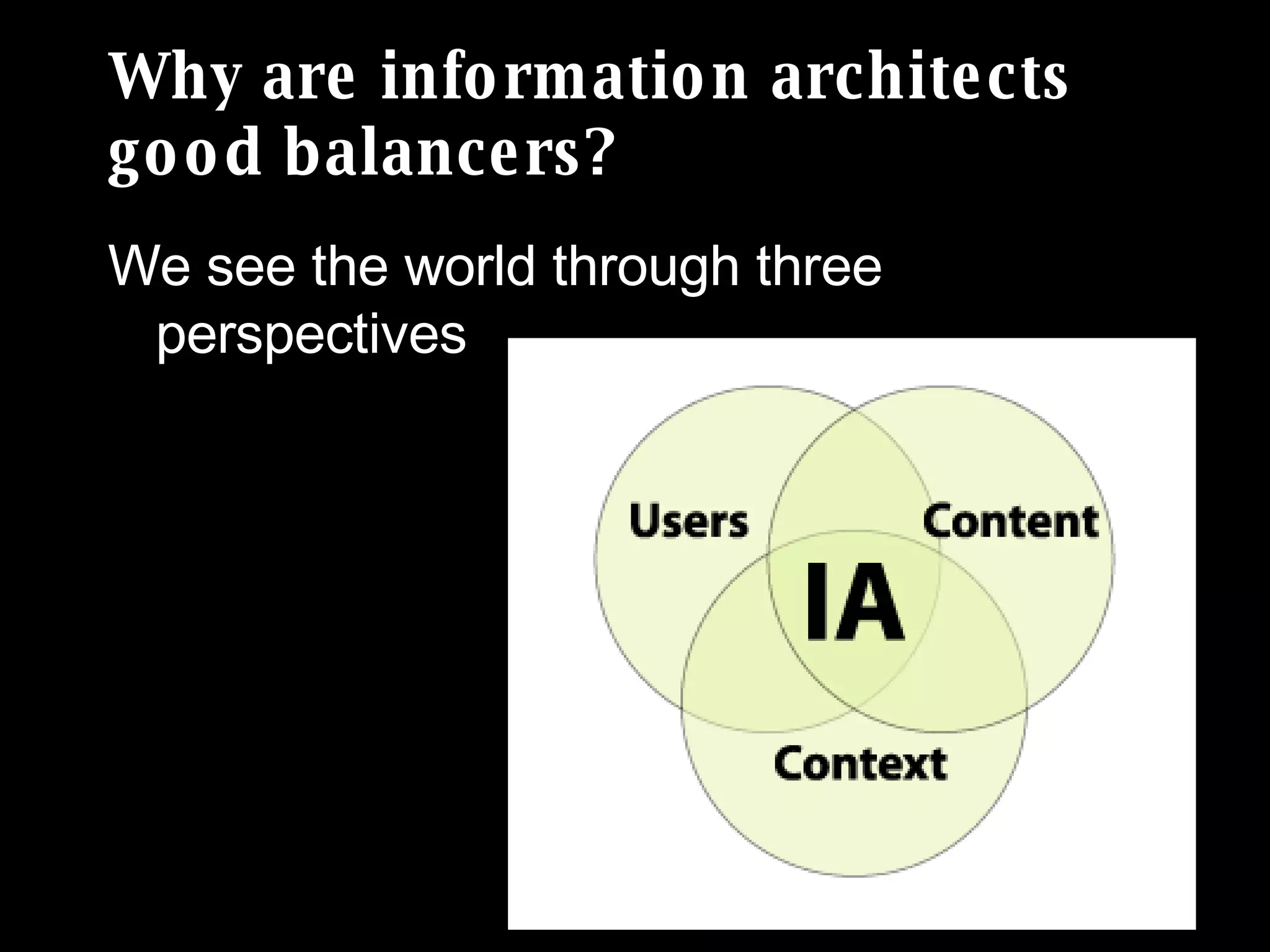
Why IT managers need  information architects Information architects are the people who organize, structure, and label information Our goal:  help users find what they want We worry a lot about these things Taxonomies, metadata, labeling Search systems performance Navigation and orientation Content lifecycle Users, users, users
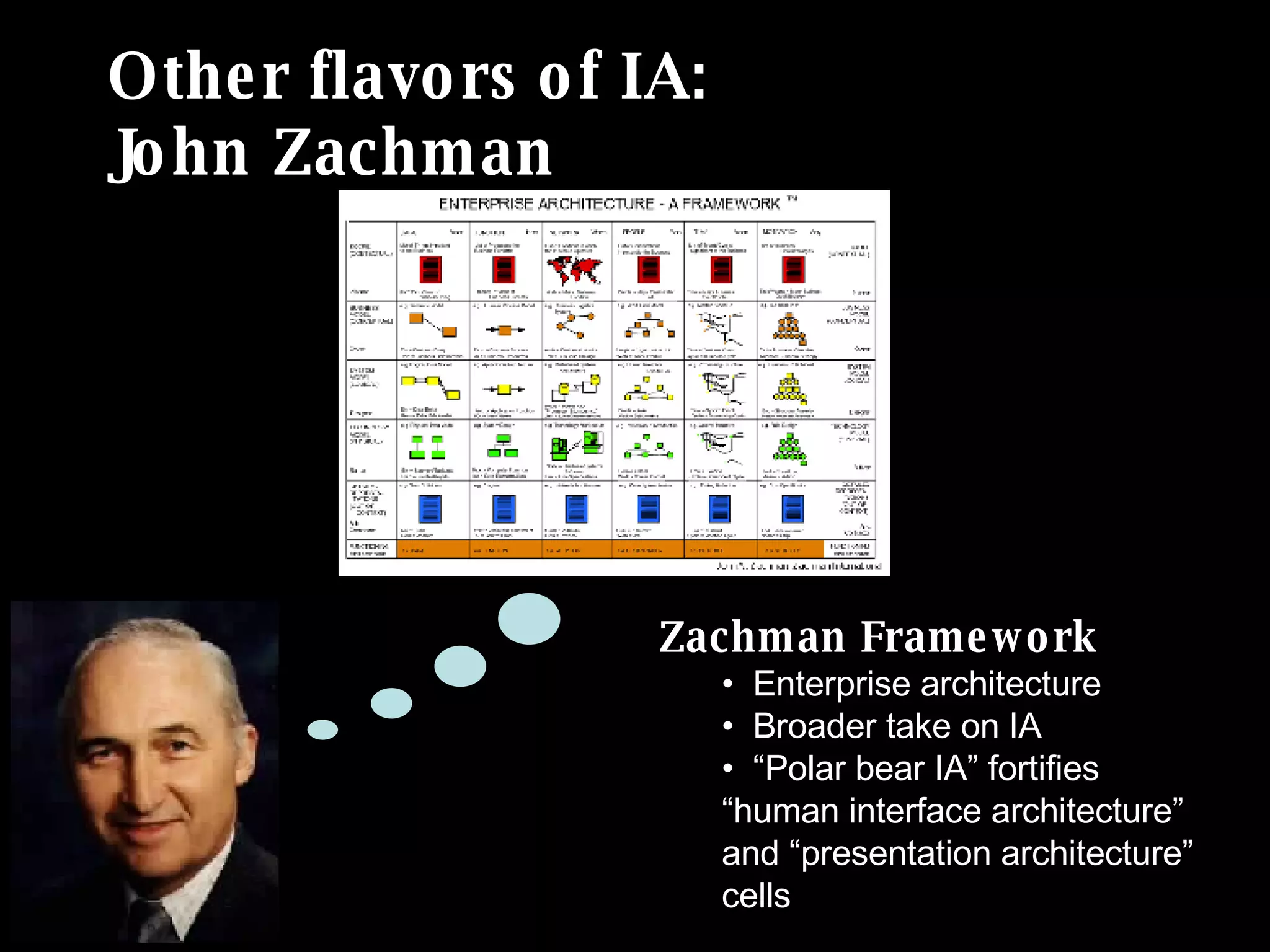
Other flavors of IA:  John Zachman Zachman Framework Enterprise architecture Broader take on IA “ Polar bear IA” fortifies “human interface architecture” and “presentation architecture” cells
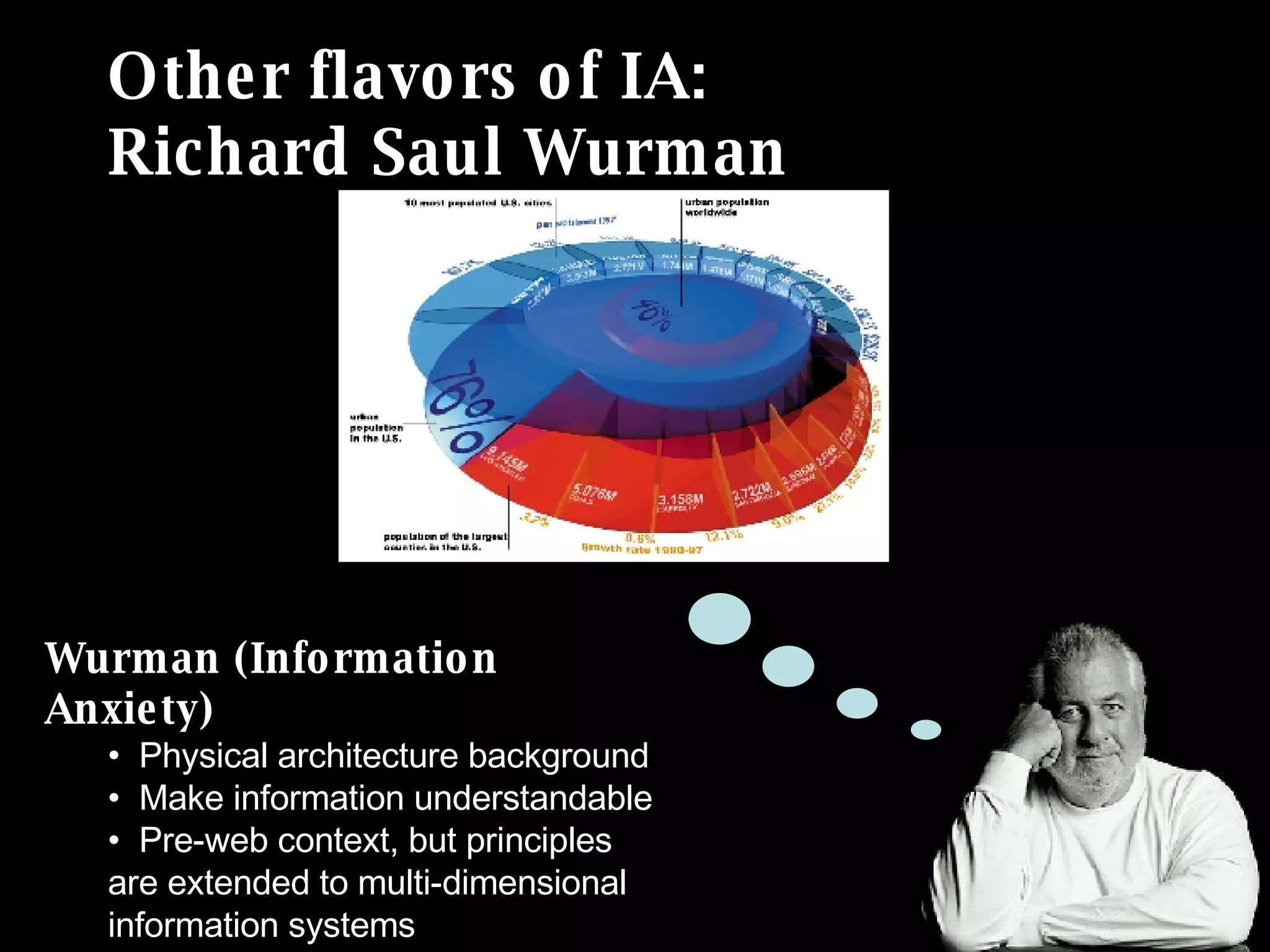
Other flavors of IA:  Richard Saul Wurman Wurman (Information Anxiety) Physical architecture background Make information understandable Pre-web context, but principles are extended to multi-dimensional information systems
Information architects help by rebalancing information systems Structured versus semi-structured:  IAs are strong in the latter (where IT is often weak) Centralization versus autonomy:  IAs develop balanced workflows and processes Traditional, formal versus emergent, informal:  IAs integrate these as part of broader ecology  Build it versus buy it:  IAs are technology agnostics who help develop functional specs that go beyond technical requirements Customers versus business:   IAs shore up knowledge of the former, and are neutral balancers between competing needs
Why are information architects  good balancers? We see the world through three perspectives
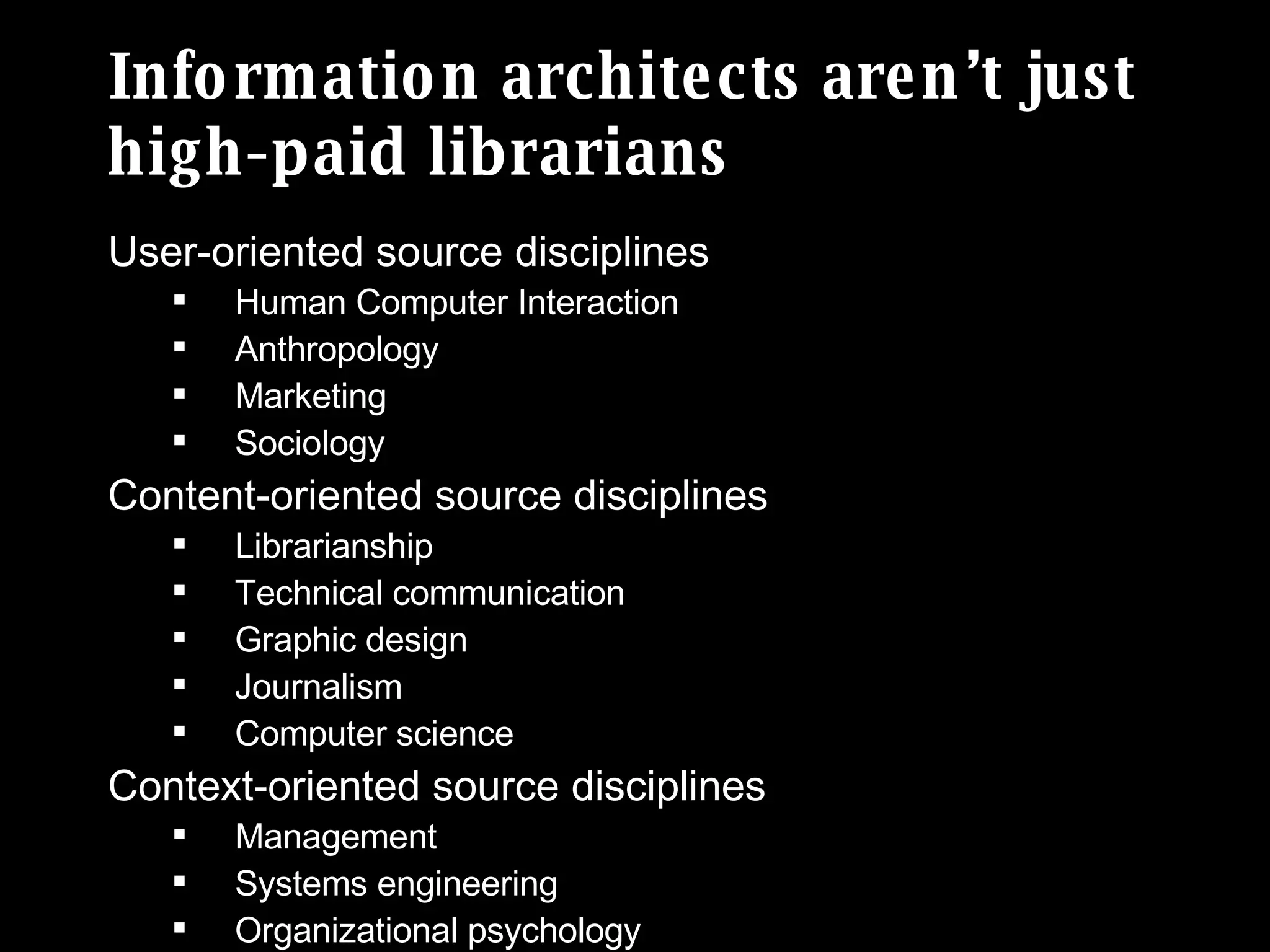
Information architects aren’t just high-paid librarians User-oriented source disciplines Human Computer Interaction Anthropology Marketing Sociology Content-oriented source disciplines Librarianship Technical communication Graphic design Journalism Computer science Context-oriented source disciplines Management Systems engineering Organizational psychology
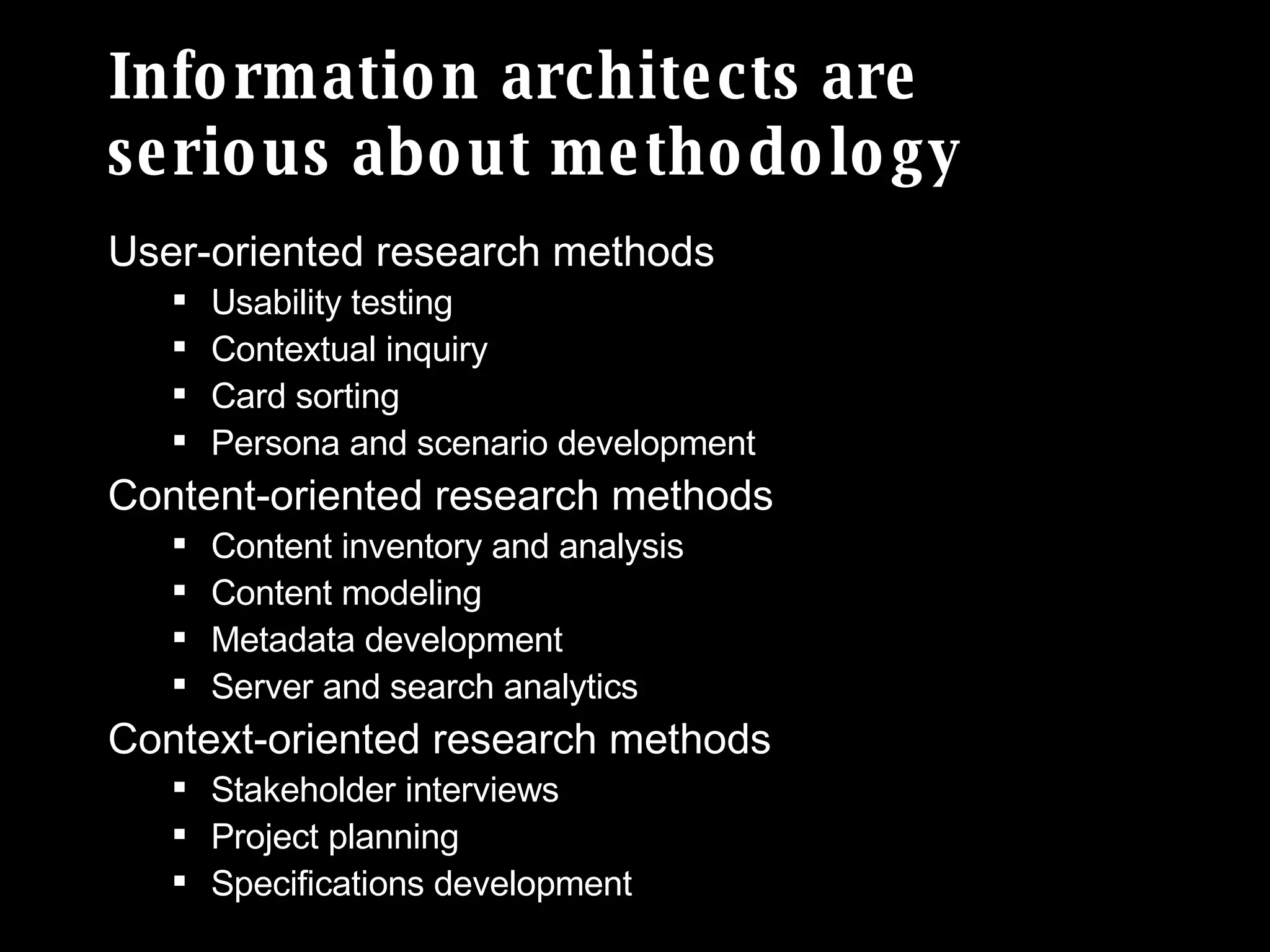
Information architects are serious about methodology User-oriented research methods Usability testing Contextual inquiry Card sorting Persona and scenario development Content-oriented research methods Content inventory and analysis Content modeling Metadata development Server and search analytics Context-oriented research methods Stakeholder interviews Project planning Specifications development
How do we use our methods?  To prioritize Can you confidently answer these two questions? What are your site’s major audiences? What are each audience’s  Big Questions  (and how well are you addressing them)?
Major audiences: Who are they? Secondary goal? (You may already know who they are) Political challenges of audience definition Problem:  defining audience by silo leads to stakeholder infighting Goal:  err toward apolitical segmenting that cuts across silos; examples: Job functions (admin, clerical, research, mgmt) Demographics
Big questions: What are they? Major tasks users want to accomplish or topics they want to know about Examples:  “ Where do I reconfigure my health benefits?” “ Where can I find our past sales proposals?” “ How do I file an expense report?”
Big questions: How do you determine them?  1/2 Active methods: ask people who would know Webmasters and the hate mail they get Switchboard operators and their FAQs SMEs and the people who bother them Who else? Avoid:  focus groups
Big questions: How do you determine them?  2/2 Passive methods:  look at data derived from users’ behavior (you already have it!) Switchboard logs Server logs (Web Analytics)  Search logs (Search Analytics) Information center logs Where else? Grouping log data can help you (re)define audience segments
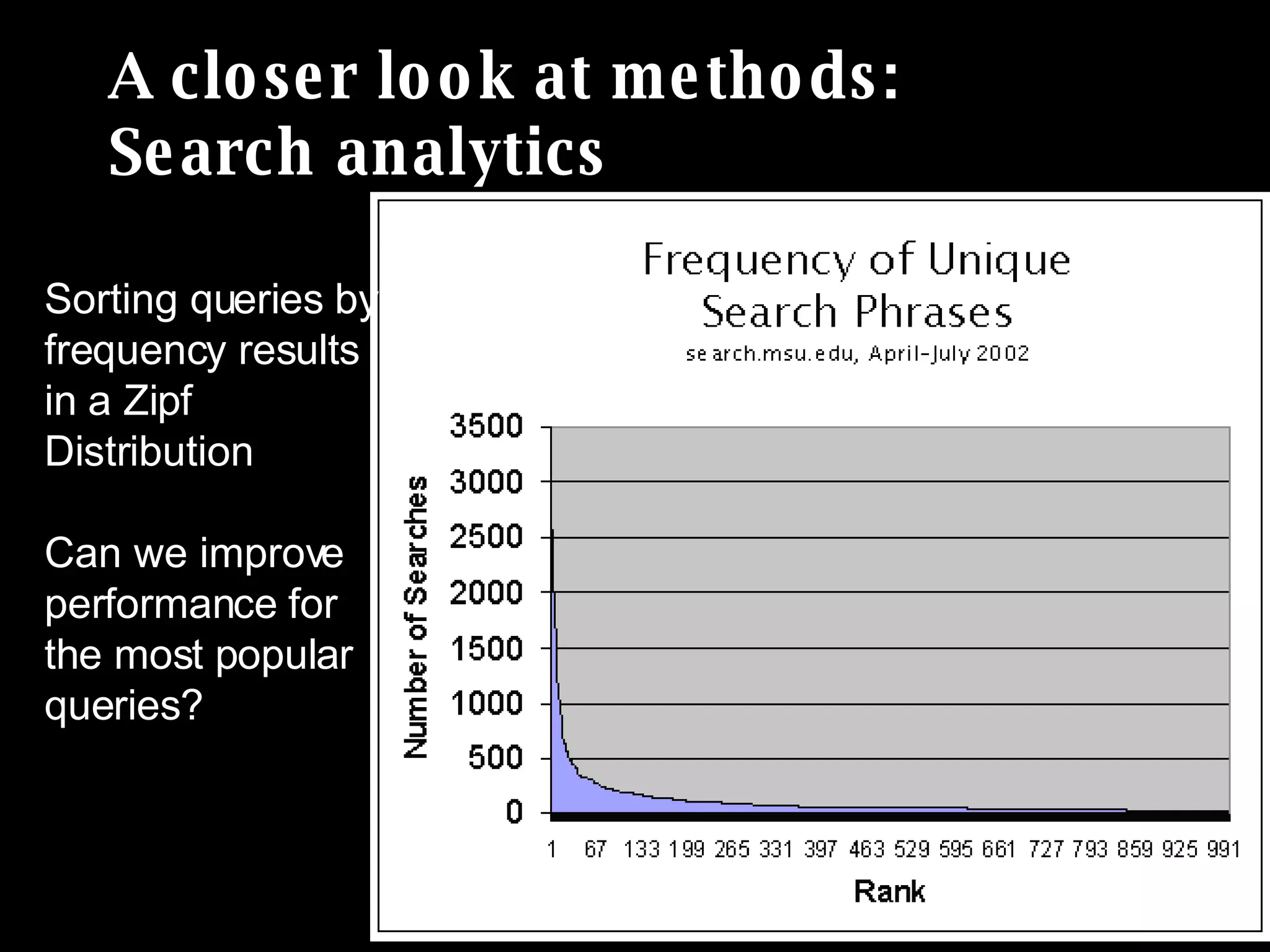
A closer look at methods: Search analytics Sorting queries by frequency results in a Zipf Distribution Can we improve performance for the most popular queries?
Anatomy of a search log (from Google Search Appliance) Critical elements in bold:  IP address ,  time/date stamp ,  query , and  # of results: XXX.XXX.X.104  - - [ 10/Jul/2006:10:25:46  -0800] "GET /search?access=p&entqr=0&output=xml_no_dtd&sort=date%3AD%3AL%3Ad1&ud=1&site=AllSites&ie=UTF-8&client=www&oe=UTF-8&proxystylesheet=www&q= lincense+plate &ip=XXX.XXX.X.104 HTTP/1.1" 200 971  0  0.02 XXX.XXX.X.104  - - [ 10/Jul/2006:10:25:48  -0800] "GET /search?access=p&entqr=0&output=xml_no_dtd&sort=date%3AD%3AL%3Ad1&ie=UTF-8&client=www&q= license+plate &ud=1&site=AllSites&spell=1&oe=UTF-8&proxystylesheet=www&ip=XXX.XXX.X.104 HTTP/1.1" 200 8283  146  0.16 XXX.XXX.XX.130  - - [ 10/Jul/2006:10:24:38  -0800] "GET /search?access=p&entqr=0&output=xml_no_dtd&sort=date%3AD%3AL%3Ad1&ud=1&site=AllSites&ie=UTF-8&client=www&oe=UTF-8&proxystylesheet=www&q= regional+transportation+governance+commission &ip=XXX.XXX.X.130 HTTP/1.1" 200 9718  62  0.17 Full legend and more examples here: http://www.rosenfeldmedia.com/books/searchanalytics/blog/log_sample_google_appliance/
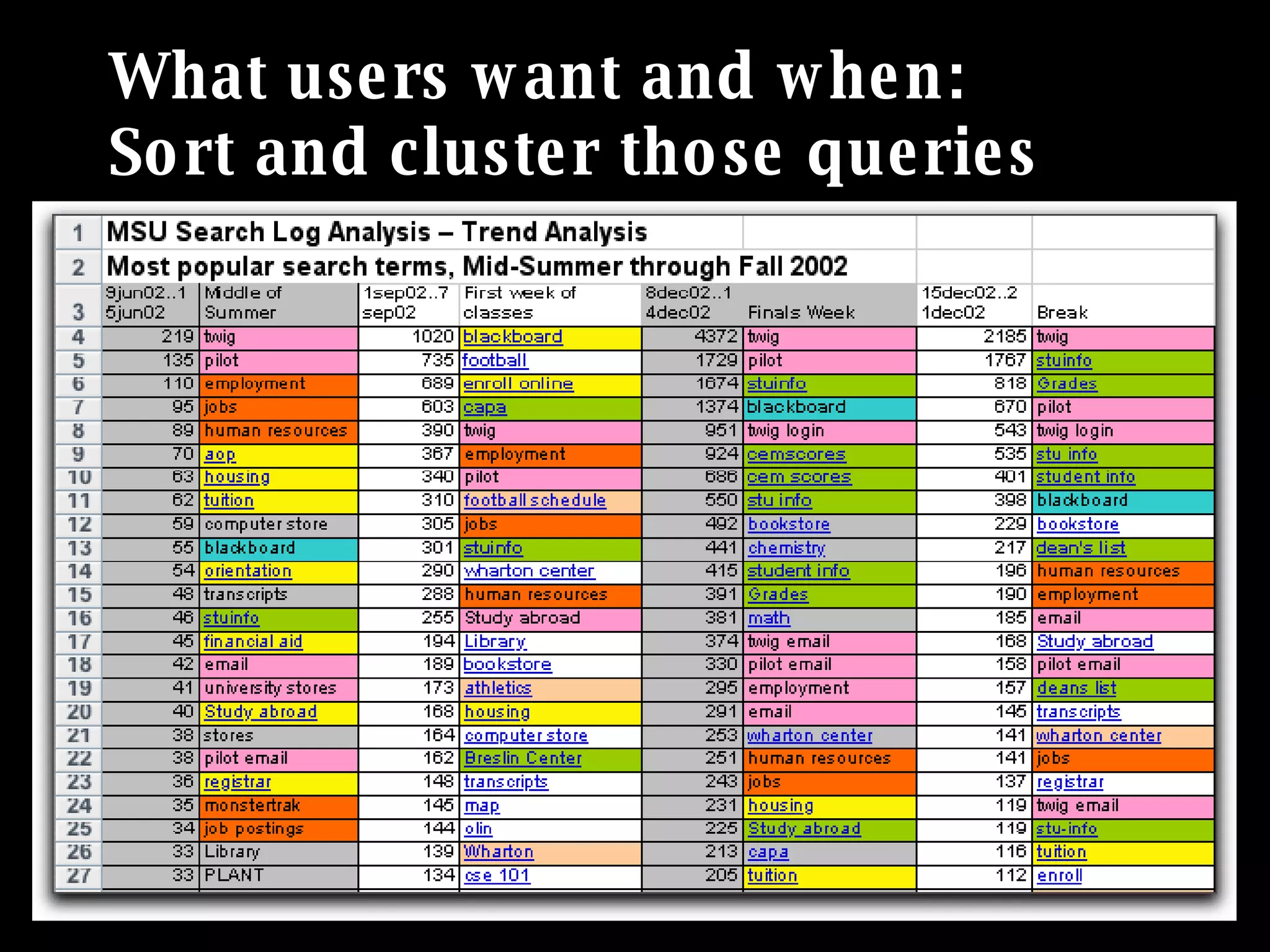
What users want and when: Sort and cluster those queries
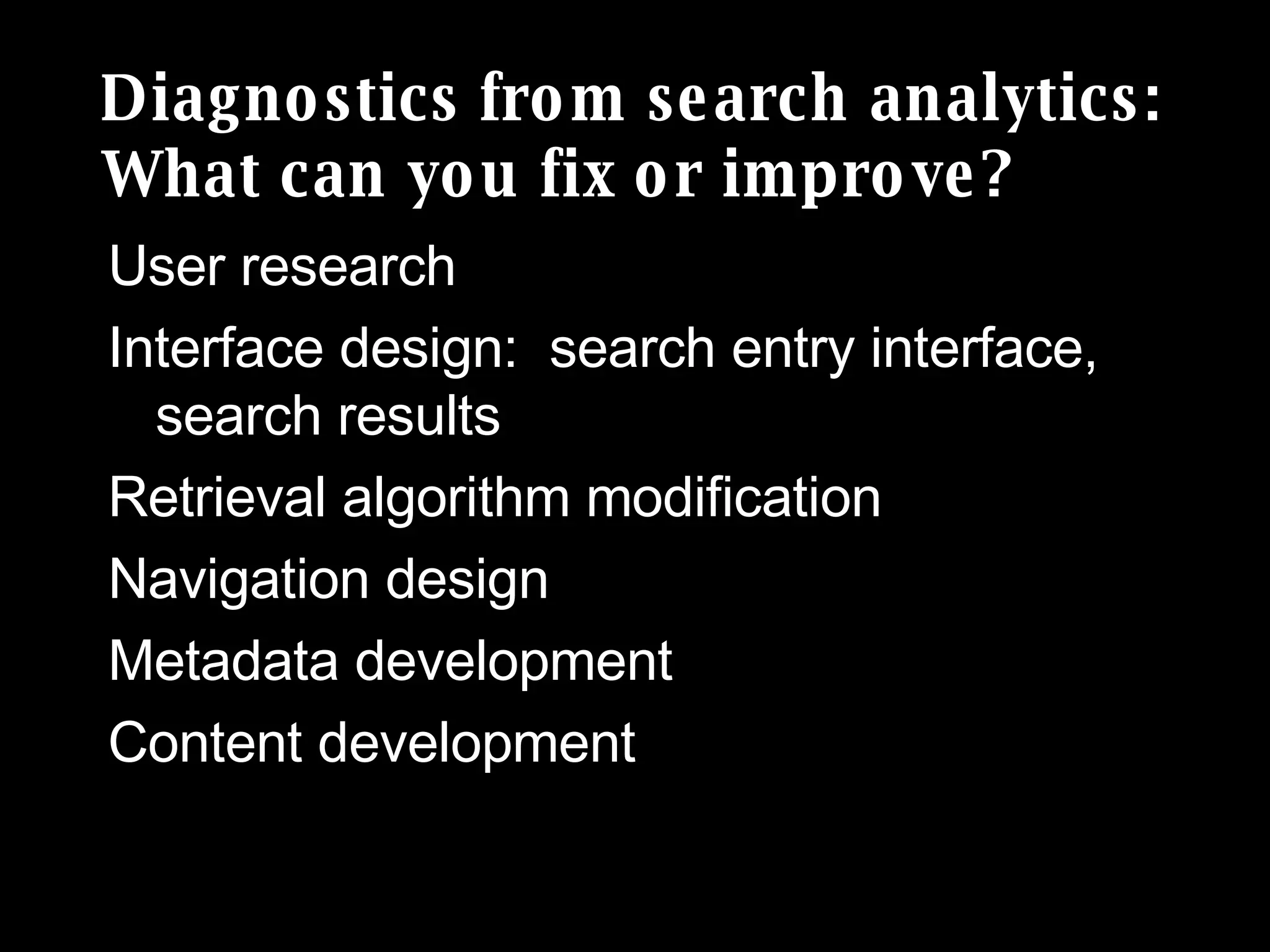
Diagnostics from search analytics:  What can you fix or improve? User research Interface design:  search entry interface, search results Retrieval algorithm modification Navigation design Metadata development Content development
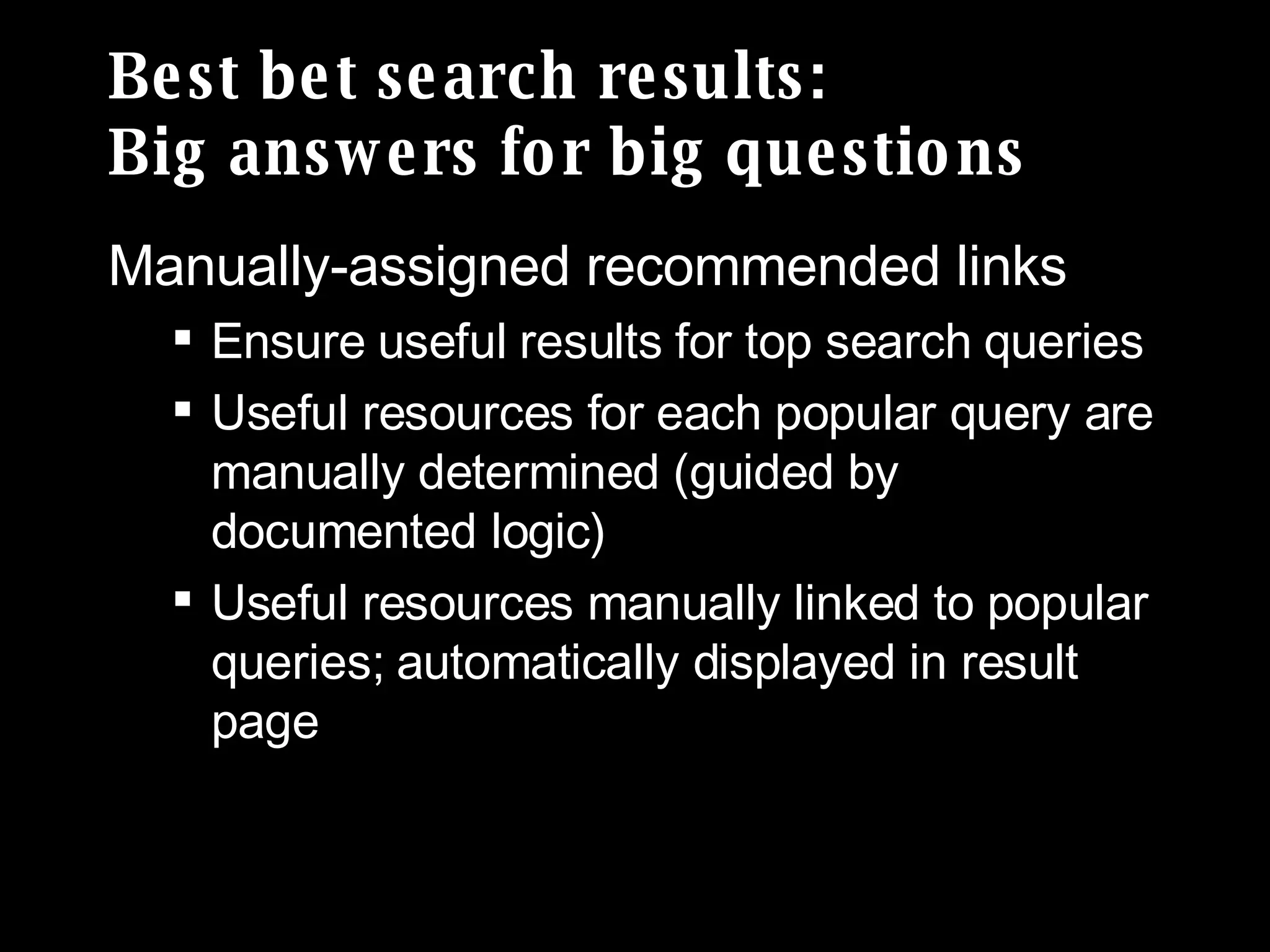
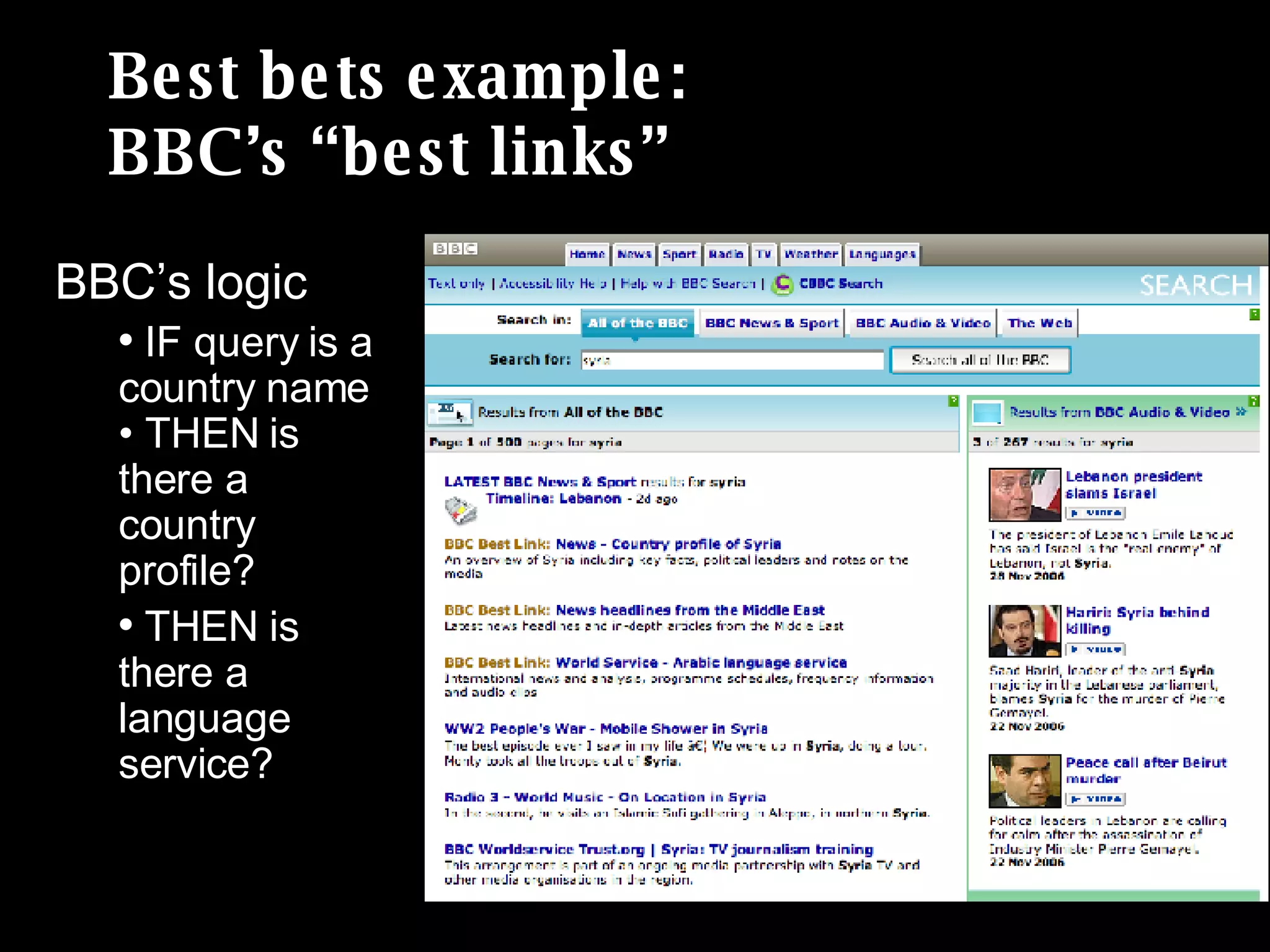
Best bet search results:  Big answers for big questions Manually-assigned recommended links Ensure useful results for top search queries Useful resources for each popular query are manually determined (guided by documented logic) Useful resources manually linked to popular queries; automatically displayed in result page
Best bets example:  BBC’s “best links” BBC’s logic IF query is a country name • THEN is there a country profile? THEN is there a language service?
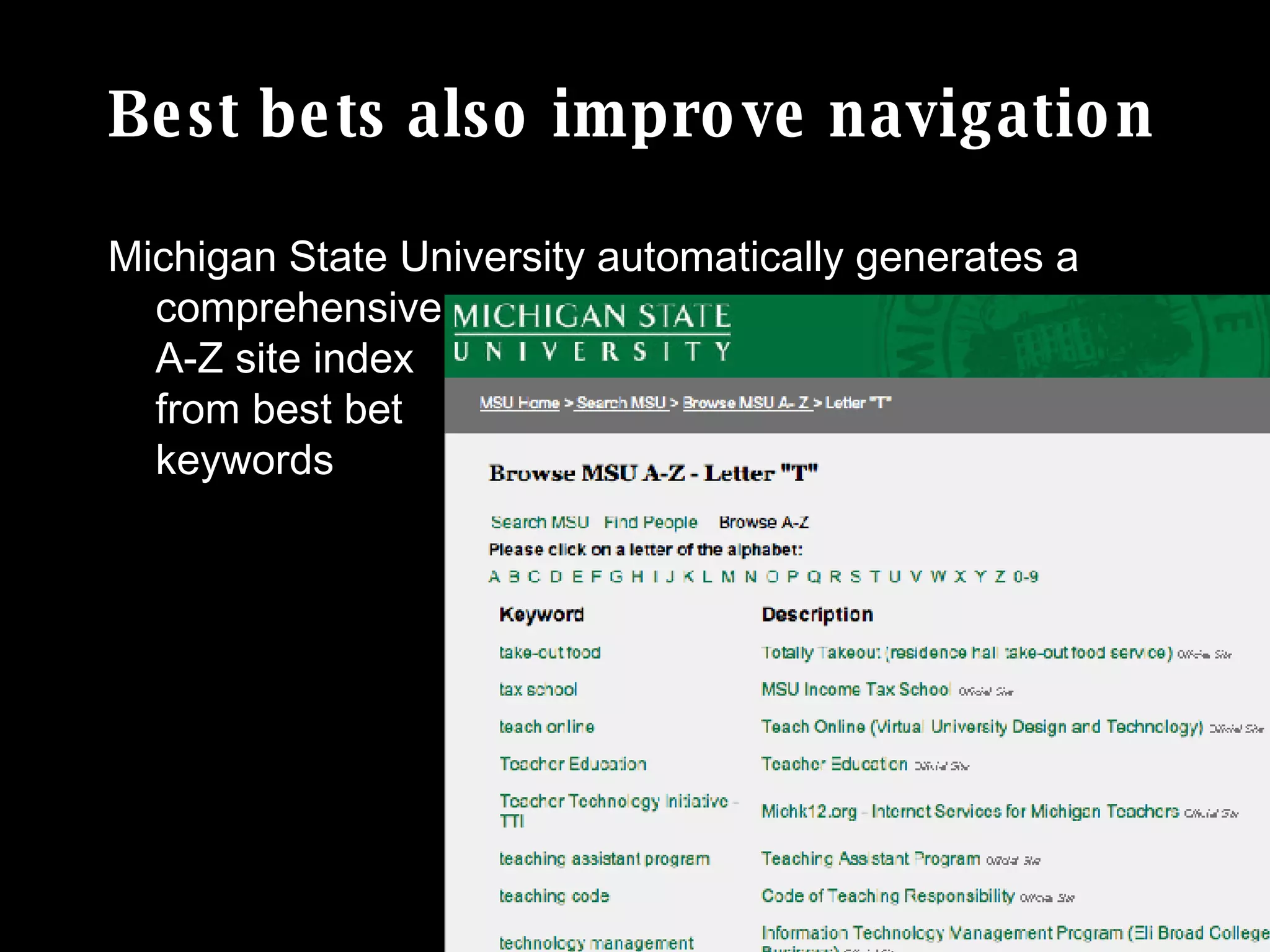
Best bets also improve navigation Michigan State University automatically generates a comprehensive  A-Z site index  from best bet  keywords
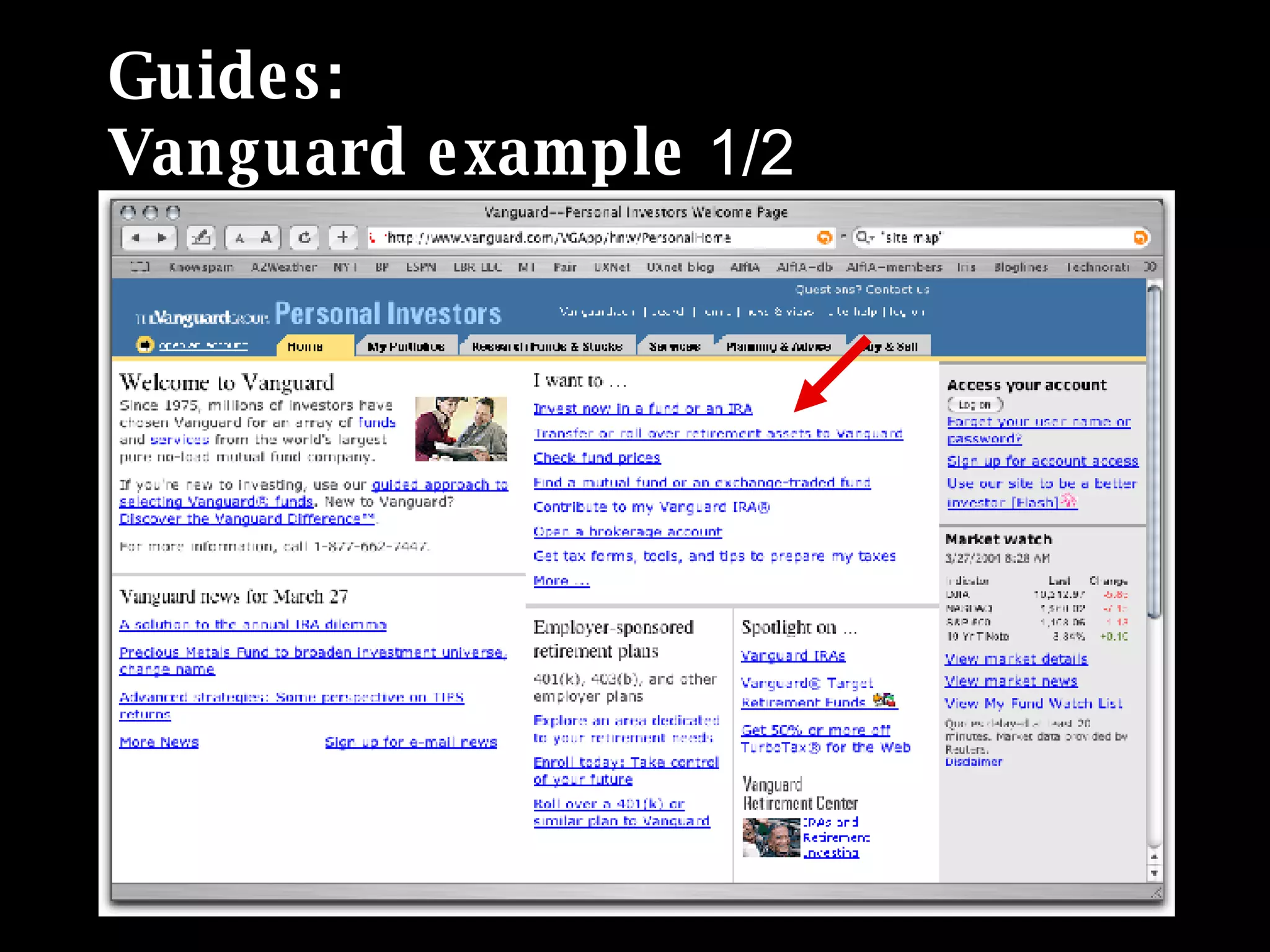
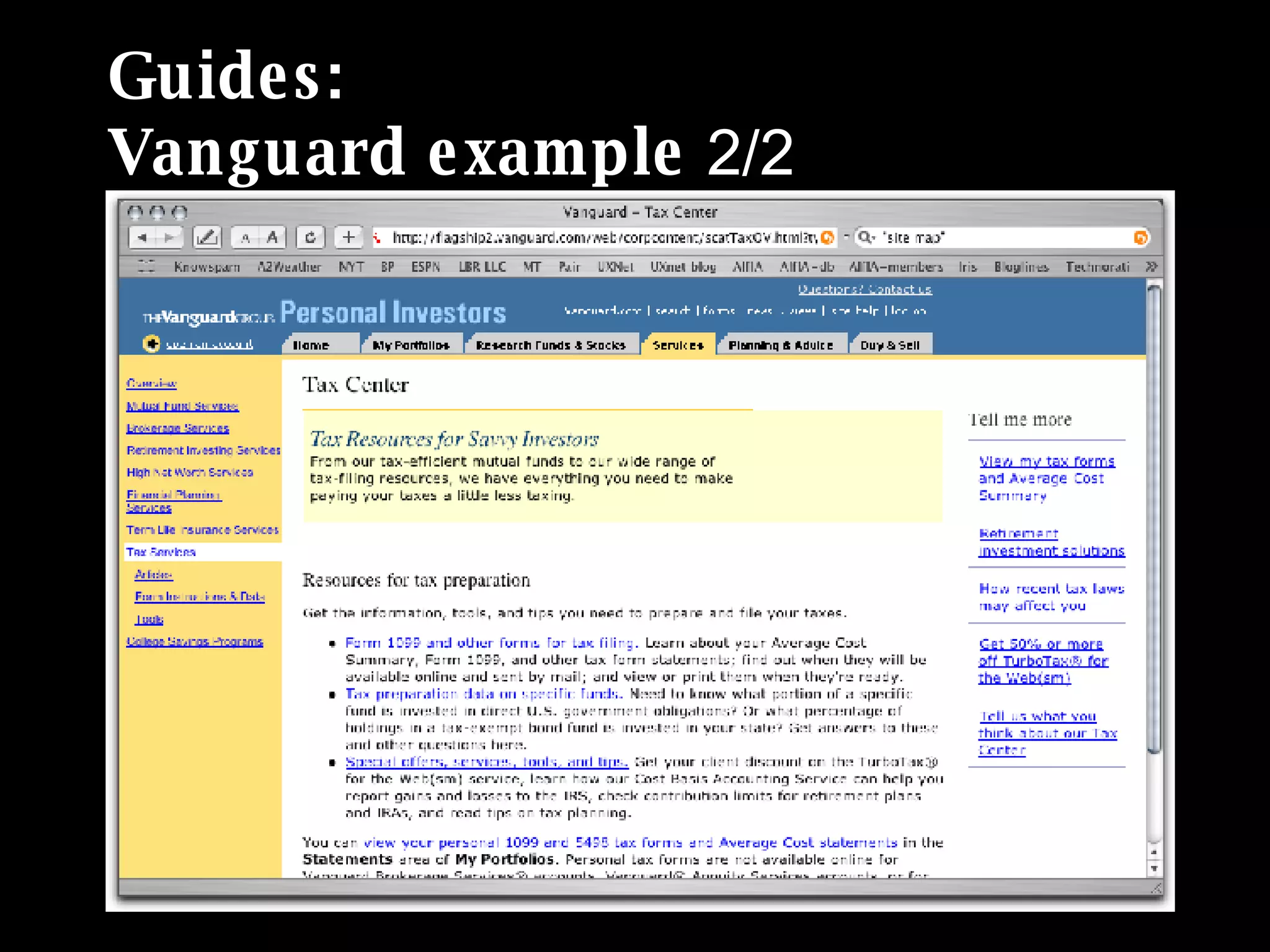
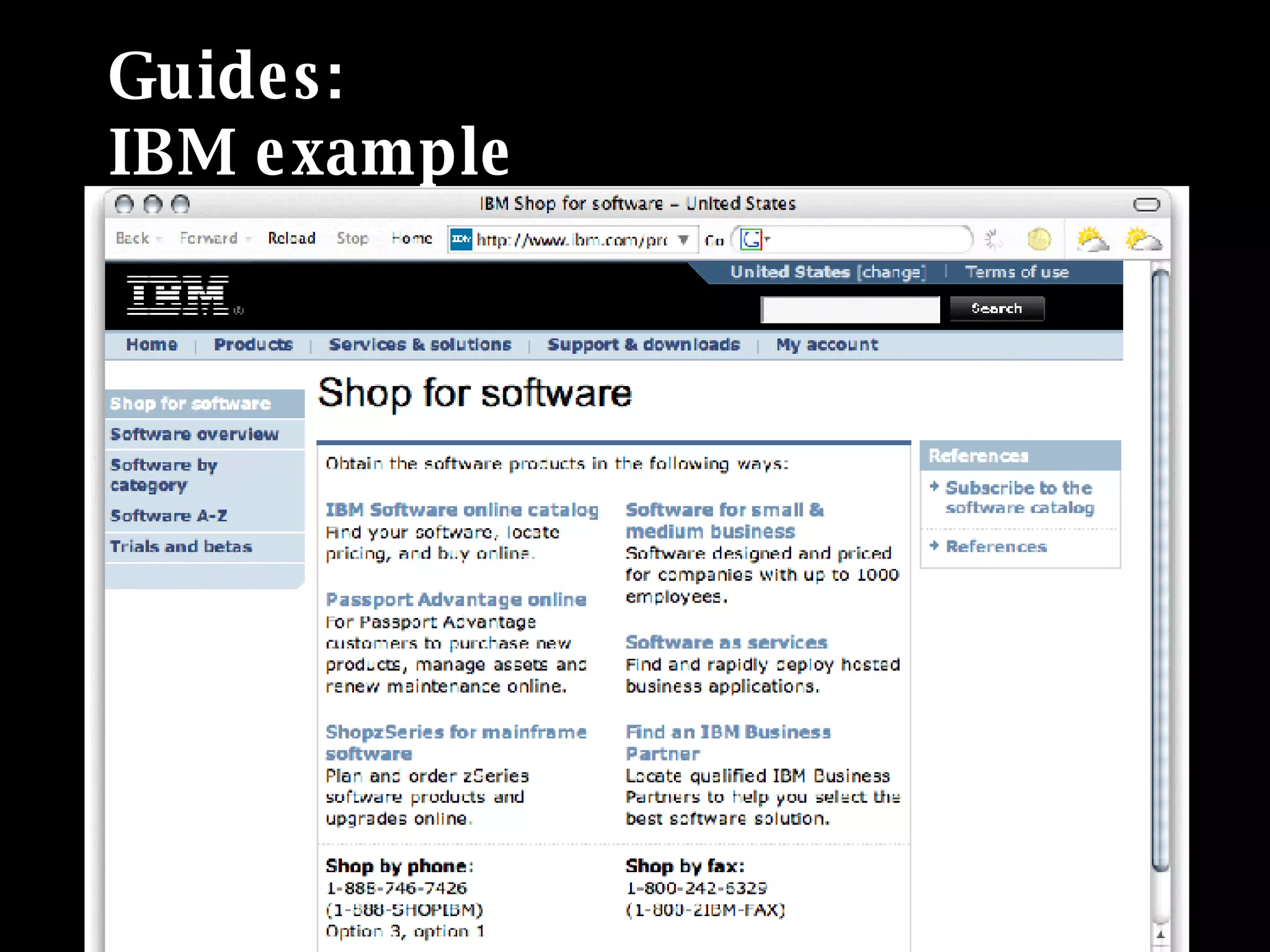
Guides: Even bigger answers to big questions Guides are single pages that contain A selective set (5-10) of important links related to a Big Question Narrative text that explains the topic and what’s available to help with that topic Generally linked from the main page, but also used in more specific contexts Subsite main pages Search results
Guides: Vanguard example  1/2
Guides: Vanguard example  2/2
Guides: IBM example
Guides: Painless and efficient Low impact on IT (single HTML page) Cut across departmental silos Gap fillers; complement comprehensive methods of navigation and search Can be timely (e.g., news-oriented guides, seasonal guides) Minimize political headaches by creating new real estate Can grow into fuller subsites
Contextual navigation: Focusing on  where  users are Contextual navigation supports users deep in site Where am I? Where can I go from here? Mandated by Web 2.0 world Top layers of information systems are increasingly bypassed Search engines  Syndication (RSS, Atom) Banner advertising Deep content becomes starting point
Contextual navigation is  powered by content models “Data modeling for semi-structured content” Content modeling process helps narrow down both content and metadata choices Content models consist of Content objects Links between objects  Metadata Use sparingly to support high-value contextual navigation
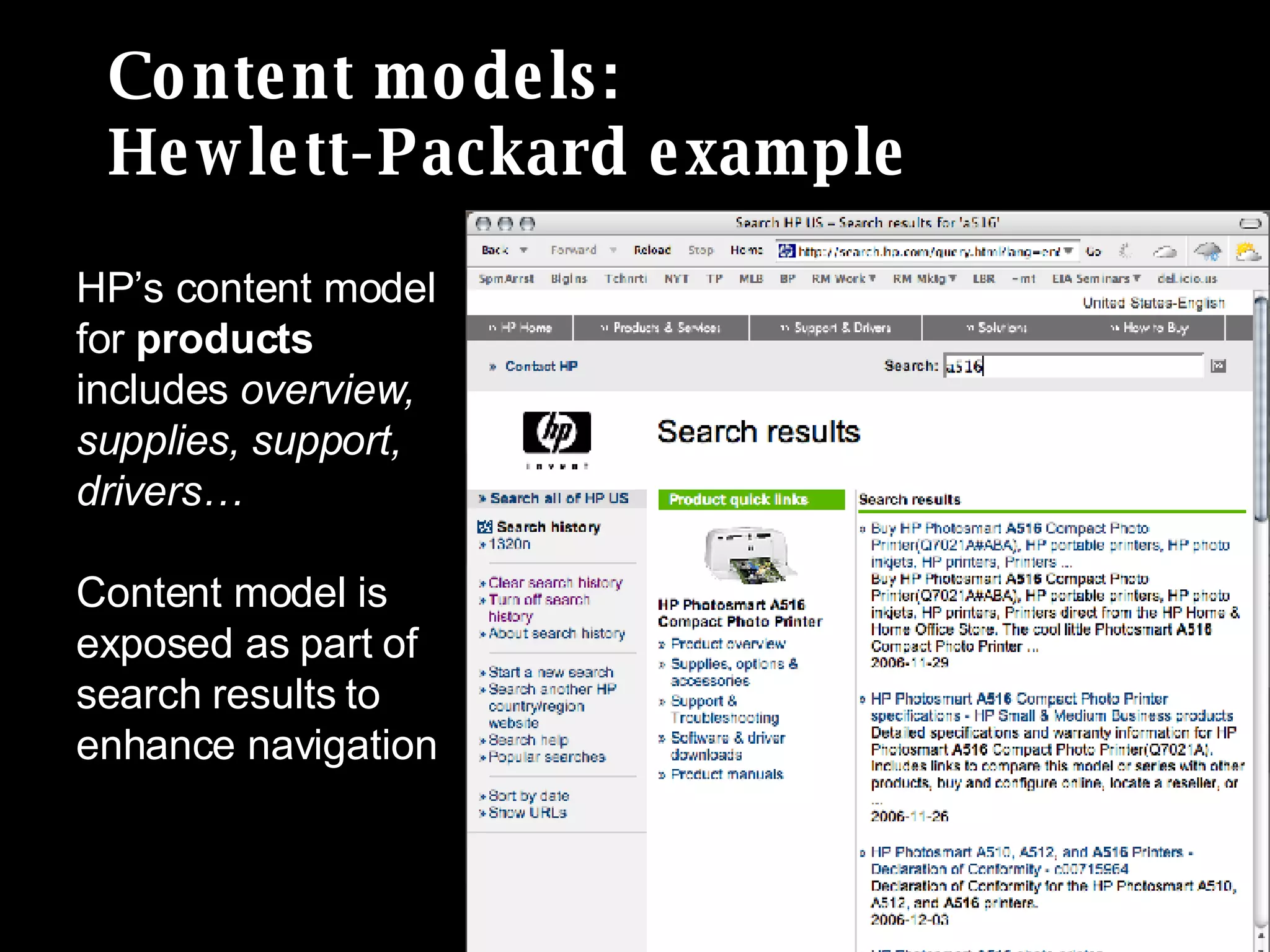
Content models: Hewlett-Packard example  HP’s content model for  products  includes  overview, supplies, support, drivers… Content model is exposed as part of search results to enhance navigation
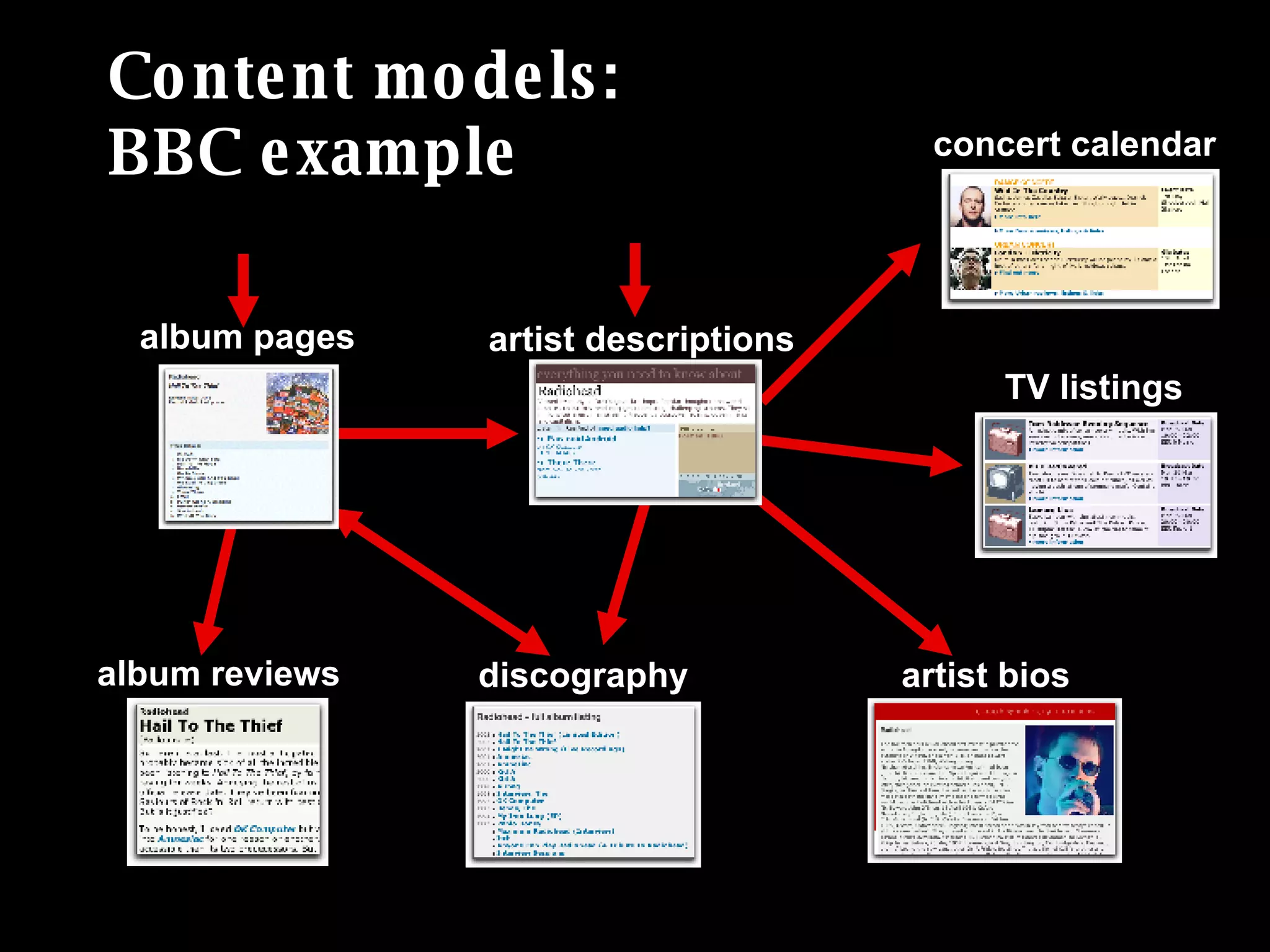
Content models:  BBC example artist descriptions album reviews album pages artist bios discography concert calendar TV listings
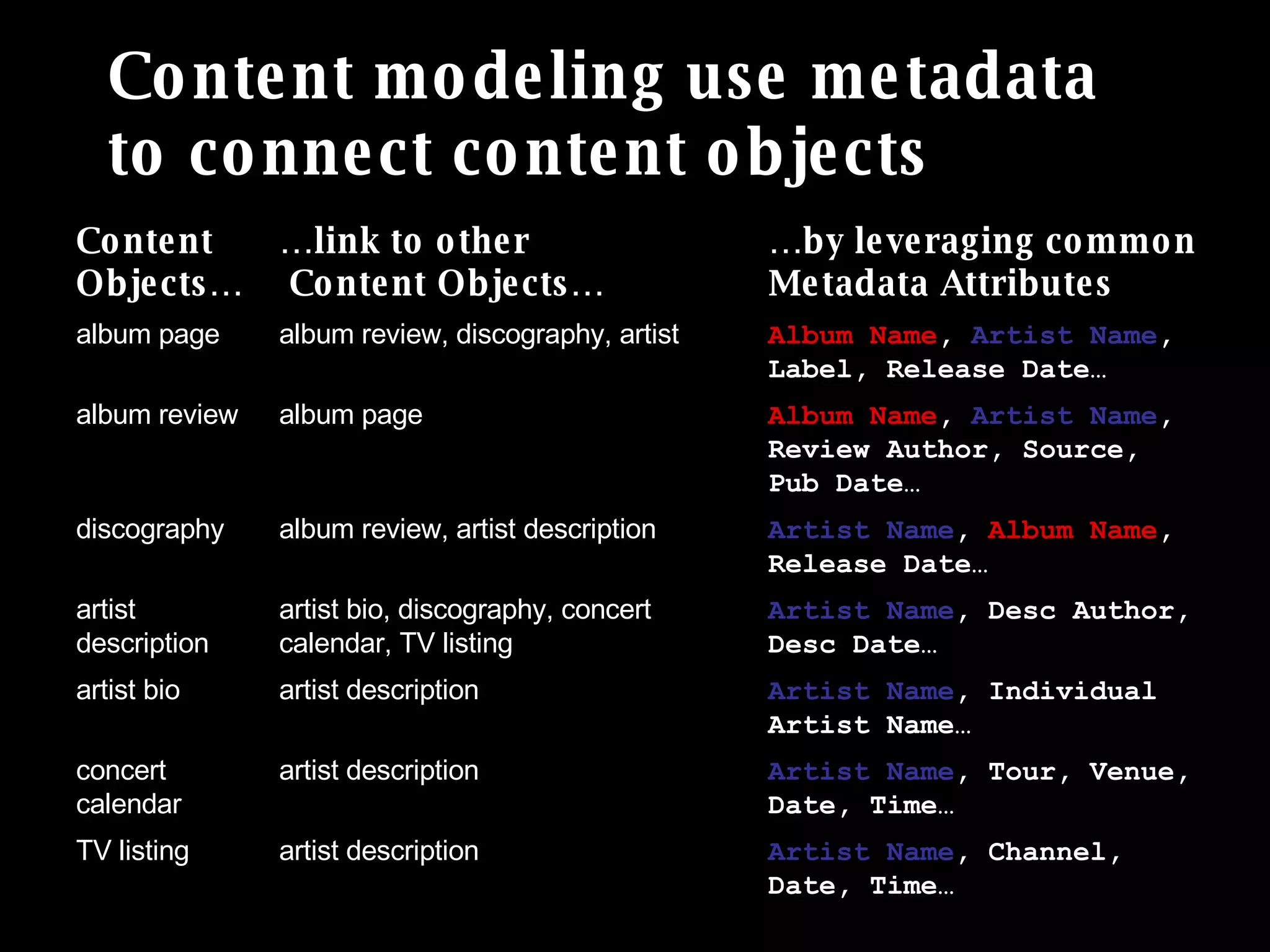
Content modeling use metadata to connect content objects artist description artist description artist description artist bio, discography, concert calendar, TV listing album review, artist description album page album review, discography, artist … link to other  Content Objects… Artist Name , Channel, Date, Time… Artist Name , Tour, Venue, Date, Time… Artist Name , Individual Artist Name… Artist Name , Desc Author, Desc Date… Artist Name ,  Album Name , Release Date… Album Name ,  Artist Name , Review Author, Source, Pub Date… Album Name ,  Artist Name , Label, Release Date… … by leveraging common Metadata Attributes TV listing concert calendar artist bio artist description discography album review album page Content Objects…
Small steps start to add up Make that search engine earn its keep Institute best bets, spell checking, guides, etc. Can improve user experience performance by 20%-30% (make up your own numbers) Make that CMS earn its keep Manage content objects and metadata to support contextual navigation Touch a  small portion  of your content to improve experience for many users
Information architects can help  IT managers avoid boiling the ocean Ban the word  redesign  from your vocabulary Replace it with  continual improvement And pause before replacing enterprise apps Take small, concrete steps that have large impacts (guides, best bets, spell checking, limited content modeling) Focus on  what  you can reasonably accomplish, and  when  you can do it
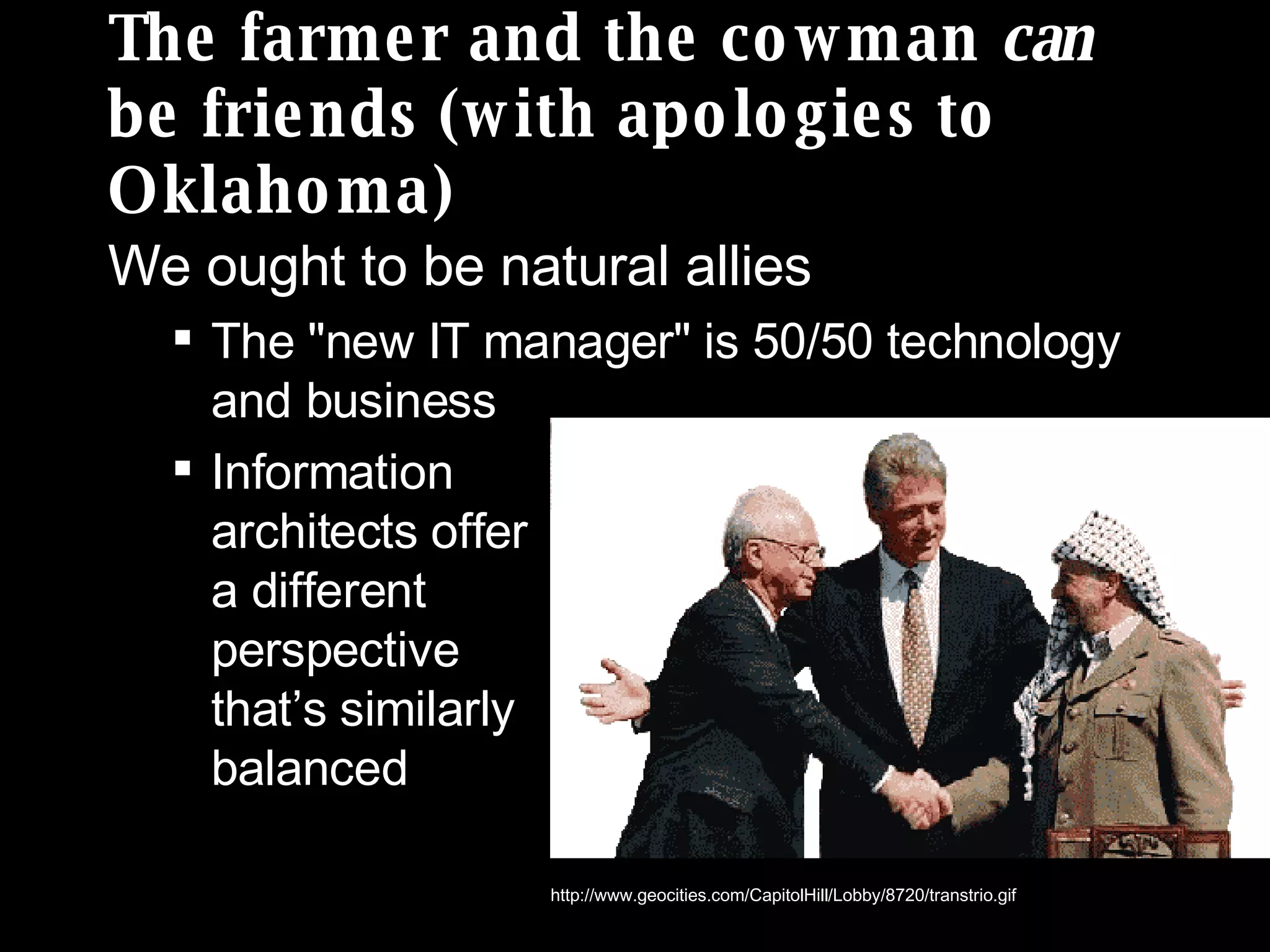
The farmer and the cowman  can  be friends (with apologies to Oklahoma) We ought to be natural allies The "new IT manager" is 50/50 technology and business Information  architects offer  a different  perspective  that’s similarly  balanced http://www.geocities.com/CapitolHill/Lobby/8720/transtrio.gif
Putting the I back in IT For IT to be truly strategic, emphasis has to move away from  technology,  toward  information Information architects can help IT managers move away from providing commodity services Information architects and IT managers can work together to help organizations Truly understand information’s strategic value Make technology really perform Hopefully, a seat at the strategy table will be that much closer
What I’ve covered IT managers are excluded from corporate strategy Information architects can help get IT managers a seat at the table (and how) Information architecture briefly introduced  Examples of concrete benefits from information architecture Can we be friends?
How to reach me Louis Rosenfeld, LLC 705 Carroll Street, #2L Brooklyn, NY  11215  USA +1.718.306.9396 voice +1.734.661.1655 fax [email_address] www.louisrosenfeld.com

Information Architecture: Putting the "I" back in IT

  • 1.
    Information Architecture: Puttingthe I back in IT April 26, 2007 Louis Rosenfeld www.louisrosenfeld.com
  • 2.
    My perspective Independentinformation architecture consultant Work with Fortune 500s and government agencies Background in library and information science Co-author, Information Architecture for the World Wide Web (O’Reilly & Associates; 3rd edition, 2006)
  • 3.
    What I’m goingto cover IT managers are excluded from corporate strategy Information architects can help get IT managers a seat at the table (and how) Information architecture briefly introduced Examples of concrete benefits from information architecture Can we be friends?
  • 4.
    Everyone wants aseat at the strategy table http://www.tsawwasseninn.com/images/boardroom%201_640.jpg
  • 5.
    Why there’s noseat for IT managers “Keep those lights on!” Growing pressures to commoditize IT services Difficult to break out of reaction mode Getting beyond commodities Business side doesn't understand technology and its possibilities Lack of common language quashes dialogue Result: IT cut out of strategic decision-making
  • 6.
    IT organizations outof balance http://www.magnumad.com/adm/photo/425_web-ERE-seesaw-PAR116898.jpg
  • 7.
    What’s out ofwhack? Structured data versus semi-structured content Centralization versus autonomy Traditional, formal approaches versus emergent, informal approaches Build it versus buy it Customers versus business
  • 8.
    How exactly doesone commoditize IT when facing these issues? Imbalances (as previously noted) Tidal wave of unstructured information Deriving actual value from enterprise applications Globalization, localization, and internationalization Content resident in user-hostile enterprise silos
  • 9.
    So we’re alldrowning. As usual. http://www.silverbearcafe.com/private/images/drowning.jpg
  • 10.
    Do you agree?“If you understand how the web site should be organized to serve your customers, then you know how the company should be organized.” --Anonymous information architect, IBM Key phrases: serve customers, company organized
  • 11.
    Should IT managersbe involved in organizing the company? If “information is strategic,” then of course! Information should be organized around needs of customers/users IT provides the infrastructure for creating and managing information Business side not always able to understand implications of information systems How can IT not be involved? How is this not strategic work?
  • 12.
    “Information people” arethe tail that wags the dog Not just IT managers, but… … Information architects … Knowledge managers … Content specialists … User experience designers … Marketers … Product managers … Etc… http://whatisee.org/mt/archives/images/dogtail.jpg
  • 13.
    Why IT managersneed information architects Information architects are the people who organize, structure, and label information Our goal: help users find what they want We worry a lot about these things Taxonomies, metadata, labeling Search systems performance Navigation and orientation Content lifecycle Users, users, users
  • 14.
    Other flavors ofIA: John Zachman Zachman Framework Enterprise architecture Broader take on IA “ Polar bear IA” fortifies “human interface architecture” and “presentation architecture” cells
  • 15.
    Other flavors ofIA: Richard Saul Wurman Wurman (Information Anxiety) Physical architecture background Make information understandable Pre-web context, but principles are extended to multi-dimensional information systems
  • 16.
    Information architects helpby rebalancing information systems Structured versus semi-structured: IAs are strong in the latter (where IT is often weak) Centralization versus autonomy: IAs develop balanced workflows and processes Traditional, formal versus emergent, informal: IAs integrate these as part of broader ecology Build it versus buy it: IAs are technology agnostics who help develop functional specs that go beyond technical requirements Customers versus business: IAs shore up knowledge of the former, and are neutral balancers between competing needs
  • 17.
    Why are informationarchitects good balancers? We see the world through three perspectives
  • 18.
    Information architects aren’tjust high-paid librarians User-oriented source disciplines Human Computer Interaction Anthropology Marketing Sociology Content-oriented source disciplines Librarianship Technical communication Graphic design Journalism Computer science Context-oriented source disciplines Management Systems engineering Organizational psychology
  • 19.
    Information architects areserious about methodology User-oriented research methods Usability testing Contextual inquiry Card sorting Persona and scenario development Content-oriented research methods Content inventory and analysis Content modeling Metadata development Server and search analytics Context-oriented research methods Stakeholder interviews Project planning Specifications development
  • 20.
    How do weuse our methods? To prioritize Can you confidently answer these two questions? What are your site’s major audiences? What are each audience’s Big Questions (and how well are you addressing them)?
  • 21.
    Major audiences: Whoare they? Secondary goal? (You may already know who they are) Political challenges of audience definition Problem: defining audience by silo leads to stakeholder infighting Goal: err toward apolitical segmenting that cuts across silos; examples: Job functions (admin, clerical, research, mgmt) Demographics
  • 22.
    Big questions: Whatare they? Major tasks users want to accomplish or topics they want to know about Examples: “ Where do I reconfigure my health benefits?” “ Where can I find our past sales proposals?” “ How do I file an expense report?”
  • 23.
    Big questions: Howdo you determine them? 1/2 Active methods: ask people who would know Webmasters and the hate mail they get Switchboard operators and their FAQs SMEs and the people who bother them Who else? Avoid: focus groups
  • 24.
    Big questions: Howdo you determine them? 2/2 Passive methods: look at data derived from users’ behavior (you already have it!) Switchboard logs Server logs (Web Analytics) Search logs (Search Analytics) Information center logs Where else? Grouping log data can help you (re)define audience segments
  • 25.
    A closer lookat methods: Search analytics Sorting queries by frequency results in a Zipf Distribution Can we improve performance for the most popular queries?
  • 26.
    Anatomy of asearch log (from Google Search Appliance) Critical elements in bold: IP address , time/date stamp , query , and # of results: XXX.XXX.X.104 - - [ 10/Jul/2006:10:25:46 -0800] "GET /search?access=p&entqr=0&output=xml_no_dtd&sort=date%3AD%3AL%3Ad1&ud=1&site=AllSites&ie=UTF-8&client=www&oe=UTF-8&proxystylesheet=www&q= lincense+plate &ip=XXX.XXX.X.104 HTTP/1.1" 200 971 0 0.02 XXX.XXX.X.104 - - [ 10/Jul/2006:10:25:48 -0800] "GET /search?access=p&entqr=0&output=xml_no_dtd&sort=date%3AD%3AL%3Ad1&ie=UTF-8&client=www&q= license+plate &ud=1&site=AllSites&spell=1&oe=UTF-8&proxystylesheet=www&ip=XXX.XXX.X.104 HTTP/1.1" 200 8283 146 0.16 XXX.XXX.XX.130 - - [ 10/Jul/2006:10:24:38 -0800] "GET /search?access=p&entqr=0&output=xml_no_dtd&sort=date%3AD%3AL%3Ad1&ud=1&site=AllSites&ie=UTF-8&client=www&oe=UTF-8&proxystylesheet=www&q= regional+transportation+governance+commission &ip=XXX.XXX.X.130 HTTP/1.1" 200 9718 62 0.17 Full legend and more examples here: http://www.rosenfeldmedia.com/books/searchanalytics/blog/log_sample_google_appliance/
  • 27.
    What users wantand when: Sort and cluster those queries
  • 28.
    Diagnostics from searchanalytics: What can you fix or improve? User research Interface design: search entry interface, search results Retrieval algorithm modification Navigation design Metadata development Content development
  • 29.
    Best bet searchresults: Big answers for big questions Manually-assigned recommended links Ensure useful results for top search queries Useful resources for each popular query are manually determined (guided by documented logic) Useful resources manually linked to popular queries; automatically displayed in result page
  • 30.
    Best bets example: BBC’s “best links” BBC’s logic IF query is a country name • THEN is there a country profile? THEN is there a language service?
  • 31.
    Best bets alsoimprove navigation Michigan State University automatically generates a comprehensive A-Z site index from best bet keywords
  • 32.
    Guides: Even biggeranswers to big questions Guides are single pages that contain A selective set (5-10) of important links related to a Big Question Narrative text that explains the topic and what’s available to help with that topic Generally linked from the main page, but also used in more specific contexts Subsite main pages Search results
  • 33.
  • 34.
  • 35.
  • 36.
    Guides: Painless andefficient Low impact on IT (single HTML page) Cut across departmental silos Gap fillers; complement comprehensive methods of navigation and search Can be timely (e.g., news-oriented guides, seasonal guides) Minimize political headaches by creating new real estate Can grow into fuller subsites
  • 37.
    Contextual navigation: Focusingon where users are Contextual navigation supports users deep in site Where am I? Where can I go from here? Mandated by Web 2.0 world Top layers of information systems are increasingly bypassed Search engines Syndication (RSS, Atom) Banner advertising Deep content becomes starting point
  • 38.
    Contextual navigation is powered by content models “Data modeling for semi-structured content” Content modeling process helps narrow down both content and metadata choices Content models consist of Content objects Links between objects Metadata Use sparingly to support high-value contextual navigation
  • 39.
    Content models: Hewlett-Packardexample HP’s content model for products includes overview, supplies, support, drivers… Content model is exposed as part of search results to enhance navigation
  • 40.
    Content models: BBC example artist descriptions album reviews album pages artist bios discography concert calendar TV listings
  • 41.
    Content modeling usemetadata to connect content objects artist description artist description artist description artist bio, discography, concert calendar, TV listing album review, artist description album page album review, discography, artist … link to other Content Objects… Artist Name , Channel, Date, Time… Artist Name , Tour, Venue, Date, Time… Artist Name , Individual Artist Name… Artist Name , Desc Author, Desc Date… Artist Name , Album Name , Release Date… Album Name , Artist Name , Review Author, Source, Pub Date… Album Name , Artist Name , Label, Release Date… … by leveraging common Metadata Attributes TV listing concert calendar artist bio artist description discography album review album page Content Objects…
  • 42.
    Small steps startto add up Make that search engine earn its keep Institute best bets, spell checking, guides, etc. Can improve user experience performance by 20%-30% (make up your own numbers) Make that CMS earn its keep Manage content objects and metadata to support contextual navigation Touch a small portion of your content to improve experience for many users
  • 43.
    Information architects canhelp IT managers avoid boiling the ocean Ban the word redesign from your vocabulary Replace it with continual improvement And pause before replacing enterprise apps Take small, concrete steps that have large impacts (guides, best bets, spell checking, limited content modeling) Focus on what you can reasonably accomplish, and when you can do it
  • 44.
    The farmer andthe cowman can be friends (with apologies to Oklahoma) We ought to be natural allies The "new IT manager" is 50/50 technology and business Information architects offer a different perspective that’s similarly balanced http://www.geocities.com/CapitolHill/Lobby/8720/transtrio.gif
  • 45.
    Putting the Iback in IT For IT to be truly strategic, emphasis has to move away from technology, toward information Information architects can help IT managers move away from providing commodity services Information architects and IT managers can work together to help organizations Truly understand information’s strategic value Make technology really perform Hopefully, a seat at the strategy table will be that much closer
  • 46.
    What I’ve coveredIT managers are excluded from corporate strategy Information architects can help get IT managers a seat at the table (and how) Information architecture briefly introduced Examples of concrete benefits from information architecture Can we be friends?
  • 47.
    How to reachme Louis Rosenfeld, LLC 705 Carroll Street, #2L Brooklyn, NY 11215 USA +1.718.306.9396 voice +1.734.661.1655 fax [email_address] www.louisrosenfeld.com