Presented by: Aaina
Contents Introduction Objectives Functions Features A workflow with metadata Advantages & Disadvantages Enterprise content  management  systems CMS
Introduction A content management system (CMS) is a system used to manage the content of a Web site. It provides a collection of procedures used to manage work flow . The procedures are designed to do the following:  - Allows large number of people to share stored data - Control access to data, based on user roles - Aid in easy storage and retrieval of data - Reduce repetitive duplicate input - Improve the ease of report writing
CMS consists of two elements:  -content management application (CMA)  -the content delivery application (CDA). 
CMS Objectives Devolve content creation throughout the institution regardless of contributors’ skills  Provide security, governance and approval processes over content published on the web Enable the creation, management, and usage of standardized metadata  Improve the quality of web sites through the implementation of standards across presentation, metadata, governance, discovery, and navigation
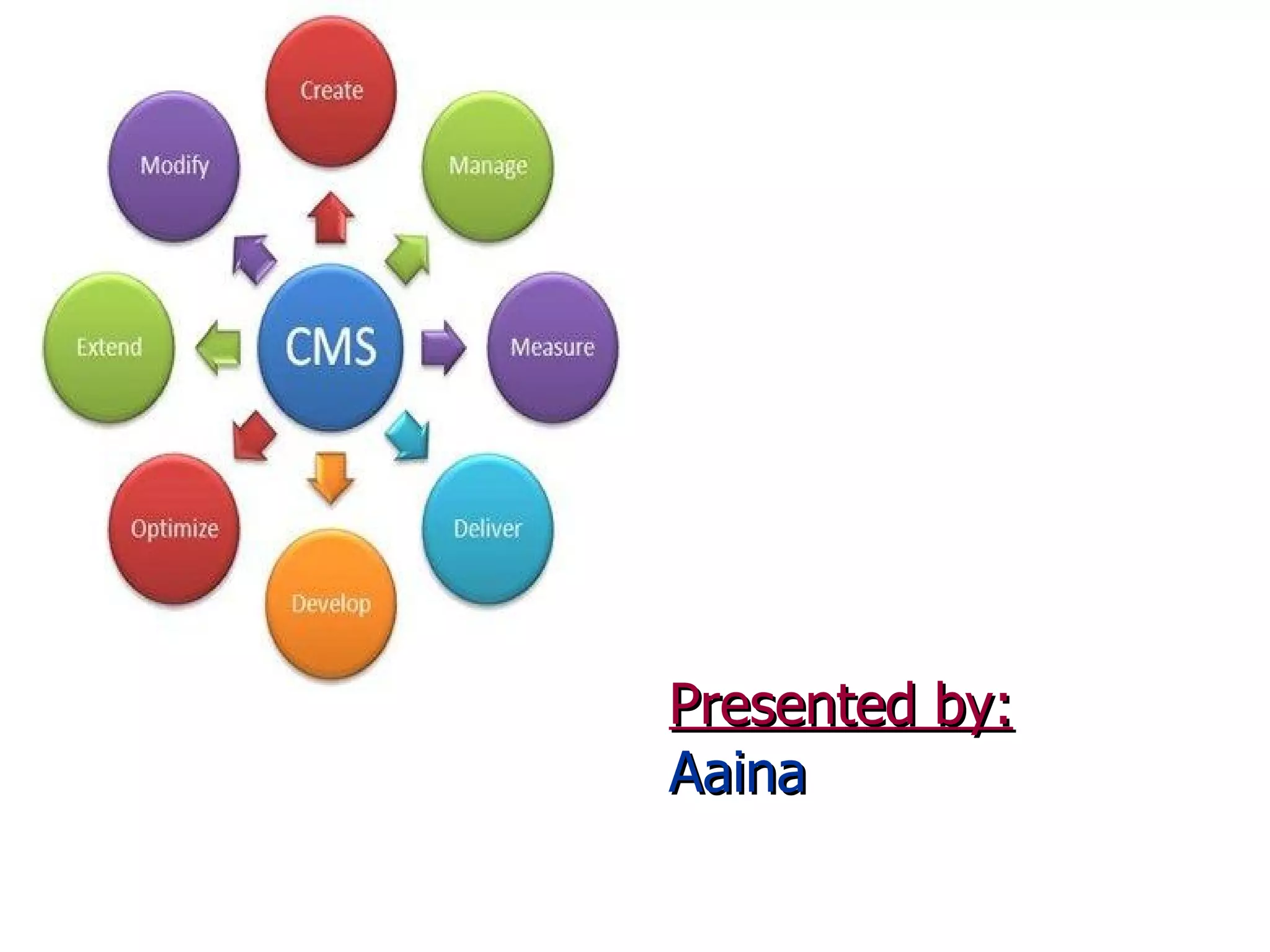
Functions Maintaining Security Managing Objects Managing Servers Managing Auditing Maintaining Reports.
features Integrated and online help Modular and extensible Easy user and group management Group-based permission system Full template support without changing a line of content Easy wizard based install and upgrade procedures Minimal server requirement
Feature cont.. Admin panel with multiple language support Content hierarchy with unlimited depth and size Integrated file manager w/ upload capabilities
Content Creation Aim: Simplify the processes of placing content on the web and obtaining approval to do so Use templates to capture the content and to present it Use workflow to simplify the upload, approve and publish processes Embed Team site buttons in standard Microsoft applications if required
Quality - Actions Accuracy Availability Discoverability Relevance
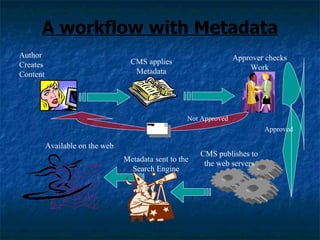
A workflow with Metadata Author  Creates Content CMS applies Metadata Approver checks Work Not Approved Available on the web Metadata sent to the Search Engine CMS publishes to the web servers Approved
Advantages Low Cost Easy Customization Easy to use workflow management
Disadvantages Cost of maintenance Storage Volume Latency issues Tool Mixing
Enterprise content management systems An enterprise content management system (ECM) is content, documents, details and records related to the organizational processes of an enterprise. The purpose and result is to manage the organization's unstructured information content
EXAMPLES OF CMS Drupal Joomla
DRUPAL Drupal is an open source content management platform powering millions of websites and applications.  Drupal is free, flexible, robust and constantly being improved by hundreds of thousands of passionate people from all over the world. 
Joomla Joomla is the world’ s most popular open source CMS With 2.7 percent of the Web running on Joomla, the software is used by individuals, small & medium-sized businesses, and large organizations worldwide to easily create & build a variety of websites & web-enabled applications.
 

CMS (CONTENT MANAGEMENT SYSTEM)

  • 1.
  • 2.
    Contents Introduction ObjectivesFunctions Features A workflow with metadata Advantages & Disadvantages Enterprise content management systems CMS
  • 3.
    Introduction A contentmanagement system (CMS) is a system used to manage the content of a Web site. It provides a collection of procedures used to manage work flow . The procedures are designed to do the following: - Allows large number of people to share stored data - Control access to data, based on user roles - Aid in easy storage and retrieval of data - Reduce repetitive duplicate input - Improve the ease of report writing
  • 4.
    CMS consists oftwo elements: -content management application (CMA) -the content delivery application (CDA). 
  • 5.
    CMS Objectives Devolvecontent creation throughout the institution regardless of contributors’ skills Provide security, governance and approval processes over content published on the web Enable the creation, management, and usage of standardized metadata Improve the quality of web sites through the implementation of standards across presentation, metadata, governance, discovery, and navigation
  • 6.
    Functions Maintaining SecurityManaging Objects Managing Servers Managing Auditing Maintaining Reports.
  • 7.
    features Integrated andonline help Modular and extensible Easy user and group management Group-based permission system Full template support without changing a line of content Easy wizard based install and upgrade procedures Minimal server requirement
  • 8.
    Feature cont.. Adminpanel with multiple language support Content hierarchy with unlimited depth and size Integrated file manager w/ upload capabilities
  • 9.
    Content Creation Aim:Simplify the processes of placing content on the web and obtaining approval to do so Use templates to capture the content and to present it Use workflow to simplify the upload, approve and publish processes Embed Team site buttons in standard Microsoft applications if required
  • 10.
    Quality - ActionsAccuracy Availability Discoverability Relevance
  • 11.
    A workflow withMetadata Author Creates Content CMS applies Metadata Approver checks Work Not Approved Available on the web Metadata sent to the Search Engine CMS publishes to the web servers Approved
  • 12.
    Advantages Low CostEasy Customization Easy to use workflow management
  • 13.
    Disadvantages Cost ofmaintenance Storage Volume Latency issues Tool Mixing
  • 14.
    Enterprise content managementsystems An enterprise content management system (ECM) is content, documents, details and records related to the organizational processes of an enterprise. The purpose and result is to manage the organization's unstructured information content
  • 15.
    EXAMPLES OF CMSDrupal Joomla
  • 16.
    DRUPAL Drupal isan open source content management platform powering millions of websites and applications. Drupal is free, flexible, robust and constantly being improved by hundreds of thousands of passionate people from all over the world. 
  • 17.
    Joomla Joomla isthe world’ s most popular open source CMS With 2.7 percent of the Web running on Joomla, the software is used by individuals, small & medium-sized businesses, and large organizations worldwide to easily create & build a variety of websites & web-enabled applications.
  • 18.