https://heatherannzink.wordpress.com/
c o n t a c t m e
online
learning
blended
learning
Combining face to face
instruction with
computer-mediated
instruction (2).
The use of the Internet to
access and interact with
learning materials, the
instructor and fellow learners
(1).
Repetition of content - Digital
content in an online course provides
opportunity for continued exposure
as the learner needs it (1).
Depth of discussion - Online learning
provides additional time for the learner
to think before responding, which
ultimate leads to more participation in
group reflection activities (especicially
for introverted learners) (2). 
DEFINITION
BENEFITS
Flexibility in access & participation
- Online learning removes the time
and place barrier (7). 
Connection & community building -
Human beings are meant to experience
life in a community. Blended
learning contributes to growth and
development of the learner inside and
outside the classroom (4, 10). 
Immediate
feedback/spontaneity -
Instructors in a blended model
can react to student facial
expressions and adjust learning
activites in real-time (2). 
Rich pedagogical opportunity - Blended
learning offers a vast array of learning
experiences for students. Combining
both face-to-face elements and online
actitivities, instructors can reach a
multitude of learning styles (2).  
vs
Limited or delayed social and
emotional feedback - Online
learning can feel isolating if the
learner is consistently waiting
responses or engagement (4, 6, 10).
Higher cognitive load due to
technology design - Technology tools
can hinder or frustrate learners if the
user experience is not well-designed
or intuitive (8). 
CHALLENGES
Access to reliable technology - Internet
connections and rapidly changing
technology present challenges for both
the student and instructor that may
hinder the learning) (3).
Support for technology
implementation in the classroom -
Without proper support for instructors,
the technology can be a barrier for
producing a quality blended course
experience (5).
Course participation - Due to
time constraints, not all
learners are able to participate
in the same manner potentially
missing opportunities to
engage in activities (2).
Complexity of instruction - Instructors
need time and training to understand
how to craft effective blended
learning experiences. Research
continues to focus on specific tools
lacking in depth of pedagogy (9).
Collaboration
Software
Microsoft Teams
Google Classroom
Digital Content
Creation Tools
Powtoon
Screencast-o-matic
Camtasia
Social Media
Platforms
Twitter
Wordpress
TECHNOLOGY TOOLS
The need to consider learners as a complex system is key in utilizing
technology tools to aid in the learning process (10). Tools can be used to
present material, encourage interaction, and build community. These must be
carefully selected, however, so as not to interfere with the high cognitive load
required to acquire knowledge (8).
LTEC 5040  |   Heather Zink
1. Ally, M. (2008). Foundations of educational theory for online learning in Theory and Practice of Online
Learning, ed. Terry Anderson (Edmonton, Alberta: Athabasca University Press, 2004), 15–44.
https://read.aupress.ca/read/the-theory-and-practice-of-online-learning/section/8949f723-6904-454a-
9704-6c241fb891ab#ch01
2. Bonk, C. J. & Graham, C. R. (2012). The Handbook of Blended Learning: Global Perspectives, Local
Designs. Germany: Wiley.
3. Brooks, D. C., & Gierdowski, D. C. (2021, April 5). Student experiences with technology in the pandemic.
EDUCAUSE Research. https://library.educause.edu/resources/2021/4/student-experiences-with-technology-
in-the-pandemic
4. Immordino-Yang, M., & Damasio, A. (2007). We feel, therefore we learn: The relevance of affective and
social neuroscience to education. Mind, Brain & Education, 1(1), 3-10. https://doi.org/10.1111/j.1751-
228X.2007.00004.x
5. Ma'arop, A. H., & Embi, M. A. (2016). Implementation of blended learning in higher learning institutions: A
review of the literature. International Education Studies, 9(3), 41-52.
https://files.eric.ed.gov/fulltext/EJ1093338.pdf
6. Mansour, B. E., & Mupinga, D. M. (2007). Students' positive and negative experiences in hybrid and online
classes. College Student Journal, 41(1), 242-248.
7. Martin, F., Polly, D., & Ritzhaupt, A. (2020, September 8). Bichronous online learning: Blending
Asynchronous and synchronous online learning. EDUCAUSE Review.
https://er.educause.edu/articles/2020/9/bichronous-online-learning-blending-asynchronous-and-
synchronous-online-learning
8. Mayer, R. (2019). Thirty years of research on online learning. Applied Cognitive Psychology, 33 (2), 152–159.
https://doi-org.libproxy.library.unt.edu/10.1002/acp.3482
9. Ocak, M. A. (2011). Why are faculty members not teaching blended courses? Insights from faculty members.
Computers & Education, 56(3), 689-699. https://doi.org/10.1016/j.compedu.2010.10.011
10. Op't Eynde, P., & Turner, J. E. (2006). Focusing on the complexity of emotion issues in academic learning: A
dynamical component systems approach. Educational Psychology Review, 18(4), 361-376.
https://doi.org/10.1007/s10648-006-9031-2
References

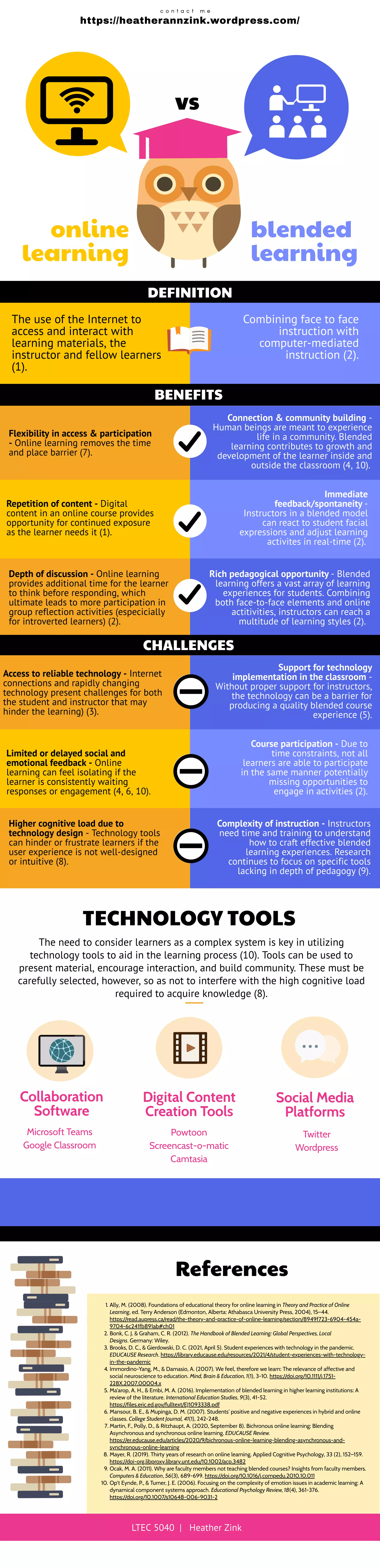
Infographic - online vs blended learning

  • 1.
    https://heatherannzink.wordpress.com/ c o nt a c t m e online learning blended learning Combining face to face instruction with computer-mediated instruction (2). The use of the Internet to access and interact with learning materials, the instructor and fellow learners (1). Repetition of content - Digital content in an online course provides opportunity for continued exposure as the learner needs it (1). Depth of discussion - Online learning provides additional time for the learner to think before responding, which ultimate leads to more participation in group reflection activities (especicially for introverted learners) (2).  DEFINITION BENEFITS Flexibility in access & participation - Online learning removes the time and place barrier (7).  Connection & community building - Human beings are meant to experience life in a community. Blended learning contributes to growth and development of the learner inside and outside the classroom (4, 10).  Immediate feedback/spontaneity - Instructors in a blended model can react to student facial expressions and adjust learning activites in real-time (2).  Rich pedagogical opportunity - Blended learning offers a vast array of learning experiences for students. Combining both face-to-face elements and online actitivities, instructors can reach a multitude of learning styles (2).   vs Limited or delayed social and emotional feedback - Online learning can feel isolating if the learner is consistently waiting responses or engagement (4, 6, 10). Higher cognitive load due to technology design - Technology tools can hinder or frustrate learners if the user experience is not well-designed or intuitive (8).  CHALLENGES Access to reliable technology - Internet connections and rapidly changing technology present challenges for both the student and instructor that may hinder the learning) (3). Support for technology implementation in the classroom - Without proper support for instructors, the technology can be a barrier for producing a quality blended course experience (5). Course participation - Due to time constraints, not all learners are able to participate in the same manner potentially missing opportunities to engage in activities (2). Complexity of instruction - Instructors need time and training to understand how to craft effective blended learning experiences. Research continues to focus on specific tools lacking in depth of pedagogy (9). Collaboration Software Microsoft Teams Google Classroom Digital Content Creation Tools Powtoon Screencast-o-matic Camtasia Social Media Platforms Twitter Wordpress TECHNOLOGY TOOLS The need to consider learners as a complex system is key in utilizing technology tools to aid in the learning process (10). Tools can be used to present material, encourage interaction, and build community. These must be carefully selected, however, so as not to interfere with the high cognitive load required to acquire knowledge (8). LTEC 5040  |   Heather Zink 1. Ally, M. (2008). Foundations of educational theory for online learning in Theory and Practice of Online Learning, ed. Terry Anderson (Edmonton, Alberta: Athabasca University Press, 2004), 15–44. https://read.aupress.ca/read/the-theory-and-practice-of-online-learning/section/8949f723-6904-454a- 9704-6c241fb891ab#ch01 2. Bonk, C. J. & Graham, C. R. (2012). The Handbook of Blended Learning: Global Perspectives, Local Designs. Germany: Wiley. 3. Brooks, D. C., & Gierdowski, D. C. (2021, April 5). Student experiences with technology in the pandemic. EDUCAUSE Research. https://library.educause.edu/resources/2021/4/student-experiences-with-technology- in-the-pandemic 4. Immordino-Yang, M., & Damasio, A. (2007). We feel, therefore we learn: The relevance of affective and social neuroscience to education. Mind, Brain & Education, 1(1), 3-10. https://doi.org/10.1111/j.1751- 228X.2007.00004.x 5. Ma'arop, A. H., & Embi, M. A. (2016). Implementation of blended learning in higher learning institutions: A review of the literature. International Education Studies, 9(3), 41-52. https://files.eric.ed.gov/fulltext/EJ1093338.pdf 6. Mansour, B. E., & Mupinga, D. M. (2007). Students' positive and negative experiences in hybrid and online classes. College Student Journal, 41(1), 242-248. 7. Martin, F., Polly, D., & Ritzhaupt, A. (2020, September 8). Bichronous online learning: Blending Asynchronous and synchronous online learning. EDUCAUSE Review. https://er.educause.edu/articles/2020/9/bichronous-online-learning-blending-asynchronous-and- synchronous-online-learning 8. Mayer, R. (2019). Thirty years of research on online learning. Applied Cognitive Psychology, 33 (2), 152–159. https://doi-org.libproxy.library.unt.edu/10.1002/acp.3482 9. Ocak, M. A. (2011). Why are faculty members not teaching blended courses? Insights from faculty members. Computers & Education, 56(3), 689-699. https://doi.org/10.1016/j.compedu.2010.10.011 10. Op't Eynde, P., & Turner, J. E. (2006). Focusing on the complexity of emotion issues in academic learning: A dynamical component systems approach. Educational Psychology Review, 18(4), 361-376. https://doi.org/10.1007/s10648-006-9031-2 References