
INFECTIVE ENDOCARDITIS
Presented by:
Cristina Joy F. Reyes
• Definition
Infective endocarditis (IE ) is an infection of the heart valves or the
endocardial lining of the wall
Etiological agent – most commonly bacteria but may be fungal.
Vegetation – bacterial or fungal infection of the valves form
clusters of organisms.
- can be seen by echocardiography
Antibiotics are essentially the only treatment for endocarditis.
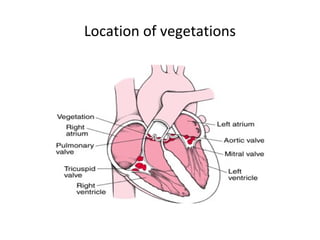
Location of vegetations
Etiology
• Classified into three categories:
Native Valve IE
Intravenous drug abuse (IVDA) IE
Prosthetic Valve IE
• Acute IE
• Aggressive
• Rapidly destructive
• Commonly Staph. (S. aureus)
• Infecting native and normal
heart valve
• Fatal within 6 weeks (if not
treated)
• Subacute IE
• Commonly viridans
streptococci
• Often affects damaged
heart valves
• Indolent nature
Classification
Native Valve Endocarditis
• Native Valve Endocarditis
 Caused by any organism (but most common) viridans
streptococci, enterococci, and S. aureus
 S. aureus can attack normal valves
 Most patients will have some damage to the heart valves
• Rheumatic
• Age- related degeneration
Endocarditis in Intravenous Drug Abusers
• Endocarditis in Intravenous Drug
Abusers
 Caused by S. aureus (common) ,
streptococci, enterococci, gram-
negative organisms and fungi.
IV drug users have infection of the tricuspid
valve.
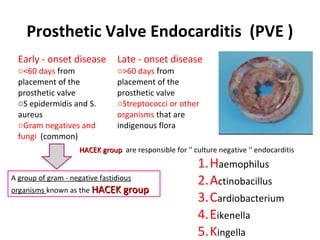
Early - onset disease
o<60 days from
placement of the
prosthetic valve
oS epidermidis and S.
aureus
oGram negatives and
fungi (common)
Late - onset disease
o>60 days from
placement of the
prosthetic valve
oStreptococci or other
organisms that are
indigenous flora
A group of gram - negative fastidious
organisms known as the HACEK groupHACEK group
1.Haemophilus
2.Actinobacillus
3.Cardiobacterium
4.Eikenella
5.Kingella
HACEK groupHACEK group are responsible for '' culture negative '' endocarditis
Prosthetic Valve Endocarditis (PVE )
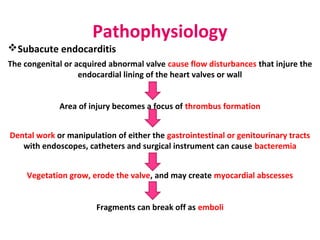
Pathophysiology
Subacute endocarditis
The congenital or acquired abnormal valve cause flow disturbances that injure the
endocardial lining of the heart valves or wall
Area of injury becomes a focus of thrombus formation
Dental work or manipulation of either the gastrointestinal or genitourinary tracts
with endoscopes, catheters and surgical instrument can cause bacteremia
Vegetation grow, erode the valve, and may create myocardial abscesses
Fragments can break off as emboli
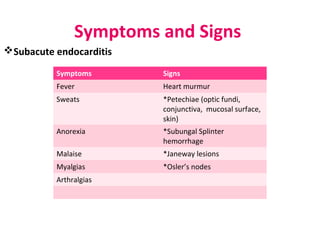
Symptoms and Signs
Subacute endocarditis
Symptoms Signs
Fever Heart murmur
Sweats *Petechiae (optic fundi,
conjunctiva, mucosal surface,
skin)
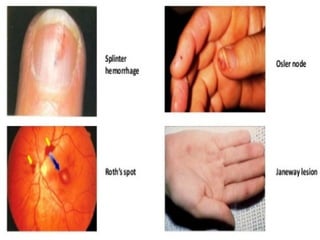
Anorexia *Subungal Splinter
hemorrhage
Malaise *Janeway lesions
Myalgias *Osler’s nodes
Arthralgias
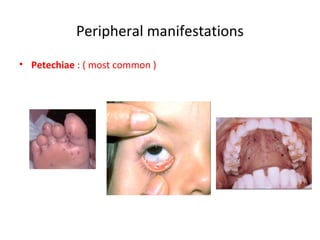
Peripheral manifestations
• Petechiae : ( most common )
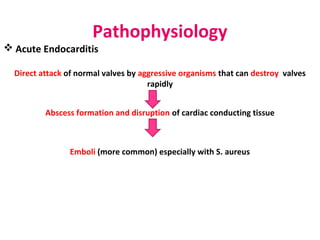
Pathophysiology
 Acute Endocarditis
Direct attack of normal valves by aggressive organisms that can destroy valves
rapidly
Abscess formation and disruption of cardiac conducting tissue
Emboli (more common) especially with S. aureus
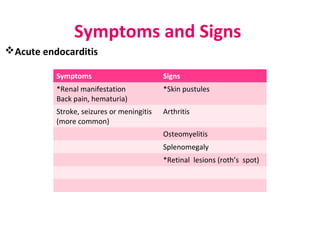
Symptoms and Signs
Acute endocarditis
Symptoms Signs
*Renal manifestation
Back pain, hematuria)
*Skin pustules
Stroke, seizures or meningitis
(more common)
Arthritis
Osteomyelitis
Splenomegaly
*Retinal lesions (roth’s spot)
Diagnosis
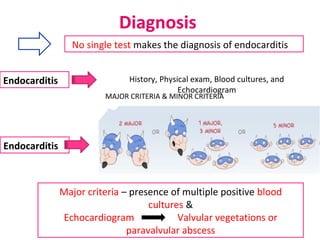
No single test makes the diagnosis of endocarditis
MAJOR CRITERIA & MINOR CRITERIA
Endocarditis
Major criteria – presence of multiple positive blood
cultures &
Echocardiogram Valvular vegetations or
paravalvular abscess
History, Physical exam, Blood cultures, and
Echocardiogram
Endocarditis
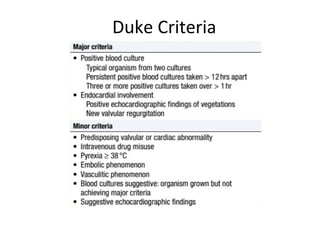
Duke Criteria
THANK YOU

Infective endocarditis

  • 1.
  • 2.
    • Definition Infective endocarditis(IE ) is an infection of the heart valves or the endocardial lining of the wall Etiological agent – most commonly bacteria but may be fungal. Vegetation – bacterial or fungal infection of the valves form clusters of organisms. - can be seen by echocardiography Antibiotics are essentially the only treatment for endocarditis.
  • 3.
  • 4.
    Etiology • Classified intothree categories: Native Valve IE Intravenous drug abuse (IVDA) IE Prosthetic Valve IE • Acute IE • Aggressive • Rapidly destructive • Commonly Staph. (S. aureus) • Infecting native and normal heart valve • Fatal within 6 weeks (if not treated) • Subacute IE • Commonly viridans streptococci • Often affects damaged heart valves • Indolent nature Classification
  • 5.
    Native Valve Endocarditis •Native Valve Endocarditis  Caused by any organism (but most common) viridans streptococci, enterococci, and S. aureus  S. aureus can attack normal valves  Most patients will have some damage to the heart valves • Rheumatic • Age- related degeneration
  • 6.
    Endocarditis in IntravenousDrug Abusers • Endocarditis in Intravenous Drug Abusers  Caused by S. aureus (common) , streptococci, enterococci, gram- negative organisms and fungi. IV drug users have infection of the tricuspid valve.
  • 7.
    Early - onsetdisease o<60 days from placement of the prosthetic valve oS epidermidis and S. aureus oGram negatives and fungi (common) Late - onset disease o>60 days from placement of the prosthetic valve oStreptococci or other organisms that are indigenous flora A group of gram - negative fastidious organisms known as the HACEK groupHACEK group 1.Haemophilus 2.Actinobacillus 3.Cardiobacterium 4.Eikenella 5.Kingella HACEK groupHACEK group are responsible for '' culture negative '' endocarditis Prosthetic Valve Endocarditis (PVE )
  • 8.
    Pathophysiology Subacute endocarditis The congenitalor acquired abnormal valve cause flow disturbances that injure the endocardial lining of the heart valves or wall Area of injury becomes a focus of thrombus formation Dental work or manipulation of either the gastrointestinal or genitourinary tracts with endoscopes, catheters and surgical instrument can cause bacteremia Vegetation grow, erode the valve, and may create myocardial abscesses Fragments can break off as emboli
  • 9.
    Symptoms and Signs Subacuteendocarditis Symptoms Signs Fever Heart murmur Sweats *Petechiae (optic fundi, conjunctiva, mucosal surface, skin) Anorexia *Subungal Splinter hemorrhage Malaise *Janeway lesions Myalgias *Osler’s nodes Arthralgias
  • 10.
  • 12.
    Pathophysiology  Acute Endocarditis Directattack of normal valves by aggressive organisms that can destroy valves rapidly Abscess formation and disruption of cardiac conducting tissue Emboli (more common) especially with S. aureus
  • 13.
    Symptoms and Signs Acuteendocarditis Symptoms Signs *Renal manifestation Back pain, hematuria) *Skin pustules Stroke, seizures or meningitis (more common) Arthritis Osteomyelitis Splenomegaly *Retinal lesions (roth’s spot)
  • 14.
    Diagnosis No single testmakes the diagnosis of endocarditis MAJOR CRITERIA & MINOR CRITERIA Endocarditis Major criteria – presence of multiple positive blood cultures & Echocardiogram Valvular vegetations or paravalvular abscess History, Physical exam, Blood cultures, and Echocardiogram Endocarditis
  • 15.
  • 16.

Editor's Notes