ANALYSE YOUR
SMILEPresented By: Josephine Joyce Nicolas
Mouth
Is the dominant feature of the face by
virtue of its size.
Central Incisor
Is the dominant tooth of the smile. It
goes without saying that dominance
must be measured according to
personality.
Cosmetic Dentistry
Creates attractive smiles that function
in a state of health.
Cosmetic and Restorative Dentist
Determine how to improve your smile,
thereby looking better and feeling
better about your appearance.
Two ways regularly used to analyse
your smile
1. The Emotional Smile Evaluation
2. The Objective Smile Analysis
Emotional Smile Evaluation
Is based on each individual's
subjective perceptions of his or her
smile.
Questions
1. Do you love the appearance of your teeth and
smile?
2. Do you ever turn your face when smiling or hold
your hand up in front of your mouth when talking
to others?
3. Have you ever found yourself looking at models
or other people with beautiful smiles and wishing
you had a similar smile?
4. Have you figured out a way to use your lips to
cover any aspect of your smile?
5. Are you embarrassed to visit a cosmetic dentist
due to the condition of your teeth or the length of
time since your last visit to a dentist?
6. How does your smile make you feel? Confident?
7. Do you shy away from showing a full smile in
front of other people, especially strangers?
8. When taking pictures, do you tend to smile with
your lips closed instead of flashing a happy smile?
9. Have you ever held back a laugh because you
felt uncomfortable about your smile?
10. How would a beautiful new smile make you
feel?
11. What would you like to change about your
smile?
Objective Smile Analysis
Objective analysis, the best thing
is for you to stand in front of a
mirror.
Questions
1. Are all of your teeth brilliant white or are they
somewhat yellow, dark, or stained?
2. Are there spaces between any of your teeth?
3. Are you missing any of your teeth?
4. Do you have teeth that are crooked, uneven,
or out of line?
5. Do the biting edges of your upper teeth follow
the curvature of your upper lip?
6. Do any of your teeth appear short and fat or too
small or too large?
7. Are the edges of any of your teeth too long or
too short or are all your teeth even?
8. Do your teeth (as a group) slant one way or
another?
9. Is the midline of your two front teeth centred
with your face and nose?
10. Are the edges of your canine teeth too long,
sharp, or look out of line?
11. Do you grind your teeth or are any of the biting
edges on your teeth chipped or worn down?
12. Do you have a "gummy" smile -- showing too
much gum tissue or having gums that are too thick?
13. Are your gums even and in line and symmetrical
or irregularly shaped -- higher on some teeth and
lower on others?
14. Have your gums receded or do they appear red
or puffy?
15. Do you have any grey, black or silver dental
fillings in your teeth?
16. Do you have any old crowns that have dark
edges at the top or that don't really look natural?
Assess Your Smile
1. Are you embarrassed to smile?
2. Does this affect your confidence?
3. What do you not like about your
smile?
4. How would you like to change your
smile?
5. What makes a great smile?
Teeth, Lips, Gum, & Symmetry
TEETH have the greatest influence on the
appearance of the smile, they are not the only
factor that would make a beautiful smile. The
shape and form of the LIPS as well as healthy
GUM tissue that does not show too much , all
contribute to the smile that is perfect for you.
Regardless whether you want a Hollywood smile
or a more natural appearance, SYMMETRY is
essential for a beautiful smile.
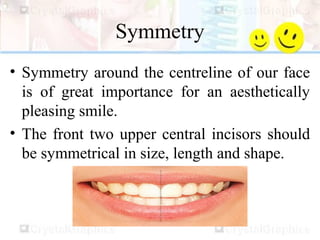
Symmetry
• Symmetry around the centreline of our face
is of great importance for an aesthetically
pleasing smile.
• The front two upper central incisors should
be symmetrical in size, length and shape.
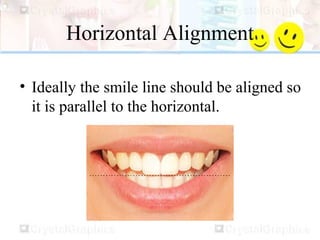
Horizontal Alignment
• Ideally the smile line should be aligned so
it is parallel to the horizontal.
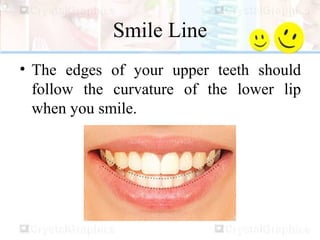
Smile Line
• The edges of your upper teeth should
follow the curvature of the lower lip
when you smile.
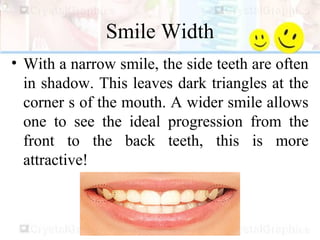
Smile Width
• With a narrow smile, the side teeth are often
in shadow. This leaves dark triangles at the
corner s of the mouth. A wider smile allows
one to see the ideal progression from the
front to the back teeth, this is more
attractive!
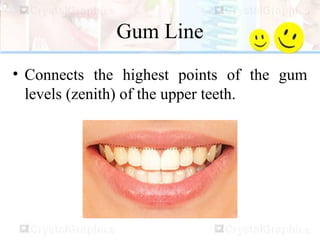
Gum Line
• Connects the highest points of the gum
levels (zenith) of the upper teeth.
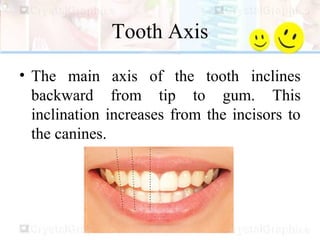
Tooth Axis
• The main axis of the tooth inclines
backward from tip to gum. This
inclination increases from the incisors to
the canines.
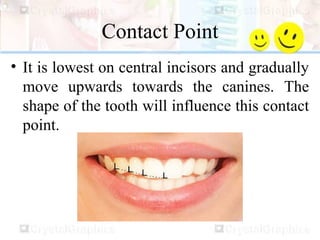
Contact Point
• It is lowest on central incisors and gradually
move upwards towards the canines. The
shape of the tooth will influence this contact
point.
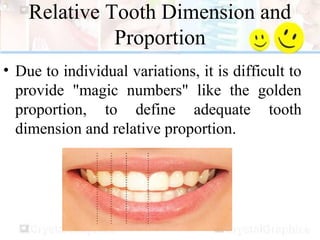
Relative Tooth Dimension and
Proportion
• Due to individual variations, it is difficult to
provide "magic numbers" like the golden
proportion, to define adequate tooth
dimension and relative proportion.
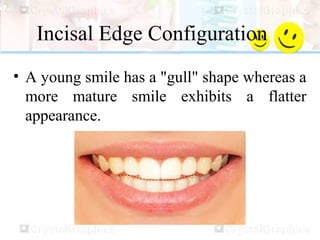
Incisal Edge Configuration
• A young smile has a "gull" shape whereas a
more mature smile exhibits a flatter
appearance.
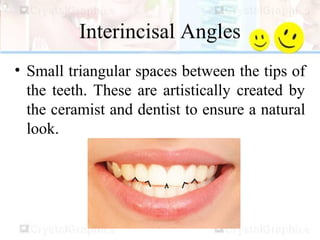
Interincisal Angles
• Small triangular spaces between the tips of
the teeth. These are artistically created by
the ceramist and dentist to ensure a natural
look.
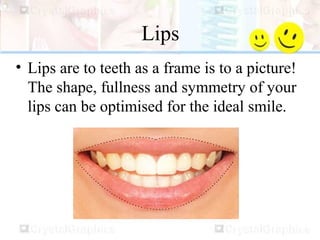
Lips
• Lips are to teeth as a frame is to a picture!
The shape, fullness and symmetry of your
lips can be optimised for the ideal smile.
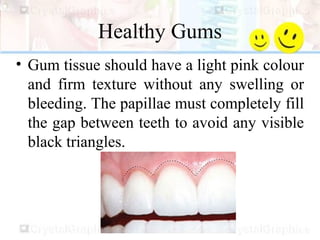
Healthy Gums
• Gum tissue should have a light pink colour
and firm texture without any swelling or
bleeding. The papillae must completely fill
the gap between teeth to avoid any visible
black triangles.
Thank You
For
Listening 
Reference:
http://www.perfectsmile.co.za/analyse-
your-smile.htm
Analyse your-smile-new.ppt

Analyse your-smile-new.ppt

  • 1.
    ANALYSE YOUR SMILEPresented By:Josephine Joyce Nicolas
  • 2.
    Mouth Is the dominantfeature of the face by virtue of its size.
  • 3.
    Central Incisor Is thedominant tooth of the smile. It goes without saying that dominance must be measured according to personality.
  • 4.
    Cosmetic Dentistry Creates attractivesmiles that function in a state of health.
  • 5.
    Cosmetic and RestorativeDentist Determine how to improve your smile, thereby looking better and feeling better about your appearance.
  • 6.
    Two ways regularlyused to analyse your smile 1. The Emotional Smile Evaluation 2. The Objective Smile Analysis
  • 7.
    Emotional Smile Evaluation Isbased on each individual's subjective perceptions of his or her smile.
  • 8.
    Questions 1. Do youlove the appearance of your teeth and smile? 2. Do you ever turn your face when smiling or hold your hand up in front of your mouth when talking to others? 3. Have you ever found yourself looking at models or other people with beautiful smiles and wishing you had a similar smile?
  • 9.
    4. Have youfigured out a way to use your lips to cover any aspect of your smile? 5. Are you embarrassed to visit a cosmetic dentist due to the condition of your teeth or the length of time since your last visit to a dentist? 6. How does your smile make you feel? Confident? 7. Do you shy away from showing a full smile in front of other people, especially strangers? 8. When taking pictures, do you tend to smile with your lips closed instead of flashing a happy smile?
  • 10.
    9. Have youever held back a laugh because you felt uncomfortable about your smile? 10. How would a beautiful new smile make you feel? 11. What would you like to change about your smile?
  • 11.
    Objective Smile Analysis Objectiveanalysis, the best thing is for you to stand in front of a mirror.
  • 12.
    Questions 1. Are allof your teeth brilliant white or are they somewhat yellow, dark, or stained? 2. Are there spaces between any of your teeth? 3. Are you missing any of your teeth? 4. Do you have teeth that are crooked, uneven, or out of line? 5. Do the biting edges of your upper teeth follow the curvature of your upper lip?
  • 13.
    6. Do anyof your teeth appear short and fat or too small or too large? 7. Are the edges of any of your teeth too long or too short or are all your teeth even? 8. Do your teeth (as a group) slant one way or another? 9. Is the midline of your two front teeth centred with your face and nose? 10. Are the edges of your canine teeth too long, sharp, or look out of line? 11. Do you grind your teeth or are any of the biting edges on your teeth chipped or worn down?
  • 14.
    12. Do youhave a "gummy" smile -- showing too much gum tissue or having gums that are too thick? 13. Are your gums even and in line and symmetrical or irregularly shaped -- higher on some teeth and lower on others? 14. Have your gums receded or do they appear red or puffy? 15. Do you have any grey, black or silver dental fillings in your teeth? 16. Do you have any old crowns that have dark edges at the top or that don't really look natural?
  • 15.
    Assess Your Smile 1.Are you embarrassed to smile? 2. Does this affect your confidence? 3. What do you not like about your smile? 4. How would you like to change your smile? 5. What makes a great smile?
  • 16.
    Teeth, Lips, Gum,& Symmetry TEETH have the greatest influence on the appearance of the smile, they are not the only factor that would make a beautiful smile. The shape and form of the LIPS as well as healthy GUM tissue that does not show too much , all contribute to the smile that is perfect for you. Regardless whether you want a Hollywood smile or a more natural appearance, SYMMETRY is essential for a beautiful smile.
  • 17.
    Symmetry • Symmetry aroundthe centreline of our face is of great importance for an aesthetically pleasing smile. • The front two upper central incisors should be symmetrical in size, length and shape.
  • 18.
    Horizontal Alignment • Ideallythe smile line should be aligned so it is parallel to the horizontal.
  • 19.
    Smile Line • Theedges of your upper teeth should follow the curvature of the lower lip when you smile.
  • 20.
    Smile Width • Witha narrow smile, the side teeth are often in shadow. This leaves dark triangles at the corner s of the mouth. A wider smile allows one to see the ideal progression from the front to the back teeth, this is more attractive!
  • 21.
    Gum Line • Connectsthe highest points of the gum levels (zenith) of the upper teeth.
  • 22.
    Tooth Axis • Themain axis of the tooth inclines backward from tip to gum. This inclination increases from the incisors to the canines.
  • 23.
    Contact Point • Itis lowest on central incisors and gradually move upwards towards the canines. The shape of the tooth will influence this contact point.
  • 24.
    Relative Tooth Dimensionand Proportion • Due to individual variations, it is difficult to provide "magic numbers" like the golden proportion, to define adequate tooth dimension and relative proportion.
  • 25.
    Incisal Edge Configuration •A young smile has a "gull" shape whereas a more mature smile exhibits a flatter appearance.
  • 26.
    Interincisal Angles • Smalltriangular spaces between the tips of the teeth. These are artistically created by the ceramist and dentist to ensure a natural look.
  • 27.
    Lips • Lips areto teeth as a frame is to a picture! The shape, fullness and symmetry of your lips can be optimised for the ideal smile.
  • 28.
    Healthy Gums • Gumtissue should have a light pink colour and firm texture without any swelling or bleeding. The papillae must completely fill the gap between teeth to avoid any visible black triangles.
  • 29.
  • 30.