 Infection
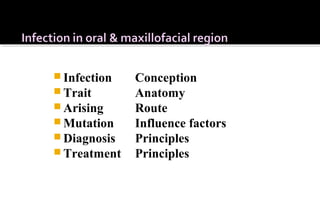
 Trait
 Arising
 Mutation
 Diagnosis
 Treatment

Conception
Anatomy
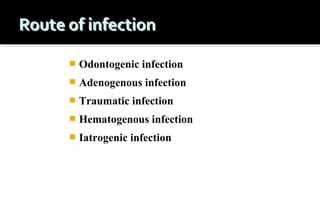
Route
Influence factors
Principles
Principles
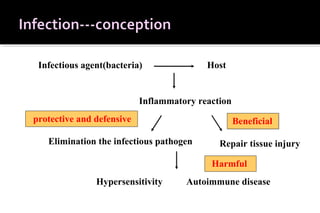
Infectious agent(bacteria)

Host

Inflammatory reaction
protective and defensive

Beneficial

Elimination the infectious pathogen

Repair tissue injury
Harmful

Hypersensitivity

Autoimmune disease
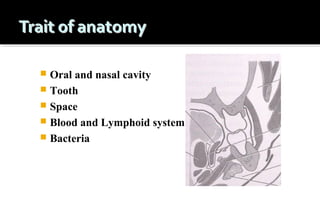
Oral and nasal cavity
 Tooth
 Space
 Blood and Lymphoid system
 Bacteria

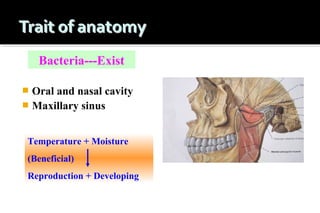
Bacteria---Exist
Oral and nasal cavity
 Maxillary sinus


Temperature + Moisture
(Beneficial)
Reproduction + Developing
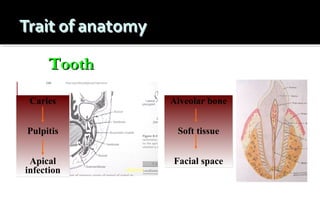
Tooth
Caries

Alveolar bone

Pulpitis

Soft tissue

Apical
infection

Facial space
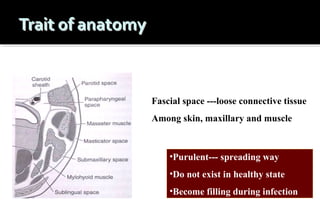
Fascial space ---loose connective tissue
Among skin, maxillary and muscle

•Purulent--- spreading way
•Do not exist in healthy state
•Become filling during infection
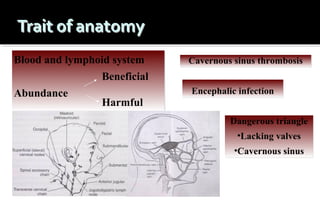
Blood and lymphoid system
Beneficial
Abundance

Harmful

Cavernous sinus thrombosis
Encephalic infection
Dangerous triangle
•Lacking valves
•Cavernous sinus
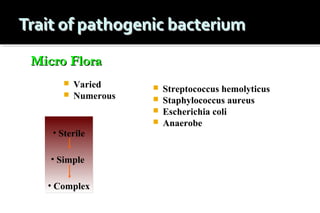
Micro Flora



Varied
Numerous

• Sterile
• Simple
• Complex






Streptococcus hemolyticus
Staphylococcus aureus
Escherichia coli
Anaerobe


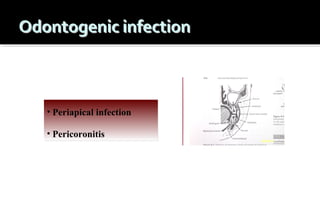
Odontogenic infection



Adenogenous infection



Traumatic infection



Hematogenous infection



Iatrogenic infection
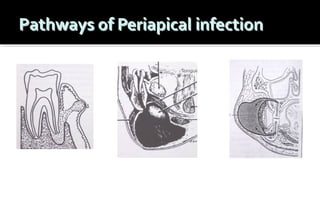
• Periapical infection
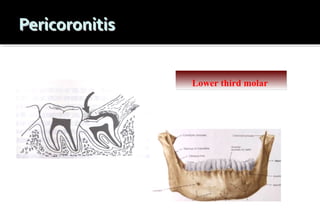
• Pericoronitis
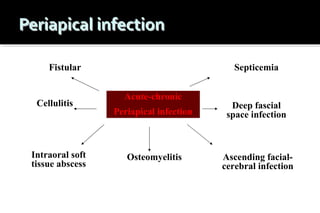
Fistular

Cellulitis

Intraoral soft
tissue abscess

Septicemia
Acute-chronic
Periapical infection

Deep fascial
space infection

Osteomyelitis

Ascending facialcerebral infection
Lower third molar


Local Signs and Symptoms



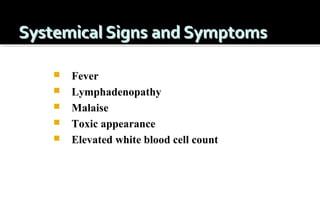
Systemical Signs and Symptoms
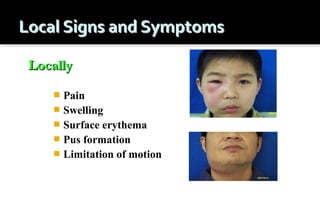
Locally
Pain
 Swelling
 Surface erythema
 Pus formation
 Limitation of motion







Fever
Lymphadenopathy
Malaise
Toxic appearance
Elevated white blood cell count
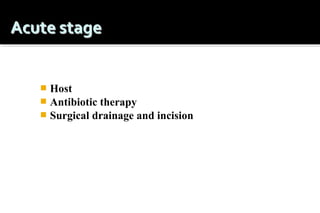
Acute stage
 Chronic stage

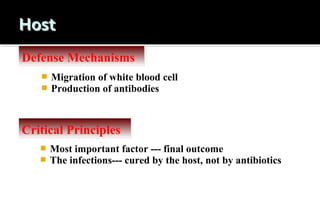
Host
 Antibiotic therapy
 Surgical drainage and incision

Defense Mechanisms



Migration of white blood cell
Production of antibodies

Critical Principles



Most important factor --- final outcome
The infections--- cured by the host, not by antibiotics
Antibiotic era

causative organism
 sensitivity
 specific, narrow-spectrum antibiotic
 least toxic antibiotic
 drug history(success, allergic and toxic)

Proper dose
 Proper time interval
 Proper route of administration(oral, parenteral)
 Combination antibiotic therapy

How to judge the pus formation?
 Purposes of surgical drainage and incision
 Principles of surgical drainage and incision

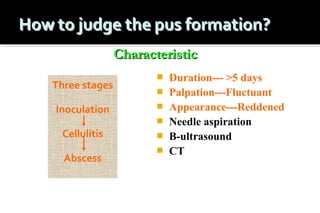
Characteristic
Three stages
Inoculation






Cellulitis
Abscess




Duration--- >5 days
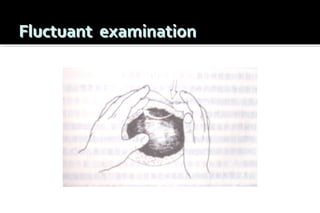
Palpation---Fluctuant
Appearance---Reddened
Needle aspiration
B-ultrasound
CT
Rid the body of toxic purulent material
 Decompress the tissues
 Allowing better perfusion of blood containing antibiotics
and defensive elements
 Increased oxygenation of the infected area

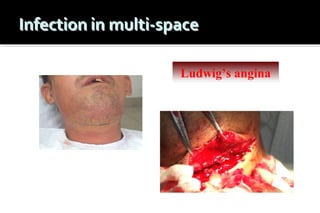
Ludwig’s angina
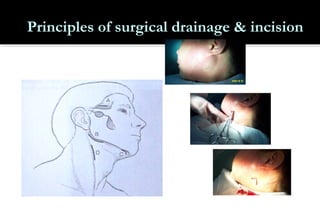
Place the incision in an esthetically acceptable
 Place the incision in a dependent position to
encourage drainage by gravity
 Dissect bluntly through deeper tissues and explore all
portions of the abscess
 Place a drain and stabilize it with sutures

Principles of surgical drainage & incision
Chronic stage
Surgical removal of the focus


Lesion tooth---Impacted tooth



Osteomyelitis
Infection in oral & maxillo-facial region
The trait of Infection
 Odontogenic infection
 mutation of infectious
 Diagnosis of the infection
 Diagnosis of the abscess formation
 The principles of the treatment


Infection oms (1)