RECURRENT APHTHOUS
STOMATITIS
CONTENTS
1. Definition
2. Etiology
3. Types
4. Clinical features
5. Presentation
6. Clinical types
7. Histopathology
8. Syndromes associated with aphthous ulcers
9. Differential diagnosis
10. Treatment
11. Conclusion
DEFINITION OF ULCER
•ANY BREACH IN THE CONTINUITY OF
THE EPITHELIUM OF THE SKIN OR
MUCOUS MEMBRANE TO INVOLVE THE
UNDERLYING CONNECTIVE TISSUE AS
A RESULT OF MICROMOLECULAR CELL
DEATH OF SURFACE EPITHELIUM OR
ITS TRAUMATIC REMOVAL.
DEFINITION
It is a common disorder
characterized by recurring
ulcers confined to oral mucosa
with no other signs of
systemic diseases.
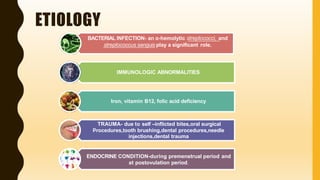
ETIOLOGY
BACTERIAL INFECTION- an α-hemolytic streptococci, and
streptococcus sanguis play a significant role.
IMMUNOLOGIC ABNORMALITIES
Iron, vitamin B12, folic acid deficiency
p
TRAUMA- due to self –inflicted bites,oral surgical
rocedures,tooth brushing,dental procedures,needle
injections,dental trauma
ENDOCRINE CONDITION-during premenstrual period and
at postovulation period.
ETIOLOGY
 Cessation of smoking increases the
frequency and
severity of
RAS.
Increased prevalence seen among children of RAS
positive parents (HLA – B 51)
Acute psychological problems appear to precipitate the
attacks of RAS.(more in examination; less in vacation)
CLINICAL FEATURES
•Age: second, third and fourth decades.
•Sex: Females>Males
•A higher prevalence has been found in the
higher socioeconomic groups and among
individuals with stress, such as students at
the time of examinations.
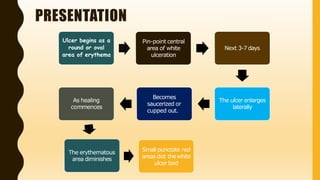
PRESENTATION
Ulcer begins as a
round or oval
area of erythema
Pin-point central
area of white
ulceration
Next 3-7 days
The ulcer enlarges
laterally
Becomes
saucerized or
cupped out.
As healing
commences
The erythematous
area diminishes
Small punctate red
areas dot thewhite
ulcer bed
CLASSIFICATION
Simple aphthous is described when
1. Ulcer recurrences are few
2. Not associated with systemic factors
3. Occur only 2–4 times each year.
Complex aphthous is described when
1. Develop recurrent oral and genital aphthous ulcers
2.When there is a continuous disease activity with new lesions
developing as older lesions heal
3. When ulcers are associated with systemic diseases.
CLINICAL TYPES:
RECURRENTAPHTHOUS
MINOR
RECURRENTAPHTHOUS
MAJOR
RECURRENT
HERPETIFORM
ULCERATIONS
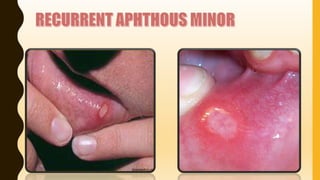
AGE- 10-30yr
GENDER- women>men
SITE- common on non-keratinized mucosa e.g –
buccal & labial mucosa, buccal & lingual sulci,
tongue, soft palate, pharynx,gingiva.
APPEARANCE- begins as a single or multiple
superficial erosions covered by greyish – white
removable fibrinopurulent membrane encircled by
erythematous halo.
Number-1-6
SIZE- 2-3 mm to 10 mm in diameter.
Persist for 7-14 days & heal without scarring.
Previously it represent a separate disease entity k/n as
periadenitis mucosa necrotica recurrens (mikulicz’s
scarring aphthae or sutton’s disease)
It is now regarded as severe expression of aphthous
stomatitis.
COMMON SITE- lips, cheeks, tongue, soft palate,
fauces, cause severe pain & dysphagia.
Also involve keratinized mucosa
INCIDENCE – common in HIV patient.
SIZE – Larger than the minor apthous ulcer diameter
more than 10mm.
NO.-1-10 in no.
Takes 4-6 weeks to heal.
Heal with scarring
Recurrs in less than a month time.
APPEARANCE- extend deeper and may present as
crater-like ulcers with rolled margins which are
indurated on palpation because of underlying fibrosis.
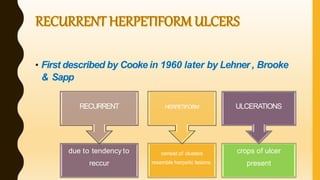
consist of clusters
resemble herpetic lesions.
HERPETIFORM
crops of ulcer
present
ULCERATIONS
• First described by Cooke in 1960 later by Lehner , Brooke
& Sapp
due to tendency to
reccur
RECURRENT
SITE- any intra oral site
SIZE-1-3 mm in diameter
APPEARANCE – characterized by crop of small, shallow
ulcers ,that may be joined together and form large
ulcer.
No. – 10 – 100
Healing occur in 1 to 2 weeks.
Heal with scarring.
Lesions persist for 1 to 3 year with short remissions
HISTOPATHOLOGY
DIFFERENTIAL DIAGNOSIS
• Recurrent herpes simplex infection
• Bednar’s aphthae
• Cyclic neutropenia
• Erosive lichen planus
• Stomatitis medicamentosa
• Squamous cell carcinoma
TREATMENT
• Tetracycline mouthrinse : Dosage 250mg per 5ml. It is
usually taken by diluting the tetracycline capsules in 5 ml
of water and is gargled in the mouth four times a day for
5 to 7 days.
This treatment produced a good response in nearly 70 %
of the Patients tested, by reliving the pain, reducing the
size of the lesions and reducing the healing time.
TREATMENT
• 5%Amlexanox is an anti- inflammatory, antiallergic used
to treat Recurrent Apthous Ulcers during prodromal
phases.
• It is applied on the Ulcer’s directly 3-4 times a day.
TREATMENT
• TRIAMCINOLONE a corticosteroid.
It is used to reduce swelling and ulcers in the mouth.
Applied 3-4 times a day on the ulcer.
TREATMENT
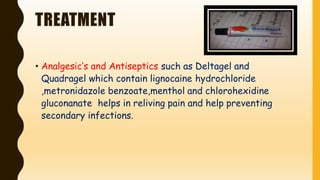
• Analgesic’s and Antiseptics such as Deltagel and
Quadragel which contain lignocaine hydrochloride
,metronidazole benzoate,menthol and chlorohexidine
gluconanate helps in reliving pain and help preventing
secondary infections.
TREATMENT
• Vitamin B12, Folic Acid Iron
• Not much of positive results are found with administration
of vitamin B12 in patients with Recurrent Apthous Ulcer’s.
TREATMENT
• Intralesional injection of steroid
– Triamcinolone acetonide (0.1-0.5 ml/l) or
– Betamethasone propionate and sodium phosphate
• Placing of gauze sponge containing topical steroids on ulcers in
cases of larger ulcers.
TREATMENT
• Surgical
– Laser surgery
Apthous ulcers

Apthous ulcers

  • 1.
  • 2.
    CONTENTS 1. Definition 2. Etiology 3.Types 4. Clinical features 5. Presentation 6. Clinical types 7. Histopathology 8. Syndromes associated with aphthous ulcers 9. Differential diagnosis 10. Treatment 11. Conclusion
  • 4.
    DEFINITION OF ULCER •ANYBREACH IN THE CONTINUITY OF THE EPITHELIUM OF THE SKIN OR MUCOUS MEMBRANE TO INVOLVE THE UNDERLYING CONNECTIVE TISSUE AS A RESULT OF MICROMOLECULAR CELL DEATH OF SURFACE EPITHELIUM OR ITS TRAUMATIC REMOVAL.
  • 5.
    DEFINITION It is acommon disorder characterized by recurring ulcers confined to oral mucosa with no other signs of systemic diseases.
  • 6.
    ETIOLOGY BACTERIAL INFECTION- anα-hemolytic streptococci, and streptococcus sanguis play a significant role. IMMUNOLOGIC ABNORMALITIES Iron, vitamin B12, folic acid deficiency p TRAUMA- due to self –inflicted bites,oral surgical rocedures,tooth brushing,dental procedures,needle injections,dental trauma ENDOCRINE CONDITION-during premenstrual period and at postovulation period.
  • 7.
    ETIOLOGY  Cessation ofsmoking increases the frequency and severity of RAS. Increased prevalence seen among children of RAS positive parents (HLA – B 51) Acute psychological problems appear to precipitate the attacks of RAS.(more in examination; less in vacation)
  • 8.
    CLINICAL FEATURES •Age: second,third and fourth decades. •Sex: Females>Males •A higher prevalence has been found in the higher socioeconomic groups and among individuals with stress, such as students at the time of examinations.
  • 9.
    PRESENTATION Ulcer begins asa round or oval area of erythema Pin-point central area of white ulceration Next 3-7 days The ulcer enlarges laterally Becomes saucerized or cupped out. As healing commences The erythematous area diminishes Small punctate red areas dot thewhite ulcer bed
  • 10.
    CLASSIFICATION Simple aphthous isdescribed when 1. Ulcer recurrences are few 2. Not associated with systemic factors 3. Occur only 2–4 times each year. Complex aphthous is described when 1. Develop recurrent oral and genital aphthous ulcers 2.When there is a continuous disease activity with new lesions developing as older lesions heal 3. When ulcers are associated with systemic diseases.
  • 11.
  • 12.
    AGE- 10-30yr GENDER- women>men SITE-common on non-keratinized mucosa e.g – buccal & labial mucosa, buccal & lingual sulci, tongue, soft palate, pharynx,gingiva. APPEARANCE- begins as a single or multiple superficial erosions covered by greyish – white removable fibrinopurulent membrane encircled by erythematous halo.
  • 13.
    Number-1-6 SIZE- 2-3 mmto 10 mm in diameter. Persist for 7-14 days & heal without scarring.
  • 15.
    Previously it representa separate disease entity k/n as periadenitis mucosa necrotica recurrens (mikulicz’s scarring aphthae or sutton’s disease) It is now regarded as severe expression of aphthous stomatitis. COMMON SITE- lips, cheeks, tongue, soft palate, fauces, cause severe pain & dysphagia. Also involve keratinized mucosa INCIDENCE – common in HIV patient. SIZE – Larger than the minor apthous ulcer diameter more than 10mm.
  • 16.
    NO.-1-10 in no. Takes4-6 weeks to heal. Heal with scarring Recurrs in less than a month time. APPEARANCE- extend deeper and may present as crater-like ulcers with rolled margins which are indurated on palpation because of underlying fibrosis.
  • 18.
    consist of clusters resembleherpetic lesions. HERPETIFORM crops of ulcer present ULCERATIONS • First described by Cooke in 1960 later by Lehner , Brooke & Sapp due to tendency to reccur RECURRENT
  • 19.
    SITE- any intraoral site SIZE-1-3 mm in diameter APPEARANCE – characterized by crop of small, shallow ulcers ,that may be joined together and form large ulcer. No. – 10 – 100 Healing occur in 1 to 2 weeks. Heal with scarring. Lesions persist for 1 to 3 year with short remissions
  • 21.
  • 22.
    DIFFERENTIAL DIAGNOSIS • Recurrentherpes simplex infection • Bednar’s aphthae • Cyclic neutropenia • Erosive lichen planus • Stomatitis medicamentosa • Squamous cell carcinoma
  • 23.
    TREATMENT • Tetracycline mouthrinse: Dosage 250mg per 5ml. It is usually taken by diluting the tetracycline capsules in 5 ml of water and is gargled in the mouth four times a day for 5 to 7 days. This treatment produced a good response in nearly 70 % of the Patients tested, by reliving the pain, reducing the size of the lesions and reducing the healing time.
  • 24.
    TREATMENT • 5%Amlexanox isan anti- inflammatory, antiallergic used to treat Recurrent Apthous Ulcers during prodromal phases. • It is applied on the Ulcer’s directly 3-4 times a day.
  • 25.
    TREATMENT • TRIAMCINOLONE acorticosteroid. It is used to reduce swelling and ulcers in the mouth. Applied 3-4 times a day on the ulcer.
  • 26.
    TREATMENT • Analgesic’s andAntiseptics such as Deltagel and Quadragel which contain lignocaine hydrochloride ,metronidazole benzoate,menthol and chlorohexidine gluconanate helps in reliving pain and help preventing secondary infections.
  • 27.
    TREATMENT • Vitamin B12,Folic Acid Iron • Not much of positive results are found with administration of vitamin B12 in patients with Recurrent Apthous Ulcer’s.
  • 28.
    TREATMENT • Intralesional injectionof steroid – Triamcinolone acetonide (0.1-0.5 ml/l) or – Betamethasone propionate and sodium phosphate • Placing of gauze sponge containing topical steroids on ulcers in cases of larger ulcers.
  • 29.