Dr.MuhammadUzairJamal
FCPSResidentII
Oral&MaxillofacialSurgery
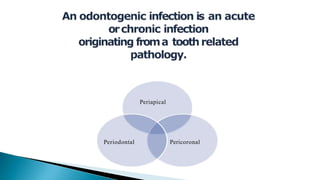
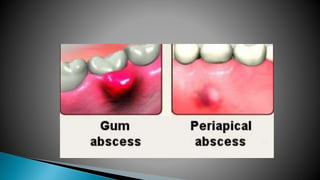
Periapical
Pericoronal
Periodontal
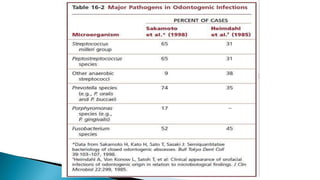
•Bacteriathat causeodontogenic infections arepart of normalflora
•Aerobic grampositive coocci
•Anaerobicgrampositive coocci
•Anaerobicgramnegativerods
•Thecausedental caries,gingivitis andperiodentitis
•Almost all of of Odontogenic infections arecausedbymultiple
bacteria
•Predominant aerobicbacteria inOI
•3members
1. S.anginious
2. S.intermedious
3. S.constellatus
•Theycaninitiate processof spreadingin deeptissue
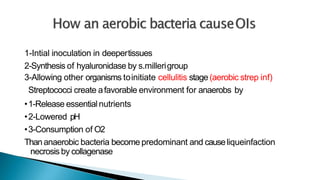
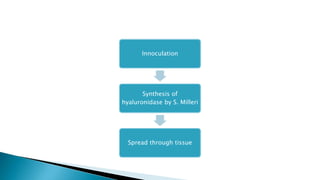
1-Intial inoculation in deepertissues
2-Synthesis of hyaluronidase by s.millerigroup
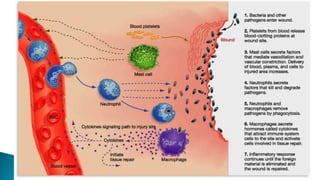
3-Allowing other organisms toinitiate cellulitis stage(aerobic strep inf)
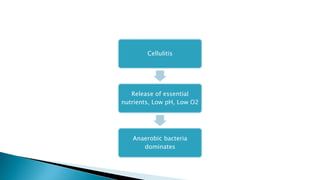
Streptococci create afavorable environment for anaerobs by
•1-Release essentialnutrients
•2-Lowered pH
•3-Consumption of O2
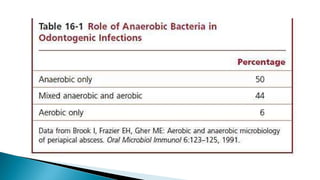
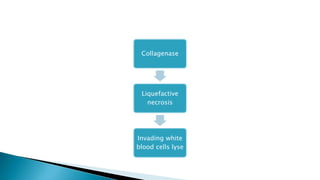
Thananaerobic bacteria become predominant and causeliqueinfaction
necrosis by collagenase
Innoculation
Synthesis of
hyaluronidase by S. Milleri
Spread through tissue
Cellulitis
Release of essential
nutrients, Low pH, Low O2
Anaerobic bacteria
dominates
Collagenase
Liquefactive
necrosis
Invading white
blood cells lyse
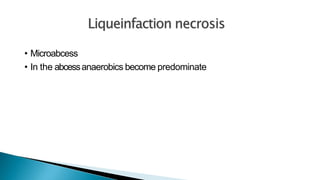
• Microabcess
• In the abcessanaerobics become predominate
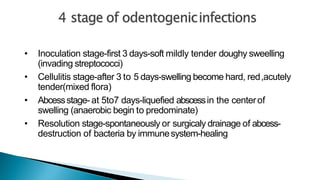
• Inoculation stage-first 3 days-soft mildly tender doughy sweelling
(invading streptococci)
• Cellulitis stage-after 3 to 5 days-swelling become hard, red,acutely
tender(mixed flora)
• Abcessstage- at 5to7 days-liquefied abscessin the centerof
swelling (anaerobic begin to predominate)
• Resolution stage-spontaneously or surgicaly drainage of abcess-
destruction of bacteria by immunesystem-healing
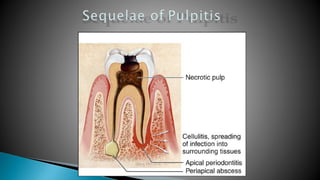
• Periapical (palpal necrosis) –most common
• Periodental(deep pocket)
• Treatment:endodontic or extraction
• Antibiotic alone therapy just may arrestOI
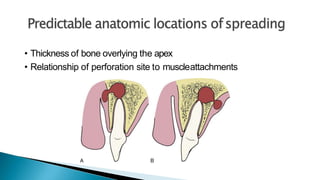
• Thickness of bone overlying the apex
• Relationship of perforation site to muscleattachments
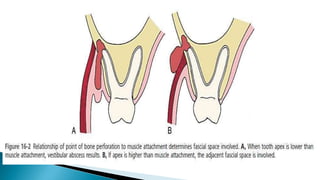
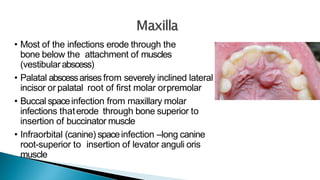
• Most of the infections erode through the
bone below the attachment of muscles
(vestibularabscess)
• Palatal abscessarises from severely inclined lateral
incisor or palatal root of first molar orpremolar
• Buccal spaceinfection from maxillary molar
infections thaterode through bone superior to
insertion of buccinator muscle
• Infraorbital (canine) spaceinfection –long canine
root-superior to insertion of levator anguli oris
muscle
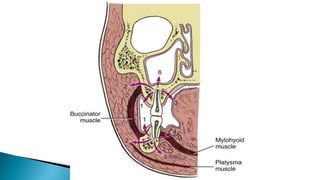
• Vestibular abscess-incisors,canine ,premolars –erode through facial
cortical plate , superior to attachment of the muscles of lower lip
• First molar – may drain Buccally or lingual
• Second molar-may drain buccally or lingual - usuallylingually
• Third molar –almost alwayslingually
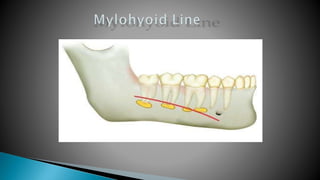
• Mylohyoid muscle determine whether infections drain linguallygo
superior to sublingual spaceor below to submandibularspace
• Theabscessmay establishes If the patient do not seektreatment
• In oral cavity or skin
• No pain aslong asits open
• Treatment =endodontic or extraction
• Antibiotic =just arrest
• Complete history of current infection
• Physical examination
• Chief compliant (patient own words)
• History of chief compliant of OI
1. How long OIbeen present
2. Time of onset
3. How long from firstsymptoms(pain-swelling-drainage)
4. Change of severity in time
• Infections are actually asevere inflammation
• Redness-pain-swelling-warmth-loss of function
• Most common compliant
• Where it started
• How it spread since first noted
• Askabout area of swelling
• Warmth
• Whether the area hasfelt warm to the touch
• Redness
• Askabout Anychangeof the color especiallyredness
• Function
• Dentist should askabout trismus .dyspnea,dysphagia
• Finally
• Askhow patient feel ingeneral
• Fatigue ,weak , sick,feverish
• Askabout
• Professional treatment
• Self treatment –leftover antibiotics-hot soaks–herbal remedies
• Completing the lasttreatment
• Vital signs(temperature,bp,pulse rate,respiratoryrate)
• Severeinfections =greater temperature than 38c
• Infection =Pulse rate up to100
• Severeinfection =greater than 100,aggressivetreatment
• Painand anxiety =elevation on systolic bp
• Septic shock result in Hypotension
• Extention of Infection in fascial spacesof neck =partial or complete upper
airway obstruction
• Normal respiratory rate=14-16 in amin
• Mild of moderate infection =respiratory rate greater than 18 per min
• Normal vital sign
• Only amild temperature elevation
• Canbe rapidly treated
• Abnormal vital signs
• Elevation in temperature,blood pressure ,respiratoryrate,
• Require more intensive therapy and evaluation by maxillofacial
surgeon
• Inspection of patients general appearance (toxic
appearance,malaise,fatigue,feverishness)
• Signof infection
• Opening mouth
• Swallowing
• Breathing
• In the area of swelling
• Tenderness
• Local warmth
• Consistency of swelling(soft-doughy-indurated-fluctuance)
• Fluctuance =afluid filled balloon in the center ofindurated tissue
• T
o find specific causeofinfection
• Likeseverely carious teeth, periodontal abscess,periodontal disease,
• Infected fracture of atooth or entire of the jaw
• Should look for area of gingivitis , swelling , draining sinustracts
• Usually PA radiographs
• If there was any trismus and limited mouth opening or
tenderness, panoramic view may be necessary
• Soft tissue infection in inoculation stage may be cured by removalof
odontogenic causewith or without supportiveantibiotics
Cellulitis or abscessstagesrequire removal of dental cause,incisionand
drainage and antibiotics
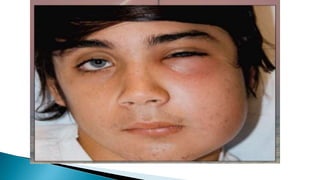
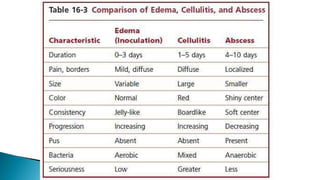
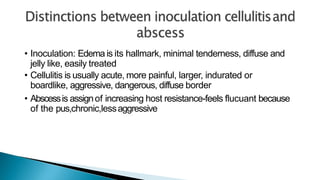
• Inoculation: Edema is its hallmark, minimal tenderness, diffuse and
jelly like, easily treated
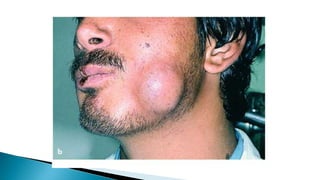
• Cellulitis is usually acute, more painful, larger, indurated or
boardlike, aggressive, dangerous, diffuse border
• Abscessis assignof increasing host resistance-feels flucuant because
of the pus,chronic,lessaggressive
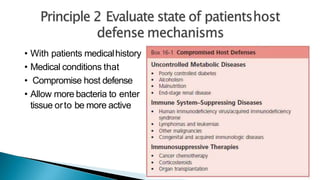
• With patients medicalhistory
• Medical conditions that
• Compromise host defense
• Allow more bacteria to enter
tissue orto be more active
• Most common immunocompromising disease
• Lower control of hyperglycemia =lower resistance to all typesof
infections
• Secondmajor immunocompromosing diseases
• Result in decrease WBCfunction and antibody function and
production
• BecauseOdontogenic infections are causedby bacteria
• HIV attacks T-lymphocytes
• HIV+patient are able to combat odontogenic infections fairly
• Until the AIDSstage when b cells are alsoimpaired
• It willbe more intensive than normal patients
• Cancerchemotherapeutic agents=decreasecirculating WBCcounts
usually lessthan 1000 cell/ml =effect of some agents canlast for a
year after end of therapy
• Immunosuppressive therapy in organ transplantation and
autoimmune disease
• Most common drugs are cyclosporine ,tacrolimus,azathioporine
• Theycandecrease B-Cellsand T-cells function and decrease
of antibody production
• Patient with history of condition or anything that compromise host
defense must be treated more vigorously because infection may be
spread more
• So referral to OMFsurgeon and initiate parenteral antibiotic
therapy must be considered
 Most of OI can be managed by dentist with expectation ofrapid
healing
 Some are life threatening and require aggressive treatment by
surgeon
 For some hospitalization is required
• Themain criteria for hospitalization is an impending threat tothe
airway
• 1-Rapidly progressive infection that maycause swellingin deepfascial
spaceof neck ,which cancompress and deviate airway
• 2-Dyspnea –swelling of upper airway-refuse to lie down-distorted
speech-distressed by breathing difficulty –should be referred directly
to emergencyroom
• 3-Dysphagia-drooling-should be referred directly to emergencyroom
• 1-Extraoral Swelling –buccal space-submandibular space–because
may require incision and drainage
• 2-High temperature
• 3-Trismus-opening between 20 and 30 =mild -10 and 20
=moderate- lessthan10 =severe
• Moderate of severe =infection in masticator spacesor worse boththe
lateral pharyngeal spaceand retropharyngeal space
• 4- Systematic involvement(toxic appearance)
• 5- Compromised host defense
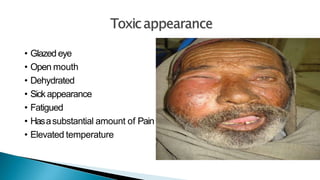
• Glazed eye
• Open mouth
• Dehydrated
• Sickappearance
• Fatigued
• Hasasubstantial amount of Pain
• Elevated temperature
• Theprimary principle of management of OIis to perform surgical
drainage and remove the causeof infection (necrotic pulp mostlyor
deep pocket)
• Endodontic access-wide incision of tissue in theneck-
• remove the causeof infection is the primarygoal
• Secondary goal is to providedrainage
• 1-Decrease the load of bacteria and necroticdebries
• 2-Reduce the hydrostatic pressure in the region,which improveblood
supply and delivery of host defense andantibiotic
• 3-Stop cellulitis to spreaddeeper
• 1-Preffered site is the site with maximumswelling
• 2-Avoid incising acrossafrenum or path of mentalnerve
• 1-method of pain control =regional nerve block by injecting inan area
away from site oninfection
• 2-do not reuse the needle if it been used in an infection area
• 3-culture sensitivity test most be considered before I&D and it most
be carried out in the first portion of surgery
• 4-disinfect the area by betadine and dry it by gauze
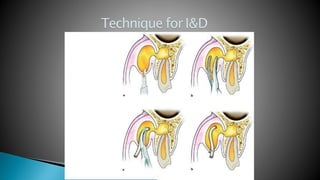
• 1-most be short,not more than 1cmlength
• 2-with ascalpel blade
• 3- open the cavity with aclosed curved hemostat and then itwill be
opened in severaldirections
• 4 –suction of pus and tissue fluids
• 5-insert asmall drain to maintain opening toreach depth of abscess
(quarterinch sterile Penrose drain or rubber dam or surgical glove
material )-be aware of latexsensitivity
• 6-suture the drain to edge osincision with anon- resorbablesuture-2
to 5days
•Whenever an abscess or cellulitis is
diagnosed the surgeon must drainit.
• even iftooth cant be opened or extracted immedietly
• Antibiotic should be used if complete dranage cannotbe
achieved
• Medically compromised patient
• 1-should be treated byspecialists
• 2-hospitalization and consolation are required
• 3-antibiotics
• Coumadin (warfarin)-require reversal of anticoagulationbefore
surgery
• Feverincrease fluid requirement
• Inadequate fluid intake –because of the swelling –pain
• Theyshould be encouraged to drink water and totake high
nutritional supplements
• Should be taking analgesics for pain
• 1- seriousness of infection
• 2-whether adequate surgical treatment can beachieved
• 3- patients host defense
• Presenceof an acute-onset infection with diffuse swelling and
moderate to severepain
• Immunologically compromised patient
• Involvement of the deep fascialspace
• Severe pericoronitis with fever
• Osteomyelitis
• 1-minor –chronic well-localized abscess
• 2-well localized dentoalveolar abscess
• 3-localized alveolar osteitis (dry socket)
• 4-mild pericoronitis with minor gingival edema andpain
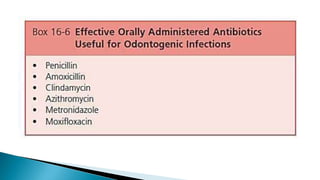
• Usually penicillin
• For penicillin allergic, clindamycin and azithromycin
• For anaerobic bacteria,metronidazole and should be used in
combination to others
• Fewest times daily to improvecompliance
• C&Stest should beconsidered
• 1- Rapid onset of sever infection and rapidspreading
• 2-Post operative infection
• 3- Infection that does not resolve asexpected
• 4-Resistant bacteria infection after 2 daysto 2 weeks infectionfree
period
• 5-Patient with compromised hostdefense
• Penicillin will kill streptococci and oral anaerobic bacteria and alitle
effect on staphylococci of skin and no effect on gastrointestinaltract
bacteria =does no facilitate developingresistance
• Co–amoxicillin is broad and result in alternation in floraand
resistance
ABwith narrow-spectrum activity are aseffective asothers but with
lessupsetting flora and lessdeveloping resistance
• Resistancecanbe passedon by dental patient to their families,
coworkers and entire communities
• Theolder generation antibiotics usually used for OIhave asurprising
low incidence of toxicity relatedproblems.
• Allergy to penicillin in 2%of allpopulation
• Clindamycin =pseudomembranous (diarrhea) colitis by clostridium
difficile
• In macrolide family azithromycin hasthe best combination of
effectiveness , low toxicity an infrequent druginteraction
• Erytromycin is no longer considered becauseof the druginteractions
involving the liver microsomal enzyme and loweffectiveness
• Moxifloxacin= beter effect on oral pathogens but significanttoxicity
,mental clouding and muscle weakness, fatal drug interactions with
many commonly used drugs ,contraindicated in children under18,and
pregnant women,
• Oral cephalosporins have lost much of their effectiveness andmay
causeallergic reactions like penicillin
• Tetracycline are no longer considered for the samereason.except
topically like in pockets-photosensitivity in systemic use-
contraindication in pregnancy andchildren.(discoloration)
• Metronidazile .mild toxicity-reaction to alcohol and disulfirameffect
Sudden violent abdominal cramping and vomiting
• Host defense play alessimportant role
• Specially in medically compromisedpatient
• Penicillin –narrow spectrum- low toxicity
• Amoxicillin is preferable to penicillin Vbecauseof lessfrequent
dosage
Co-amoxicillin (broad) for complexinfections
Azithromycin –in allergy
Clindamycin-allergy anaerobic bacteria
Metronidazole- anaerobic bacteria –combination with aerobicAB
Moxifloxacin-only by specialist
• For odontogenic infection a 3 or 4 day course of penicillin
with appropriate surgery is effective asa7 day course
• Entire prescription must betaken
• 2 to3 daysafter completion of the original therapy
• Checkthe site of I&D toremove the drain
•Failure =main reason inadequate surgery -so extraction orI&D
into the area that wasnot detected in the first time, must be
considered
• Secondreason of failure: depressed hostdefense.
• Third reason : presence of foreign body(infected radiopaque body)a
shelter from immune system
• Dental implants should be debrided or removed
• Forth :antibiotic may be problematic :poor penetration to abscess
(inadequate surgery or drainage blood supply , low dose),
• Incorrect chose of ABfor the bacteria
• Resistanceof bacteria
• Establishment of asecondary infection like candida
• Early removal of thedrain
• Patient may stopped taking the drug tooearly
• Surgical intervention and antibiotic therapy should beconsidered
•Prophylaxis of woundinfection
• ProphylacticABare effective against post operative infections and
blood borne infections
• Most office procedures Do not require prophylacticAB
• Likeextraction, frenectomy, biopsy, minor alveoloplasty, torus
reduction, periapical infection, severe periodontitis, multiple
extractions
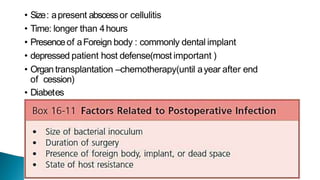
• Size: apresent abscessor cellulitis
• Time: longer than 4hours
• Presenceof aForeign body : commonly dental implant
• depressed patient host defense(most important )
• Organ transplantation –chemotherapy(until ayear after end
of cession)
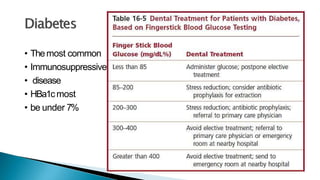
• Diabetes
• Themost common
• Immunosuppressive
• disease
• HBa1cmost
• be under 7%
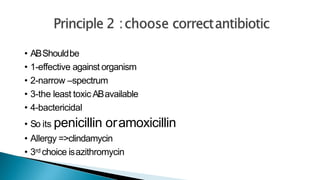
• ABShouldbe
• 1-effective against organism
• 2-narrow –spectrum
• 3-the least toxic ABavailable
• 4-bactericidal
• So its penicillin oramoxicillin
• Allergy =>clindamycin
• 3rd choice isazithromycin
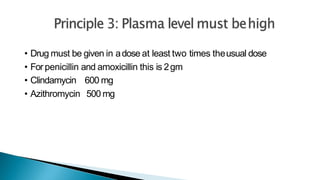
• Drug must be given in adose at least two times theusual dose
• For penicillin and amoxicillin this is 2gm
• Clindamycin
• Azithromycin
600 mg
500 mg
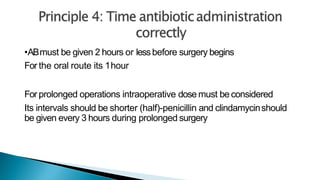
•ABmust be given 2 hours or lessbefore surgery begins
For the oral route its 1hour
For prolonged operations intraoperative dose must be considered
Its intervals should be shorter (half)-penicillin and clindamycinshould
be given every 3 hours during prolonged surgery
• For short operations asingle dose before the surgery isenough
• Useof antibiotics is only necessary in the time ofsurgery
• not after that
• Metastatic infection: infection that occurs at alocationphysically
separate from the portal entry ofbacteria
• Bacterial endocarditis
• 1-suspectible location (hearth valve)
• 2-bacteremia
• 3-bacterial proteins–adheins in 3 streps(s.sanguis- s.mitis s.oralis )
• 4-impaired local host defense
• High dose of intravenous antibiotic for prolongedperiods
• Often damaged native valve must be surgically replaced bya
prosthetic valve
• Recurrence reduces survival rate in 5 years to 60%
• 1-previos endocarditis
• 2-prosthetic heart valve
• 3-cyanotic congenital heart defects –not been repaired or havepartial
defect after repair
• 4- heart transplant with valvopathy
• -----6 mounts after procedure (endothlialization time)
• Patient with daily taking of penicillin =>streptococcus may be resistant to
penicillin sopatient shoulduse
• clindamycin or clarithromycin orazithromycin
• If possible aperiod of 10 days after ABcompleted to allow flora tobecome
normal
• 10 daysbetween appointment for the samereason and to reduce resistant
colonies
• In the case of an unexpected bleeding or a patient who didn’t inform the
surgeon of the condition , ABprophylaxis should be administered assoon
aspossible
• Thelimitation of ABprophylaxis is 4hours
• Comprehensive prophylaxis program including
• 1-excellent oral hygiene
• 2-excellent periodic care
• 3-treat of all dental and periodontaldiseases
• 4-mount wash with chlorhexidine beforesurgery
• 5-patient should be inform about signsof IE(it may stilloccur)
• -prosthetic valve Eis more fatal than native valveE
• 1-in renal dialysis metastatic infection canoccur inshunts
• 2-patient who have hydrocephaly in ventriculoatrial shunts
• 3- nonvalvular cardiovascular devices -just if there must be aI&Dof
abscessin other sites
• Riskof hematogenous spread of bacteria
• May result in the lose ofimplant
• Aggressive treatment including extraction , I&D ,highdose
bactericidal ABand C&Stest
• Hyaluronidase (Produced by aerobes;causes cellulitis and
lowers the pH)
• Collagenase (Produced by anaerobes;cause
 liquefactive necrosis;pus)
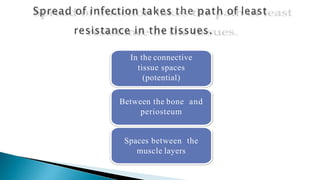
In the connective
tissue spaces
(potential)
Between the bone and
periosteum
Spaces between the
muscle layers
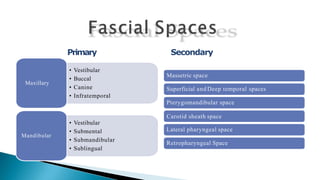
Primary Secondary
• Vestibular
• Buccal
• Canine
• Infratemporal
Maxillary
• Vestibular
• Submental
• Submandibular
• Sublingual
Mandibular
Massetric space
Superficial and Deep temporal spaces
Pterygomandibular space
Carotid sheath space
Lateral pharyngeal space
Retropharyngeal Space
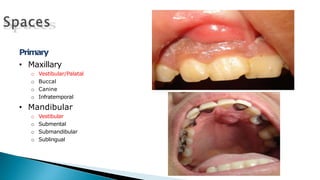
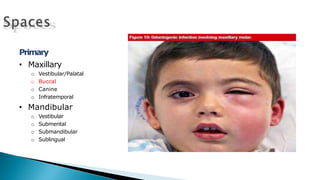
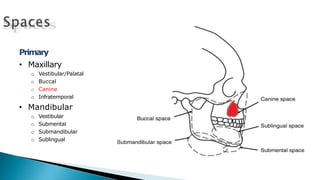
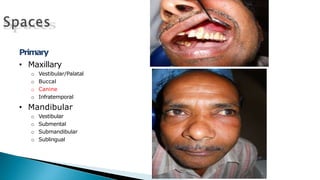
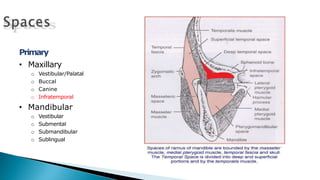
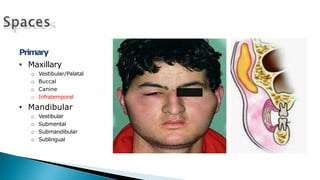
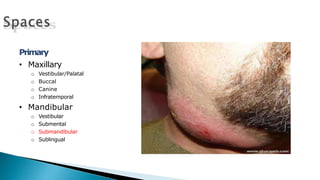
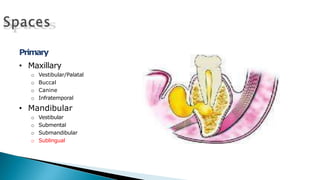
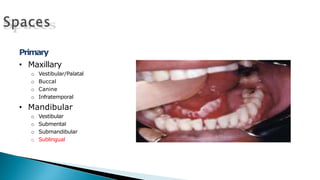
Primary
• Maxillary
o Vestibular/Palatal
o Buccal
o Canine
o Infratemporal
• Mandibular
o Vestibular
o Submental
o Submandibular
o Sublingual
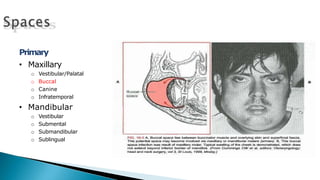
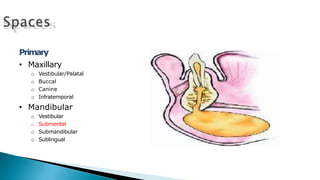
Primary
• Maxillary
o Vestibular/Palatal
o Buccal
o Canine
o Infratemporal
• Mandibular
o Vestibular
o Submental
o Submandibular
o Sublingual
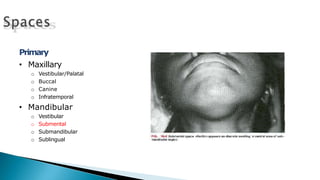
Primary
• Maxillary
o Vestibular/Palatal
o Buccal
o Canine
o Infratemporal
• Mandibular
o Vestibular
o Submental
o Submandibular
o Sublingual
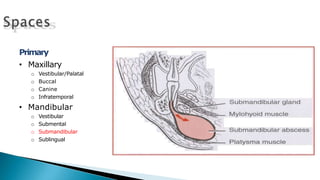
Primary
• Maxillary
o Vestibular/Palatal
o Buccal
o Canine
o Infratemporal
• Mandibular
o Vestibular
o Submental
o Submandibular
o Sublingual
Primary
• Maxillary
o Vestibular/Palatal
o Buccal
o Canine
o Infratemporal
• Mandibular
o Vestibular
o Submental
o Submandibular
o Sublingual
Primary
• Maxillary
o Vestibular/Palatal
o Buccal
o Canine
o Infratemporal
• Mandibular
o Vestibular
o Submental
o Submandibular
o Sublingual
Primary
• Maxillary
o Vestibular/Palatal
o Buccal
o Canine
o Infratemporal
• Mandibular
o Vestibular
o Submental
o Submandibular
o Sublingual
Primary
• Maxillary
o Vestibular/Palatal
o Buccal
o Canine
o Infratemporal
• Mandibular
o Vestibular
o Submental
o Submandibular
o Sublingual
Primary
• Maxillary
o Vestibular/Palatal
o Buccal
o Canine
o Infratemporal
• Mandibular
o Vestibular
o Submental
o Submandibular
o Sublingual
Primary
• Maxillary
o Vestibular/Palatal
o Buccal
o Canine
o Infratemporal
• Mandibular
o Vestibular
o Submental
o Submandibular
o Sublingual
Primary
• Maxillary
o Vestibular/Palatal
o Buccal
o Canine
o Infratemporal
• Mandibular
o Vestibular
o Submental
o Submandibular
o Sublingual
Primary
• Maxillary
o Vestibular/Palatal
o Buccal
o Canine
o Infratemporal
• Mandibular
o Vestibular
o Submental
o Submandibular
o Sublingual
Primary
• Maxillary
o Vestibular/Palatal
o Buccal
o Canine
o Infratemporal
• Mandibular
o Vestibular
o Submental
o Submandibular
o Sublingual
chapter16-161027084810.pptx

chapter16-161027084810.pptx

  • 2.
  • 3.
  • 7.
    •Bacteriathat causeodontogenic infectionsarepart of normalflora •Aerobic grampositive coocci •Anaerobicgrampositive coocci •Anaerobicgramnegativerods •Thecausedental caries,gingivitis andperiodentitis •Almost all of of Odontogenic infections arecausedbymultiple bacteria
  • 8.
    •Predominant aerobicbacteria inOI •3members 1.S.anginious 2. S.intermedious 3. S.constellatus •Theycaninitiate processof spreadingin deeptissue
  • 11.
    1-Intial inoculation indeepertissues 2-Synthesis of hyaluronidase by s.millerigroup 3-Allowing other organisms toinitiate cellulitis stage(aerobic strep inf) Streptococci create afavorable environment for anaerobs by •1-Release essentialnutrients •2-Lowered pH •3-Consumption of O2 Thananaerobic bacteria become predominant and causeliqueinfaction necrosis by collagenase
  • 13.
    Innoculation Synthesis of hyaluronidase byS. Milleri Spread through tissue
  • 14.
    Cellulitis Release of essential nutrients,Low pH, Low O2 Anaerobic bacteria dominates
  • 15.
  • 16.
    • Microabcess • Inthe abcessanaerobics become predominate
  • 17.
    • Inoculation stage-first3 days-soft mildly tender doughy sweelling (invading streptococci) • Cellulitis stage-after 3 to 5 days-swelling become hard, red,acutely tender(mixed flora) • Abcessstage- at 5to7 days-liquefied abscessin the centerof swelling (anaerobic begin to predominate) • Resolution stage-spontaneously or surgicaly drainage of abcess- destruction of bacteria by immunesystem-healing
  • 22.
    • Periapical (palpalnecrosis) –most common • Periodental(deep pocket)
  • 23.
    • Treatment:endodontic orextraction • Antibiotic alone therapy just may arrestOI
  • 24.
    • Thickness ofbone overlying the apex • Relationship of perforation site to muscleattachments
  • 26.
    • Most ofthe infections erode through the bone below the attachment of muscles (vestibularabscess) • Palatal abscessarises from severely inclined lateral incisor or palatal root of first molar orpremolar • Buccal spaceinfection from maxillary molar infections thaterode through bone superior to insertion of buccinator muscle • Infraorbital (canine) spaceinfection –long canine root-superior to insertion of levator anguli oris muscle
  • 27.
    • Vestibular abscess-incisors,canine,premolars –erode through facial cortical plate , superior to attachment of the muscles of lower lip • First molar – may drain Buccally or lingual • Second molar-may drain buccally or lingual - usuallylingually • Third molar –almost alwayslingually • Mylohyoid muscle determine whether infections drain linguallygo superior to sublingual spaceor below to submandibularspace
  • 29.
    • Theabscessmay establishesIf the patient do not seektreatment • In oral cavity or skin • No pain aslong asits open • Treatment =endodontic or extraction • Antibiotic =just arrest
  • 32.
    • Complete historyof current infection • Physical examination
  • 33.
    • Chief compliant(patient own words) • History of chief compliant of OI 1. How long OIbeen present 2. Time of onset 3. How long from firstsymptoms(pain-swelling-drainage) 4. Change of severity in time
  • 34.
    • Infections areactually asevere inflammation • Redness-pain-swelling-warmth-loss of function
  • 35.
    • Most commoncompliant • Where it started • How it spread since first noted
  • 36.
    • Askabout areaof swelling • Warmth • Whether the area hasfelt warm to the touch • Redness • Askabout Anychangeof the color especiallyredness • Function • Dentist should askabout trismus .dyspnea,dysphagia • Finally • Askhow patient feel ingeneral • Fatigue ,weak , sick,feverish
  • 37.
    • Askabout • Professionaltreatment • Self treatment –leftover antibiotics-hot soaks–herbal remedies • Completing the lasttreatment
  • 38.
    • Vital signs(temperature,bp,pulserate,respiratoryrate) • Severeinfections =greater temperature than 38c • Infection =Pulse rate up to100 • Severeinfection =greater than 100,aggressivetreatment • Painand anxiety =elevation on systolic bp • Septic shock result in Hypotension • Extention of Infection in fascial spacesof neck =partial or complete upper airway obstruction • Normal respiratory rate=14-16 in amin • Mild of moderate infection =respiratory rate greater than 18 per min
  • 39.
    • Normal vitalsign • Only amild temperature elevation • Canbe rapidly treated
  • 40.
    • Abnormal vitalsigns • Elevation in temperature,blood pressure ,respiratoryrate, • Require more intensive therapy and evaluation by maxillofacial surgeon
  • 41.
    • Inspection ofpatients general appearance (toxic appearance,malaise,fatigue,feverishness) • Signof infection • Opening mouth • Swallowing • Breathing
  • 42.
    • In thearea of swelling • Tenderness • Local warmth • Consistency of swelling(soft-doughy-indurated-fluctuance) • Fluctuance =afluid filled balloon in the center ofindurated tissue
  • 43.
    • T o findspecific causeofinfection • Likeseverely carious teeth, periodontal abscess,periodontal disease, • Infected fracture of atooth or entire of the jaw • Should look for area of gingivitis , swelling , draining sinustracts
  • 44.
    • Usually PAradiographs • If there was any trismus and limited mouth opening or tenderness, panoramic view may be necessary
  • 45.
    • Soft tissueinfection in inoculation stage may be cured by removalof odontogenic causewith or without supportiveantibiotics Cellulitis or abscessstagesrequire removal of dental cause,incisionand drainage and antibiotics
  • 47.
    • Inoculation: Edemais its hallmark, minimal tenderness, diffuse and jelly like, easily treated • Cellulitis is usually acute, more painful, larger, indurated or boardlike, aggressive, dangerous, diffuse border • Abscessis assignof increasing host resistance-feels flucuant because of the pus,chronic,lessaggressive
  • 48.
    • With patientsmedicalhistory • Medical conditions that • Compromise host defense • Allow more bacteria to enter tissue orto be more active
  • 49.
    • Most commonimmunocompromising disease • Lower control of hyperglycemia =lower resistance to all typesof infections
  • 50.
    • Secondmajor immunocompromosingdiseases • Result in decrease WBCfunction and antibody function and production
  • 51.
    • BecauseOdontogenic infectionsare causedby bacteria • HIV attacks T-lymphocytes • HIV+patient are able to combat odontogenic infections fairly • Until the AIDSstage when b cells are alsoimpaired • It willbe more intensive than normal patients
  • 52.
    • Cancerchemotherapeutic agents=decreasecirculatingWBCcounts usually lessthan 1000 cell/ml =effect of some agents canlast for a year after end of therapy • Immunosuppressive therapy in organ transplantation and autoimmune disease • Most common drugs are cyclosporine ,tacrolimus,azathioporine • Theycandecrease B-Cellsand T-cells function and decrease of antibody production
  • 53.
    • Patient withhistory of condition or anything that compromise host defense must be treated more vigorously because infection may be spread more • So referral to OMFsurgeon and initiate parenteral antibiotic therapy must be considered
  • 54.
     Most ofOI can be managed by dentist with expectation ofrapid healing  Some are life threatening and require aggressive treatment by surgeon  For some hospitalization is required
  • 55.
    • Themain criteriafor hospitalization is an impending threat tothe airway • 1-Rapidly progressive infection that maycause swellingin deepfascial spaceof neck ,which cancompress and deviate airway • 2-Dyspnea –swelling of upper airway-refuse to lie down-distorted speech-distressed by breathing difficulty –should be referred directly to emergencyroom • 3-Dysphagia-drooling-should be referred directly to emergencyroom
  • 56.
    • 1-Extraoral Swelling–buccal space-submandibular space–because may require incision and drainage • 2-High temperature • 3-Trismus-opening between 20 and 30 =mild -10 and 20 =moderate- lessthan10 =severe • Moderate of severe =infection in masticator spacesor worse boththe lateral pharyngeal spaceand retropharyngeal space • 4- Systematic involvement(toxic appearance) • 5- Compromised host defense
  • 57.
    • Glazed eye •Open mouth • Dehydrated • Sickappearance • Fatigued • Hasasubstantial amount of Pain • Elevated temperature
  • 58.
    • Theprimary principleof management of OIis to perform surgical drainage and remove the causeof infection (necrotic pulp mostlyor deep pocket) • Endodontic access-wide incision of tissue in theneck- • remove the causeof infection is the primarygoal • Secondary goal is to providedrainage
  • 59.
    • 1-Decrease theload of bacteria and necroticdebries • 2-Reduce the hydrostatic pressure in the region,which improveblood supply and delivery of host defense andantibiotic • 3-Stop cellulitis to spreaddeeper
  • 61.
    • 1-Preffered siteis the site with maximumswelling • 2-Avoid incising acrossafrenum or path of mentalnerve
  • 62.
    • 1-method ofpain control =regional nerve block by injecting inan area away from site oninfection • 2-do not reuse the needle if it been used in an infection area • 3-culture sensitivity test most be considered before I&D and it most be carried out in the first portion of surgery • 4-disinfect the area by betadine and dry it by gauze
  • 64.
    • 1-most beshort,not more than 1cmlength • 2-with ascalpel blade • 3- open the cavity with aclosed curved hemostat and then itwill be opened in severaldirections • 4 –suction of pus and tissue fluids • 5-insert asmall drain to maintain opening toreach depth of abscess (quarterinch sterile Penrose drain or rubber dam or surgical glove material )-be aware of latexsensitivity • 6-suture the drain to edge osincision with anon- resorbablesuture-2 to 5days
  • 65.
    •Whenever an abscessor cellulitis is diagnosed the surgeon must drainit. • even iftooth cant be opened or extracted immedietly • Antibiotic should be used if complete dranage cannotbe achieved
  • 67.
    • Medically compromisedpatient • 1-should be treated byspecialists • 2-hospitalization and consolation are required • 3-antibiotics
  • 68.
    • Coumadin (warfarin)-requirereversal of anticoagulationbefore surgery
  • 69.
    • Feverincrease fluidrequirement • Inadequate fluid intake –because of the swelling –pain • Theyshould be encouraged to drink water and totake high nutritional supplements • Should be taking analgesics for pain
  • 70.
    • 1- seriousnessof infection • 2-whether adequate surgical treatment can beachieved • 3- patients host defense
  • 71.
    • Presenceof anacute-onset infection with diffuse swelling and moderate to severepain • Immunologically compromised patient • Involvement of the deep fascialspace • Severe pericoronitis with fever • Osteomyelitis
  • 72.
    • 1-minor –chronicwell-localized abscess • 2-well localized dentoalveolar abscess • 3-localized alveolar osteitis (dry socket) • 4-mild pericoronitis with minor gingival edema andpain
  • 74.
    • Usually penicillin •For penicillin allergic, clindamycin and azithromycin • For anaerobic bacteria,metronidazole and should be used in combination to others • Fewest times daily to improvecompliance • C&Stest should beconsidered
  • 75.
    • 1- Rapidonset of sever infection and rapidspreading • 2-Post operative infection • 3- Infection that does not resolve asexpected • 4-Resistant bacteria infection after 2 daysto 2 weeks infectionfree period • 5-Patient with compromised hostdefense
  • 76.
    • Penicillin willkill streptococci and oral anaerobic bacteria and alitle effect on staphylococci of skin and no effect on gastrointestinaltract bacteria =does no facilitate developingresistance • Co–amoxicillin is broad and result in alternation in floraand resistance ABwith narrow-spectrum activity are aseffective asothers but with lessupsetting flora and lessdeveloping resistance • Resistancecanbe passedon by dental patient to their families, coworkers and entire communities
  • 79.
    • Theolder generationantibiotics usually used for OIhave asurprising low incidence of toxicity relatedproblems. • Allergy to penicillin in 2%of allpopulation • Clindamycin =pseudomembranous (diarrhea) colitis by clostridium difficile • In macrolide family azithromycin hasthe best combination of effectiveness , low toxicity an infrequent druginteraction • Erytromycin is no longer considered becauseof the druginteractions involving the liver microsomal enzyme and loweffectiveness
  • 80.
    • Moxifloxacin= betereffect on oral pathogens but significanttoxicity ,mental clouding and muscle weakness, fatal drug interactions with many commonly used drugs ,contraindicated in children under18,and pregnant women, • Oral cephalosporins have lost much of their effectiveness andmay causeallergic reactions like penicillin • Tetracycline are no longer considered for the samereason.except topically like in pockets-photosensitivity in systemic use- contraindication in pregnancy andchildren.(discoloration)
  • 81.
    • Metronidazile .mildtoxicity-reaction to alcohol and disulfirameffect Sudden violent abdominal cramping and vomiting
  • 82.
    • Host defenseplay alessimportant role • Specially in medically compromisedpatient
  • 83.
    • Penicillin –narrowspectrum- low toxicity • Amoxicillin is preferable to penicillin Vbecauseof lessfrequent dosage Co-amoxicillin (broad) for complexinfections Azithromycin –in allergy Clindamycin-allergy anaerobic bacteria Metronidazole- anaerobic bacteria –combination with aerobicAB Moxifloxacin-only by specialist
  • 84.
    • For odontogenicinfection a 3 or 4 day course of penicillin with appropriate surgery is effective asa7 day course • Entire prescription must betaken
  • 85.
    • 2 to3daysafter completion of the original therapy • Checkthe site of I&D toremove the drain •Failure =main reason inadequate surgery -so extraction orI&D into the area that wasnot detected in the first time, must be considered • Secondreason of failure: depressed hostdefense.
  • 86.
    • Third reason: presence of foreign body(infected radiopaque body)a shelter from immune system • Dental implants should be debrided or removed • Forth :antibiotic may be problematic :poor penetration to abscess (inadequate surgery or drainage blood supply , low dose), • Incorrect chose of ABfor the bacteria • Resistanceof bacteria • Establishment of asecondary infection like candida
  • 88.
    • Early removalof thedrain • Patient may stopped taking the drug tooearly • Surgical intervention and antibiotic therapy should beconsidered
  • 89.
  • 90.
    • ProphylacticABare effectiveagainst post operative infections and blood borne infections
  • 91.
    • Most officeprocedures Do not require prophylacticAB • Likeextraction, frenectomy, biopsy, minor alveoloplasty, torus reduction, periapical infection, severe periodontitis, multiple extractions
  • 92.
    • Size: apresentabscessor cellulitis • Time: longer than 4hours • Presenceof aForeign body : commonly dental implant • depressed patient host defense(most important ) • Organ transplantation –chemotherapy(until ayear after end of cession) • Diabetes
  • 93.
    • Themost common •Immunosuppressive • disease • HBa1cmost • be under 7%
  • 94.
    • ABShouldbe • 1-effectiveagainst organism • 2-narrow –spectrum • 3-the least toxic ABavailable • 4-bactericidal • So its penicillin oramoxicillin • Allergy =>clindamycin • 3rd choice isazithromycin
  • 95.
    • Drug mustbe given in adose at least two times theusual dose • For penicillin and amoxicillin this is 2gm • Clindamycin • Azithromycin 600 mg 500 mg
  • 96.
    •ABmust be given2 hours or lessbefore surgery begins For the oral route its 1hour For prolonged operations intraoperative dose must be considered Its intervals should be shorter (half)-penicillin and clindamycinshould be given every 3 hours during prolonged surgery
  • 97.
    • For shortoperations asingle dose before the surgery isenough • Useof antibiotics is only necessary in the time ofsurgery • not after that
  • 98.
    • Metastatic infection:infection that occurs at alocationphysically separate from the portal entry ofbacteria • Bacterial endocarditis
  • 99.
    • 1-suspectible location(hearth valve) • 2-bacteremia • 3-bacterial proteins–adheins in 3 streps(s.sanguis- s.mitis s.oralis ) • 4-impaired local host defense
  • 100.
    • High doseof intravenous antibiotic for prolongedperiods • Often damaged native valve must be surgically replaced bya prosthetic valve • Recurrence reduces survival rate in 5 years to 60%
  • 101.
    • 1-previos endocarditis •2-prosthetic heart valve • 3-cyanotic congenital heart defects –not been repaired or havepartial defect after repair • 4- heart transplant with valvopathy • -----6 mounts after procedure (endothlialization time)
  • 106.
    • Patient withdaily taking of penicillin =>streptococcus may be resistant to penicillin sopatient shoulduse • clindamycin or clarithromycin orazithromycin • If possible aperiod of 10 days after ABcompleted to allow flora tobecome normal • 10 daysbetween appointment for the samereason and to reduce resistant colonies • In the case of an unexpected bleeding or a patient who didn’t inform the surgeon of the condition , ABprophylaxis should be administered assoon aspossible • Thelimitation of ABprophylaxis is 4hours
  • 107.
    • Comprehensive prophylaxisprogram including • 1-excellent oral hygiene • 2-excellent periodic care • 3-treat of all dental and periodontaldiseases • 4-mount wash with chlorhexidine beforesurgery • 5-patient should be inform about signsof IE(it may stilloccur) • -prosthetic valve Eis more fatal than native valveE
  • 108.
    • 1-in renaldialysis metastatic infection canoccur inshunts • 2-patient who have hydrocephaly in ventriculoatrial shunts • 3- nonvalvular cardiovascular devices -just if there must be aI&Dof abscessin other sites
  • 109.
    • Riskof hematogenousspread of bacteria • May result in the lose ofimplant • Aggressive treatment including extraction , I&D ,highdose bactericidal ABand C&Stest
  • 111.
    • Hyaluronidase (Producedby aerobes;causes cellulitis and lowers the pH) • Collagenase (Produced by anaerobes;cause  liquefactive necrosis;pus)
  • 112.
    In the connective tissuespaces (potential) Between the bone and periosteum Spaces between the muscle layers
  • 113.
    Primary Secondary • Vestibular •Buccal • Canine • Infratemporal Maxillary • Vestibular • Submental • Submandibular • Sublingual Mandibular Massetric space Superficial and Deep temporal spaces Pterygomandibular space Carotid sheath space Lateral pharyngeal space Retropharyngeal Space
  • 114.
    Primary • Maxillary o Vestibular/Palatal oBuccal o Canine o Infratemporal • Mandibular o Vestibular o Submental o Submandibular o Sublingual
  • 115.
    Primary • Maxillary o Vestibular/Palatal oBuccal o Canine o Infratemporal • Mandibular o Vestibular o Submental o Submandibular o Sublingual
  • 116.
    Primary • Maxillary o Vestibular/Palatal oBuccal o Canine o Infratemporal • Mandibular o Vestibular o Submental o Submandibular o Sublingual
  • 117.
    Primary • Maxillary o Vestibular/Palatal oBuccal o Canine o Infratemporal • Mandibular o Vestibular o Submental o Submandibular o Sublingual
  • 118.
    Primary • Maxillary o Vestibular/Palatal oBuccal o Canine o Infratemporal • Mandibular o Vestibular o Submental o Submandibular o Sublingual
  • 119.
    Primary • Maxillary o Vestibular/Palatal oBuccal o Canine o Infratemporal • Mandibular o Vestibular o Submental o Submandibular o Sublingual
  • 120.
    Primary • Maxillary o Vestibular/Palatal oBuccal o Canine o Infratemporal • Mandibular o Vestibular o Submental o Submandibular o Sublingual
  • 121.
    Primary • Maxillary o Vestibular/Palatal oBuccal o Canine o Infratemporal • Mandibular o Vestibular o Submental o Submandibular o Sublingual
  • 122.
    Primary • Maxillary o Vestibular/Palatal oBuccal o Canine o Infratemporal • Mandibular o Vestibular o Submental o Submandibular o Sublingual
  • 123.
    Primary • Maxillary o Vestibular/Palatal oBuccal o Canine o Infratemporal • Mandibular o Vestibular o Submental o Submandibular o Sublingual
  • 124.
    Primary • Maxillary o Vestibular/Palatal oBuccal o Canine o Infratemporal • Mandibular o Vestibular o Submental o Submandibular o Sublingual
  • 125.
    Primary • Maxillary o Vestibular/Palatal oBuccal o Canine o Infratemporal • Mandibular o Vestibular o Submental o Submandibular o Sublingual
  • 126.
    Primary • Maxillary o Vestibular/Palatal oBuccal o Canine o Infratemporal • Mandibular o Vestibular o Submental o Submandibular o Sublingual