ORAL
DERMATOLOGICAL
CONDITIONS

MODERATOR:Dr.MOHANTY
PRESENTER:RAVINDRA.D
Anatomy: Oral cavity
• Oral cavity

o Lips
o Tongue
o Floor of Mouth
o Buccal mucosa
o Palate
o Retromolar
trigone
Common diseases of oral cavity
Sub-mucous fibrosis

Aphthous ulcer

Leukoplakia

Erythroplakia

Oral candidiasis

Oro-labial Herpes

Vincent’s infection

Infectious mononucleosis

Tongue tie

Geographic tongue

Ranula

Mucocoele
1.Aphthous ulcer
INTRODUCTION
• Recurrent, superficial ulcers, with necrotic centre +
red margin, involving movable mucosa of inner
surface of lips, cheeks, tongue & soft palate
 Differences from viral ulcer
1. Frequent recurrence

2. Selective involvement of movable mucosa
3. Absence of fever, malaise, lymph node enlargement
1. Minor aphthous ulcer: 2 – 10 mm in size, multiple,
heal with no scar in 1 - 2 weeks
2. Major aphthous ulcer: 20 – 40 mm in size, usually single,
heal with scar over months

Rule out HIV & malignancy
3. Herpetiform aphthous ulcer: < 1 mm in size, multiple,
heal with no scar in 1 week
TREATMENT
1. Avoid trigger factors
2. Supplement: vitamin B complex + folic acid + iron
3. Topical gel combination:
a. steroid: triamcinolone
b. antibiotic: chlorhexidine, metronidazole,
benzalkonium, cetalkonium, tannic acid
c. analgesic: benzydamine, choline salicylate
d. anesthetic: lignocaine, benzocaine
4. Mouth rinse: betamethasone, tetracycline
5. Immuno-modulator: thalidomide 50 -100 mg daily
2.Behcet’s syndrome
• Uveitis + Aphthous ulcer +
Genital ulcer
• Oculo – Oro - Genital
syndrome
• Treatment : steroid
3.Oral candidiasis
• Etiology: Infection with Candida albicans

• Predisposing factors:
1. Chronic ill-health
2. Uncontrolled diabetes mellitus

3. Acquired immune deficiency syndrome
4. Prolonged use of steroids
5. Prolonged antibiotic therapy

6. Immuno-suppressant therapy (cyclosporine)
7. Anti-cancer chemotherapy
TYPES

1.Chronic hyperplastic: white plaques, cannot be
removed by scraping (Candidal leukoplakia)
2.Pseudo-membranous: loosely adherent white lesions,
can be scraped off leaving red patches
3.Erythematous (atrophic): smooth, red patches
4.Cheilitis: white lesions on angle of mouth
DIAGNOSIS
1. Microscopic exam of wet smear
on KOH mount: look for pseudohyphae
2. Culture (Sabouraud dextrose
agar): white colony
TREATMENT
1. Clotrimazole paint, Nystatin
mouthwash
2. Systemic
chronic cases

Fluconazole:

for

3. Excision of hyperplastic plaque
4. Correction of underlying cause
4.Vincent’s infection (Acute Necrotizing
Ulcerative Gingivitis or Trench mouth)
Etiology: infection with

spirochete Borrelia vincenti &
Gram –ve anaerobe Bacillus
fusiformis
Predisposing factors:
• Poor general health

• Poor oro-dental hygiene
• Dental caries

CLINICAL FEATURES
1. Painful, ulcerative
lesions covered by
necrotic membrane
present over:
 inter-dental papillae &
spreading toward free
gum margins (acute
necrotizing ulcerative
gingivitis)
 tonsils (Vincent’s angina)
2. Halitosis, neck lymph
node enlargement &
fever
STAGES
 Diagnosis
Smear stained with Gentian violet to identify Borrelia

vincenti & Bacillus fusiformis
 Treatment
1. Systemic Benzylpenicillin / Erythromycin
2. Systemic Metronidazole / Clindamycin
3. Betadine mouthwash & H2O2 gargle
4. Dental care & bed rest
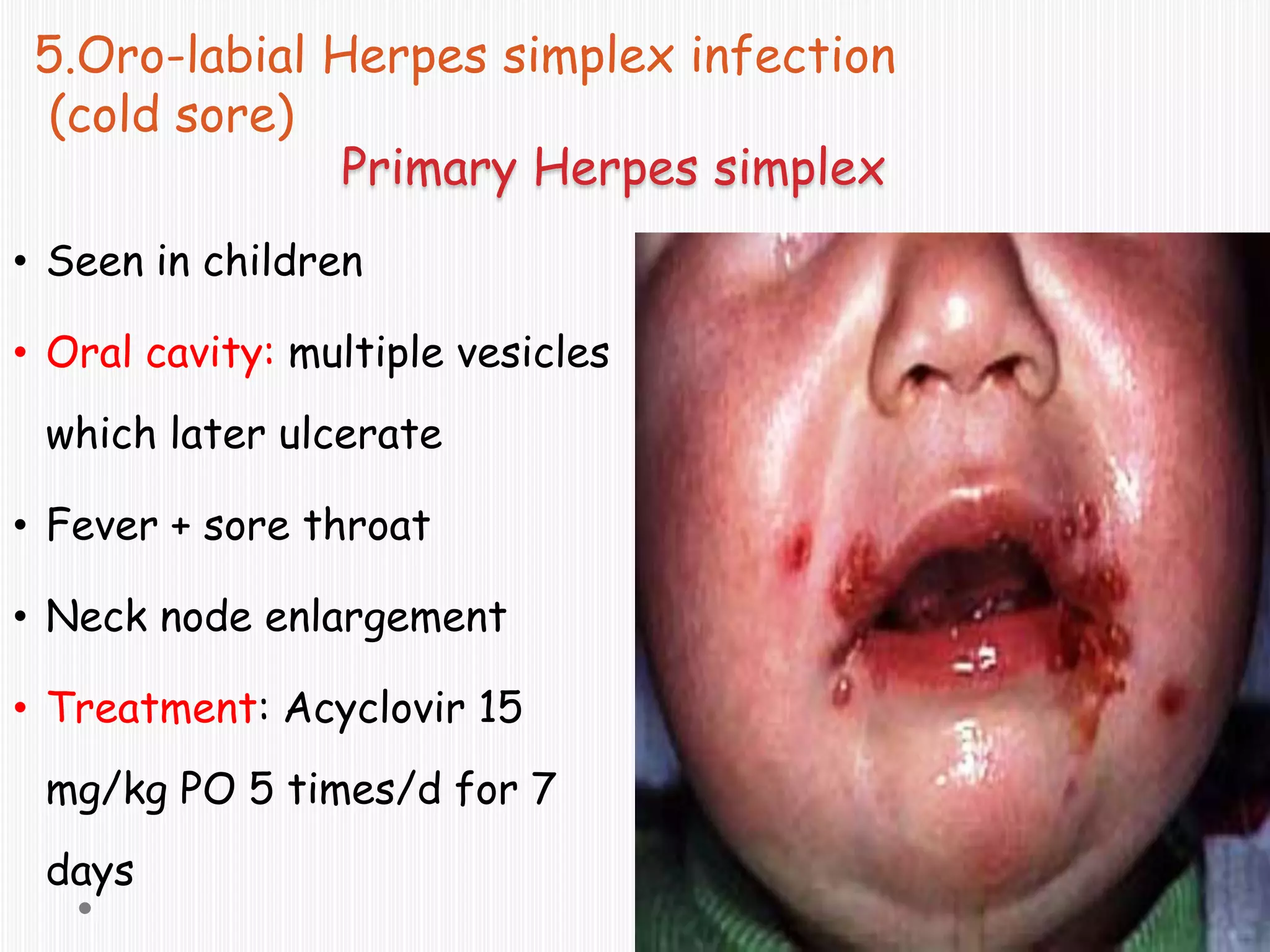
5.Oro-labial Herpes simplex infection
(cold sore)
Primary Herpes simplex
• Seen in children

• Oral cavity: multiple vesicles
which later ulcerate
• Fever + sore throat
• Neck node enlargement
• Treatment: Acyclovir 15

mg/kg PO 5 times/d for 7
days
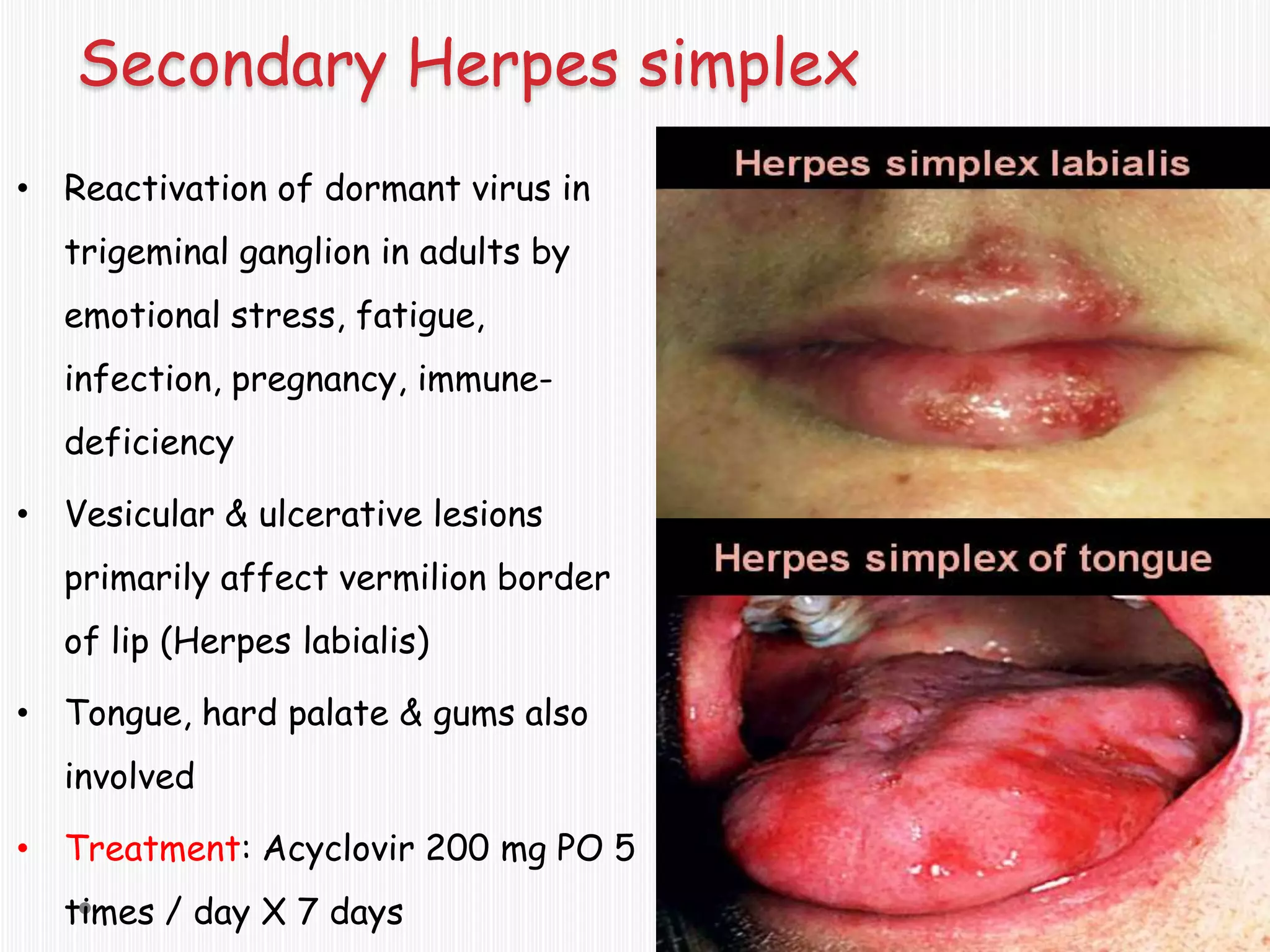
Secondary Herpes simplex
• Reactivation of dormant virus in
trigeminal ganglion in adults by
emotional stress, fatigue,
infection, pregnancy, immunedeficiency
• Vesicular & ulcerative lesions
primarily affect vermilion border
of lip (Herpes labialis)
• Tongue, hard palate & gums also

involved
• Treatment: Acyclovir 200 mg PO 5
times / day X 7 days
Other Bacterial Infections

Syphilis

A-Ulcerated chancre

B-Ulcerated mucous
patches (snail track ulcers)

Tuberculosis of
The Tongue

C-Gummatous ulcer
6.Trauma:
CHEEK BITING

ILL-FITTING DENTURES

CHEMICAL BURNS

ABRASIONS FROM TEETH
7.Infectious mononucleosis
(glandular fever)
Caused by Epstein Barr virus
Spreads only by intimate contact
(kissing disease)
C/F:

1. fever, fatigue, malaise
2. pharyngitis, palatal petechiae

3. ulcer-membranous lesions
over tonsils
4. neck lymph node enlargement
5. hepatomegaly & splenomegaly
•

INVESTIGATIONS

•

Total count: leukocytosis

•

Differential count: lymphocytosis + monocytosis

•

Peripheral blood smear: atypical lymphocytes

•

Paul Bunnel test (with sheep RBC): positive

•

Monospot test (with horse RBC): positive Sensitivity 85%,
specificity 100%

•

TREATMENT

•

Symptomatic:Bed rest. Paracetamol for fever

•

Steroids + tracheostomy for stridor

•

Valacyclovir (1000 mg BD – TID X 7 d) is effective

•

Avoid aspirin in children - Reye syndrome (fattY liver +
encephalopathy)
8.Submucosal fibrosis
• Chronic pre-malignant disease of oral cavity, characterized
by juxta-epithelial inflammation + progressive fibrosis of
lamina propria & deeper connective tissues, followed by
stiffening of mucosa resulting in difficulty in mouth opening
• ETIOLOGY (MULTI-FACTORIAL)
1. Areca nut (betel nut) chewing
2. Tobacco & Paan masala chewing
3. Genetic predisposition
4. Auto-immune injury
5. Nutritional deficiency of vitamins,
iron, anti-oxidants
6. Excessive alcohol consumption
PRESENTING SYMPTOMS
•

Burning pain on consumption of spicy food

• Dryness of mouth
• Impaired mouth movements while eating & talking

• Progressive inability to open the mouth (trismus)
•This patient has so much of limitation in opening of mouth
that it is difficult to put even 2 fingers in the mouth
• Hearing loss (stenosis of Eustachian tubes)
• Nasal intonation ( ed soft palate mobility)
•STAGES
1.

Stage of stomatitis: red mucosa

vesicles

2.

Stage

blanching

of

fibrosis

(healing):

rupture to form mucosal ulcers
of

mucosafibrous

bands

in

trismus, deceased soft palate mobility
3.

Stage of sequelae: difficult speech, hearing loss,leukoplakia, malignancy (3 - 8 %)

oral

mucosa,
MEDICAL TREATMENT
1.

SURGICAL TREATMENT

Bi-weekly submucosal intralesional injections of
for 6-

8 wks
2.

Submucosal injection of human
placental extract

3. Vitamin B complex + anti-oxidant
supplement
4. Increased intake of fruits &
vegetables

Simple

release

of

fibrous

bands + skin grafting

Dexamethasone 4 mg +
Hyaluronidase 1500 IU

1.

2. Laser-assisted

release

of

fibrous bands
3. Excision

of

lesions

&

reconstruction with:buccal fat
pad,

naso-labial

flap,

palatal

flap,lingual

muco-periosteal

flap, radial forearm flap

4. Temporalis muscle myotomy +
mandibular coronoidectomy
9.Leukoplakia
Definition: pre-malignant condition with white patch or plaque that cannot be
rubbed off with gauze swab & cannot be characterized clinically or pathologically
as any other disease

Malignant transformation: 1 - 20% (average 5 %)
Sites: Buccal mucosa, tongue, lips, palate, floor of mouth, gingiva, alveolar mucosa
ETIOLOGY

1.

Chronic smoking

2. Chronic tobacco chewing
3. Irritation from jagged teeth or ill-fitting dentures
4. Chronic alcohol consumption
5. Sun exposure to lips
6. Associated with: submucous fibrosis, hyperplastic candidiasis, Plummer-Vinson
syndrome, AIDS
TYPES
1. Homogeneous leukoplakia:
smooth,white

2. Nodular leukoplakia: nodular, white
3. Verrucous leukoplakia: warty, white

Malignant potential:

4. Speckled (erythro) leukoplakia:
white + red

speckled >> nodular & verrucous >> homogenous
INVESTIGATIONS

TREATMENT

1. Supra-vital staining /

1.

Ora-screen: Toluidine
blue solution stains

areas of malignancy
2. Biopsy: to rule out

malignancy

Removal of causative
agent

2. Supplement: Vitamin A
(beta-carotene), C, E, B12,
folic acid.
3. Surgical excision: if HPE
shows dysplasia.
Surgical excision modalities:
cold knife, cryosurgery, laser
surgery
10.Erythroplakia
Definition:

pre-malignant

condition

with red patch or plaque that cannot
be rubbed off with gauze swab &
cannot be characterized clinically or
pathologically as any other disease
o Red

colour

due

to

vascular

submucosal tissue shining through
under-keratinized mucosa
o Malignant potential: 17 times >
leukoplakia
o Treatment : excision biopsy
11.Oral lichen planus
Etiology: unknown (? hypersensitivity reaction)
Types of oral lichen planus:

SKIN LESIONS: purple, polygonal, pruritic papules
TREATMENT: Reticular & plaque types: no treatment required
Erosive type: topical or systemic steroids
12.Stevens - Johnson
syndrome
ETIOLOGY
• Severe form of Erythema
multiforme
• Minor form of Toxic Epidermal
Necrolysis involving < 10 % of body
surface area
• Muco-cutaneous, immune-complex–
mediated hypersensitivity disorder

causing separation of epidermis
from dermis

• Idiopathic: 25 - 50 % cases
• Drug reaction: Penicillin,
Sulfonamides, Macrolide,
Ciprofloxacin, Phenytoin,
Carbamazepine, Valproate,
Lamotrigine, NSAIDs,
Valdecoxib, Allopurinol
• Viral infection: herpes
simplex, HIV, influenza
• Malignancy: carcinoma,
lymphoma
Symptomatic Treatment
• Airway stability, fluid replacement,
electrolyte correction, wound

cared as burns & pain control
• Underlying diseases & infections
treated
• Offending drugs must be stopped
• Local anesthetics & mouthwashes
for oral lesions
• Steroids use is controversial.
Cyclophosphamide, cyclosporine &
I.V. immunoglobulin are used.
13.Black hairy
tongue

Elongated filiform papillae
on tongue due to excess
keratin formation.
Become infected with chromogenic
bacteria & look like hairs.
• Etiology: smoking
• Treatment : scraping of tongue

14.Nicotinic stomatitis
•

Seen in pipe smokers & reverse
smokers

•

Cobblestone mucosa of postr hard

palate, with red dot in center
•

treatment: smoking cessation
15.ORAL CANCER

 Squamous Cell Carcinoma constitutes 95% of oral cancers
 Common in Old Men (50-60 years)
 COMMON SITES :

1.
2.
3.
4.

1.

2.
3.
4,
5.

Lip (lower lip)
Tongue (anterior ⅔)
Mouth floor
Tonsil and Fauces
AETIOLOGY:
Tobacco and alcohol are the most common associations:
Smokers can have 15-fold greater risk ( than nonsmokers ) of malignancy.
Chewing tobacco and betel nuts are important causes in India and parts of Asia
Leukoplakia and Erythroplakia
Human papilloma virus (HPV) (type16)
Genetic factors may also play a role
(deletions in chromosomes 18q, 8p, and 3p are implicated).
Exposure to ultra-violet light (cancer of the lip).
Squamous cell ca. of lip

Squamous Cell carcinoma of the
Tongue
Uncommon Malignant Tumors of
The Oral Cavity
Malignant melanoma
Lymphomas
Leukemic infiltration
Adenocarcinoma of minor
salivary glands
• Sarcomas
•
•
•
•

Acute Leukemia: gum involvement
JOURNAL PROPER
INTRODUCTION
• Very often the oral dermatological conditions
involving oral cavity are misdiagnosed and proper
attention and care is not given.
• This study is to sensitize the clinicians to the
prevailing situation of oral dermatological conditions.
MATERIALS & METHODS

• A total of 150 cases were
taken up for the study
irrespective of
age,sex,duration of lesions
attending dermatology/ENT
dept. during 1 year period.
• The following areas were
taken into consideration:
1. Site of lesion
2. Morphology
3. Extent of lesion
4. Discharge if any
5. Margins of lesion
6. Floor and base of lesion
7. Regional lymphnodes if any

• Investigations done are:
1. Routine blood,urine and
stool tests
2. Scrapings,KOH mount
3. Tzank test
4. Gram stains
5. Biopsy for certain
cases.
6. Special tests were done
for systemic diseases
if indicated
OBSERVATIONS

AGE DISTRIBUTION

AGE(yr.)

MALE

FEMALE

TOTAL

% (out of
150)

0-10

4

4

8

5.33%

11-20

12

20

32

21.33%

21-30

13

22

35

23.34%

31-40

13

24

37

24.67%

41-50

9

14

23

15.33%

>50

9

6

15

10.00%

TOTAL

60

90

150
AGE AND SEX DISTRIBUTION
30

PATIENTS

25
20

20

15
12

NO.

OF

10
5

22

13

24

13

MALE

14
9

female
9
6

4

0
0--10

11--20

AGE IN YEARS

21--30

31--40

41--50

>50
DISEASES WITH ORAL MANIFESTATIONS
DISEASES

NO.OF PATIENTS

% OUT OF 150

Aphthous ulcer

16

28.57%

Oral candidiasis

9

16.07%

Angular chelitis

6

10.71%

Oral leukoplakia

4

7.14%

Fixed drug eruption

4

7.14%

Squamous cell ca.

3

5.36%

Fordyce spot

2

3.57%

Herpes simplex stomatitis

2

3.57%

Oral sub mucosal fibrosis

6

10.71%

Mucocele

2

3.57%

Leukemia

1

1.79%

Warts

1

1.79%

Scrotal tongue

1

1.79%
DISCUSSION

• Pt.s having oral diseases
presents with different signs
and symptoms like
Oral pain,soreness,burning,
xerostomia,bleeding, swelling,
change ofcolour,erosion,crusting,
Ulcers,fissuring
• The study has recorded 25 pt.s
of pemphigus vulgaris having
both cutaneous manifestations,
revealing that this is the
common lesion.
• The study shows that buccal
mucosa was the most commonly
affected site(68%),followed by
palates(56%),lips(44%),tongue(
40%),labial mucosa(16%).

pemphigus vulgaris
• Collagen diseases form the next common group. Among this
systemic lupus erythematosus is major one, and most of the
lesions are confined to palate.
• The study recorded 13 cases of discoid lupus
erythematosus,with lips being the commonest site.
• Among the specific cutaneous disorders,16 cases of recurrent
aphthous stomatits have been recorded,with labial mucosa
being common site.,and most common one was minor type.
• 12 pts of lichen planus were recorded with lip&cheek being
common sites, and common in age group of 20-40.
• Infective disorders constitute 10% of study with candidiasis
being common one.common site of involvement is dorsal tongue.
• The study also recorded 6 cases of oral submucosal fibrosis
with cheeks(buccal mucosa) being common site.
• 4 pts of oral leukoplakia have been recorded with buccal
mucosa being common site of involvement.
• 6 pts of angular stomatitis have been recorded with lesions on
lips and buccal mucosa..
Diseases with oral and cutaneous
manifestations
DISEASES

NO.OF PTS.

% OUT OF 94

Pemphigus vulgaris

25

26.60%

Pemphigus vegetans

2

2.13%

Stevens Johnson's syndrome

8

8.15%

Toxix epidermal necrosis

4

4.26%

Erythema multiforme

1

1.06%

Discoid lupus erythematosus

13

13.83%

Systemic lupus erythematosus

16

17.02%

Systemic sclerosis

6

6.38%

Lichen planus

12

12.77%

Vitiligo

6

6.38%
Pie diagram showing distribution of

lesions

37.33

62.67

ORAL LESIONS
ORAL&CUTANEOUS
LESIONS
CONCLUSIONS
• Oral mucous membrane alone may be involved in some
disesases,but it is often missed by clinician.
• This can be taken care of by primary health care
providers without going through much sophisticated
investigations and thus early intervention for
patients.
BIBLIOGRAPHY
• INDIAN JOURNAL OF OTOLARYNGOLOGY AND
HEAD &NECK SURGERY(apr-june 2013)
• SCOTT&BROWN 6TH EDITION
• TEXT BOOK OF DERMATOLOGY BY NEENA
KHANNA
• Next academic session:
18-11-13-MONDAY
CASE PRESENTATION BY

Dr.SUSRUTHA
Thank you

common oral lesions by ravindra daggupati

  • 1.
  • 2.
    Anatomy: Oral cavity •Oral cavity o Lips o Tongue o Floor of Mouth o Buccal mucosa o Palate o Retromolar trigone
  • 3.
    Common diseases oforal cavity Sub-mucous fibrosis Aphthous ulcer Leukoplakia Erythroplakia Oral candidiasis Oro-labial Herpes Vincent’s infection Infectious mononucleosis Tongue tie Geographic tongue Ranula Mucocoele
  • 4.
    1.Aphthous ulcer INTRODUCTION • Recurrent,superficial ulcers, with necrotic centre + red margin, involving movable mucosa of inner surface of lips, cheeks, tongue & soft palate  Differences from viral ulcer 1. Frequent recurrence 2. Selective involvement of movable mucosa 3. Absence of fever, malaise, lymph node enlargement
  • 5.
    1. Minor aphthousulcer: 2 – 10 mm in size, multiple, heal with no scar in 1 - 2 weeks
  • 6.
    2. Major aphthousulcer: 20 – 40 mm in size, usually single, heal with scar over months Rule out HIV & malignancy
  • 7.
    3. Herpetiform aphthousulcer: < 1 mm in size, multiple, heal with no scar in 1 week
  • 8.
    TREATMENT 1. Avoid triggerfactors 2. Supplement: vitamin B complex + folic acid + iron 3. Topical gel combination: a. steroid: triamcinolone b. antibiotic: chlorhexidine, metronidazole, benzalkonium, cetalkonium, tannic acid c. analgesic: benzydamine, choline salicylate d. anesthetic: lignocaine, benzocaine 4. Mouth rinse: betamethasone, tetracycline 5. Immuno-modulator: thalidomide 50 -100 mg daily
  • 9.
    2.Behcet’s syndrome • Uveitis+ Aphthous ulcer + Genital ulcer • Oculo – Oro - Genital syndrome • Treatment : steroid
  • 10.
    3.Oral candidiasis • Etiology:Infection with Candida albicans • Predisposing factors: 1. Chronic ill-health 2. Uncontrolled diabetes mellitus 3. Acquired immune deficiency syndrome 4. Prolonged use of steroids 5. Prolonged antibiotic therapy 6. Immuno-suppressant therapy (cyclosporine) 7. Anti-cancer chemotherapy
  • 11.
    TYPES 1.Chronic hyperplastic: whiteplaques, cannot be removed by scraping (Candidal leukoplakia)
  • 12.
    2.Pseudo-membranous: loosely adherentwhite lesions, can be scraped off leaving red patches
  • 13.
  • 14.
    4.Cheilitis: white lesionson angle of mouth
  • 15.
    DIAGNOSIS 1. Microscopic examof wet smear on KOH mount: look for pseudohyphae 2. Culture (Sabouraud dextrose agar): white colony TREATMENT 1. Clotrimazole paint, Nystatin mouthwash 2. Systemic chronic cases Fluconazole: for 3. Excision of hyperplastic plaque 4. Correction of underlying cause
  • 16.
    4.Vincent’s infection (AcuteNecrotizing Ulcerative Gingivitis or Trench mouth) Etiology: infection with spirochete Borrelia vincenti & Gram –ve anaerobe Bacillus fusiformis Predisposing factors: • Poor general health • Poor oro-dental hygiene • Dental caries CLINICAL FEATURES 1. Painful, ulcerative lesions covered by necrotic membrane present over:  inter-dental papillae & spreading toward free gum margins (acute necrotizing ulcerative gingivitis)  tonsils (Vincent’s angina) 2. Halitosis, neck lymph node enlargement & fever
  • 17.
  • 18.
     Diagnosis Smear stainedwith Gentian violet to identify Borrelia vincenti & Bacillus fusiformis  Treatment 1. Systemic Benzylpenicillin / Erythromycin 2. Systemic Metronidazole / Clindamycin 3. Betadine mouthwash & H2O2 gargle 4. Dental care & bed rest
  • 19.
    5.Oro-labial Herpes simplexinfection (cold sore) Primary Herpes simplex • Seen in children • Oral cavity: multiple vesicles which later ulcerate • Fever + sore throat • Neck node enlargement • Treatment: Acyclovir 15 mg/kg PO 5 times/d for 7 days
  • 20.
    Secondary Herpes simplex •Reactivation of dormant virus in trigeminal ganglion in adults by emotional stress, fatigue, infection, pregnancy, immunedeficiency • Vesicular & ulcerative lesions primarily affect vermilion border of lip (Herpes labialis) • Tongue, hard palate & gums also involved • Treatment: Acyclovir 200 mg PO 5 times / day X 7 days
  • 21.
    Other Bacterial Infections Syphilis A-Ulceratedchancre B-Ulcerated mucous patches (snail track ulcers) Tuberculosis of The Tongue C-Gummatous ulcer
  • 22.
  • 23.
    7.Infectious mononucleosis (glandular fever) Causedby Epstein Barr virus Spreads only by intimate contact (kissing disease) C/F: 1. fever, fatigue, malaise 2. pharyngitis, palatal petechiae 3. ulcer-membranous lesions over tonsils 4. neck lymph node enlargement 5. hepatomegaly & splenomegaly
  • 24.
    • INVESTIGATIONS • Total count: leukocytosis • Differentialcount: lymphocytosis + monocytosis • Peripheral blood smear: atypical lymphocytes • Paul Bunnel test (with sheep RBC): positive • Monospot test (with horse RBC): positive Sensitivity 85%, specificity 100% • TREATMENT • Symptomatic:Bed rest. Paracetamol for fever • Steroids + tracheostomy for stridor • Valacyclovir (1000 mg BD – TID X 7 d) is effective • Avoid aspirin in children - Reye syndrome (fattY liver + encephalopathy)
  • 25.
    8.Submucosal fibrosis • Chronicpre-malignant disease of oral cavity, characterized by juxta-epithelial inflammation + progressive fibrosis of lamina propria & deeper connective tissues, followed by stiffening of mucosa resulting in difficulty in mouth opening • ETIOLOGY (MULTI-FACTORIAL) 1. Areca nut (betel nut) chewing 2. Tobacco & Paan masala chewing 3. Genetic predisposition 4. Auto-immune injury 5. Nutritional deficiency of vitamins, iron, anti-oxidants 6. Excessive alcohol consumption
  • 26.
    PRESENTING SYMPTOMS • Burning painon consumption of spicy food • Dryness of mouth • Impaired mouth movements while eating & talking • Progressive inability to open the mouth (trismus) •This patient has so much of limitation in opening of mouth that it is difficult to put even 2 fingers in the mouth • Hearing loss (stenosis of Eustachian tubes) • Nasal intonation ( ed soft palate mobility) •STAGES 1. Stage of stomatitis: red mucosa vesicles 2. Stage blanching of fibrosis (healing): rupture to form mucosal ulcers of mucosafibrous bands in trismus, deceased soft palate mobility 3. Stage of sequelae: difficult speech, hearing loss,leukoplakia, malignancy (3 - 8 %) oral mucosa,
  • 27.
    MEDICAL TREATMENT 1. SURGICAL TREATMENT Bi-weeklysubmucosal intralesional injections of for 6- 8 wks 2. Submucosal injection of human placental extract 3. Vitamin B complex + anti-oxidant supplement 4. Increased intake of fruits & vegetables Simple release of fibrous bands + skin grafting Dexamethasone 4 mg + Hyaluronidase 1500 IU 1. 2. Laser-assisted release of fibrous bands 3. Excision of lesions & reconstruction with:buccal fat pad, naso-labial flap, palatal flap,lingual muco-periosteal flap, radial forearm flap 4. Temporalis muscle myotomy + mandibular coronoidectomy
  • 28.
    9.Leukoplakia Definition: pre-malignant conditionwith white patch or plaque that cannot be rubbed off with gauze swab & cannot be characterized clinically or pathologically as any other disease Malignant transformation: 1 - 20% (average 5 %) Sites: Buccal mucosa, tongue, lips, palate, floor of mouth, gingiva, alveolar mucosa ETIOLOGY 1. Chronic smoking 2. Chronic tobacco chewing 3. Irritation from jagged teeth or ill-fitting dentures 4. Chronic alcohol consumption 5. Sun exposure to lips 6. Associated with: submucous fibrosis, hyperplastic candidiasis, Plummer-Vinson syndrome, AIDS
  • 29.
    TYPES 1. Homogeneous leukoplakia: smooth,white 2.Nodular leukoplakia: nodular, white
  • 30.
    3. Verrucous leukoplakia:warty, white Malignant potential: 4. Speckled (erythro) leukoplakia: white + red speckled >> nodular & verrucous >> homogenous
  • 31.
    INVESTIGATIONS TREATMENT 1. Supra-vital staining/ 1. Ora-screen: Toluidine blue solution stains areas of malignancy 2. Biopsy: to rule out malignancy Removal of causative agent 2. Supplement: Vitamin A (beta-carotene), C, E, B12, folic acid. 3. Surgical excision: if HPE shows dysplasia. Surgical excision modalities: cold knife, cryosurgery, laser surgery
  • 32.
    10.Erythroplakia Definition: pre-malignant condition with red patchor plaque that cannot be rubbed off with gauze swab & cannot be characterized clinically or pathologically as any other disease o Red colour due to vascular submucosal tissue shining through under-keratinized mucosa o Malignant potential: 17 times > leukoplakia o Treatment : excision biopsy
  • 33.
    11.Oral lichen planus Etiology:unknown (? hypersensitivity reaction) Types of oral lichen planus: SKIN LESIONS: purple, polygonal, pruritic papules TREATMENT: Reticular & plaque types: no treatment required Erosive type: topical or systemic steroids
  • 34.
    12.Stevens - Johnson syndrome ETIOLOGY •Severe form of Erythema multiforme • Minor form of Toxic Epidermal Necrolysis involving < 10 % of body surface area • Muco-cutaneous, immune-complex– mediated hypersensitivity disorder causing separation of epidermis from dermis • Idiopathic: 25 - 50 % cases • Drug reaction: Penicillin, Sulfonamides, Macrolide, Ciprofloxacin, Phenytoin, Carbamazepine, Valproate, Lamotrigine, NSAIDs, Valdecoxib, Allopurinol • Viral infection: herpes simplex, HIV, influenza • Malignancy: carcinoma, lymphoma
  • 35.
    Symptomatic Treatment • Airwaystability, fluid replacement, electrolyte correction, wound cared as burns & pain control • Underlying diseases & infections treated • Offending drugs must be stopped • Local anesthetics & mouthwashes for oral lesions • Steroids use is controversial. Cyclophosphamide, cyclosporine & I.V. immunoglobulin are used.
  • 36.
    13.Black hairy tongue Elongated filiformpapillae on tongue due to excess keratin formation. Become infected with chromogenic bacteria & look like hairs. • Etiology: smoking • Treatment : scraping of tongue 14.Nicotinic stomatitis • Seen in pipe smokers & reverse smokers • Cobblestone mucosa of postr hard palate, with red dot in center • treatment: smoking cessation
  • 37.
    15.ORAL CANCER  SquamousCell Carcinoma constitutes 95% of oral cancers  Common in Old Men (50-60 years)  COMMON SITES : 1. 2. 3. 4.  1. 2. 3. 4, 5. Lip (lower lip) Tongue (anterior ⅔) Mouth floor Tonsil and Fauces AETIOLOGY: Tobacco and alcohol are the most common associations: Smokers can have 15-fold greater risk ( than nonsmokers ) of malignancy. Chewing tobacco and betel nuts are important causes in India and parts of Asia Leukoplakia and Erythroplakia Human papilloma virus (HPV) (type16) Genetic factors may also play a role (deletions in chromosomes 18q, 8p, and 3p are implicated). Exposure to ultra-violet light (cancer of the lip).
  • 38.
    Squamous cell ca.of lip Squamous Cell carcinoma of the Tongue
  • 39.
    Uncommon Malignant Tumorsof The Oral Cavity Malignant melanoma Lymphomas Leukemic infiltration Adenocarcinoma of minor salivary glands • Sarcomas • • • • Acute Leukemia: gum involvement
  • 40.
  • 41.
    INTRODUCTION • Very oftenthe oral dermatological conditions involving oral cavity are misdiagnosed and proper attention and care is not given. • This study is to sensitize the clinicians to the prevailing situation of oral dermatological conditions.
  • 42.
    MATERIALS & METHODS •A total of 150 cases were taken up for the study irrespective of age,sex,duration of lesions attending dermatology/ENT dept. during 1 year period. • The following areas were taken into consideration: 1. Site of lesion 2. Morphology 3. Extent of lesion 4. Discharge if any 5. Margins of lesion 6. Floor and base of lesion 7. Regional lymphnodes if any • Investigations done are: 1. Routine blood,urine and stool tests 2. Scrapings,KOH mount 3. Tzank test 4. Gram stains 5. Biopsy for certain cases. 6. Special tests were done for systemic diseases if indicated
  • 43.
    OBSERVATIONS AGE DISTRIBUTION AGE(yr.) MALE FEMALE TOTAL % (outof 150) 0-10 4 4 8 5.33% 11-20 12 20 32 21.33% 21-30 13 22 35 23.34% 31-40 13 24 37 24.67% 41-50 9 14 23 15.33% >50 9 6 15 10.00% TOTAL 60 90 150
  • 44.
    AGE AND SEXDISTRIBUTION 30 PATIENTS 25 20 20 15 12 NO. OF 10 5 22 13 24 13 MALE 14 9 female 9 6 4 0 0--10 11--20 AGE IN YEARS 21--30 31--40 41--50 >50
  • 45.
    DISEASES WITH ORALMANIFESTATIONS DISEASES NO.OF PATIENTS % OUT OF 150 Aphthous ulcer 16 28.57% Oral candidiasis 9 16.07% Angular chelitis 6 10.71% Oral leukoplakia 4 7.14% Fixed drug eruption 4 7.14% Squamous cell ca. 3 5.36% Fordyce spot 2 3.57% Herpes simplex stomatitis 2 3.57% Oral sub mucosal fibrosis 6 10.71% Mucocele 2 3.57% Leukemia 1 1.79% Warts 1 1.79% Scrotal tongue 1 1.79%
  • 46.
    DISCUSSION • Pt.s havingoral diseases presents with different signs and symptoms like Oral pain,soreness,burning, xerostomia,bleeding, swelling, change ofcolour,erosion,crusting, Ulcers,fissuring • The study has recorded 25 pt.s of pemphigus vulgaris having both cutaneous manifestations, revealing that this is the common lesion. • The study shows that buccal mucosa was the most commonly affected site(68%),followed by palates(56%),lips(44%),tongue( 40%),labial mucosa(16%). pemphigus vulgaris
  • 47.
    • Collagen diseasesform the next common group. Among this systemic lupus erythematosus is major one, and most of the lesions are confined to palate. • The study recorded 13 cases of discoid lupus erythematosus,with lips being the commonest site. • Among the specific cutaneous disorders,16 cases of recurrent aphthous stomatits have been recorded,with labial mucosa being common site.,and most common one was minor type. • 12 pts of lichen planus were recorded with lip&cheek being common sites, and common in age group of 20-40. • Infective disorders constitute 10% of study with candidiasis being common one.common site of involvement is dorsal tongue. • The study also recorded 6 cases of oral submucosal fibrosis with cheeks(buccal mucosa) being common site. • 4 pts of oral leukoplakia have been recorded with buccal mucosa being common site of involvement. • 6 pts of angular stomatitis have been recorded with lesions on lips and buccal mucosa..
  • 48.
    Diseases with oraland cutaneous manifestations DISEASES NO.OF PTS. % OUT OF 94 Pemphigus vulgaris 25 26.60% Pemphigus vegetans 2 2.13% Stevens Johnson's syndrome 8 8.15% Toxix epidermal necrosis 4 4.26% Erythema multiforme 1 1.06% Discoid lupus erythematosus 13 13.83% Systemic lupus erythematosus 16 17.02% Systemic sclerosis 6 6.38% Lichen planus 12 12.77% Vitiligo 6 6.38%
  • 49.
    Pie diagram showingdistribution of lesions 37.33 62.67 ORAL LESIONS ORAL&CUTANEOUS LESIONS
  • 50.
    CONCLUSIONS • Oral mucousmembrane alone may be involved in some disesases,but it is often missed by clinician. • This can be taken care of by primary health care providers without going through much sophisticated investigations and thus early intervention for patients.
  • 51.
    BIBLIOGRAPHY • INDIAN JOURNALOF OTOLARYNGOLOGY AND HEAD &NECK SURGERY(apr-june 2013) • SCOTT&BROWN 6TH EDITION • TEXT BOOK OF DERMATOLOGY BY NEENA KHANNA
  • 52.
    • Next academicsession: 18-11-13-MONDAY CASE PRESENTATION BY Dr.SUSRUTHA
  • 53.