Copyright 2003, Elsevier Science (USA). All rights reserved.
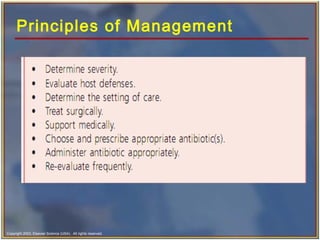
Principles of
Management of
Odontogenic Infections
Fouad Al-Belasy
Copyright 2003, Elsevier Science (USA). All rights reserved.
Disclaimer
 This presentation is based on chapter 16 authored by
Thomas R. Flynn in Hupp JR, et al. (ed. 6). Contemporary
Oral and Maxillofacial Surgery. St Louis, Mosby, 2014.
 Some pictures used in this presentation and their content
have been obtained from a number of other sources. Their
use is purely for academic and teaching purposes.
 This presentation does not have any intended commercial
use. In case the owner of any of the pictures has any
objection and seeks their removal please contact at
albelasy@netscape.net. These pictures will be removed
immediately.
Copyright 2003, Elsevier Science (USA). All rights reserved.
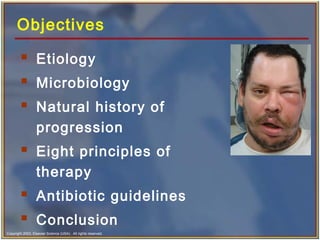
Objectives
 Etiology
 Microbiology
 Natural history of
progression
 Eight principles of
therapy
 Antibiotic guidelines
 Conclusion
Copyright 2003, Elsevier Science (USA). All rights reserved.
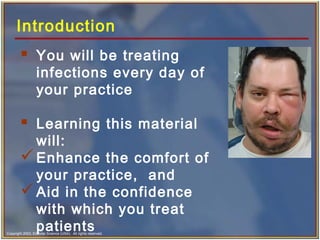
Introduction
 You will be treating
infections every day of
your practice
 Learning this material
will:
Enhance the comfort of
your practice, and
Aid in the confidence
with which you treat
patients
Copyright 2003, Elsevier Science (USA). All rights reserved.
Introduction
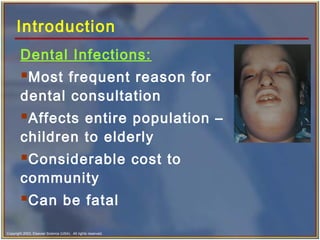
Dental Infections:
Most frequent reason for
dental consultation
Affects entire population –
children to elderly
Considerable cost to
community
Can be fatal
Copyright 2003, Elsevier Science (USA). All rights reserved.
Spectrum of Severity
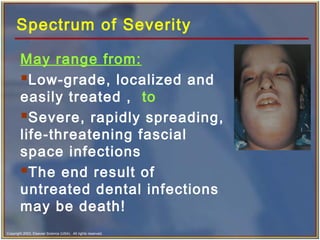
May range from:
Low-grade, localized and
easily treated , to
Severe, rapidly spreading,
life-threatening fascial
space infections
The end result of
untreated dental infections
may be death!
Copyright 2003, Elsevier Science (USA). All rights reserved.
Etiology
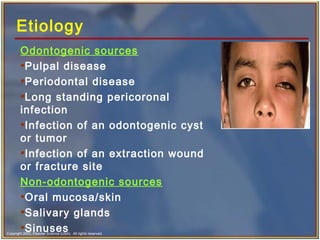
Odontogenic sources
•Pulpal disease
•Periodontal disease
•Long standing pericoronal
infection
•Infection of an odontogenic cyst
or tumor
•Infection of an extraction wound
or fracture site
Non-odontogenic sources
•Oral mucosa/skin
•Salivary glands
•Sinuses
Copyright 2003, Elsevier Science (USA). All rights reserved.
Microbiology
Most infections result from indigenous
bacteria
Primarily aerobic & anaerobic Gram +
cocci, and anaerobic Gram – rods
Most of these bacteria cause common
caries and periodontal disease - become
pathogenic when gaining access to deeper
tissues
Copyright 2003, Elsevier Science (USA). All rights reserved.
Microbiology
 Odontogenic infections are polymicrobial in
nature: multiple bacterial species isolated
• Average 5 species isolated
• Not unusual to identify as many as 8 species
• Rarely a single species isolated
• Both aerobic and anaerobic species isolated
Aerobic 6%
Anaerobic 44%
Mixed aerobic and anaerobic 50%
 Culture techniques must be accurate to identify
all species
Copyright 2003, Elsevier Science (USA). All rights reserved.
Aerobic Bacteria
Most common
Strep. milleri group:
65% of aerobic infections
Miscellaneous:
staph. 5% of aerobic infections
Minor contributors
Gram – cocci (Neisseria)
Gram + rods (Corynebacterium)
Gram – rods (Haemophilus)
Copyright 2003, Elsevier Science (USA). All rights reserved.
Streptococcus Milleri
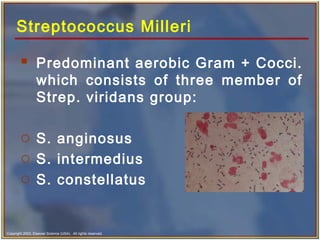
 Predominant aerobic Gram + Cocci.
which consists of three member of
Strep. viridans group:
o S. anginosus
o S. intermedius
o S. constellatus
Copyright 2003, Elsevier Science (USA). All rights reserved.
Anaerobic Bacteria
Most common
Gram + cocci:
Streptococcus and Peptostreptococcus
-75%
Gram – rods:
Prevotella and Porphyromonas spp. 75%
Fusobacteria - 50% of anaerobic
infections
Opportunists with little role
Gram – cocci (Viellonella)
Gram + rods (Actinomyces, Lactobacilli)
Copyright 2003, Elsevier Science (USA). All rights reserved.
Major Pathogens of Dental
Infections
Early Lesions
Streptococcus milleri group
Mature Lesions
Other members of strep. viridans group
Peptostreptococcus
Prevotella
Porphyromonas
Fusobacteria
Hence, aerobic and anaerobic Gram+cocci
and anaerobic Gram-rods play the major
role.
Copyright 2003, Elsevier Science (USA). All rights reserved.
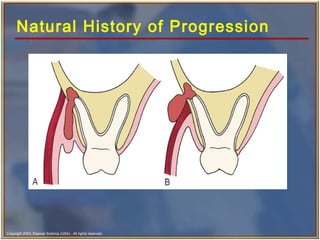
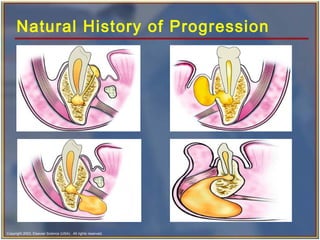
Stages of Infection
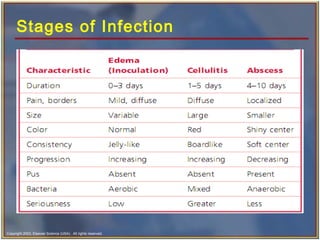
1. Inoculation (edema) stage (0-3 days):
Aerobes inoculate the host resulting in a
soft, doughy, and mildly tender swelling
2. Cellulitis stage (3-5 days): Mixed species
- Intense inflammatory response, hard,
red, exquisitely tender swelling
3. Abscess stage (5-7 days): anaerobes
predominate, liquefied abscess in the
center of a swelling
4. Resolution stage: Spontaneous drainage,
or surgical drainage
Copyright 2003, Elsevier Science (USA). All rights reserved.
Stages of Infection
Copyright 2003, Elsevier Science (USA). All rights reserved.
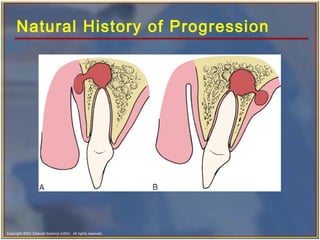
Natural History of Progression
Copyright 2003, Elsevier Science (USA). All rights reserved.
Natural History of Progression
Copyright 2003, Elsevier Science (USA). All rights reserved.
Natural History of Progression
Copyright 2003, Elsevier Science (USA). All rights reserved.
Principles of Management
Copyright 2003, Elsevier Science (USA). All rights reserved.
1. Determine Severity of
Infection
 Most odontogenic infections are mild
and require only minor surgical therapy
 Determination of severity is based on:
• Complete history of the current
infection
• Physical examination
Copyright 2003, Elsevier Science (USA). All rights reserved.
1. Determine Severity of Infection
(cont’d)
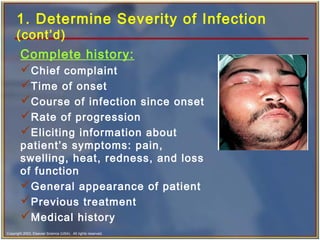
Complete history:
Chief complaint
Time of onset
Course of infection since onset
Rate of progression
Eliciting information about
patient’s symptoms: pain,
swelling, heat, redness, and loss
of function
General appearance of patient
Previous treatment
Medical history
Copyright 2003, Elsevier Science (USA). All rights reserved.
1. Determine Severity of Infection
(cont’d)
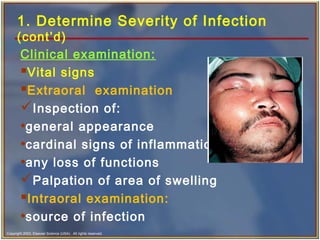
Clinical examination:
Vital signs
Extraoral examination
Inspection of:
•general appearance
•cardinal signs of inflammation
•any loss of functions
Palpation of area of swelling
Intraoral examination:
•source of infection
Copyright 2003, Elsevier Science (USA). All rights reserved.
1. Determine Severity of Infection
(cont’d)
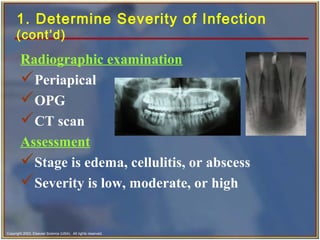
Radiographic examination
Periapical
OPG
CT scan
Assessment
Stage is edema, cellulitis, or abscess
Severity is low, moderate, or high
Copyright 2003, Elsevier Science (USA). All rights reserved.
2. Evaluate Host Defenses
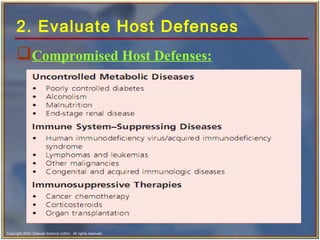
Compromised Host Defenses:
Copyright 2003, Elsevier Science (USA). All rights reserved.
3. Determine the Setting of Care
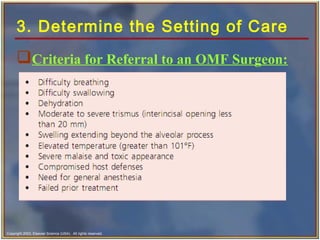
Criteria for Referral to an OMF Surgeon:
Copyright 2003, Elsevier Science (USA). All rights reserved.
3. Determine the Setting of Care
(cont’d)
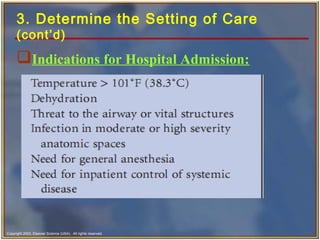
Indications for Hospital Admission:
Copyright 2003, Elsevier Science (USA). All rights reserved.
3. Determine the Setting of Care
(cont’d)
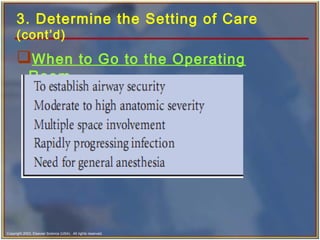
When to Go to the Operating
Room
Copyright 2003, Elsevier Science (USA). All rights reserved.
4. Treat Infection Surgically
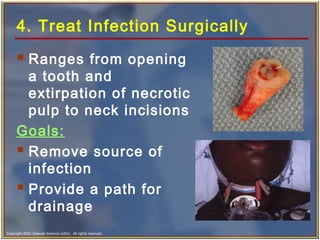
 Ranges from opening
a tooth and
extirpation of necrotic
pulp to neck incisions
Goals:
 Remove source of
infection
 Provide a path for
drainage
Copyright 2003, Elsevier Science (USA). All rights reserved.
4. Treat Infection Surgically (cont’d)
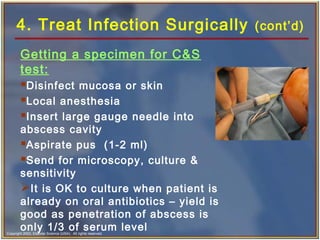
Getting a specimen for C&S
test:
Disinfect mucosa or skin
Local anesthesia
Insert large gauge needle into
abscess cavity
Aspirate pus (1-2 ml)
Send for microscopy, culture &
sensitivity
It is OK to culture when patient is
already on oral antibiotics – yield is
good as penetration of abscess is
only 1/3 of serum level
Copyright 2003, Elsevier Science (USA). All rights reserved.
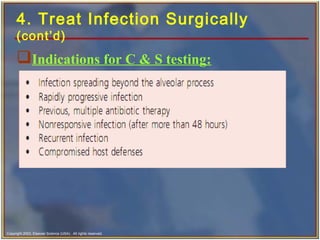
4. Treat Infection Surgically
(cont’d)
Indications for C & S testing:
Copyright 2003, Elsevier Science (USA). All rights reserved.
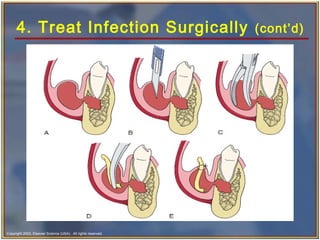
4. Treat Infection Surgically (cont’d)
Copyright 2003, Elsevier Science (USA). All rights reserved.
5. Support Patient Medically
 Host systemic resistance must be
considered in 3 areas:
 Immune system compromise
 Control of systemic diseases:
o Hypertension, dysrhythmias, med.
warfarin
 Physiologic reserves
 Fever elevation by 1∘
F per day
Increases:
• Daily fluid requirements by 800ml/∘
F/day
• Caloric requirements by 3% - 5% /∘
F/day
Copyright 2003, Elsevier Science (USA). All rights reserved.
5. Support Patient Medically
(cont’d)
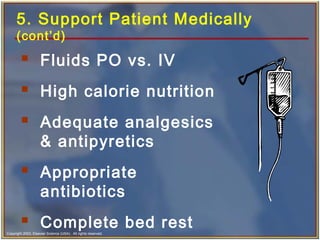
 Fluids PO vs. IV
 High calorie nutrition
 Adequate analgesics
& antipyretics
 Appropriate
antibiotics
 Complete bed rest
Copyright 2003, Elsevier Science (USA). All rights reserved.
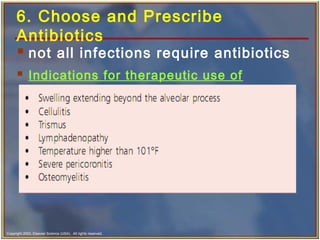
6. Choose and Prescribe
Antibiotics
 not all infections require antibiotics
 Indications for therapeutic use of
antibiotics:
Copyright 2003, Elsevier Science (USA). All rights reserved.
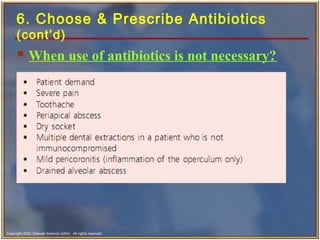
6. Choose & Prescribe Antibiotics
(cont’d)
 When use of antibiotics is not necessary?
Copyright 2003, Elsevier Science (USA). All rights reserved.
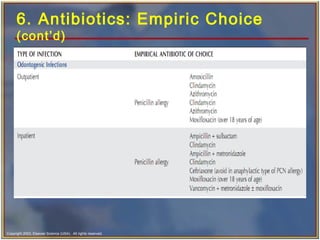
6. Antibiotics: Empiric Choice
(cont’d)
Odontogenic infections generally
caused by predictable group of bacteria
An antibiotic is prescribed empirically
i.e. on the basis that an appropriate
antibiotic is being given
Routine culture & sensitivity testing is
not cost-effective
Copyright 2003, Elsevier Science (USA). All rights reserved.
6. Antibiotics: Empiric Choice
(cont’d)
Copyright 2003, Elsevier Science (USA). All rights reserved.
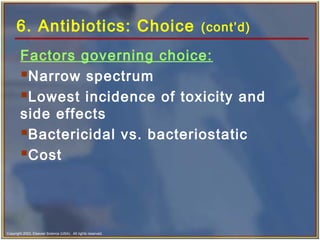
6. Antibiotics: Choice (cont’d)
Factors governing choice:
Narrow spectrum
Lowest incidence of toxicity and
side effects
Bactericidal vs. bacteriostatic
Cost
Copyright 2003, Elsevier Science (USA). All rights reserved.
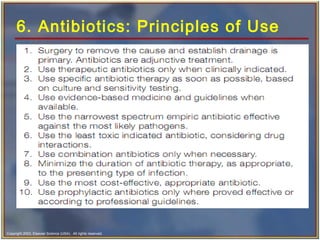
6. Antibiotics: Principles of Use
Copyright 2003, Elsevier Science (USA). All rights reserved.
7. Administer Antibiotic
Properly
Proper dose
Peak plasma level of antibiotic should be
4-5 times the MIC for bacteria involved in
infection
Proper dose interval
Interval is 4 times the t ½ life of
antibiotic
Proper route !
Proper duration !
Copyright 2003, Elsevier Science (USA). All rights reserved.
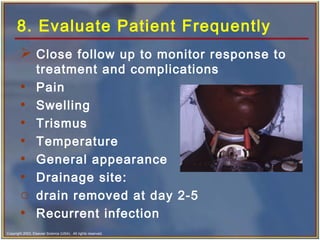
8. Evaluate Patient Frequently
 Close follow up to monitor response to
treatment and complications
• Pain
• Swelling
• Trismus
• Temperature
• General appearance
• Drainage site:
o drain removed at day 2-5
• Recurrent infection
Copyright 2003, Elsevier Science (USA). All rights reserved.
8. Evaluate Patient Frequently (cont’d)
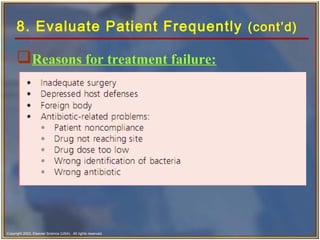
Reasons for treatment failure:
Copyright 2003, Elsevier Science (USA). All rights reserved.
8. Evaluate Patient Frequently (cont’d)
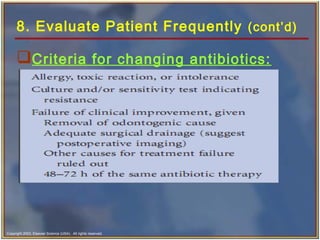
Criteria for changing antibiotics:
Copyright 2003, Elsevier Science (USA). All rights reserved.
Conclusion
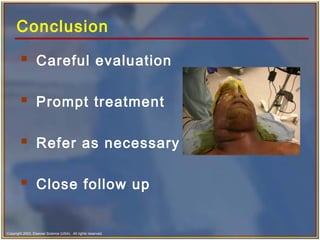
 Careful evaluation
 Prompt treatment
 Refer as necessary
 Close follow up
Copyright 2003, Elsevier Science (USA). All rights reserved.
Conclusion
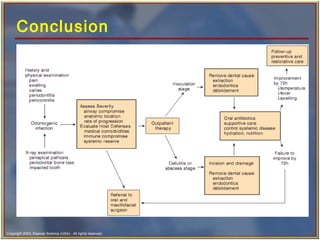
Copyright 2003, Elsevier Science (USA). All rights reserved.
References
Fragiskos FD: Oral surgery. Springer-Verlag
Berlin Heidelberg, pp. 205-241, 2007
Flynn TR: Principles of management of
odontogenic infections. In Peterson's principles
of oral and maxillofacial surgery. BC Decker Inc,
Hamilton , London, pp. 277-293, 2004

Odontogenic infections

  • 1.
    Copyright 2003, ElsevierScience (USA). All rights reserved. Principles of Management of Odontogenic Infections Fouad Al-Belasy
  • 2.
    Copyright 2003, ElsevierScience (USA). All rights reserved. Disclaimer  This presentation is based on chapter 16 authored by Thomas R. Flynn in Hupp JR, et al. (ed. 6). Contemporary Oral and Maxillofacial Surgery. St Louis, Mosby, 2014.  Some pictures used in this presentation and their content have been obtained from a number of other sources. Their use is purely for academic and teaching purposes.  This presentation does not have any intended commercial use. In case the owner of any of the pictures has any objection and seeks their removal please contact at albelasy@netscape.net. These pictures will be removed immediately.
  • 3.
    Copyright 2003, ElsevierScience (USA). All rights reserved. Objectives  Etiology  Microbiology  Natural history of progression  Eight principles of therapy  Antibiotic guidelines  Conclusion
  • 4.
    Copyright 2003, ElsevierScience (USA). All rights reserved. Introduction  You will be treating infections every day of your practice  Learning this material will: Enhance the comfort of your practice, and Aid in the confidence with which you treat patients
  • 5.
    Copyright 2003, ElsevierScience (USA). All rights reserved. Introduction Dental Infections: Most frequent reason for dental consultation Affects entire population – children to elderly Considerable cost to community Can be fatal
  • 6.
    Copyright 2003, ElsevierScience (USA). All rights reserved. Spectrum of Severity May range from: Low-grade, localized and easily treated , to Severe, rapidly spreading, life-threatening fascial space infections The end result of untreated dental infections may be death!
  • 7.
    Copyright 2003, ElsevierScience (USA). All rights reserved. Etiology Odontogenic sources •Pulpal disease •Periodontal disease •Long standing pericoronal infection •Infection of an odontogenic cyst or tumor •Infection of an extraction wound or fracture site Non-odontogenic sources •Oral mucosa/skin •Salivary glands •Sinuses
  • 8.
    Copyright 2003, ElsevierScience (USA). All rights reserved. Microbiology Most infections result from indigenous bacteria Primarily aerobic & anaerobic Gram + cocci, and anaerobic Gram – rods Most of these bacteria cause common caries and periodontal disease - become pathogenic when gaining access to deeper tissues
  • 9.
    Copyright 2003, ElsevierScience (USA). All rights reserved. Microbiology  Odontogenic infections are polymicrobial in nature: multiple bacterial species isolated • Average 5 species isolated • Not unusual to identify as many as 8 species • Rarely a single species isolated • Both aerobic and anaerobic species isolated Aerobic 6% Anaerobic 44% Mixed aerobic and anaerobic 50%  Culture techniques must be accurate to identify all species
  • 10.
    Copyright 2003, ElsevierScience (USA). All rights reserved. Aerobic Bacteria Most common Strep. milleri group: 65% of aerobic infections Miscellaneous: staph. 5% of aerobic infections Minor contributors Gram – cocci (Neisseria) Gram + rods (Corynebacterium) Gram – rods (Haemophilus)
  • 11.
    Copyright 2003, ElsevierScience (USA). All rights reserved. Streptococcus Milleri  Predominant aerobic Gram + Cocci. which consists of three member of Strep. viridans group: o S. anginosus o S. intermedius o S. constellatus
  • 12.
    Copyright 2003, ElsevierScience (USA). All rights reserved. Anaerobic Bacteria Most common Gram + cocci: Streptococcus and Peptostreptococcus -75% Gram – rods: Prevotella and Porphyromonas spp. 75% Fusobacteria - 50% of anaerobic infections Opportunists with little role Gram – cocci (Viellonella) Gram + rods (Actinomyces, Lactobacilli)
  • 13.
    Copyright 2003, ElsevierScience (USA). All rights reserved. Major Pathogens of Dental Infections Early Lesions Streptococcus milleri group Mature Lesions Other members of strep. viridans group Peptostreptococcus Prevotella Porphyromonas Fusobacteria Hence, aerobic and anaerobic Gram+cocci and anaerobic Gram-rods play the major role.
  • 14.
    Copyright 2003, ElsevierScience (USA). All rights reserved. Stages of Infection 1. Inoculation (edema) stage (0-3 days): Aerobes inoculate the host resulting in a soft, doughy, and mildly tender swelling 2. Cellulitis stage (3-5 days): Mixed species - Intense inflammatory response, hard, red, exquisitely tender swelling 3. Abscess stage (5-7 days): anaerobes predominate, liquefied abscess in the center of a swelling 4. Resolution stage: Spontaneous drainage, or surgical drainage
  • 15.
    Copyright 2003, ElsevierScience (USA). All rights reserved. Stages of Infection
  • 16.
    Copyright 2003, ElsevierScience (USA). All rights reserved. Natural History of Progression
  • 17.
    Copyright 2003, ElsevierScience (USA). All rights reserved. Natural History of Progression
  • 18.
    Copyright 2003, ElsevierScience (USA). All rights reserved. Natural History of Progression
  • 19.
    Copyright 2003, ElsevierScience (USA). All rights reserved. Principles of Management
  • 20.
    Copyright 2003, ElsevierScience (USA). All rights reserved. 1. Determine Severity of Infection  Most odontogenic infections are mild and require only minor surgical therapy  Determination of severity is based on: • Complete history of the current infection • Physical examination
  • 21.
    Copyright 2003, ElsevierScience (USA). All rights reserved. 1. Determine Severity of Infection (cont’d) Complete history: Chief complaint Time of onset Course of infection since onset Rate of progression Eliciting information about patient’s symptoms: pain, swelling, heat, redness, and loss of function General appearance of patient Previous treatment Medical history
  • 22.
    Copyright 2003, ElsevierScience (USA). All rights reserved. 1. Determine Severity of Infection (cont’d) Clinical examination: Vital signs Extraoral examination Inspection of: •general appearance •cardinal signs of inflammation •any loss of functions Palpation of area of swelling Intraoral examination: •source of infection
  • 23.
    Copyright 2003, ElsevierScience (USA). All rights reserved. 1. Determine Severity of Infection (cont’d) Radiographic examination Periapical OPG CT scan Assessment Stage is edema, cellulitis, or abscess Severity is low, moderate, or high
  • 24.
    Copyright 2003, ElsevierScience (USA). All rights reserved. 2. Evaluate Host Defenses Compromised Host Defenses:
  • 25.
    Copyright 2003, ElsevierScience (USA). All rights reserved. 3. Determine the Setting of Care Criteria for Referral to an OMF Surgeon:
  • 26.
    Copyright 2003, ElsevierScience (USA). All rights reserved. 3. Determine the Setting of Care (cont’d) Indications for Hospital Admission:
  • 27.
    Copyright 2003, ElsevierScience (USA). All rights reserved. 3. Determine the Setting of Care (cont’d) When to Go to the Operating Room
  • 28.
    Copyright 2003, ElsevierScience (USA). All rights reserved. 4. Treat Infection Surgically  Ranges from opening a tooth and extirpation of necrotic pulp to neck incisions Goals:  Remove source of infection  Provide a path for drainage
  • 29.
    Copyright 2003, ElsevierScience (USA). All rights reserved. 4. Treat Infection Surgically (cont’d) Getting a specimen for C&S test: Disinfect mucosa or skin Local anesthesia Insert large gauge needle into abscess cavity Aspirate pus (1-2 ml) Send for microscopy, culture & sensitivity It is OK to culture when patient is already on oral antibiotics – yield is good as penetration of abscess is only 1/3 of serum level
  • 30.
    Copyright 2003, ElsevierScience (USA). All rights reserved. 4. Treat Infection Surgically (cont’d) Indications for C & S testing:
  • 31.
    Copyright 2003, ElsevierScience (USA). All rights reserved. 4. Treat Infection Surgically (cont’d)
  • 32.
    Copyright 2003, ElsevierScience (USA). All rights reserved. 5. Support Patient Medically  Host systemic resistance must be considered in 3 areas:  Immune system compromise  Control of systemic diseases: o Hypertension, dysrhythmias, med. warfarin  Physiologic reserves  Fever elevation by 1∘ F per day Increases: • Daily fluid requirements by 800ml/∘ F/day • Caloric requirements by 3% - 5% /∘ F/day
  • 33.
    Copyright 2003, ElsevierScience (USA). All rights reserved. 5. Support Patient Medically (cont’d)  Fluids PO vs. IV  High calorie nutrition  Adequate analgesics & antipyretics  Appropriate antibiotics  Complete bed rest
  • 34.
    Copyright 2003, ElsevierScience (USA). All rights reserved. 6. Choose and Prescribe Antibiotics  not all infections require antibiotics  Indications for therapeutic use of antibiotics:
  • 35.
    Copyright 2003, ElsevierScience (USA). All rights reserved. 6. Choose & Prescribe Antibiotics (cont’d)  When use of antibiotics is not necessary?
  • 36.
    Copyright 2003, ElsevierScience (USA). All rights reserved. 6. Antibiotics: Empiric Choice (cont’d) Odontogenic infections generally caused by predictable group of bacteria An antibiotic is prescribed empirically i.e. on the basis that an appropriate antibiotic is being given Routine culture & sensitivity testing is not cost-effective
  • 37.
    Copyright 2003, ElsevierScience (USA). All rights reserved. 6. Antibiotics: Empiric Choice (cont’d)
  • 38.
    Copyright 2003, ElsevierScience (USA). All rights reserved. 6. Antibiotics: Choice (cont’d) Factors governing choice: Narrow spectrum Lowest incidence of toxicity and side effects Bactericidal vs. bacteriostatic Cost
  • 39.
    Copyright 2003, ElsevierScience (USA). All rights reserved. 6. Antibiotics: Principles of Use
  • 40.
    Copyright 2003, ElsevierScience (USA). All rights reserved. 7. Administer Antibiotic Properly Proper dose Peak plasma level of antibiotic should be 4-5 times the MIC for bacteria involved in infection Proper dose interval Interval is 4 times the t ½ life of antibiotic Proper route ! Proper duration !
  • 41.
    Copyright 2003, ElsevierScience (USA). All rights reserved. 8. Evaluate Patient Frequently  Close follow up to monitor response to treatment and complications • Pain • Swelling • Trismus • Temperature • General appearance • Drainage site: o drain removed at day 2-5 • Recurrent infection
  • 42.
    Copyright 2003, ElsevierScience (USA). All rights reserved. 8. Evaluate Patient Frequently (cont’d) Reasons for treatment failure:
  • 43.
    Copyright 2003, ElsevierScience (USA). All rights reserved. 8. Evaluate Patient Frequently (cont’d) Criteria for changing antibiotics:
  • 44.
    Copyright 2003, ElsevierScience (USA). All rights reserved. Conclusion  Careful evaluation  Prompt treatment  Refer as necessary  Close follow up
  • 45.
    Copyright 2003, ElsevierScience (USA). All rights reserved. Conclusion
  • 46.
    Copyright 2003, ElsevierScience (USA). All rights reserved. References Fragiskos FD: Oral surgery. Springer-Verlag Berlin Heidelberg, pp. 205-241, 2007 Flynn TR: Principles of management of odontogenic infections. In Peterson's principles of oral and maxillofacial surgery. BC Decker Inc, Hamilton , London, pp. 277-293, 2004