

Dr.T.V.Rao MD
INFECTION CONTROL
COMMITTEE
NEED CONSTITUTION AND RESPONSIBILITIES
DR.T.V.RAO MD 1
 Patient may acquire infection before admission to the
hospital = Community acquired infection.
 Patient may get infected inside the hospital = Nosocomial
infection.
 It includes infections
not present nor incubating at admission,
infections that appear more than 48 hours after
admission,
those acquired in the hospital but appear after
discharge
also occupational infections among staff.
THE RISK OF INFECTION IS ALWAYS
PRESENT IN EVERY HOSPITAL
DR.T.V.RAO MD 2
INFECTION
• Definition: Injurious contamination of body or parts of the
body by bacteria, viruses, fungi, protozoa and rickettsia or by
the toxin that they may produce.
 Infection may be local or generalized and spread throughout
the body.
 Once the infectious agent enters the host it begins to
proliferate and reacts with the defense mechanisms of the
body producing infection symptoms and signs: pain, swelling,
redness, functional disorders, rise in temperature and pulse
rate and leukocytosis.
DR.T.V.RAO MD 3
FREQUENCY OF NOSOCOMIAL INFECTION
 Nosocomial infections occur worldwide.
 The incidence is about 5-8% of
hospitalized patients, 1/3 of which is
preventable.
 The highest frequencies are in East
Mediterranean and South-East Asia.
 A high frequency of N.I. is evidence of
poor quality health service delivered.
DR.T.V.RAO MD 4
FACTORS INFLUENCING N.I.
The microbial agent
Patient susceptibility
Environmental factors
DR.T.V.RAO MD 5
TRANSMISSION
• Where do nosocomial infection come
from?
 Endogenous infection: When normal
patient flora change to pathogenic bacteria
because of change of normal habitat,
damage of skin and inappropriate antibiotic
use. About 50% of N.I. Are caused by this
way.
 Exogenous cross-infection: Mainly
through hands of healthcare workers,
visitors, patients.
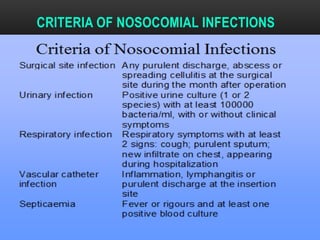
CRITERIA OF NOSOCOMIAL INFECTIONS
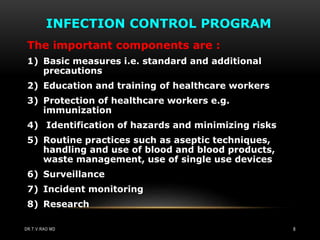
INFECTION CONTROL PROGRAM
The important components are :
1) Basic measures i.e. standard and additional
precautions
2) Education and training of healthcare workers
3) Protection of healthcare workers e.g.
immunization
4) Identification of hazards and minimizing risks
5) Routine practices such as aseptic techniques,
handling and use of blood and blood products,
waste management, use of single use devices
6) Surveillance
7) Incident monitoring
8) Research
DR.T.V.RAO MD 8
BASICS OF INFECTION CONTROL
 Prevention of nosocomial infection is the
responsibility of all individuals and services
provided by healthcare setting.
 To practice good asepsis, one should always
know: what is dirty, what is clean, what is
sterile and keep them separate.
 Hospital policies & procedures are applied
to prevent spread of infection in hospital.
DR.T.V.RAO MD 9
GOALS FOR INFECTION CONTROL AND
HOSPITAL EPIDEMIOLOGY
There are three principal goals for hospital
infection control and prevention programs:
1. Protect the patients
2. Protect the health care workers, visitors,
and others in the healthcare environment.
3. Accomplish the previous two goals in a cost
effective and cost efficient manner,
whenever possible.
.
DR.T.V.RAO MD 10
INFECTION CONTROL COMMITTEE
1. Review and approve surveillance and prevention program
2. Identify areas for intervention
3. To assess and promote improved practice at all levels of
health facility.
4. To ensure appropriate staff training
5. Safety management
• 6 Development of policies for the prevention and control of
infection
• 7. To develop its own infection control manual
• 8. Monitor and evaluate the performance of program
DR.T.V.RAO MD 11
FUNCTION AND ORGANIZATION OF THE
INFECTION CONTROL PROGRAM
The provision of an effective infection control
program (ICP) is a key to the quality and a reflection
of the overall standard of care provided by the health
care institution.
The growth in ICP has been paralleled by the
establishment and growth of a number of
professional and governmental organizations which
focus on NI prevention and control such as (APIC,
SHEA, CDC, HICPAC).
DR.T.V.RAO MD 12
INFECTION CONTROL PROGRAM
(ICP)
In the majority of countries ICP, typically
operates on two levels: an executive body –
the infection control team (ICT) – and an
advisory body to the hospital management
– the infection control committee (ICC) –
which adopts the ‘legislative’ role of policy
making.
DR.T.V.RAO MD 13
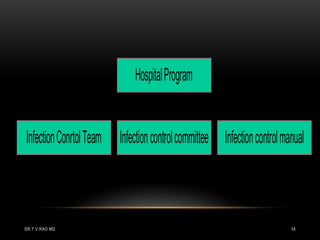
InfectionConrtolTeam Infectioncontrolcommittee Infectioncontrolmanual
HospitalProgram
DR.T.V.RAO MD 14
INFECTION CONTROL TEAM
• The optimal structure varies with hospitals
types, needs and resources.
• Hospital can appoint epidemiologist or
infectious disease specialist,
microbiologist to work as infection control
physician.
• Infection control nurse who is interested and
has experience in infection control issues.
DR.T.V.RAO MD 15
INFECTION CONTROL COMMITTEE
 It is a multidisciplinary committee responsible for
monitoring program policies implementation and
recommend corrective actions.
 It includes representatives from different concerned
hospital departments & management. They meet
bimonthly.
 It establishes standards for patient care, it reviews
and assesses IC reports and identifies areas of
intervention.
DR.T.V.RAO MD 16
INFECTION CONTROL COMMITTEE (CONT):
The membership of the hospital ICC should reflect the spectrum of
clinical services and administrative arrangements of the health care
facility. As a minimum, the committee should include:
1. Chief executive, or hospital administrator or his/her nominated
representative.
2. ICD or hospital microbiologist (chairperson).
3. Infection Control Nurse (ICN).
4. Infectious Diseases Physician (if available)
5. Director of nursing or his representative.
6. Occupational Health Physician (if available).
7. Representative from the major clinical specialties.
8. Additionally representatives of any other department (pharmacy,
central supply, maintenance, housekeeping…etc) may be invited as
necessary
DR.T.V.RAO MD 17
TEAM MEMBERS TO BE AUTHOURSIED
Team should have authority to manage an
effective control program.
Team should have a direct reporting with senior
administration.
Infection control team members or are
responsible for day-to-day functions of IC and
preparing the yearly work plan.
They should be expert and creative in their job.
DR.T.V.RAO MD 18
THE ICC HAS THE FOLLOWING TASKS:
• To review and approve the annual plan for
infection control
• To review and approve the infection control
policies.
• To support the IC team and direct resources to
address problems as identified
• To ensure availability of appropriate supplies
• To review epidemiological surveillance data and
identify area for intervention.
DR.T.V.RAO MD 19
THE ICC HAS THE FOLLOWING TASKS (CONT):
• To assess and promote improved
practice at all levels of the health care
facility
• To ensure appropriate training in
infection control and safety.
• To review risks associated with new
technology and new devices prior to
their approval for use.
• To review and provide input into an
outbreak investigation
DR.T.V.RAO MD 20
INFECTION CONTROL COMMITTEE (ICC):
The hospital ICC is charged with the responsibility for
the planning, evaluation of evidenced-based
practice and implementation, prioritization and
resource allocation of all matters relating to
infection control.
The ICC must have a reporting relationship directly to
either administration or the medical staff to
promote ICP visibility and effectiveness. The ICC
should meet regularly (monthly) according to local
need
DR.T.V.RAO MD 21
THE ROLE OF INFECTION CONTROL TEAM :
• To develop an annual infection control plan with clearly
defined objective.
• To develop written policies and procedures including
regular evaluation and update.
• To supervise and monitor daily practices of patient care
designed to prevent infection.
• To ensure availability of appropriate supplies
• To organize an epidemiological surveillance program
(particularly in high risk areas for early detection of
outbreak).
• To educate all grades of staff in infection control policy,
practice and procedures
DR.T.V.RAO MD 22
THE ROLE OF ICN
 Identify, investigate and monitor infections,
hazardous practice and procedures
 Participate in the preparation of documents
relating to service specifications and quality
standards.
 Participate in training and educational
programs and in membership of relevant
committees where infection control input is
needed
DR.T.V.RAO MD 23
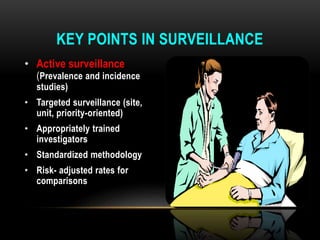
• Active surveillance
(Prevalence and incidence
studies)
• Targeted surveillance (site,
unit, priority-oriented)
• Appropriately trained
investigators
• Standardized methodology
• Risk- adjusted rates for
comparisons
KEY POINTS IN SURVEILLANCE
• Automated laboratory,
pharmacy and HIS data
integration
Detection of pathogenic
microorganisms
Sending of alerts in real time
Increased productivity.
Calculation of Infection
Incidence
Rates Generation of
statistical data in real time
HOSPITAL EPIDEMIOLOGIC CONTROL
DR.T.V.RAO MD 25
INFECTION CONTROL MANUAL
Every Hospital should have a nosocomial
infection prevention manual compiling
recommended instructions and practices
for patient care.
This manual should be developed and
updated in a timely manner by the
infection control team.
It is to be reviewed and accepted by
infection control committee.
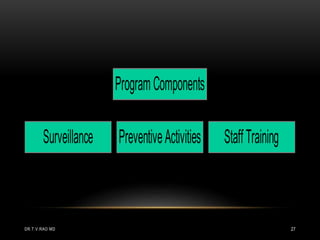
Surveillance PreventiveActivities StaffTraining
ProgramComponents
DR.T.V.RAO MD 27
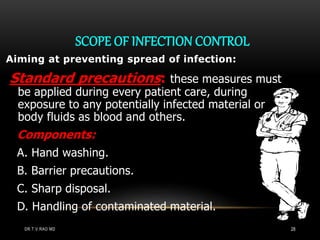
SCOPE OF INFECTION CONTROL
Aiming at preventing spread of infection:
Standard precautions: these measures must
be applied during every patient care, during
exposure to any potentially infected material or
body fluids as blood and others.
Components:
A. Hand washing.
B. Barrier precautions.
C. Sharp disposal.
D. Handling of contaminated material.
DR.T.V.RAO MD 28
• Model good hand
washing/hand hygiene
practices
• ˙ Encourage others to do
the same
• ˙ Maintain hand hygiene
supplies for your area
• ˙ Maintain soap and paper
products for your area
MAKE YOUR HOSPITAL A MODEL FOR HAND
WASHING
DR.T.V.RAO MD 29
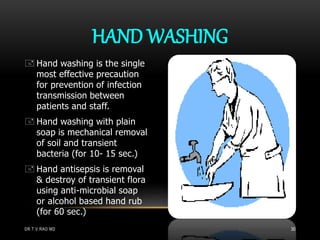
 Hand washing is the single
most effective precaution
for prevention of infection
transmission between
patients and staff.
 Hand washing with plain
soap is mechanical removal
of soil and transient
bacteria (for 10- 15 sec.)
 Hand antisepsis is removal
& destroy of transient flora
using anti-microbial soap
or alcohol based hand rub
(for 60 sec.)
HAND WASHING
DR.T.V.RAO MD 30
INFECTION CONTROL IS RESPONSIBILITY OF ???
DR.T.V.RAO MD 31
DO NOT FORGET IT IS EVERYONE'S
RESPONSIBILITY
DR.T.V.RAO MD 32
HAVE A VISION FOR CREATING BETTER
HOSPITALS
DR.T.V.RAO MD 33
DR.T.V.RAO MD 34
Programme created by Dr.T.V.Rao MD for
basic Infection control Programme in
Developing world
Email
doctortvrao@gmail.com

Infection control committee.pptx

  • 1.
    Dr.T.V.Rao MD INFECTION CONTROL COMMITTEE NEEDCONSTITUTION AND RESPONSIBILITIES DR.T.V.RAO MD 1
  • 2.
     Patient mayacquire infection before admission to the hospital = Community acquired infection.  Patient may get infected inside the hospital = Nosocomial infection.  It includes infections not present nor incubating at admission, infections that appear more than 48 hours after admission, those acquired in the hospital but appear after discharge also occupational infections among staff. THE RISK OF INFECTION IS ALWAYS PRESENT IN EVERY HOSPITAL DR.T.V.RAO MD 2
  • 3.
    INFECTION • Definition: Injuriouscontamination of body or parts of the body by bacteria, viruses, fungi, protozoa and rickettsia or by the toxin that they may produce.  Infection may be local or generalized and spread throughout the body.  Once the infectious agent enters the host it begins to proliferate and reacts with the defense mechanisms of the body producing infection symptoms and signs: pain, swelling, redness, functional disorders, rise in temperature and pulse rate and leukocytosis. DR.T.V.RAO MD 3
  • 4.
    FREQUENCY OF NOSOCOMIALINFECTION  Nosocomial infections occur worldwide.  The incidence is about 5-8% of hospitalized patients, 1/3 of which is preventable.  The highest frequencies are in East Mediterranean and South-East Asia.  A high frequency of N.I. is evidence of poor quality health service delivered. DR.T.V.RAO MD 4
  • 5.
    FACTORS INFLUENCING N.I. Themicrobial agent Patient susceptibility Environmental factors DR.T.V.RAO MD 5
  • 6.
    TRANSMISSION • Where donosocomial infection come from?  Endogenous infection: When normal patient flora change to pathogenic bacteria because of change of normal habitat, damage of skin and inappropriate antibiotic use. About 50% of N.I. Are caused by this way.  Exogenous cross-infection: Mainly through hands of healthcare workers, visitors, patients.
  • 7.
  • 8.
    INFECTION CONTROL PROGRAM Theimportant components are : 1) Basic measures i.e. standard and additional precautions 2) Education and training of healthcare workers 3) Protection of healthcare workers e.g. immunization 4) Identification of hazards and minimizing risks 5) Routine practices such as aseptic techniques, handling and use of blood and blood products, waste management, use of single use devices 6) Surveillance 7) Incident monitoring 8) Research DR.T.V.RAO MD 8
  • 9.
    BASICS OF INFECTIONCONTROL  Prevention of nosocomial infection is the responsibility of all individuals and services provided by healthcare setting.  To practice good asepsis, one should always know: what is dirty, what is clean, what is sterile and keep them separate.  Hospital policies & procedures are applied to prevent spread of infection in hospital. DR.T.V.RAO MD 9
  • 10.
    GOALS FOR INFECTIONCONTROL AND HOSPITAL EPIDEMIOLOGY There are three principal goals for hospital infection control and prevention programs: 1. Protect the patients 2. Protect the health care workers, visitors, and others in the healthcare environment. 3. Accomplish the previous two goals in a cost effective and cost efficient manner, whenever possible. . DR.T.V.RAO MD 10
  • 11.
    INFECTION CONTROL COMMITTEE 1.Review and approve surveillance and prevention program 2. Identify areas for intervention 3. To assess and promote improved practice at all levels of health facility. 4. To ensure appropriate staff training 5. Safety management • 6 Development of policies for the prevention and control of infection • 7. To develop its own infection control manual • 8. Monitor and evaluate the performance of program DR.T.V.RAO MD 11
  • 12.
    FUNCTION AND ORGANIZATIONOF THE INFECTION CONTROL PROGRAM The provision of an effective infection control program (ICP) is a key to the quality and a reflection of the overall standard of care provided by the health care institution. The growth in ICP has been paralleled by the establishment and growth of a number of professional and governmental organizations which focus on NI prevention and control such as (APIC, SHEA, CDC, HICPAC). DR.T.V.RAO MD 12
  • 13.
    INFECTION CONTROL PROGRAM (ICP) Inthe majority of countries ICP, typically operates on two levels: an executive body – the infection control team (ICT) – and an advisory body to the hospital management – the infection control committee (ICC) – which adopts the ‘legislative’ role of policy making. DR.T.V.RAO MD 13
  • 14.
  • 15.
    INFECTION CONTROL TEAM •The optimal structure varies with hospitals types, needs and resources. • Hospital can appoint epidemiologist or infectious disease specialist, microbiologist to work as infection control physician. • Infection control nurse who is interested and has experience in infection control issues. DR.T.V.RAO MD 15
  • 16.
    INFECTION CONTROL COMMITTEE It is a multidisciplinary committee responsible for monitoring program policies implementation and recommend corrective actions.  It includes representatives from different concerned hospital departments & management. They meet bimonthly.  It establishes standards for patient care, it reviews and assesses IC reports and identifies areas of intervention. DR.T.V.RAO MD 16
  • 17.
    INFECTION CONTROL COMMITTEE(CONT): The membership of the hospital ICC should reflect the spectrum of clinical services and administrative arrangements of the health care facility. As a minimum, the committee should include: 1. Chief executive, or hospital administrator or his/her nominated representative. 2. ICD or hospital microbiologist (chairperson). 3. Infection Control Nurse (ICN). 4. Infectious Diseases Physician (if available) 5. Director of nursing or his representative. 6. Occupational Health Physician (if available). 7. Representative from the major clinical specialties. 8. Additionally representatives of any other department (pharmacy, central supply, maintenance, housekeeping…etc) may be invited as necessary DR.T.V.RAO MD 17
  • 18.
    TEAM MEMBERS TOBE AUTHOURSIED Team should have authority to manage an effective control program. Team should have a direct reporting with senior administration. Infection control team members or are responsible for day-to-day functions of IC and preparing the yearly work plan. They should be expert and creative in their job. DR.T.V.RAO MD 18
  • 19.
    THE ICC HASTHE FOLLOWING TASKS: • To review and approve the annual plan for infection control • To review and approve the infection control policies. • To support the IC team and direct resources to address problems as identified • To ensure availability of appropriate supplies • To review epidemiological surveillance data and identify area for intervention. DR.T.V.RAO MD 19
  • 20.
    THE ICC HASTHE FOLLOWING TASKS (CONT): • To assess and promote improved practice at all levels of the health care facility • To ensure appropriate training in infection control and safety. • To review risks associated with new technology and new devices prior to their approval for use. • To review and provide input into an outbreak investigation DR.T.V.RAO MD 20
  • 21.
    INFECTION CONTROL COMMITTEE(ICC): The hospital ICC is charged with the responsibility for the planning, evaluation of evidenced-based practice and implementation, prioritization and resource allocation of all matters relating to infection control. The ICC must have a reporting relationship directly to either administration or the medical staff to promote ICP visibility and effectiveness. The ICC should meet regularly (monthly) according to local need DR.T.V.RAO MD 21
  • 22.
    THE ROLE OFINFECTION CONTROL TEAM : • To develop an annual infection control plan with clearly defined objective. • To develop written policies and procedures including regular evaluation and update. • To supervise and monitor daily practices of patient care designed to prevent infection. • To ensure availability of appropriate supplies • To organize an epidemiological surveillance program (particularly in high risk areas for early detection of outbreak). • To educate all grades of staff in infection control policy, practice and procedures DR.T.V.RAO MD 22
  • 23.
    THE ROLE OFICN  Identify, investigate and monitor infections, hazardous practice and procedures  Participate in the preparation of documents relating to service specifications and quality standards.  Participate in training and educational programs and in membership of relevant committees where infection control input is needed DR.T.V.RAO MD 23
  • 24.
    • Active surveillance (Prevalenceand incidence studies) • Targeted surveillance (site, unit, priority-oriented) • Appropriately trained investigators • Standardized methodology • Risk- adjusted rates for comparisons KEY POINTS IN SURVEILLANCE
  • 25.
    • Automated laboratory, pharmacyand HIS data integration Detection of pathogenic microorganisms Sending of alerts in real time Increased productivity. Calculation of Infection Incidence Rates Generation of statistical data in real time HOSPITAL EPIDEMIOLOGIC CONTROL DR.T.V.RAO MD 25
  • 26.
    INFECTION CONTROL MANUAL EveryHospital should have a nosocomial infection prevention manual compiling recommended instructions and practices for patient care. This manual should be developed and updated in a timely manner by the infection control team. It is to be reviewed and accepted by infection control committee.
  • 27.
  • 28.
    SCOPE OF INFECTIONCONTROL Aiming at preventing spread of infection: Standard precautions: these measures must be applied during every patient care, during exposure to any potentially infected material or body fluids as blood and others. Components: A. Hand washing. B. Barrier precautions. C. Sharp disposal. D. Handling of contaminated material. DR.T.V.RAO MD 28
  • 29.
    • Model goodhand washing/hand hygiene practices • ˙ Encourage others to do the same • ˙ Maintain hand hygiene supplies for your area • ˙ Maintain soap and paper products for your area MAKE YOUR HOSPITAL A MODEL FOR HAND WASHING DR.T.V.RAO MD 29
  • 30.
     Hand washingis the single most effective precaution for prevention of infection transmission between patients and staff.  Hand washing with plain soap is mechanical removal of soil and transient bacteria (for 10- 15 sec.)  Hand antisepsis is removal & destroy of transient flora using anti-microbial soap or alcohol based hand rub (for 60 sec.) HAND WASHING DR.T.V.RAO MD 30
  • 31.
    INFECTION CONTROL ISRESPONSIBILITY OF ??? DR.T.V.RAO MD 31
  • 32.
    DO NOT FORGETIT IS EVERYONE'S RESPONSIBILITY DR.T.V.RAO MD 32
  • 33.
    HAVE A VISIONFOR CREATING BETTER HOSPITALS DR.T.V.RAO MD 33
  • 34.
    DR.T.V.RAO MD 34 Programmecreated by Dr.T.V.Rao MD for basic Infection control Programme in Developing world Email doctortvrao@gmail.com