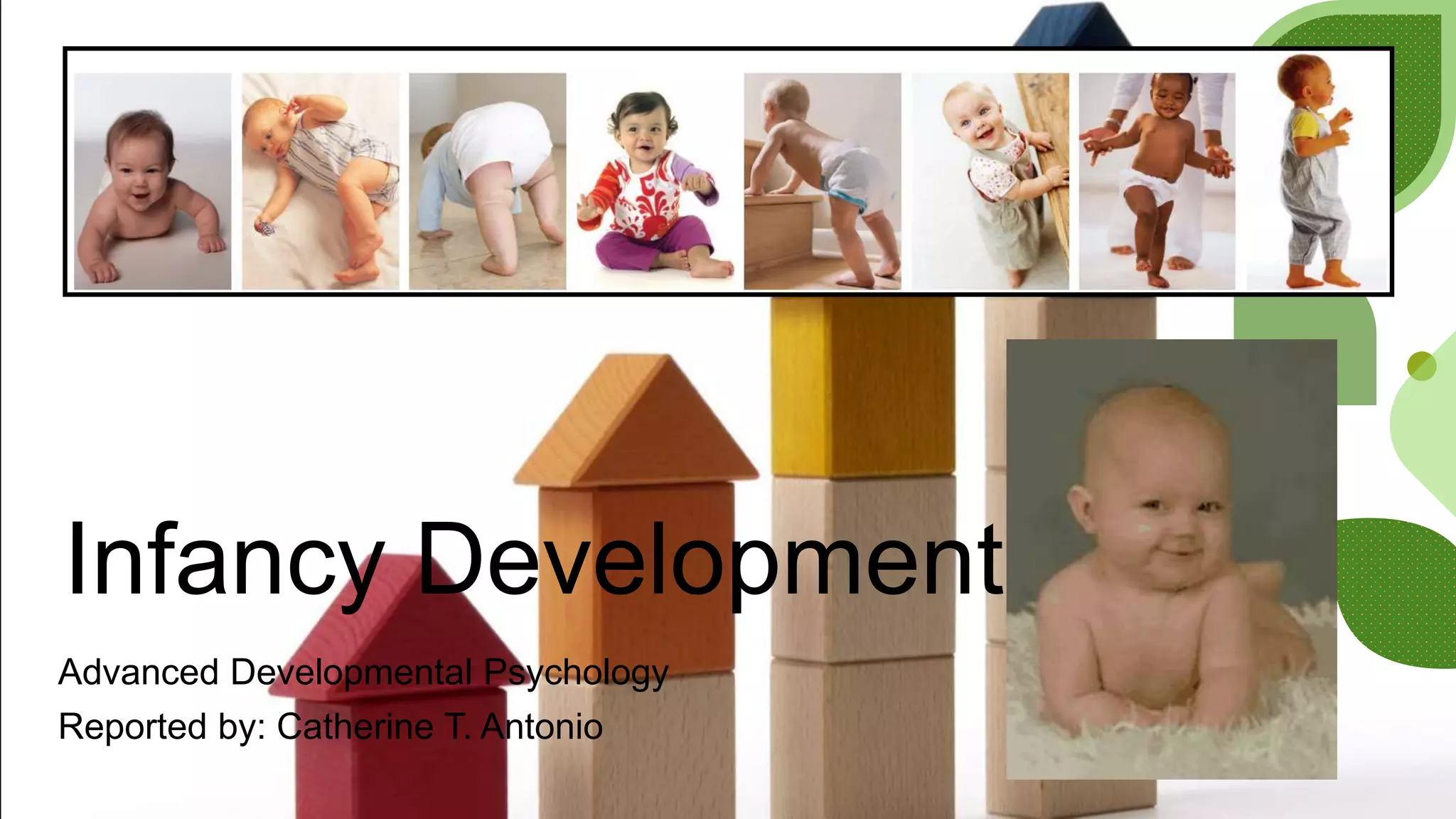
Infancy Development
Advanced Developmental Psychology
Reported by: Catherine T. Antonio
Infancy Development
Infancy is the period of life between birth
and the emergence of language roughly one
and one half to two years later and thus
encompasses only about 2% of the average
person’s life expectancy.
One of the most critical stages of
development and learning is from birth to
five years old. The first five years of child
development are crucial to their health, well
being and the overall trajectory of their lives
in a variety of ways.
Infancy Development
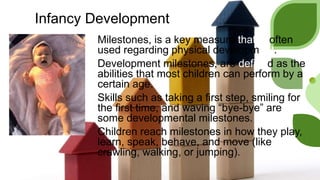
Milestones, is a key measure that is often
used regarding physical development.
Development milestones, are defined as the
abilities that most children can perform by a
certain age.
Skills such as taking a first step, smiling for
the first time, and waving “bye-bye” are
some developmental milestones.
Children reach milestones in how they play,
learn, speak, behave, and move (like
crawling, walking, or jumping).
Infancy Physical Development
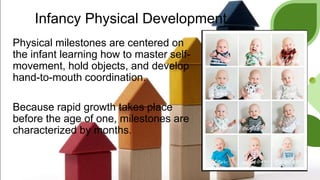
Physical milestones are centered on
the infant learning how to master self-
movement, hold objects, and develop
hand-to-mouth coordination.
Because rapid growth takes place
before the age of one, milestones are
characterized by months.
Infancy Physical Development
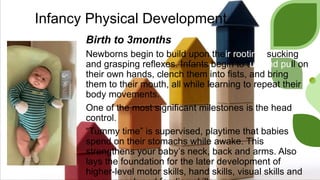
Birth to 3months
Newborns begin to build upon their rooting, sucking
and grasping reflexes. Infants begin to tug and pull on
their own hands, clench them into fists, and bring
them to their mouth, all while learning to repeat their
body movements.
One of the most significant milestones is the head
control.
“Tummy time” is supervised, playtime that babies
spend on their stomachs while awake. This
strengthens your baby’s neck, back and arms. Also
lays the foundation for the later development of
higher-level motor skills, hand skills, visual skills and
Infancy Physical Development
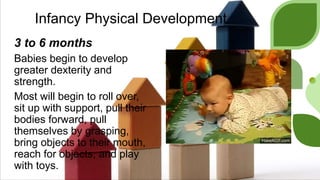
3 to 6 months
Babies begin to develop
greater dexterity and
strength.
Most will begin to roll over,
sit up with support, pull their
bodies forward, pull
themselves by grasping,
bring objects to their mouth,
reach for objects, and play
with toys.
Infancy Physical Development
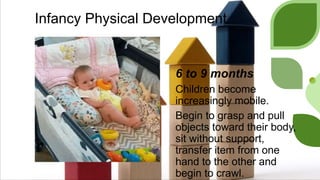
6 to 9 months
Children become
increasingly mobile.
Begin to grasp and pull
objects toward their body,
sit without support,
transfer item from one
hand to the other and
begin to crawl.
Infancy Physical Development
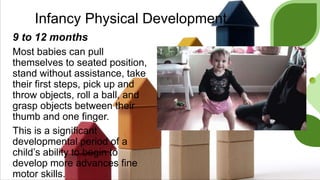
9 to 12 months
Most babies can pull
themselves to seated position,
stand without assistance, take
their first steps, pick up and
throw objects, roll a ball, and
grasp objects between their
thumb and one finger.
This is a significant
developmental period of a
child’s ability to begin to
develop more advances fine
motor skills.
Infancy Physical Development
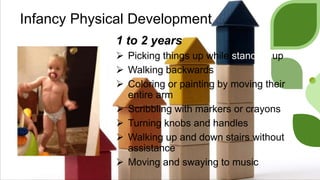
1 to 2 years
 Picking things up while standing up
 Walking backwards
 Coloring or painting by moving their
entire arm
 Scribbling with markers or crayons
 Turning knobs and handles
 Walking up and down stairs without
assistance
 Moving and swaying to music
Infancy Physical Development
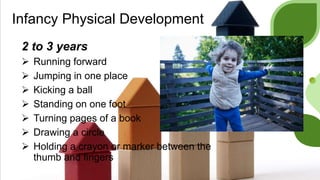
2 to 3 years
 Running forward
 Jumping in one place
 Kicking a ball
 Standing on one foot
 Turning pages of a book
 Drawing a circle
 Holding a crayon or marker between the
thumb and fingers
Infancy Physical Development
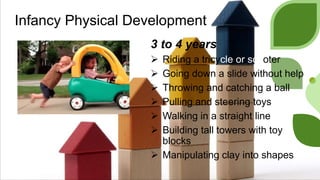
3 to 4 years
 Riding a tricycle or scooter
 Going down a slide without help
 Throwing and catching a ball
 Pulling and steering toys
 Walking in a straight line
 Building tall towers with toy
blocks
 Manipulating clay into shapes
Infancy Physical Development
4 to 5 years
 Jumping on one foot
 Walking backwards
 Doing somersaults
 Cutting paper with safety
scissors
 Printing letters
 Copying shapes (squares,
circles and crosses
Infancy Physical Reflexes
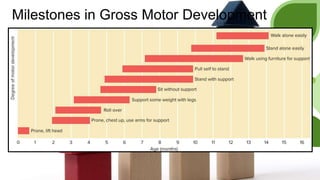
Milestones in Gross Motor Development
Visual acuity during the first months of life
The four photographs represent a computer estimation
of what a picture of a face looks like to a 1-month-old, 2-
month-old, 3-month-old and 1-year-old
Infancy Cognitive Development
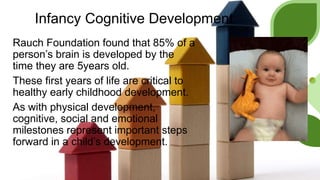
Rauch Foundation found that 85% of a
person’s brain is developed by the
time they are 5years old.
These first years of life are critical to
healthy early childhood development.
As with physical development,
cognitive, social and emotional
milestones represent important steps
forward in a child’s development.
Infancy Cognitive Development
Birth to 3months
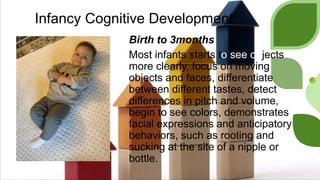
Most infants starts to see objects
more clearly, focus on moving
objects and faces, differentiate
between different tastes, detect
differences in pitch and volume,
begin to see colors, demonstrates
facial expressions and anticipatory
behaviors, such as rooting and
sucking at the site of a nipple or
bottle.
Infancy Cognitive Development
3 to 6 months
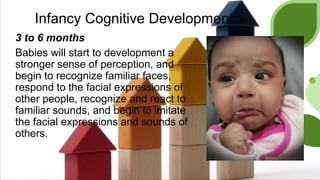
Babies will start to development a
stronger sense of perception, and
begin to recognize familiar faces,
respond to the facial expressions of
other people, recognize and react to
familiar sounds, and begin to imitate
the facial expressions and sounds of
others.
Infancy Cognitive Development
6 to 9 months
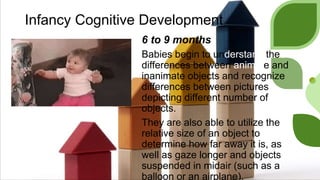
Babies begin to understand the
differences between animate and
inanimate objects and recognize
differences between pictures
depicting different number of
objects.
They are also able to utilize the
relative size of an object to
determine how far away it is, as
well as gaze longer and objects
suspended in midair (such as a
balloon or an airplane).
Infancy Cognitive Development
9 to 12 months
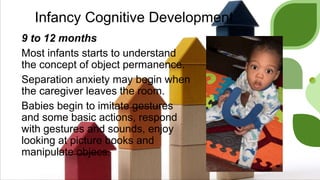
Most infants starts to understand
the concept of object permanence.
Separation anxiety may begin when
the caregiver leaves the room.
Babies begin to imitate gestures
and some basic actions, respond
with gestures and sounds, enjoy
looking at picture books and
manipulate objecs.
Infancy Cognitive Development
1 to 2 years
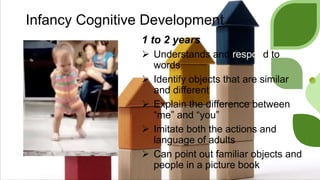
 Understands and respond to
words
 Identify objects that are similar
and different
 Explain the difference between
“me” and “you”
 Imitate both the actions and
language of adults
 Can point out familiar objects and
people in a picture book
Infancy Cognitive Development
2 to 3 years
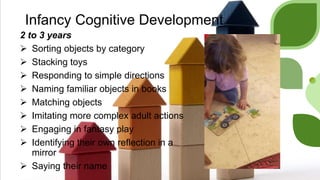
 Sorting objects by category
 Stacking toys
 Responding to simple directions
 Naming familiar objects in books
 Matching objects
 Imitating more complex adult actions
 Engaging in fantasy play
 Identifying their own reflection in a
mirror
 Saying their name
Infancy Cognitive Development
3 to 4 years
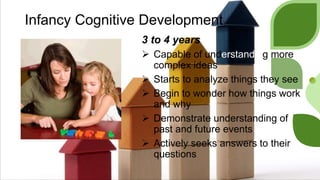
 Capable of understanding more
complex ideas
 Starts to analyze things they see
 Begin to wonder how things work
and why
 Demonstrate understanding of
past and future events
 Actively seeks answers to their
questions
Infancy Cognitive Development
4 to 5 years
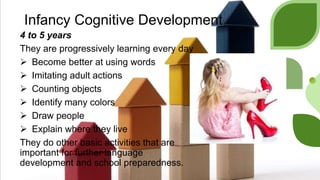
They are progressively learning every day
 Become better at using words
 Imitating adult actions
 Counting objects
 Identify many colors
 Draw people
 Explain where they live
They do other basic activities that are
important for further language
development and school preparedness.
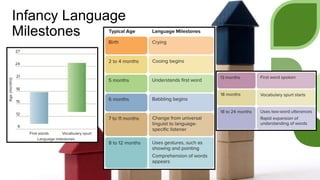
Infancy Language
Milestones
Infancy Cognitive Development
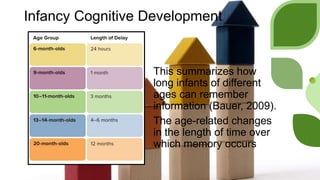
This summarizes how
long infants of different
ages can remember
information (Bauer, 2009).
The age-related changes
in the length of time over
which memory occurs
Infancy Socio-emotional Development
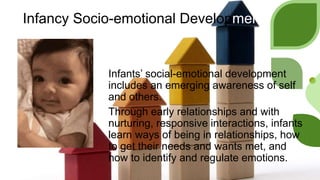
Infants’ social-emotional development
includes an emerging awareness of self
and others.
Through early relationships and with
nurturing, responsive interactions, infants
learn ways of being in relationships, how
to get their needs and wants met, and
how to identify and regulate emotions.
Infancy Socio-emotional Development
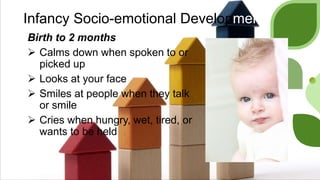
Birth to 2 months
 Calms down when spoken to or
picked up
 Looks at your face
 Smiles at people when they talk
or smile
 Cries when hungry, wet, tired, or
wants to be held
Infancy Socio-emotional Development
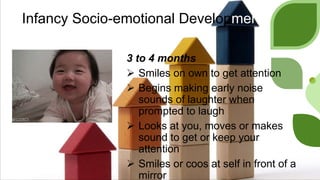
3 to 4 months
 Smiles on own to get attention
 Begins making early noise
sounds of laughter when
prompted to laugh
 Looks at you, moves or makes
sound to get or keep your
attention
 Smiles or coos at self in front of a
mirror
Infancy Socio-emotional Development
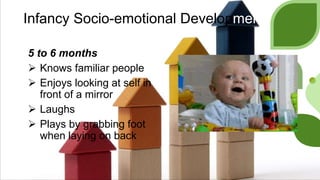
5 to 6 months
 Knows familiar people
 Enjoys looking at self in
front of a mirror
 Laughs
 Plays by grabbing foot
when laying on back
Infancy Socio-emotional Development
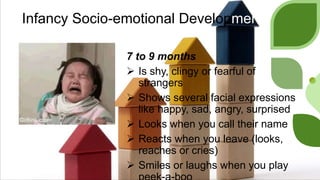
7 to 9 months
 Is shy, clingy or fearful of
strangers
 Shows several facial expressions
like happy, sad, angry, surprised
 Looks when you call their name
 Reacts when you leave (looks,
reaches or cries)
 Smiles or laughs when you play
Infancy Socio-emotional Development
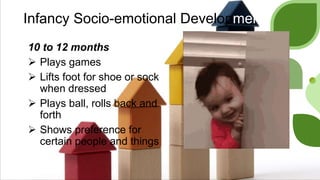
10 to 12 months
 Plays games
 Lifts foot for shoe or sock
when dressed
 Plays ball, rolls back and
forth
 Shows preference for
certain people and things
Infancy Socio-emotional Development
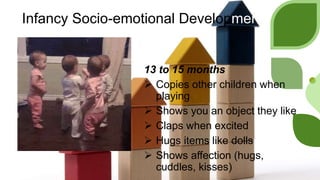
13 to 15 months
 Copies other children when
playing
 Shows you an object they like
 Claps when excited
 Hugs items like dolls
 Shows affection (hugs,
cuddles, kisses)
Infancy Socio-emotional Development
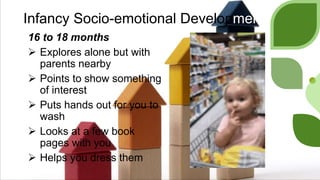
16 to 18 months
 Explores alone but with
parents nearby
 Points to show something
of interest
 Puts hands out for you to
wash
 Looks at a few book
pages with you
 Helps you dress them
Infancy Socio-emotional Development
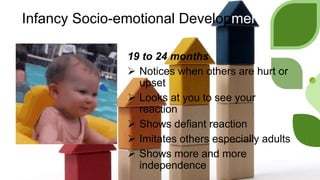
19 to 24 months
 Notices when others are hurt or
upset
 Looks at you to see your
reaction
 Shows defiant reaction
 Imitates others especially adults
 Shows more and more
independence
Infancy Socio-emotional Development
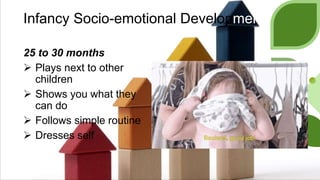
25 to 30 months
 Plays next to other
children
 Shows you what they
can do
 Follows simple routine
 Dresses self
Infancy Socio-emotional Development
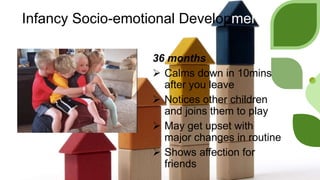
36 months
 Calms down in 10mins
after you leave
 Notices other children
and joins them to play
 May get upset with
major changes in routine
 Shows affection for
friends
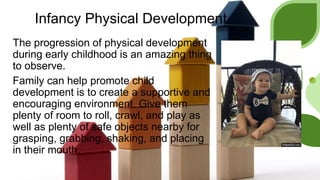
Infancy Physical Development
The progression of physical development
during early childhood is an amazing thing
to observe.
Family can help promote child
development is to create a supportive and
encouraging environment. Give them
plenty of room to roll, crawl, and play as
well as plenty of safe objects nearby for
grasping, grabbing, shaking, and placing
in their mouth.
Infancy Cognitive Development
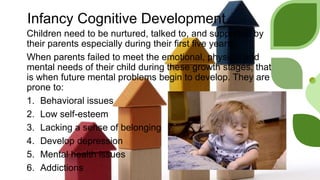
Children need to be nurtured, talked to, and supported by
their parents especially during their first five years.
When parents failed to meet the emotional, physical and
mental needs of their child during these growth stages, that
is when future mental problems begin to develop. They are
prone to:
1. Behavioral issues
2. Low self-esteem
3. Lacking a sense of belonging
4. Develop depression
5. Mental health issues
6. Addictions
Infancy Socio-emotional Development
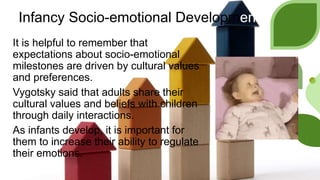
It is helpful to remember that
expectations about socio-emotional
milestones are driven by cultural values
and preferences.
Vygotsky said that adults share their
cultural values and beliefs with children
through daily interactions.
As infants develop, it is important for
them to increase their ability to regulate
their emotions.
References
https://www.all4kids.org/news/blog/why-the-first-5-years-
of-child-development-are-so-important/
https://www.cdc.gov/ncbddd/childdevelopment/positivepar
enting/infants.html#:~:text=In%20the%20first%20year%2
C%20babies,and%20%E2%80%9Cda%2Dda%E2%80%9
D.
https://www.virtuallabschool.org/infant-toddler/social-and-
emotional-development/lesson-2
INFANCY DEVELOPMENT.ppt

INFANCY DEVELOPMENT.ppt

  • 1.
    Infancy Development Advanced DevelopmentalPsychology Reported by: Catherine T. Antonio
  • 2.
    Infancy Development Infancy isthe period of life between birth and the emergence of language roughly one and one half to two years later and thus encompasses only about 2% of the average person’s life expectancy. One of the most critical stages of development and learning is from birth to five years old. The first five years of child development are crucial to their health, well being and the overall trajectory of their lives in a variety of ways.
  • 3.
    Infancy Development Milestones, isa key measure that is often used regarding physical development. Development milestones, are defined as the abilities that most children can perform by a certain age. Skills such as taking a first step, smiling for the first time, and waving “bye-bye” are some developmental milestones. Children reach milestones in how they play, learn, speak, behave, and move (like crawling, walking, or jumping).
  • 4.
    Infancy Physical Development Physicalmilestones are centered on the infant learning how to master self- movement, hold objects, and develop hand-to-mouth coordination. Because rapid growth takes place before the age of one, milestones are characterized by months.
  • 5.
    Infancy Physical Development Birthto 3months Newborns begin to build upon their rooting, sucking and grasping reflexes. Infants begin to tug and pull on their own hands, clench them into fists, and bring them to their mouth, all while learning to repeat their body movements. One of the most significant milestones is the head control. “Tummy time” is supervised, playtime that babies spend on their stomachs while awake. This strengthens your baby’s neck, back and arms. Also lays the foundation for the later development of higher-level motor skills, hand skills, visual skills and
  • 6.
    Infancy Physical Development 3to 6 months Babies begin to develop greater dexterity and strength. Most will begin to roll over, sit up with support, pull their bodies forward, pull themselves by grasping, bring objects to their mouth, reach for objects, and play with toys.
  • 7.
    Infancy Physical Development 6to 9 months Children become increasingly mobile. Begin to grasp and pull objects toward their body, sit without support, transfer item from one hand to the other and begin to crawl.
  • 8.
    Infancy Physical Development 9to 12 months Most babies can pull themselves to seated position, stand without assistance, take their first steps, pick up and throw objects, roll a ball, and grasp objects between their thumb and one finger. This is a significant developmental period of a child’s ability to begin to develop more advances fine motor skills.
  • 9.
    Infancy Physical Development 1to 2 years  Picking things up while standing up  Walking backwards  Coloring or painting by moving their entire arm  Scribbling with markers or crayons  Turning knobs and handles  Walking up and down stairs without assistance  Moving and swaying to music
  • 10.
    Infancy Physical Development 2to 3 years  Running forward  Jumping in one place  Kicking a ball  Standing on one foot  Turning pages of a book  Drawing a circle  Holding a crayon or marker between the thumb and fingers
  • 11.
    Infancy Physical Development 3to 4 years  Riding a tricycle or scooter  Going down a slide without help  Throwing and catching a ball  Pulling and steering toys  Walking in a straight line  Building tall towers with toy blocks  Manipulating clay into shapes
  • 12.
    Infancy Physical Development 4to 5 years  Jumping on one foot  Walking backwards  Doing somersaults  Cutting paper with safety scissors  Printing letters  Copying shapes (squares, circles and crosses
  • 13.
  • 14.
    Milestones in GrossMotor Development
  • 15.
    Visual acuity duringthe first months of life The four photographs represent a computer estimation of what a picture of a face looks like to a 1-month-old, 2- month-old, 3-month-old and 1-year-old
  • 16.
    Infancy Cognitive Development RauchFoundation found that 85% of a person’s brain is developed by the time they are 5years old. These first years of life are critical to healthy early childhood development. As with physical development, cognitive, social and emotional milestones represent important steps forward in a child’s development.
  • 17.
    Infancy Cognitive Development Birthto 3months Most infants starts to see objects more clearly, focus on moving objects and faces, differentiate between different tastes, detect differences in pitch and volume, begin to see colors, demonstrates facial expressions and anticipatory behaviors, such as rooting and sucking at the site of a nipple or bottle.
  • 18.
    Infancy Cognitive Development 3to 6 months Babies will start to development a stronger sense of perception, and begin to recognize familiar faces, respond to the facial expressions of other people, recognize and react to familiar sounds, and begin to imitate the facial expressions and sounds of others.
  • 19.
    Infancy Cognitive Development 6to 9 months Babies begin to understand the differences between animate and inanimate objects and recognize differences between pictures depicting different number of objects. They are also able to utilize the relative size of an object to determine how far away it is, as well as gaze longer and objects suspended in midair (such as a balloon or an airplane).
  • 20.
    Infancy Cognitive Development 9to 12 months Most infants starts to understand the concept of object permanence. Separation anxiety may begin when the caregiver leaves the room. Babies begin to imitate gestures and some basic actions, respond with gestures and sounds, enjoy looking at picture books and manipulate objecs.
  • 21.
    Infancy Cognitive Development 1to 2 years  Understands and respond to words  Identify objects that are similar and different  Explain the difference between “me” and “you”  Imitate both the actions and language of adults  Can point out familiar objects and people in a picture book
  • 22.
    Infancy Cognitive Development 2to 3 years  Sorting objects by category  Stacking toys  Responding to simple directions  Naming familiar objects in books  Matching objects  Imitating more complex adult actions  Engaging in fantasy play  Identifying their own reflection in a mirror  Saying their name
  • 23.
    Infancy Cognitive Development 3to 4 years  Capable of understanding more complex ideas  Starts to analyze things they see  Begin to wonder how things work and why  Demonstrate understanding of past and future events  Actively seeks answers to their questions
  • 24.
    Infancy Cognitive Development 4to 5 years They are progressively learning every day  Become better at using words  Imitating adult actions  Counting objects  Identify many colors  Draw people  Explain where they live They do other basic activities that are important for further language development and school preparedness.
  • 25.
  • 26.
    Infancy Cognitive Development Thissummarizes how long infants of different ages can remember information (Bauer, 2009). The age-related changes in the length of time over which memory occurs
  • 27.
    Infancy Socio-emotional Development Infants’social-emotional development includes an emerging awareness of self and others. Through early relationships and with nurturing, responsive interactions, infants learn ways of being in relationships, how to get their needs and wants met, and how to identify and regulate emotions.
  • 28.
    Infancy Socio-emotional Development Birthto 2 months  Calms down when spoken to or picked up  Looks at your face  Smiles at people when they talk or smile  Cries when hungry, wet, tired, or wants to be held
  • 29.
    Infancy Socio-emotional Development 3to 4 months  Smiles on own to get attention  Begins making early noise sounds of laughter when prompted to laugh  Looks at you, moves or makes sound to get or keep your attention  Smiles or coos at self in front of a mirror
  • 30.
    Infancy Socio-emotional Development 5to 6 months  Knows familiar people  Enjoys looking at self in front of a mirror  Laughs  Plays by grabbing foot when laying on back
  • 31.
    Infancy Socio-emotional Development 7to 9 months  Is shy, clingy or fearful of strangers  Shows several facial expressions like happy, sad, angry, surprised  Looks when you call their name  Reacts when you leave (looks, reaches or cries)  Smiles or laughs when you play
  • 32.
    Infancy Socio-emotional Development 10to 12 months  Plays games  Lifts foot for shoe or sock when dressed  Plays ball, rolls back and forth  Shows preference for certain people and things
  • 33.
    Infancy Socio-emotional Development 13to 15 months  Copies other children when playing  Shows you an object they like  Claps when excited  Hugs items like dolls  Shows affection (hugs, cuddles, kisses)
  • 34.
    Infancy Socio-emotional Development 16to 18 months  Explores alone but with parents nearby  Points to show something of interest  Puts hands out for you to wash  Looks at a few book pages with you  Helps you dress them
  • 35.
    Infancy Socio-emotional Development 19to 24 months  Notices when others are hurt or upset  Looks at you to see your reaction  Shows defiant reaction  Imitates others especially adults  Shows more and more independence
  • 36.
    Infancy Socio-emotional Development 25to 30 months  Plays next to other children  Shows you what they can do  Follows simple routine  Dresses self
  • 37.
    Infancy Socio-emotional Development 36months  Calms down in 10mins after you leave  Notices other children and joins them to play  May get upset with major changes in routine  Shows affection for friends
  • 38.
    Infancy Physical Development Theprogression of physical development during early childhood is an amazing thing to observe. Family can help promote child development is to create a supportive and encouraging environment. Give them plenty of room to roll, crawl, and play as well as plenty of safe objects nearby for grasping, grabbing, shaking, and placing in their mouth.
  • 39.
    Infancy Cognitive Development Childrenneed to be nurtured, talked to, and supported by their parents especially during their first five years. When parents failed to meet the emotional, physical and mental needs of their child during these growth stages, that is when future mental problems begin to develop. They are prone to: 1. Behavioral issues 2. Low self-esteem 3. Lacking a sense of belonging 4. Develop depression 5. Mental health issues 6. Addictions
  • 40.
    Infancy Socio-emotional Development Itis helpful to remember that expectations about socio-emotional milestones are driven by cultural values and preferences. Vygotsky said that adults share their cultural values and beliefs with children through daily interactions. As infants develop, it is important for them to increase their ability to regulate their emotions.
  • 41.