Infancy
Rozina Amir Ali
Lecturer
ION/JSMU
Objectives
At the end of this unit the learners will be able to:
• Growth and motor development
• Cognitive development (learning and memory)
• Piaget’s sensorimotor period
• Freud interpretation and parents-child
relationship
• Erickson’s stage of psycho social development
trust and autonomy.
Infancy
• It extends from birth to Two year. This stage is
basic trust versus basic Mistrust. There are
various aspects of development:
• Perceptual
• Psychological
• Motor
• Intellectual or cognitive
• Social and emotional
Perceptual development
• Perception refers to any process by which
immediate awareness of what is happening in
the environment is obtained.
• New born baby perceived the world by seeing,
hearing touching, smelling and tasting.
• Research has shown that infant can locate
sound but not accurately
• The newly born infant does seem to know
what part of his skin is being touched.
• The infants prefer sweet things.
• A study has shown that babies between 3 and
8 days of age are particularly response to
human speech.
Psychological development
In this stage the baby develops the world in a
dependable place and its people are friendly.
Baby responds only by crying and gradually he
learns his mother and other family members
with relief of his discomfort.
• If a baby is hungry or cold, there will be loving
care, he begins the trust and later on such
infant become optimistic, confident, bright,
secure and tolerant.
On the contrary if a baby treated carelessly, he
will feel that the world is painful place, later
on such infant become pessimism, insecure,
impatience, lack of confidence, cruelty and
some child may suffer mental disorder.
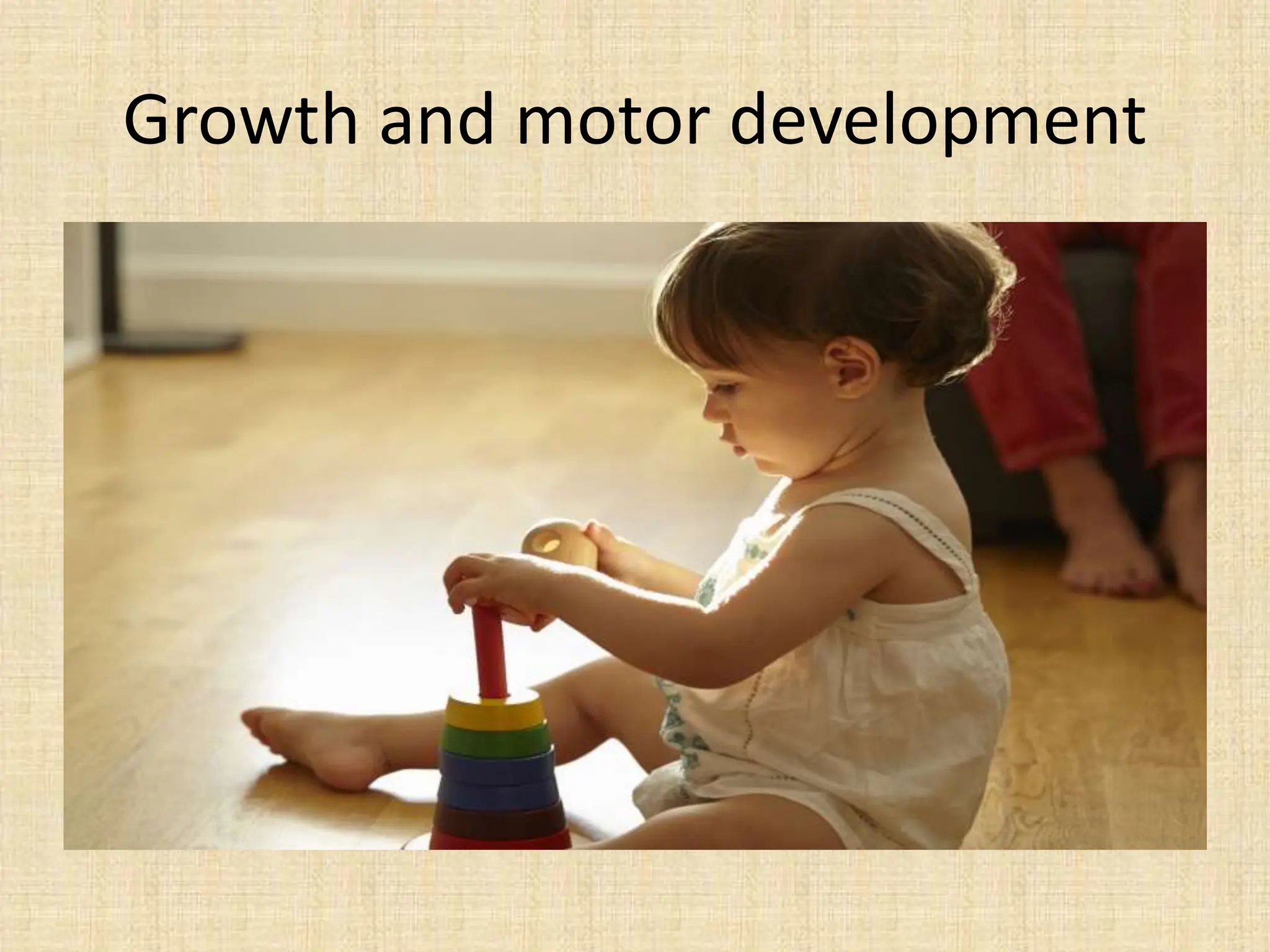
Growth and motor development
The typical 4-month-old baby should:
• Slow in weight gain to about 20 grams per day
• Double the birth weight.
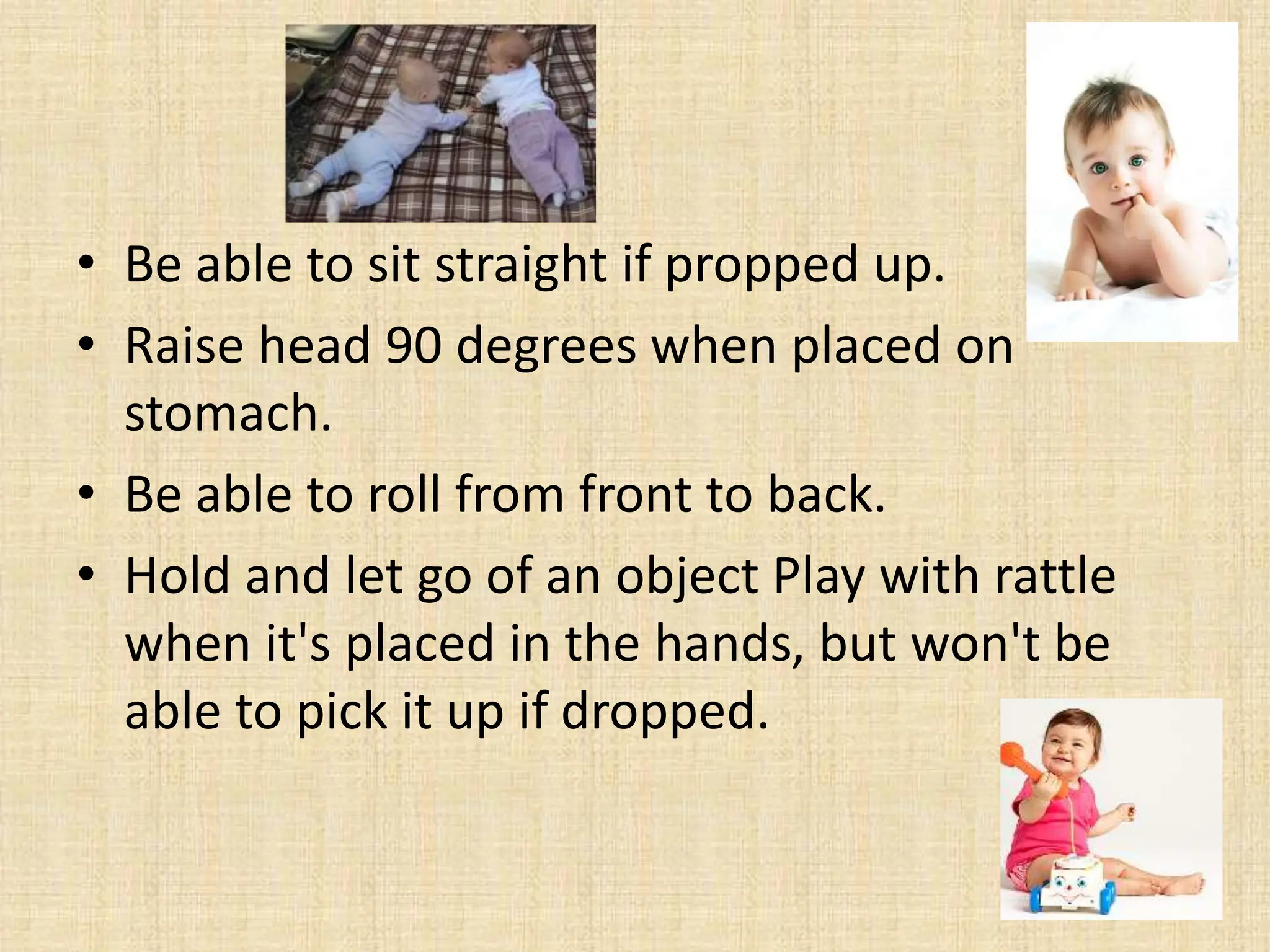
• Be able to sit straight if propped up.
• Raise head 90 degrees when placed on
stomach.
• Be able to roll from front to back.
• Hold and let go of an object Play with rattle
when it's placed in the hands, but won't be
able to pick it up if dropped.
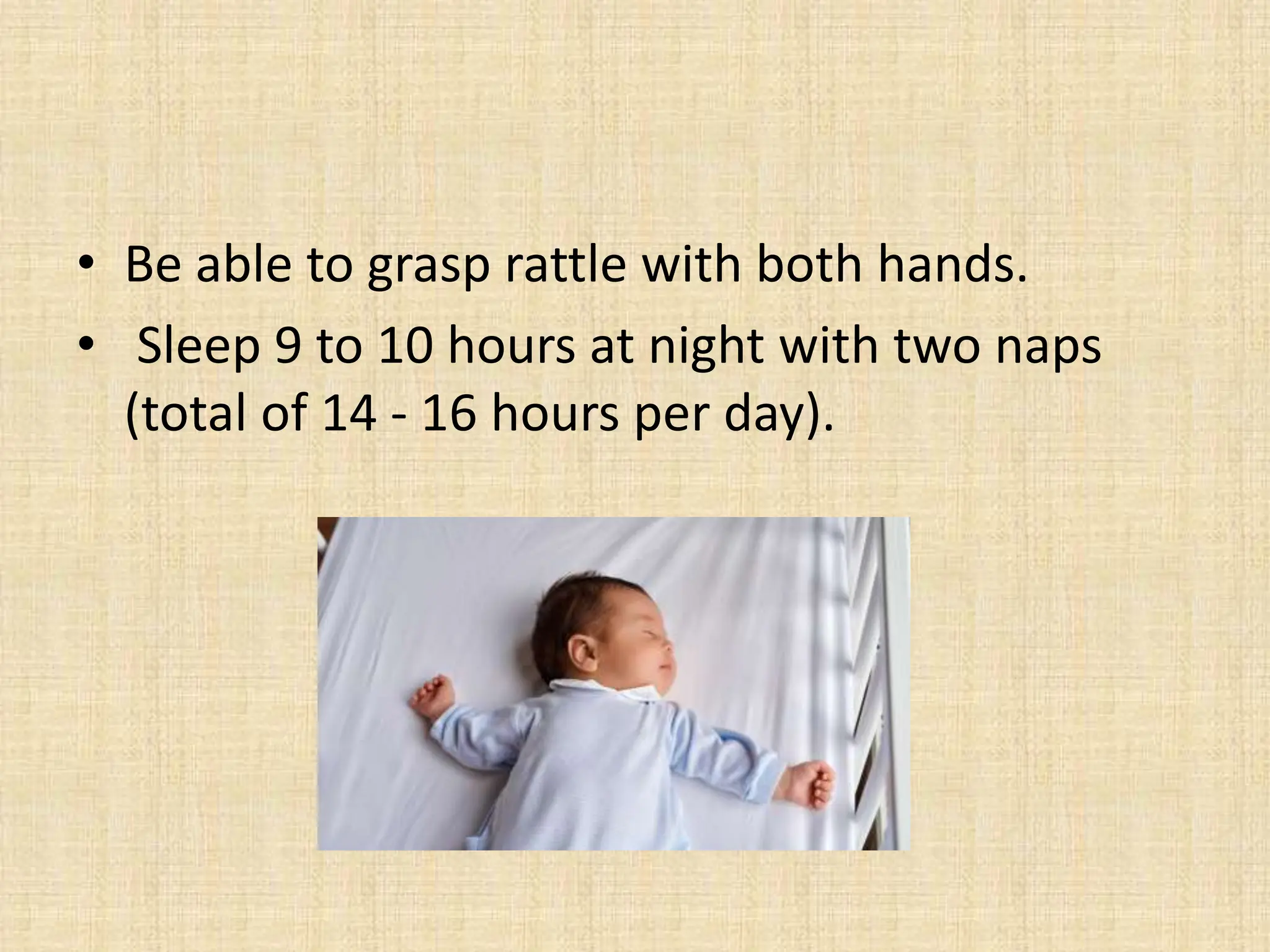
• Be able to grasp rattle with both hands.
• Sleep 9 to 10 hours at night with two naps
(total of 14 - 16 hours per day).
9 month old has usually reached the following
milestones:
• Gains weight at a slower rate about 15 grams per
day, 1 pound per month.
• Increases in length by 1.5 centimeters per month.
• Bowel and bladder become more regular
• Is able to crawl.
• Sits for long periods.
• Pulls self to standing position.
A 12-month-old child is expected to:
• Be 3 times more the birth weight.
• Grow to a height of 50% over birth length
• Have one to eight teeth.
• Stands by his or herself.
• Walk alone or when holding one hand.
• Sit down without help.
• Sleep 8 - 10 hours a night and take one to two
naps.
Intellectual or cognitive development
• Infant cognitive development is the study of
how psychological processes involved in
thinking and knowing develop in young
children.
Piaget’s sensorimotor period
• The famous psychologist Jaen Piaget has
described various periods of intellectual
development.
• The sensory motor stage starts in infancy and
continues early childhood.
• The first substage (first month of life) is the
stage of reflex acts. The neonate responds to
external stimulation with innate reflex actions.
• For example, if you brush a baby’s mouth or
cheek with your finger it will suck reflexively.
• The second substage is the stage
of primary circular reactions. The baby
will repeat pleasurable actions centered
on its own body.
• For example, babies from 1 – 4 months
old will wiggle(twist) their fingers, kick
their legs and suck their thumbs.
• These are not reflex actions. They are
done intentionally – for the sake of the
pleasurable stimulation produced.
• The third stage extends from 4 to 8 months.
During this stage the child begins to
intentional action. It is called “Secondary
Circular Reaction”.
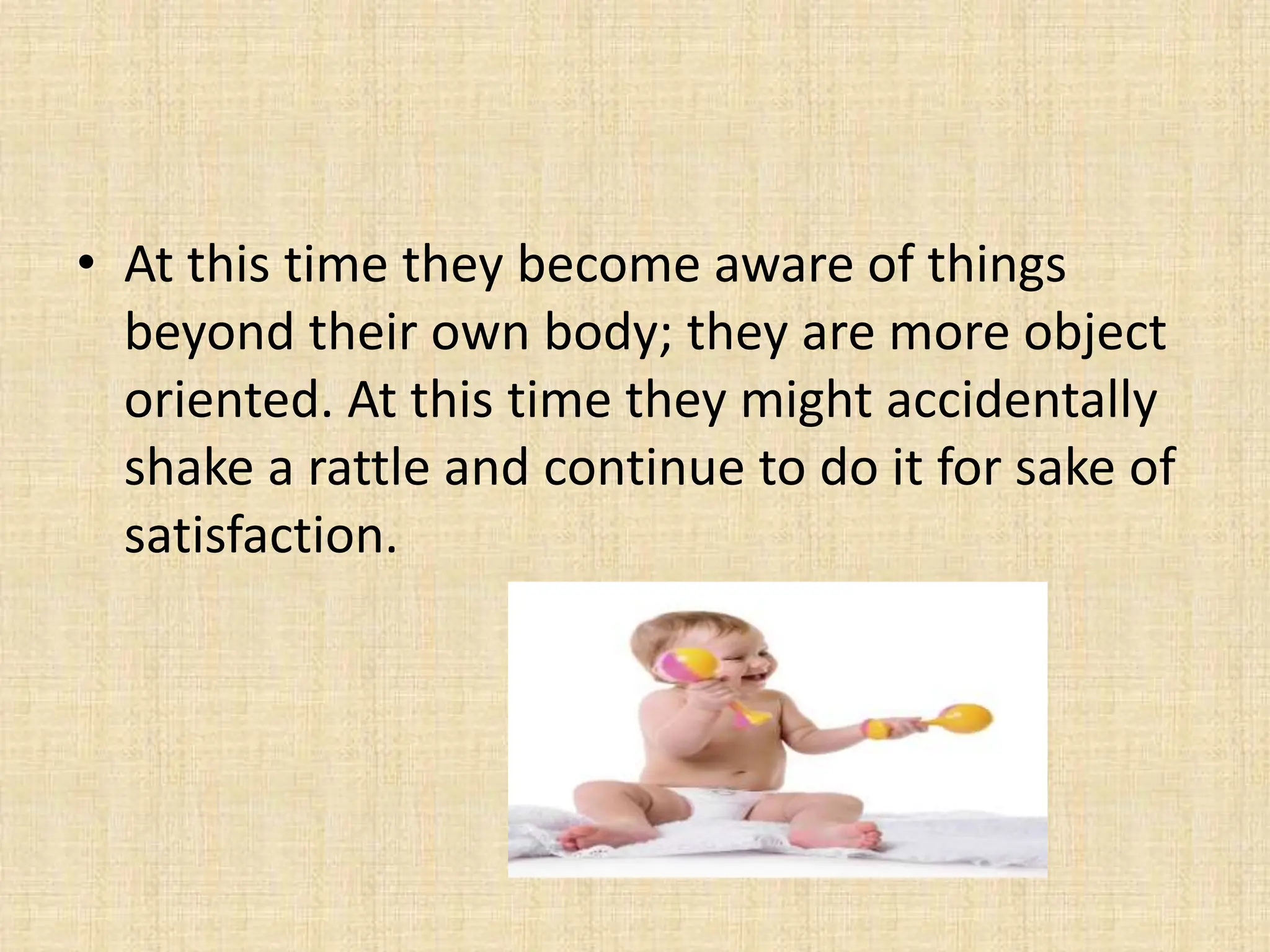
• At this time they become aware of things
beyond their own body; they are more object
oriented. At this time they might accidentally
shake a rattle and continue to do it for sake of
satisfaction.
The fourth stage of sensory motor period from 8
to 12 months. Coordination phase
During this stage the child precedes intentional
action. This is seen when the child will try to
remove barrier in order to get a favorite toy.
• During this stage they can do things
intentionally. They can now combine and
recombine schemes and try to reach a goal
They also understand object permanence
during this stage. That is, they understand that
objects continue to exist even when they can't
see them.
• Goal directed behavior
• The fifth stage extent from 1 to ½ years. In this
stage the child begins explores his
environment of objects actively in order to
discover their salient features. This stage
called as “tertiary circular reactions”.
• During this stage infants explore new
possibilities of objects; they try different
things to get different results.
• The child is considered a “little scientist” and
begins exploring the world in a trial-and-error
manner, using both motor skills and planning
abilities.
• For example, the child might throw her ball
down the stairs to see what happens. The
toddler’s active engagement in
experimentation helps them learn about their
world.
• During the last stage they are 18 to 24 months
old. During this stage they shift to symbolic
thinking./mental representation
• About two years the child beginning of
thoughts. He can perform certain mental
experience.
• This means that they have developed the
ability to visualize things that are not
physically present.
Social and emotional development
• A newly born baby will cry in a number of
different situation. Through cry the child
divert attention of people towards him.
• The development of smiling and bubbling is
extremely important. Earliest smiling seems to
convey little in the way of social awareness
• Babies display attachment to people by
seeking to be close to them.
• A child feels anxiety when separated from his
mother.
• Some young babies may be seen freezing
behavior when approached by strangers.
Erickson's stage of psycho social
development during infancy
• Psychosocial Stage 1 - Trust vs. Mistrust
• The first stage of Erikson’s theory of
psychosocial development occurs between
birth and one year of age and is the most
fundamental stage in life.
• Because an infant is utterly dependent, the
development of trust is based on the
dependability and quality of the child’s
caregivers.
• If a child successfully develops trust, he or she
will feel safe and secure in the world.
Caregivers who are inconsistent, emotionally
unavailable, or rejecting contribute to feelings
of mistrust in the children they care for.
• Failure to develop trust will result in fear and a
belief that the world is inconsistent and
unpredictable.
Freud theory (psychosexual)
• Oral stage
• The oral stage begin at birth, when the oral
cavity is the primary focus. The child, of
course, preoccupies himself with nursing, with
the pleasure of sucking and accepting thing in
to the mouth.
• The oral character who is frustrated at this
stage, whose mother refused to nurse him on
demand or who truncated nursing session
early, is characterized by pessimism, envy,
suspicion
• The overindulged oral character, whose
nursing urges were always and often
excessively satisfied, is optimistic, gullible and
is full of admiration for others around him.
infancy-231024062717-52fe7b18 (22.1).pdf

infancy-231024062717-52fe7b18 (22.1).pdf

  • 1.
  • 3.
    Objectives At the endof this unit the learners will be able to: • Growth and motor development • Cognitive development (learning and memory) • Piaget’s sensorimotor period • Freud interpretation and parents-child relationship • Erickson’s stage of psycho social development trust and autonomy.
  • 4.
    Infancy • It extendsfrom birth to Two year. This stage is basic trust versus basic Mistrust. There are various aspects of development: • Perceptual • Psychological • Motor • Intellectual or cognitive • Social and emotional
  • 5.
    Perceptual development • Perceptionrefers to any process by which immediate awareness of what is happening in the environment is obtained. • New born baby perceived the world by seeing, hearing touching, smelling and tasting.
  • 6.
    • Research hasshown that infant can locate sound but not accurately • The newly born infant does seem to know what part of his skin is being touched. • The infants prefer sweet things. • A study has shown that babies between 3 and 8 days of age are particularly response to human speech.
  • 7.
    Psychological development In thisstage the baby develops the world in a dependable place and its people are friendly. Baby responds only by crying and gradually he learns his mother and other family members with relief of his discomfort.
  • 8.
    • If ababy is hungry or cold, there will be loving care, he begins the trust and later on such infant become optimistic, confident, bright, secure and tolerant.
  • 9.
    On the contraryif a baby treated carelessly, he will feel that the world is painful place, later on such infant become pessimism, insecure, impatience, lack of confidence, cruelty and some child may suffer mental disorder.
  • 10.
    Growth and motordevelopment
  • 11.
    The typical 4-month-oldbaby should: • Slow in weight gain to about 20 grams per day • Double the birth weight.
  • 12.
    • Be ableto sit straight if propped up. • Raise head 90 degrees when placed on stomach. • Be able to roll from front to back. • Hold and let go of an object Play with rattle when it's placed in the hands, but won't be able to pick it up if dropped.
  • 13.
    • Be ableto grasp rattle with both hands. • Sleep 9 to 10 hours at night with two naps (total of 14 - 16 hours per day).
  • 14.
    9 month oldhas usually reached the following milestones: • Gains weight at a slower rate about 15 grams per day, 1 pound per month. • Increases in length by 1.5 centimeters per month. • Bowel and bladder become more regular • Is able to crawl. • Sits for long periods. • Pulls self to standing position.
  • 15.
    A 12-month-old childis expected to: • Be 3 times more the birth weight. • Grow to a height of 50% over birth length • Have one to eight teeth. • Stands by his or herself. • Walk alone or when holding one hand. • Sit down without help. • Sleep 8 - 10 hours a night and take one to two naps.
  • 16.
    Intellectual or cognitivedevelopment • Infant cognitive development is the study of how psychological processes involved in thinking and knowing develop in young children.
  • 21.
    Piaget’s sensorimotor period •The famous psychologist Jaen Piaget has described various periods of intellectual development. • The sensory motor stage starts in infancy and continues early childhood.
  • 23.
    • The firstsubstage (first month of life) is the stage of reflex acts. The neonate responds to external stimulation with innate reflex actions. • For example, if you brush a baby’s mouth or cheek with your finger it will suck reflexively.
  • 24.
    • The secondsubstage is the stage of primary circular reactions. The baby will repeat pleasurable actions centered on its own body. • For example, babies from 1 – 4 months old will wiggle(twist) their fingers, kick their legs and suck their thumbs. • These are not reflex actions. They are done intentionally – for the sake of the pleasurable stimulation produced.
  • 25.
    • The thirdstage extends from 4 to 8 months. During this stage the child begins to intentional action. It is called “Secondary Circular Reaction”.
  • 26.
    • At thistime they become aware of things beyond their own body; they are more object oriented. At this time they might accidentally shake a rattle and continue to do it for sake of satisfaction.
  • 27.
    The fourth stageof sensory motor period from 8 to 12 months. Coordination phase During this stage the child precedes intentional action. This is seen when the child will try to remove barrier in order to get a favorite toy.
  • 28.
    • During thisstage they can do things intentionally. They can now combine and recombine schemes and try to reach a goal They also understand object permanence during this stage. That is, they understand that objects continue to exist even when they can't see them. • Goal directed behavior
  • 29.
    • The fifthstage extent from 1 to ½ years. In this stage the child begins explores his environment of objects actively in order to discover their salient features. This stage called as “tertiary circular reactions”. • During this stage infants explore new possibilities of objects; they try different things to get different results.
  • 30.
    • The childis considered a “little scientist” and begins exploring the world in a trial-and-error manner, using both motor skills and planning abilities. • For example, the child might throw her ball down the stairs to see what happens. The toddler’s active engagement in experimentation helps them learn about their world.
  • 31.
    • During thelast stage they are 18 to 24 months old. During this stage they shift to symbolic thinking./mental representation • About two years the child beginning of thoughts. He can perform certain mental experience. • This means that they have developed the ability to visualize things that are not physically present.
  • 32.
    Social and emotionaldevelopment • A newly born baby will cry in a number of different situation. Through cry the child divert attention of people towards him.
  • 33.
    • The developmentof smiling and bubbling is extremely important. Earliest smiling seems to convey little in the way of social awareness
  • 34.
    • Babies displayattachment to people by seeking to be close to them. • A child feels anxiety when separated from his mother. • Some young babies may be seen freezing behavior when approached by strangers.
  • 35.
    Erickson's stage ofpsycho social development during infancy • Psychosocial Stage 1 - Trust vs. Mistrust • The first stage of Erikson’s theory of psychosocial development occurs between birth and one year of age and is the most fundamental stage in life. • Because an infant is utterly dependent, the development of trust is based on the dependability and quality of the child’s caregivers.
  • 36.
    • If achild successfully develops trust, he or she will feel safe and secure in the world. Caregivers who are inconsistent, emotionally unavailable, or rejecting contribute to feelings of mistrust in the children they care for. • Failure to develop trust will result in fear and a belief that the world is inconsistent and unpredictable.
  • 37.
    Freud theory (psychosexual) •Oral stage • The oral stage begin at birth, when the oral cavity is the primary focus. The child, of course, preoccupies himself with nursing, with the pleasure of sucking and accepting thing in to the mouth.
  • 38.
    • The oralcharacter who is frustrated at this stage, whose mother refused to nurse him on demand or who truncated nursing session early, is characterized by pessimism, envy, suspicion • The overindulged oral character, whose nursing urges were always and often excessively satisfied, is optimistic, gullible and is full of admiration for others around him.