M I C H E L L E F I T Z P A T R I C K , M A , C I M I
I N F A N T M E N T A L H E A L T H S P E C I A L I S T
M A Y 7 , 2 0 1 4
W I T H :
Understanding Parent-Child
Attachment
In Children with Special Needs
Parents Helping Parents, Santa Clara County
HappyPaleoKids.com
Special Topics in Early Childhood Development Series
About Me - Michelle
 Education
 BA, Mills College, Psychology
 MA, Mills College, Infant Mental Health
 Work History
 Infant Developmental Specialist, Baby Builders, Oakland
 Early Start Service Coordinator, SARC, Campbell
 Mental Health Counselor, Pre-to-Three, San Mateo County
 …more!
 Currently
 Stay at home mom (Annie, 4; Rosie, 2; Elizabeth, 1)
 Blog: happypaleokids.com, applying child development
knowledge with practical nutritional advice for families
What is Attachment?
 Children form relationships
with people “stronger and
wiser” in their
environment in order to be
protected
 Children use their caregivers
as a Secure Base/ Safe
Haven from which to
explore
Ainsworth, et. Al (1978); Bowlby (1969/1982)
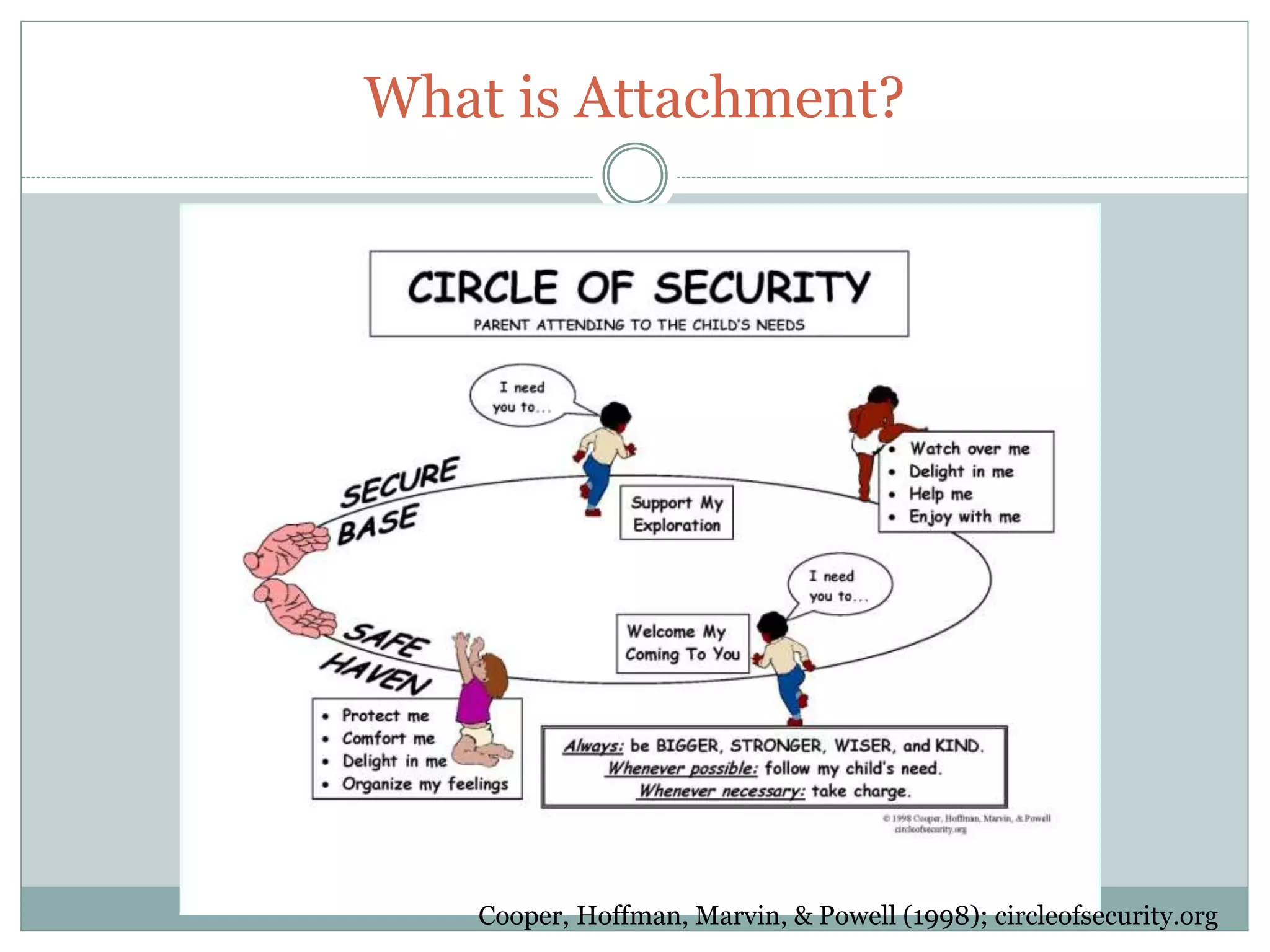
What is Attachment?
Cooper, Hoffman, Marvin, & Powell (1998); circleofsecurity.org
What is Attachment?
 Overtime, they develop mental representations
of those relationships based on experiences
o Will my caregiver protect
me?
o What is the best way to
receive protection
o Is my caregiver reliable?
o Is the world a safe place?
o Do I deserve protection?
 They use those mental representations to make
predictions about future interactions, as well as
about the world in general
Ainsworth, et. Al (1978); Bowlby (1969/1982)
What is Attachment?
Ainsworth, et. Al (1978)
Attachment ~ A Buffer For Development
 Attachment relationship serves as a buffer
factor against developmental risk
 Decreased mental health/ psychopathology in adolescence
and adulthood
 Improved social skills during preschool, school-age, and
beyond
 Greater self-esteem, independence, and cooperation
 Higher cognitive scores
 Greater language and communication skills
 Emotion regulation
 Increased Positive behavior and Compliance
 Positive affect (mood)
 Improved play/symbolic play in the preschool years
Thomson, R.A. (2010)
Attachment & Children with Special Needs
 Children with special needs form attachments to
caregivers
 Physical disabilities, cognitive disabilities,
psychological disorders, and developmental delays
complicate the parent-child relationship
 Children with disabilities are more likely to have
Insecure/Disorganized attachment than
typically developing
Howe, D. (2006); Schuengel, C., & Janssen, C.G.C. (2006)
Attachment & Children with Special Needs
Child Factors:
• Decreased
communication/
understanding
• Inability to interpret
social cues
• Less feedback to
caregivers
• Needs are difficult
to interpret
Parent Factors:
• Increased stress
(financial, increased
caregiving, parenting
stress)
• Parent’s own
Attachment Defenses
• Understanding/
“resolving” child’s
diagnosis
Examples
“After the age of 2 years, hearing
parents of deaf children appear to
show decreased levels of interaction
compared with hearing parents of hearing
children whose levels of interaction
increase (Gregory, 1976), and what
interaction there is tends to become a little
more difficult, frustrated, and
punitive (Meadow, 1980).”
Howe, D. (2006), p. 98
Examples
“It has also been observed that children with Downs Syndrome use fewer
internal state words, i.e. they are less likely to report on what they think,
feel, believe or remember.” Over time, “their mother’s also begin to use
fewer internal state words in conversation with their children (Beeghly &
Cicchetti, 1997). The effect of this is that less information is being shared
between parents and children about… thoughts and feelings.”
Howe, D. (2006), p. 98
Examples
Children with autism lack the
ability to understand other
peoples’ states of mind. “This
produces major problems in
achieving joint attention, social
relationships, and communication,
particularly for parents.”
Howe, D. (2006), p. 100
What does this mean???
 Learn about your child’s
diagnosis, disability or delay to
understand what their individual
attachment “cues” look like
 From professionals – NOT just
the internet
 Find ways to decrease stress
 Exercise, meditation, social
activities, sleep, hobbies
 Social support, social support,
social support!!
Howe, D. (2006); Schuengel, C., & Janssen, C.G.C. (2006)
What does this mean???
 “Resolve” your own
attachment issues, which you
bring to your relationship with
your child
 Parenting from the Inside Out
by Daniel Siegel
 Talk with a therapist/counselor
(even if you don’t think you need
to)
Howe, D. (2006); Schuengel, C., & Janssen, C.G.C. (2006)
What does this mean???
 Circle of Security counseling group/ parent
educators (circleofsecurity.org  “parents”)
ALWAYS: Be BIGGER,
STRONGER, WISER, and
KIND
WHENEVER
POSSIBLE: follow my
child’s need
WHENEVER
NECESSARY: take charge
Cooper, Hoffman, Marvin, & Powell (1998); circleofsecurity.org
QUESTIONS??
SPECIAL THANKS TO PHP AND DENNY
DE HARNE
THANK YOU!

Understanding Child-Parent Attachment in Children with Special Needs

  • 1.
    M I CH E L L E F I T Z P A T R I C K , M A , C I M I I N F A N T M E N T A L H E A L T H S P E C I A L I S T M A Y 7 , 2 0 1 4 W I T H : Understanding Parent-Child Attachment In Children with Special Needs Parents Helping Parents, Santa Clara County HappyPaleoKids.com Special Topics in Early Childhood Development Series
  • 2.
    About Me -Michelle  Education  BA, Mills College, Psychology  MA, Mills College, Infant Mental Health  Work History  Infant Developmental Specialist, Baby Builders, Oakland  Early Start Service Coordinator, SARC, Campbell  Mental Health Counselor, Pre-to-Three, San Mateo County  …more!  Currently  Stay at home mom (Annie, 4; Rosie, 2; Elizabeth, 1)  Blog: happypaleokids.com, applying child development knowledge with practical nutritional advice for families
  • 3.
    What is Attachment? Children form relationships with people “stronger and wiser” in their environment in order to be protected  Children use their caregivers as a Secure Base/ Safe Haven from which to explore Ainsworth, et. Al (1978); Bowlby (1969/1982)
  • 4.
    What is Attachment? Cooper,Hoffman, Marvin, & Powell (1998); circleofsecurity.org
  • 5.
    What is Attachment? Overtime, they develop mental representations of those relationships based on experiences o Will my caregiver protect me? o What is the best way to receive protection o Is my caregiver reliable? o Is the world a safe place? o Do I deserve protection?  They use those mental representations to make predictions about future interactions, as well as about the world in general Ainsworth, et. Al (1978); Bowlby (1969/1982)
  • 6.
  • 7.
    Attachment ~ ABuffer For Development  Attachment relationship serves as a buffer factor against developmental risk  Decreased mental health/ psychopathology in adolescence and adulthood  Improved social skills during preschool, school-age, and beyond  Greater self-esteem, independence, and cooperation  Higher cognitive scores  Greater language and communication skills  Emotion regulation  Increased Positive behavior and Compliance  Positive affect (mood)  Improved play/symbolic play in the preschool years Thomson, R.A. (2010)
  • 8.
    Attachment & Childrenwith Special Needs  Children with special needs form attachments to caregivers  Physical disabilities, cognitive disabilities, psychological disorders, and developmental delays complicate the parent-child relationship  Children with disabilities are more likely to have Insecure/Disorganized attachment than typically developing Howe, D. (2006); Schuengel, C., & Janssen, C.G.C. (2006)
  • 9.
    Attachment & Childrenwith Special Needs Child Factors: • Decreased communication/ understanding • Inability to interpret social cues • Less feedback to caregivers • Needs are difficult to interpret Parent Factors: • Increased stress (financial, increased caregiving, parenting stress) • Parent’s own Attachment Defenses • Understanding/ “resolving” child’s diagnosis
  • 10.
    Examples “After the ageof 2 years, hearing parents of deaf children appear to show decreased levels of interaction compared with hearing parents of hearing children whose levels of interaction increase (Gregory, 1976), and what interaction there is tends to become a little more difficult, frustrated, and punitive (Meadow, 1980).” Howe, D. (2006), p. 98
  • 11.
    Examples “It has alsobeen observed that children with Downs Syndrome use fewer internal state words, i.e. they are less likely to report on what they think, feel, believe or remember.” Over time, “their mother’s also begin to use fewer internal state words in conversation with their children (Beeghly & Cicchetti, 1997). The effect of this is that less information is being shared between parents and children about… thoughts and feelings.” Howe, D. (2006), p. 98
  • 12.
    Examples Children with autismlack the ability to understand other peoples’ states of mind. “This produces major problems in achieving joint attention, social relationships, and communication, particularly for parents.” Howe, D. (2006), p. 100
  • 13.
    What does thismean???  Learn about your child’s diagnosis, disability or delay to understand what their individual attachment “cues” look like  From professionals – NOT just the internet  Find ways to decrease stress  Exercise, meditation, social activities, sleep, hobbies  Social support, social support, social support!! Howe, D. (2006); Schuengel, C., & Janssen, C.G.C. (2006)
  • 14.
    What does thismean???  “Resolve” your own attachment issues, which you bring to your relationship with your child  Parenting from the Inside Out by Daniel Siegel  Talk with a therapist/counselor (even if you don’t think you need to) Howe, D. (2006); Schuengel, C., & Janssen, C.G.C. (2006)
  • 15.
    What does thismean???  Circle of Security counseling group/ parent educators (circleofsecurity.org  “parents”) ALWAYS: Be BIGGER, STRONGER, WISER, and KIND WHENEVER POSSIBLE: follow my child’s need WHENEVER NECESSARY: take charge Cooper, Hoffman, Marvin, & Powell (1998); circleofsecurity.org
  • 16.
  • 17.
    SPECIAL THANKS TOPHP AND DENNY DE HARNE THANK YOU!