Industrial Policies - Meaning  Industrial policy means rules, regulations, principles, policies  and  procedures laid down by government for regulating,  developing, and controlling industrial undertakings in the  country. It prescribes the respective roles of the public, private, joint, and co-operative sectors for the development of industries. It also indicates  the role of the large, medium and small scale sector. It incorporates fiscal and monetary policies, tarrif policy, labour policy,  and the government attitude towards foreign capital, and Role to be played by multinational corporations in the development of the industrial sector.
Objectives of Industrial Policies Industrial policy statements have been announced from 1948 onwards . A number of objectives have been projected by the Government of India while making industrial policy declarations. Some of the important objectives can be identified as follows: Achieving a socialistic pattern of society Preventing undue concentration of economic power Achieving industrial development Reducing disparities in regional development Developing heavy and capital goods industry Providing opportunities for gainful employment Expanding the public sector for achieving socialism
Achieving a self-sustained economy Achieving faster economic growth Alleviating poverty Protecting and developing a healthy small-  scale sector Updating technology and modernization of  industry Liberalization and globalization of economy Many measures have been adopted by the central  government for the accomplishment of these industrial policy objectives.
India’s Industrial Policies from 1948 to 1991
Pandit Jawaharlal Nehru laid the foundations of modern India.  It is due to his initiative that India now has a strong and diversified  industrial base and is a major industrial nation of the world.  The goals and objectives set out for the nation by Pandit Nehru  on the eve of Independence, were as follows: Rapid agricultural and industrial development of the country  Rapid expansion of opportunities for gainful employment  Progressive reduction of social and economic disparities Removal of poverty and attainment of self-reliance  These objectives remain as valid today as at the time Pandit Nehru first set them out before the nation. Any industrial policy must  contribute to the realisation of these goals and objectives at an accelerated pace.  The present statement of industrial policy is inspired by these very  concerns, and represents a renewed initiative towards consolidating the gains of national reconstruction at this crucial stage.
Industrial Policy Resolution of 1948   The Government of India announced its first industrial policy resolution on 6 April,1948. The policy resolution laid stress  on the role of the state in the development of industry.  The industrial activities were divided into four broad areas: Items under central government control  –  Manufacture of arms and ammunition,  The production and control of atomic energy and  O wnership and management of railway transport  Further in any emergency, the Government would always have the power to take over any industry vital for  national defense.
2.  Items under the state government control  ( which in  this context, includes Central, State Governments and  other Public Authorities like Municipal Corporations ) - Coal  Iron and Steel.  Aircraft manufacture.  Shipbuilding.  Manufacture of telephone, telegraph and wireless  apparatus, excluding radio receiving sets.  Mineral oils.
3.  Items of  basic importance, would be planned and  regulated by the Central government   The following are such basic industries:  Salt  Automobiles and tractors  Electric engineering   Other heavy machinery  Machine tools  Heavy chemicals,  Fertilizers and  pharmaceuticals and drugs   Rubber manufactures  Power  Cotton and woolen textiles   Cement   Sugar  Paper and Newsprint  Air and Sea transport, and so on
Items for Private Sector :  The rest of the industrial field will normally be open to private enterprise.  The State will also progressively participate in this field;  nor will it hesitate to intervene whenever the progress of an  industry under private enterprise is unsatisfactory . Highlights of the Policy : The 1948 resolution accepted the importance of small and  cottage industries in industrial development. These  industries are particularly suited for the utilization of local  resources and for the achievement of the local self-sufficiency in respect of certain types of essential  consumer goods like food, cloth and agricultural implements.
The healthy expansion of cottage and small scale industries depends upon a number of factors like the provision of raw  materials,  cheap power, technical advice, and where necessary, safeguards  against intensive competition by large scale manufacture, as the  education of the worker in the use of the best available technique.  Most of these are receiving the attention of the Governments .
Industrial Policy Resolution 1956 Introduction : Eight years have passed since the declaration of  Industrial policy 1948. These eight years have witnessed many  Important changes and developments in India.  The constitution of India has been enacted, guaranteeing certain fundamental rights and enunciating Directive Principles of State Policy. Planning has proceeded on an organised basis, and the first Five Year Plan has recently been completed.  Parliament has accepted the socialist pattern of society as the objective of social and economic policy.  These important developments necessiate a fresh statement  of industrial policy, more particularly as the Second Five Year Plan  will soon be placed before the country.
This policy also emphasised that industrial development of the country should be guided by the Directive Principles laid down in the Constitution.  The 1956 Policy was regarded as the “ economic constitution of India “.  Directive Principles: In its Directive Principles of State Policy, it is stated that –  "The State shall strive to promote the welfare of the people by  securing and protecting as effectively as it may a social order in which justice, social, economic and political, shall inform all the institutions of the national life."
Further that-  "The State shall, in particular, direct its policy towards securing:  that the citizens, men and women equally, have the right to an adequate means of livelihood;  that the ownership and control of the material resources of the community are so distributed as best to sub serve the common good;  that the operation of the economic system dies not result in the concentration of wealth and means of production to the common detriment; that there is equal pay for equal work for both men women;  that childhood are protected against exploitation and so on.
Objectives of the 1956 Industrial Policy To accelerate the rate of growth and speed up industrialisation. To expand public sector. To develop heavy and machine industry. To curtail the concentration of economic power in few hands. To reduce the disequilibrium in the distribution of income and wealth. To build a cooperative sector. To expand cottage, village and small-scale industry. To achieve balanced regional development and other  socio-economic objectives.
The adoption of the socialist pattern of society as the national objective,  as well as the need for planned and rapid development, require that all industries of basic and strategic importance, or in the nature of public utility  services, should be in the public sector.  Other industries, which are essential and require investment on a scale which  only the state, has, therefore, to assume direct responsibility for the further  development of industries over a wider area. Nevertheless, there are limiting factors, which make it necessary at this stage for the state to define the field in which it will undertake sole responsibility for further development, and to make a selection of industries in the development  of which it will play dominant role.  After considering all aspects of the problem in consultation with the Planning Commission, the Government of India have decided to classify industries into three categories, having regard to the part which the State would play in each of them. It should also be remembered that it is always open to the State to undertake any type of industrial production.
Features of the Policy The 1956 resolution divided industries into three categories: Monopoly of the State Mixed Sector Industries left for Private Sector Monopoly of the State In this list (Schedule A) industries the future development of  which will be the exclusive responsibility of the State were  included.
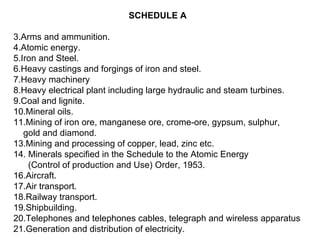
SCHEDULE A Arms and ammunition.   Atomic energy.  Iron and Steel.  Heavy castings and forgings of iron and steel.  Heavy machinery  Heavy electrical plant including large hydraulic and steam turbines.   Coal and lignite.   Mineral oils.   Mining of iron ore, manganese ore, crome-ore, gypsum, sulphur, gold and diamond.  Mining and processing of copper, lead, zinc etc. Minerals specified in the Schedule to the Atomic Energy (Control of production and Use) Order, 1953.  Aircraft.  Air transport.   Railway transport.   Shipbuilding.  Telephones and telephones cables, telegraph and wireless apparatus  Generation and distribution of electricity. 
Mineral oil is one of a number of inexpensive byproducts that are made from petroleum. Sometimes referred to as  paraffin oil , or liquid petroleum.  ferrous is an adjective used to indicate the presence of iron. [1]  The word  is derived from the  Latin  word ferrum ( iron ). [2]  Ferrous metals include  steel  and  pig iron  (which contain a few percent of carbon) and  alloys  of iron with other metals (such as stainless steel.) The term non-ferrous is used to indicate  metals  other than iron and  alloys  that do not contain an appreciable amount of iron. [3]
Mixed Sector In this list (Schedule B) 12 industries were included. These will be progressively State-owned and in which the State will, therefore, generally take the initiative in establishing new undertakings, but in which private enterprise will also be  expected to supplement the efforts of the State.
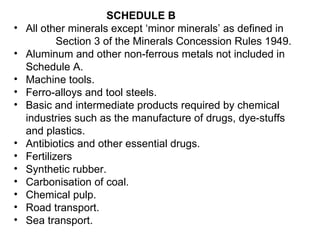
SCHEDULE B All other minerals except ‘minor minerals’ as defined in  Section 3 of the Minerals Concession Rules 1949.  Aluminum and other non-ferrous metals not included in Schedule A.  Machine tools.  Ferro-alloys and tool steels.  Basic and intermediate products required by chemical industries such as the manufacture of drugs, dye-stuffs and plastics.  Antibiotics and other essential drugs.  Fertilizers  Synthetic rubber.  Carbonisation of coal.   Chemical pulp.  Road transport.  Sea transport. 
The major producers in the India heavy chemical industry:  Pidilite Industries Limited  Asian Paints  Balmer Lawrie  Indian Petrochemical Corporation Limited  Ciba Specialty Chemicals  ION Exchange  Gujarat Narmada Valley Fertilizers Company  Rallis  United Phosphorus  IFFCO  Bayer CropScience Limited  Hindustan Lever Limited  Reliance Industries Limited  Clariant India  BASF India

Industrial Policies

  • 1.
    Industrial Policies -Meaning Industrial policy means rules, regulations, principles, policies and procedures laid down by government for regulating, developing, and controlling industrial undertakings in the country. It prescribes the respective roles of the public, private, joint, and co-operative sectors for the development of industries. It also indicates the role of the large, medium and small scale sector. It incorporates fiscal and monetary policies, tarrif policy, labour policy, and the government attitude towards foreign capital, and Role to be played by multinational corporations in the development of the industrial sector.
  • 2.
    Objectives of IndustrialPolicies Industrial policy statements have been announced from 1948 onwards . A number of objectives have been projected by the Government of India while making industrial policy declarations. Some of the important objectives can be identified as follows: Achieving a socialistic pattern of society Preventing undue concentration of economic power Achieving industrial development Reducing disparities in regional development Developing heavy and capital goods industry Providing opportunities for gainful employment Expanding the public sector for achieving socialism
  • 3.
    Achieving a self-sustainedeconomy Achieving faster economic growth Alleviating poverty Protecting and developing a healthy small- scale sector Updating technology and modernization of industry Liberalization and globalization of economy Many measures have been adopted by the central government for the accomplishment of these industrial policy objectives.
  • 4.
  • 5.
    Pandit Jawaharlal Nehrulaid the foundations of modern India. It is due to his initiative that India now has a strong and diversified industrial base and is a major industrial nation of the world. The goals and objectives set out for the nation by Pandit Nehru on the eve of Independence, were as follows: Rapid agricultural and industrial development of the country Rapid expansion of opportunities for gainful employment Progressive reduction of social and economic disparities Removal of poverty and attainment of self-reliance These objectives remain as valid today as at the time Pandit Nehru first set them out before the nation. Any industrial policy must contribute to the realisation of these goals and objectives at an accelerated pace. The present statement of industrial policy is inspired by these very concerns, and represents a renewed initiative towards consolidating the gains of national reconstruction at this crucial stage.
  • 6.
    Industrial Policy Resolutionof 1948 The Government of India announced its first industrial policy resolution on 6 April,1948. The policy resolution laid stress on the role of the state in the development of industry. The industrial activities were divided into four broad areas: Items under central government control – Manufacture of arms and ammunition, The production and control of atomic energy and O wnership and management of railway transport Further in any emergency, the Government would always have the power to take over any industry vital for national defense.
  • 7.
    2. Itemsunder the state government control ( which in this context, includes Central, State Governments and other Public Authorities like Municipal Corporations ) - Coal Iron and Steel. Aircraft manufacture. Shipbuilding. Manufacture of telephone, telegraph and wireless apparatus, excluding radio receiving sets. Mineral oils.
  • 8.
    3. Itemsof basic importance, would be planned and regulated by the Central government The following are such basic industries: Salt Automobiles and tractors Electric engineering  Other heavy machinery Machine tools Heavy chemicals, Fertilizers and pharmaceuticals and drugs  Rubber manufactures Power Cotton and woolen textiles  Cement  Sugar Paper and Newsprint Air and Sea transport, and so on
  • 9.
    Items for PrivateSector : The rest of the industrial field will normally be open to private enterprise. The State will also progressively participate in this field; nor will it hesitate to intervene whenever the progress of an industry under private enterprise is unsatisfactory . Highlights of the Policy : The 1948 resolution accepted the importance of small and cottage industries in industrial development. These industries are particularly suited for the utilization of local resources and for the achievement of the local self-sufficiency in respect of certain types of essential consumer goods like food, cloth and agricultural implements.
  • 10.
    The healthy expansionof cottage and small scale industries depends upon a number of factors like the provision of raw materials, cheap power, technical advice, and where necessary, safeguards against intensive competition by large scale manufacture, as the education of the worker in the use of the best available technique. Most of these are receiving the attention of the Governments .
  • 11.
    Industrial Policy Resolution1956 Introduction : Eight years have passed since the declaration of Industrial policy 1948. These eight years have witnessed many Important changes and developments in India. The constitution of India has been enacted, guaranteeing certain fundamental rights and enunciating Directive Principles of State Policy. Planning has proceeded on an organised basis, and the first Five Year Plan has recently been completed. Parliament has accepted the socialist pattern of society as the objective of social and economic policy. These important developments necessiate a fresh statement of industrial policy, more particularly as the Second Five Year Plan will soon be placed before the country.
  • 12.
    This policy alsoemphasised that industrial development of the country should be guided by the Directive Principles laid down in the Constitution. The 1956 Policy was regarded as the “ economic constitution of India “. Directive Principles: In its Directive Principles of State Policy, it is stated that – "The State shall strive to promote the welfare of the people by securing and protecting as effectively as it may a social order in which justice, social, economic and political, shall inform all the institutions of the national life."
  • 13.
    Further that- "The State shall, in particular, direct its policy towards securing: that the citizens, men and women equally, have the right to an adequate means of livelihood; that the ownership and control of the material resources of the community are so distributed as best to sub serve the common good; that the operation of the economic system dies not result in the concentration of wealth and means of production to the common detriment; that there is equal pay for equal work for both men women; that childhood are protected against exploitation and so on.
  • 14.
    Objectives of the1956 Industrial Policy To accelerate the rate of growth and speed up industrialisation. To expand public sector. To develop heavy and machine industry. To curtail the concentration of economic power in few hands. To reduce the disequilibrium in the distribution of income and wealth. To build a cooperative sector. To expand cottage, village and small-scale industry. To achieve balanced regional development and other socio-economic objectives.
  • 15.
    The adoption ofthe socialist pattern of society as the national objective, as well as the need for planned and rapid development, require that all industries of basic and strategic importance, or in the nature of public utility services, should be in the public sector. Other industries, which are essential and require investment on a scale which only the state, has, therefore, to assume direct responsibility for the further development of industries over a wider area. Nevertheless, there are limiting factors, which make it necessary at this stage for the state to define the field in which it will undertake sole responsibility for further development, and to make a selection of industries in the development of which it will play dominant role. After considering all aspects of the problem in consultation with the Planning Commission, the Government of India have decided to classify industries into three categories, having regard to the part which the State would play in each of them. It should also be remembered that it is always open to the State to undertake any type of industrial production.
  • 16.
    Features of thePolicy The 1956 resolution divided industries into three categories: Monopoly of the State Mixed Sector Industries left for Private Sector Monopoly of the State In this list (Schedule A) industries the future development of which will be the exclusive responsibility of the State were included.
  • 17.
    SCHEDULE A Armsand ammunition.  Atomic energy. Iron and Steel. Heavy castings and forgings of iron and steel. Heavy machinery Heavy electrical plant including large hydraulic and steam turbines.  Coal and lignite.  Mineral oils.  Mining of iron ore, manganese ore, crome-ore, gypsum, sulphur, gold and diamond. Mining and processing of copper, lead, zinc etc. Minerals specified in the Schedule to the Atomic Energy (Control of production and Use) Order, 1953. Aircraft. Air transport.  Railway transport.  Shipbuilding. Telephones and telephones cables, telegraph and wireless apparatus Generation and distribution of electricity. 
  • 18.
    Mineral oil isone of a number of inexpensive byproducts that are made from petroleum. Sometimes referred to as paraffin oil , or liquid petroleum. ferrous is an adjective used to indicate the presence of iron. [1] The word is derived from the Latin word ferrum ( iron ). [2] Ferrous metals include steel and pig iron (which contain a few percent of carbon) and alloys of iron with other metals (such as stainless steel.) The term non-ferrous is used to indicate metals other than iron and alloys that do not contain an appreciable amount of iron. [3]
  • 19.
    Mixed Sector Inthis list (Schedule B) 12 industries were included. These will be progressively State-owned and in which the State will, therefore, generally take the initiative in establishing new undertakings, but in which private enterprise will also be expected to supplement the efforts of the State.
  • 20.
    SCHEDULE B Allother minerals except ‘minor minerals’ as defined in Section 3 of the Minerals Concession Rules 1949. Aluminum and other non-ferrous metals not included in Schedule A. Machine tools. Ferro-alloys and tool steels. Basic and intermediate products required by chemical industries such as the manufacture of drugs, dye-stuffs and plastics. Antibiotics and other essential drugs. Fertilizers Synthetic rubber. Carbonisation of coal.  Chemical pulp. Road transport.  Sea transport. 
  • 21.
    The major producersin the India heavy chemical industry: Pidilite Industries Limited Asian Paints Balmer Lawrie Indian Petrochemical Corporation Limited Ciba Specialty Chemicals ION Exchange Gujarat Narmada Valley Fertilizers Company Rallis United Phosphorus IFFCO Bayer CropScience Limited Hindustan Lever Limited Reliance Industries Limited Clariant India BASF India