MONETARY POLICY
Reserve Bank Of India
The Reserve Bank Of India (RBI) is the central banking
system of India and control the monetary policy of the
rupee.
The institution was established on 1stApril, 1935 and plays
an important part in the development strategy of the
government.
The inaugural officeholder was the British banker Osborne
Smith, while C. D. Deshmukh was the first Indian
governor. The position is currently held by Urjit Patel, who
took over from Raghuram Rajan on 4 September 2016.
Role of RBI
 India’s monetary authority
 Supervisor of financial system
 Issuer of currency
 Manager of foreign exchange reserves
 Banker and debt manager to Government
 Banker to bank
 Developmental functions
 Research, data and knowledge sharing since 75 years:
Monetary Policy
The process by which the monetary authority of a
country controls the supply of money.
Monetary policy refers to the use of instruments under
the control of the RBI to regulate the availability, cost
and use of money and credit.
The goal: achieving specific economic objectives, such
as low and stable inflation and promoting growth.
Objective
Objective are classified in two aspects :
Under Developed countries
Developed countries
 To have high aggregate demand without inflation
 Eradicate inflationary and deflationary gap
 High research/ further development
 Providing assistance to other countries
 Gaining monetary control over others
Under Developed Countries
 To achieve full employment
 To have high Efficiency
 To have large scale of resources mobilization
 To increase Export
 To have high investment
 To provide price and exchange stability
 To have efficient allocation and utilization of resources
 To raise living standards
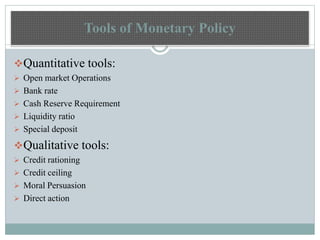
Tools of Monetary Policy
Quantitative tools:
 Open market Operations
 Bank rate
 Cash Reserve Requirement
 Liquidity ratio
 Special deposit
Qualitative tools:
 Credit rationing
 Credit ceiling
 Moral Persuasion
 Direct action
Process of Monetary policy Formulation
Internal Work Process
Technical analysis, coordination, horizontal
management
Monetary Policy:
A consultative and participative process
Central
Board of
Directors
Reviews the
stance of
monetary
policy
Board for
Financial
supervision
reviews
supervisory data
and financial
stability issues
Committee of the
Board meets weekly
to review the
monetary, economic,
financial condition
and advice
appropriately
Periodic
consultations
with the
Government
mainly Ministry
of finance to
ensure
coordination
Resource
management
discussions
with select
major banks
Periodic
consultations
with
academics and
market
Analyses strategies
on an ongoing basis:
reviews growth and
inflation situation
and macroeconomic
projections
Market
information,
economic and
statistical
analysis
Financial
Markets
Committee
Technical Advisory
Committees on
Monetary Policy:
Advises on the stance
of monetary policy
Monetary policy
strategy Meetings
Reviews and manages
daily market operation
and adopts strategies
Target for Monetary Policy
Used to control
Set to Achieve
Tools for Monetary Policy
Open Market Operations
Discount Loans
Changes in Reserve Requirement
Goals for Monetary Policy
High Employment and Growth
Price Stability or low Inflation
Financial Market and Interest
Rate stability
Target for Monetary
Policy
Money supply
Interest Rates
Open Market Operations: Buying securities
from commercial bank
• Gives up
securities
Bank
• Pays the
bank
Fed/ CB
• Increase
reserves
Bank
Open Market Operation:Buying securites from
public
• Gives up
securities
Public
• Pays
Fed/CB
• Deposits
in bank
Public
• Increase
reserves
Bank
Open Market Operation : Selling securities to
commercial bank
• Gives up
securities
Fed/CB
• Pays
Bank
• Decreases
reserves
Bank
Open Market Operation : Selling securities to public
• Gives up
securities
Fed/ CB
• Pays by
check from
bank
Public
• Decreases
reserves
Bank
Different interest rates prevalent in India
 Bank rate: The rate at which RBI lends money to domestic
banking system.
 Call Money rate : The rate at which commercial bank borrows
money from other commercial banks for a short period
 Prime Lending rate : The rate at which the commercial banks
can provide credit to industries or business
 Repo and Reverse Repo rate : The interest rate at which RBI
provides loan to commercial banks is called Repo rate(rate
6.5%). The rate at which RBI takes short term credit is Reverse
Repo rate(rate 6%).
 Deposit rate: The rate of interest at which the customers are paid
interest on their bank deposits.
Different interest rates prevalent in India (cont..)
 Bond rate : To meet expenses for the development,
Government issues the bond maturing in definite period at a
definite rate.
 Cash Reserve Ratio: banks in India are required to hold a
certain proportion of their deposits in the form of cash with
RBI. This minimum ratio is known as the CRR.(rate 4%)
 Statutory Liquidity Ratio: The minimum percentage of
deposits that the bank has to maintains in form of gold, cash,
or other approved securities is known as SLR. (rate 21%)
Limitation of Monetary Policy
 Monetary policy cannot change long-term growth.
 There is no long term tradeoff between growth and
inflation
 Monetary policy can deliver low and stable inflation,
and thereby reduce the volatility of the business cycle.
 It cannot really predict when inflationary pressures
builds up
THANK YOU

Monetary policy Presentations

  • 1.
  • 2.
    Reserve Bank OfIndia The Reserve Bank Of India (RBI) is the central banking system of India and control the monetary policy of the rupee. The institution was established on 1stApril, 1935 and plays an important part in the development strategy of the government. The inaugural officeholder was the British banker Osborne Smith, while C. D. Deshmukh was the first Indian governor. The position is currently held by Urjit Patel, who took over from Raghuram Rajan on 4 September 2016.
  • 3.
    Role of RBI India’s monetary authority  Supervisor of financial system  Issuer of currency  Manager of foreign exchange reserves  Banker and debt manager to Government  Banker to bank  Developmental functions  Research, data and knowledge sharing since 75 years:
  • 4.
    Monetary Policy The processby which the monetary authority of a country controls the supply of money. Monetary policy refers to the use of instruments under the control of the RBI to regulate the availability, cost and use of money and credit. The goal: achieving specific economic objectives, such as low and stable inflation and promoting growth.
  • 5.
    Objective Objective are classifiedin two aspects : Under Developed countries Developed countries  To have high aggregate demand without inflation  Eradicate inflationary and deflationary gap  High research/ further development  Providing assistance to other countries  Gaining monetary control over others
  • 6.
    Under Developed Countries To achieve full employment  To have high Efficiency  To have large scale of resources mobilization  To increase Export  To have high investment  To provide price and exchange stability  To have efficient allocation and utilization of resources  To raise living standards
  • 7.
    Tools of MonetaryPolicy Quantitative tools:  Open market Operations  Bank rate  Cash Reserve Requirement  Liquidity ratio  Special deposit Qualitative tools:  Credit rationing  Credit ceiling  Moral Persuasion  Direct action
  • 8.
    Process of Monetarypolicy Formulation Internal Work Process Technical analysis, coordination, horizontal management Monetary Policy: A consultative and participative process Central Board of Directors Reviews the stance of monetary policy Board for Financial supervision reviews supervisory data and financial stability issues Committee of the Board meets weekly to review the monetary, economic, financial condition and advice appropriately Periodic consultations with the Government mainly Ministry of finance to ensure coordination Resource management discussions with select major banks Periodic consultations with academics and market Analyses strategies on an ongoing basis: reviews growth and inflation situation and macroeconomic projections Market information, economic and statistical analysis Financial Markets Committee Technical Advisory Committees on Monetary Policy: Advises on the stance of monetary policy Monetary policy strategy Meetings Reviews and manages daily market operation and adopts strategies
  • 9.
    Target for MonetaryPolicy Used to control Set to Achieve Tools for Monetary Policy Open Market Operations Discount Loans Changes in Reserve Requirement Goals for Monetary Policy High Employment and Growth Price Stability or low Inflation Financial Market and Interest Rate stability Target for Monetary Policy Money supply Interest Rates
  • 10.
    Open Market Operations:Buying securities from commercial bank • Gives up securities Bank • Pays the bank Fed/ CB • Increase reserves Bank
  • 11.
    Open Market Operation:Buyingsecurites from public • Gives up securities Public • Pays Fed/CB • Deposits in bank Public • Increase reserves Bank
  • 12.
    Open Market Operation: Selling securities to commercial bank • Gives up securities Fed/CB • Pays Bank • Decreases reserves Bank
  • 13.
    Open Market Operation: Selling securities to public • Gives up securities Fed/ CB • Pays by check from bank Public • Decreases reserves Bank
  • 14.
    Different interest ratesprevalent in India  Bank rate: The rate at which RBI lends money to domestic banking system.  Call Money rate : The rate at which commercial bank borrows money from other commercial banks for a short period  Prime Lending rate : The rate at which the commercial banks can provide credit to industries or business  Repo and Reverse Repo rate : The interest rate at which RBI provides loan to commercial banks is called Repo rate(rate 6.5%). The rate at which RBI takes short term credit is Reverse Repo rate(rate 6%).  Deposit rate: The rate of interest at which the customers are paid interest on their bank deposits.
  • 15.
    Different interest ratesprevalent in India (cont..)  Bond rate : To meet expenses for the development, Government issues the bond maturing in definite period at a definite rate.  Cash Reserve Ratio: banks in India are required to hold a certain proportion of their deposits in the form of cash with RBI. This minimum ratio is known as the CRR.(rate 4%)  Statutory Liquidity Ratio: The minimum percentage of deposits that the bank has to maintains in form of gold, cash, or other approved securities is known as SLR. (rate 21%)
  • 16.
    Limitation of MonetaryPolicy  Monetary policy cannot change long-term growth.  There is no long term tradeoff between growth and inflation  Monetary policy can deliver low and stable inflation, and thereby reduce the volatility of the business cycle.  It cannot really predict when inflationary pressures builds up
  • 17.