1
Course: LLB I
Subject: Environmental Law
Unit : I
Concept of Environment
The Concept of Environment
2
 “Environment” owes its genesis to a French word ‘environ’,
which means ‘encircle’. It encompasses within its ambit land,
water, flora, fauna, living creatures, forest and everything above
the earth.
 ‘Environment’ all components surrounding man,
Consist of two important major parts.
3
Physical & Natural
Physical environment constitutes lithosphere, land,
hydrosphere and atmosphere means water and air respectively.
The natural environment constitutes living organisms including
human beings, flora and fauna, etc.
It may be noted that all this is perceived in the definition of
environment provided by the Environment (Protection) Act,
1986, which states:
Environment includes water, air and land, and the inter-
relationships which exist among and between water, air and
land, and human beings, other living creatures, plants, micro-
organisms and property.
The Indian Constitution and Environment
4
 The culmination of various international efforts initiated 38
years ago at Stockholm(Sweden) where the first historic
international conference on Human Environment was held in
1972.
 There is a major environmental crisis of a global proportion
affecting the physical, natural and human environment due to
pollution of all kinds.
 It is of serious concern to the international community that the
greenhouse gases emissions continued to be on the rise.
5
 The UN mandated intergovernmental panel
on climate change says that by 2100 the
global temperature increases will range
between 1.4 degree Celsius and 5.8 degree
Celsius. Mean sea levels may rise by 80 cm,
inundating low-laying areas and smaller
islands. It has been predicted that there will
be more frequent and severe heat waves,
more intense tropical cyclones, changes in
rainfall patterns and melting of ice.
The Indian Constitution and Environment
6
 Environmental degradation is generally caused not only by the pollution of
the atmosphere and of the maritime, and the coastal inland waters through
the disruption of rural lands but also by the destruction of ecological balance
of natural areas and the adverse effect of the use of biocides upon animal
and plant life. Another important reason for environment degradation is the
uncontrolled exploitation and the consequent depletion of world’s natural
resources.
 The Indian Apex Court, The entire world is facing a serious problem of
environmental degradation due to indiscriminate development.
Industrialization, burning of fossil fuels and massive deforestation are
leading to degradation of environment.
The Indian Constitution and Environment
7
 Today the atmosphere level of carbon dioxide, the principal source of global
warming is 26 percent higher than pre-industrial concentration.
 Enormous amount of gases and chemicals emitted by the industrial plants
and automobiles have led to depletion of ozone layers which serve as a
shield to protect life on the earth from the ultraviolet rays of the sun.
 The problems of “acid rain” which is caused mainly by the emission of
sulphur dioxide and Nitrogen oxides from power stations and industrial
installations is a graphic example of it. The ill effect of “acid rain” can be
found on vegetables, soil, marine resources, and monuments as well as on
humans.
 Air pollutants and acids generated by the industrial activities are now
entering forest at an unprecedented scale.
International Community
8
 It is imperative that the international community
should be shaken from its slumber to be prepared to
combat this environmental crisis by taking
appropriate measures,
 which should be not only for controlling pollution but
also for protecting and promoting environment.
 The 5th June of every year as an International
Environmental Day, given at the UN summit on
Environment and development at Stockholm, in 1972.
Indian Efforts to Combat Environmental Pollution
9
 India has joined the members of the international community
in their crusade against environmental problems, first, by
amending its own fundamental law, and then, by following it up
with the enactment of several laws to protect national
environment.
 The new constitutional provisions have given the necessary
impetus to the environmental legislation in the country.
ENVIRONMENTAL REGULATIONS AND LEGAL FRAMEWORK IN INDIA
10
 The State's responsibility with regard to environmental
protection has been laid down under Article 48-A "The State
shall endeavour to protect and improve the environment and to
safeguard the forests and wildlife of the country".
 Environmental protection is a fundamental duty of every citizen
of this country under Article 51-A(g) "It shall be the duty of
every citizen of India to protect and improve the natural
environment including forests, lakes, rivers and wildlife and to
have compassion for living creatures.“
11
"No person shall be deprived of his life or personal
liberty except according to procedure
Article 48-A of the Constitution comes under Directive
Principles of State Policy and Article 51 A(g) of the
Constitution comes under Fundamental Duties.
established by law."
ENVIRONMENTAL REGULATIONS AND LEGAL FRAMEWORK IN INDIA
12
 The 42nd amendment to the Constitution was brought about in the year
1974 makes it the responsibility of the State Government to protect and
improve the environment and to safeguard the forests and wildlife of the
country.
Environment ACT
13
 THE ELECTRICITY ACT, 2003
 This Act seeks to create a framework for the power sector
development by measures conducive to the industry. Section
68(1) - sanction from the Ministry of Power (MOP) is a
mandatory requirement for taking up any new project. The
sanction authorizes SJVN to plan and coordinate activities to
commission new projects.
 THE FOREST (CONSERVATION) ACT, 1980
 This Act provides for the conservation of forests and regulating
diversion of forestlands for non-forestry purposes. State
governments cannot de-reserve any forestland or authorise its
use for any non-forest purposes without approval from the
Central government.
ENVIRONMENTAL (PROTECTION) ACT, 1986
14
 The Environment (Protection) Act, 1986 was introduced as an
umbrella legislation that provides a holistic framework for the
protection and improvement to the environment.
 SJVNL undertakes Environmental Impact Assessment for all
projects as a standard management procedure as laid down in
The Environment (Protection) Act, 1986 and also functions
within permissible standards of ambient air quality and noise
levels as prescribed by national laws and international
regulations.
15
 Other rules and regulations under the Environmental
(Protection) Act, 1986 applicable to the operation of SJVNL are
described below:
 AIR (PREVENTION AND CONTROL OF POLLUTION) ACT 1981
 The objective of this Act is to provide for the prevention, control
and abatement of air pollution.
 includes the preservation of the quality of air and control of air
pollution.
 WATER (PREVENTION & CONTROL ) ACT 1974
 The objectives of the Water Act are to provide for the
Prevention and Control of Water Pollution and the maintenance
or restoration.
ENVIRONMENTAL (PROTECTION) ACT, 1986
16
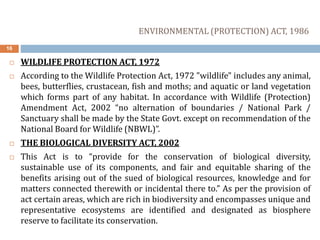
 WILDLIFE PROTECTION ACT, 1972
 According to the Wildlife Protection Act, 1972 "wildlife" includes any animal,
bees, butterflies, crustacean, fish and moths; and aquatic or land vegetation
which forms part of any habitat. In accordance with Wildlife (Protection)
Amendment Act, 2002 “no alternation of boundaries / National Park /
Sanctuary shall be made by the State Govt. except on recommendation of the
National Board for Wildlife (NBWL)”.
 THE BIOLOGICAL DIVERSITY ACT, 2002
 This Act is to “provide for the conservation of biological diversity,
sustainable use of its components, and fair and equitable sharing of the
benefits arising out of the sued of biological resources, knowledge and for
matters connected therewith or incidental there to.” As per the provision of
act certain areas, which are rich in biodiversity and encompasses unique and
representative ecosystems are identified and designated as biosphere
reserve to facilitate its conservation.
ENVIRONMENTAL (PROTECTION) ACT, 1986
17
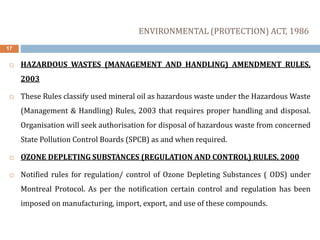
 HAZARDOUS WASTES (MANAGEMENT AND HANDLING) AMENDMENT RULES,
2003
 These Rules classify used mineral oil as hazardous waste under the Hazardous Waste
(Management & Handling) Rules, 2003 that requires proper handling and disposal.
Organisation will seek authorisation for disposal of hazardous waste from concerned
State Pollution Control Boards (SPCB) as and when required.
 OZONE DEPLETING SUBSTANCES (REGULATION AND CONTROL) RULES, 2000
 Notified rules for regulation/ control of Ozone Depleting Substances ( ODS) under
Montreal Protocol. As per the notification certain control and regulation has been
imposed on manufacturing, import, export, and use of these compounds.
ENVIRONMENTAL (PROTECTION) ACT, 1986
OTHER ENVIRONMENT – RELATED LAWS
18
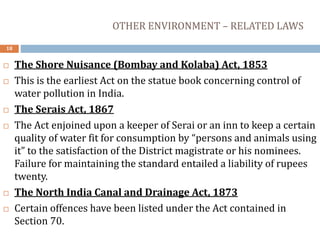
 The Shore Nuisance (Bombay and Kolaba) Act, 1853
 This is the earliest Act on the statue book concerning control of
water pollution in India.
 The Serais Act, 1867
 The Act enjoined upon a keeper of Serai or an inn to keep a certain
quality of water fit for consumption by “persons and animals using
it” to the satisfaction of the District magistrate or his nominees.
Failure for maintaining the standard entailed a liability of rupees
twenty.
 The North India Canal and Drainage Act, 1873
 Certain offences have been listed under the Act contained in
Section 70.
19
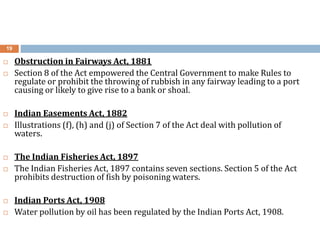
 Obstruction in Fairways Act, 1881
 Section 8 of the Act empowered the Central Government to make Rules to
regulate or prohibit the throwing of rubbish in any fairway leading to a port
causing or likely to give rise to a bank or shoal.
 Indian Easements Act, 1882
 Illustrations (f), (h) and (j) of Section 7 of the Act deal with pollution of
waters.
 The Indian Fisheries Act, 1897
 The Indian Fisheries Act, 1897 contains seven sections. Section 5 of the Act
prohibits destruction of fish by poisoning waters.
 Indian Ports Act, 1908
 Water pollution by oil has been regulated by the Indian Ports Act, 1908.
OTHER ENVIRONMENT – RELATED LAWS
20
 The Indian Forest Act, 1927
 Section 26(i) of the Act makes it punishable if any person, who, in
contravention of the rules made by the State Government, poisons
water of a forest area. The State Government has been empowered
under Section 32(f) to make rules relating to poisoning of water in
forests.
 The Damodar Valley Corporation Act, 1948
 The Act Government the Corporation to make regulations with the
previous sanction of the Central Government for preventing
“pollution of water”.
21
 The Factories Act, 1948
 Factories Act, 1948 is a social welfare legislation intend to secure health,
safety and welfare of the workers employed in factories. Hiowever,some of the
provisions of this Act are concerned with prevention of water pollution.
 The Mines Act, 1952
 Chapter V of the Act deals with provisions regarding health and Safety of the
employees. Section 19(i) Government upon arrangement for the quality of
water for drinking purposes.
 The River Boards Act, 1956
 The Act provides for the creation of River Boards for regulation and
development of interstate rivers and river valleys. One of the functions of the
Board is to advise to the Government concerned on “prevention of pollution of
the waters of the interstate rivers”.
OTHER ENVIRONMENT – RELATED LAWS
22
 The Merchant Shipping Act, 1958
 The International Convention for the Prevention of Pollution
of the Sea by Oil, 1954 is the first treaty for the reduction of oil
pollution of the sea. In order to give effect to this Convention,
 The Merchant Shipping Act regulates and controls the
discharge of oil or oil mixture by an Indian tanker or ship
within any of the prohibited zones or by a foreign tanker or
other ship within the prohibited zone adjoining the territories
of India.
 Further, there is a prohibition for discharging any oil
anywhere at sea from an Indian ship.
LEGAL AND REGULATORY FRAMEWORK FOR HYDRO PROJECTS
23
 The principal Environmental Regulatory Agency in India is the Ministry of
Environment and Forests (MOEF). MOEF formulates environmental policies
and accords environmental clearance for the projects. The State Pollution
Control Board (SPCB) accords ‘No Objection Certificate’ (NOC) and ‘Consent
for Establishment and Operation’ for the projects.
 The project features entail a Environmental Impact Assessment Study to be
conducted which is a pre-requisite for obtaining environmental clearance
from Ministry of Environment & Forests.
 Environmental Impact Assessment (EIA) is an important management tool for
ensuring optimal use of natural resources for sustainable development, and was
introduced in India initially for River Valley Projects in 1978-79. The scope of the
EIA has been enhanced to cover other developmental sectors such as industries,
mining schemes, energy, etc.
References:
24
 1. Diwan Shyam, Rosencranz Armin,
Environmental Law & Policy in India
 2. P. Leelakrishnan , The Environmental Law
in india
THANK YOU
25

Llb i EL u 1.1 environment concept

  • 1.
    1 Course: LLB I Subject:Environmental Law Unit : I Concept of Environment
  • 2.
    The Concept ofEnvironment 2  “Environment” owes its genesis to a French word ‘environ’, which means ‘encircle’. It encompasses within its ambit land, water, flora, fauna, living creatures, forest and everything above the earth.  ‘Environment’ all components surrounding man, Consist of two important major parts.
  • 3.
    3 Physical & Natural Physicalenvironment constitutes lithosphere, land, hydrosphere and atmosphere means water and air respectively. The natural environment constitutes living organisms including human beings, flora and fauna, etc. It may be noted that all this is perceived in the definition of environment provided by the Environment (Protection) Act, 1986, which states: Environment includes water, air and land, and the inter- relationships which exist among and between water, air and land, and human beings, other living creatures, plants, micro- organisms and property.
  • 4.
    The Indian Constitutionand Environment 4  The culmination of various international efforts initiated 38 years ago at Stockholm(Sweden) where the first historic international conference on Human Environment was held in 1972.  There is a major environmental crisis of a global proportion affecting the physical, natural and human environment due to pollution of all kinds.  It is of serious concern to the international community that the greenhouse gases emissions continued to be on the rise.
  • 5.
    5  The UNmandated intergovernmental panel on climate change says that by 2100 the global temperature increases will range between 1.4 degree Celsius and 5.8 degree Celsius. Mean sea levels may rise by 80 cm, inundating low-laying areas and smaller islands. It has been predicted that there will be more frequent and severe heat waves, more intense tropical cyclones, changes in rainfall patterns and melting of ice.
  • 6.
    The Indian Constitutionand Environment 6  Environmental degradation is generally caused not only by the pollution of the atmosphere and of the maritime, and the coastal inland waters through the disruption of rural lands but also by the destruction of ecological balance of natural areas and the adverse effect of the use of biocides upon animal and plant life. Another important reason for environment degradation is the uncontrolled exploitation and the consequent depletion of world’s natural resources.  The Indian Apex Court, The entire world is facing a serious problem of environmental degradation due to indiscriminate development. Industrialization, burning of fossil fuels and massive deforestation are leading to degradation of environment.
  • 7.
    The Indian Constitutionand Environment 7  Today the atmosphere level of carbon dioxide, the principal source of global warming is 26 percent higher than pre-industrial concentration.  Enormous amount of gases and chemicals emitted by the industrial plants and automobiles have led to depletion of ozone layers which serve as a shield to protect life on the earth from the ultraviolet rays of the sun.  The problems of “acid rain” which is caused mainly by the emission of sulphur dioxide and Nitrogen oxides from power stations and industrial installations is a graphic example of it. The ill effect of “acid rain” can be found on vegetables, soil, marine resources, and monuments as well as on humans.  Air pollutants and acids generated by the industrial activities are now entering forest at an unprecedented scale.
  • 8.
    International Community 8  Itis imperative that the international community should be shaken from its slumber to be prepared to combat this environmental crisis by taking appropriate measures,  which should be not only for controlling pollution but also for protecting and promoting environment.  The 5th June of every year as an International Environmental Day, given at the UN summit on Environment and development at Stockholm, in 1972.
  • 9.
    Indian Efforts toCombat Environmental Pollution 9  India has joined the members of the international community in their crusade against environmental problems, first, by amending its own fundamental law, and then, by following it up with the enactment of several laws to protect national environment.  The new constitutional provisions have given the necessary impetus to the environmental legislation in the country.
  • 10.
    ENVIRONMENTAL REGULATIONS ANDLEGAL FRAMEWORK IN INDIA 10  The State's responsibility with regard to environmental protection has been laid down under Article 48-A "The State shall endeavour to protect and improve the environment and to safeguard the forests and wildlife of the country".  Environmental protection is a fundamental duty of every citizen of this country under Article 51-A(g) "It shall be the duty of every citizen of India to protect and improve the natural environment including forests, lakes, rivers and wildlife and to have compassion for living creatures.“
  • 11.
    11 "No person shallbe deprived of his life or personal liberty except according to procedure Article 48-A of the Constitution comes under Directive Principles of State Policy and Article 51 A(g) of the Constitution comes under Fundamental Duties. established by law."
  • 12.
    ENVIRONMENTAL REGULATIONS ANDLEGAL FRAMEWORK IN INDIA 12  The 42nd amendment to the Constitution was brought about in the year 1974 makes it the responsibility of the State Government to protect and improve the environment and to safeguard the forests and wildlife of the country.
  • 13.
    Environment ACT 13  THEELECTRICITY ACT, 2003  This Act seeks to create a framework for the power sector development by measures conducive to the industry. Section 68(1) - sanction from the Ministry of Power (MOP) is a mandatory requirement for taking up any new project. The sanction authorizes SJVN to plan and coordinate activities to commission new projects.  THE FOREST (CONSERVATION) ACT, 1980  This Act provides for the conservation of forests and regulating diversion of forestlands for non-forestry purposes. State governments cannot de-reserve any forestland or authorise its use for any non-forest purposes without approval from the Central government.
  • 14.
    ENVIRONMENTAL (PROTECTION) ACT,1986 14  The Environment (Protection) Act, 1986 was introduced as an umbrella legislation that provides a holistic framework for the protection and improvement to the environment.  SJVNL undertakes Environmental Impact Assessment for all projects as a standard management procedure as laid down in The Environment (Protection) Act, 1986 and also functions within permissible standards of ambient air quality and noise levels as prescribed by national laws and international regulations.
  • 15.
    15  Other rulesand regulations under the Environmental (Protection) Act, 1986 applicable to the operation of SJVNL are described below:  AIR (PREVENTION AND CONTROL OF POLLUTION) ACT 1981  The objective of this Act is to provide for the prevention, control and abatement of air pollution.  includes the preservation of the quality of air and control of air pollution.  WATER (PREVENTION & CONTROL ) ACT 1974  The objectives of the Water Act are to provide for the Prevention and Control of Water Pollution and the maintenance or restoration. ENVIRONMENTAL (PROTECTION) ACT, 1986
  • 16.
    16  WILDLIFE PROTECTIONACT, 1972  According to the Wildlife Protection Act, 1972 "wildlife" includes any animal, bees, butterflies, crustacean, fish and moths; and aquatic or land vegetation which forms part of any habitat. In accordance with Wildlife (Protection) Amendment Act, 2002 “no alternation of boundaries / National Park / Sanctuary shall be made by the State Govt. except on recommendation of the National Board for Wildlife (NBWL)”.  THE BIOLOGICAL DIVERSITY ACT, 2002  This Act is to “provide for the conservation of biological diversity, sustainable use of its components, and fair and equitable sharing of the benefits arising out of the sued of biological resources, knowledge and for matters connected therewith or incidental there to.” As per the provision of act certain areas, which are rich in biodiversity and encompasses unique and representative ecosystems are identified and designated as biosphere reserve to facilitate its conservation. ENVIRONMENTAL (PROTECTION) ACT, 1986
  • 17.
    17  HAZARDOUS WASTES(MANAGEMENT AND HANDLING) AMENDMENT RULES, 2003  These Rules classify used mineral oil as hazardous waste under the Hazardous Waste (Management & Handling) Rules, 2003 that requires proper handling and disposal. Organisation will seek authorisation for disposal of hazardous waste from concerned State Pollution Control Boards (SPCB) as and when required.  OZONE DEPLETING SUBSTANCES (REGULATION AND CONTROL) RULES, 2000  Notified rules for regulation/ control of Ozone Depleting Substances ( ODS) under Montreal Protocol. As per the notification certain control and regulation has been imposed on manufacturing, import, export, and use of these compounds. ENVIRONMENTAL (PROTECTION) ACT, 1986
  • 18.
    OTHER ENVIRONMENT –RELATED LAWS 18  The Shore Nuisance (Bombay and Kolaba) Act, 1853  This is the earliest Act on the statue book concerning control of water pollution in India.  The Serais Act, 1867  The Act enjoined upon a keeper of Serai or an inn to keep a certain quality of water fit for consumption by “persons and animals using it” to the satisfaction of the District magistrate or his nominees. Failure for maintaining the standard entailed a liability of rupees twenty.  The North India Canal and Drainage Act, 1873  Certain offences have been listed under the Act contained in Section 70.
  • 19.
    19  Obstruction inFairways Act, 1881  Section 8 of the Act empowered the Central Government to make Rules to regulate or prohibit the throwing of rubbish in any fairway leading to a port causing or likely to give rise to a bank or shoal.  Indian Easements Act, 1882  Illustrations (f), (h) and (j) of Section 7 of the Act deal with pollution of waters.  The Indian Fisheries Act, 1897  The Indian Fisheries Act, 1897 contains seven sections. Section 5 of the Act prohibits destruction of fish by poisoning waters.  Indian Ports Act, 1908  Water pollution by oil has been regulated by the Indian Ports Act, 1908.
  • 20.
    OTHER ENVIRONMENT –RELATED LAWS 20  The Indian Forest Act, 1927  Section 26(i) of the Act makes it punishable if any person, who, in contravention of the rules made by the State Government, poisons water of a forest area. The State Government has been empowered under Section 32(f) to make rules relating to poisoning of water in forests.  The Damodar Valley Corporation Act, 1948  The Act Government the Corporation to make regulations with the previous sanction of the Central Government for preventing “pollution of water”.
  • 21.
    21  The FactoriesAct, 1948  Factories Act, 1948 is a social welfare legislation intend to secure health, safety and welfare of the workers employed in factories. Hiowever,some of the provisions of this Act are concerned with prevention of water pollution.  The Mines Act, 1952  Chapter V of the Act deals with provisions regarding health and Safety of the employees. Section 19(i) Government upon arrangement for the quality of water for drinking purposes.  The River Boards Act, 1956  The Act provides for the creation of River Boards for regulation and development of interstate rivers and river valleys. One of the functions of the Board is to advise to the Government concerned on “prevention of pollution of the waters of the interstate rivers”.
  • 22.
    OTHER ENVIRONMENT –RELATED LAWS 22  The Merchant Shipping Act, 1958  The International Convention for the Prevention of Pollution of the Sea by Oil, 1954 is the first treaty for the reduction of oil pollution of the sea. In order to give effect to this Convention,  The Merchant Shipping Act regulates and controls the discharge of oil or oil mixture by an Indian tanker or ship within any of the prohibited zones or by a foreign tanker or other ship within the prohibited zone adjoining the territories of India.  Further, there is a prohibition for discharging any oil anywhere at sea from an Indian ship.
  • 23.
    LEGAL AND REGULATORYFRAMEWORK FOR HYDRO PROJECTS 23  The principal Environmental Regulatory Agency in India is the Ministry of Environment and Forests (MOEF). MOEF formulates environmental policies and accords environmental clearance for the projects. The State Pollution Control Board (SPCB) accords ‘No Objection Certificate’ (NOC) and ‘Consent for Establishment and Operation’ for the projects.  The project features entail a Environmental Impact Assessment Study to be conducted which is a pre-requisite for obtaining environmental clearance from Ministry of Environment & Forests.  Environmental Impact Assessment (EIA) is an important management tool for ensuring optimal use of natural resources for sustainable development, and was introduced in India initially for River Valley Projects in 1978-79. The scope of the EIA has been enhanced to cover other developmental sectors such as industries, mining schemes, energy, etc.
  • 24.
    References: 24  1. DiwanShyam, Rosencranz Armin, Environmental Law & Policy in India  2. P. Leelakrishnan , The Environmental Law in india
  • 25.