Environment means the surroundings, external objects, influences or circumstances under which someone or something exists. The environment of any organisation is the aggregate of all conditions, events & influences that surround & affect it.
Purchase decision: Automobile Supplier of raw materials Manufacturer Dealer Advertising agency Banker Insurance agent
Business- economic activity  Business firm- economic unit  Business decision making- economic in nature  Business achieve objectives by using resources optimally Decisions taken in the presence of environmental factors
Business firm is micro economic unit Business environment furnishes macro economic context for its operation Environment in which business operates Includes conditions, events, factors that influence the working of business
Classification: Time: past, present & future environment of business Space: local, regional, national , international environment of business Forces: forces of market like demand, supply Factors: economic & non-economic
The classification of relevant environment into components helps the organisation to cope with its complexity, comprehend the different influences operating & relating the environmental changes to its strategic management process. Business firms: adaptability & adoptability to environment Managers: capability & copability to deal with environment
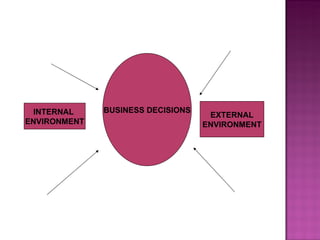
BUSINESS DECISIONS INTERNAL  ENVIRONMENT EXTERNAL ENVIRONMENT
Richman & Copen…………   Environment factors or constraints are largely, if not totally, external and beyond the control of individual industrial enterprises & their managements. These are essentially the ‘givers’ within which the firms & their managements must operate in a specific country & they vary often greatly from country to country.
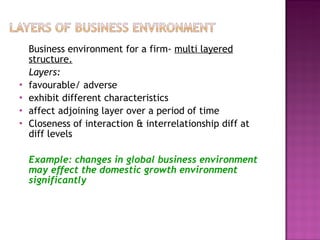
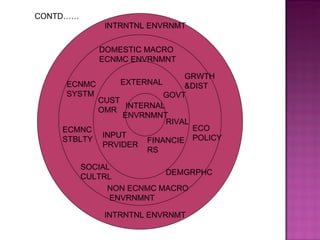
Business environment for a firm-  multi layered structure. Layers: favourable/ adverse exhibit different characteristics affect adjoining layer over a period of time Closeness of interaction & interrelationship diff at diff levels Example: changes in global business environment may effect the domestic growth environment significantly
INTERNAL ENVRNMNT EXTERNAL RIVAL FINANCIERS CUST OMR INPUT PRVIDER DOMESTIC MACRO ECNMC ENVRNMNT NON ECNMC MACRO ENVRNMNT SOCIAL CULTRL ECMNC STBLTY ECNMC SYSTM GRWTH &DIST ECO POLICY DEMGRPHC INTRNTNL ENVRNMT INTRNTNL ENVRNMT GOVT CONTD……
Change in environment presents opportunity to some & threat to others Examples: General agreement on trade & services (GATS) implemented in India on Jan 1, 2005: opportunity for research based pharmaceutical cos like Ranbaxy but threat to smaller companies. HUL took advantage of new takeover & merger codes: acquired Kissan from UB group, Lakme from Tata, Modern foods from government.
Regarded as controllable factors: companies have control over them Internal economy: some internal factors contribute increase in productivity
Mission & vision of the organisation Management strategy Industrial relations Corporate culture & values Line & staff relations Quality control system Team spirit among employees Work culture  Compensation system Career progression of employees
Conflict b/w different owner groups Conflicts b/w workers & managers Inter departmental conflicts Unhealthy competition & conflict among employees Office politics Discrimination at work place Absenteeism
Regarded as uncontrollable factors: by and large beyond the control of company. External economy: some external factors contribute to the growth of the company.
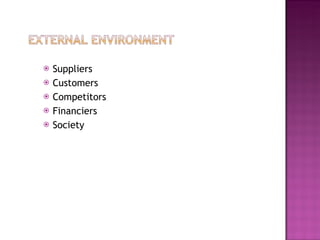
Suppliers Customers Competitors Financiers  Society
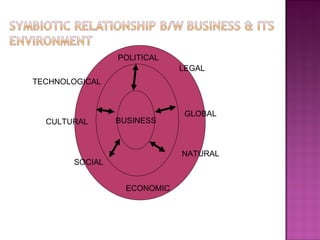
BUSINESS POLITICAL LEGAL ECONOMIC SOCIAL CULTURAL TECHNOLOGICAL GLOBAL NATURAL
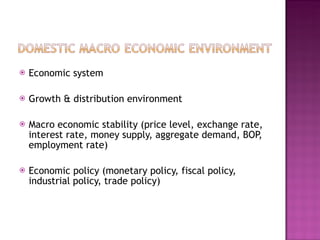
Economic system Growth & distribution environment Macro economic stability (price level, exchange rate, interest rate, money supply, aggregate demand, BOP, employment rate) Economic policy (monetary policy, fiscal policy, industrial policy, trade policy)
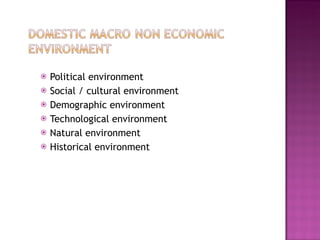
Political environment Social / cultural environment Demographic environment Technological environment Natural environment Historical environment
State of world economy  International economic cooperation Role of multilateral economic institutions International economic laws, agreements, codes Political condition & system in different countries Cultural factors across countries Growth & spread of MNCs Technology growth & transfer International market structure & competition Barriers to international trade & investment
(I)   POLITICAL ENVIRONMENT Political stability- changes in the form & structure of government administration Political organisation- ideology of ruling government; influence of premier groups; conflicting role of public & private sector
Example: Nehru: transformation of agrarian economy into industrialised economy Indira Gandhi: state became active in agriculture sector (subsidised fertilisers, expansion of institutional credit); tightening of state control over industrial finance, foreign investment, trade Since 1990-91, political environment changed-  economy increasingly being liberalised
Example: In 1977, Janata govt came to power: Coca cola, IBM had to leave country. All liquor cos had to close operations.  1991 new economic order presented new opportunities for business & also threat to inefficient organizations.
(II) REGULATORY & LEGAL ENVIRONMENT Legal policies- formulation & implementation  Economic legislations- facilitator and/ or restrictor Playa a vital role- dictating dos & don’ts of business Flexibility & adaptability of law- constitutional amendments  Foreign policy- tariffs, custom unions etc
(III) SOCIO- CULTURAL ENVIRONMENT SOCIAL ENVIRONMENT Made up of attitude, desires, expectations, education, beliefs & customs of people Changes gradually To forecast a change is difficult
CULTURAL ENVIRONMENT Organisational culture is the customary or traditional ways on thinking & doing things, which are shared to  a greater or lesser extent by all the members of the organisation, which new members must learn & at least partially accept in order to be accepted into the service of the firm.
A firm wanting to market its product in various regions with diversified cultures will have to carefully study the existing consumption pattern & scope for creating demand for new products & will have to adjust their marketing communication to cultural characteristics. If the society is multi- cultural, then the firm can not meet the demands of different groups with a uniform product. To be successful in a multi cultural society, the firm will have to carefully study the consumption behaviour of different groups.
Example: Companies have to change their product portfolio because of cultural differences as McDonald and KFC did when they launched their restaurant chain in India.
(IV)  DEMOGRAPHIC ENVIRONMENT (a)   Size & growth rate of population Growing population: boon Increase in productive forces Bigger market for products
Growing population: bane Adverse impact on per capita income & standard of living Adverse impact on savings: unfavourable impact on capital formation Adverse impact on employment situation Increasing pressure on agriculture
(b) age structure of population It determines: Productivity level Demand pattern  Young population: PTC high Elderly population: high savings
(c) urban- rural population Proportion of urban rural population increasing Reasons Pull factors: Better employment opportunities in urban areas Better income Better education Better health facilities
Push factors: Low level of agriculture productivity Disguised unemployment Wide disparity between urban & rural levels of living In India, urban population increased from 17.3% of total population in 1951 to 27.78% of total population in 2001 (Source: Economic Survey 2003-04)
Example: Demographic environment decides the marketing mix for an organisation. A one rupee sachet of shampoo or a five rupee ice-cream cone are some examples.
(V) TECHNOLOGICAL ENVIRONMENT Refers to body of skills, knowledge & procedures for making, using & doing useful things Positive effects of technology : Increased productivity Spread effects Production of new & better goods of standardised quality with more efficient use of raw materials Basis for fast growing urban & industrial system
Negative effects of technology : Displacement of labour Environmental pollution Switching over might be costly
Example: FIAT was using old technology but MUL had no option than to go for superior technology.
(VI) NATURAL ENVIRONMENT Industrial activity not entirely independent of nature Industrial units using weight losing inputs to be set up at sources of these inputs Externalities
(VII)   EDUCATIONAL ENVIRONMENT Attitude towards education & acquisition of knowledge Types of education- formal or informal Literacy level  Educational match with skill requirement
(VII)   HISTORICAL ENVIRONMENT Historical events & ideologies have a strong impact on the current state of business Example: business environment in a number of newly independent nation states has been determined by the colonial status that these countries had.
Dynamic Uncertain Element of Risk Opportunities & threats  Internal & external factors Economic & non-economic factors
Facilitates operations of the organisation  Forms the basis of long term policies, plans, strategies of organisation Helps organisation in identifying & understanding its competitors Helps the firm to expand & grow
CORPORATE RESPONSE & ADJUSTMENT TO SPECIFIC CHANGES IN BUSINESS ENVIRONMENT
Competitive environment Marketing strategy Developing new product Satisfying customers Measures for realisation of economies of scale & scope
Technological environment R & D Foreign technical collaborations Choice of technology Capital labour ratio
Labour environment Productivity Employee motivation Employees’ turnover rate Working conditions Compensation
Legal environment Procedures & documentation Ethical practices Intellectual property protection Credibility
Social environment Social responsibility Welfare expenditure And so on………….
Environmental changes: Liberalisation era forced businessmen to think of core competencies Reckless diversifications made during pre liberalisation era became liabilities
Strategic responses: Restructuring business Internationally to consolidate strength in brewing & distilling In India to focus on engineering, services, health care, brewing & distilling Hiving of non core business like pharmaceuticals
Consequences: With the excess baggage being shed, UB group looks slim & vibrant
Firms that are able to make appropriate adjustment to business environment changes reduce risk & uncertainty & gain competitive edge over others. Failure in making timely adjustment may erode profitability, competitiveness & market share.
Legal risk : arising from legal challenges or changes in laws Regulatory risk : arising from regulatory design & its changes Political risk : arising from political changes Social risk : originating from social attitudes, perceptions Natural risk : associated with natural calamities
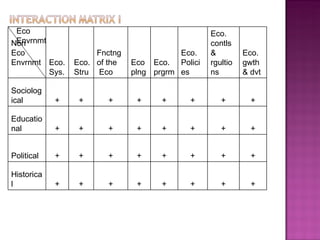
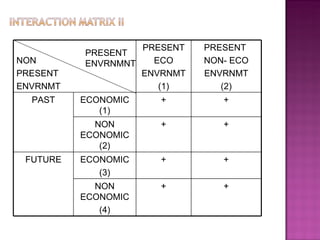
Studies interaction, interdependence, interlocking of various environmental factors Economic environment is both-  endogenous & exogenous-  it is determined as well as determining
Eco Envrnmt Non  Eco Envrnmt  Eco. Sys. Eco. Stru Fnctng  of the Eco Eco plng Eco. prgrm Eco. Policies Eco. contls & rgultions Eco. gwth  & dvt Sociological + + + + + + + + Educational + + + + + + + + Political + + + + + + + + Historical + + + + + + + +
PRESENT ENVRNMNT NON PRESENT ENVRNMT PRESENT ECO ENVRNMT (1) PRESENT  NON- ECO ENVRNMT (2) PAST ECONOMIC (1) + + NON ECONOMIC (2) + + FUTURE ECONOMIC (3) + + NON ECONOMIC (4) + +
Wiliam & Lawrence…….. Environmental analysis & diagnosis give strategists time to anticipate opportunities & to plan to take optional responses to these opportunities. Its also helps strategists to develop an early warning system to prevent threats & to develop strategies which can turn a threat to the firm’s advantage
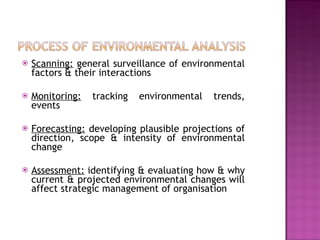
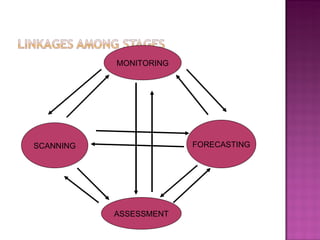
Scanning:  general surveillance of environmental factors & their interactions Monitoring:  tracking environmental trends, events Forecasting:  developing plausible projections of direction, scope & intensity of environmental change Assessment:  identifying & evaluating how & why current & projected environmental changes will affect strategic management of organisation
Strategic planning in which managers try to determine best fit b/w organisation & its external environment  Important step towards corporate planning & business policy decisions  Aimed at continuous improvement of the company, its policies & programs.
INTERNAL SCANNING : acquisition, analysis, use of information from within the organisation that will help the management in determining future course of action of business EXTERNAL SCANNING : acquisition, analysis, use of information about events & establishing the relationship of business with its external environmental variables
Corporate managers analyse the Strengths (S), Weakness (W), opportunity (O) & Threat (T)  that exist for their organisation in the context of its environment.  O & T are external to the firm.  With S the firm can seize the O & captilise on it & because of its W it becomes the victim of T in the environment
MONITORING SCANNING FORECASTING ASSESSMENT
To provide economic logic & perspective for managerial decision making Integrating economic theory with practical business situations Monitoring, scanning, careful analysis & interpretations of business environment Forecasting, future panning & formulating future business strategy

Business environment

  • 1.
  • 2.
    Environment means thesurroundings, external objects, influences or circumstances under which someone or something exists. The environment of any organisation is the aggregate of all conditions, events & influences that surround & affect it.
  • 3.
    Purchase decision: AutomobileSupplier of raw materials Manufacturer Dealer Advertising agency Banker Insurance agent
  • 4.
    Business- economic activity Business firm- economic unit Business decision making- economic in nature Business achieve objectives by using resources optimally Decisions taken in the presence of environmental factors
  • 5.
    Business firm ismicro economic unit Business environment furnishes macro economic context for its operation Environment in which business operates Includes conditions, events, factors that influence the working of business
  • 6.
    Classification: Time: past,present & future environment of business Space: local, regional, national , international environment of business Forces: forces of market like demand, supply Factors: economic & non-economic
  • 7.
    The classification ofrelevant environment into components helps the organisation to cope with its complexity, comprehend the different influences operating & relating the environmental changes to its strategic management process. Business firms: adaptability & adoptability to environment Managers: capability & copability to deal with environment
  • 8.
    BUSINESS DECISIONS INTERNAL ENVIRONMENT EXTERNAL ENVIRONMENT
  • 9.
    Richman & Copen………… Environment factors or constraints are largely, if not totally, external and beyond the control of individual industrial enterprises & their managements. These are essentially the ‘givers’ within which the firms & their managements must operate in a specific country & they vary often greatly from country to country.
  • 10.
    Business environment fora firm- multi layered structure. Layers: favourable/ adverse exhibit different characteristics affect adjoining layer over a period of time Closeness of interaction & interrelationship diff at diff levels Example: changes in global business environment may effect the domestic growth environment significantly
  • 11.
    INTERNAL ENVRNMNT EXTERNALRIVAL FINANCIERS CUST OMR INPUT PRVIDER DOMESTIC MACRO ECNMC ENVRNMNT NON ECNMC MACRO ENVRNMNT SOCIAL CULTRL ECMNC STBLTY ECNMC SYSTM GRWTH &DIST ECO POLICY DEMGRPHC INTRNTNL ENVRNMT INTRNTNL ENVRNMT GOVT CONTD……
  • 12.
    Change in environmentpresents opportunity to some & threat to others Examples: General agreement on trade & services (GATS) implemented in India on Jan 1, 2005: opportunity for research based pharmaceutical cos like Ranbaxy but threat to smaller companies. HUL took advantage of new takeover & merger codes: acquired Kissan from UB group, Lakme from Tata, Modern foods from government.
  • 13.
    Regarded as controllablefactors: companies have control over them Internal economy: some internal factors contribute increase in productivity
  • 14.
    Mission & visionof the organisation Management strategy Industrial relations Corporate culture & values Line & staff relations Quality control system Team spirit among employees Work culture Compensation system Career progression of employees
  • 15.
    Conflict b/w differentowner groups Conflicts b/w workers & managers Inter departmental conflicts Unhealthy competition & conflict among employees Office politics Discrimination at work place Absenteeism
  • 16.
    Regarded as uncontrollablefactors: by and large beyond the control of company. External economy: some external factors contribute to the growth of the company.
  • 17.
  • 18.
    BUSINESS POLITICAL LEGALECONOMIC SOCIAL CULTURAL TECHNOLOGICAL GLOBAL NATURAL
  • 19.
    Economic system Growth& distribution environment Macro economic stability (price level, exchange rate, interest rate, money supply, aggregate demand, BOP, employment rate) Economic policy (monetary policy, fiscal policy, industrial policy, trade policy)
  • 20.
    Political environment Social/ cultural environment Demographic environment Technological environment Natural environment Historical environment
  • 21.
    State of worldeconomy International economic cooperation Role of multilateral economic institutions International economic laws, agreements, codes Political condition & system in different countries Cultural factors across countries Growth & spread of MNCs Technology growth & transfer International market structure & competition Barriers to international trade & investment
  • 22.
    (I) POLITICAL ENVIRONMENT Political stability- changes in the form & structure of government administration Political organisation- ideology of ruling government; influence of premier groups; conflicting role of public & private sector
  • 23.
    Example: Nehru: transformationof agrarian economy into industrialised economy Indira Gandhi: state became active in agriculture sector (subsidised fertilisers, expansion of institutional credit); tightening of state control over industrial finance, foreign investment, trade Since 1990-91, political environment changed- economy increasingly being liberalised
  • 24.
    Example: In 1977,Janata govt came to power: Coca cola, IBM had to leave country. All liquor cos had to close operations. 1991 new economic order presented new opportunities for business & also threat to inefficient organizations.
  • 25.
    (II) REGULATORY &LEGAL ENVIRONMENT Legal policies- formulation & implementation Economic legislations- facilitator and/ or restrictor Playa a vital role- dictating dos & don’ts of business Flexibility & adaptability of law- constitutional amendments Foreign policy- tariffs, custom unions etc
  • 26.
    (III) SOCIO- CULTURALENVIRONMENT SOCIAL ENVIRONMENT Made up of attitude, desires, expectations, education, beliefs & customs of people Changes gradually To forecast a change is difficult
  • 27.
    CULTURAL ENVIRONMENT Organisationalculture is the customary or traditional ways on thinking & doing things, which are shared to a greater or lesser extent by all the members of the organisation, which new members must learn & at least partially accept in order to be accepted into the service of the firm.
  • 28.
    A firm wantingto market its product in various regions with diversified cultures will have to carefully study the existing consumption pattern & scope for creating demand for new products & will have to adjust their marketing communication to cultural characteristics. If the society is multi- cultural, then the firm can not meet the demands of different groups with a uniform product. To be successful in a multi cultural society, the firm will have to carefully study the consumption behaviour of different groups.
  • 29.
    Example: Companies haveto change their product portfolio because of cultural differences as McDonald and KFC did when they launched their restaurant chain in India.
  • 30.
    (IV) DEMOGRAPHICENVIRONMENT (a) Size & growth rate of population Growing population: boon Increase in productive forces Bigger market for products
  • 31.
    Growing population: baneAdverse impact on per capita income & standard of living Adverse impact on savings: unfavourable impact on capital formation Adverse impact on employment situation Increasing pressure on agriculture
  • 32.
    (b) age structureof population It determines: Productivity level Demand pattern Young population: PTC high Elderly population: high savings
  • 33.
    (c) urban- ruralpopulation Proportion of urban rural population increasing Reasons Pull factors: Better employment opportunities in urban areas Better income Better education Better health facilities
  • 34.
    Push factors: Lowlevel of agriculture productivity Disguised unemployment Wide disparity between urban & rural levels of living In India, urban population increased from 17.3% of total population in 1951 to 27.78% of total population in 2001 (Source: Economic Survey 2003-04)
  • 35.
    Example: Demographic environmentdecides the marketing mix for an organisation. A one rupee sachet of shampoo or a five rupee ice-cream cone are some examples.
  • 36.
    (V) TECHNOLOGICAL ENVIRONMENTRefers to body of skills, knowledge & procedures for making, using & doing useful things Positive effects of technology : Increased productivity Spread effects Production of new & better goods of standardised quality with more efficient use of raw materials Basis for fast growing urban & industrial system
  • 37.
    Negative effects oftechnology : Displacement of labour Environmental pollution Switching over might be costly
  • 38.
    Example: FIAT wasusing old technology but MUL had no option than to go for superior technology.
  • 39.
    (VI) NATURAL ENVIRONMENTIndustrial activity not entirely independent of nature Industrial units using weight losing inputs to be set up at sources of these inputs Externalities
  • 40.
    (VII) EDUCATIONAL ENVIRONMENT Attitude towards education & acquisition of knowledge Types of education- formal or informal Literacy level Educational match with skill requirement
  • 41.
    (VII) HISTORICAL ENVIRONMENT Historical events & ideologies have a strong impact on the current state of business Example: business environment in a number of newly independent nation states has been determined by the colonial status that these countries had.
  • 42.
    Dynamic Uncertain Elementof Risk Opportunities & threats Internal & external factors Economic & non-economic factors
  • 43.
    Facilitates operations ofthe organisation Forms the basis of long term policies, plans, strategies of organisation Helps organisation in identifying & understanding its competitors Helps the firm to expand & grow
  • 44.
    CORPORATE RESPONSE &ADJUSTMENT TO SPECIFIC CHANGES IN BUSINESS ENVIRONMENT
  • 45.
    Competitive environment Marketingstrategy Developing new product Satisfying customers Measures for realisation of economies of scale & scope
  • 46.
    Technological environment R& D Foreign technical collaborations Choice of technology Capital labour ratio
  • 47.
    Labour environment ProductivityEmployee motivation Employees’ turnover rate Working conditions Compensation
  • 48.
    Legal environment Procedures& documentation Ethical practices Intellectual property protection Credibility
  • 49.
    Social environment Socialresponsibility Welfare expenditure And so on………….
  • 50.
    Environmental changes: Liberalisationera forced businessmen to think of core competencies Reckless diversifications made during pre liberalisation era became liabilities
  • 51.
    Strategic responses: Restructuringbusiness Internationally to consolidate strength in brewing & distilling In India to focus on engineering, services, health care, brewing & distilling Hiving of non core business like pharmaceuticals
  • 52.
    Consequences: With theexcess baggage being shed, UB group looks slim & vibrant
  • 53.
    Firms that areable to make appropriate adjustment to business environment changes reduce risk & uncertainty & gain competitive edge over others. Failure in making timely adjustment may erode profitability, competitiveness & market share.
  • 54.
    Legal risk :arising from legal challenges or changes in laws Regulatory risk : arising from regulatory design & its changes Political risk : arising from political changes Social risk : originating from social attitudes, perceptions Natural risk : associated with natural calamities
  • 55.
    Studies interaction, interdependence,interlocking of various environmental factors Economic environment is both- endogenous & exogenous- it is determined as well as determining
  • 56.
    Eco Envrnmt Non Eco Envrnmt  Eco. Sys. Eco. Stru Fnctng of the Eco Eco plng Eco. prgrm Eco. Policies Eco. contls & rgultions Eco. gwth & dvt Sociological + + + + + + + + Educational + + + + + + + + Political + + + + + + + + Historical + + + + + + + +
  • 57.
    PRESENT ENVRNMNT NONPRESENT ENVRNMT PRESENT ECO ENVRNMT (1) PRESENT NON- ECO ENVRNMT (2) PAST ECONOMIC (1) + + NON ECONOMIC (2) + + FUTURE ECONOMIC (3) + + NON ECONOMIC (4) + +
  • 58.
    Wiliam & Lawrence……..Environmental analysis & diagnosis give strategists time to anticipate opportunities & to plan to take optional responses to these opportunities. Its also helps strategists to develop an early warning system to prevent threats & to develop strategies which can turn a threat to the firm’s advantage
  • 59.
    Scanning: generalsurveillance of environmental factors & their interactions Monitoring: tracking environmental trends, events Forecasting: developing plausible projections of direction, scope & intensity of environmental change Assessment: identifying & evaluating how & why current & projected environmental changes will affect strategic management of organisation
  • 60.
    Strategic planning inwhich managers try to determine best fit b/w organisation & its external environment Important step towards corporate planning & business policy decisions Aimed at continuous improvement of the company, its policies & programs.
  • 61.
    INTERNAL SCANNING :acquisition, analysis, use of information from within the organisation that will help the management in determining future course of action of business EXTERNAL SCANNING : acquisition, analysis, use of information about events & establishing the relationship of business with its external environmental variables
  • 62.
    Corporate managers analysethe Strengths (S), Weakness (W), opportunity (O) & Threat (T) that exist for their organisation in the context of its environment. O & T are external to the firm. With S the firm can seize the O & captilise on it & because of its W it becomes the victim of T in the environment
  • 63.
  • 64.
    To provide economiclogic & perspective for managerial decision making Integrating economic theory with practical business situations Monitoring, scanning, careful analysis & interpretations of business environment Forecasting, future panning & formulating future business strategy