UNIT- II
ELECTRIC LIGHTING
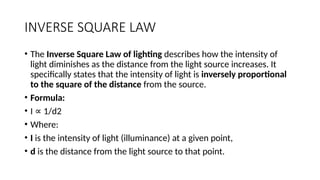
INVERSE SQUARE LAW
• The Inverse Square Law of lighting describes how the intensity of
light diminishes as the distance from the light source increases. It
specifically states that the intensity of light is inversely proportional
to the square of the distance from the source.
• Formula:
• I 1/d2
∝
• Where:
• I is the intensity of light (illuminance) at a given point,
• d is the distance from the light source to that point.
Explanation:
•As you move away from a light source, the same amount of light spreads over a larger
area. This means that the further away you are, the less intense the light appears.
•If you double the distance (2d), the light intensity reduces to one-fourth (1/2² = 1/4)
of its original intensity. Similarly, tripling the distance (3d) reduces the intensity to one-
ninth (1/3² = 1/9).
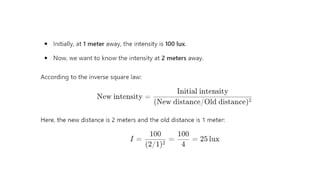
Practical Example:
Imagine you have a lamp that illuminates a surface 1 meter away. If the light on that
surface has an intensity of 100 lux, moving to 2 meters away would reduce the
intensity to:
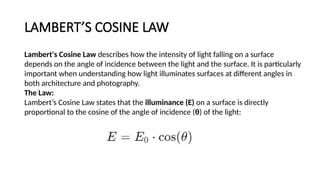
LAMBERT’S COSINE LAW
Lambert's Cosine Law describes how the intensity of light falling on a surface
depends on the angle of incidence between the light and the surface. It is particularly
important when understanding how light illuminates surfaces at different angles in
both architecture and photography.
The Law:
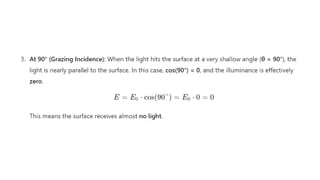
Lambert’s Cosine Law states that the illuminance (E) on a surface is directly
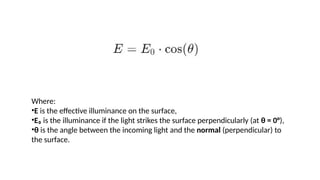
proportional to the cosine of the angle of incidence (θ) of the light:
Where:
•E is the effective illuminance on the surface,
•E₀ is the illuminance if the light strikes the surface perpendicularly (at θ = 0°),
•θ is the angle between the incoming light and the normal (perpendicular) to
the surface.
Practical Example:
Imagine sunlight hitting the ground at different times of day:
•At noon, the sun is almost directly overhead, so the light is nearly perpendicular to the
ground (θ is small), and the ground is brightly lit.
•In the morning or evening, the sun is lower on the horizon, and light strikes the ground
at a steeper angle (larger θ). As a result, the light is less intense, and the ground appears
dimmer.
Applications in Architecture and Design:
Lighting Design: Lambert’s Cosine Law helps architects and designers calculate how well-
lit surfaces will be based on light angles, ensuring even lighting across spaces.
Solar Panels: Solar panels are angled to maximize the amount of sunlight hitting them
perpendicularly for better energy efficiency, following this principle.
Visualization:
Imagine holding a flashlight directly above a table (perpendicular). The
light circle on the table is bright and focused. Now tilt the flashlight to a
steeper angle. The light spreads over a larger area, but it becomes
dimmer. This is Lambert’s Cosine Law in action!
LAW OF REFLECTION
The Law of Reflection governs how light behaves when it bounces off a reflective surface, such as
a mirror or a smooth, shiny object. This law is fundamental in optics and helps us understand how
light rays interact with different surfaces.
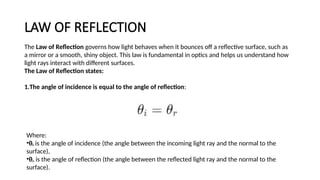
The Law of Reflection states:
1.The angle of incidence is equal to the angle of reflection:
Where:
•θᵢ is the angle of incidence (the angle between the incoming light ray and the normal to the
surface),
•θᵣ is the angle of reflection (the angle between the reflected light ray and the normal to the
surface).
1.The incident ray, the reflected ray, and the normal
to the surface all lie in the same plane: This means
all these components are coplanar (they are confined
to the same flat surface).
Key Components:
•Incident Ray: The ray of light that strikes the
surface.
•Reflected Ray: The ray of light that bounces off the
surface.
•Normal: An imaginary line perpendicular to the
reflective surface at the point where the light ray
strikes it.
Example:
Imagine a light ray striking a mirror:
•If the ray hits the mirror at an angle of incidence of 30° (measured from the
normal), the angle of reflection will also be 30° on the other side of the normal.
Visualization:
1.Incident Ray: The ray approaches the surface at some angle, say 30° from the
normal.
2.Normal: This is a line perpendicular (90°) to the surface at the point where the
incident ray strikes.
3.Reflected Ray: The light bounces off the surface at an angle equal to the angle of
incidence (in this case, also 30° from the normal).
Example in Real Life:
•Mirrors: When you look into a mirror, the light from your face strikes the mirror, and
the reflected light reaches your eyes. The angles of incidence and reflection determine
how you see your reflection.
•Billiard Ball Game: When you hit a ball against the side of a pool table, the ball bounces
off in a predictable manner because its path follows the law of reflection. The angle at
which it hits the side (angle of incidence) equals the angle at which it bounces back
(angle of reflection).
Types of Reflection:
1.Specular Reflection: Occurs when light reflects off a smooth surface, like a mirror or
calm water, where the angles of incidence and reflection are clearly defined. This
creates a clear reflection, like a mirror image.
2.Diffuse Reflection: Occurs when light reflects off a rough surface. Although the law
of reflection still applies locally at every small point, the uneven surface causes the
reflected light to scatter in many directions, so no clear image is formed (e.g.,
reflection from a rough wall).
QUANTITY OF LIGHT
•The quantity of light is measured using the concept of luminous flux, which refers to the total
amount of visible light emitted by a source per unit of time. It is measured in lumens (lm).
•Luminous flux accounts for the sensitivity of the human eye to different wavelengths of light,
meaning it only measures light that is perceived by the human eye (the visible spectrum).
•Considerations:
•Task Lighting: Requires high illuminance for activities like reading or cooking.
•Ambient Lighting: Provides general illumination for spaces, requiring moderate lux levels.
•Accent Lighting: Highlights specific features, often with focused light and variable lux levels.
QUANTITY OF LIGHT
• Here are some related terms and units used to measure light:
• Luminous Intensity: The amount of light emitted in a particular
direction, measured in candelas (cd).
• Illuminance: The amount of light falling on a surface, measured in lux
(lx), where 1 lux equals 1 lumen per square meter.
• Luminance: The brightness of a light source as perceived by the
human eye, measured in candelas per square meter (cd/m²).
Quality of Light
• Color Temperature (Kelvin):
• Measured in Kelvin (K), it indicates the warmth or coolness of a light source.
• Warm Light: 2700K - 3000K (yellowish, cozy atmosphere).
• Neutral Light: 3500K - 4100K (balanced, natural feel).
• Cool Light: 5000K - 6500K (bluish, daylight-like).
• Color Rendering Index (CRI):
• Measures the ability of a light source to reveal the colors of objects faithfully compared to
natural light. It ranges from 0 to 100, with higher values indicating better color rendering.
• A CRI of 80+ is considered good for most applications, while 90+ is excellent for spaces where
accurate color perception is crucial.
• Light Distribution:
• Refers to how light is spread in a space. Different fixtures provide varying distributions, such as
direct, indirect, diffuse, or focused beams.
• Glare and Flicker:
• Glare: Uncomfortable brightness that can cause eye strain. It’s crucial to minimize
glare for visual comfort.
• Flicker: Rapid variations in light intensity, which can be distracting and harmful,
especially in sensitive environments.
• Uniformity:
• Ensuring an even distribution of light across a space to avoid dark spots or excessive
brightness.
• Application Considerations:
• Residential Spaces: Warm, ambient lighting with a high CRI to create a comfortable
atmosphere.
• Workspaces: Cool, bright lighting with good CRI and minimal glare for focus and
productivity.
• Retail and Galleries: High CRI and adjustable lighting to highlight products or artwork.
TYPES OF LAMPS AND LUMINAIRS
• Lamps and luminaires are
essential components of lighting
design. While lamps refer to the
light sources themselves,
luminaires include the entire
fixture that holds the lamp,
controls its distribution, and
connects it to the power source.
Below is an overview of
different types of lamps and
luminaires:
Types of Lamps:
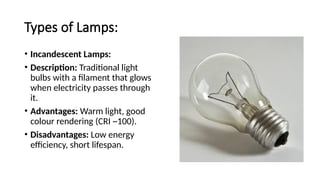
• Incandescent Lamps:
• Description: Traditional light
bulbs with a filament that glows
when electricity passes through
it.
• Advantages: Warm light, good
colour rendering (CRI ~100).
• Disadvantages: Low energy
efficiency, short lifespan.
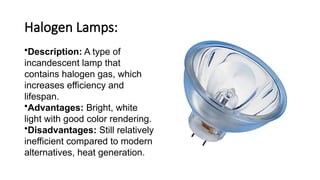
Halogen Lamps:
•Description: A type of
incandescent lamp that
contains halogen gas, which
increases efficiency and
lifespan.
•Advantages: Bright, white
light with good color rendering.
•Disadvantages: Still relatively
inefficient compared to modern
alternatives, heat generation.
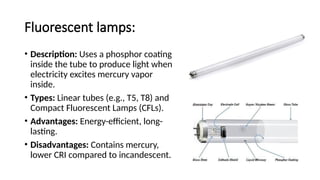
Fluorescent lamps:
• Description: Uses a phosphor coating
inside the tube to produce light when
electricity excites mercury vapor
inside.
• Types: Linear tubes (e.g., T5, T8) and
Compact Fluorescent Lamps (CFLs).
• Advantages: Energy-efficient, long-
lasting.
• Disadvantages: Contains mercury,
lower CRI compared to incandescent.
Compact Fluorescent lamps:
Compact Fluorescent Lamps (CFLs) are energy-efficient light bulbs that use a gas-
filled tube to produce light. They work by passing an electric current through a
gas, which generates ultraviolet light. This light then excites a phosphor coating
inside the bulb, producing visible light.
Here are some key features of CFLs:
1.Energy Efficiency: CFLs use about 70-80% less energy than traditional
incandescent bulbs, making them a cost-effective option in the long run.
2.Longer Lifespan: They typically last about 10 times longer than incandescent
bulbs, often up to 10,000 hours or more.
3.Lower Heat Emission: CFLs emit less heat compared to incandescent bulbs,
reducing cooling costs in warm environments.
4.Light Quality: They come in various color temperatures, allowing you to choose
the type of light (warm, cool, daylight) that suits your needs.
5.Environmental Considerations: While CFLs are more energy-efficient, they
contain a small amount of mercury, so proper disposal is important to prevent
environmental contamination.
LED lamps
•Description: Light Emitting Diodes
that produce light through
electroluminescence.
•Advantages: Highly energy-
efficient, long lifespan, available in a
range of color temperatures and
CRI levels.
•Disadvantages: Initial cost is
higher, but it's decreasing over time.
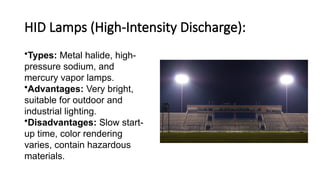
HID Lamps (High-Intensity Discharge):
•Types: Metal halide, high-
pressure sodium, and
mercury vapor lamps.
•Advantages: Very bright,
suitable for outdoor and
industrial lighting.
•Disadvantages: Slow start-
up time, color rendering
varies, contain hazardous
materials.
Induction Lamps:
•Description: Operates on
a principle similar to
fluorescent lamps but
without electrodes.
•Advantages: Long
lifespan, energy-efficient.
•Disadvantages: Higher
initial cost, limited
availability.
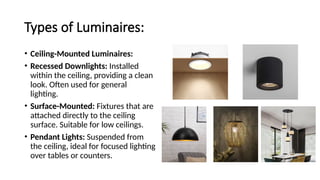
Types of Luminaires:
• Ceiling-Mounted Luminaires:
• Recessed Downlights: Installed
within the ceiling, providing a clean
look. Often used for general
lighting.
• Surface-Mounted: Fixtures that are
attached directly to the ceiling
surface. Suitable for low ceilings.
• Pendant Lights: Suspended from
the ceiling, ideal for focused lighting
over tables or counters.
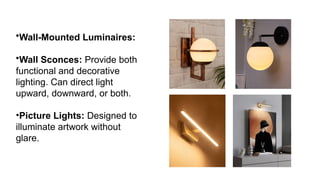
•Wall-Mounted Luminaires:
•Wall Sconces: Provide both
functional and decorative
lighting. Can direct light
upward, downward, or both.
•Picture Lights: Designed to
illuminate artwork without
glare.
• Portable Luminaires:
• Table Lamps: Provide
localized lighting, often
used in living rooms and
bedrooms.
• Floor Lamps: Freestanding
fixtures, ideal for reading
areas or ambient lighting.
•Track and Rail Lighting:
•Track Lighting: Multiple fixtures
mounted on a track system,
allowing for adjustable and
focused lighting.
•Monorail Lighting: A flexible
track system that allows for
creative arrangements and
custom lighting designs.
•Linear Luminaires:
•Linear Pendants: Often used
in offices and commercial
spaces, providing even lighting
over a long area.
•Under-Cabinet Lighting:
Used in kitchens for task
lighting, typically LED or
fluorescent.
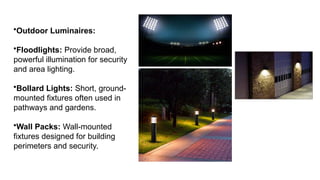
•Outdoor Luminaires:
•Floodlights: Provide broad,
powerful illumination for security
and area lighting.
•Bollard Lights: Short, ground-
mounted fixtures often used in
pathways and gardens.
•Wall Packs: Wall-mounted
fixtures designed for building
perimeters and security.
• Architectural Luminaires:
• Cove Lighting: Indirect
lighting placed in ledges or
recesses in ceilings or walls.
• Accent Lighting: Designed
to highlight architectural
features or artwork.
Applications and choice of luminaires
• The choice of luminaires depends on the specific application,
environment, and desired lighting effect.
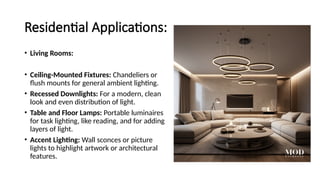
Residential Applications:
• Living Rooms:
• Ceiling-Mounted Fixtures: Chandeliers or
flush mounts for general ambient lighting.
• Recessed Downlights: For a modern, clean
look and even distribution of light.
• Table and Floor Lamps: Portable luminaires
for task lighting, like reading, and for adding
layers of light.
• Accent Lighting: Wall sconces or picture
lights to highlight artwork or architectural
features.
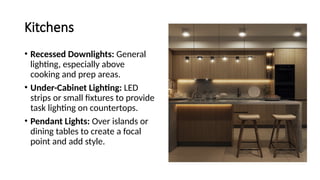
Kitchens
• Recessed Downlights: General
lighting, especially above
cooking and prep areas.
• Under-Cabinet Lighting: LED
strips or small fixtures to provide
task lighting on countertops.
• Pendant Lights: Over islands or
dining tables to create a focal
point and add style.
Bedrooms
•Ceiling-Mounted Fixtures:
Flush mounts or semi-flush for
general lighting.
•Bedside Lamps: Table lamps
for reading or ambient lighting.
•Recessed Lighting: For a
minimalist, streamlined look.
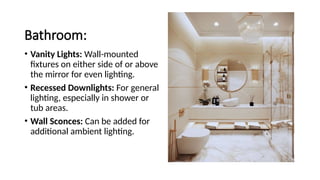
Bathroom:
• Vanity Lights: Wall-mounted
fixtures on either side of or above
the mirror for even lighting.
• Recessed Downlights: For general
lighting, especially in shower or
tub areas.
• Wall Sconces: Can be added for
additional ambient lighting.
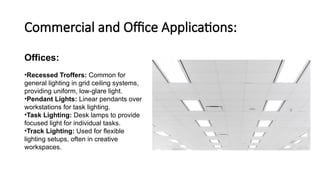
Commercial and Office Applications:
Offices:
•Recessed Troffers: Common for
general lighting in grid ceiling systems,
providing uniform, low-glare light.
•Pendant Lights: Linear pendants over
workstations for task lighting.
•Task Lighting: Desk lamps to provide
focused light for individual tasks.
•Track Lighting: Used for flexible
lighting setups, often in creative
workspaces.
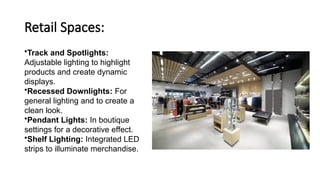
Retail Spaces:
•Track and Spotlights:
Adjustable lighting to highlight
products and create dynamic
displays.
•Recessed Downlights: For
general lighting and to create a
clean look.
•Pendant Lights: In boutique
settings for a decorative effect.
•Shelf Lighting: Integrated LED
strips to illuminate merchandise.
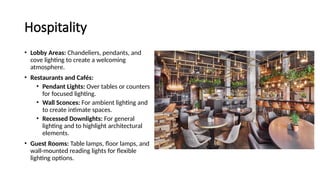
Hospitality
• Lobby Areas: Chandeliers, pendants, and
cove lighting to create a welcoming
atmosphere.
• Restaurants and Cafés:
• Pendant Lights: Over tables or counters
for focused lighting.
• Wall Sconces: For ambient lighting and
to create intimate spaces.
• Recessed Downlights: For general
lighting and to highlight architectural
elements.
• Guest Rooms: Table lamps, floor lamps, and
wall-mounted reading lights for flexible
lighting options.
Industrial and Warehouse Applications:
•High-Bay Lighting: For tall ceilings, providing
bright, even illumination over large areas.
•Low-Bay Lighting: Used in areas with lower
ceilings, often in workshops or smaller
industrial spaces.
•Linear Fixtures: LED or fluorescent linear
fixtures for general lighting in aisles or
workstations.
•Task Lighting: Adjustable lamps for specific
work areas where precise lighting is required.
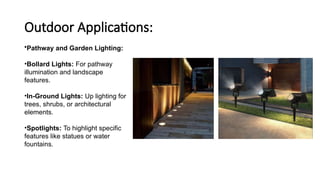
Outdoor Applications:
•Pathway and Garden Lighting:
•Bollard Lights: For pathway
illumination and landscape
features.
•In-Ground Lights: Up lighting for
trees, shrubs, or architectural
elements.
•Spotlights: To highlight specific
features like statues or water
fountains.
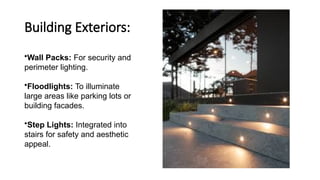
Building Exteriors:
•Wall Packs: For security and
perimeter lighting.
•Floodlights: To illuminate
large areas like parking lots or
building facades.
•Step Lights: Integrated into
stairs for safety and aesthetic
appeal.
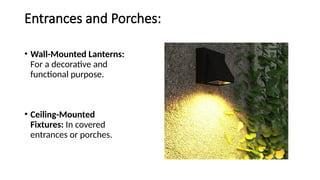
Entrances and Porches:
• Wall-Mounted Lanterns:
For a decorative and
functional purpose.
• Ceiling-Mounted
Fixtures: In covered
entrances or porches.
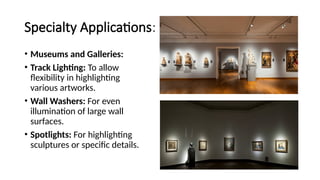
Specialty Applications:
• Museums and Galleries:
• Track Lighting: To allow
flexibility in highlighting
various artworks.
• Wall Washers: For even
illumination of large wall
surfaces.
• Spotlights: For highlighting
sculptures or specific details.
Healthcare Facilities:
• Indirect Lighting: To reduce
glare and create a calm
environment.
• Recessed and Surface-Mounted
Fixtures: For general lighting in
patient rooms and corridors.
• Task Lighting: Adjustable,
focused lighting in examination
areas.
Primary and Secondary lighting
• Primary lighting refers to the main source of illumination in a space,
providing overall brightness. This includes ceiling fixtures or overhead
lights designed to light up the entire room.
• Secondary lighting, or supplementary lighting, enhances or
complements the primary lighting. It focuses on specific areas or
tasks, such as floor lamps, table lamps, or accent lights, helping to
create a layered lighting effect and improve functionality or ambiance.
Choosing Luminaires:
•Purpose: Determine the primary function—ambient, task, accent, or
decorative lighting.
•Space and Style: Choose luminaires that complement the architectural
style and fit within the physical constraints of the space.
•Light Quality: Consider factors like CRI, color temperature, and glare
control based on the application.
•Energy Efficiency: Opt for energy-efficient options like LEDs, especially
in commercial or industrial settings to reduce operational costs.
•Durability and Maintenance: In high-traffic or outdoor areas, select
robust fixtures that require minimal maintenance.

Electrical lighting and aquatics lessons

  • 1.
  • 2.
    INVERSE SQUARE LAW •The Inverse Square Law of lighting describes how the intensity of light diminishes as the distance from the light source increases. It specifically states that the intensity of light is inversely proportional to the square of the distance from the source. • Formula: • I 1/d2 ∝ • Where: • I is the intensity of light (illuminance) at a given point, • d is the distance from the light source to that point.
  • 3.
    Explanation: •As you moveaway from a light source, the same amount of light spreads over a larger area. This means that the further away you are, the less intense the light appears. •If you double the distance (2d), the light intensity reduces to one-fourth (1/2² = 1/4) of its original intensity. Similarly, tripling the distance (3d) reduces the intensity to one- ninth (1/3² = 1/9). Practical Example: Imagine you have a lamp that illuminates a surface 1 meter away. If the light on that surface has an intensity of 100 lux, moving to 2 meters away would reduce the intensity to:
  • 5.
    LAMBERT’S COSINE LAW Lambert'sCosine Law describes how the intensity of light falling on a surface depends on the angle of incidence between the light and the surface. It is particularly important when understanding how light illuminates surfaces at different angles in both architecture and photography. The Law: Lambert’s Cosine Law states that the illuminance (E) on a surface is directly proportional to the cosine of the angle of incidence (θ) of the light:
  • 6.
    Where: •E is theeffective illuminance on the surface, •E₀ is the illuminance if the light strikes the surface perpendicularly (at θ = 0°), •θ is the angle between the incoming light and the normal (perpendicular) to the surface.
  • 9.
    Practical Example: Imagine sunlighthitting the ground at different times of day: •At noon, the sun is almost directly overhead, so the light is nearly perpendicular to the ground (θ is small), and the ground is brightly lit. •In the morning or evening, the sun is lower on the horizon, and light strikes the ground at a steeper angle (larger θ). As a result, the light is less intense, and the ground appears dimmer. Applications in Architecture and Design: Lighting Design: Lambert’s Cosine Law helps architects and designers calculate how well- lit surfaces will be based on light angles, ensuring even lighting across spaces. Solar Panels: Solar panels are angled to maximize the amount of sunlight hitting them perpendicularly for better energy efficiency, following this principle.
  • 10.
    Visualization: Imagine holding aflashlight directly above a table (perpendicular). The light circle on the table is bright and focused. Now tilt the flashlight to a steeper angle. The light spreads over a larger area, but it becomes dimmer. This is Lambert’s Cosine Law in action!
  • 11.
    LAW OF REFLECTION TheLaw of Reflection governs how light behaves when it bounces off a reflective surface, such as a mirror or a smooth, shiny object. This law is fundamental in optics and helps us understand how light rays interact with different surfaces. The Law of Reflection states: 1.The angle of incidence is equal to the angle of reflection: Where: •θᵢ is the angle of incidence (the angle between the incoming light ray and the normal to the surface), •θᵣ is the angle of reflection (the angle between the reflected light ray and the normal to the surface).
  • 12.
    1.The incident ray,the reflected ray, and the normal to the surface all lie in the same plane: This means all these components are coplanar (they are confined to the same flat surface). Key Components: •Incident Ray: The ray of light that strikes the surface. •Reflected Ray: The ray of light that bounces off the surface. •Normal: An imaginary line perpendicular to the reflective surface at the point where the light ray strikes it.
  • 13.
    Example: Imagine a lightray striking a mirror: •If the ray hits the mirror at an angle of incidence of 30° (measured from the normal), the angle of reflection will also be 30° on the other side of the normal. Visualization: 1.Incident Ray: The ray approaches the surface at some angle, say 30° from the normal. 2.Normal: This is a line perpendicular (90°) to the surface at the point where the incident ray strikes. 3.Reflected Ray: The light bounces off the surface at an angle equal to the angle of incidence (in this case, also 30° from the normal).
  • 14.
    Example in RealLife: •Mirrors: When you look into a mirror, the light from your face strikes the mirror, and the reflected light reaches your eyes. The angles of incidence and reflection determine how you see your reflection. •Billiard Ball Game: When you hit a ball against the side of a pool table, the ball bounces off in a predictable manner because its path follows the law of reflection. The angle at which it hits the side (angle of incidence) equals the angle at which it bounces back (angle of reflection).
  • 15.
    Types of Reflection: 1.SpecularReflection: Occurs when light reflects off a smooth surface, like a mirror or calm water, where the angles of incidence and reflection are clearly defined. This creates a clear reflection, like a mirror image. 2.Diffuse Reflection: Occurs when light reflects off a rough surface. Although the law of reflection still applies locally at every small point, the uneven surface causes the reflected light to scatter in many directions, so no clear image is formed (e.g., reflection from a rough wall).
  • 16.
    QUANTITY OF LIGHT •Thequantity of light is measured using the concept of luminous flux, which refers to the total amount of visible light emitted by a source per unit of time. It is measured in lumens (lm). •Luminous flux accounts for the sensitivity of the human eye to different wavelengths of light, meaning it only measures light that is perceived by the human eye (the visible spectrum). •Considerations: •Task Lighting: Requires high illuminance for activities like reading or cooking. •Ambient Lighting: Provides general illumination for spaces, requiring moderate lux levels. •Accent Lighting: Highlights specific features, often with focused light and variable lux levels.
  • 17.
    QUANTITY OF LIGHT •Here are some related terms and units used to measure light: • Luminous Intensity: The amount of light emitted in a particular direction, measured in candelas (cd). • Illuminance: The amount of light falling on a surface, measured in lux (lx), where 1 lux equals 1 lumen per square meter. • Luminance: The brightness of a light source as perceived by the human eye, measured in candelas per square meter (cd/m²).
  • 18.
    Quality of Light •Color Temperature (Kelvin): • Measured in Kelvin (K), it indicates the warmth or coolness of a light source. • Warm Light: 2700K - 3000K (yellowish, cozy atmosphere). • Neutral Light: 3500K - 4100K (balanced, natural feel). • Cool Light: 5000K - 6500K (bluish, daylight-like). • Color Rendering Index (CRI): • Measures the ability of a light source to reveal the colors of objects faithfully compared to natural light. It ranges from 0 to 100, with higher values indicating better color rendering. • A CRI of 80+ is considered good for most applications, while 90+ is excellent for spaces where accurate color perception is crucial. • Light Distribution: • Refers to how light is spread in a space. Different fixtures provide varying distributions, such as direct, indirect, diffuse, or focused beams.
  • 19.
    • Glare andFlicker: • Glare: Uncomfortable brightness that can cause eye strain. It’s crucial to minimize glare for visual comfort. • Flicker: Rapid variations in light intensity, which can be distracting and harmful, especially in sensitive environments. • Uniformity: • Ensuring an even distribution of light across a space to avoid dark spots or excessive brightness. • Application Considerations: • Residential Spaces: Warm, ambient lighting with a high CRI to create a comfortable atmosphere. • Workspaces: Cool, bright lighting with good CRI and minimal glare for focus and productivity. • Retail and Galleries: High CRI and adjustable lighting to highlight products or artwork.
  • 20.
    TYPES OF LAMPSAND LUMINAIRS • Lamps and luminaires are essential components of lighting design. While lamps refer to the light sources themselves, luminaires include the entire fixture that holds the lamp, controls its distribution, and connects it to the power source. Below is an overview of different types of lamps and luminaires:
  • 21.
    Types of Lamps: •Incandescent Lamps: • Description: Traditional light bulbs with a filament that glows when electricity passes through it. • Advantages: Warm light, good colour rendering (CRI ~100). • Disadvantages: Low energy efficiency, short lifespan.
  • 22.
    Halogen Lamps: •Description: Atype of incandescent lamp that contains halogen gas, which increases efficiency and lifespan. •Advantages: Bright, white light with good color rendering. •Disadvantages: Still relatively inefficient compared to modern alternatives, heat generation.
  • 23.
    Fluorescent lamps: • Description:Uses a phosphor coating inside the tube to produce light when electricity excites mercury vapor inside. • Types: Linear tubes (e.g., T5, T8) and Compact Fluorescent Lamps (CFLs). • Advantages: Energy-efficient, long- lasting. • Disadvantages: Contains mercury, lower CRI compared to incandescent.
  • 24.
    Compact Fluorescent lamps: CompactFluorescent Lamps (CFLs) are energy-efficient light bulbs that use a gas- filled tube to produce light. They work by passing an electric current through a gas, which generates ultraviolet light. This light then excites a phosphor coating inside the bulb, producing visible light. Here are some key features of CFLs: 1.Energy Efficiency: CFLs use about 70-80% less energy than traditional incandescent bulbs, making them a cost-effective option in the long run. 2.Longer Lifespan: They typically last about 10 times longer than incandescent bulbs, often up to 10,000 hours or more. 3.Lower Heat Emission: CFLs emit less heat compared to incandescent bulbs, reducing cooling costs in warm environments. 4.Light Quality: They come in various color temperatures, allowing you to choose the type of light (warm, cool, daylight) that suits your needs. 5.Environmental Considerations: While CFLs are more energy-efficient, they contain a small amount of mercury, so proper disposal is important to prevent environmental contamination.
  • 25.
    LED lamps •Description: LightEmitting Diodes that produce light through electroluminescence. •Advantages: Highly energy- efficient, long lifespan, available in a range of color temperatures and CRI levels. •Disadvantages: Initial cost is higher, but it's decreasing over time.
  • 26.
    HID Lamps (High-IntensityDischarge): •Types: Metal halide, high- pressure sodium, and mercury vapor lamps. •Advantages: Very bright, suitable for outdoor and industrial lighting. •Disadvantages: Slow start- up time, color rendering varies, contain hazardous materials.
  • 27.
    Induction Lamps: •Description: Operateson a principle similar to fluorescent lamps but without electrodes. •Advantages: Long lifespan, energy-efficient. •Disadvantages: Higher initial cost, limited availability.
  • 28.
    Types of Luminaires: •Ceiling-Mounted Luminaires: • Recessed Downlights: Installed within the ceiling, providing a clean look. Often used for general lighting. • Surface-Mounted: Fixtures that are attached directly to the ceiling surface. Suitable for low ceilings. • Pendant Lights: Suspended from the ceiling, ideal for focused lighting over tables or counters.
  • 29.
    •Wall-Mounted Luminaires: •Wall Sconces:Provide both functional and decorative lighting. Can direct light upward, downward, or both. •Picture Lights: Designed to illuminate artwork without glare.
  • 30.
    • Portable Luminaires: •Table Lamps: Provide localized lighting, often used in living rooms and bedrooms. • Floor Lamps: Freestanding fixtures, ideal for reading areas or ambient lighting.
  • 31.
    •Track and RailLighting: •Track Lighting: Multiple fixtures mounted on a track system, allowing for adjustable and focused lighting. •Monorail Lighting: A flexible track system that allows for creative arrangements and custom lighting designs.
  • 32.
    •Linear Luminaires: •Linear Pendants:Often used in offices and commercial spaces, providing even lighting over a long area. •Under-Cabinet Lighting: Used in kitchens for task lighting, typically LED or fluorescent.
  • 33.
    •Outdoor Luminaires: •Floodlights: Providebroad, powerful illumination for security and area lighting. •Bollard Lights: Short, ground- mounted fixtures often used in pathways and gardens. •Wall Packs: Wall-mounted fixtures designed for building perimeters and security.
  • 34.
    • Architectural Luminaires: •Cove Lighting: Indirect lighting placed in ledges or recesses in ceilings or walls. • Accent Lighting: Designed to highlight architectural features or artwork.
  • 35.
    Applications and choiceof luminaires • The choice of luminaires depends on the specific application, environment, and desired lighting effect.
  • 36.
    Residential Applications: • LivingRooms: • Ceiling-Mounted Fixtures: Chandeliers or flush mounts for general ambient lighting. • Recessed Downlights: For a modern, clean look and even distribution of light. • Table and Floor Lamps: Portable luminaires for task lighting, like reading, and for adding layers of light. • Accent Lighting: Wall sconces or picture lights to highlight artwork or architectural features.
  • 37.
    Kitchens • Recessed Downlights:General lighting, especially above cooking and prep areas. • Under-Cabinet Lighting: LED strips or small fixtures to provide task lighting on countertops. • Pendant Lights: Over islands or dining tables to create a focal point and add style.
  • 38.
    Bedrooms •Ceiling-Mounted Fixtures: Flush mountsor semi-flush for general lighting. •Bedside Lamps: Table lamps for reading or ambient lighting. •Recessed Lighting: For a minimalist, streamlined look.
  • 39.
    Bathroom: • Vanity Lights:Wall-mounted fixtures on either side of or above the mirror for even lighting. • Recessed Downlights: For general lighting, especially in shower or tub areas. • Wall Sconces: Can be added for additional ambient lighting.
  • 40.
    Commercial and OfficeApplications: Offices: •Recessed Troffers: Common for general lighting in grid ceiling systems, providing uniform, low-glare light. •Pendant Lights: Linear pendants over workstations for task lighting. •Task Lighting: Desk lamps to provide focused light for individual tasks. •Track Lighting: Used for flexible lighting setups, often in creative workspaces.
  • 41.
    Retail Spaces: •Track andSpotlights: Adjustable lighting to highlight products and create dynamic displays. •Recessed Downlights: For general lighting and to create a clean look. •Pendant Lights: In boutique settings for a decorative effect. •Shelf Lighting: Integrated LED strips to illuminate merchandise.
  • 42.
    Hospitality • Lobby Areas:Chandeliers, pendants, and cove lighting to create a welcoming atmosphere. • Restaurants and Cafés: • Pendant Lights: Over tables or counters for focused lighting. • Wall Sconces: For ambient lighting and to create intimate spaces. • Recessed Downlights: For general lighting and to highlight architectural elements. • Guest Rooms: Table lamps, floor lamps, and wall-mounted reading lights for flexible lighting options.
  • 43.
    Industrial and WarehouseApplications: •High-Bay Lighting: For tall ceilings, providing bright, even illumination over large areas. •Low-Bay Lighting: Used in areas with lower ceilings, often in workshops or smaller industrial spaces. •Linear Fixtures: LED or fluorescent linear fixtures for general lighting in aisles or workstations. •Task Lighting: Adjustable lamps for specific work areas where precise lighting is required.
  • 45.
    Outdoor Applications: •Pathway andGarden Lighting: •Bollard Lights: For pathway illumination and landscape features. •In-Ground Lights: Up lighting for trees, shrubs, or architectural elements. •Spotlights: To highlight specific features like statues or water fountains.
  • 47.
    Building Exteriors: •Wall Packs:For security and perimeter lighting. •Floodlights: To illuminate large areas like parking lots or building facades. •Step Lights: Integrated into stairs for safety and aesthetic appeal.
  • 48.
    Entrances and Porches: •Wall-Mounted Lanterns: For a decorative and functional purpose. • Ceiling-Mounted Fixtures: In covered entrances or porches.
  • 49.
    Specialty Applications: • Museumsand Galleries: • Track Lighting: To allow flexibility in highlighting various artworks. • Wall Washers: For even illumination of large wall surfaces. • Spotlights: For highlighting sculptures or specific details.
  • 50.
    Healthcare Facilities: • IndirectLighting: To reduce glare and create a calm environment. • Recessed and Surface-Mounted Fixtures: For general lighting in patient rooms and corridors. • Task Lighting: Adjustable, focused lighting in examination areas.
  • 51.
    Primary and Secondarylighting • Primary lighting refers to the main source of illumination in a space, providing overall brightness. This includes ceiling fixtures or overhead lights designed to light up the entire room. • Secondary lighting, or supplementary lighting, enhances or complements the primary lighting. It focuses on specific areas or tasks, such as floor lamps, table lamps, or accent lights, helping to create a layered lighting effect and improve functionality or ambiance.
  • 52.
    Choosing Luminaires: •Purpose: Determinethe primary function—ambient, task, accent, or decorative lighting. •Space and Style: Choose luminaires that complement the architectural style and fit within the physical constraints of the space. •Light Quality: Consider factors like CRI, color temperature, and glare control based on the application. •Energy Efficiency: Opt for energy-efficient options like LEDs, especially in commercial or industrial settings to reduce operational costs. •Durability and Maintenance: In high-traffic or outdoor areas, select robust fixtures that require minimal maintenance.