 Rathod jigna p.
 Enroll no.-140210107052
As we know that almost all human activities depends on
light. Sun is a prime natural source of light but
artificial lighting plays almost main role in our daily
life. These artificial lights are produced by
mechanical lamps and electrical lamps.
But due to poor performance the mechanical light are
totally replaced by electrical lights. The electrical
lighting are mainly used for decorative purpose,
advertising, traffic control , medical field and street
lighting etc.
11/03/2013
Electrical lighting has following advantages :
1. Cleanliness
2. Easy to control
3. Economical
4. Easy to handle
5. Steady output
6. Better reliability
7. Suitable for almost all purposes etc.
11/03/2013
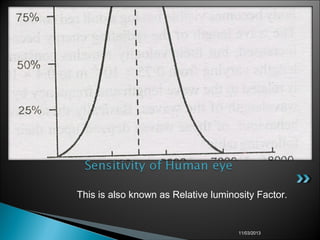
As we know natural light consists of seven colors
having different wavelengths. The average human
eye is most sensitive to a wave length of 5500 0
A.
The relative sensitivity of eye for a particular wave
length is the visual effect produced by the light on
the average human eye as compared with the
effect of light having wave length 5500 0
A on
human eye.
11/03/2013
This is also known as Relative luminosity Factor.
11/03/2013
That part of radiant energy
from a hot body which
produced the visual sensation
on human eye is called light.
11/03/2013
Lighting schemes are classified according
to the location, requirement and
purpose etc. are as under :
1. Direct lighting
2. Indirect lighting
3. Semi direct lighting
4. Semi indirect lighting
5. General lighting
11/03/2013
As is clear from the name, in this system
almost 90 to 95 % light falls directly on the
object or the surface. The light is made to
fall upon the surface with the help of deep
reflectors. Such type of lighting scheme is
most used in industries and commercial
lighting. Although this scheme is most
efficient but it is liable to cause glare and
shadows.
11/03/2013
11/03/2013
In this system, the light does not fall directly
on the surface but more than 90 % of light
is directed upwards by using diffusing
reflectors. Here the ceiling acts as a source
of light and this light is uniformly distributed
over the surface and glare is reduced to
minimum. It provides shadow less
illumination which is useful for drawing
offices and composing rooms. It is also
used for decoration purposes in cinema
halls, hotels etc.
This is also an efficient system of lighting and
chances of glare are also reduced. Here
transparent type shades are used through which
about 60 % light is directed downward and 40 % is
directed upward. This also provides a uniform
distribution of light and is best suited for room with
high ceilings.
11/03/2013
In this system about 60 to 90 % of total light is thrown
upward to the ceiling for diffused reflection and the
rest reaches the working plane directly. A very
small amount of light is absorbed by the bowl. It is
mainly used for interior decoration.
11/03/2013
This system employs such type of luminaries, shades
and reflectors which give equal illumination in all
the directions.
11/03/2013
While designing a good lighting schemes, the
following points must be kept in mind :
1. It should provide adequate illumination.
2. It should provides uniformly distributed light all
over working plane.
3. It should avoid glare and shadows as far as
possible.
4. It should provide light of suitable colors.
11/03/2013
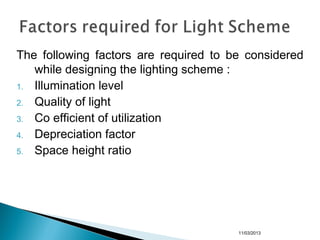
The following factors are required to be considered
while designing the lighting scheme :
1. Illumination level
2. Quality of light
3. Co efficient of utilization
4. Depreciation factor
5. Space height ratio
11/03/2013
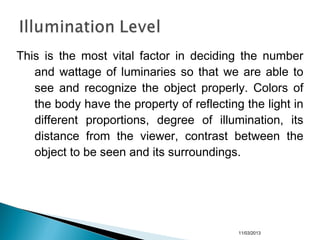
This is the most vital factor in deciding the number
and wattage of luminaries so that we are able to
see and recognize the object properly. Colors of
the body have the property of reflecting the light in
different proportions, degree of illumination, its
distance from the viewer, contrast between the
object to be seen and its surroundings.
11/03/2013
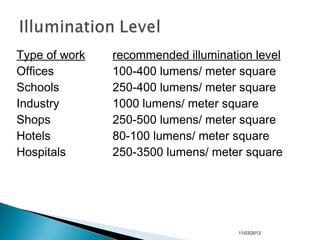
Type of work recommended illumination level
Offices 100-400 lumens/ meter square
Schools 250-400 lumens/ meter square
Industry 1000 lumens/ meter square
Shops 250-500 lumens/ meter square
Hotels 80-100 lumens/ meter square
Hospitals 250-3500 lumens/ meter square
11/03/2013
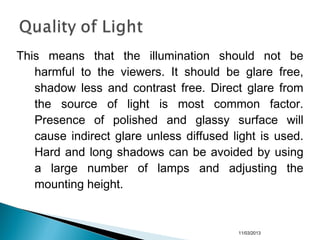
This means that the illumination should not be
harmful to the viewers. It should be glare free,
shadow less and contrast free. Direct glare from
the source of light is most common factor.
Presence of polished and glassy surface will
cause indirect glare unless diffused light is used.
Hard and long shadows can be avoided by using
a large number of lamps and adjusting the
mounting height.
11/03/2013
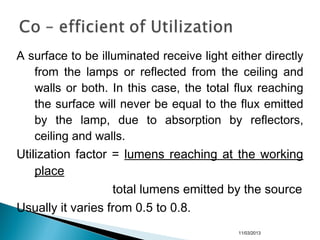
A surface to be illuminated receive light either directly
from the lamps or reflected from the ceiling and
walls or both. In this case, the total flux reaching
the surface will never be equal to the flux emitted
by the lamp, due to absorption by reflectors,
ceiling and walls.
Utilization factor = lumens reaching at the working
place
total lumens emitted by the source
Usually it varies from 0.5 to 0.8.
11/03/2013
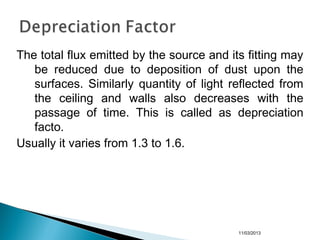
The total flux emitted by the source and its fitting may
be reduced due to deposition of dust upon the
surfaces. Similarly quantity of light reflected from
the ceiling and walls also decreases with the
passage of time. This is called as depreciation
facto.
Usually it varies from 1.3 to 1.6.
11/03/2013
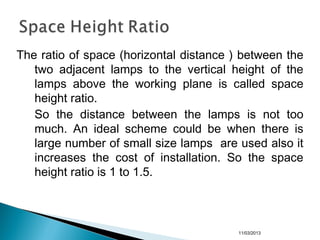
The ratio of space (horizontal distance ) between the
two adjacent lamps to the vertical height of the
lamps above the working plane is called space
height ratio.
So the distance between the lamps is not too
much. An ideal scheme could be when there is
large number of small size lamps are used also it
increases the cost of installation. So the space
height ratio is 1 to 1.5.
11/03/2013
11/03/2013

(Eee)140210107052

  • 1.
     Rathod jignap.  Enroll no.-140210107052
  • 2.
    As we knowthat almost all human activities depends on light. Sun is a prime natural source of light but artificial lighting plays almost main role in our daily life. These artificial lights are produced by mechanical lamps and electrical lamps. But due to poor performance the mechanical light are totally replaced by electrical lights. The electrical lighting are mainly used for decorative purpose, advertising, traffic control , medical field and street lighting etc. 11/03/2013
  • 3.
    Electrical lighting hasfollowing advantages : 1. Cleanliness 2. Easy to control 3. Economical 4. Easy to handle 5. Steady output 6. Better reliability 7. Suitable for almost all purposes etc. 11/03/2013
  • 4.
    As we knownatural light consists of seven colors having different wavelengths. The average human eye is most sensitive to a wave length of 5500 0 A. The relative sensitivity of eye for a particular wave length is the visual effect produced by the light on the average human eye as compared with the effect of light having wave length 5500 0 A on human eye. 11/03/2013
  • 5.
    This is alsoknown as Relative luminosity Factor. 11/03/2013
  • 6.
    That part ofradiant energy from a hot body which produced the visual sensation on human eye is called light. 11/03/2013
  • 7.
    Lighting schemes areclassified according to the location, requirement and purpose etc. are as under : 1. Direct lighting 2. Indirect lighting 3. Semi direct lighting 4. Semi indirect lighting 5. General lighting 11/03/2013
  • 8.
    As is clearfrom the name, in this system almost 90 to 95 % light falls directly on the object or the surface. The light is made to fall upon the surface with the help of deep reflectors. Such type of lighting scheme is most used in industries and commercial lighting. Although this scheme is most efficient but it is liable to cause glare and shadows. 11/03/2013
  • 9.
    11/03/2013 In this system,the light does not fall directly on the surface but more than 90 % of light is directed upwards by using diffusing reflectors. Here the ceiling acts as a source of light and this light is uniformly distributed over the surface and glare is reduced to minimum. It provides shadow less illumination which is useful for drawing offices and composing rooms. It is also used for decoration purposes in cinema halls, hotels etc.
  • 10.
    This is alsoan efficient system of lighting and chances of glare are also reduced. Here transparent type shades are used through which about 60 % light is directed downward and 40 % is directed upward. This also provides a uniform distribution of light and is best suited for room with high ceilings. 11/03/2013
  • 11.
    In this systemabout 60 to 90 % of total light is thrown upward to the ceiling for diffused reflection and the rest reaches the working plane directly. A very small amount of light is absorbed by the bowl. It is mainly used for interior decoration. 11/03/2013
  • 12.
    This system employssuch type of luminaries, shades and reflectors which give equal illumination in all the directions. 11/03/2013
  • 13.
    While designing agood lighting schemes, the following points must be kept in mind : 1. It should provide adequate illumination. 2. It should provides uniformly distributed light all over working plane. 3. It should avoid glare and shadows as far as possible. 4. It should provide light of suitable colors. 11/03/2013
  • 14.
    The following factorsare required to be considered while designing the lighting scheme : 1. Illumination level 2. Quality of light 3. Co efficient of utilization 4. Depreciation factor 5. Space height ratio 11/03/2013
  • 15.
    This is themost vital factor in deciding the number and wattage of luminaries so that we are able to see and recognize the object properly. Colors of the body have the property of reflecting the light in different proportions, degree of illumination, its distance from the viewer, contrast between the object to be seen and its surroundings. 11/03/2013
  • 16.
    Type of workrecommended illumination level Offices 100-400 lumens/ meter square Schools 250-400 lumens/ meter square Industry 1000 lumens/ meter square Shops 250-500 lumens/ meter square Hotels 80-100 lumens/ meter square Hospitals 250-3500 lumens/ meter square 11/03/2013
  • 17.
    This means thatthe illumination should not be harmful to the viewers. It should be glare free, shadow less and contrast free. Direct glare from the source of light is most common factor. Presence of polished and glassy surface will cause indirect glare unless diffused light is used. Hard and long shadows can be avoided by using a large number of lamps and adjusting the mounting height. 11/03/2013
  • 18.
    A surface tobe illuminated receive light either directly from the lamps or reflected from the ceiling and walls or both. In this case, the total flux reaching the surface will never be equal to the flux emitted by the lamp, due to absorption by reflectors, ceiling and walls. Utilization factor = lumens reaching at the working place total lumens emitted by the source Usually it varies from 0.5 to 0.8. 11/03/2013
  • 19.
    The total fluxemitted by the source and its fitting may be reduced due to deposition of dust upon the surfaces. Similarly quantity of light reflected from the ceiling and walls also decreases with the passage of time. This is called as depreciation facto. Usually it varies from 1.3 to 1.6. 11/03/2013
  • 20.
    The ratio ofspace (horizontal distance ) between the two adjacent lamps to the vertical height of the lamps above the working plane is called space height ratio. So the distance between the lamps is not too much. An ideal scheme could be when there is large number of small size lamps are used also it increases the cost of installation. So the space height ratio is 1 to 1.5. 11/03/2013

  • 21.