MATERIAL HANDLING & SAFETY
Jamshed Khan 2017-BT-Mech-761
Hafiz Arsalan Hassan 2017-BT-Mech-762
Noise
Noise:
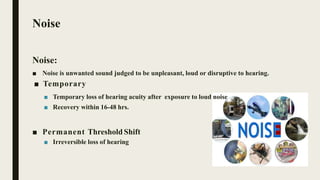
■ Noise is unwanted sound judged to be unpleasant, loud or disruptive to hearing.
■ Temporary
■ Temporary loss of hearing acuity after exposure to loud noise
■ Recovery within 16-48 hrs.
■ Permanent Threshold Shift
■ Irreversible loss of hearing
Machinery Noise
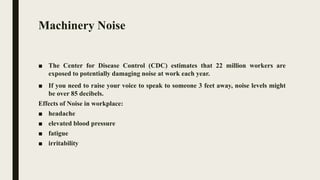
■ The Center for Disease Control (CDC) estimates that 22 million workers are
exposed to potentially damaging noise at work each year.
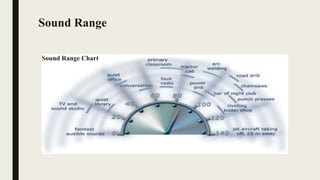
■ If you need to raise your voice to speak to someone 3 feet away, noise levels might
be over 85 decibels.
Effects of Noise in workplace:
■ headache
■ elevated blood pressure
■ fatigue
■ irritability
Sound Range
Sound Range Chart
HealthEffectsofNoiseatWork
Hearing loss:
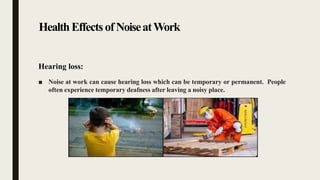
■ Noise at work can cause hearing loss which can be temporary or permanent. People
often experience temporary deafness after leaving a noisy place.
Hearing Protection
Hearing protection should be issued to employees:
 Where extra protection is needed above what has been achieved using noise control;
 As a short-term measure while other methods of controlling noise are being
developed.
What does the law require employers to do?
You are required to:
 provide your employees with hearing protectors if they ask for them and their noise
exposure is between the lower and upper exposure action values;
 identify hearing protection zones, i.e. areas where the use of hearing protection is
compulsory, and mark them with signs if possible;
 provide your employees with training and information on how to use and care for the
hearing protectors;
 ensure that the hearing protectors are properly used and maintained.
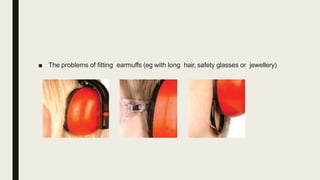
■ The problems of fitting earmuffs (eg with long hair, safety glasses or jewellery)
Health Surveillance
Providing health surveillance
■ You must provide health surveillance (hearing checks) for all your employees who are
likely to be frequently exposed above the upper exposure action values, or are at risk for any
reason, e.g. they already suffer from hearing loss or are particularly sensitive to damage.
The purpose of health surveillance is to:
■ warn you when employees might be suffering from early signs of hearing damage;
■ give you an opportunity to do something to prevent the damage getting worse;
■ check that control measures are working.
Electrical Failure
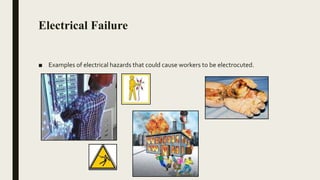
■ Examples of electrical hazards that could cause workers to be electrocuted.
Electrical Failure
BE SAFE:
■ Burns
■ Electrocution
■ Shock
■ Arc flash/arc blast
■ Fire
■ Explosions
Electrical Failure
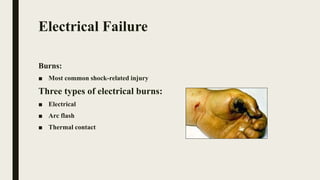
Burns:
■ Most common shock-related injury
Three types of electrical burns:
■ Electrical
■ Arc flash
■ Thermal contact
Electrical Failure
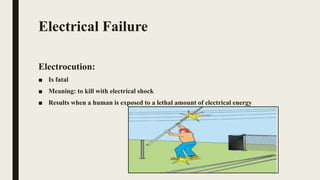
Electrocution:
■ Is fatal
■ Meaning: to kill with electrical shock
■ Results when a human is exposed to a lethal amount of electrical energy
Electrical Failure
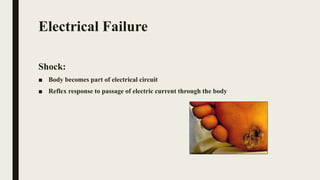
Shock:
■ Body becomes part of electrical circuit
■ Reflex response to passage of electric current through the body
Electrical Failure
Arc Flash/Arc Blast
Arc flash:
■ Sudden release of electrical energy through air when a high-voltage gap exists and
there is a breakdown between conductors
■ Gives off thermal radiation (heat) and bright, intense light that can cause burns
■ Temperatures as high as 35,000°F
Arc blast:
■ High-voltage arcs can also produce considerable pressure waves by rapidly heating
the air and creating a blast
Electrical Failure
Fire:
■ Most result from problems with "fixed wiring”
■ Problems with cords, plugs, receptacles, and switches also cause electrical fires
Explosions:
Occur when electricity ignites explosive mixture of material in the air
 Electricity is source of these hazards
 All hazards are of equal importance
 Lesson focuses on eliminating electrical hazards
Electrical Protection Methods
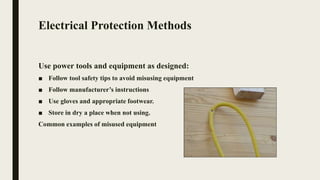
Use power tools and equipment as designed:
■ Follow tool safety tips to avoid misusing equipment
■ Follow manufacturer’s instructions
■ Use gloves and appropriate footwear.
■ Store in dry a place when not using.
Common examples of misused equipment
Employer Requirements
Employer requirements to protect workers:
■ Ensure overhead power line safety
■ Isolate electrical parts
■ Ensure power tools are maintained in a safe condition
■ Ensure proper guarding
■ Provide training
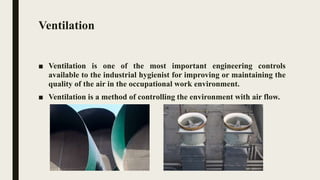
Ventilation
■ Ventilation is one of the most important engineering controls
available to the industrial hygienist for improving or maintaining the
quality of the air in the occupational work environment.
■ Ventilation is a method of controlling the environment with air flow.
Importance of Ventilation System
Other ways to control contaminants include:
■ Eliminate the use of the hazardous chemical or material,
■ Substitute with less toxic chemicals,
■ Process change, or
■ Work practice change.
Purposes of Ventilation
There are four purposes of ventilation:
■ Provide a continuous supply of fresh outside air.
■ Maintain temperature and humidity at comfortable levels.
■ Reduce potential fire or explosion hazards.
■ Remove or dilute airborne contaminants.
Parts of Industrial Ventilation System
In general, the supply system is a heating, ventilation, and air-
conditioning system (HVAC) and consists of
■ air inlet,
■ air filtering equipment,
■ heating/cooling equipment,
■ fan,
■ ducts
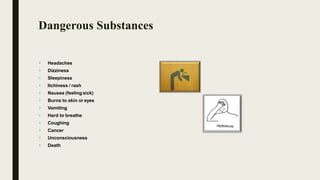
Dangerous Substances
 Headaches
 Dizziness
 Sleepiness
 Itchiness / rash
 Nausea (feeling sick)
 Burns to skin or eyes
 Vomiting
 Hard to breathe
 Coughing
 Cancer
 Unconsciousness
 Death
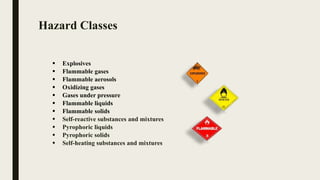
Hazard Classes
 Explosives
 Flammable gases
 Flammable aerosols
 Oxidizing gases
 Gases under pressure
 Flammable liquids
 Flammable solids
 Self-reactive substances and mixtures
 Pyrophoric liquids
 Pyrophoric solids
 Self-heating substances and mixtures
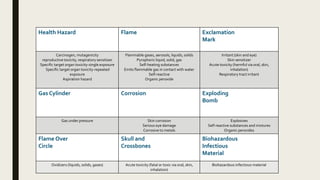
Health Hazard Flame Exclamation
Mark
Carcinogen, mutagenicity
reproductive toxicity, respiratory sensitizer
Specific target organ toxicity-single exposure
Specific target organ toxicity-repeated
exposure
Aspiration hazard
Flammable gases, aerosols, liquids, solids
Pyrophoric liquid, solid, gas
Self-heating substances
Emits flammable gas in contact with water
Self-reactive
Organic peroxide
Irritant (skin and eye)
Skin sensitizer
Acute toxicity (harmful via oral, skin,
inhalation)
Respiratory tract irritant
Gas Cylinder Corrosion Exploding
Bomb
Gas under pressure Skin corrosion
Serious eye damage
Corrosive to metals
Explosives
Self-reactive substances and mixtures
Organic peroxides
Flame Over
Circle
Skull and
Crossbones
Biohazardous
Infectious
Material
Oxidizers (liquids, solids, gases) Acute toxicity (fatal or toxic via oral, skin,
inhalation)
Biohazardous infectious material
Dangerous Substances
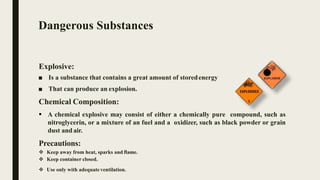
Explosive:
■ Is a substance that contains a great amount of storedenergy
■ That can produce an explosion.
Chemical Composition:
 A chemical explosive may consist of either a chemically pure compound, such as
nitroglycerin, or a mixture of an fuel and a oxidizer, such as black powder or grain
dust and air.
Precautions:
 Keep away from heat, sparks and flame.
 Keep container closed.
 Use only with adequate ventilation.
Dangerous Substances
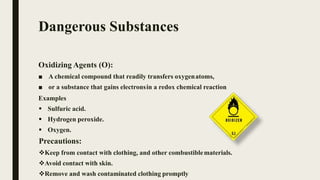
Oxidizing Agents (O):
■ A chemical compound that readily transfers oxygenatoms,
■ or a substance that gains electronsin a redox chemical reaction
Examples
 Sulfuric acid.
 Hydrogen peroxide.
 Oxygen.
Precautions:
Keep from contact with clothing, and other combustiblematerials.
Avoid contact with skin.
Remove and wash contaminated clothing promptly
Dangerous Substances
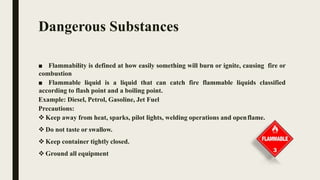
■ Flammability is defined at how easily something will burn or ignite, causing fire or
combustion
■ Flammable liquid is a liquid that can catch fire flammable liquids classified
according to flash point and a boiling point.
Example: Diesel, Petrol, Gasoline, Jet Fuel
Precautions:
 Keep away from heat, sparks, pilot lights, welding operations and openflame.
 Do not taste or swallow.
 Keep container tightly closed.
 Ground all equipment
Dangerous Substances
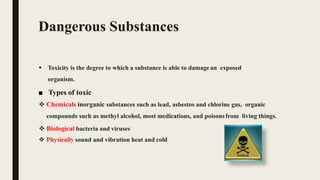
 Toxicity is the degree to which a substance is able to damagean exposed
organism.
■ Types of toxic
 Chemicals inorganic substances such as lead, asbestos and chlorine gas, organic
compounds such as methyl alcohol, most medications, and poisonsfrom living things.
 Biological bacteria and viruses
 Physically sound and vibration heat and cold
Dangerous Substances
Precautions:
Avoid contact with eyes, skin and clothing.
Avoid breathing vapor. Use only with adequate ventilation.
Wash thoroughly afterhandling.
Remove and wash contaminated clothing before reuse.
Labeling
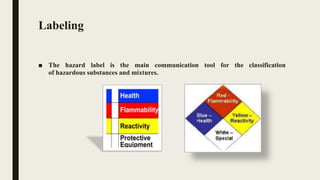
■ The hazard label is the main communication tool for the classification
of hazardous substances and mixtures.

Material Handling & Safety

  • 1.
    MATERIAL HANDLING &SAFETY Jamshed Khan 2017-BT-Mech-761 Hafiz Arsalan Hassan 2017-BT-Mech-762
  • 2.
    Noise Noise: ■ Noise isunwanted sound judged to be unpleasant, loud or disruptive to hearing. ■ Temporary ■ Temporary loss of hearing acuity after exposure to loud noise ■ Recovery within 16-48 hrs. ■ Permanent Threshold Shift ■ Irreversible loss of hearing
  • 3.
    Machinery Noise ■ TheCenter for Disease Control (CDC) estimates that 22 million workers are exposed to potentially damaging noise at work each year. ■ If you need to raise your voice to speak to someone 3 feet away, noise levels might be over 85 decibels. Effects of Noise in workplace: ■ headache ■ elevated blood pressure ■ fatigue ■ irritability
  • 4.
  • 5.
    HealthEffectsofNoiseatWork Hearing loss: ■ Noiseat work can cause hearing loss which can be temporary or permanent. People often experience temporary deafness after leaving a noisy place.
  • 6.
    Hearing Protection Hearing protectionshould be issued to employees:  Where extra protection is needed above what has been achieved using noise control;  As a short-term measure while other methods of controlling noise are being developed.
  • 7.
    What does thelaw require employers to do? You are required to:  provide your employees with hearing protectors if they ask for them and their noise exposure is between the lower and upper exposure action values;  identify hearing protection zones, i.e. areas where the use of hearing protection is compulsory, and mark them with signs if possible;  provide your employees with training and information on how to use and care for the hearing protectors;  ensure that the hearing protectors are properly used and maintained.
  • 8.
    ■ The problemsof fitting earmuffs (eg with long hair, safety glasses or jewellery)
  • 9.
    Health Surveillance Providing healthsurveillance ■ You must provide health surveillance (hearing checks) for all your employees who are likely to be frequently exposed above the upper exposure action values, or are at risk for any reason, e.g. they already suffer from hearing loss or are particularly sensitive to damage. The purpose of health surveillance is to: ■ warn you when employees might be suffering from early signs of hearing damage; ■ give you an opportunity to do something to prevent the damage getting worse; ■ check that control measures are working.
  • 10.
    Electrical Failure ■ Examplesof electrical hazards that could cause workers to be electrocuted.
  • 11.
    Electrical Failure BE SAFE: ■Burns ■ Electrocution ■ Shock ■ Arc flash/arc blast ■ Fire ■ Explosions
  • 12.
    Electrical Failure Burns: ■ Mostcommon shock-related injury Three types of electrical burns: ■ Electrical ■ Arc flash ■ Thermal contact
  • 13.
    Electrical Failure Electrocution: ■ Isfatal ■ Meaning: to kill with electrical shock ■ Results when a human is exposed to a lethal amount of electrical energy
  • 14.
    Electrical Failure Shock: ■ Bodybecomes part of electrical circuit ■ Reflex response to passage of electric current through the body
  • 15.
    Electrical Failure Arc Flash/ArcBlast Arc flash: ■ Sudden release of electrical energy through air when a high-voltage gap exists and there is a breakdown between conductors ■ Gives off thermal radiation (heat) and bright, intense light that can cause burns ■ Temperatures as high as 35,000°F Arc blast: ■ High-voltage arcs can also produce considerable pressure waves by rapidly heating the air and creating a blast
  • 16.
    Electrical Failure Fire: ■ Mostresult from problems with "fixed wiring” ■ Problems with cords, plugs, receptacles, and switches also cause electrical fires Explosions: Occur when electricity ignites explosive mixture of material in the air  Electricity is source of these hazards  All hazards are of equal importance  Lesson focuses on eliminating electrical hazards
  • 17.
    Electrical Protection Methods Usepower tools and equipment as designed: ■ Follow tool safety tips to avoid misusing equipment ■ Follow manufacturer’s instructions ■ Use gloves and appropriate footwear. ■ Store in dry a place when not using. Common examples of misused equipment
  • 18.
    Employer Requirements Employer requirementsto protect workers: ■ Ensure overhead power line safety ■ Isolate electrical parts ■ Ensure power tools are maintained in a safe condition ■ Ensure proper guarding ■ Provide training
  • 19.
    Ventilation ■ Ventilation isone of the most important engineering controls available to the industrial hygienist for improving or maintaining the quality of the air in the occupational work environment. ■ Ventilation is a method of controlling the environment with air flow.
  • 20.
    Importance of VentilationSystem Other ways to control contaminants include: ■ Eliminate the use of the hazardous chemical or material, ■ Substitute with less toxic chemicals, ■ Process change, or ■ Work practice change.
  • 21.
    Purposes of Ventilation Thereare four purposes of ventilation: ■ Provide a continuous supply of fresh outside air. ■ Maintain temperature and humidity at comfortable levels. ■ Reduce potential fire or explosion hazards. ■ Remove or dilute airborne contaminants.
  • 22.
    Parts of IndustrialVentilation System In general, the supply system is a heating, ventilation, and air- conditioning system (HVAC) and consists of ■ air inlet, ■ air filtering equipment, ■ heating/cooling equipment, ■ fan, ■ ducts
  • 23.
    Dangerous Substances  Headaches Dizziness  Sleepiness  Itchiness / rash  Nausea (feeling sick)  Burns to skin or eyes  Vomiting  Hard to breathe  Coughing  Cancer  Unconsciousness  Death
  • 24.
    Hazard Classes  Explosives Flammable gases  Flammable aerosols  Oxidizing gases  Gases under pressure  Flammable liquids  Flammable solids  Self-reactive substances and mixtures  Pyrophoric liquids  Pyrophoric solids  Self-heating substances and mixtures
  • 25.
    Health Hazard FlameExclamation Mark Carcinogen, mutagenicity reproductive toxicity, respiratory sensitizer Specific target organ toxicity-single exposure Specific target organ toxicity-repeated exposure Aspiration hazard Flammable gases, aerosols, liquids, solids Pyrophoric liquid, solid, gas Self-heating substances Emits flammable gas in contact with water Self-reactive Organic peroxide Irritant (skin and eye) Skin sensitizer Acute toxicity (harmful via oral, skin, inhalation) Respiratory tract irritant Gas Cylinder Corrosion Exploding Bomb Gas under pressure Skin corrosion Serious eye damage Corrosive to metals Explosives Self-reactive substances and mixtures Organic peroxides Flame Over Circle Skull and Crossbones Biohazardous Infectious Material Oxidizers (liquids, solids, gases) Acute toxicity (fatal or toxic via oral, skin, inhalation) Biohazardous infectious material
  • 26.
    Dangerous Substances Explosive: ■ Isa substance that contains a great amount of storedenergy ■ That can produce an explosion. Chemical Composition:  A chemical explosive may consist of either a chemically pure compound, such as nitroglycerin, or a mixture of an fuel and a oxidizer, such as black powder or grain dust and air. Precautions:  Keep away from heat, sparks and flame.  Keep container closed.  Use only with adequate ventilation.
  • 27.
    Dangerous Substances Oxidizing Agents(O): ■ A chemical compound that readily transfers oxygenatoms, ■ or a substance that gains electronsin a redox chemical reaction Examples  Sulfuric acid.  Hydrogen peroxide.  Oxygen. Precautions: Keep from contact with clothing, and other combustiblematerials. Avoid contact with skin. Remove and wash contaminated clothing promptly
  • 28.
    Dangerous Substances ■ Flammabilityis defined at how easily something will burn or ignite, causing fire or combustion ■ Flammable liquid is a liquid that can catch fire flammable liquids classified according to flash point and a boiling point. Example: Diesel, Petrol, Gasoline, Jet Fuel Precautions:  Keep away from heat, sparks, pilot lights, welding operations and openflame.  Do not taste or swallow.  Keep container tightly closed.  Ground all equipment
  • 29.
    Dangerous Substances  Toxicityis the degree to which a substance is able to damagean exposed organism. ■ Types of toxic  Chemicals inorganic substances such as lead, asbestos and chlorine gas, organic compounds such as methyl alcohol, most medications, and poisonsfrom living things.  Biological bacteria and viruses  Physically sound and vibration heat and cold
  • 30.
    Dangerous Substances Precautions: Avoid contactwith eyes, skin and clothing. Avoid breathing vapor. Use only with adequate ventilation. Wash thoroughly afterhandling. Remove and wash contaminated clothing before reuse.
  • 31.
    Labeling ■ The hazardlabel is the main communication tool for the classification of hazardous substances and mixtures.