


Hazard and Risk Assessment 
Ethics in Industrial Hygiene 
National Conference in Industrial Hygiene 
February 14, 2014 
Maharshi Mehta, CSP, CIH 
International Safety Systems, Inc., 
Washingtonville New York, USA 
www.issehs.com
Agenda 
 Introduction to Ethics in Industrial Hygiene 
 Current Situation 
 Elements 
 The need 
– Professional 
– Personal 
 Religion and ethics 
– Place of worship (temple, synagogue, mosques VS Workplace) 
– Gods Vs Stakeholders 
 Benefits - Case Studies 
 Conclusions 
©International Safety Systems, Inc. 
www.issehs.com
Current situation 
 Exposure control decisions seem to be made 
based on erroneous data at 50%+ workplaces 
– One or more of reproducible, representative and 
reliable data missing 
 Issues with sampling and analytical methods 
 Greed has no lid 
– Knowingly results are delivered what company or 
client is looking at some of the workplaces 
– Financial gains at the cost of integrity 
©International Safety Systems, Inc. 
www.issehs.com
Issues with sampling and 
analytical methods 
 Collect more samples in limited time 
– Exposure numbers, no indicating on what is contributing to 
exposure 
 Reproducibility 
– 1 sample 
 Reliability 
– Calibration 
– Laboratories analyzing samples 
 Representativeness 
– Sampling durations 
 Focus on monitoring and not on exposure controls 
©International Safety Systems, Inc. 
www.issehs.com
The Need-Professional 
 Impact on Stakeholders 
– Employee 
 Reputation 
– ABC Environmental company in China 
 Trust 
 Financial and standard of living 
 Business Growth – word of mouth 
©International Safety Systems, Inc. 
www.issehs.com
The Need-Other 
 Impact on Family, Society and Nation 
 Family 
– Values in children and other family members 
– Bonding and benefits of bonding 
– Friends 
– Ever widening virtuous circle 
 Nation 
– Erosion of values 
– Economical impact 
 Impact on individual 
– Effective utilization of latent ability 
– Peace of mind 
– Growth 
©International Safety Systems, Inc. 
www.issehs.com
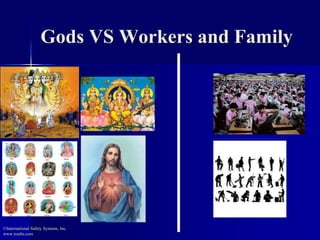
Gods VS Workers and Family 
©International Safety Systems, Inc. 
www.issehs.com
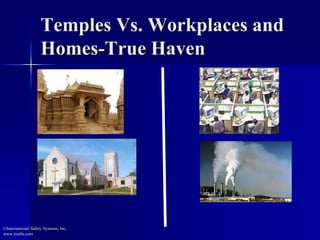
Temples Vs. Workplaces and 
Homes-True Haven 
©International Safety Systems, Inc. 
www.issehs.com
Examples All Around Us 
- Cost to Shareholders 
Enron collapsed in 2001 – 
costing shareholders 
$74B and prompting 
Sarbane-Oxley 
Accounting Regulation. 
WorldCom-$11B.
How Do Professionals Use a Code? 
 As “The Law?” 
-- (Enforceable v. not enforceable?) 
 As a “set of guidelines?” 
 As a means to set a baseline standard of 
practice? 
 As a way to raise the level of practice?
Code History 
 Originally Adopted – Early 80’s 
 Revised – Mid 90’s 
– Cannons with Interpretive Guidelines 
– Joint IH Ethics Education Committee (JIHEEC) 
 March 2006 Meeting 
– ABIH, ACGIH, AIH, AIHA & JIHEEC 
 ABIH – Legally Enforceable Code of Ethics – 
May 2007 
– Diplomates, Applicants & Examinees
 A guideline for professional ethical 
decisions 
 Not a black and white set of rules 
 Not a replacement for good judgment 
http://www.abih.org/downloads/ABIHCodeo 
fEthics.pdf
IH Ethical Misconduct Examples 
 Borrowing from another’s proposal 
 Deliberate failure to control data quality 
 Failure to protect confidential data 
 Release of results of study before peer review 
 Avoiding competition by refusing to share data 
 Research designed to favor a specific result 
 Fabrication of data 
 Deliberate failure to disclose sources of 
support
Ethical Dilemma 
Exposure assessment for formaldehyde in manufactured housing 
is contracted and scheduled for a specific week with an industrial 
hygiene consultant. The contract is for the collection of the data 
only. The hygienist will not have access to the analytical results or 
be involved in writing the report. The client changes the date 
twice for reasons not explained. The industrial hygienist arrives 
on site ready to conduct the study, but it begins to rain. Rain is 
projected for the entire week of the study and the relative 
humidity is projected to be between 85-95%.
A call to the laboratory and the sorbent tube 
media manufacturer confirms that the high 
humidity environment will skew the results low 
if the data is used. Upon informing the client of 
the current circumstances for performing the 
exposure assessment, the client complains that 
the hygienist is being too cautious and should 
collect the data anyways.
What are Potential Responses? 
 Refuse to collect any further samples 
 Collect and submit the samples and contact the 
laboratory to report field conditions 
 Collect the samples and report nothing 
 Collect the samples and require that the client 
submit them to the laboratory
What are the Likely Outcomes 
of the Responses? 
 Integrity of the Samples 
 Integrity of the Client 
 Role of the Laboratory and Media 
Manufacturer 
 Long-term Responsibility – Social Justice 
Issues
Ethical Dilemma 
You are bound by a contract to protect 
the confidentiality of the project for 
which you are hired. Because of the 
complexity of the IH issues, you wish 
to obtain input from a professional 
peer regarding the technical aspects 
of the project.
What are Potential Responses? 
 Ignore your desire to obtain input from a professional 
peer because it could be considered an ethical breach of 
your clients confidentiality. 
 Discuss the project without disclosing confidential 
details such as the name of the company, individual 
names, proprietary or other. 
 Discuss in full disclosure with a professional peer who is 
unrelated to the project and lives thousands of miles 
away. 
 Consider publishing your quandaries in the next edition 
of the Synergist.
What are the Likely Outcomes of 
the Responses?
Ethical Dilemma 
 You witness what you feel is a 
violation of the code by one of your 
professional peers who is a CIH. She 
agrees with her boss to date a safety 
review earlier than it was conducted, 
so it lines up closer to when the issue 
was identified.
What are Potential Responses 
 Contact anyone you can think of along with ABIH, 
and/or AIHA and report the incident. 
 Submit a written allegation of a breach of ethical 
duty or professional responsibility to the chair of the 
JIHEEC. 
 Call the AIHA President to personally complain. 
 Explain to the peer that you feel they are acting 
unethically and give them an opportunity to correct 
the situation before taking further action. If it 
remains unresolved then you could submit a written 
allegation of a breach of ethical duty or professional 
responsibility to ABIH.
Ethical Dilemma 
You are invited by a vendor who 
provides a majority of your industrial 
hygiene laboratory services to play 
golf and have dinner at an “exclusive” 
country club.
What are Potential Responses? 
 Accept the offer and ask if he wouldn’t mind 
throwing in a sleeve of balls and a hat. 
 Investigate your company’s policy on accepting 
vendor gifts and determine the best course of 
action with your supervisor. 
 Decide to accept the offer, but only if you can 
pay for your own green fees and dinner. 
 Accept the invitation but insist that the bill be 
paid in cash instead of a credit card to avoid 
leaving a “paper trail”.
Ethical Dilemma 
As an IH consultant you are asked by a major 
insurance carrier to sample for mold in a 
residential setting. One of the home’s 
occupants is recovering from cancer and 
recently had a bone marrow transplant. 
Moderate to extensive visible mold is present 
throughout the home and you recommend 
relocating the family. The insurance carrier 
disagrees and asks you “to keep your mouth 
shut” or they will take legal action.
What are Potential Responses? 
 Wonder why you chose to be a consultant and run out of 
the building screaming. 
 Keep your mouth shut and pretend it never happened. 
 Ignore the insurance carriers threats and immediately 
notify the occupants to vacate the premises. 
 Contact a close friend, attorney and/or mentor and ask 
for additional advice and direction.
Challenges encountered-Ethical 
Approaches adopted 
 Filter fell off during sampling operator connected upside down 
 Calibrator did not function – only 3 days in Australia 
 Middle man ask for % of the total project cost 
 After leaving company, professionals learns about environmental 
violations 
 Collect 10 samples/day by calling operators in lunch room and 
remove samples at the end of day 
 Spray welding exposure below limit-of Cr3 and Ni elemental – 
potential for hexchrome insoluble Ni exposure to exceed OEL exits, 
recommend RPE, 
 Toluene exposure likely to exceed somewhere in Europe 
 Pharma clients ask not to mention exposure is above OEL in report 
 Friend for 20+ years ask not to write about system not working just 
list exposure above limit for new operation 
©International Safety Systems, Inc. 
www.issehs.com
Case Study: Construction Safety 
 EHS professional in financial crisis finally gets job in 
middle east 
 Manager sends letter to all EHS managers has full 
authority to even close the work for safety violations and 
calls EHS professionals in office and conveys – sit in the 
office don’t go out we will give you salary-relax and 
enjoy 
 What would you do? 
 Mobile Crane is to be used at site without testing – 
Managers threatens EHS person you will loose job if you 
insist on testing, what would you do? 
©International Safety Systems, Inc. 
www.issehs.com
 How Good People Make Tough Choices, Rushworth M. 
Kidder,1995 
 Business Ethics, Richard De George 
 “Ethical Issues for Industrial Hygienists: Survey Results and 
Suggestions”, Laura A. Goldberg & Michael R. Greenberg, 
March 1993 AIHA Journal 
 “Observations of Ethical Misconduct Among Industrial 
Hygienists in England”, Burgess G. L., Mullen, D., AIHA 
Journal (63) March/April 2002 
 ABIH Executive Director, Lynn O’Donnell, 2011 Data 
 http://www.abih.org/downloads/ABIHCodeofEthics.pdf 
 Lectures shared by Jeff Throckmorton, David Roskelley, 
Barbara Weeks, Pam Greenley, Steve Rucker
Beyond Reading - Action 
JIHEEC Mission: 
 “Promote an awareness and understanding of the 
enforceable code of ethics published by the 
ABIH” 
 Not an enforcement group or resolution board 
 Publishes case studies of ethical dilemmas in the 
Synergist
Business Ethics: Codes 
 Premise 
– Business integrity earns respect and brings peace in our lives 
– Transparency and ethics have positive impact on generations to 
come 
 Codes 
– Do not give, receive bribe in any form cash, favor, kind, gift, % 
commission 
– Do not compromise on identified risk in reporting, among other 
things 
– Ensure sound basis 
– Offer to take client out for lunch/dinner once, do not push. Offer 
to pay for lunch/dinner, do not push, go “Dutch”
Confidentiality Codes 
 Significance 
– Most Sensitive information 
– Client’s trust on us 
 Do not communicate verbally or in writing what you saw at site especially 
process details and findings with any one out side ISS and in ISS with 
affected persons only 
 Data protection: Password when you are not around in your laptop, no one 
should have access to your hard disk, place relevant information in 
centralized storage and delete from file 
 Digital images: 
– Obtain permission 
– Do not take if it does not serve purpose 
– Avoid taking entire process large area, take what you want 
– Do not show images to ANYONE. Delete them once purpose is 
served 
– Keep only good images and provide to Chirantan or centralised 
storage and then delete all images
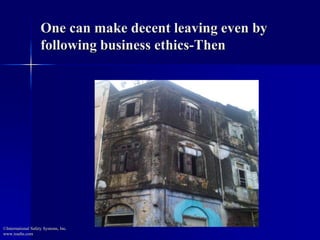
One can make decent leaving even by 
following business ethics-Then 
©International Safety Systems, Inc. 
www.issehs.com
Now 
©International Safety Systems, Inc. 
www.issehs.com
Conclusion 
Listen to inner 
voice and 
implement 
©International Safety Systems, Inc. 
www.issehs.com

Ethics In Industrial Hygiene, National Conference, February 2014

  • 1.
    Hazard and RiskAssessment Ethics in Industrial Hygiene National Conference in Industrial Hygiene February 14, 2014 Maharshi Mehta, CSP, CIH International Safety Systems, Inc., Washingtonville New York, USA www.issehs.com
  • 2.
    Agenda  Introductionto Ethics in Industrial Hygiene  Current Situation  Elements  The need – Professional – Personal  Religion and ethics – Place of worship (temple, synagogue, mosques VS Workplace) – Gods Vs Stakeholders  Benefits - Case Studies  Conclusions ©International Safety Systems, Inc. www.issehs.com
  • 3.
    Current situation Exposure control decisions seem to be made based on erroneous data at 50%+ workplaces – One or more of reproducible, representative and reliable data missing  Issues with sampling and analytical methods  Greed has no lid – Knowingly results are delivered what company or client is looking at some of the workplaces – Financial gains at the cost of integrity ©International Safety Systems, Inc. www.issehs.com
  • 4.
    Issues with samplingand analytical methods  Collect more samples in limited time – Exposure numbers, no indicating on what is contributing to exposure  Reproducibility – 1 sample  Reliability – Calibration – Laboratories analyzing samples  Representativeness – Sampling durations  Focus on monitoring and not on exposure controls ©International Safety Systems, Inc. www.issehs.com
  • 5.
    The Need-Professional Impact on Stakeholders – Employee  Reputation – ABC Environmental company in China  Trust  Financial and standard of living  Business Growth – word of mouth ©International Safety Systems, Inc. www.issehs.com
  • 6.
    The Need-Other Impact on Family, Society and Nation  Family – Values in children and other family members – Bonding and benefits of bonding – Friends – Ever widening virtuous circle  Nation – Erosion of values – Economical impact  Impact on individual – Effective utilization of latent ability – Peace of mind – Growth ©International Safety Systems, Inc. www.issehs.com
  • 7.
    Gods VS Workersand Family ©International Safety Systems, Inc. www.issehs.com
  • 8.
    Temples Vs. Workplacesand Homes-True Haven ©International Safety Systems, Inc. www.issehs.com
  • 9.
    Examples All AroundUs - Cost to Shareholders Enron collapsed in 2001 – costing shareholders $74B and prompting Sarbane-Oxley Accounting Regulation. WorldCom-$11B.
  • 10.
    How Do ProfessionalsUse a Code?  As “The Law?” -- (Enforceable v. not enforceable?)  As a “set of guidelines?”  As a means to set a baseline standard of practice?  As a way to raise the level of practice?
  • 11.
    Code History Originally Adopted – Early 80’s  Revised – Mid 90’s – Cannons with Interpretive Guidelines – Joint IH Ethics Education Committee (JIHEEC)  March 2006 Meeting – ABIH, ACGIH, AIH, AIHA & JIHEEC  ABIH – Legally Enforceable Code of Ethics – May 2007 – Diplomates, Applicants & Examinees
  • 12.
     A guidelinefor professional ethical decisions  Not a black and white set of rules  Not a replacement for good judgment http://www.abih.org/downloads/ABIHCodeo fEthics.pdf
  • 13.
    IH Ethical MisconductExamples  Borrowing from another’s proposal  Deliberate failure to control data quality  Failure to protect confidential data  Release of results of study before peer review  Avoiding competition by refusing to share data  Research designed to favor a specific result  Fabrication of data  Deliberate failure to disclose sources of support
  • 14.
    Ethical Dilemma Exposureassessment for formaldehyde in manufactured housing is contracted and scheduled for a specific week with an industrial hygiene consultant. The contract is for the collection of the data only. The hygienist will not have access to the analytical results or be involved in writing the report. The client changes the date twice for reasons not explained. The industrial hygienist arrives on site ready to conduct the study, but it begins to rain. Rain is projected for the entire week of the study and the relative humidity is projected to be between 85-95%.
  • 15.
    A call tothe laboratory and the sorbent tube media manufacturer confirms that the high humidity environment will skew the results low if the data is used. Upon informing the client of the current circumstances for performing the exposure assessment, the client complains that the hygienist is being too cautious and should collect the data anyways.
  • 16.
    What are PotentialResponses?  Refuse to collect any further samples  Collect and submit the samples and contact the laboratory to report field conditions  Collect the samples and report nothing  Collect the samples and require that the client submit them to the laboratory
  • 17.
    What are theLikely Outcomes of the Responses?  Integrity of the Samples  Integrity of the Client  Role of the Laboratory and Media Manufacturer  Long-term Responsibility – Social Justice Issues
  • 18.
    Ethical Dilemma Youare bound by a contract to protect the confidentiality of the project for which you are hired. Because of the complexity of the IH issues, you wish to obtain input from a professional peer regarding the technical aspects of the project.
  • 19.
    What are PotentialResponses?  Ignore your desire to obtain input from a professional peer because it could be considered an ethical breach of your clients confidentiality.  Discuss the project without disclosing confidential details such as the name of the company, individual names, proprietary or other.  Discuss in full disclosure with a professional peer who is unrelated to the project and lives thousands of miles away.  Consider publishing your quandaries in the next edition of the Synergist.
  • 20.
    What are theLikely Outcomes of the Responses?
  • 21.
    Ethical Dilemma You witness what you feel is a violation of the code by one of your professional peers who is a CIH. She agrees with her boss to date a safety review earlier than it was conducted, so it lines up closer to when the issue was identified.
  • 22.
    What are PotentialResponses  Contact anyone you can think of along with ABIH, and/or AIHA and report the incident.  Submit a written allegation of a breach of ethical duty or professional responsibility to the chair of the JIHEEC.  Call the AIHA President to personally complain.  Explain to the peer that you feel they are acting unethically and give them an opportunity to correct the situation before taking further action. If it remains unresolved then you could submit a written allegation of a breach of ethical duty or professional responsibility to ABIH.
  • 23.
    Ethical Dilemma Youare invited by a vendor who provides a majority of your industrial hygiene laboratory services to play golf and have dinner at an “exclusive” country club.
  • 24.
    What are PotentialResponses?  Accept the offer and ask if he wouldn’t mind throwing in a sleeve of balls and a hat.  Investigate your company’s policy on accepting vendor gifts and determine the best course of action with your supervisor.  Decide to accept the offer, but only if you can pay for your own green fees and dinner.  Accept the invitation but insist that the bill be paid in cash instead of a credit card to avoid leaving a “paper trail”.
  • 25.
    Ethical Dilemma Asan IH consultant you are asked by a major insurance carrier to sample for mold in a residential setting. One of the home’s occupants is recovering from cancer and recently had a bone marrow transplant. Moderate to extensive visible mold is present throughout the home and you recommend relocating the family. The insurance carrier disagrees and asks you “to keep your mouth shut” or they will take legal action.
  • 26.
    What are PotentialResponses?  Wonder why you chose to be a consultant and run out of the building screaming.  Keep your mouth shut and pretend it never happened.  Ignore the insurance carriers threats and immediately notify the occupants to vacate the premises.  Contact a close friend, attorney and/or mentor and ask for additional advice and direction.
  • 27.
    Challenges encountered-Ethical Approachesadopted  Filter fell off during sampling operator connected upside down  Calibrator did not function – only 3 days in Australia  Middle man ask for % of the total project cost  After leaving company, professionals learns about environmental violations  Collect 10 samples/day by calling operators in lunch room and remove samples at the end of day  Spray welding exposure below limit-of Cr3 and Ni elemental – potential for hexchrome insoluble Ni exposure to exceed OEL exits, recommend RPE,  Toluene exposure likely to exceed somewhere in Europe  Pharma clients ask not to mention exposure is above OEL in report  Friend for 20+ years ask not to write about system not working just list exposure above limit for new operation ©International Safety Systems, Inc. www.issehs.com
  • 28.
    Case Study: ConstructionSafety  EHS professional in financial crisis finally gets job in middle east  Manager sends letter to all EHS managers has full authority to even close the work for safety violations and calls EHS professionals in office and conveys – sit in the office don’t go out we will give you salary-relax and enjoy  What would you do?  Mobile Crane is to be used at site without testing – Managers threatens EHS person you will loose job if you insist on testing, what would you do? ©International Safety Systems, Inc. www.issehs.com
  • 29.
     How GoodPeople Make Tough Choices, Rushworth M. Kidder,1995  Business Ethics, Richard De George  “Ethical Issues for Industrial Hygienists: Survey Results and Suggestions”, Laura A. Goldberg & Michael R. Greenberg, March 1993 AIHA Journal  “Observations of Ethical Misconduct Among Industrial Hygienists in England”, Burgess G. L., Mullen, D., AIHA Journal (63) March/April 2002  ABIH Executive Director, Lynn O’Donnell, 2011 Data  http://www.abih.org/downloads/ABIHCodeofEthics.pdf  Lectures shared by Jeff Throckmorton, David Roskelley, Barbara Weeks, Pam Greenley, Steve Rucker
  • 30.
    Beyond Reading -Action JIHEEC Mission:  “Promote an awareness and understanding of the enforceable code of ethics published by the ABIH”  Not an enforcement group or resolution board  Publishes case studies of ethical dilemmas in the Synergist
  • 31.
    Business Ethics: Codes  Premise – Business integrity earns respect and brings peace in our lives – Transparency and ethics have positive impact on generations to come  Codes – Do not give, receive bribe in any form cash, favor, kind, gift, % commission – Do not compromise on identified risk in reporting, among other things – Ensure sound basis – Offer to take client out for lunch/dinner once, do not push. Offer to pay for lunch/dinner, do not push, go “Dutch”
  • 32.
    Confidentiality Codes Significance – Most Sensitive information – Client’s trust on us  Do not communicate verbally or in writing what you saw at site especially process details and findings with any one out side ISS and in ISS with affected persons only  Data protection: Password when you are not around in your laptop, no one should have access to your hard disk, place relevant information in centralized storage and delete from file  Digital images: – Obtain permission – Do not take if it does not serve purpose – Avoid taking entire process large area, take what you want – Do not show images to ANYONE. Delete them once purpose is served – Keep only good images and provide to Chirantan or centralised storage and then delete all images
  • 33.
    One can makedecent leaving even by following business ethics-Then ©International Safety Systems, Inc. www.issehs.com
  • 34.
    Now ©International SafetySystems, Inc. www.issehs.com
  • 35.
    Conclusion Listen toinner voice and implement ©International Safety Systems, Inc. www.issehs.com