
INDUCTION OF
LABOUR
MOUMITA MANNA
INTRODUCTION
• Refers to the process of artificial initiation
of uterine contractions before their
spontaneuos onset, leading to cervical
dilatation and effacement and delivery of
the baby.
• The term usually refers to procedures
carried out in the third trimester but
occasionally to gestations more than the
legal definition of fetal viability (24 weeks)
DEFINITION
Artificial stimulation of uterine
contractions before
spontaneous onset of labour
with the purpose of
accomplishing successful
vaginal delivery
MATERNAL
 Preeclampsia,Eclampsia
 PROM
 Postterm preg
 Abruptio placenta
 Chorioamnionitis
 Medical conditions-
DM,Heart ds, Renal
ds,Chr. HT etc
INDICATIONS
FETAL
• IUFD
• Fetal anomaly incompatible with
life
• Severe IUGR
• Rh isoimmunisation
• Macrosomia
INDICATIONS
• Generally, the purpose is to achieve benefit to the
health of the mother or baby or both greater than if
the pregnancy continues.
• Fetal
• Prolonged pregnancy (more than 41 weeks) ----
commonest indication
• IUGR, DM, Polyhydramnios, Macrosomia, Ruptured
membranes, Multiple pregnancy, Rhesus iso-
immunization, IUGR, oligohydramnios
INDICATIONS
• Maternal
• Maternal disease e.g. renal disease,
hypertensive disorders, DM, Auto-immune
disease, Malignancy, IUFD
• Pregnancy related conditions e.g. PET,
recurrent APH
• Maternal request--Reasons must be justified
and the woman must be fully informed
disadvantages
ASSESSMENT BEFORE INDUCTION
• Induction should only be performed in a
setting with facilities to monitor both mother
and fetus
• Check dates again ---? Early scan
• Fetal lie and presentation
• Fetal viability
• VE to assess the condition of the cervix
MOD. BISHOPS SCORE
SCORE 0 1 2 3
DILATATION 0 1-2 3-4 >4
EFFACEMENT 0-30% 40-50% 60-70% >80%
STATION -3 -2 -1/0 +1,+2,
+3
CONSISTENCY firm medium soft
POSITION posteri
or
mid anterior
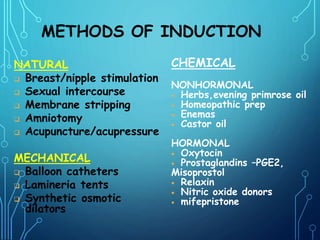
METHODS OF INDUCTION
NATURAL
 Breast/nipple stimulation
 Sexual intercourse
 Membrane stripping
 Amniotomy
 Acupuncture/acupressure
MECHANICAL
 Balloon catheters
 Lamineria tents
 Synthetic osmotic
dilators
CHEMICAL
NONHORMONAL
 Herbs,evening primrose oil
 Homeopathic prep
 Enemas
 Castor oil
HORMONAL
 Oxytocin
 Prostaglandins –PGE2,
Misoprostol
 Relaxin
 Nitric oxide donors
 mifepristone
METHODS OF INDUCTION
• Traditional methods
• Castor oil, breast and nipple stimulation, sexual
intercourse
• Little evidence to support efficacy and may sometimes
be harmful
• Their use must be discouraged
MEDICAL INTERVENTIONS
1- Mechanical
• Membrane sweeping
• Hygroscopic and mechanical dilators
• Extra-amniotic infusion of saline
• Amniotomy (ARM)
2- Biochemical
• Prostaglandin E2
• Prostaglandin E2 is agent of choice
• Long chain fatty acids derived from arachidonic acid via the
cyclo-oxygenase pathway
• Given via the oral, intra vaginal, intra-cervical or I.V routes
• Intra-vaginal gel and tablets have fewer side effects
• Misoprostol
• Prostaglandin E1 analogue
• Oxytocin
• An octapeptide hormone secreted from the hypothalamus and
stored in the pituitary
• Given via an infusion pump starting at a rate of 1-2mU/minute
and doubling every 30 minutes to a maximum of 32 mU/ml
CHOICE OF METHOD
• Generally the more remote from term the more difficult the
induction
• Most important consideration is cervical condition and ripeness
• Favorability of the cervix is assessed by Bishops score (or one of
its modifications)
• Score less than 5 is un-favorable
• The lower the score, the more likely induction will fail and
ripening with prostaglandins should be carried out
CONTRAINDICATIONS
Severe degree CPD
Major degree placenta praevia
Transverse lie
Previous classical CS,Myomectomy
Previous>= 2 LSCS
Grand multiparity
Active genital herpes
Hypersensitivity to inducing agent
COMPLICATIONS OF
INDUCTION OF LABOUR
• Failed induction
• Cord prolapse
• Abruption
• Hyponatremia
• Uterine hyperstimulation
• Post-partum hemorrhage
• Prematurity
• Hyperbillirubinemia and jaundice
Induction of-labour

Induction of-labour

  • 1.
  • 2.
    INTRODUCTION • Refers tothe process of artificial initiation of uterine contractions before their spontaneuos onset, leading to cervical dilatation and effacement and delivery of the baby. • The term usually refers to procedures carried out in the third trimester but occasionally to gestations more than the legal definition of fetal viability (24 weeks)
  • 3.
    DEFINITION Artificial stimulation ofuterine contractions before spontaneous onset of labour with the purpose of accomplishing successful vaginal delivery
  • 4.
    MATERNAL  Preeclampsia,Eclampsia  PROM Postterm preg  Abruptio placenta  Chorioamnionitis  Medical conditions- DM,Heart ds, Renal ds,Chr. HT etc INDICATIONS FETAL • IUFD • Fetal anomaly incompatible with life • Severe IUGR • Rh isoimmunisation • Macrosomia
  • 5.
    INDICATIONS • Generally, thepurpose is to achieve benefit to the health of the mother or baby or both greater than if the pregnancy continues. • Fetal • Prolonged pregnancy (more than 41 weeks) ---- commonest indication • IUGR, DM, Polyhydramnios, Macrosomia, Ruptured membranes, Multiple pregnancy, Rhesus iso- immunization, IUGR, oligohydramnios
  • 6.
    INDICATIONS • Maternal • Maternaldisease e.g. renal disease, hypertensive disorders, DM, Auto-immune disease, Malignancy, IUFD • Pregnancy related conditions e.g. PET, recurrent APH • Maternal request--Reasons must be justified and the woman must be fully informed disadvantages
  • 7.
    ASSESSMENT BEFORE INDUCTION •Induction should only be performed in a setting with facilities to monitor both mother and fetus • Check dates again ---? Early scan • Fetal lie and presentation • Fetal viability • VE to assess the condition of the cervix
  • 8.
    MOD. BISHOPS SCORE SCORE0 1 2 3 DILATATION 0 1-2 3-4 >4 EFFACEMENT 0-30% 40-50% 60-70% >80% STATION -3 -2 -1/0 +1,+2, +3 CONSISTENCY firm medium soft POSITION posteri or mid anterior
  • 9.
    METHODS OF INDUCTION NATURAL Breast/nipple stimulation  Sexual intercourse  Membrane stripping  Amniotomy  Acupuncture/acupressure MECHANICAL  Balloon catheters  Lamineria tents  Synthetic osmotic dilators CHEMICAL NONHORMONAL  Herbs,evening primrose oil  Homeopathic prep  Enemas  Castor oil HORMONAL  Oxytocin  Prostaglandins –PGE2, Misoprostol  Relaxin  Nitric oxide donors  mifepristone
  • 10.
    METHODS OF INDUCTION •Traditional methods • Castor oil, breast and nipple stimulation, sexual intercourse • Little evidence to support efficacy and may sometimes be harmful • Their use must be discouraged
  • 11.
    MEDICAL INTERVENTIONS 1- Mechanical •Membrane sweeping • Hygroscopic and mechanical dilators • Extra-amniotic infusion of saline • Amniotomy (ARM)
  • 12.
    2- Biochemical • ProstaglandinE2 • Prostaglandin E2 is agent of choice • Long chain fatty acids derived from arachidonic acid via the cyclo-oxygenase pathway • Given via the oral, intra vaginal, intra-cervical or I.V routes • Intra-vaginal gel and tablets have fewer side effects
  • 13.
    • Misoprostol • ProstaglandinE1 analogue • Oxytocin • An octapeptide hormone secreted from the hypothalamus and stored in the pituitary • Given via an infusion pump starting at a rate of 1-2mU/minute and doubling every 30 minutes to a maximum of 32 mU/ml
  • 14.
    CHOICE OF METHOD •Generally the more remote from term the more difficult the induction • Most important consideration is cervical condition and ripeness • Favorability of the cervix is assessed by Bishops score (or one of its modifications) • Score less than 5 is un-favorable • The lower the score, the more likely induction will fail and ripening with prostaglandins should be carried out
  • 15.
    CONTRAINDICATIONS Severe degree CPD Majordegree placenta praevia Transverse lie Previous classical CS,Myomectomy Previous>= 2 LSCS Grand multiparity Active genital herpes Hypersensitivity to inducing agent
  • 16.
    COMPLICATIONS OF INDUCTION OFLABOUR • Failed induction • Cord prolapse • Abruption • Hyponatremia • Uterine hyperstimulation • Post-partum hemorrhage • Prematurity • Hyperbillirubinemia and jaundice