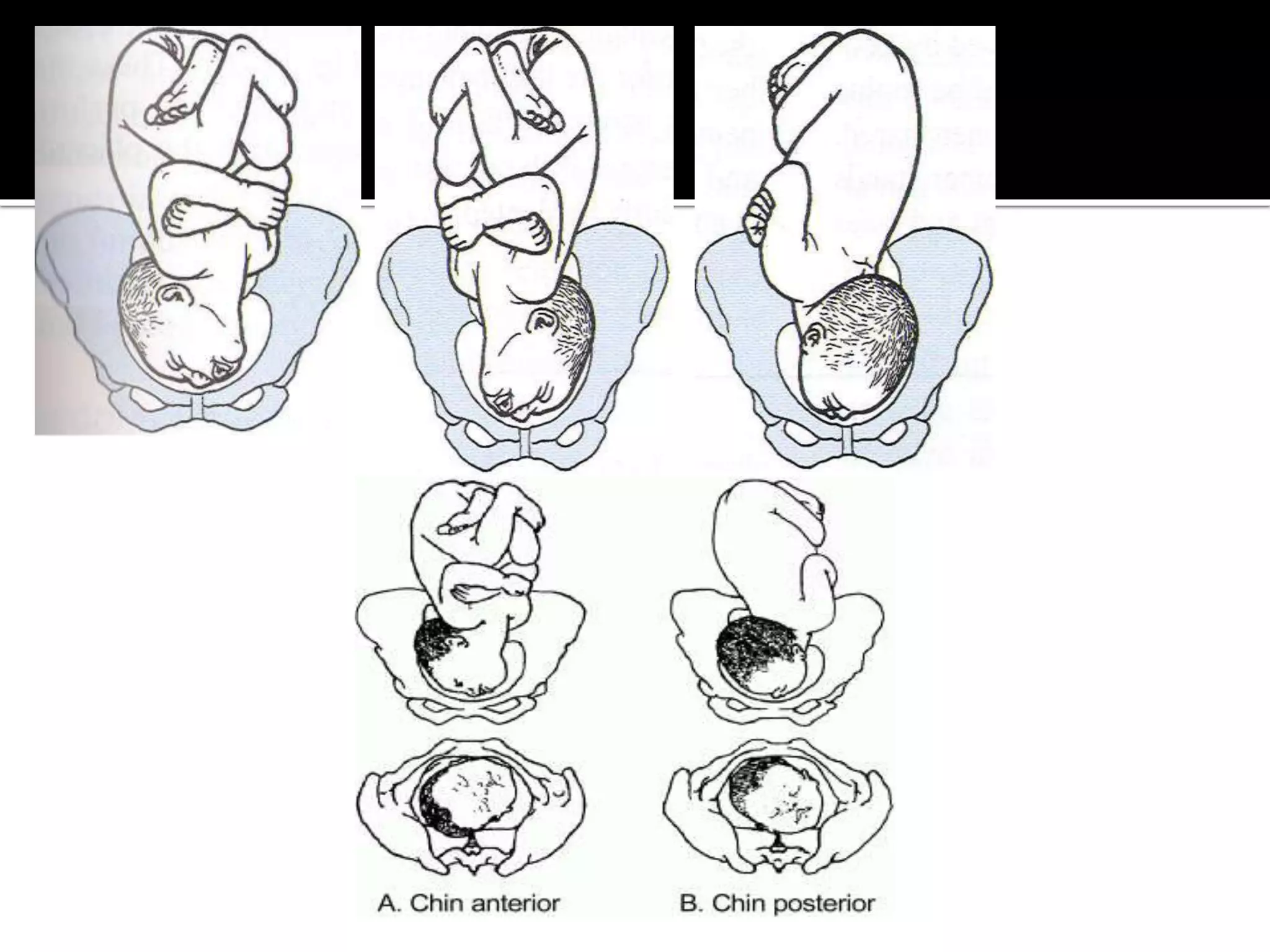
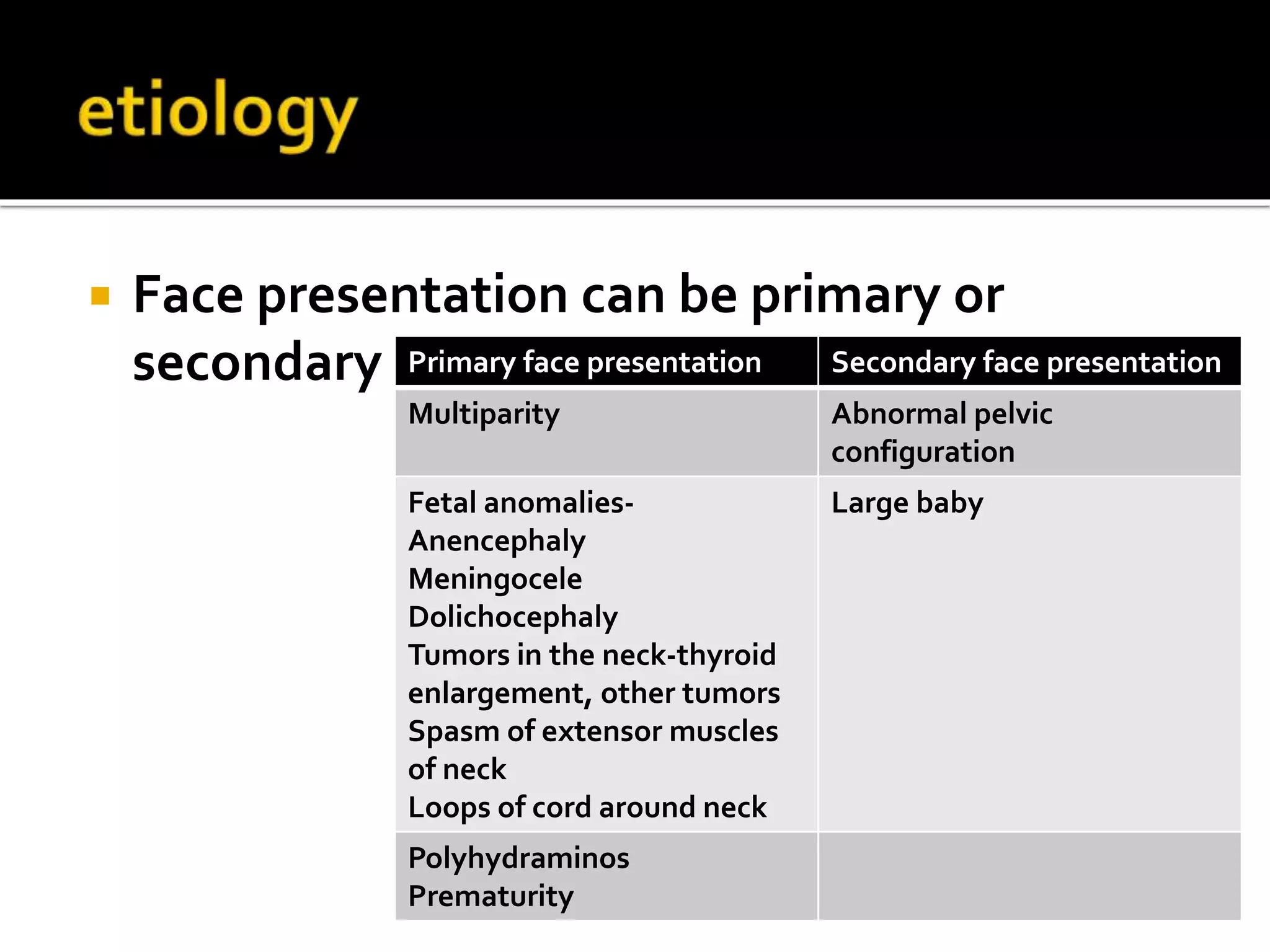
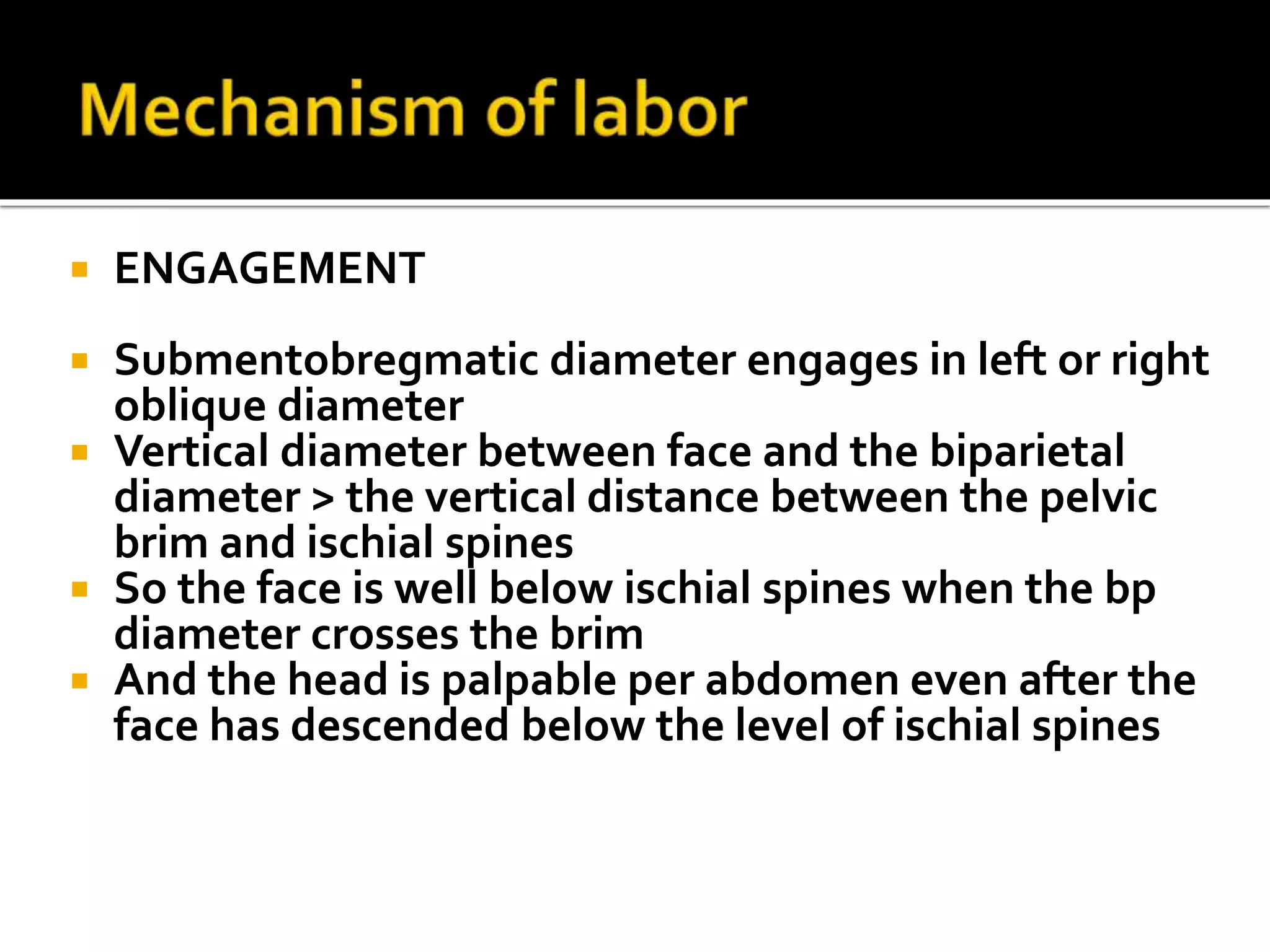
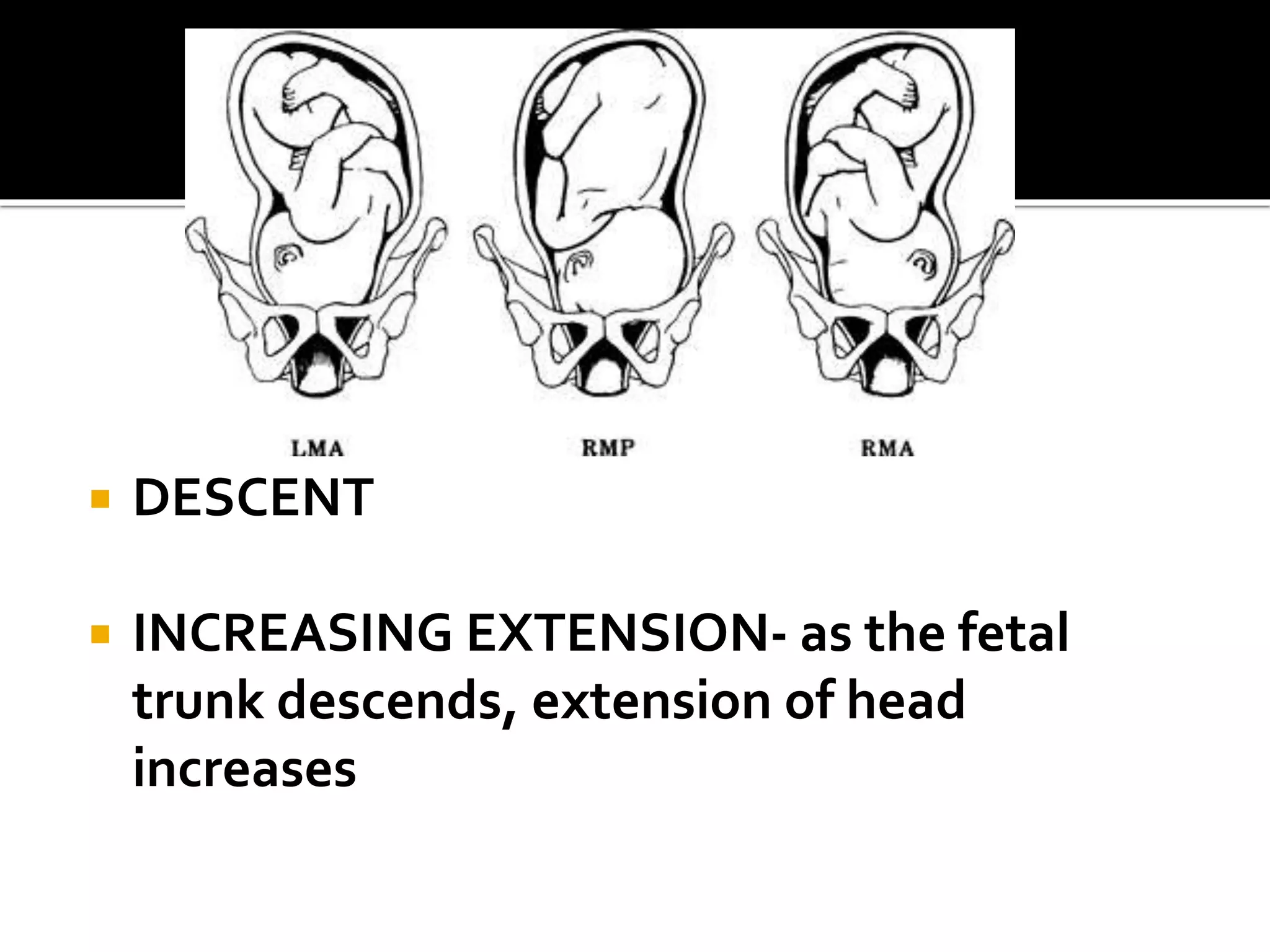
 Face: chin to glabella
 Results when the head is hyperextended
with the occiput touching the fetal neck
 All parts of the face from the chin to the
glabella present in the pelvis
 Incidence is about 1/200-1/500 deliveries
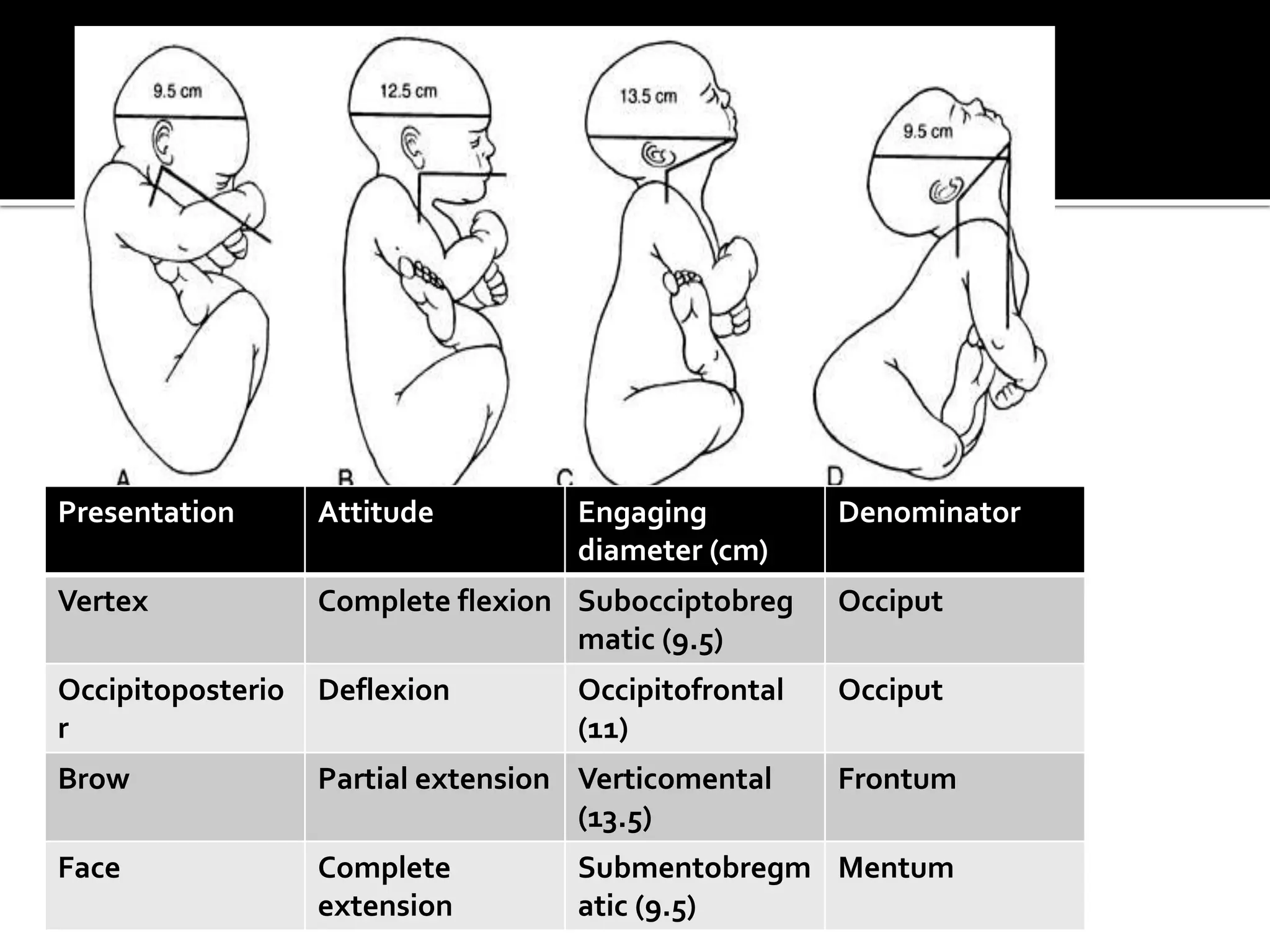
Presentation Attitude Engaging
diameter (cm)
Denominator
Vertex Complete flexion Subocciptobreg
matic (9.5)
Occiput
Occipitoposterio
r
Deflexion Occipitofrontal
(11)
Occiput
Brow Partial extension Verticomental
(13.5)
Frontum
Face Complete
extension
Submentobregm
atic (9.5)
Mentum
Denominator The mentum (chin)
Attitude Complete extension
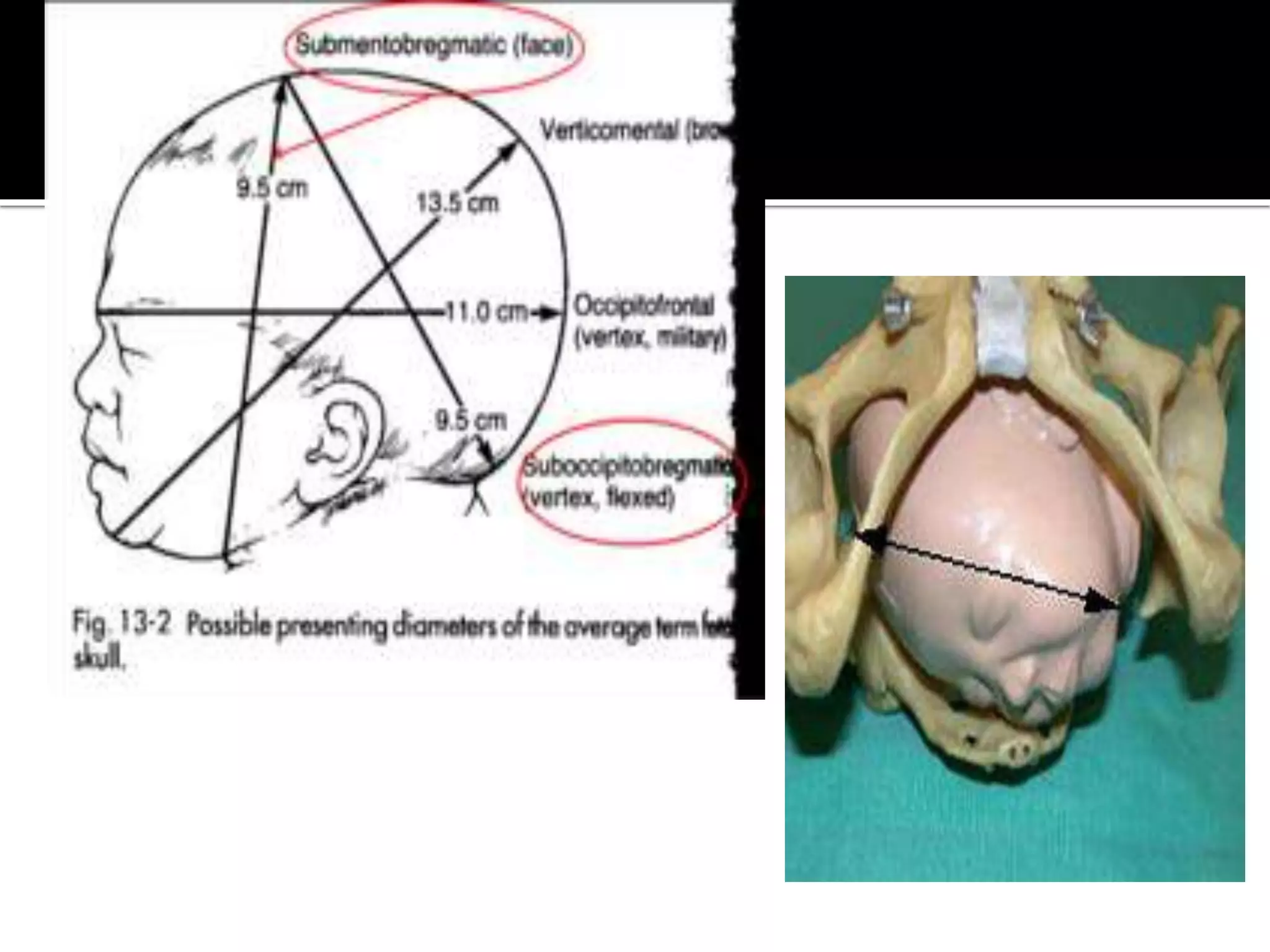
Engaging diameter Submentobregmatic
Possible positions Right mentoanterior (RMA)
Left mentoanterior (LMA)
Right mentoposterior (RMP)
Left mentoposterior (LMP)
 Face presentation can be primary or
secondary Primary face presentation Secondary face presentation
Multiparity Abnormal pelvic
configuration
Fetal anomalies-
Anencephaly
Meningocele
Dolichocephaly
Tumors in the neck-thyroid
enlargement, other tumors
Spasm of extensor muscles
of neck
Loops of cord around neck
Large baby
Polyhydraminos
Prematurity
 ENGAGEMENT
 Submentobregmatic diameter engages in left or right
oblique diameter
 Vertical diameter between face and the biparietal
diameter > the vertical distance between the pelvic
brim and ischial spines
 So the face is well below ischial spines when the bp
diameter crosses the brim
 And the head is palpable per abdomen even after the
face has descended below the level of ischial spines
 DESCENT
 INCREASING EXTENSION- as the fetal
trunk descends, extension of head
increases
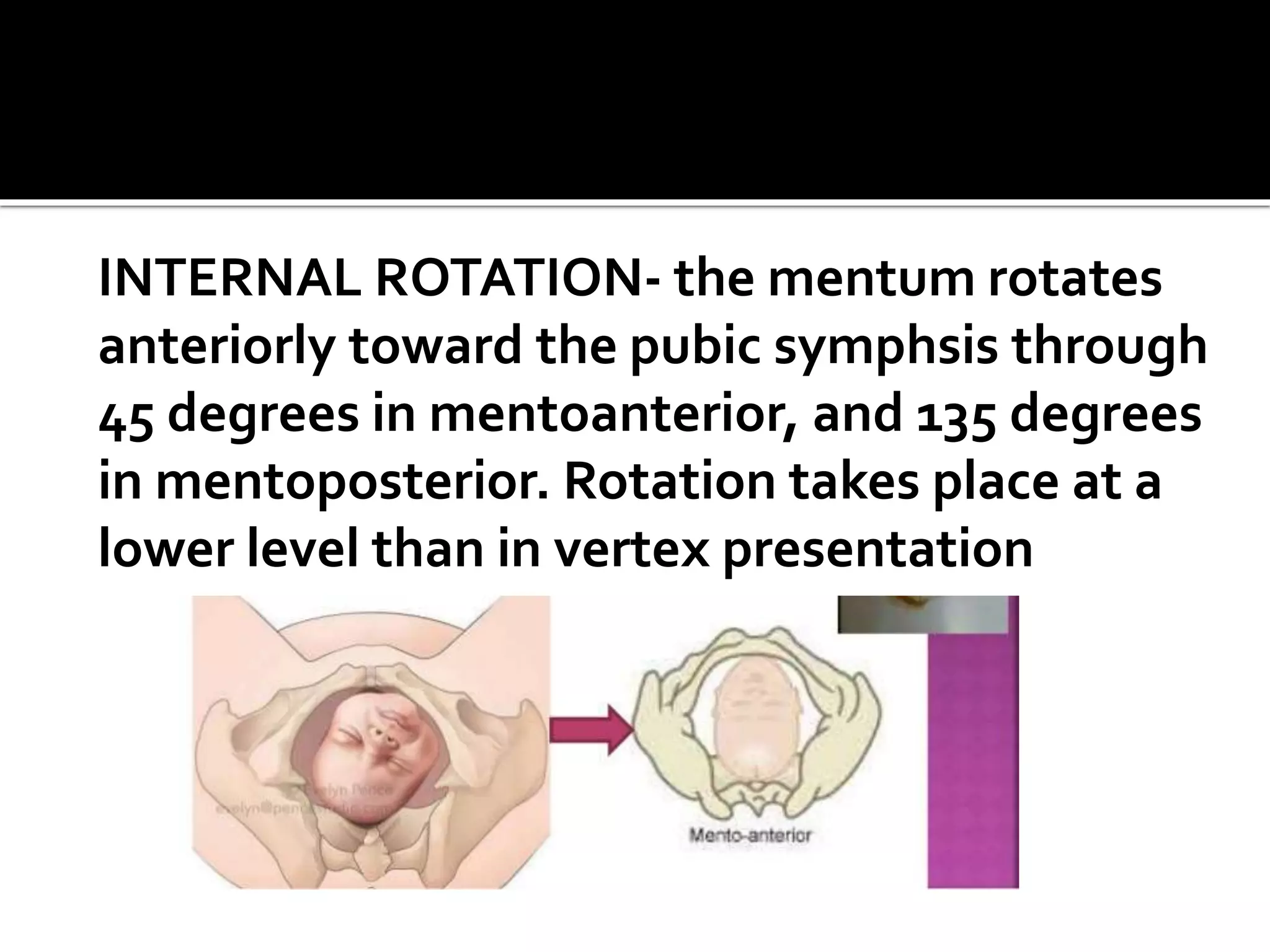
INTERNAL ROTATION- the mentum rotates
anteriorly toward the pubic symphsis through
45 degrees in mentoanterior, and 135 degrees
in mentoposterior. Rotation takes place at a
lower level than in vertex presentation
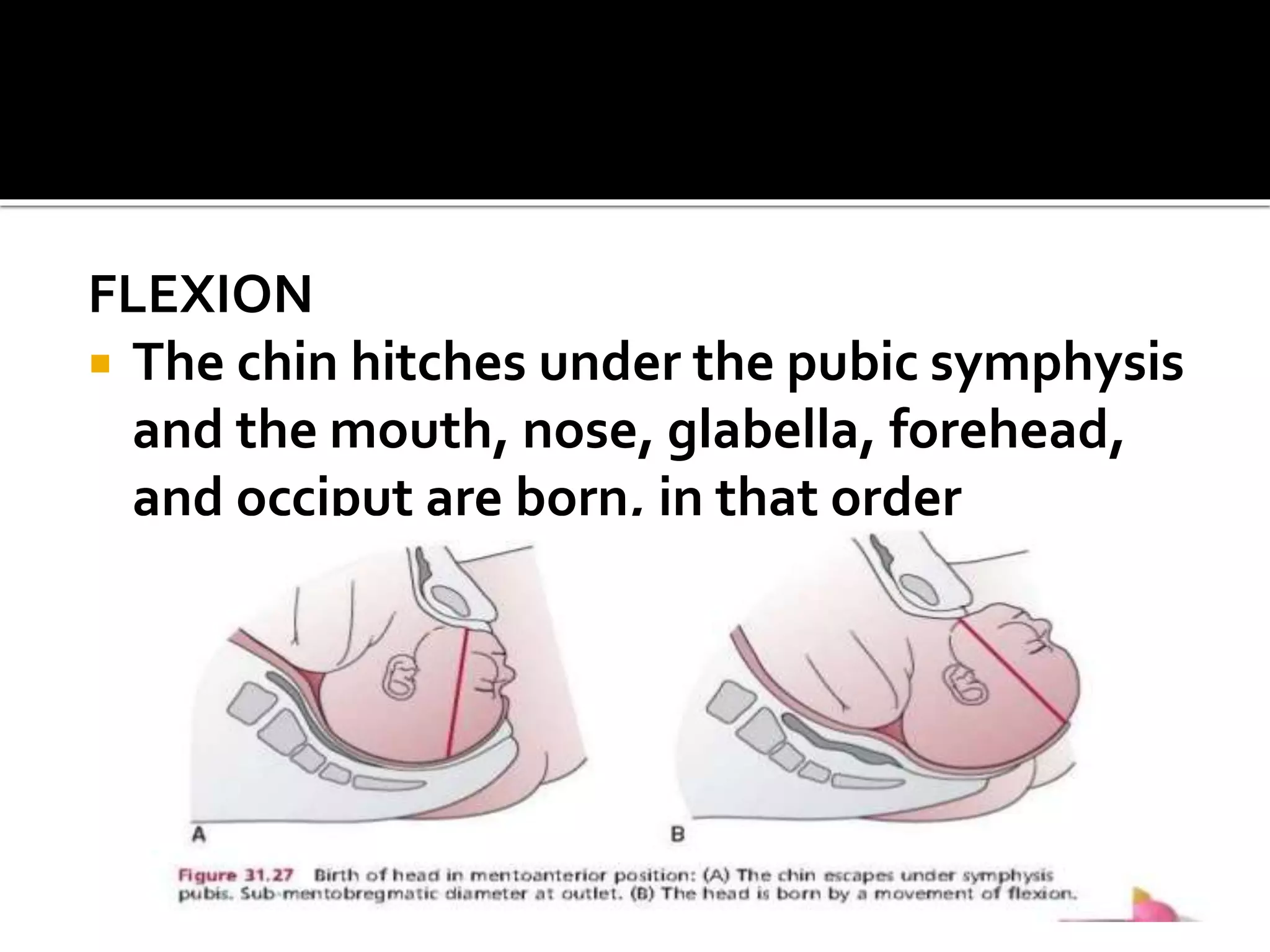
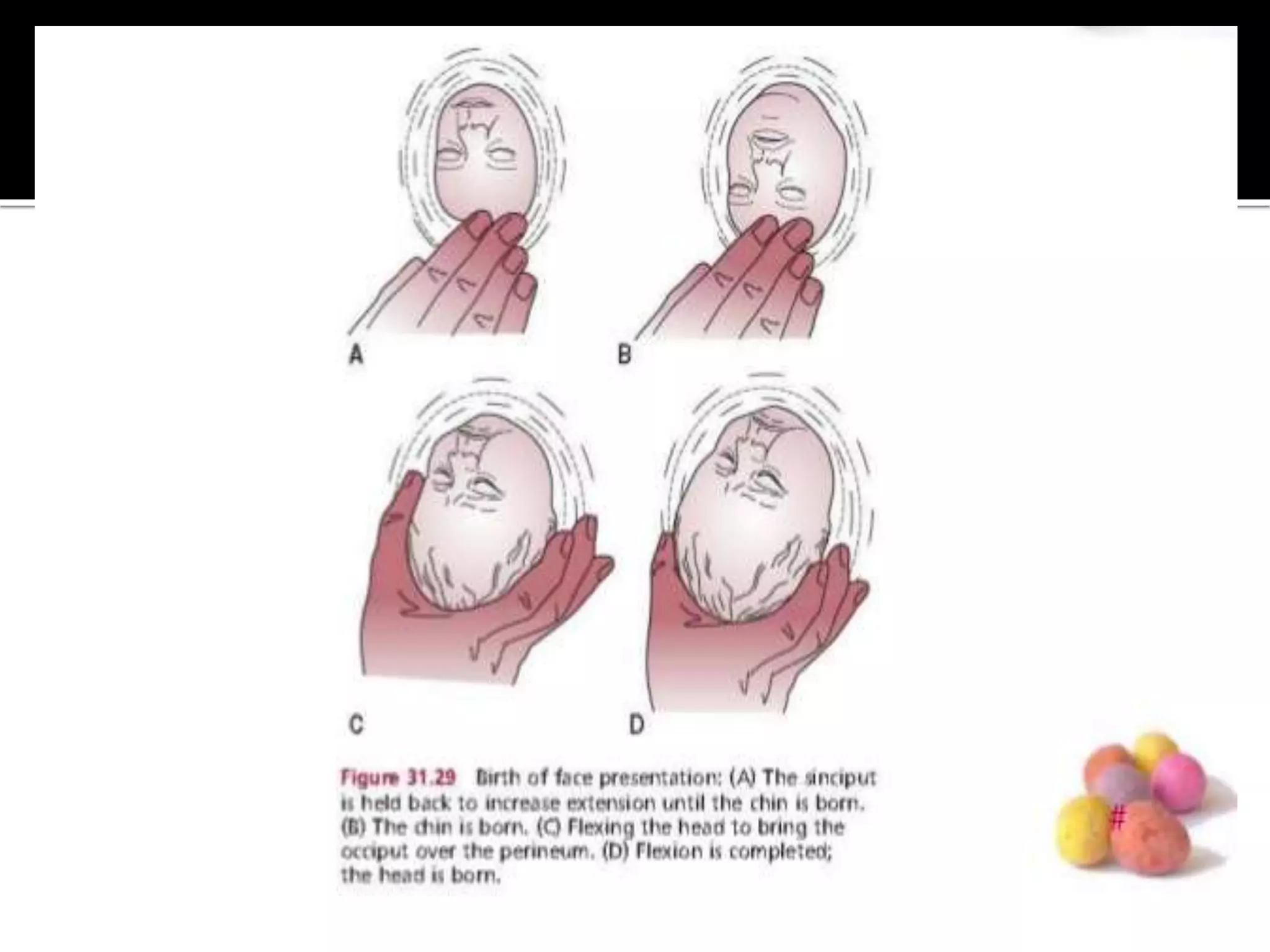
FLEXION
 The chin hitches under the pubic symphysis
and the mouth, nose, glabella, forehead,
and occiput are born, in that order
RESTITUTION
 Neck untwists toward the opposite side
EXTERNAL ROTATION
 Shoulders rotate toward the pubic
symphysis
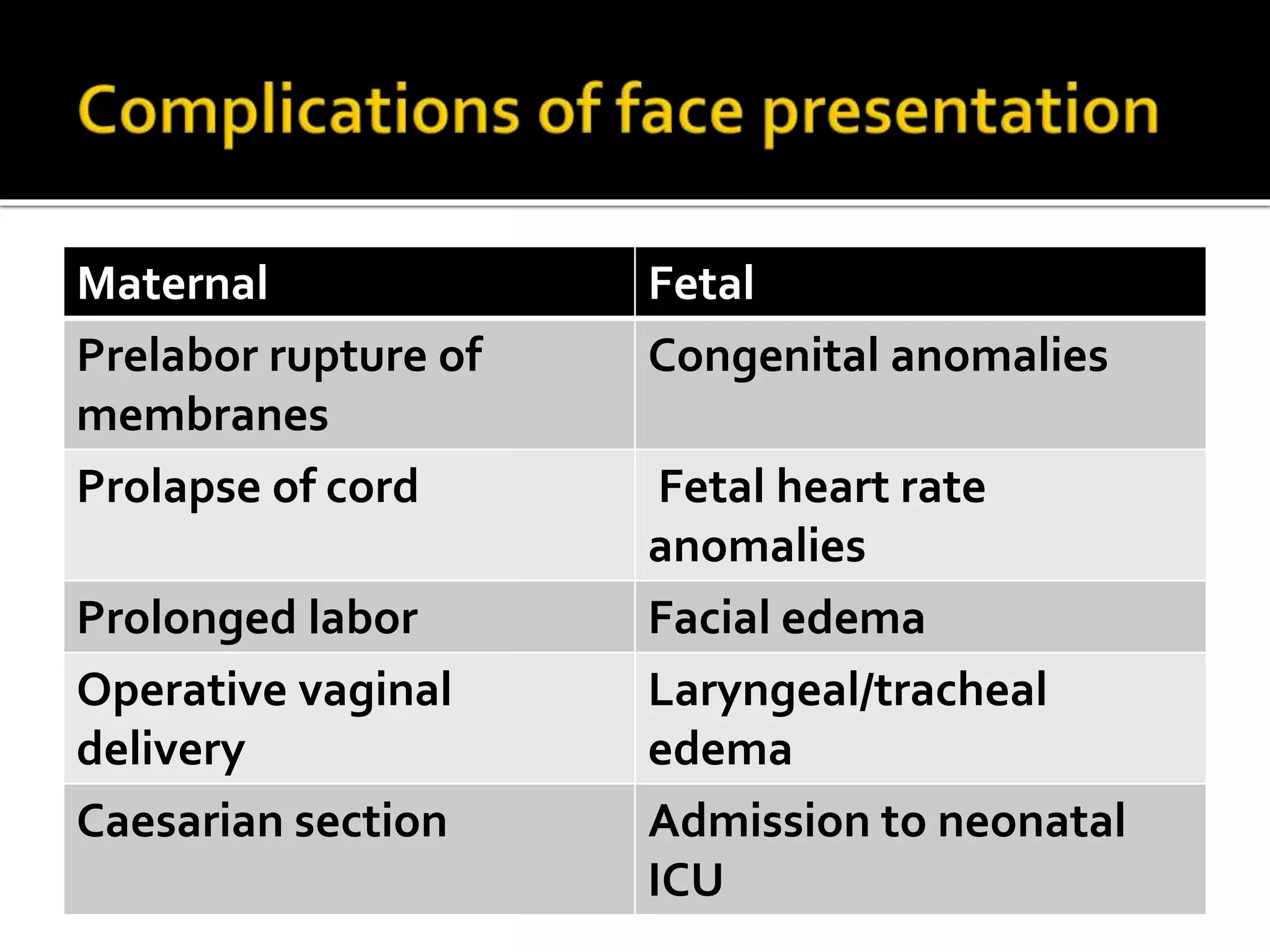
Maternal Fetal
Prelabor rupture of
membranes
Congenital anomalies
Prolapse of cord Fetal heart rate
anomalies
Prolonged labor Facial edema
Operative vaginal
delivery
Laryngeal/tracheal
edema
Caesarian section Admission to neonatal
ICU
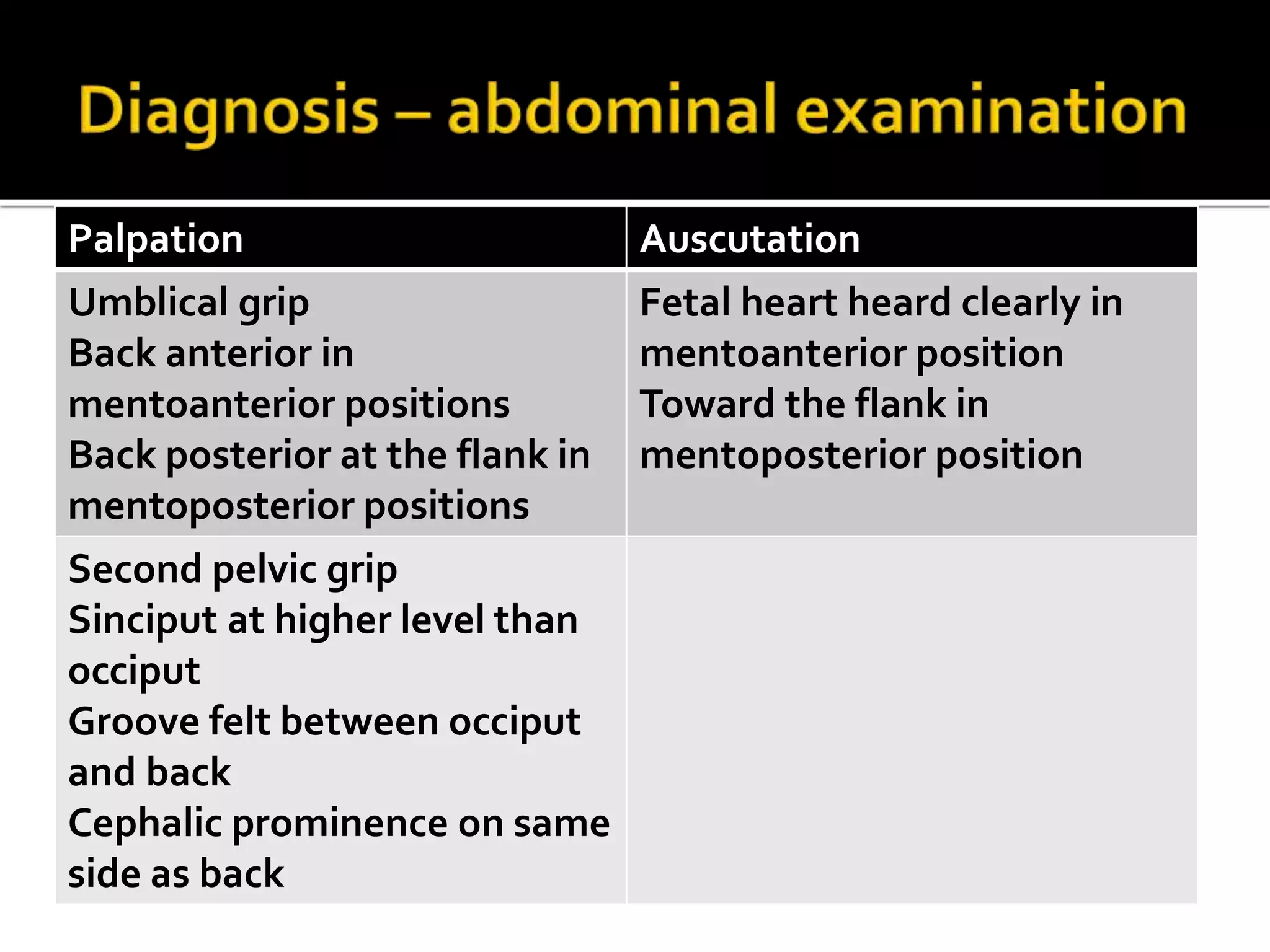
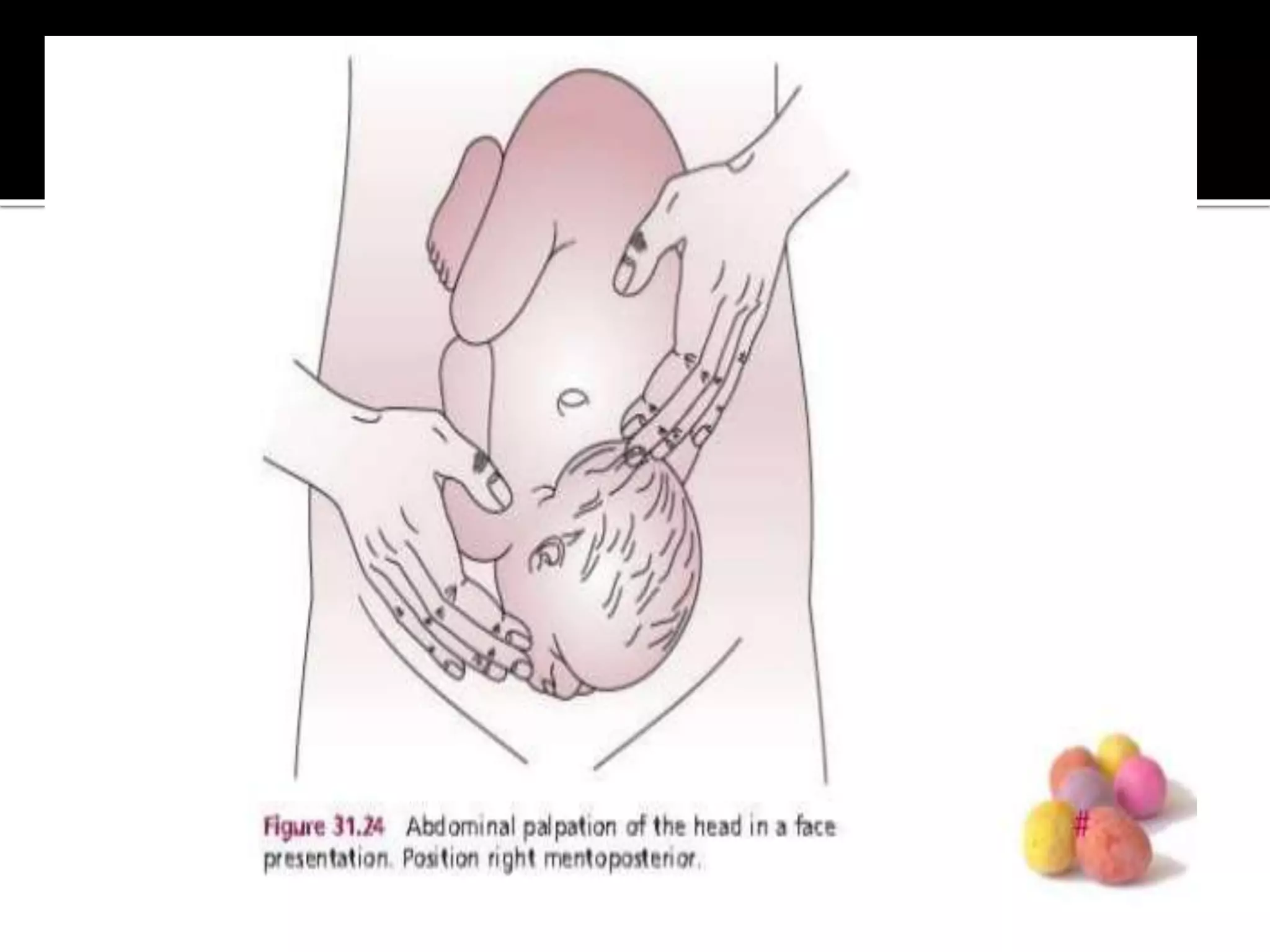
Palpation Auscutation
Umblical grip
Back anterior in
mentoanterior positions
Back posterior at the flank in
mentoposterior positions
Fetal heart heard clearly in
mentoanterior position
Toward the flank in
mentoposterior position
Second pelvic grip
Sinciput at higher level than
occiput
Groove felt between occiput
and back
Cephalic prominence on same
side as back
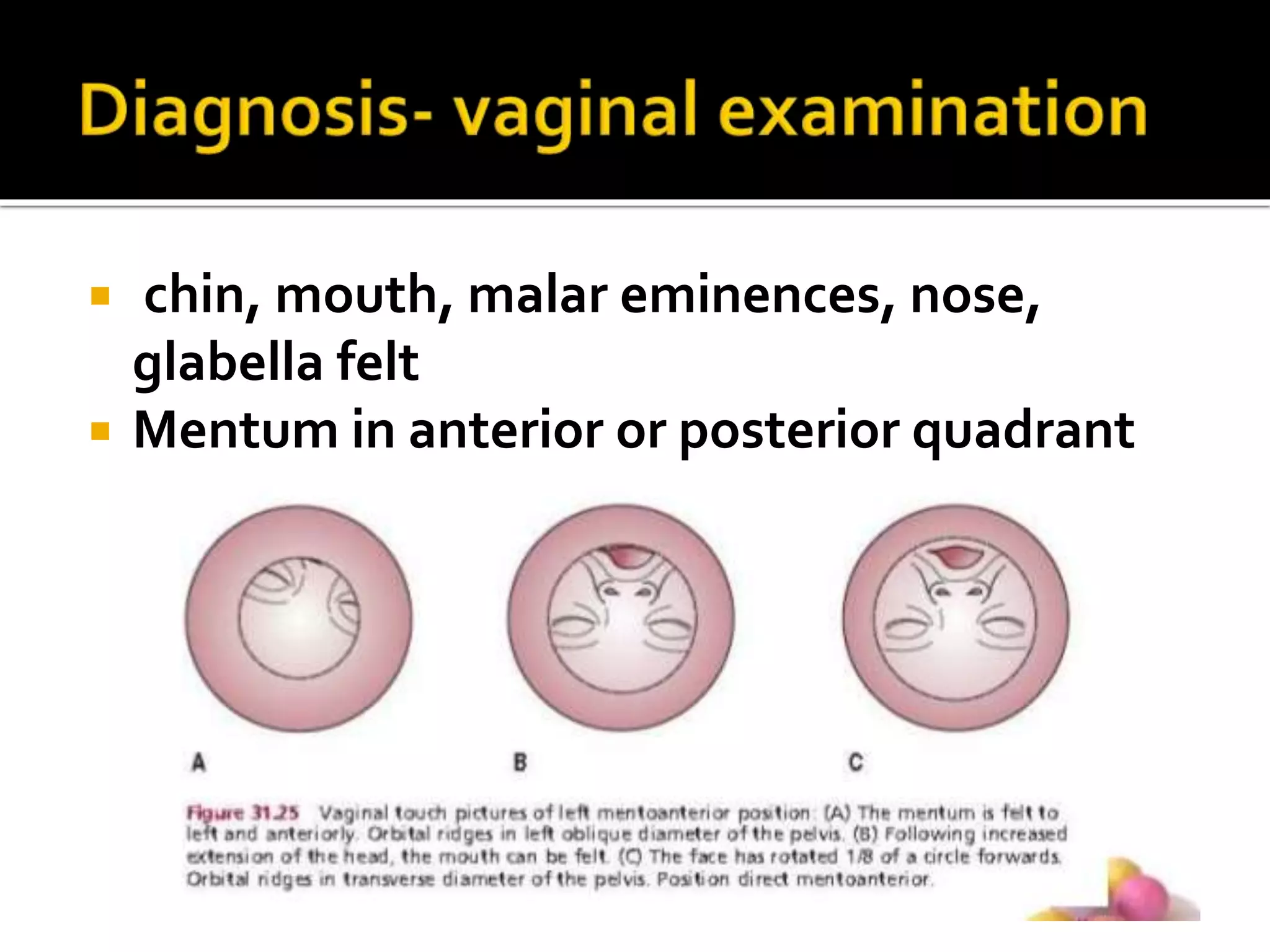
 chin, mouth, malar eminences, nose,
glabella felt
 Mentum in anterior or posterior quadrant
 Labor progresses normally in
mentoanterior positions since the engaging
diameter is similar to that in vertex
presentation
 Majority of the mentoposterior position
also rotate anteriorly and deliver normally
 25% may remain as mentoposterior or
rotate to direct posterior
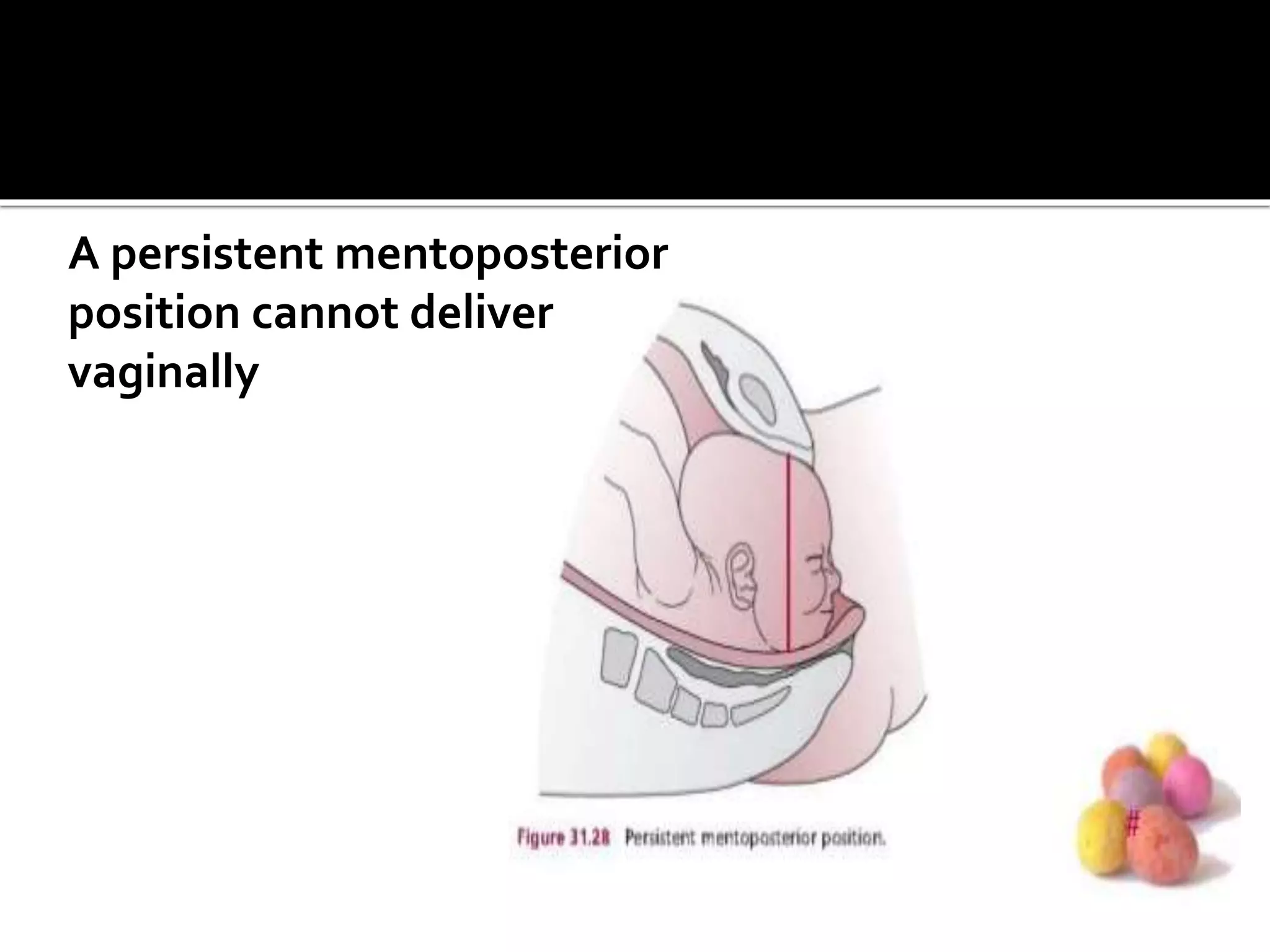
A persistent mentoposterior
position cannot deliver
vaginally
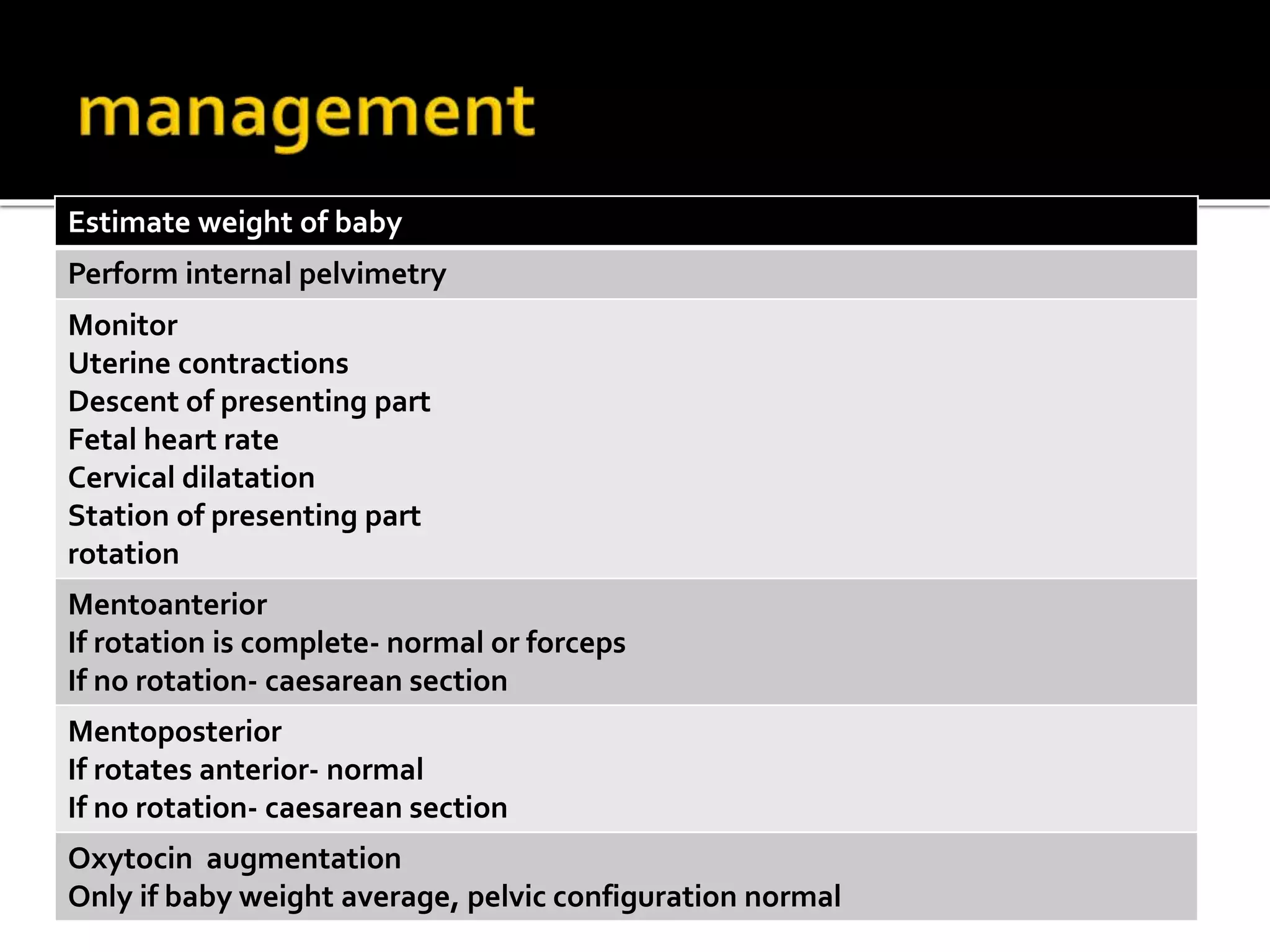
Estimate weight of baby
Perform internal pelvimetry
Monitor
Uterine contractions
Descent of presenting part
Fetal heart rate
Cervical dilatation
Station of presenting part
rotation
Mentoanterior
If rotation is complete- normal or forceps
If no rotation- caesarean section
Mentoposterior
If rotates anterior- normal
If no rotation- caesarean section
Oxytocin augmentation
Only if baby weight average, pelvic configuration normal
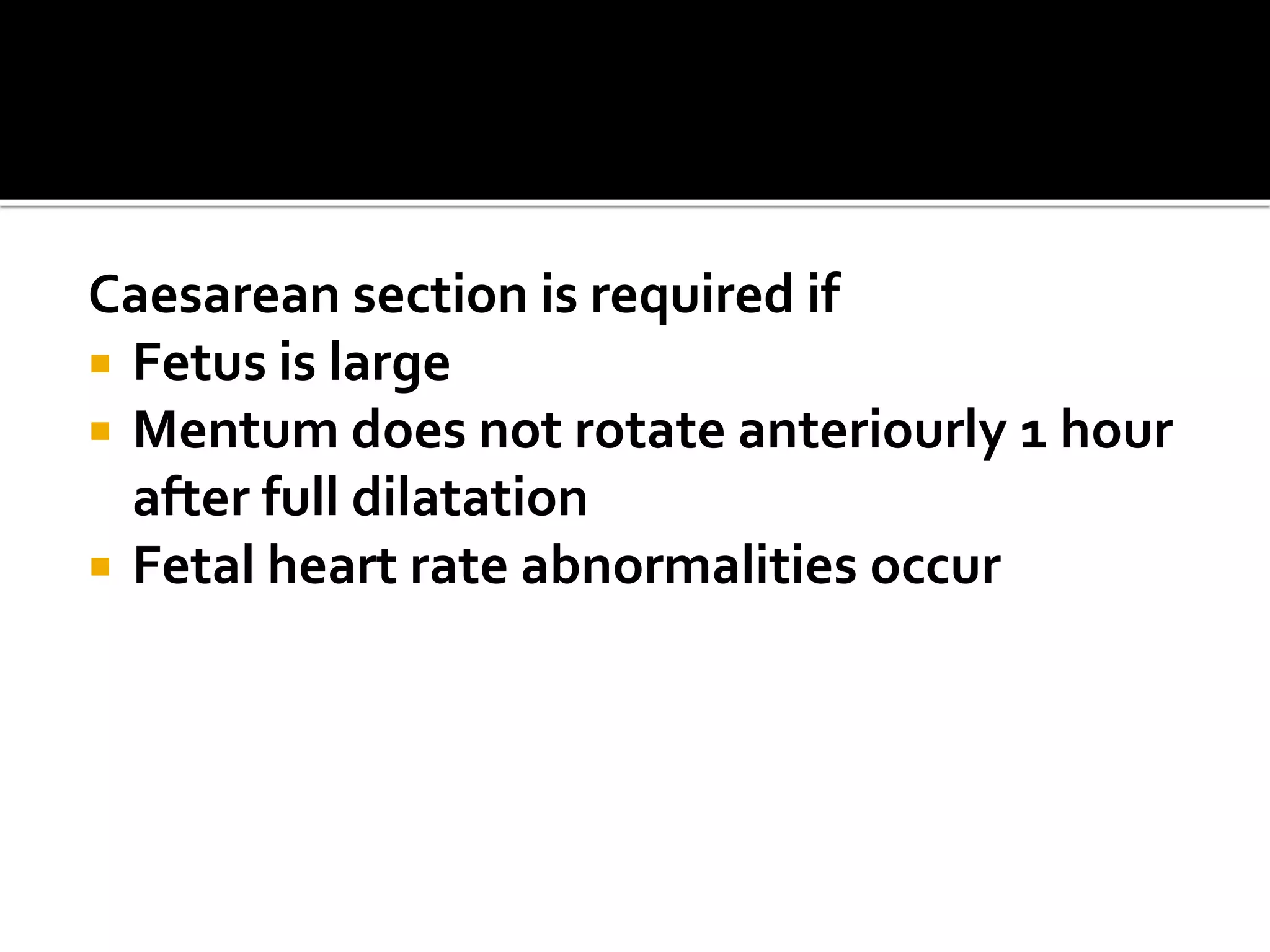
Caesarean section is required if
 Fetus is large
 Mentum does not rotate anteriourly 1 hour
after full dilatation
 Fetal heart rate abnormalities occur
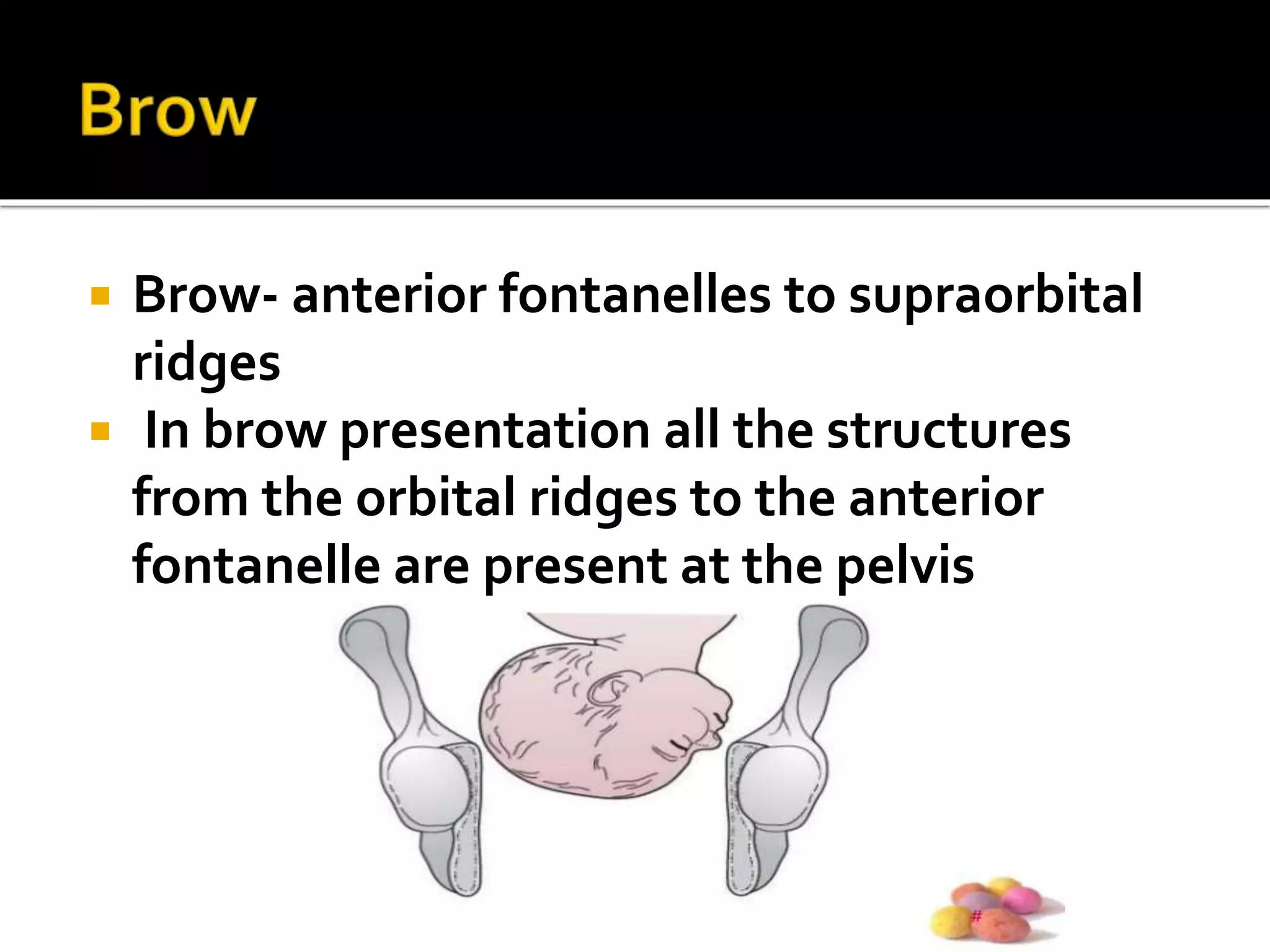
 Brow- anterior fontanelles to supraorbital
ridges
 In brow presentation all the structures
from the orbital ridges to the anterior
fontanelle are present at the pelvis
 Most common
 Prematurity
 Multiparity
 Cephalopelvic disproportion (CPD)
 Others
 Tumour of neck
 Spasm of neck
 Polyhyrdoamnios
 Denominator – Frontum
 Attitude – Partial extension
 Engaging diameter –Vertico-mental(13.5)
 Positions
 LFA
 LFP
 RFA
 RFP
 VAGINAL DELIVERY NOT POSSIBLE (unless
the fetus is very small or premature or the
pelvis is very roomy)
 Usually found early in labor
 With good contractions, flexes to vertex or
extends to face presentation
 If it persists in established labor, there is no
mechanism of labor or delivery
 If undiagnosed, can lead to rupture of
uterus in multigravida
 Maternal complications- premature rupture
of membranes, prolapse of cord, if
undiagnosed can lead to uterine rupture
 Fetal complications- related to associated
anomalies, operative delivery and
obstructed labor
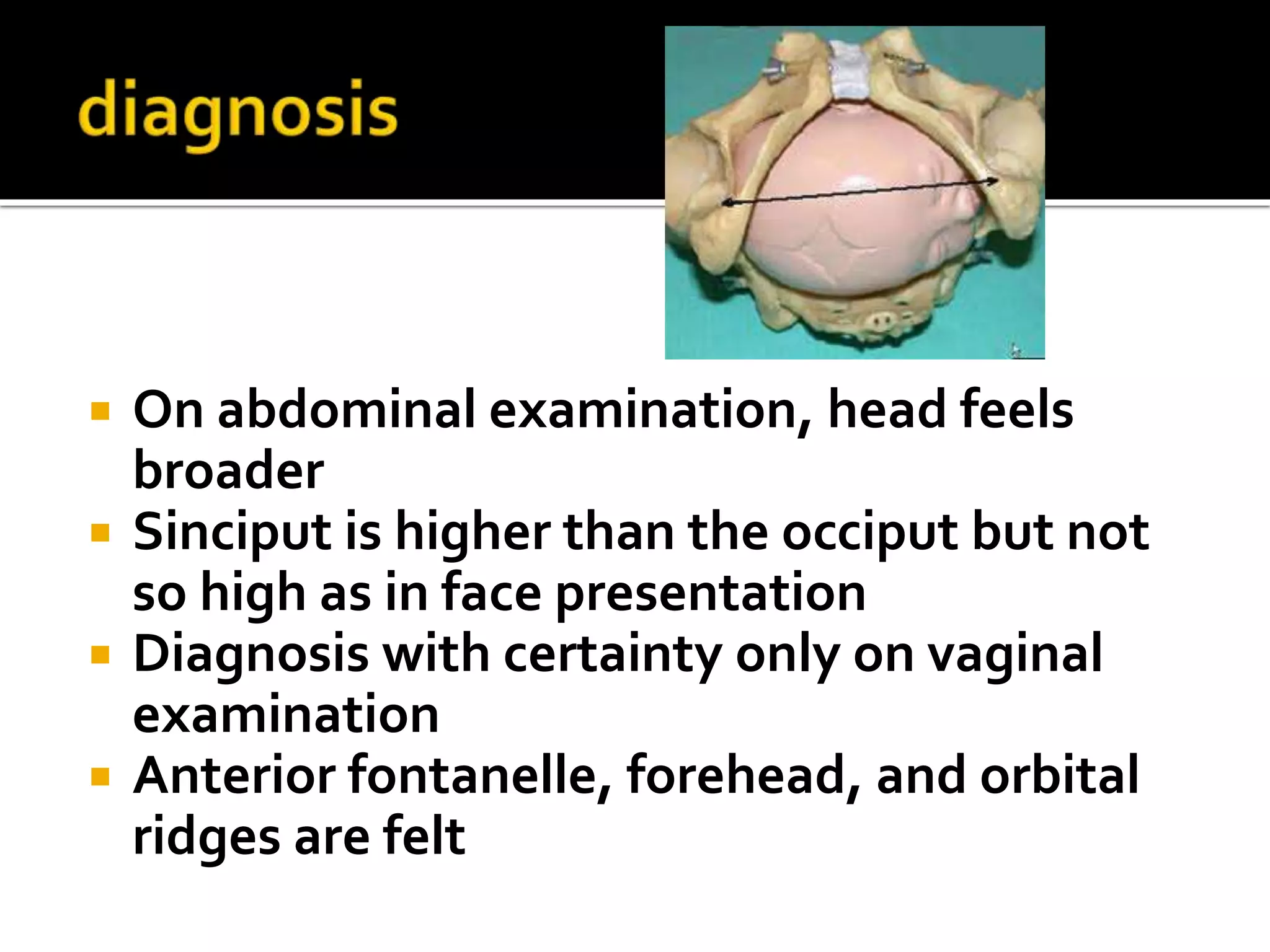
 On abdominal examination, head feels
broader
 Sinciput is higher than the occiput but not
so high as in face presentation
 Diagnosis with certainty only on vaginal
examination
 Anterior fontanelle, forehead, and orbital
ridges are felt
 If diagnosed in early labor, the mother is
monitored closely and vaginal exam
repeated every 4-6 hours to see conversion
 If diagnosed in active labor, cesarean is
indicated
 Oxytocin augmentation not recommended
 Lakshmi seshadri

Malpresentation (face, brow)

  • 2.
     Face: chinto glabella  Results when the head is hyperextended with the occiput touching the fetal neck  All parts of the face from the chin to the glabella present in the pelvis  Incidence is about 1/200-1/500 deliveries
  • 3.
    Presentation Attitude Engaging diameter(cm) Denominator Vertex Complete flexion Subocciptobreg matic (9.5) Occiput Occipitoposterio r Deflexion Occipitofrontal (11) Occiput Brow Partial extension Verticomental (13.5) Frontum Face Complete extension Submentobregm atic (9.5) Mentum
  • 5.
    Denominator The mentum(chin) Attitude Complete extension Engaging diameter Submentobregmatic Possible positions Right mentoanterior (RMA) Left mentoanterior (LMA) Right mentoposterior (RMP) Left mentoposterior (LMP)
  • 7.
     Face presentationcan be primary or secondary Primary face presentation Secondary face presentation Multiparity Abnormal pelvic configuration Fetal anomalies- Anencephaly Meningocele Dolichocephaly Tumors in the neck-thyroid enlargement, other tumors Spasm of extensor muscles of neck Loops of cord around neck Large baby Polyhydraminos Prematurity
  • 8.
     ENGAGEMENT  Submentobregmaticdiameter engages in left or right oblique diameter  Vertical diameter between face and the biparietal diameter > the vertical distance between the pelvic brim and ischial spines  So the face is well below ischial spines when the bp diameter crosses the brim  And the head is palpable per abdomen even after the face has descended below the level of ischial spines
  • 9.
     DESCENT  INCREASINGEXTENSION- as the fetal trunk descends, extension of head increases
  • 10.
    INTERNAL ROTATION- thementum rotates anteriorly toward the pubic symphsis through 45 degrees in mentoanterior, and 135 degrees in mentoposterior. Rotation takes place at a lower level than in vertex presentation
  • 11.
    FLEXION  The chinhitches under the pubic symphysis and the mouth, nose, glabella, forehead, and occiput are born, in that order
  • 12.
    RESTITUTION  Neck untwiststoward the opposite side EXTERNAL ROTATION  Shoulders rotate toward the pubic symphysis
  • 13.
    Maternal Fetal Prelabor ruptureof membranes Congenital anomalies Prolapse of cord Fetal heart rate anomalies Prolonged labor Facial edema Operative vaginal delivery Laryngeal/tracheal edema Caesarian section Admission to neonatal ICU
  • 14.
    Palpation Auscutation Umblical grip Backanterior in mentoanterior positions Back posterior at the flank in mentoposterior positions Fetal heart heard clearly in mentoanterior position Toward the flank in mentoposterior position Second pelvic grip Sinciput at higher level than occiput Groove felt between occiput and back Cephalic prominence on same side as back
  • 16.
     chin, mouth,malar eminences, nose, glabella felt  Mentum in anterior or posterior quadrant
  • 17.
     Labor progressesnormally in mentoanterior positions since the engaging diameter is similar to that in vertex presentation  Majority of the mentoposterior position also rotate anteriorly and deliver normally  25% may remain as mentoposterior or rotate to direct posterior
  • 18.
    A persistent mentoposterior positioncannot deliver vaginally
  • 19.
    Estimate weight ofbaby Perform internal pelvimetry Monitor Uterine contractions Descent of presenting part Fetal heart rate Cervical dilatation Station of presenting part rotation Mentoanterior If rotation is complete- normal or forceps If no rotation- caesarean section Mentoposterior If rotates anterior- normal If no rotation- caesarean section Oxytocin augmentation Only if baby weight average, pelvic configuration normal
  • 21.
    Caesarean section isrequired if  Fetus is large  Mentum does not rotate anteriourly 1 hour after full dilatation  Fetal heart rate abnormalities occur
  • 22.
     Brow- anteriorfontanelles to supraorbital ridges  In brow presentation all the structures from the orbital ridges to the anterior fontanelle are present at the pelvis
  • 23.
     Most common Prematurity  Multiparity  Cephalopelvic disproportion (CPD)  Others  Tumour of neck  Spasm of neck  Polyhyrdoamnios
  • 24.
     Denominator –Frontum  Attitude – Partial extension  Engaging diameter –Vertico-mental(13.5)  Positions  LFA  LFP  RFA  RFP  VAGINAL DELIVERY NOT POSSIBLE (unless the fetus is very small or premature or the pelvis is very roomy)
  • 25.
     Usually foundearly in labor  With good contractions, flexes to vertex or extends to face presentation  If it persists in established labor, there is no mechanism of labor or delivery  If undiagnosed, can lead to rupture of uterus in multigravida
  • 26.
     Maternal complications-premature rupture of membranes, prolapse of cord, if undiagnosed can lead to uterine rupture  Fetal complications- related to associated anomalies, operative delivery and obstructed labor
  • 27.
     On abdominalexamination, head feels broader  Sinciput is higher than the occiput but not so high as in face presentation  Diagnosis with certainty only on vaginal examination  Anterior fontanelle, forehead, and orbital ridges are felt
  • 28.
     If diagnosedin early labor, the mother is monitored closely and vaginal exam repeated every 4-6 hours to see conversion  If diagnosed in active labor, cesarean is indicated  Oxytocin augmentation not recommended
  • 29.