

ALTERNATIVE THERAPIES IN
MATERNITY
PREPARED BY
MOUMITA MANNA
SEMINAR ON
Charak Samhita states –
“Evam kurvati hi arogya-bala-yarna-samyahana-
sampadam upetam jnatinam shreshtam apatyam janayat.”
Alternative Medicine
The term Alternative Medicine means any form
of medicine that is outside the mainstream of
western medicine or conventional medicine
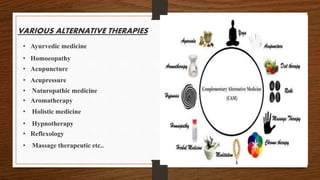
VARIOUS ALTERNATIVE THERAPIES
• Ayurvedic medicine
• Homoeopathy
• Acupuncture
• Acupressure
• Naturopathic medicine
• Aromatherapy
• Holistic medicine
• Hypnotherapy
• Reflexology
• Massage therapeutic etc..
AYURVEDIC MEDICINE
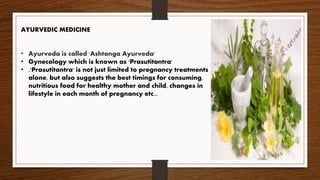
• Ayurveda is called 'Ashtanga Ayurveda'
• Gynecology which is known as 'Prasutitantra'
• .'Prasutitantra' is not just limited to pregnancy treatments
alone, but also suggests the best timings for consuming,
nutritious food for healthy mother and child, changes in
lifestyle in each month of pregnancy etc...
Pregnancy care in Ayurveda
 Correct Behavioural Patterns
 General rules from inception of pregnancy to
delivery
Do's
 It is very important for the mom-to-be to be in a
cheerful and happy mood always.
 Every day wear neat and clean clothes. Being well
dressed goes a long way in deciding your mood for
the day.
 Instead of putting complicated designer wears, go
for simple clothes.
 Lastly, sleep under a roof in a clean environment.
General rules from conception of pregnancy to delivery
Don'ts
 Excessive sex in the early or late stages of pregnancy.
 Do not overeat or fast.
 Sleep pattern followed should be a normal one, i.e. sleep at night and
stay awake during day time.
 Tight clothes and belts are strict no-no.
 Do not watch anything on TV or read a book that revolves around
feelings of sorrow, anger, horror or agony.
 Though traveling is permitted, but if it’s a rough road, try to avoid.
 Sitting on a hard surface for a long time is not beneficial.
 Bending or lifting heavy objects is objectionable during pregnancy.
 Avoid alcohol and do not binge on dry or stale meat.
 Beholding natural urges, unless in an emergency, is wrong and should
not be done.
Pregnancy care in Ayurveda contd….
 Post natal mother and baby care
 Dietetics for the lactating mother
HOMOEOPATHY
A medical system that uses infinitesimal doses of natural
substances called remedies to stimulate a person's immune and
defense system.
• Homeopathy is the use of herbal and flower essences in an extremely
diluted form, to bring subtle assistance to symptoms such as nausea
and morning sickness, heartburn, itchiness and skin problems,
fatigue, aches, swelling, tenderness, emotional problems, and even
stretch marks.
• Homeopathics can be really useful when medications are contra-
indicated for pregnancy or labour as they harm the child:
homeopathics are much more subtle and less risky
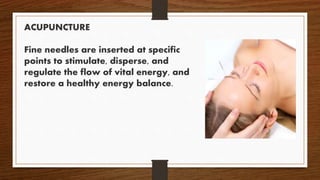
ACUPUNCTURE
Fine needles are inserted at specific
points to stimulate, disperse, and
regulate the flow of vital energy, and
restore a healthy energy balance.
Issues acupuncture can address include:
 Morning sickness
 Emotional and physical exhaustion
 Constipation
 Heartburn
 Colds & flu
 Back pain & sciatica
 Carpal tunnel syndrome
 Insomnia
 Anxiety & fear
 Varicose veins
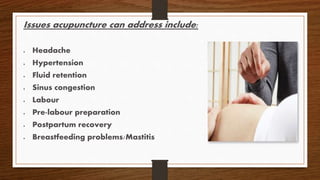
Issues acupuncture can address include:
 Headache
 Hypertension
 Fluid retention
 Sinus congestion
 Labour
 Pre-labour preparation
 Postpartum recovery
 Breastfeeding problems/Mastitis
ACUPRESSURE
Similar to acupuncture, but using finger pressure rather
than fine needles on specific points along the body to treat
ailments such as tension and stress, aches and pains,
menstrual cramps, arthritis.
NATUROPATHIC MEDICINE
Naturopathic physicians work to restore and
support the body's own healing abilities
using a variety of modalities including
nutrition, herbal medicine, homeopathic
medicine, and orient medicine.
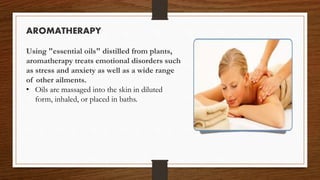
AROMATHERAPY
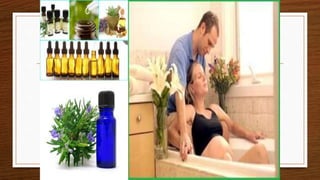
Using "essential oils" distilled from plants,
aromatherapy treats emotional disorders such
as stress and anxiety as well as a wide range
of other ailments.
• Oils are massaged into the skin in diluted
form, inhaled, or placed in baths.
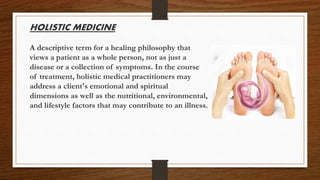
HOLISTIC MEDICINE
A descriptive term for a healing philosophy that
views a patient as a whole person, not as just a
disease or a collection of symptoms. In the course
of treatment, holistic medical practitioners may
address a client's emotional and spiritual
dimensions as well as the nutritional, environmental,
and lifestyle factors that may contribute to an illness.
HYPNOTHERAPY
A means of bypassing the conscious mind and
accessing the subconscious, where suppressed
memories, repressed emotions, and forgotten events
may remain recorded.
HYPNOTHERAPY
• Hypnosis is a psychological method which is a great tool for the
emotional anxieties to do with labour and childbirth. It has also been said to
affect length and pain of labour and lessen and/ or eliminate complications
to do with labour.
 Unlike drugs and invasive treatments, hypnosis poses no risk to the
unborn child and is mostly used to make labour less painful and stressful
for the mother.
 Mothers who choose to have a natural childbirth often do so with the
help of a trained hypnotherapist.
HYDROTHERAPY
It is defined as the scientific application of water for
therapeutic purposes. Water may be used at various
temperatures, in different modes and in different forms.
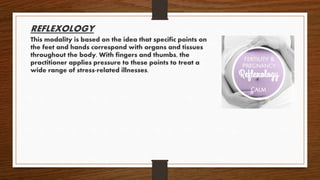
REFLEXOLOGY
This modality is based on the idea that specific points on
the feet and hands correspond with organs and tissues
throughout the body. With fingers and thumbs, the
practitioner applies pressure to these points to treat a
wide range of stress-related illnesses.
REFLEXOLOGY
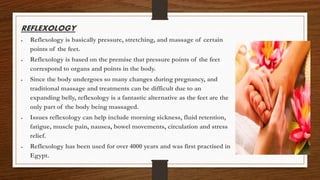
 Reflexology is basically pressure, stretching, and massage of certain
points of the feet.
 Reflexology is based on the premise that pressure points of the feet
correspond to organs and points in the body.
 Since the body undergoes so many changes during pregnancy, and
traditional massage and treatments can be difficult due to an
expanding belly, reflexology is a fantastic alternative as the feet are the
only part of the body being massaged.
 Issues reflexology can help include morning sickness, fluid retention,
fatigue, muscle pain, nausea, bowel movements, circulation and stress
relief.
 Reflexology has been used for over 4000 years and was first practised in
Egypt.
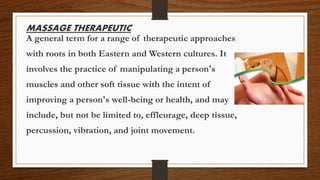
MASSAGE THERAPEUTIC
A general term for a range of therapeutic approaches
with roots in both Eastern and Western cultures. It
involves the practice of manipulating a person's
muscles and other soft tissue with the intent of
improving a person's well-being or health, and may
include, but not be limited to, effleurage, deep tissue,
percussion, vibration, and joint movement.
Approaches to management of labor pain
• Pharmacologic – eliminate physical sensation of labor pain
• Non-pharmacologic –prevent sense of suffering
Non-pharmacologic approach
Goal is to eliminate her sense of:
• Perceived threat to body and/or psych
• Helplessness, loss of control
• Distress
• Insufficient resources for coping with the situation
• Fear of death of the mother or baby
Non-pharmacologic approach
• Pain is a side effect of a normal process
• Goal is NOT to make the pain disappear
• Instill self-confidence, sense of mastery and well-being
• So that pain is neither feared, nor focused on
• Women who feel that they have successfully coped with the pain and stress
of labor note that they were “able to transcend their pain and experience a
sense of strength and profound psychologic and spiritual comfort during
labor.”
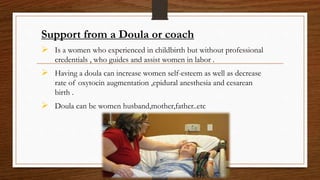
Support from a Doula or coach
 Is a women who experienced in childbirth but without professional
credentials , who guides and assist women in labor .
 Having a doula can increase women self-esteem as well as decrease
rate of oxytocin augmentation ,epidural anesthesia and cesarean
birth .
 Doula can be women husband,mother,father..etc
Continuous Labor Support
• Nonmedical care of laboring women throughout labor and delivery by a
trained person
• Supportive companion during labor can help with pain and anxiety
• Multiple studies have shown that doulas:
• Half the risk of unplanned c-sections
• Half the risk of instrumental delivery
• Significantly shorten labor
Water Immersion
• Warm water, deep enough to cover the woman’s abdomen
• Enhances relaxation, reduces labor pain
• Body temperature should be monitored
• Few minutes to hours in the first stage of labor
• Randomized trials show:
• Significant reduction in pain (via pain score or decreased narcotic use)
• No increase in infection rates (even c ROM)
Intradermal Water Blocks
• Incidence of low back pain in labor is 15-74%
• Etiologies include: fetal OP position, referred uterine pain, lumbopelvic characteristics
• Endorphins release thought to be responsible for pain relief
• Randomized trials have found:
• Significant decrease in severe LBP
• Relief lasts 45 -120 minutes
Intradermal Water Block
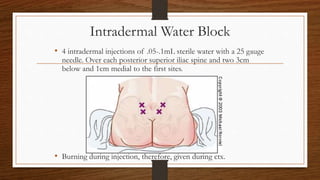
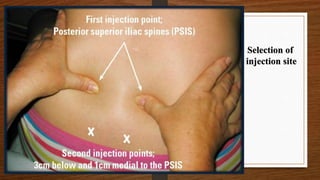
• 4 intradermal injections of .05-.1mL sterile water with a 25 gauge
needle. Over each posterior superior iliac spine and two 3cm
below and 1cm medial to the first sites.
• Burning during injection, therefore, given during ctx.
Selection of
injection site
Water therapy(hydrotherapy )
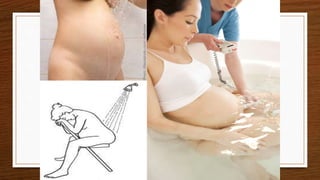
Standing under warm shower or soaking in tube of warm water , the
temperature of water used should be between 35-37c .
Several study have investigated the risk of using hydrotherapy with
rupture membrane findings have shown no increase in chorioamnionitis ,
post partum indometraitis,neonatal infection or antibiotic use
( tournaire & theau-yonneau,2007,zwelling et al ,2006)
No limit to the time women can stay in bath and often they are
encouraged to stay in it as long as desired
Warm Water Baths
Increasingly available
• Hospitals & birth centers
Recent survey (2002 - USA)
• 6% of women used warm water baths
• 49% found them very helpful
Warm Water Baths
• No effect on the usage of epidural analgesia
• Short duration of pain relief
• Only effective while she’s in the bath
Warm Water Baths – Recommendations
• Seem to be safe and effective for limited periods
Wait for active labor
Maintain water at or below body temp
Limit bath time to 1-2 hours
 In randomized controlled trial (RCT) to determine the efficacy of warm showers on parturition
pain and the birth experiences of women during the first stage of labor
 participants in the experimental group received warm shower bath interventions full body or
lower back shower, participants could spend 5 minute complete bath 15 minutes directing
shower water toward any body region that felt most comfortable. Facilities allowed participants
to stand and sit as desired. Water was constantly monitored and maintained at a temperature of
37◦C. Participants in the control group received standard care.
 women who participated in warm showers reported significantly lower VAS pain scores at 4-
cm and 7-cm cervical dilations, and higher birth experiences than the control group.
 warm showers are a cost-effective, convenient, easy to perform ,non-pharmacological approach
to pain reduction. This intervention helps women in labor to participate fully in the birthing
process, earn continuous caregiver support, feel cared for and comforted, and have a more
positive overall experience.
 (Lee, Liu, Lu, & Gau, 2013)
Maternal Movement and Positioning
• 76% of hospitalized laboring women do not walk around. Limited
movement was secondary to:
• Connections (IVs, tocometers, BP cuffs, catheters)
• Pain medications
• Instructed not to by medical staff
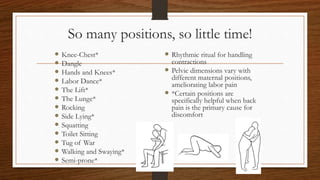
So many positions, so little time!
 Knee-Chest*
 Dangle
 Hands and Knees*
 Labor Dance*
 The Lift*
 The Lunge*
 Rocking
 Side Lying*
 Squatting
 Toilet Sitting
 Tug of War
 Walking and Swaying*
 Semi-prone*
 Rhythmic ritual for handling
contractions
 Pelvic dimensions vary with
different maternal positions,
ameliorating labor pain
 *Certain positions are
specifically helpful when back
pain is the primary cause for
discomfort
Movement during the 1st stage
• controlled trials shown that:
• Less pain while standing/sitting, compared to supine
• Compared to lying on one’s side, less pain while sitting, until 6cm, then less pain while
lying on one’s side
• Vertical and side lying positions were accompanied by more progress than the supine
position
• High satisfaction associated with the option of walking
Movement during 2nd stage
• Supine position found to be more painful than other positions
• Kneeling position preferred to sitting position
Touch and Massage
• Touch communicates caring, concern, reassurance, and love
• Massage enhances relaxation and reduces pain
• Have been found to decrease pain, anxiety and blood pressure
• Shown to improve mood, and sense of support
• NO harmful effects!
Application of Heat and Cold
 Personal choice
 Place one or two layers of cloth to protect against skin damage and intact sensation
is a prerequisite
 Heat
 Applied to back, lower abdomen, groin, perineum
 Relieves pain, chills, stiffness, muscle spasm, and increases extensibility of connective tissue
 Cold
 Applied to back, chest, face
 Relieves pain, muscle spasm, inflammation and edema
Childbirth Education
• Reading, classes, office visits
• Information on the process of labor and birth, typical pain experience, and
options for pain management should be provided for pregnant women and
partners/supports.
• Provision of education PRIOR to labor!!
Relaxation and Breathing
• Rhythmic breathing patterns that promote relaxation, and distract women from
labor pain
• Enhance sense of control
• Survey of women who gave birth in the US in 2005:
• 49% used breathing techniques
• 77% found these helpful
• 22% did not
• Study of British women using relaxation techniques:88% found techniques helpful
Music and Audioanalgesia
• Few studies, with small sample sizes and inadequate controls
• Cochrane review on the effect of music on acute pain
• Small reduction in pain intensity levels and opioid requirements
Aromatherapy
 Use of concentrated oils distilled from plants
 Use is increasing
 Some sources note that they are potent as pharmacological drugs and should be
used with caution
 One uncontrolled prospective study
8058 women
Lavender, rose or frankincense used under supervision of midwives
Used to decrease fear, anxiety, pain, nausea and vomiting
Half of women found it helpful
1% reported nausea/headache as side effect
A randomized controlled trial was conducted to determine the effect of lavender
aromatherapy on pain intensity perception and intrapartum outcome in
primiparous women
 The aroma group received 0.1 ml of lavender essential oil mixed with 1 ml of
distilled water via tissues attached to their gowns close to their nostrils. Meanwhile, the
control group received 2 ml of distilled water in a similar way.
 Pain intensity perception was measured by Visual Analogue Scale (VAS) before the
intervention and at 30 and 60 minutes afterwards
(Kaviani, Azima, Alavi, & Tabaei, 2014)
Result
The mean of pain intensity perception in the aroma group was lower
than that of the control group at 30 and 60 minutes after the
intervention (p←0.001).
Conclusion
This study revealed that aromatherapy decreased the labour pain, but
did not affect the duration of labour phases
Kaviani, Azima, Alavi, & Tabaei, 2014
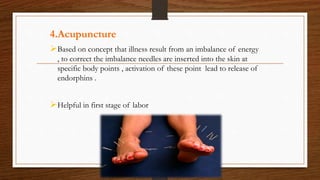
4.Acupuncture
Based on concept that illness result from an imbalance of energy
, to correct the imbalance needles are inserted into the skin at
specific body points , activation of these point lead to release of
endorphins .
Helpful in first stage of labor
Acupuncture/Acupressure
• Acupressure is a simpler alternative to acupuncture, pressure applied with
fingers or small beads at acupuncture points
• Both have shown to lead to lower use of pharmacologic pain relief
• Acupuncture has been shown to increase relaxation in laboring patients
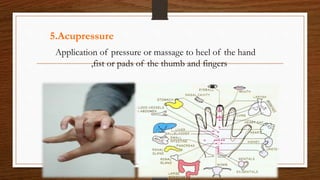
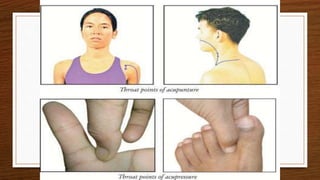
5.Acupressure
Application of pressure or massage to heel of the hand
,fist or pads of the thumb and fingers
Hypnosis
• “a state of deep physical relaxation with an alert mind, in this state, the
subconscious mind can be more readily accessed”
• Self hypnosis: “glove anesthesia”, “time distortion”, “imaginative
transformation”
• Significant reduction in analgesic use
• Contraindicated in women with history of psychosis
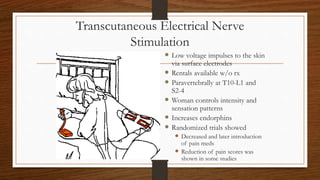
Transcutaneous Electrical Nerve
Stimulation
 Low voltage impulses to the skin
via surface electrodes
 Rentals available w/o rx
 Paravertebrally at T10-L1 and
S2-4
 Woman controls intensity and
sensation patterns
 Increases endorphins
 Randomized trials showed
 Decreased and later introduction
of pain meds
 Reduction of pain scores was
shown in some studies
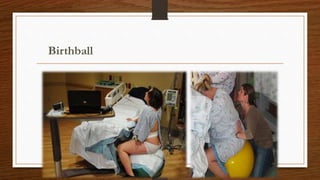
Birthball
The effect of birthing ball was supported by the findings in a study which was
conducted on effects of birth ball exercise on pain and self-efficacy during
childbirth. Results revealed that birth ball exercises provided statistically significant
improvements in childbirth self-efficacy and pain. And also mothers in the
experimental group had shorter first-stage labour duration, less epidural analgesia, and
fewer (10) caesarean deliveries than the control group.
Sukumaran S.. Nitte University.
Mangalore: 2011
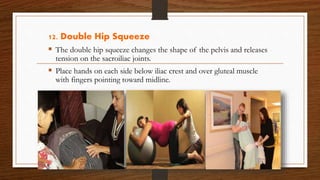
12. Double Hip Squeeze
 The double hip squeeze changes the shape of the pelvis and releases
tension on the sacroiliac joints.
 Place hands on each side below iliac crest and over gluteal muscle
with fingers pointing toward midline.
THANK YOU

Alternative therapies in maternity

  • 1.
  • 2.
    Charak Samhita states– “Evam kurvati hi arogya-bala-yarna-samyahana- sampadam upetam jnatinam shreshtam apatyam janayat.”
  • 3.
    Alternative Medicine The termAlternative Medicine means any form of medicine that is outside the mainstream of western medicine or conventional medicine
  • 4.
    VARIOUS ALTERNATIVE THERAPIES •Ayurvedic medicine • Homoeopathy • Acupuncture • Acupressure • Naturopathic medicine • Aromatherapy • Holistic medicine • Hypnotherapy • Reflexology • Massage therapeutic etc..
  • 5.
    AYURVEDIC MEDICINE • Ayurvedais called 'Ashtanga Ayurveda' • Gynecology which is known as 'Prasutitantra' • .'Prasutitantra' is not just limited to pregnancy treatments alone, but also suggests the best timings for consuming, nutritious food for healthy mother and child, changes in lifestyle in each month of pregnancy etc...
  • 6.
    Pregnancy care inAyurveda  Correct Behavioural Patterns  General rules from inception of pregnancy to delivery Do's  It is very important for the mom-to-be to be in a cheerful and happy mood always.  Every day wear neat and clean clothes. Being well dressed goes a long way in deciding your mood for the day.  Instead of putting complicated designer wears, go for simple clothes.  Lastly, sleep under a roof in a clean environment.
  • 7.
    General rules fromconception of pregnancy to delivery Don'ts  Excessive sex in the early or late stages of pregnancy.  Do not overeat or fast.  Sleep pattern followed should be a normal one, i.e. sleep at night and stay awake during day time.  Tight clothes and belts are strict no-no.  Do not watch anything on TV or read a book that revolves around feelings of sorrow, anger, horror or agony.  Though traveling is permitted, but if it’s a rough road, try to avoid.  Sitting on a hard surface for a long time is not beneficial.  Bending or lifting heavy objects is objectionable during pregnancy.  Avoid alcohol and do not binge on dry or stale meat.  Beholding natural urges, unless in an emergency, is wrong and should not be done.
  • 8.
    Pregnancy care inAyurveda contd….  Post natal mother and baby care  Dietetics for the lactating mother
  • 9.
    HOMOEOPATHY A medical systemthat uses infinitesimal doses of natural substances called remedies to stimulate a person's immune and defense system. • Homeopathy is the use of herbal and flower essences in an extremely diluted form, to bring subtle assistance to symptoms such as nausea and morning sickness, heartburn, itchiness and skin problems, fatigue, aches, swelling, tenderness, emotional problems, and even stretch marks. • Homeopathics can be really useful when medications are contra- indicated for pregnancy or labour as they harm the child: homeopathics are much more subtle and less risky
  • 10.
    ACUPUNCTURE Fine needles areinserted at specific points to stimulate, disperse, and regulate the flow of vital energy, and restore a healthy energy balance.
  • 11.
    Issues acupuncture canaddress include:  Morning sickness  Emotional and physical exhaustion  Constipation  Heartburn  Colds & flu  Back pain & sciatica  Carpal tunnel syndrome  Insomnia  Anxiety & fear  Varicose veins
  • 12.
    Issues acupuncture canaddress include:  Headache  Hypertension  Fluid retention  Sinus congestion  Labour  Pre-labour preparation  Postpartum recovery  Breastfeeding problems/Mastitis
  • 13.
    ACUPRESSURE Similar to acupuncture,but using finger pressure rather than fine needles on specific points along the body to treat ailments such as tension and stress, aches and pains, menstrual cramps, arthritis.
  • 14.
    NATUROPATHIC MEDICINE Naturopathic physicianswork to restore and support the body's own healing abilities using a variety of modalities including nutrition, herbal medicine, homeopathic medicine, and orient medicine.
  • 15.
    AROMATHERAPY Using "essential oils"distilled from plants, aromatherapy treats emotional disorders such as stress and anxiety as well as a wide range of other ailments. • Oils are massaged into the skin in diluted form, inhaled, or placed in baths.
  • 16.
    HOLISTIC MEDICINE A descriptiveterm for a healing philosophy that views a patient as a whole person, not as just a disease or a collection of symptoms. In the course of treatment, holistic medical practitioners may address a client's emotional and spiritual dimensions as well as the nutritional, environmental, and lifestyle factors that may contribute to an illness.
  • 17.
    HYPNOTHERAPY A means ofbypassing the conscious mind and accessing the subconscious, where suppressed memories, repressed emotions, and forgotten events may remain recorded.
  • 18.
    HYPNOTHERAPY • Hypnosis isa psychological method which is a great tool for the emotional anxieties to do with labour and childbirth. It has also been said to affect length and pain of labour and lessen and/ or eliminate complications to do with labour.  Unlike drugs and invasive treatments, hypnosis poses no risk to the unborn child and is mostly used to make labour less painful and stressful for the mother.  Mothers who choose to have a natural childbirth often do so with the help of a trained hypnotherapist.
  • 19.
    HYDROTHERAPY It is definedas the scientific application of water for therapeutic purposes. Water may be used at various temperatures, in different modes and in different forms.
  • 20.
    REFLEXOLOGY This modality isbased on the idea that specific points on the feet and hands correspond with organs and tissues throughout the body. With fingers and thumbs, the practitioner applies pressure to these points to treat a wide range of stress-related illnesses.
  • 21.
    REFLEXOLOGY  Reflexology isbasically pressure, stretching, and massage of certain points of the feet.  Reflexology is based on the premise that pressure points of the feet correspond to organs and points in the body.  Since the body undergoes so many changes during pregnancy, and traditional massage and treatments can be difficult due to an expanding belly, reflexology is a fantastic alternative as the feet are the only part of the body being massaged.  Issues reflexology can help include morning sickness, fluid retention, fatigue, muscle pain, nausea, bowel movements, circulation and stress relief.  Reflexology has been used for over 4000 years and was first practised in Egypt.
  • 22.
    MASSAGE THERAPEUTIC A generalterm for a range of therapeutic approaches with roots in both Eastern and Western cultures. It involves the practice of manipulating a person's muscles and other soft tissue with the intent of improving a person's well-being or health, and may include, but not be limited to, effleurage, deep tissue, percussion, vibration, and joint movement.
  • 23.
    Approaches to managementof labor pain • Pharmacologic – eliminate physical sensation of labor pain • Non-pharmacologic –prevent sense of suffering
  • 24.
    Non-pharmacologic approach Goal isto eliminate her sense of: • Perceived threat to body and/or psych • Helplessness, loss of control • Distress • Insufficient resources for coping with the situation • Fear of death of the mother or baby
  • 25.
    Non-pharmacologic approach • Painis a side effect of a normal process • Goal is NOT to make the pain disappear • Instill self-confidence, sense of mastery and well-being • So that pain is neither feared, nor focused on • Women who feel that they have successfully coped with the pain and stress of labor note that they were “able to transcend their pain and experience a sense of strength and profound psychologic and spiritual comfort during labor.”
  • 26.
    Support from aDoula or coach  Is a women who experienced in childbirth but without professional credentials , who guides and assist women in labor .  Having a doula can increase women self-esteem as well as decrease rate of oxytocin augmentation ,epidural anesthesia and cesarean birth .  Doula can be women husband,mother,father..etc
  • 27.
    Continuous Labor Support •Nonmedical care of laboring women throughout labor and delivery by a trained person • Supportive companion during labor can help with pain and anxiety • Multiple studies have shown that doulas: • Half the risk of unplanned c-sections • Half the risk of instrumental delivery • Significantly shorten labor
  • 28.
    Water Immersion • Warmwater, deep enough to cover the woman’s abdomen • Enhances relaxation, reduces labor pain • Body temperature should be monitored • Few minutes to hours in the first stage of labor • Randomized trials show: • Significant reduction in pain (via pain score or decreased narcotic use) • No increase in infection rates (even c ROM)
  • 29.
    Intradermal Water Blocks •Incidence of low back pain in labor is 15-74% • Etiologies include: fetal OP position, referred uterine pain, lumbopelvic characteristics • Endorphins release thought to be responsible for pain relief • Randomized trials have found: • Significant decrease in severe LBP • Relief lasts 45 -120 minutes
  • 30.
    Intradermal Water Block •4 intradermal injections of .05-.1mL sterile water with a 25 gauge needle. Over each posterior superior iliac spine and two 3cm below and 1cm medial to the first sites. • Burning during injection, therefore, given during ctx.
  • 31.
  • 32.
    Water therapy(hydrotherapy ) Standingunder warm shower or soaking in tube of warm water , the temperature of water used should be between 35-37c . Several study have investigated the risk of using hydrotherapy with rupture membrane findings have shown no increase in chorioamnionitis , post partum indometraitis,neonatal infection or antibiotic use ( tournaire & theau-yonneau,2007,zwelling et al ,2006) No limit to the time women can stay in bath and often they are encouraged to stay in it as long as desired
  • 34.
    Warm Water Baths Increasinglyavailable • Hospitals & birth centers Recent survey (2002 - USA) • 6% of women used warm water baths • 49% found them very helpful
  • 35.
    Warm Water Baths •No effect on the usage of epidural analgesia • Short duration of pain relief • Only effective while she’s in the bath
  • 36.
    Warm Water Baths– Recommendations • Seem to be safe and effective for limited periods Wait for active labor Maintain water at or below body temp Limit bath time to 1-2 hours
  • 37.
     In randomizedcontrolled trial (RCT) to determine the efficacy of warm showers on parturition pain and the birth experiences of women during the first stage of labor  participants in the experimental group received warm shower bath interventions full body or lower back shower, participants could spend 5 minute complete bath 15 minutes directing shower water toward any body region that felt most comfortable. Facilities allowed participants to stand and sit as desired. Water was constantly monitored and maintained at a temperature of 37◦C. Participants in the control group received standard care.  women who participated in warm showers reported significantly lower VAS pain scores at 4- cm and 7-cm cervical dilations, and higher birth experiences than the control group.  warm showers are a cost-effective, convenient, easy to perform ,non-pharmacological approach to pain reduction. This intervention helps women in labor to participate fully in the birthing process, earn continuous caregiver support, feel cared for and comforted, and have a more positive overall experience.  (Lee, Liu, Lu, & Gau, 2013)
  • 38.
    Maternal Movement andPositioning • 76% of hospitalized laboring women do not walk around. Limited movement was secondary to: • Connections (IVs, tocometers, BP cuffs, catheters) • Pain medications • Instructed not to by medical staff
  • 39.
    So many positions,so little time!  Knee-Chest*  Dangle  Hands and Knees*  Labor Dance*  The Lift*  The Lunge*  Rocking  Side Lying*  Squatting  Toilet Sitting  Tug of War  Walking and Swaying*  Semi-prone*  Rhythmic ritual for handling contractions  Pelvic dimensions vary with different maternal positions, ameliorating labor pain  *Certain positions are specifically helpful when back pain is the primary cause for discomfort
  • 40.
    Movement during the1st stage • controlled trials shown that: • Less pain while standing/sitting, compared to supine • Compared to lying on one’s side, less pain while sitting, until 6cm, then less pain while lying on one’s side • Vertical and side lying positions were accompanied by more progress than the supine position • High satisfaction associated with the option of walking
  • 41.
    Movement during 2ndstage • Supine position found to be more painful than other positions • Kneeling position preferred to sitting position
  • 42.
    Touch and Massage •Touch communicates caring, concern, reassurance, and love • Massage enhances relaxation and reduces pain • Have been found to decrease pain, anxiety and blood pressure • Shown to improve mood, and sense of support • NO harmful effects!
  • 43.
    Application of Heatand Cold  Personal choice  Place one or two layers of cloth to protect against skin damage and intact sensation is a prerequisite  Heat  Applied to back, lower abdomen, groin, perineum  Relieves pain, chills, stiffness, muscle spasm, and increases extensibility of connective tissue  Cold  Applied to back, chest, face  Relieves pain, muscle spasm, inflammation and edema
  • 44.
    Childbirth Education • Reading,classes, office visits • Information on the process of labor and birth, typical pain experience, and options for pain management should be provided for pregnant women and partners/supports. • Provision of education PRIOR to labor!!
  • 45.
    Relaxation and Breathing •Rhythmic breathing patterns that promote relaxation, and distract women from labor pain • Enhance sense of control • Survey of women who gave birth in the US in 2005: • 49% used breathing techniques • 77% found these helpful • 22% did not • Study of British women using relaxation techniques:88% found techniques helpful
  • 46.
    Music and Audioanalgesia •Few studies, with small sample sizes and inadequate controls • Cochrane review on the effect of music on acute pain • Small reduction in pain intensity levels and opioid requirements
  • 47.
    Aromatherapy  Use ofconcentrated oils distilled from plants  Use is increasing  Some sources note that they are potent as pharmacological drugs and should be used with caution  One uncontrolled prospective study 8058 women Lavender, rose or frankincense used under supervision of midwives Used to decrease fear, anxiety, pain, nausea and vomiting Half of women found it helpful 1% reported nausea/headache as side effect
  • 49.
    A randomized controlledtrial was conducted to determine the effect of lavender aromatherapy on pain intensity perception and intrapartum outcome in primiparous women  The aroma group received 0.1 ml of lavender essential oil mixed with 1 ml of distilled water via tissues attached to their gowns close to their nostrils. Meanwhile, the control group received 2 ml of distilled water in a similar way.  Pain intensity perception was measured by Visual Analogue Scale (VAS) before the intervention and at 30 and 60 minutes afterwards (Kaviani, Azima, Alavi, & Tabaei, 2014)
  • 50.
    Result The mean ofpain intensity perception in the aroma group was lower than that of the control group at 30 and 60 minutes after the intervention (p←0.001). Conclusion This study revealed that aromatherapy decreased the labour pain, but did not affect the duration of labour phases Kaviani, Azima, Alavi, & Tabaei, 2014
  • 51.
    4.Acupuncture Based on conceptthat illness result from an imbalance of energy , to correct the imbalance needles are inserted into the skin at specific body points , activation of these point lead to release of endorphins . Helpful in first stage of labor
  • 52.
    Acupuncture/Acupressure • Acupressure isa simpler alternative to acupuncture, pressure applied with fingers or small beads at acupuncture points • Both have shown to lead to lower use of pharmacologic pain relief • Acupuncture has been shown to increase relaxation in laboring patients
  • 53.
    5.Acupressure Application of pressureor massage to heel of the hand ,fist or pads of the thumb and fingers
  • 55.
    Hypnosis • “a stateof deep physical relaxation with an alert mind, in this state, the subconscious mind can be more readily accessed” • Self hypnosis: “glove anesthesia”, “time distortion”, “imaginative transformation” • Significant reduction in analgesic use • Contraindicated in women with history of psychosis
  • 56.
    Transcutaneous Electrical Nerve Stimulation Low voltage impulses to the skin via surface electrodes  Rentals available w/o rx  Paravertebrally at T10-L1 and S2-4  Woman controls intensity and sensation patterns  Increases endorphins  Randomized trials showed  Decreased and later introduction of pain meds  Reduction of pain scores was shown in some studies
  • 57.
  • 58.
    The effect ofbirthing ball was supported by the findings in a study which was conducted on effects of birth ball exercise on pain and self-efficacy during childbirth. Results revealed that birth ball exercises provided statistically significant improvements in childbirth self-efficacy and pain. And also mothers in the experimental group had shorter first-stage labour duration, less epidural analgesia, and fewer (10) caesarean deliveries than the control group. Sukumaran S.. Nitte University. Mangalore: 2011
  • 59.
    12. Double HipSqueeze  The double hip squeeze changes the shape of the pelvis and releases tension on the sacroiliac joints.  Place hands on each side below iliac crest and over gluteal muscle with fingers pointing toward midline.
  • 60.