By supriya batwalkar
10-01-2024 I msc nursing 1
DEFINITION
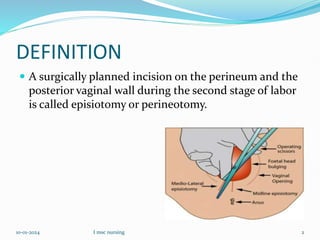
 A surgically planned incision on the perineum and the
posterior vaginal wall during the second stage of labor
is called episiotomy or perineotomy.
10-01-2024 I msc nursing 2
OBJECTIVE
 To cut short the second stage of labor.
 To enlarge introitus (vaginal opening) in order to
facilitate easy delivery of baby.
 To minimize over stretching and rupture of vagina,
perineal muscles and fascia.
 To reduce stress on fetal head.
10-01-2024 I msc nursing 3
INDICATIONS
 In elastic (rigid) perineum.
 Anticipating perineal tear.
 Operative delivery
 Previous perineal surgery.
 Threatened perineal injury in primi gravidae.
10-01-2024 I msc nursing 4
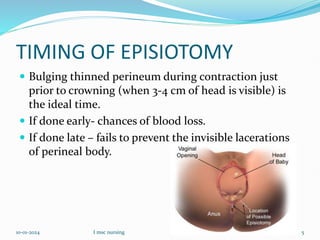
TIMING OF EPISIOTOMY
 Bulging thinned perineum during contraction just
prior to crowning (when 3-4 cm of head is visible) is
the ideal time.
 If done early- chances of blood loss.
 If done late – fails to prevent the invisible lacerations
of perineal body.
10-01-2024 I msc nursing 5
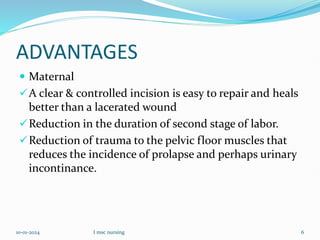
ADVANTAGES
 Maternal
A clear & controlled incision is easy to repair and heals
better than a lacerated wound
Reduction in the duration of second stage of labor.
Reduction of trauma to the pelvic floor muscles that
reduces the incidence of prolapse and perhaps urinary
incontinance.
10-01-2024 I msc nursing 6
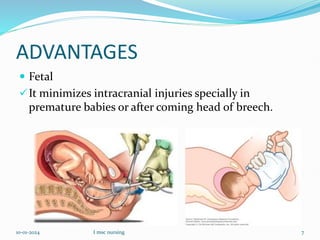
ADVANTAGES
 Fetal
It minimizes intracranial injuries specially in
premature babies or after coming head of breech.
10-01-2024 I msc nursing 7
TYPES OF EPISIOTOMY
 Median
 Medio-lateral
 Lateral
 J-shaped
10-01-2024 I msc nursing 8
Median
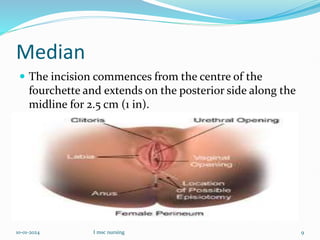
 The incision commences from the centre of the
fourchette and extends on the posterior side along the
midline for 2.5 cm (1 in).
10-01-2024 I msc nursing 9
Medio-lateral
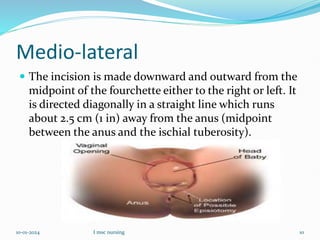
 The incision is made downward and outward from the
midpoint of the fourchette either to the right or left. It
is directed diagonally in a straight line which runs
about 2.5 cm (1 in) away from the anus (midpoint
between the anus and the ischial tuberosity).
10-01-2024 I msc nursing 10
Lateral
 The incision starts from about 1 cm (0.4 in) away from
the centre of the fourchette and extends laterally.
Drawbacks include the chance of injury to the
Bartholin's duct, therefore some practitioners have
strongly discouraged lateral incisions.
10-01-2024 I msc nursing 11
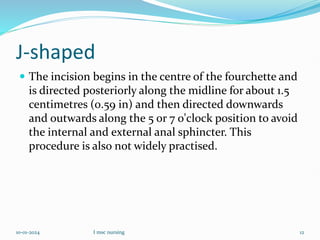
J-shaped
 The incision begins in the centre of the fourchette and
is directed posteriorly along the midline for about 1.5
centimetres (0.59 in) and then directed downwards
and outwards along the 5 or 7 o'clock position to avoid
the internal and external anal sphincter. This
procedure is also not widely practised.
10-01-2024 I msc nursing 12
10-01-2024 I msc nursing 13
10-01-2024 I msc nursing 14
10-01-2024 I msc nursing 15
10-01-2024 I msc nursing 16
10-01-2024 I msc nursing 17
10-01-2024 I msc nursing 18
10-01-2024 I msc nursing 19
10-01-2024 I msc nursing 20
10-01-2024 I msc nursing 21
10-01-2024 I msc nursing 22
10-01-2024 I msc nursing 23
10-01-2024 I msc nursing 24
10-01-2024 I msc nursing 25
10-01-2024 I msc nursing 26
10-01-2024 I msc nursing 27
10-01-2024 I msc nursing 28
10-01-2024 I msc nursing 29
10-01-2024 I msc nursing 30
10-01-2024 I msc nursing 31

Episiotomy suturing.pptx

  • 1.
  • 2.
    DEFINITION  A surgicallyplanned incision on the perineum and the posterior vaginal wall during the second stage of labor is called episiotomy or perineotomy. 10-01-2024 I msc nursing 2
  • 3.
    OBJECTIVE  To cutshort the second stage of labor.  To enlarge introitus (vaginal opening) in order to facilitate easy delivery of baby.  To minimize over stretching and rupture of vagina, perineal muscles and fascia.  To reduce stress on fetal head. 10-01-2024 I msc nursing 3
  • 4.
    INDICATIONS  In elastic(rigid) perineum.  Anticipating perineal tear.  Operative delivery  Previous perineal surgery.  Threatened perineal injury in primi gravidae. 10-01-2024 I msc nursing 4
  • 5.
    TIMING OF EPISIOTOMY Bulging thinned perineum during contraction just prior to crowning (when 3-4 cm of head is visible) is the ideal time.  If done early- chances of blood loss.  If done late – fails to prevent the invisible lacerations of perineal body. 10-01-2024 I msc nursing 5
  • 6.
    ADVANTAGES  Maternal A clear& controlled incision is easy to repair and heals better than a lacerated wound Reduction in the duration of second stage of labor. Reduction of trauma to the pelvic floor muscles that reduces the incidence of prolapse and perhaps urinary incontinance. 10-01-2024 I msc nursing 6
  • 7.
    ADVANTAGES  Fetal It minimizesintracranial injuries specially in premature babies or after coming head of breech. 10-01-2024 I msc nursing 7
  • 8.
    TYPES OF EPISIOTOMY Median  Medio-lateral  Lateral  J-shaped 10-01-2024 I msc nursing 8
  • 9.
    Median  The incisioncommences from the centre of the fourchette and extends on the posterior side along the midline for 2.5 cm (1 in). 10-01-2024 I msc nursing 9
  • 10.
    Medio-lateral  The incisionis made downward and outward from the midpoint of the fourchette either to the right or left. It is directed diagonally in a straight line which runs about 2.5 cm (1 in) away from the anus (midpoint between the anus and the ischial tuberosity). 10-01-2024 I msc nursing 10
  • 11.
    Lateral  The incisionstarts from about 1 cm (0.4 in) away from the centre of the fourchette and extends laterally. Drawbacks include the chance of injury to the Bartholin's duct, therefore some practitioners have strongly discouraged lateral incisions. 10-01-2024 I msc nursing 11
  • 12.
    J-shaped  The incisionbegins in the centre of the fourchette and is directed posteriorly along the midline for about 1.5 centimetres (0.59 in) and then directed downwards and outwards along the 5 or 7 o'clock position to avoid the internal and external anal sphincter. This procedure is also not widely practised. 10-01-2024 I msc nursing 12
  • 13.
    10-01-2024 I mscnursing 13
  • 14.
    10-01-2024 I mscnursing 14
  • 15.
    10-01-2024 I mscnursing 15
  • 16.
    10-01-2024 I mscnursing 16
  • 17.
    10-01-2024 I mscnursing 17
  • 18.
    10-01-2024 I mscnursing 18
  • 19.
    10-01-2024 I mscnursing 19
  • 20.
    10-01-2024 I mscnursing 20
  • 21.
    10-01-2024 I mscnursing 21
  • 22.
    10-01-2024 I mscnursing 22
  • 23.
    10-01-2024 I mscnursing 23
  • 24.
    10-01-2024 I mscnursing 24
  • 25.
    10-01-2024 I mscnursing 25
  • 26.
    10-01-2024 I mscnursing 26
  • 27.
    10-01-2024 I mscnursing 27
  • 28.
    10-01-2024 I mscnursing 28
  • 29.
    10-01-2024 I mscnursing 29
  • 30.
    10-01-2024 I mscnursing 30
  • 31.
    10-01-2024 I mscnursing 31