“A STUDY TO ASSESS THE KNOWLEDGE REGARDING POST NATAL CARE
AMONG ANTENATAL MOTHERS IN SELECTED HOSPITALS OF PUNE CITY.”
“The very damaging and frightening part of postpartum,
Is the lack of perspective, and the lack of priority
And understanding what is usually important.”
--- Brooke Shields
Motherhood is a very humanizing effect.
Mother is placed at the level of God to
provide love, warmth and satisfy needs of
baby. Postnatal care is regarded as one of
the most important maternal health care
services for the prevention of impairment
and disability resulting from childbirth.
1) To assess the knowledge of antenatal
mothers regarding care during postnatal
period.
2) To associate the findings with selected
demographic variables.
CONCEPTUAL FRAMEWORK :
R
<
Self Care
demands
Filling the gap
of knowledge
deficit by
education
Deficit
Lack of
knowledge
about labour
process &
child birth
preparedness
Self Care
Adopts
changes during
pregnancy
Positive
maternal and
foetal outcome
Self Care
Agency
Motivation,
willingness &
interest of
primigravida
mothers
Nursing Agency
Knowledge
assessment of
primigravida women
Assessment of knowledge
by using structured
questionnaire related to
postnatal care
MATERIALS AND METHODS :
Conceptual framework of the study based on Orem’s
self care deficit theory (supportive educative)
R=Relationship,<=deficitrelationship,currentorprojected
Non-
experimental
descriptive
design
OBJECTIVES:
Tool: Structured
questionnaire
• Validated by experts
• Karl Pearson formula
(0.95)
Sample: Antenatal mothers With ≥ 32 weeks
of pregnancy.
Sampling Technique: Non-Probability
Convenient sampling
Sample size: 100
•Informed written consent obtained
•Self structured questionnaire regarding
postnatal care administered & Data collected
•Data tabulated by descriptive and inferential
statistics
FINDINGS OF THE STUDY :
43.94
39.39
13.64 3.03
Distribution of the antenatal
mothers having average
knowledge according to their
age
18 Years - 23
Years
24 Years - 29
Years
15.15
28.7943.94
10.61 0 1.52
Distribution of the antenatal
mothers having average
knowledge according to their
education
Primary
Secondary
0
100
Home makerJob
Distribution of the antenatal
mothers having average
knowledge according to their
occupation
Percentage
(%)
0
100
1
2
Distribution of the antenatal
mothers having average
knowledge according to their
gravida status
Percentage (%)
Distribution of samples according to their demographic
characteristics
Characteristics Percentag
e (%)
Characteristics Percentag
e (%)
Age:
a) 18 - 23 years
b) 24 – 29 years
c) 30 – 35 years
d) Above 35
years
41
42
15
02
Occupation:
a) Home
maker
b) Working,
89
11
Education:
a) Primary
b) Secondary
c) Higher
secondary
d) Graduation
e) Post-
Graduation
f) Others
19
24
46
10
00
01
Gravida:
a) Primipara
b) Multipara
45
55
Weeks of gestation:
a) 32-34 weeks
b) 35-37 weeks
c) 38-40 weeks
47
47
06
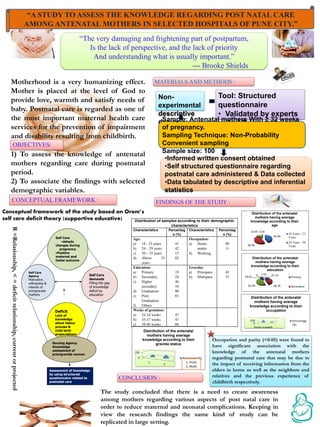
Occupation and parity (<0.05) were found to
have significant association with the
knowledge of the antenatal mothers
regarding postnatal care that may be due to
the impact of receiving information from the
elders in home as well as the neighbors and
relatives and the previous experience of
childbirth respectively.
CONCLUSION :
The study concluded that there is a need to create awareness
among mothers regarding various aspects of post natal care in
order to reduce maternal and neonatal complications. Keeping in
view the research findings the same kind of study can be
replicated in large setting.
1. Primi
2. Multi

Poster presentation final

  • 1.
    “A STUDY TOASSESS THE KNOWLEDGE REGARDING POST NATAL CARE AMONG ANTENATAL MOTHERS IN SELECTED HOSPITALS OF PUNE CITY.” “The very damaging and frightening part of postpartum, Is the lack of perspective, and the lack of priority And understanding what is usually important.” --- Brooke Shields Motherhood is a very humanizing effect. Mother is placed at the level of God to provide love, warmth and satisfy needs of baby. Postnatal care is regarded as one of the most important maternal health care services for the prevention of impairment and disability resulting from childbirth. 1) To assess the knowledge of antenatal mothers regarding care during postnatal period. 2) To associate the findings with selected demographic variables. CONCEPTUAL FRAMEWORK : R < Self Care demands Filling the gap of knowledge deficit by education Deficit Lack of knowledge about labour process & child birth preparedness Self Care Adopts changes during pregnancy Positive maternal and foetal outcome Self Care Agency Motivation, willingness & interest of primigravida mothers Nursing Agency Knowledge assessment of primigravida women Assessment of knowledge by using structured questionnaire related to postnatal care MATERIALS AND METHODS : Conceptual framework of the study based on Orem’s self care deficit theory (supportive educative) R=Relationship,<=deficitrelationship,currentorprojected Non- experimental descriptive design OBJECTIVES: Tool: Structured questionnaire • Validated by experts • Karl Pearson formula (0.95) Sample: Antenatal mothers With ≥ 32 weeks of pregnancy. Sampling Technique: Non-Probability Convenient sampling Sample size: 100 •Informed written consent obtained •Self structured questionnaire regarding postnatal care administered & Data collected •Data tabulated by descriptive and inferential statistics FINDINGS OF THE STUDY : 43.94 39.39 13.64 3.03 Distribution of the antenatal mothers having average knowledge according to their age 18 Years - 23 Years 24 Years - 29 Years 15.15 28.7943.94 10.61 0 1.52 Distribution of the antenatal mothers having average knowledge according to their education Primary Secondary 0 100 Home makerJob Distribution of the antenatal mothers having average knowledge according to their occupation Percentage (%) 0 100 1 2 Distribution of the antenatal mothers having average knowledge according to their gravida status Percentage (%) Distribution of samples according to their demographic characteristics Characteristics Percentag e (%) Characteristics Percentag e (%) Age: a) 18 - 23 years b) 24 – 29 years c) 30 – 35 years d) Above 35 years 41 42 15 02 Occupation: a) Home maker b) Working, 89 11 Education: a) Primary b) Secondary c) Higher secondary d) Graduation e) Post- Graduation f) Others 19 24 46 10 00 01 Gravida: a) Primipara b) Multipara 45 55 Weeks of gestation: a) 32-34 weeks b) 35-37 weeks c) 38-40 weeks 47 47 06 Occupation and parity (<0.05) were found to have significant association with the knowledge of the antenatal mothers regarding postnatal care that may be due to the impact of receiving information from the elders in home as well as the neighbors and relatives and the previous experience of childbirth respectively. CONCLUSION : The study concluded that there is a need to create awareness among mothers regarding various aspects of post natal care in order to reduce maternal and neonatal complications. Keeping in view the research findings the same kind of study can be replicated in large setting. 1. Primi 2. Multi