Educational psychology
Individual Difference
Submitted to: Dr Bushrah Naz
Submitted by: 513
Definitions of Individual
Differences
• 1. Drever James:
“Variations or deviations from the
average of the group, with respect to
the mental or physical characters,
occurring in the individual member of
the group are individual differences.”
Definitions of Individual
Differences
• 3. Skinner, C.E.:
“Today we think of individual
differences as including any
measurable aspect of the total
personality.”
• “Individual differences are found in
all psychological characteristics
physical mental abilities,
knowledge, habit, personality and
character traits.”
Woodworth, R.S.
and Marquis,
D.G
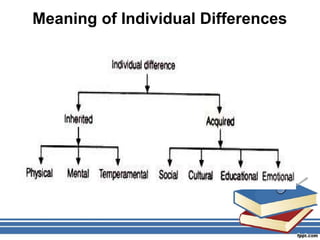
Meaning of Individual Differences
Types of Individual
Differences:
• 1. Physical differences:
Shortness or tallness of stature, darkness or
fairness of complexion, fatness, thinness, or
weakness are various physical individual
differences.
2. Differences in intelligence:
There are differences in intelligence level among
different individuals. We can classify the individuals
from super-normal (above 120 I.Q.) to idiots (from 0
to 50 I.Q.) on the basis of their intelligence level.
• 3. Differences in attitudes:
Individuals differ in their attitudes towards different people,
objects,
institutions and authority.
4. Differences in achievement:
It has been found through achievement tests that individuals
differ in their achievement abilities. These differences are very
much visible in reading, writing and in learning mathematics.
• 5. Differences in motor ability:
There are differences in motor ability. These
differences are visible at different ages. Some
people can perform mechanical tasks easily, while
others, even though they are at the same level, feel
much difficulty in performing these tasks.
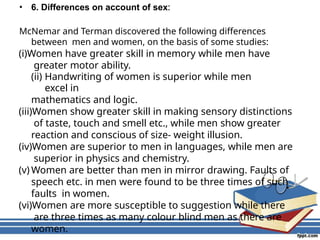
• 6. Differences on account of sex:
McNemar and Terman discovered the following differences
between men and women, on the basis of some studies:
(i)Women have greater skill in memory while men have
greater motor ability.
(ii) Handwriting of women is superior while men
excel in
mathematics and logic.
(iii)Women show greater skill in making sensory distinctions
of taste, touch and smell etc., while men show greater
reaction and conscious of size- weight illusion.
(iv)Women are superior to men in languages, while men are
superior in physics and chemistry.
(v) Women are better than men in mirror drawing. Faults of
speech etc. in men were found to be three times of such
faults in women.
(vi)Women are more susceptible to suggestion while there
are three times as many colour blind men as there are
women.
• 7. Racial differences:
There are different kinds of racial differences.
Differences of environment is a normal factor in
causing these differences. Karl Brigham has
composed a list on the basis of differences in levels
of intelligence among people who have migrated to
United States from other countries.
On the basis of these average differences between
the races, the mental age of a particular individual
cannot be calculated since this difference is based
on environment.
• 9. Differences due to economic status:
Differences in children’s interests,
tendencies and character are caused by
economic differences.
10. Differences in interests:
Factors such as sex, family background level
of development, differences of race and
nationality etc., cause differences in
interests.
• Emotional differences:
Individuals differ in their emotional reactions to a
particular situation. Some are irritable and
aggressive and they get angry very soon. There are
others who are of peaceful nature and do not get
angry easily. At a particular thing an individual may
be so much enraged that he may be prepared for
the worst crime like murder, while another person
may only laugh at it.
• 12. Personality differences:
There are differences in respect of personality. On
the basis of differences in personality, individuals
have been classified into many groups.
Spranger, for example, has classified personalities
into six types:
(a) Theoretical,
(b) Economic
(c) Aesthetic,
(d) Social,
(e) Political, and
(f) Religious.
Jung classified people into three groups:
(a) Introverts,
(b) Extroverts, and
(c) Ambiverts.
• Differences due to nationality:
Individuals of different nations differ in
respect of physical and mental differences,
interests and personality etc. ‘Russians are
tall and stout’; ‘Ceylonese are short and slim’;
‘Germans have no sense of humour’; ‘Yellow
races are cruel and revengeful’; ‘Americans
are hearty and
frank’; Indians are timid and peace-loving’ and
the like observations enter into our common
talk.
Causes of Individual Differences:
• Heredity:
• Some heretical traits bring a change from
one individual to other. An individual’s
height, size, shape and color of hair, shape of
face, nose, hands and legs so to say the
entire structure of the body is determined by
his heretical qualities. Intellectual
differences are also to a great extent
influenced by hereditary factor.
• Environment:
• Environment brings individual differences in
behaviour, activities, attitude, and style of
life characteristics. Personality etc.
Environment does not refer only physical
surroundings but also it refers the different
types of people, society, their culture,
customs, traditions, social heritage, ideas
and ideals.
• Race and Nationality:
• Race and Nationality is one cause of
individual difference. Indians are very
peace loving, Chinese are cruel;
Americans are very frank due to race
and nationality.
• Sex:
• Due to sex variation one individual differs
from other. Men are strong in mental
power. On the other hand women on the
average show small superiority over men in
memory, language and aesthetic sense.
Women excel the men in shouldering social
responsibilities and have a better control
over their emotions.
• Age:
• Age is another factor which is responsible in
bringing individual differences. Learning
ability and adjustment capacity naturally
grow with age. When one grows in age can
acquire better control over our emotions and
better social responsibilities. When a child
grows then this maturity and development
goes side by side.
• Education:
• Education is one major factor which
brings individual differences. There is a
wide gap in the behaviors of educated
and uneducated persons. All traits of
human beings like social, emotional
and intellectual are controlled and
modifies through proper education.
Role of Individual Differences in
Education
• 1. Limited size of the class:
Generally there are 50 or more than 50 students in
a class. In such a large class, it is not possible for
the teacher to pay individual attention to the
students. The size of the class should be small. It
should be divided into various units so that after
class-room work their various difficulties may be
found out.
2. Proper division of the class:
Now there are separate classes for the students,
who have different intelligence. While bringing
about this classification, the teacher should keep
in mind the difference in age, interests,
emotional and social qualities.
• 3. Home task:
The teacher should assign home task to the students while
keeping in view the individual differences.
4. Factor of sex:
Boys and girls are to play different roles in society. Hence the
factor
of sex should be kept in mind.
5. Curriculum:
The curriculum should be modified to suit the needs of all types
of children. A large number of subjects should be included in
the curriculum so that education can be provided to each child
according to his interests, needs and abilities. Curriculum
should not be rigid but it should be flexible.
• 6. Methods of Teaching:
Methods of teaching should be chosen on the basis of
individual differences. It is not advisable to use the same
method of education in the case of all children-gifted or
backward.
7. Educational Guidance:
Teacher should impart educational guidance to the students
while keeping in view their individual differences. He can
assist them in the selection of educational career, selection of
subjects, selection of books, selection of hobbies and co-
curricular activities and in many other areas connected with
education.
8. Vocational Guidance:
While keeping in view the individual differences the teacher
can guide the students in the vocation that they should
adopt.
Educational psychology Individual Difference .pptx

Educational psychology Individual Difference .pptx

  • 1.
    Educational psychology Individual Difference Submittedto: Dr Bushrah Naz Submitted by: 513
  • 2.
    Definitions of Individual Differences •1. Drever James: “Variations or deviations from the average of the group, with respect to the mental or physical characters, occurring in the individual member of the group are individual differences.”
  • 3.
    Definitions of Individual Differences •3. Skinner, C.E.: “Today we think of individual differences as including any measurable aspect of the total personality.”
  • 4.
    • “Individual differencesare found in all psychological characteristics physical mental abilities, knowledge, habit, personality and character traits.” Woodworth, R.S. and Marquis, D.G
  • 5.
  • 6.
    Types of Individual Differences: •1. Physical differences: Shortness or tallness of stature, darkness or fairness of complexion, fatness, thinness, or weakness are various physical individual differences. 2. Differences in intelligence: There are differences in intelligence level among different individuals. We can classify the individuals from super-normal (above 120 I.Q.) to idiots (from 0 to 50 I.Q.) on the basis of their intelligence level.
  • 7.
    • 3. Differencesin attitudes: Individuals differ in their attitudes towards different people, objects, institutions and authority. 4. Differences in achievement: It has been found through achievement tests that individuals differ in their achievement abilities. These differences are very much visible in reading, writing and in learning mathematics.
  • 8.
    • 5. Differencesin motor ability: There are differences in motor ability. These differences are visible at different ages. Some people can perform mechanical tasks easily, while others, even though they are at the same level, feel much difficulty in performing these tasks.
  • 9.
    • 6. Differenceson account of sex: McNemar and Terman discovered the following differences between men and women, on the basis of some studies: (i)Women have greater skill in memory while men have greater motor ability. (ii) Handwriting of women is superior while men excel in mathematics and logic. (iii)Women show greater skill in making sensory distinctions of taste, touch and smell etc., while men show greater reaction and conscious of size- weight illusion. (iv)Women are superior to men in languages, while men are superior in physics and chemistry. (v) Women are better than men in mirror drawing. Faults of speech etc. in men were found to be three times of such faults in women. (vi)Women are more susceptible to suggestion while there are three times as many colour blind men as there are women.
  • 10.
    • 7. Racialdifferences: There are different kinds of racial differences. Differences of environment is a normal factor in causing these differences. Karl Brigham has composed a list on the basis of differences in levels of intelligence among people who have migrated to United States from other countries. On the basis of these average differences between the races, the mental age of a particular individual cannot be calculated since this difference is based on environment.
  • 11.
    • 9. Differencesdue to economic status: Differences in children’s interests, tendencies and character are caused by economic differences. 10. Differences in interests: Factors such as sex, family background level of development, differences of race and nationality etc., cause differences in interests.
  • 12.
    • Emotional differences: Individualsdiffer in their emotional reactions to a particular situation. Some are irritable and aggressive and they get angry very soon. There are others who are of peaceful nature and do not get angry easily. At a particular thing an individual may be so much enraged that he may be prepared for the worst crime like murder, while another person may only laugh at it.
  • 13.
    • 12. Personalitydifferences: There are differences in respect of personality. On the basis of differences in personality, individuals have been classified into many groups. Spranger, for example, has classified personalities into six types: (a) Theoretical, (b) Economic (c) Aesthetic, (d) Social, (e) Political, and (f) Religious. Jung classified people into three groups: (a) Introverts, (b) Extroverts, and (c) Ambiverts.
  • 14.
    • Differences dueto nationality: Individuals of different nations differ in respect of physical and mental differences, interests and personality etc. ‘Russians are tall and stout’; ‘Ceylonese are short and slim’; ‘Germans have no sense of humour’; ‘Yellow races are cruel and revengeful’; ‘Americans are hearty and frank’; Indians are timid and peace-loving’ and the like observations enter into our common talk.
  • 15.
    Causes of IndividualDifferences: • Heredity: • Some heretical traits bring a change from one individual to other. An individual’s height, size, shape and color of hair, shape of face, nose, hands and legs so to say the entire structure of the body is determined by his heretical qualities. Intellectual differences are also to a great extent influenced by hereditary factor.
  • 16.
    • Environment: • Environmentbrings individual differences in behaviour, activities, attitude, and style of life characteristics. Personality etc. Environment does not refer only physical surroundings but also it refers the different types of people, society, their culture, customs, traditions, social heritage, ideas and ideals.
  • 17.
    • Race andNationality: • Race and Nationality is one cause of individual difference. Indians are very peace loving, Chinese are cruel; Americans are very frank due to race and nationality.
  • 18.
    • Sex: • Dueto sex variation one individual differs from other. Men are strong in mental power. On the other hand women on the average show small superiority over men in memory, language and aesthetic sense. Women excel the men in shouldering social responsibilities and have a better control over their emotions.
  • 19.
    • Age: • Ageis another factor which is responsible in bringing individual differences. Learning ability and adjustment capacity naturally grow with age. When one grows in age can acquire better control over our emotions and better social responsibilities. When a child grows then this maturity and development goes side by side.
  • 20.
    • Education: • Educationis one major factor which brings individual differences. There is a wide gap in the behaviors of educated and uneducated persons. All traits of human beings like social, emotional and intellectual are controlled and modifies through proper education.
  • 21.
    Role of IndividualDifferences in Education • 1. Limited size of the class: Generally there are 50 or more than 50 students in a class. In such a large class, it is not possible for the teacher to pay individual attention to the students. The size of the class should be small. It should be divided into various units so that after class-room work their various difficulties may be found out. 2. Proper division of the class: Now there are separate classes for the students, who have different intelligence. While bringing about this classification, the teacher should keep in mind the difference in age, interests, emotional and social qualities.
  • 22.
    • 3. Hometask: The teacher should assign home task to the students while keeping in view the individual differences. 4. Factor of sex: Boys and girls are to play different roles in society. Hence the factor of sex should be kept in mind. 5. Curriculum: The curriculum should be modified to suit the needs of all types of children. A large number of subjects should be included in the curriculum so that education can be provided to each child according to his interests, needs and abilities. Curriculum should not be rigid but it should be flexible.
  • 23.
    • 6. Methodsof Teaching: Methods of teaching should be chosen on the basis of individual differences. It is not advisable to use the same method of education in the case of all children-gifted or backward. 7. Educational Guidance: Teacher should impart educational guidance to the students while keeping in view their individual differences. He can assist them in the selection of educational career, selection of subjects, selection of books, selection of hobbies and co- curricular activities and in many other areas connected with education. 8. Vocational Guidance: While keeping in view the individual differences the teacher can guide the students in the vocation that they should adopt.