
CHAPTER 2
THEORY OF
CAREER
DEVELOPMENT
CHOICE
1
ESB4213 CAREER GUIDANCE
LEARNING OUTCOMES
• After studying this chapter, you should be able to:
1. Identify the different types of career development theories.
2. Describe the main six career development theories.
3. Discuss the appropriate theory to apply for individual career
choice.
4. Discuss the appropriate theory to apply for individual career
development.
2
CONTENT
• Overview of Career Development Theory
• The Big Seven (7) Career Theories
1. Trait and Factor Approaches
2. Holland’s Theory of Personality Types
3. Development Theories:
- Donald Super’s Theory Vocational Development
- Gottfredson: Theory of Circumscription and Compromise
4. Learning and Cognitive Theories
- Social Learning Theory
- Social Cognitive Career Theory
5. Theories of Embedded Career
6. Psychodynamic Approaches
7. Anne Roe-Work Adjustment Theory
3
Overview of Career
Development Theory
4
What is Theory?
• A theory presents a systematic way of understanding events or
situations.
• It is a set of concepts, definitions, and propositions that explain or
predict these events or situations by illustrating the relationships
between variables.
• Theories must be applicable to a broad variety of situations.
5
What Good is a Theory?
• A useful theory provide a framework for understanding complex
phenomena; a career theory is a way of summarizing what we see
and what we know by constructing explanations for career
development and behaviour (Marie F. Shoffner, University of Virginia,
2006).
• A theory is “an attempt to represent some aspect of behaviour, much
in the same way that a map is an attempt to represent some
geography territory (John Krumboltz, 1999).
• A good theory is a simplifies representation of some domain
constructed so that users can ask questions about that domain with
an increased probabilility of receiving valuable answers (John
Krumboltz, 1994).
6
The Big Seven (7) Career
Development Theory
7
The Big Seven (7) Career Development Theory
1. Trait and Factor Approaches
2. Holland’s Theory of Personality Types
3. Development Theories:
- Donald Super’s Theory Vocational Development
- Gottfredson: Theory of Circumstances and
Compromise
4. Learning and Cognitive Theories
- Social Learning Theory
- Social Cognitive Career Theory
5. Theories of Embedded Career
6. Psychodynamic Approaches
7. Anne Roe-Work Adjustment Theory
8
1. Trait and Factor Approaches
• Developed by Frank Parsons in 1909 helping young
people to become successfully employed.
• This theory matching individuals to work environments
so that they will be successful in and satisfied with their
work.
• Every person has a unique pattern of traits made up of
their interests, values, abilities and personality
characteristics, these traits can be objectively identified
and profiled to represent an individual’s potential.
• It is possible to identify a fit or match between individual
traits and job factors using a straight forward problem-
solving/decision making process. The closer the match
between personal traits and job factors the greater the
likelihood for successful job performance and
satisfaction.
9
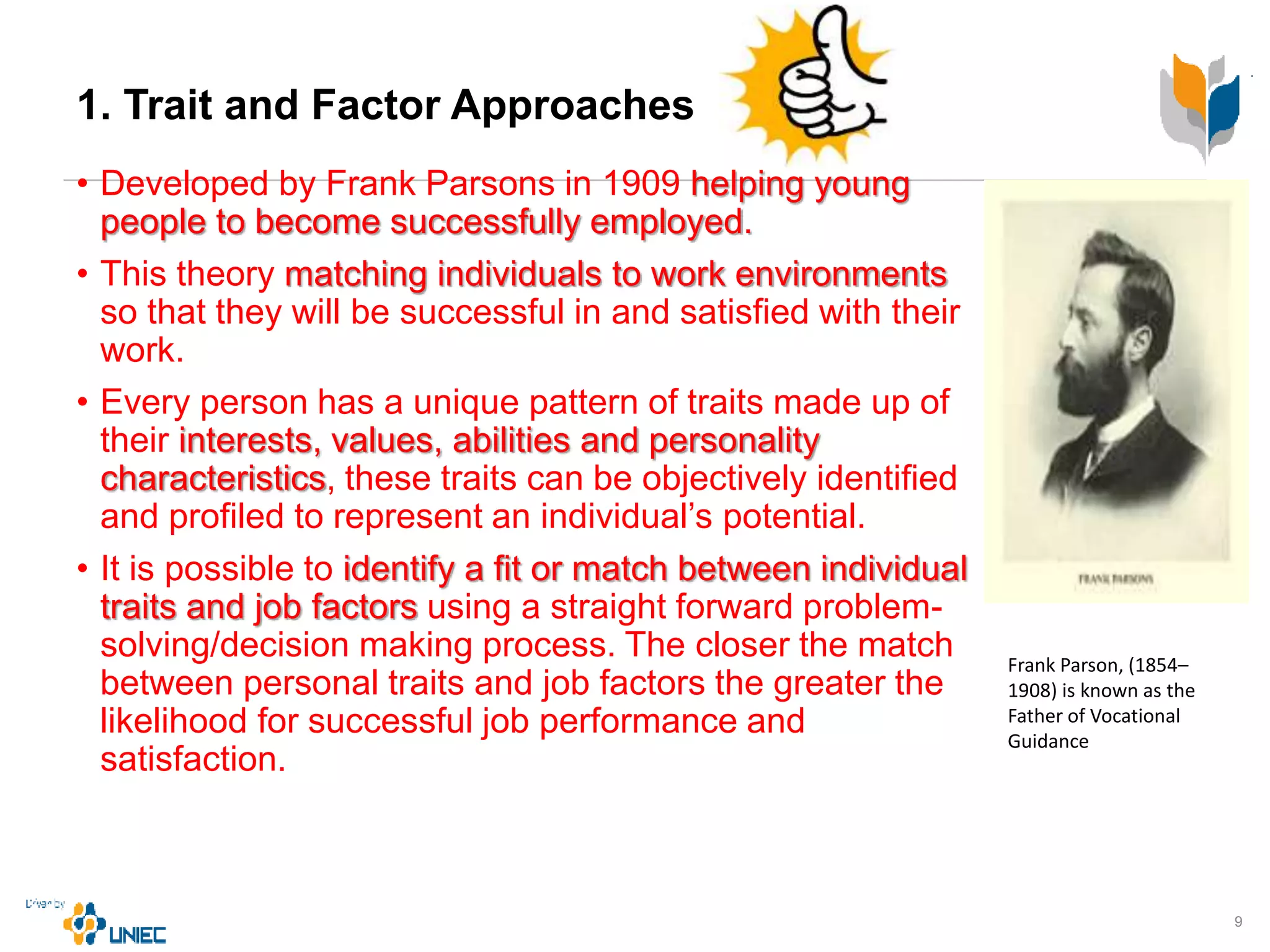
Frank Parson, (1854–
1908) is known as the
Father of Vocational
Guidance
Trait and Factor Approaches, cont.
• Parsons developed a framework to help individuals decide on a
career. This framework contained a three part formulation.
1. A clear understanding of yourself, aptitudes, abilities,
interests, resources, limitations, and other qualities
2. A knowledge of the requirements and conditions of success,
advantages and disadvantages, compensations, opportunities,
and prospects in different lines of work
3. True reasoning of the relations of these two groups of facts.
• According to Parsons, ideal career choices are based on
matching personal traits (aptitude, abilities, resources,
personality) with job factors (wages, environment, etc.) to
produce the best conditions of vocational success.
10
Parsons, 1909, p. 5, as cited in Zunker, 2002)
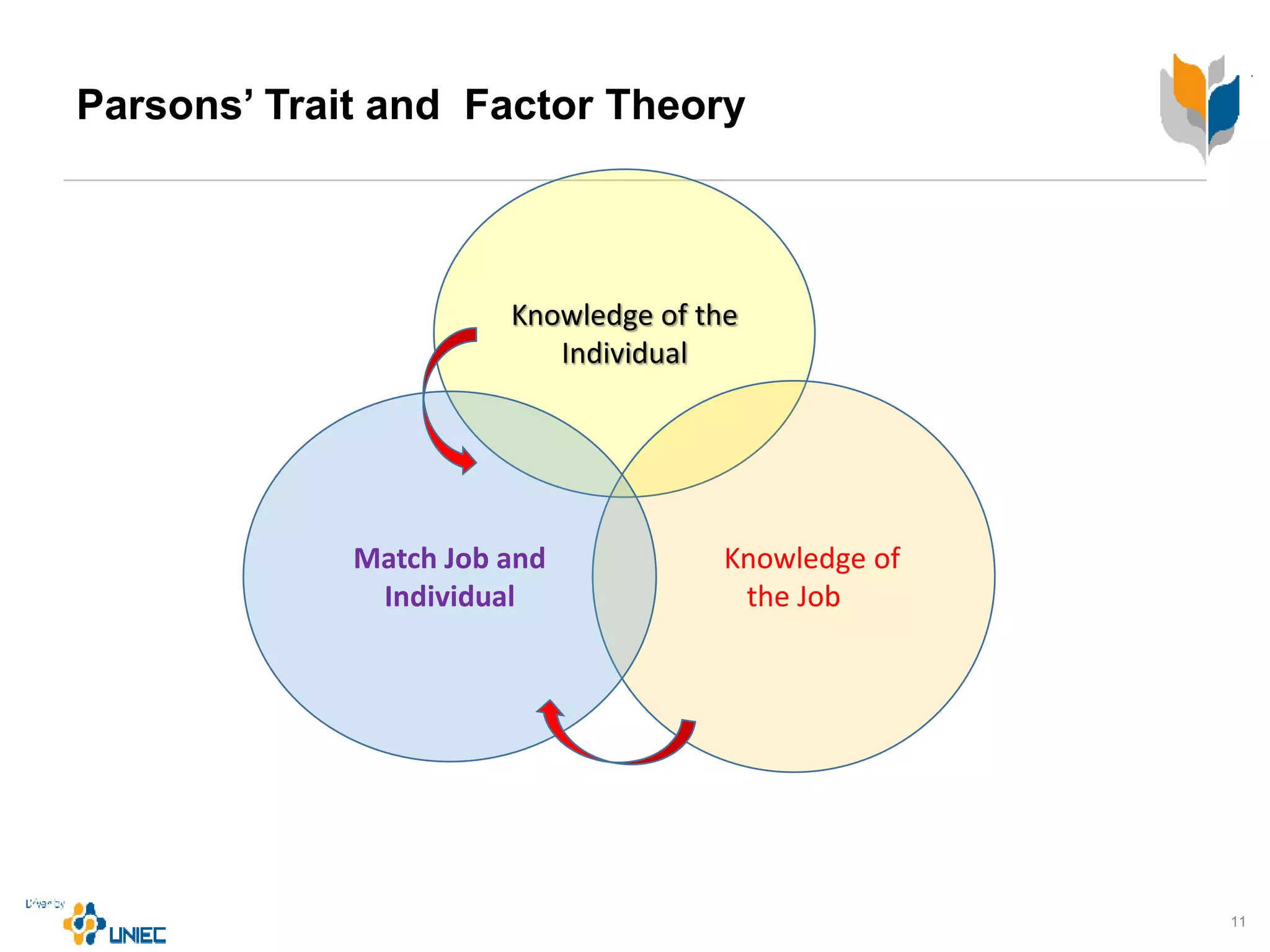
Parsons’ Trait and Factor Theory
11
Knowledge of the
Individual
Knowledge of
the Job
Match Job and
Individual
Trait and Factor Approaches, cont.
• Basic Principles
• Know oneself: aptitudes, abilities, interests, limitations
• Know the job market
• Apply “true reasoning” when matching oneself to an occupation
• The counselor provides information about client’s personality
characteristics and what occupations would be a nice fit for the client
based upon these characteristics
• Parsons states that occupational decision making occurs when
people have achieved:
• an accurate understanding of their individual traits (aptitudes, interests,
personal abilities)
• a knowledge of jobs and the labour market
• rational and objective judgment about the relationship between their
individual traits, and the labour market.
12
2. Holland’s Theory of Personality Types
•The theory developed in 1959 emphasized
the “searching” aspects of person-
environment fit:
“The person making a vocational choice in
a sense searches for situations which
satisfy his hierarchy of adjustive
orientations” (Holland, 1959, p. 35).
“Persons with more information about
occupational environments make more
adequate choices than do persons with less
information” (pp. 40–41).
13
Holland’s Theory of Personality Types, cont.
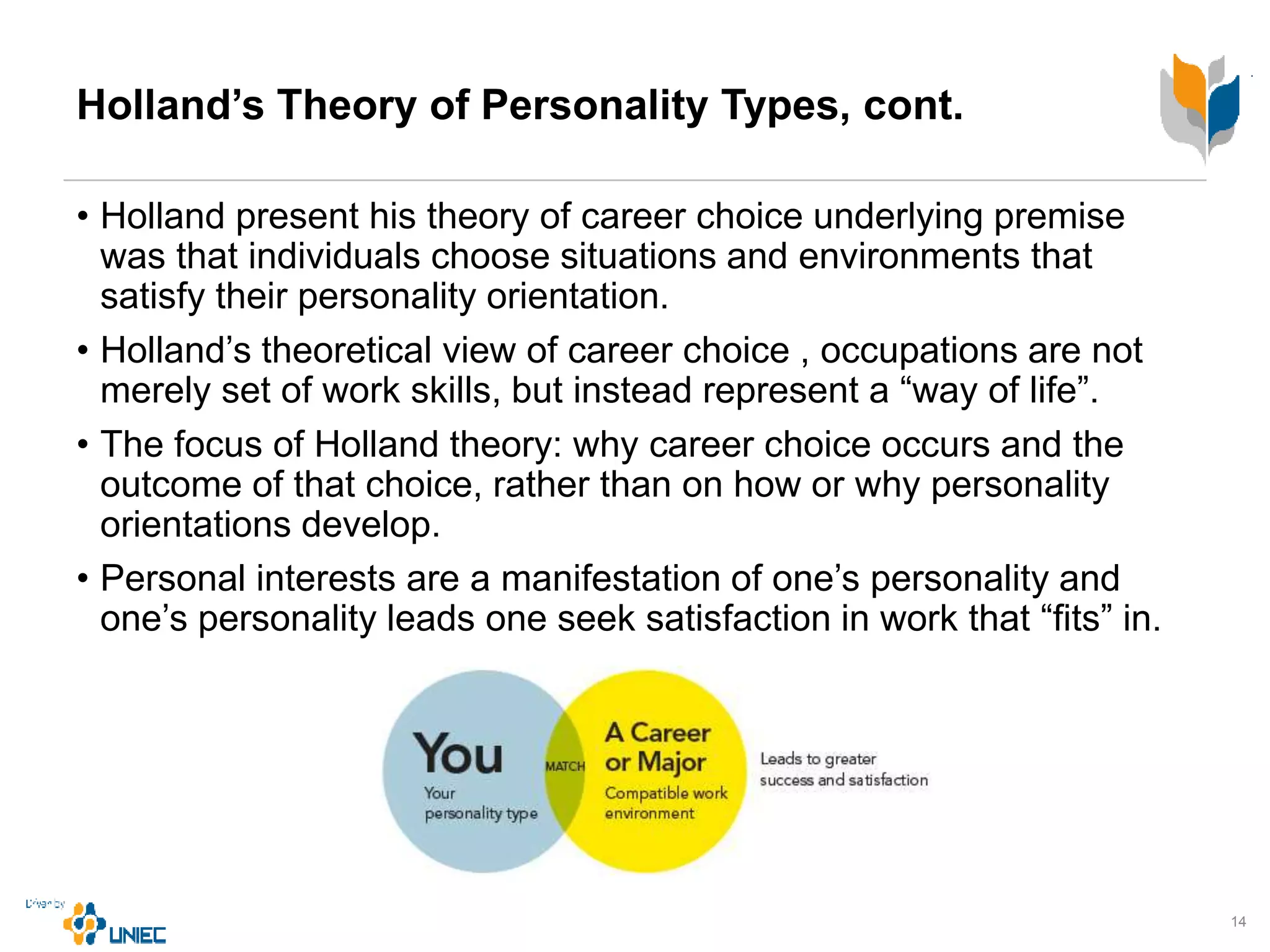
• Holland present his theory of career choice underlying premise
was that individuals choose situations and environments that
satisfy their personality orientation.
• Holland’s theoretical view of career choice , occupations are not
merely set of work skills, but instead represent a “way of life”.
• The focus of Holland theory: why career choice occurs and the
outcome of that choice, rather than on how or why personality
orientations develop.
• Personal interests are a manifestation of one’s personality and
one’s personality leads one seek satisfaction in work that “fits” in.
14
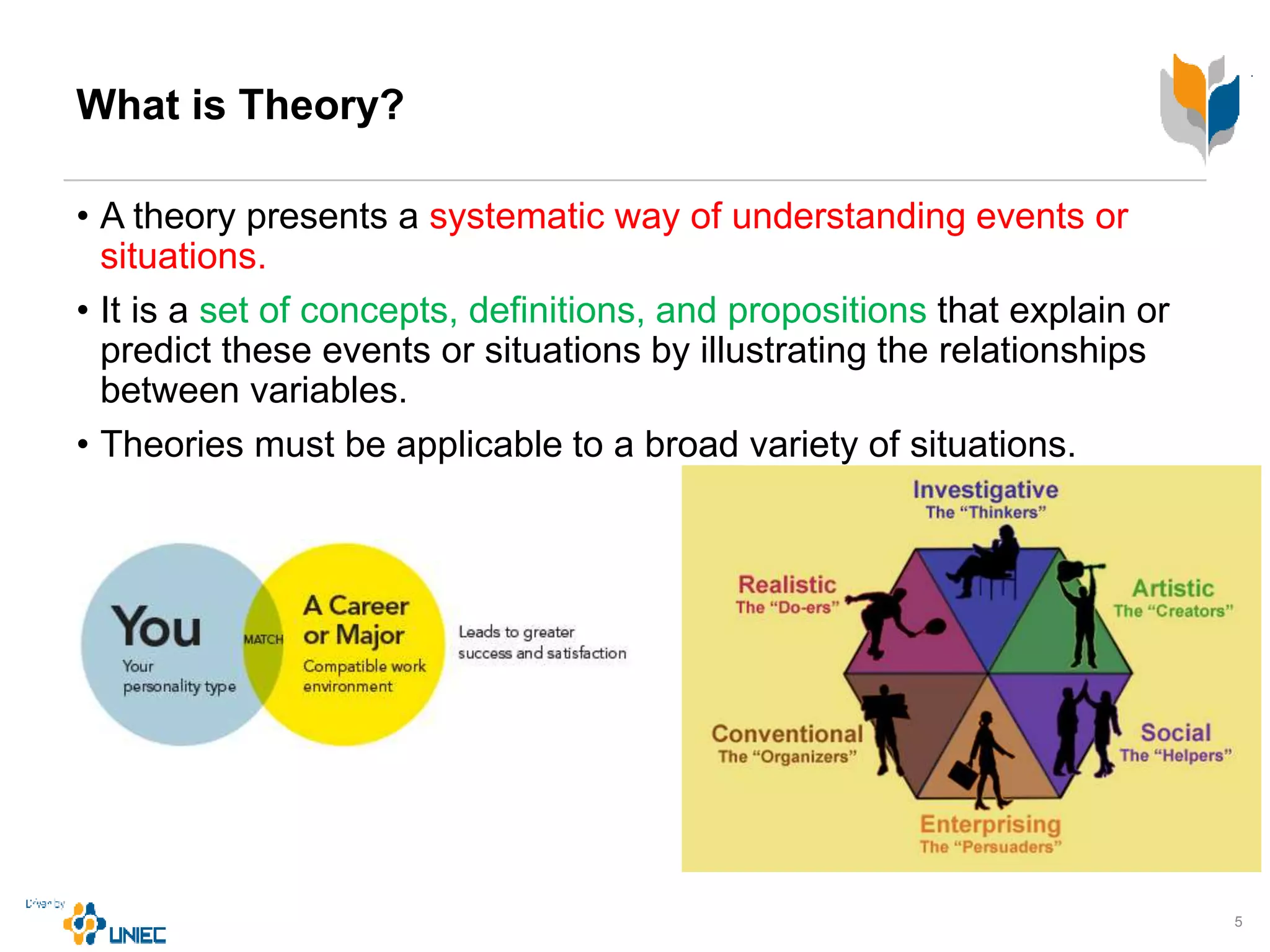
Holland’s Theory of Personality Types
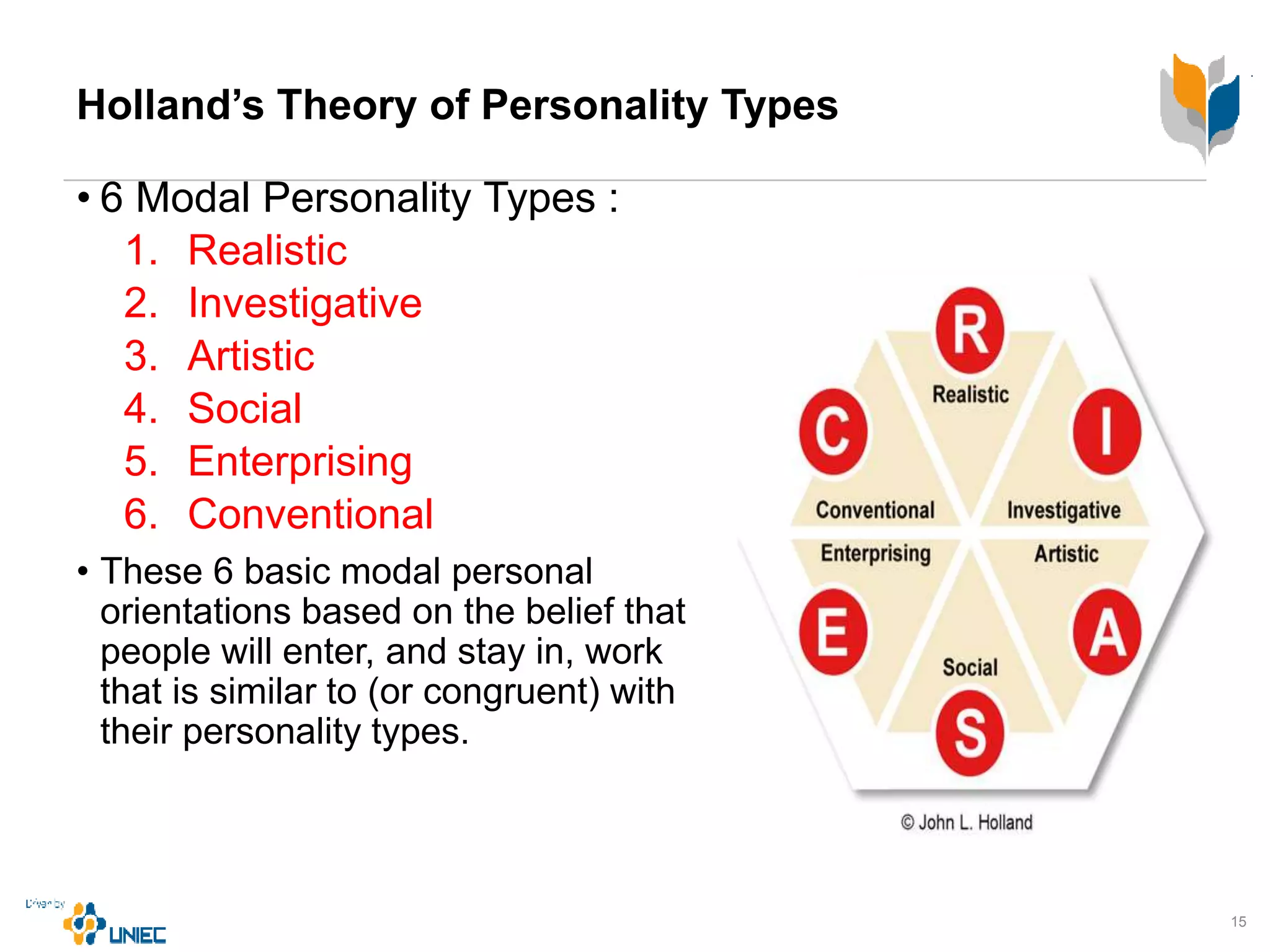
• 6 Modal Personality Types :
1. Realistic
2. Investigative
3. Artistic
4. Social
5. Enterprising
6. Conventional
• These 6 basic modal personal
orientations based on the belief that
people will enter, and stay in, work
that is similar to (or congruent) with
their personality types.
15
3. Development Theories
• Development theories provide a framework for understanding the
unfolding process of career and career choice over the life-span.
• Two development theories:
(1) Donald Super’s Theory Vocational Development and,
(2) Linda Gottfredson’s theory of circumscription and compromise.
16
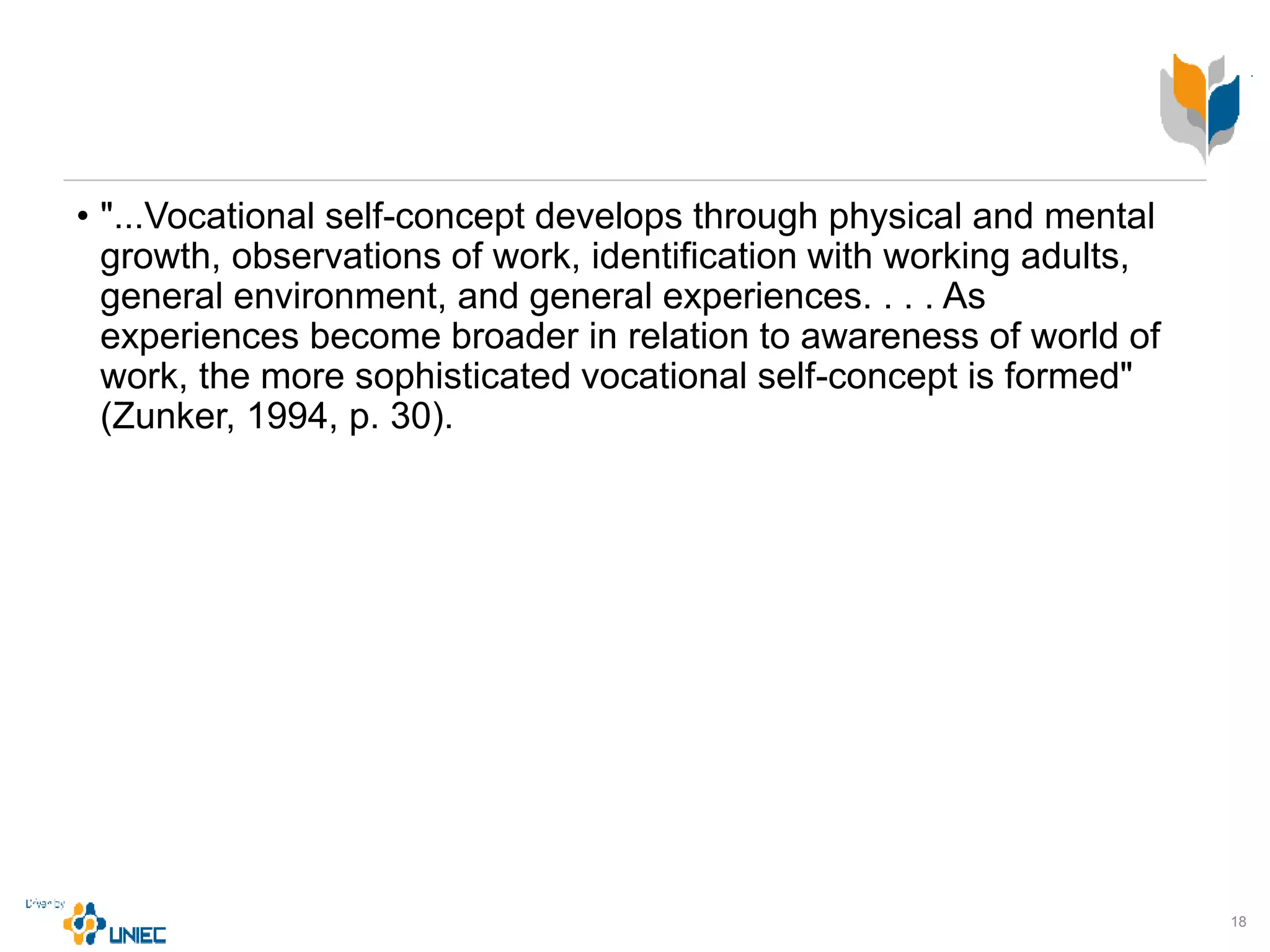
Theory of Vocational Development
• Donald Super published works in the mid 1950.
• Super believed that both learning and decision
making are career development processes
(Savickas, 1997b, p. 252).
• Built on 14 assumptions
• According to Super, career development is lifelong. A
self-concept changes over time, and develops as a
result of experience.
• At first, Super called his approach “career
development theory.” As time passed, he changed
the name to “developmental self-concept theory”
and, finally, to “life-span, life-space theory.”
• Super added the concepts of career maturity, career
adaptability, and life stages as part of this first
attempt to formulate a theory of career development.
17
• "...Vocational self-concept develops through physical and mental
growth, observations of work, identification with working adults,
general environment, and general experiences. . . . As
experiences become broader in relation to awareness of world of
work, the more sophisticated vocational self-concept is formed"
(Zunker, 1994, p. 30).
18
Theory of Vocational Development
• Super describe his theory as a differential-development-social
phenomenological approach.
• In his propositions, he posited a strong relationship between
individual’s personal growth and his or her career development.
• This theory focus on the development of vocational
behaviour and the relationship of this unfolding process to
various roles.
• Super assumed that an individual’s career choice was not
merely the results of matching his or her abilities and interest to
the world of work, but an expression of his or her self-concepts.
• Thus, people are satisfied to the degree that they “implement
self-concept” through their work choice, thereby connecting
with the personal meaning of their abilities, interests, values
and choices (Super et. al., 1996)
19
Super’s five life and career development stages
20
Stage 1: Growth: Age 0–14
Characteristics: Development of self-concept, attitudes, needs and general world
of work
Stage 2: Exploration: Age 15–24
Characteristics: “Trying out” through classes, work experience, hobbies. Tentative
choice and skill development
Stage 3: Establishment: Age 25–44
Characteristics: Entry-level skill building and stabilisation through work experience
Stage 4: Maintenance: Age 45-64
Characteristics: Continual adjustment process to improve position
Stage 5: Decline: Age 65+
Characteristics: Reduced output, prepare for retirement
Gottfredson theory of Circumscription and
Compromise
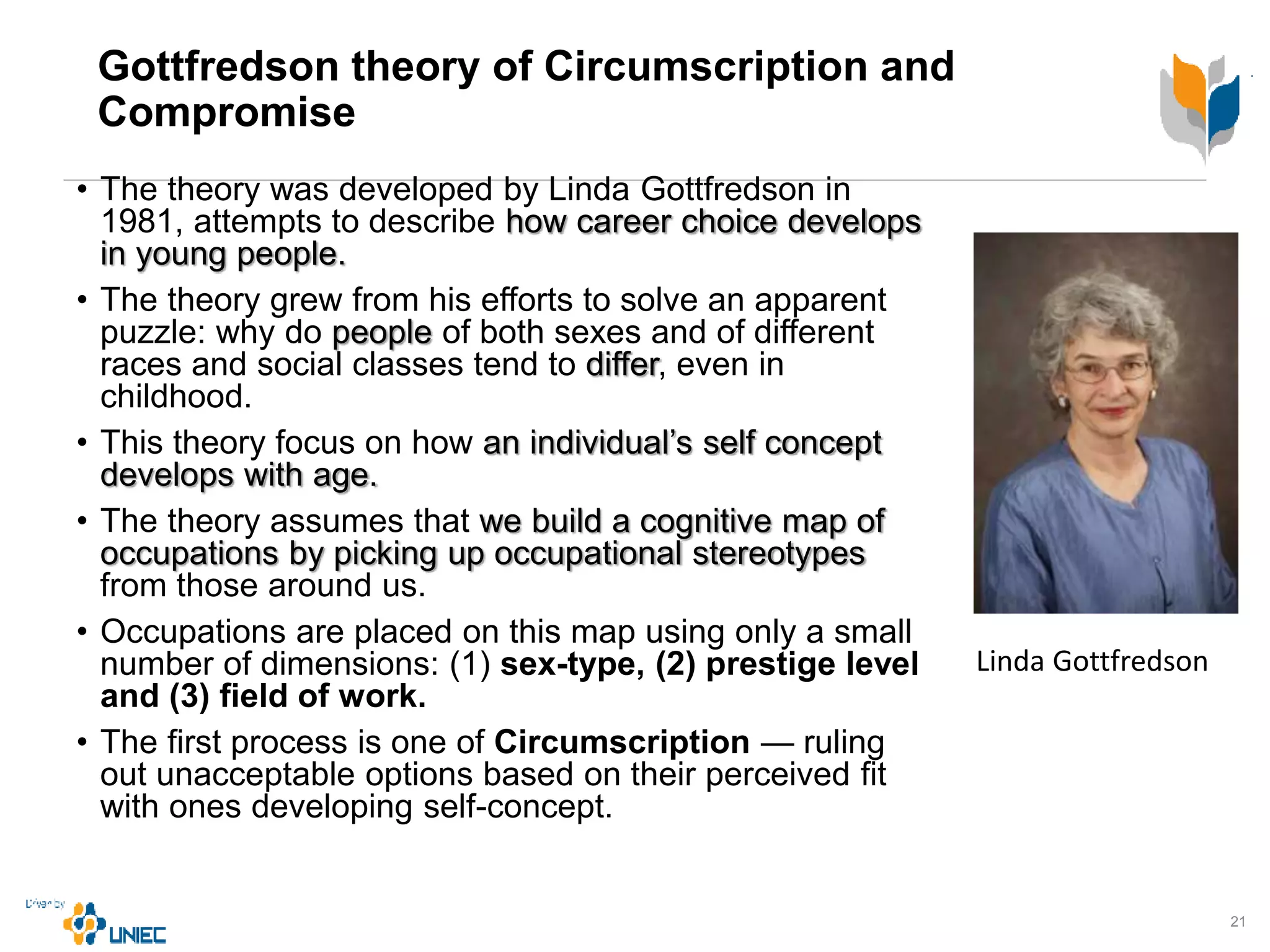
• The theory was developed by Linda Gottfredson in
1981, attempts to describe how career choice develops
in young people.
• The theory grew from his efforts to solve an apparent
puzzle: why do people of both sexes and of different
races and social classes tend to differ, even in
childhood.
• This theory focus on how an individual’s self concept
develops with age.
• The theory assumes that we build a cognitive map of
occupations by picking up occupational stereotypes
from those around us.
• Occupations are placed on this map using only a small
number of dimensions: (1) sex-type, (2) prestige level
and (3) field of work.
• The first process is one of Circumscription — ruling
out unacceptable options based on their perceived fit
with ones developing self-concept.
21
Linda Gottfredson
Gottfredson’s Theory of Circumscription and
Compromise
• Concerned with how career aspiration develop.
• Assumptions
• Career development begins in childhood
• Career aspirations are attempts to build self-concepts
• Career satisfaction is dependent on the degree to which the career is congruent with
self-perceptions
• People develop occupational stereotypes that guide them in the selection process.
Gottfredson’s Theory of Circumscription and
Compromise
She believes that people develop cognitive maps
of occupations that are organized along the
following dimensions.
a. Masculinity/Femininity of the occupation.
b. The prestige of the occupation.
c. Fields of work
* As children grow, and develop perceptions of
themselves, they begin to narrow or circumscribe
their range of occupations based on their
estimates of compatibility (sex-type, prestige and
interest).
Stages of Circumscription
1. Orientation to size and power (age 3–5). Children become aware that adults
have roles in the world. They realise that they will eventually become adults and
take on roles for themselves.
2. Orientation to sex roles (age 6–8). Children begin to categorise the world around
them with simple concrete distinctions. They become aware of the more
recognisable job roles and begin to assign them to particular sexes. They will start
to see jobs which do not match their gender identity as unacceptable.
3. Orientation to social values (age 9–13). By now children have encountered a
wider range of job roles and are capable of more abstract distinctions. They begin
to classify jobs in terms of social status (income, education level, lifestyle, etc.) as
well as sex-type. Based on the social environment in which they develop they will
begin to designate some jobs as unacceptable because they fall below a minimum
status level (tolerable level boundary) and some higher status jobs as unacceptable
because they represent too much effort or risk of failure (tolerable effort boundary).
4. Orientation to internal, unique self (age 14+). Until this point circumscription has
been mainly an unconscious process. As entry into the adult world approaches
young people engage in a conscious search of the roles still remaining in their
social space. In this process they use increasingly complex concepts such as
interests, abilities values, work-life balance and personality to exclude options
which do not fit with their self image and identify an appropriate field of work.
24
Gottfredson theory of Circumscription and
Compromise
• After circumscription has excluded options outside a perceived
social and personal space, the next process is one of
Compromise.
• In this stage, individuals may be inclined to sacrifice roles they see
as more compatible with their self-concept in favour of those that
are perceived to be more easily accessible.
• In this they are often limited by their lack of knowledge about how
to access certain roles because of lack of information, lack of
know-how and appropriate tactics, and lack of helpful social
connections.
25
4. Learning and Cognitive Theories
• The L & C theories approach focus on the impact of cognition and
the effects of learning on the career choice of development
process.
• Two L & C theories present:
• (1)Krumboltz’s theory,
• (2) social cognitive career theory and,
• (3)cognitive information processing approach.
26
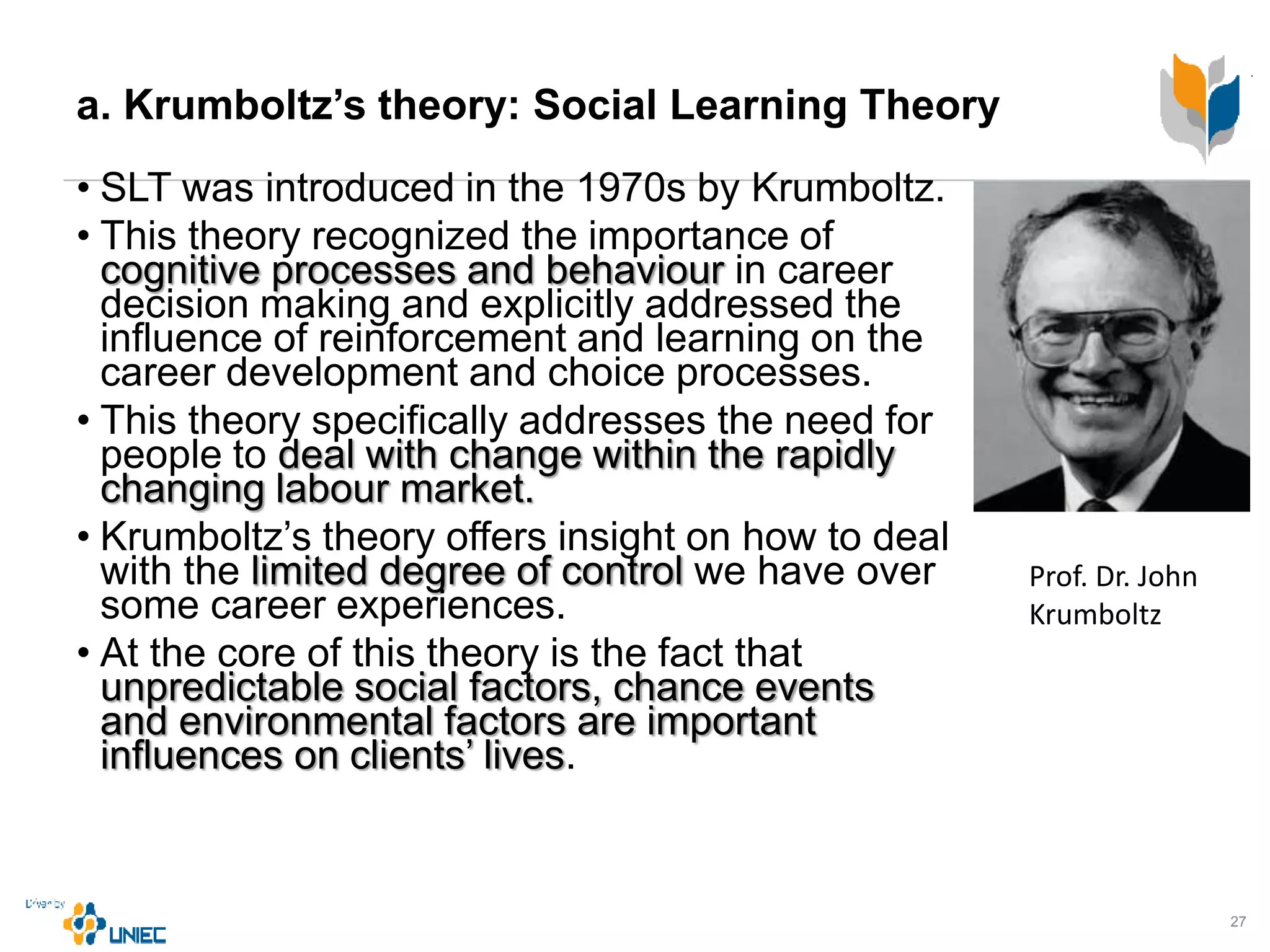
a. Krumboltz’s theory: Social Learning Theory
• SLT was introduced in the 1970s by Krumboltz.
• This theory recognized the importance of
cognitive processes and behaviour in career
decision making and explicitly addressed the
influence of reinforcement and learning on the
career development and choice processes.
• This theory specifically addresses the need for
people to deal with change within the rapidly
changing labour market.
• Krumboltz’s theory offers insight on how to deal
with the limited degree of control we have over
some career experiences.
• At the core of this theory is the fact that
unpredictable social factors, chance events
and environmental factors are important
influences on clients’ lives.
27
Prof. Dr. John
Krumboltz
Krumboltz’ Social Learning Theory,
cont.
• Four Factors that influence career decision
making;
1. Genetic endowment and special abilities
2. Environmental conditions and events.
3. Learning experiences
4. Task approach skills
*Individual is born into this world with certain genetic
characteristics. As time goes one changes happen
and career changes may happen tool.
Krumboltz’s theory, cont.
• Krumboltz states that people with these qualities are more likely
to capitalise on chance events and turn serendipity into
opportunity.
• Factors in career management, including:
the commitment to ongoing learning and skill development
ongoing self-assessment
assessment and feedback from others
effective networking
achieving work-life balance
financial planning to incorporate periods of unemployment.
29
Krumboltz’s theory, cont.
•The counsellor foster in their client:
curiosity to explore learning opportunities
persistence to deal with obstacles
flexibility to address a variety of
circumstances and events
optimism to maximise benefits from
unplanned events.
30
b. Social Cognitive Career Theory
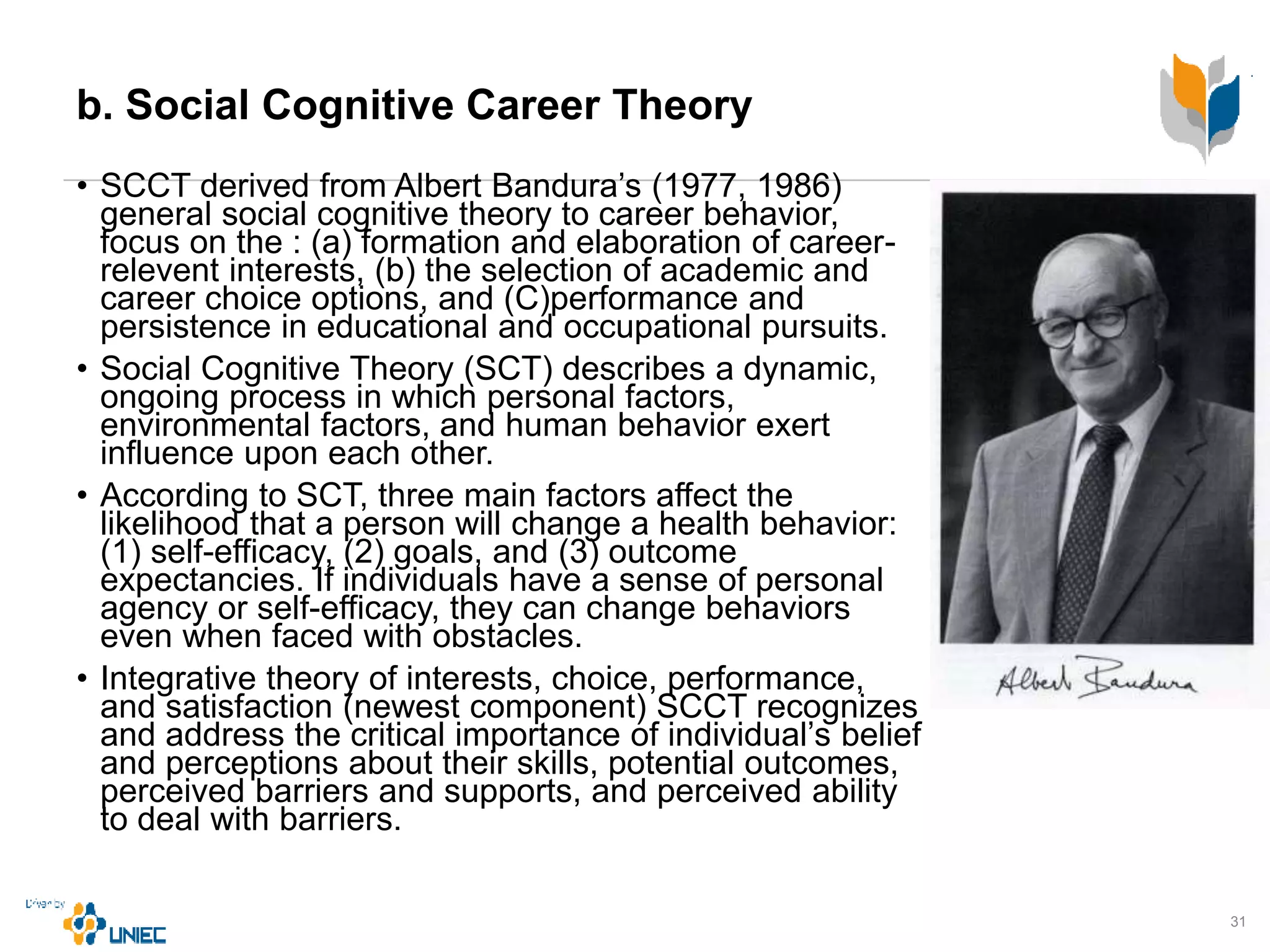
• SCCT derived from Albert Bandura’s (1977, 1986)
general social cognitive theory to career behavior,
focus on the : (a) formation and elaboration of career-
relevent interests, (b) the selection of academic and
career choice options, and (C)performance and
persistence in educational and occupational pursuits.
• Social Cognitive Theory (SCT) describes a dynamic,
ongoing process in which personal factors,
environmental factors, and human behavior exert
influence upon each other.
• According to SCT, three main factors affect the
likelihood that a person will change a health behavior:
(1) self-efficacy, (2) goals, and (3) outcome
expectancies. If individuals have a sense of personal
agency or self-efficacy, they can change behaviors
even when faced with obstacles.
• Integrative theory of interests, choice, performance,
and satisfaction (newest component) SCCT recognizes
and address the critical importance of individual’s belief
and perceptions about their skills, potential outcomes,
perceived barriers and supports, and perceived ability
to deal with barriers.
31
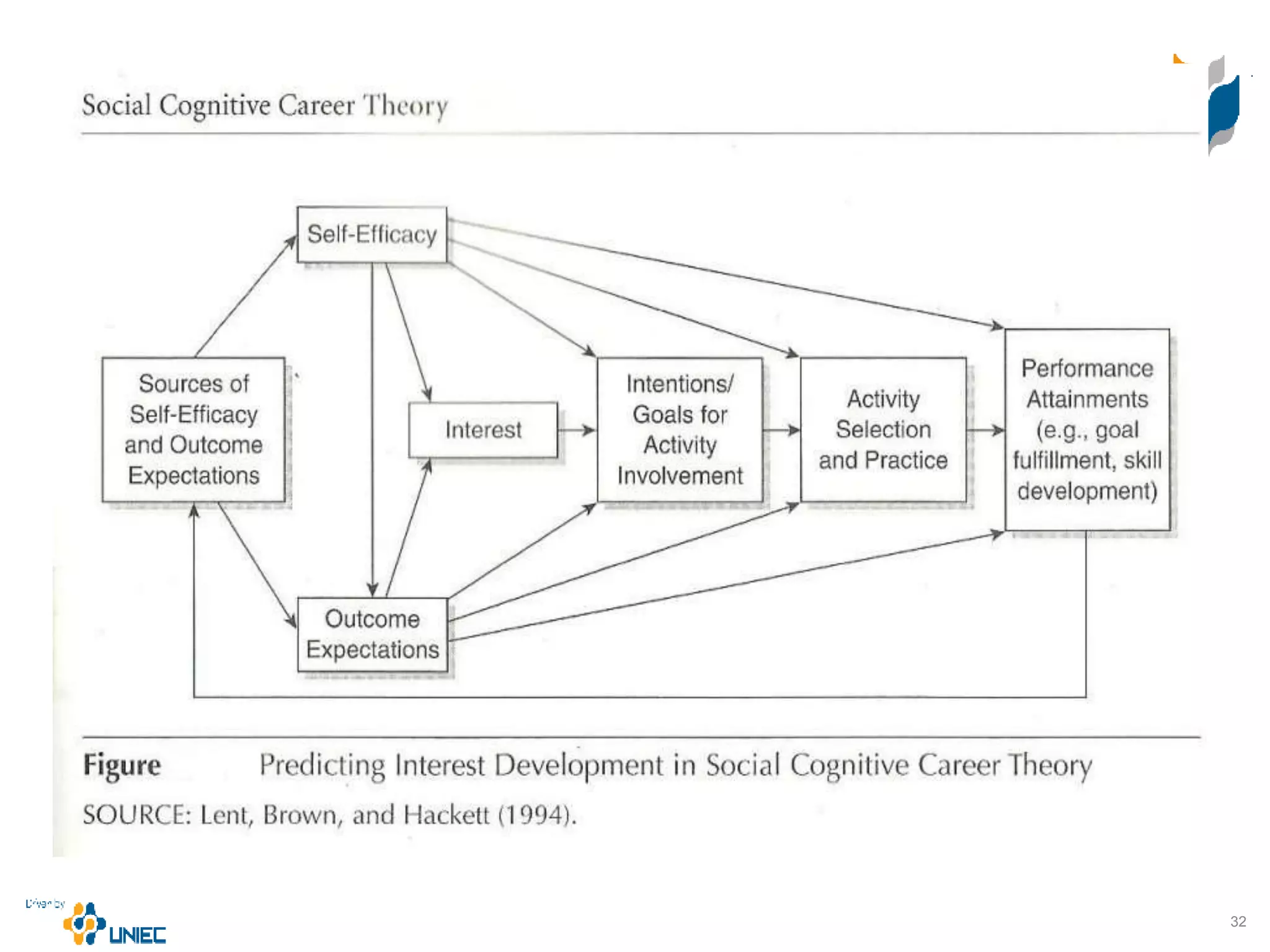
32
b. Social Cognitive Career Theory
Social cognitive career theory (SCCT) (Lent, Brown,
& Hackett, 1994, 1996) is concerned with two
primary aspects of academic performance: the level
of achieved success or proficiency and the degree of
persistance despite encountering obstacles.
SCCT assumes that complicated task performance
requires possession of requisite mastery skills and
works in tangent with a sense of personal efficacy
that enables the translation of skills into productive
performances.
SCCT proposes that the self-efficacy belief system
is impacted by past performance (as reflected by
achievement or ability indicators) therefore directly
or indirectly affecting performance. Past
performance, self-efficacy, outcome expectations,
and goals combine to influence performance.
33
5. Theories of Embedded Career
•Theories of “embedded career” include
(1)conceptualism,
(2)the ecological approach,
(3)sociological theories and additional
theories that are similar in their focus on
context or system.
34
a. Contextualism
• Contextual approaches to career theory and career counselling
are grounded in constructive approaches, which state that there is
an ongoing, dynamic, and reciprocal interaction between
individuals and their environment.
• The individual’s career development is based in their construction
of personal regarding their actions, their experience and external
events (Zunker, 2002)
• The role of the career counsellor is to explore the meaning the
client have created to facilitate their continued construction of their
career path by projecting their narrative into the future (Savikas,
1995).
• The focus of counselling can be 3 parts: unobservable behaviour,
unobservable internal process and the meaning associated with
the results of action.
35
b. An Ecological Perspective
• The Ecological approach conceptualizes client influenced by their
various environment. This perspective is based on
Bronfenbrenner’s 1979 ecological model to provide a service to
clients from whom the assumptions of more approaches to apply.
• The assumption of many the earlier theories are that roles of
family and of work are separate in the lives of clients, that
individualism is a driving force, that work is central in our client’s
lives, that career development is linear and rational, and that the
opportunity structure is the same for all individuals (Bario &
Shoffner, Cook et al., 2002).
• The counsellor roles: obtaining needed resources, creating healthy
work environments and linking individuals with role models and
mentors.
36
c. Sociological Theories
• CT theory directly address the restrictive or enhancement
influence of institutional factors, the influence of parental social
status on individual capabilities and opportunity and the restrictive
impact of work system dynamics on financial, social and
psychological choice and satisfaction (Hotchkiss & Borrow, 1990).
37
6. Psychodynamic Approaches
• Psychodynamic theory of career development (CD) focus on
issues of ego identity, life scripts, and life themes form the
extensions of the theories Alfred Adler and Erik Erikson.
• The theory focus on the role of affect in CD, the role of the family
of origin in shaping CD and career identity (CI), the interaction
between CI and identity development, and work identity.
• These approches are based on internal structures of motivation
and the constructs of identity, lifestyle, the self, and family systems
(Bordin, 1990,1994)
38
Psychodynamic Approaches
• "psychodynamic" refers to "the interaction of various conscious
and unconscious mental or emotional processes, especially as
they influence personality, behaviour, and attitudes“.
• in psychodynamic psychotherapy, a key part of the process is to
help patients and clients gain insight into these conflicts; when the
conflicts are made available to the conscious, the patient/client will
experience a "catharsis“-supposedly, the awareness of these
conflicts will lessen the likelihood that the client/patient will, for
instance, continue to employ the various defense mechanisms
which are leading to emotional "disturbance"
39
7. Ann Roe - Work Adjustment Theory
• The theory predicts occupational selection based on
individual differences, which are
•biological,
•sociological, and
•psychological
Concentration on the child
• Overprotective
• Parent encourages
dependence in the child and
restricts curiosity and
exploration.
• Overdemanding
• Parent requests perfection
from the child, asking for
excellent performance and
setting high standards of
behavior.
• First born?
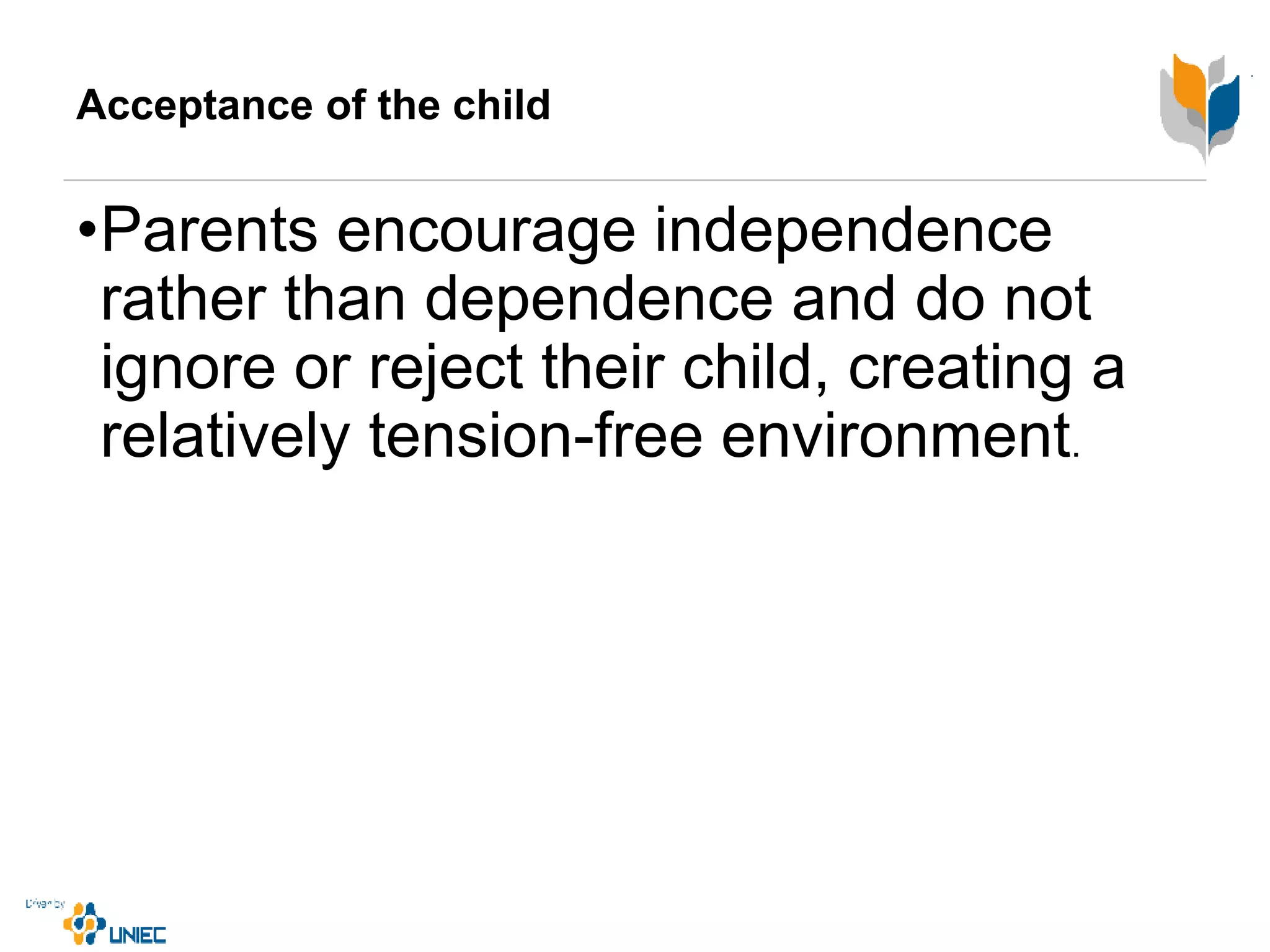
Avoidance of the child
• Rejection
• Parent may be overly critical of
the child or punish the child
excessively.
• Neglect
• Ignores the child for many
reasons, such as parents’
concern with their own
problems, other children, or
work.
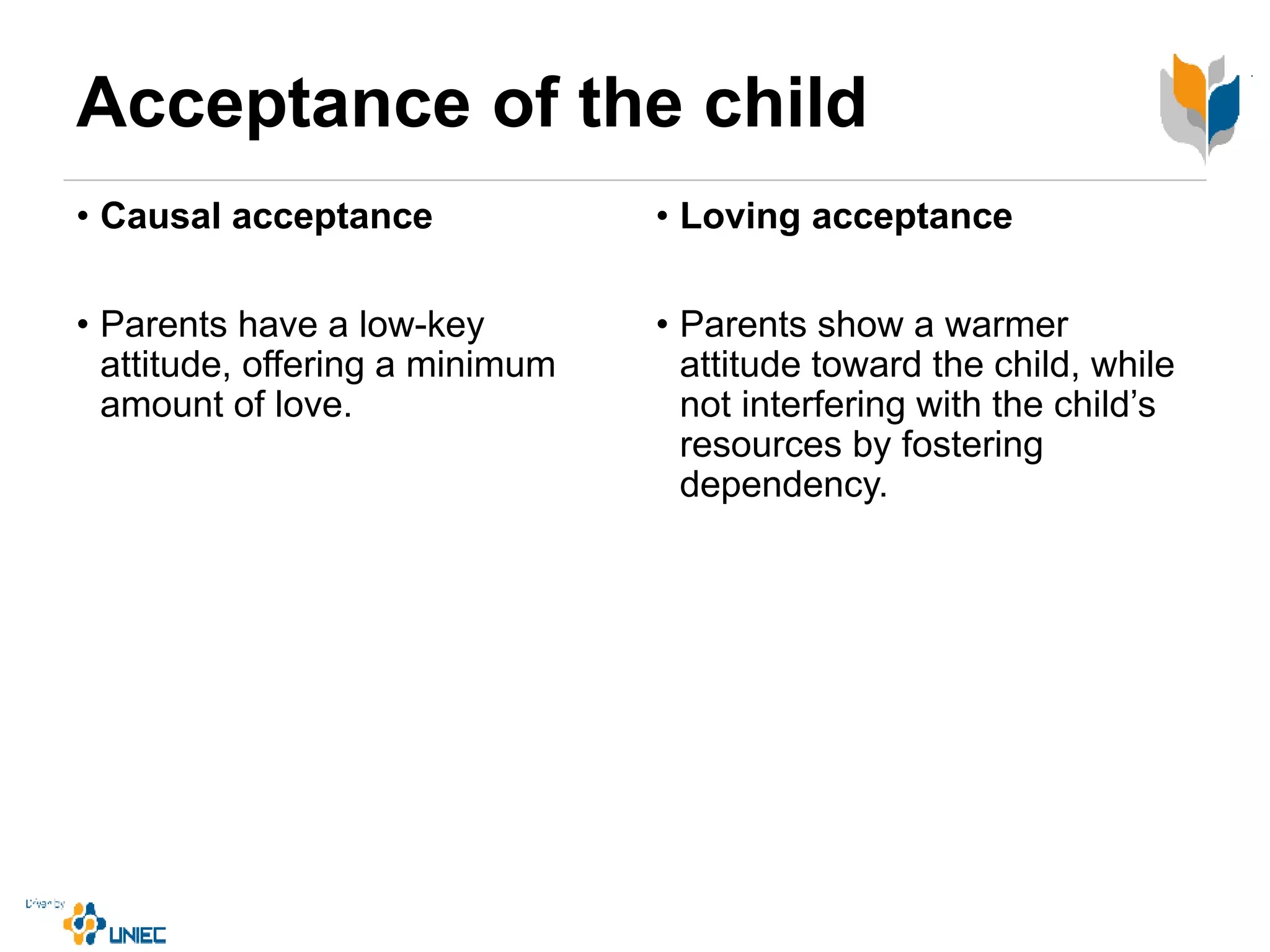
Acceptance of the child
•Parents encourage independence
rather than dependence and do not
ignore or reject their child, creating a
relatively tension-free environment.
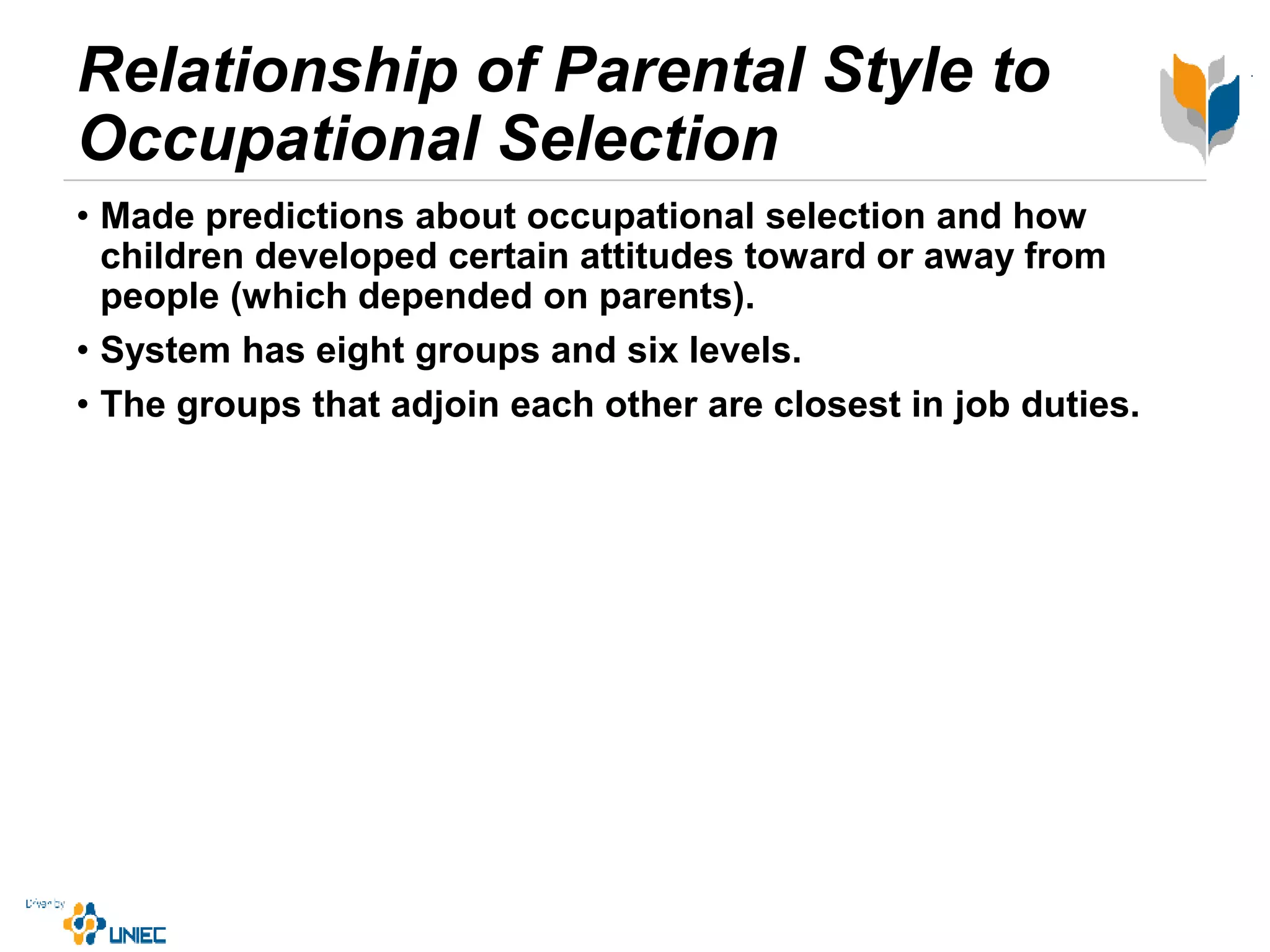
Acceptance of the child
• Causal acceptance
• Parents have a low-key
attitude, offering a minimum
amount of love.
• Loving acceptance
• Parents show a warmer
attitude toward the child, while
not interfering with the child’s
resources by fostering
dependency.
Relationship of Parental Style to
Occupational Selection
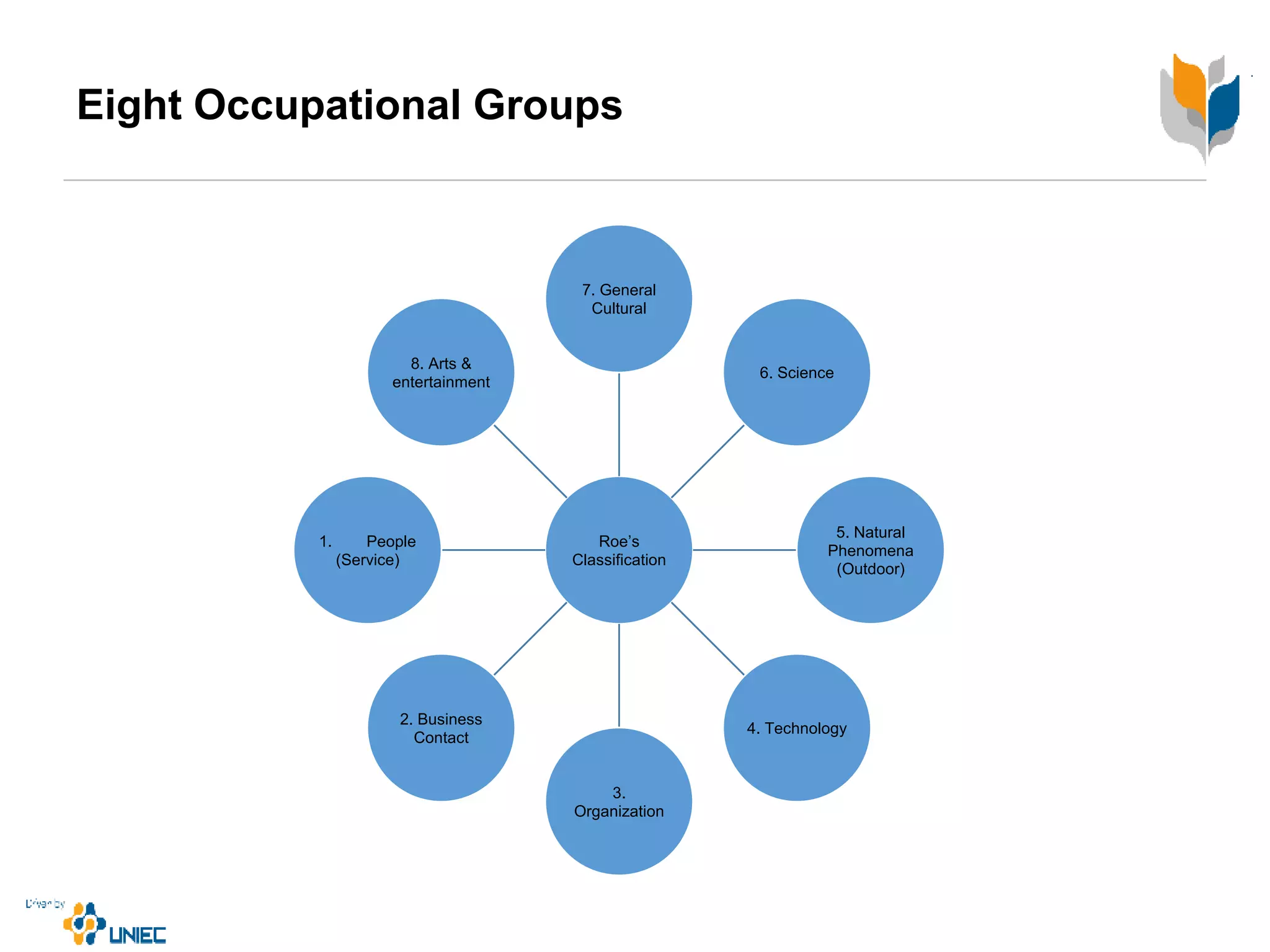
• Made predictions about occupational selection and how
children developed certain attitudes toward or away from
people (which depended on parents).
• System has eight groups and six levels.
• The groups that adjoin each other are closest in job duties.
Eight Occupational Groups
•1. Service:
•2. Business contact:
•3. Organization:
•4. Technology:
•5. Outdoor:
•6. Science:
•7. General Cultural:
•8. Arts and Entertainment:
Eight Occupational Groups
Roe’s
Classification
7. General
Cultural
6. Science
5. Natural
Phenomena
(Outdoor)
4. Technology
3.
Organization
2. Business
Contact
1. People
(Service)
8. Arts &
entertainment
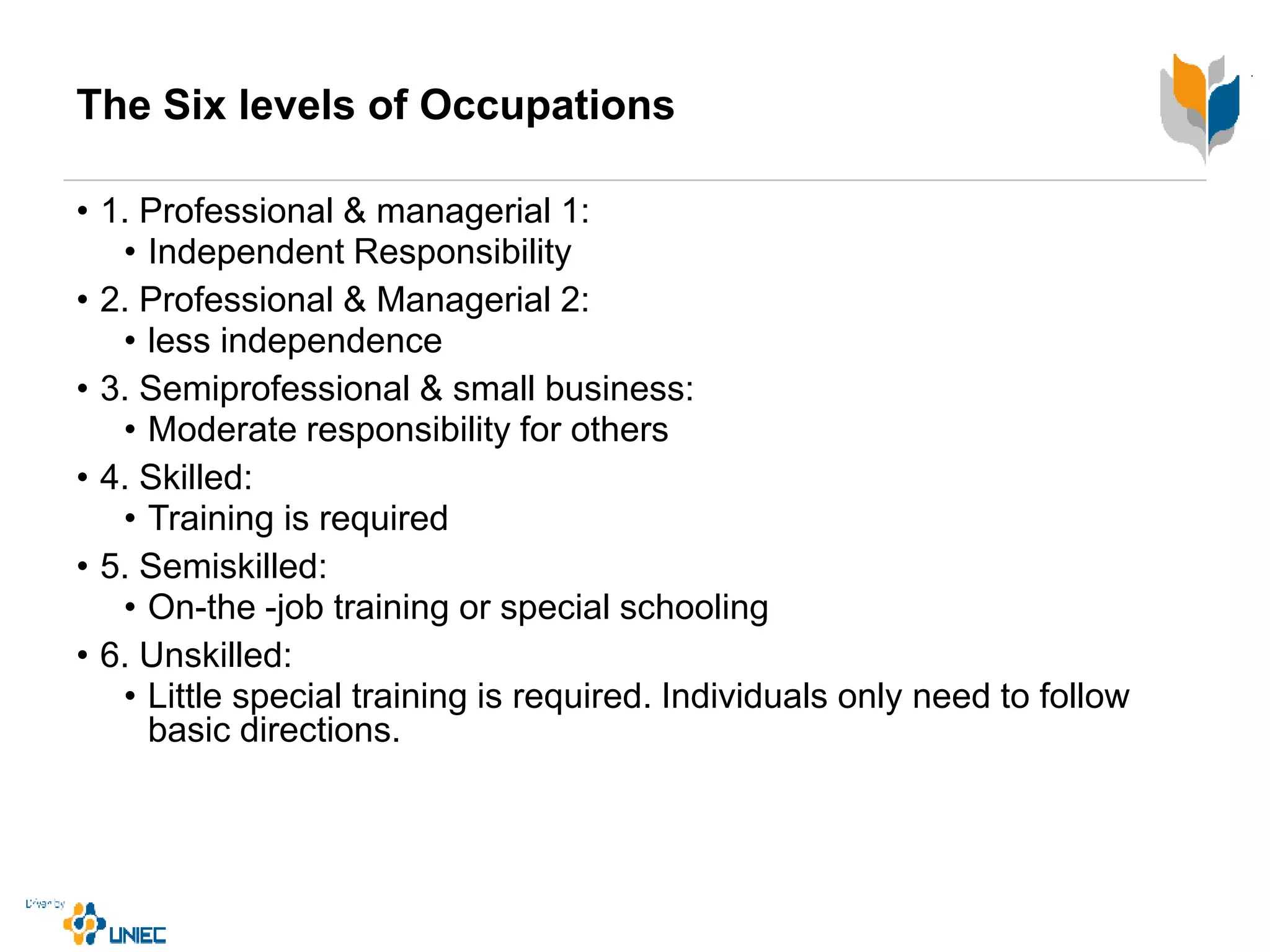
The Six levels of Occupations
• 1. Professional & managerial 1:
• Independent Responsibility
• 2. Professional & Managerial 2:
• less independence
• 3. Semiprofessional & small business:
• Moderate responsibility for others
• 4. Skilled:
• Training is required
• 5. Semiskilled:
• On-the -job training or special schooling
• 6. Unskilled:
• Little special training is required. Individuals only need to follow
basic directions.
Summary
• The counsellor use theories to help them reduce or manage
uncertainty and make more responsible decisions.
• Career development theories provide a set of assumptions about
vocational development. Theories provide models to sort out the
various factors involved in career development.
• The theories help us to understand the process and offer a framework
in which to organize activities that will facilitate insight and growth
within the client. These theories give us a foundation for organizing
information about the client to use in formulating appropriate goals.
• In summary, career development theory helps to:
• make sense of what we experience and learn;
• bridge gaps between knowledge and the unknown;
• summarize information;
• explain information;
• make predictions;
• point out relations between means and ends;
• formulate goals; and,
• "stimulate research aimed at improving the knowledge and skill bases for
career counseling" (Shertzer and Stone, as cited in ICDM, 1991, p. 4-3).
49
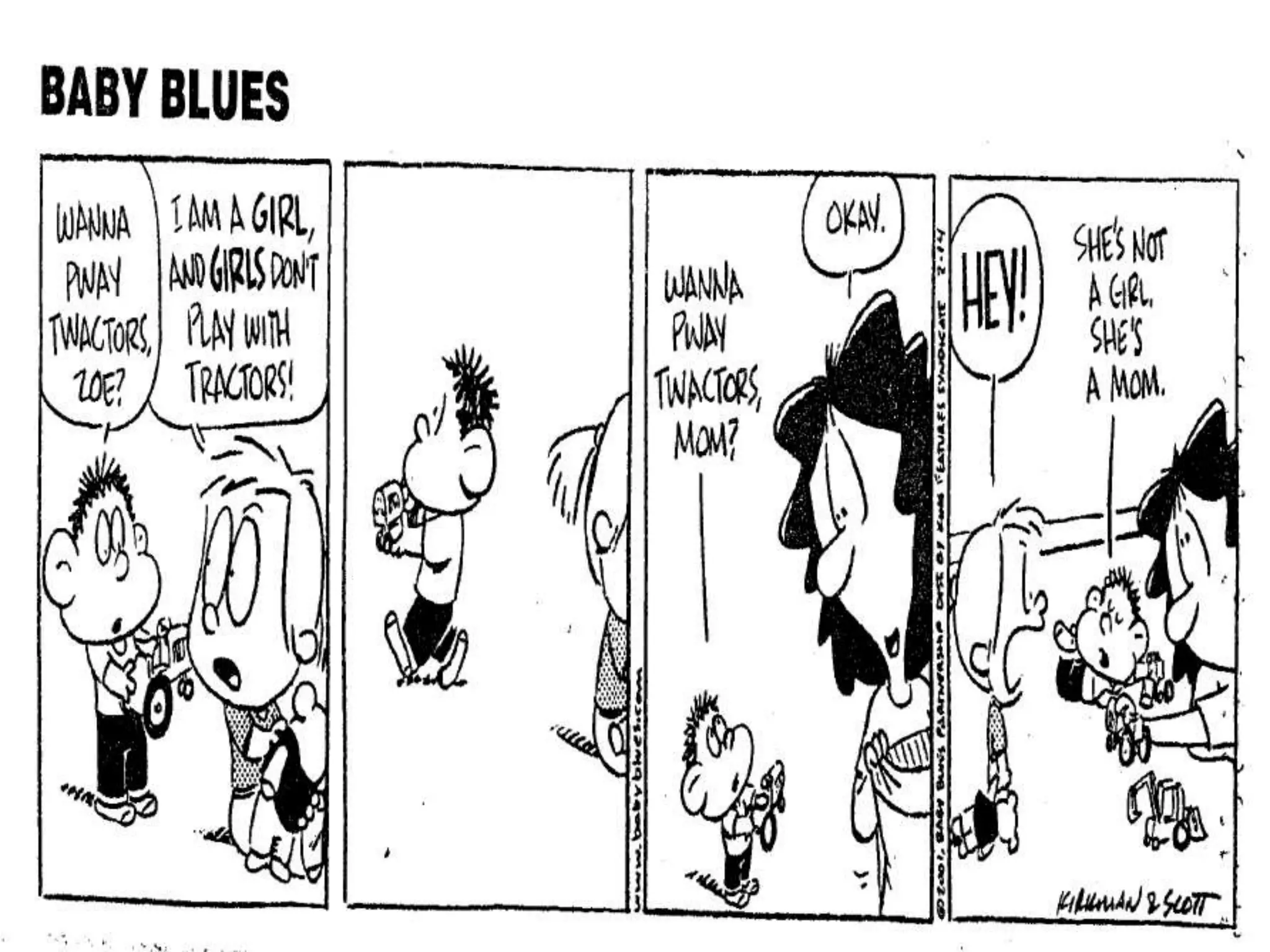
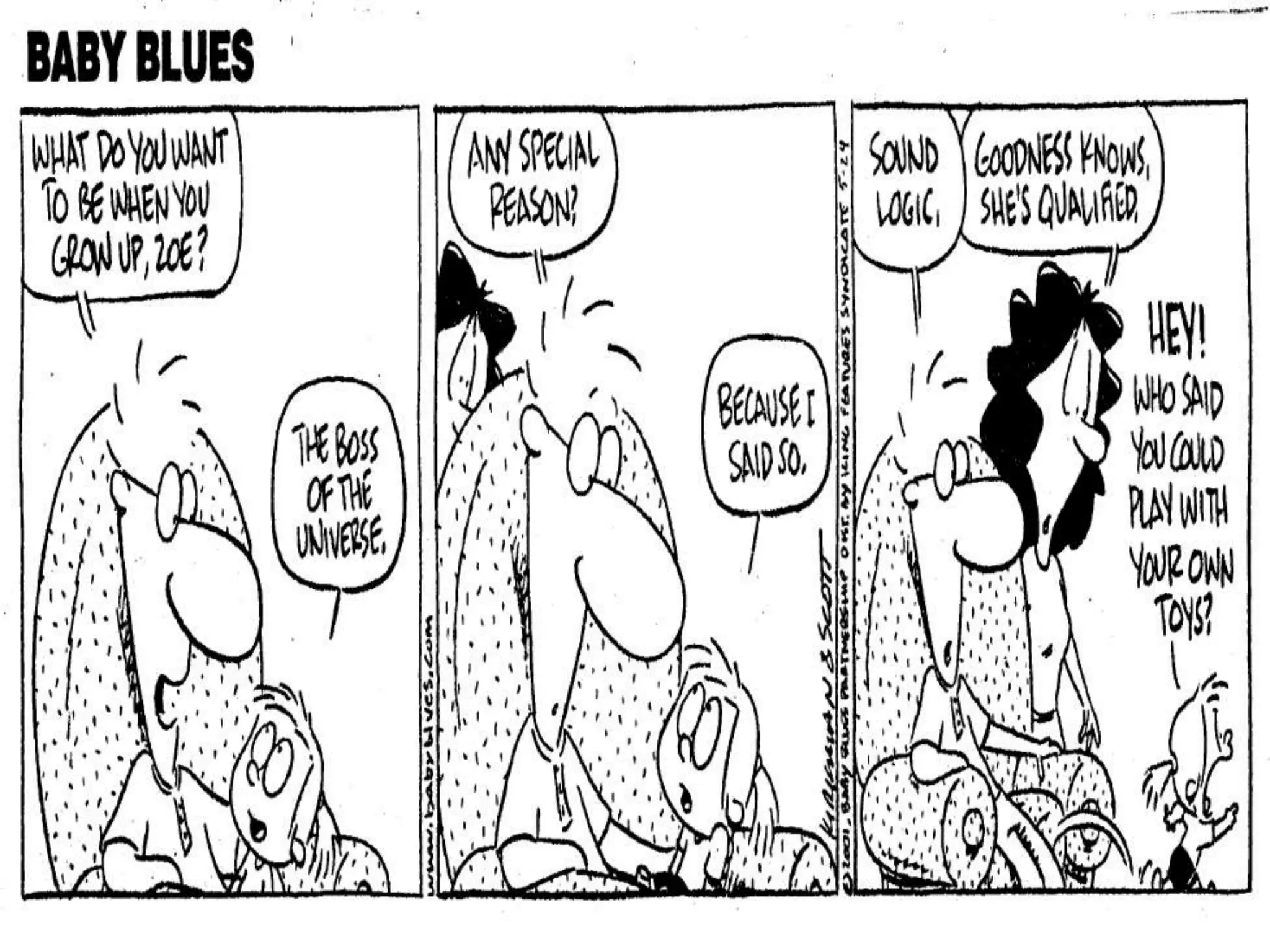
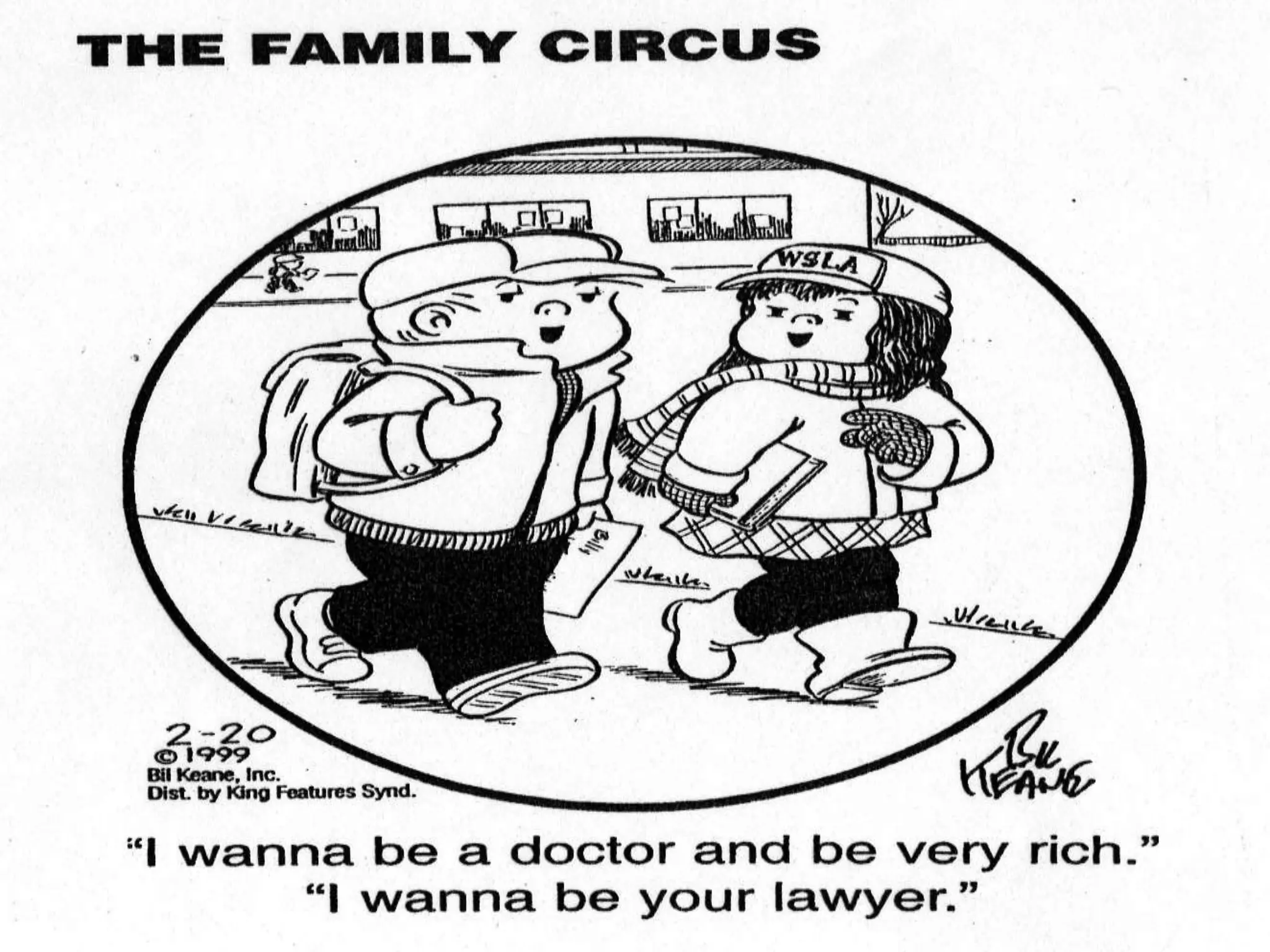
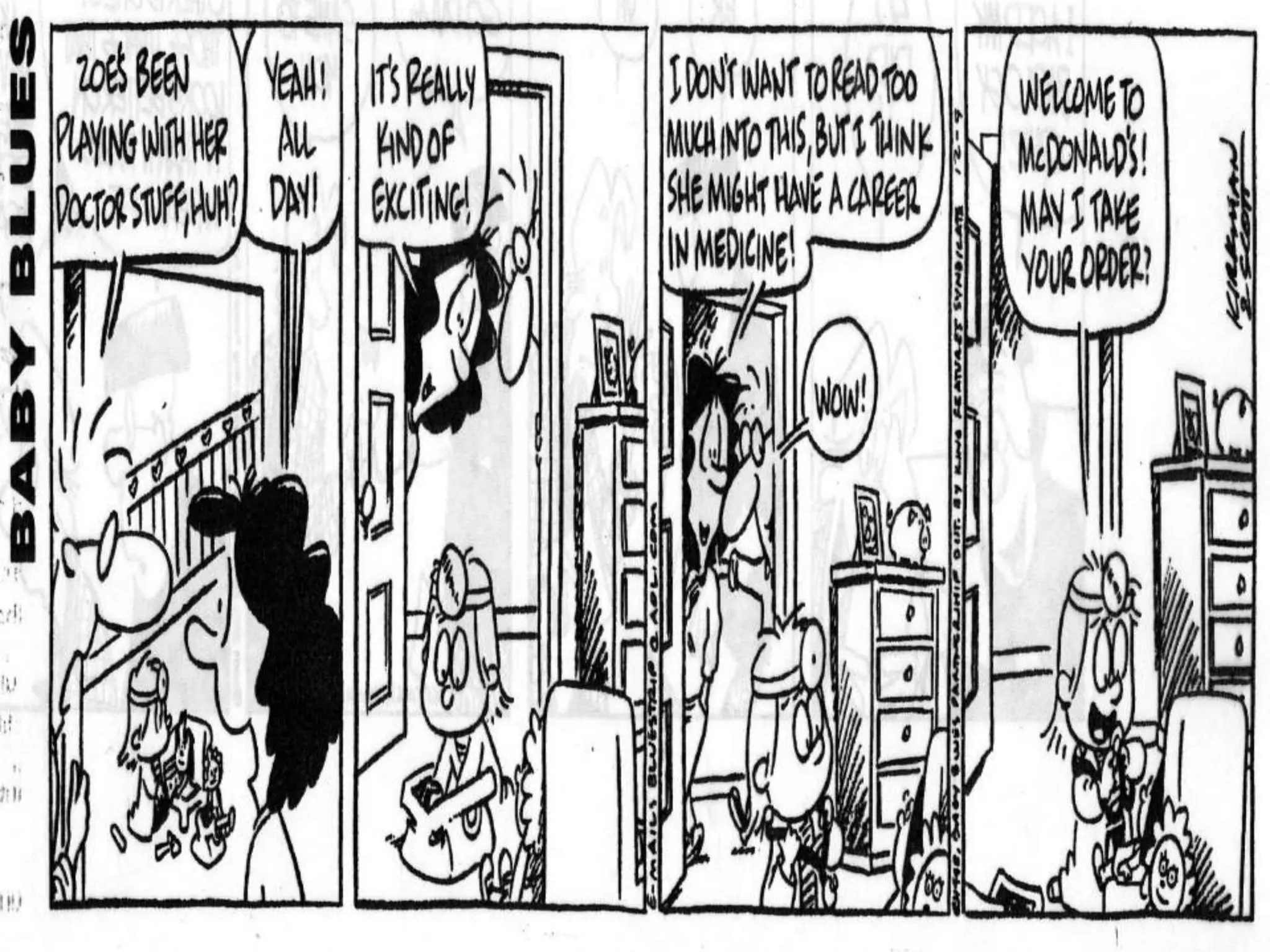
Cartoons : Stages of
Career Development
50
51
52
53
54
Child’s lack of concern with prestige
End of Chapter 2
55
Discussion Questions
1. How theory helps you do your work?
2. Why application of theories is important for us to choose our
career?
3. List six (6) Holland personality type.
4. Explain five (5) limitations of career theory.
5. List and explain five(5) stages of Super’s career development .
6. Explain how career choice develop young children in among
young people in Gottfredson theory?
7. What leads or causes people to choose the occupations or jobs
that they do?
8. Describe the work adjustment theory process by Anne Roe?
56
Class Activity 1
Write 100 words report that is your personal theory
of career development, from the perspective of
examining and explaining your own life.
57
Class Activity 2
Create a chart or table on each theories you have
studied in this lesson. Note for each theorist:
• Main ideas
• Key characteristics
• Problems with the theory (from your perspective)
58

Chapter 2. Theories of career Development Choice.pptx

  • 1.
  • 2.
    LEARNING OUTCOMES • Afterstudying this chapter, you should be able to: 1. Identify the different types of career development theories. 2. Describe the main six career development theories. 3. Discuss the appropriate theory to apply for individual career choice. 4. Discuss the appropriate theory to apply for individual career development. 2
  • 3.
    CONTENT • Overview ofCareer Development Theory • The Big Seven (7) Career Theories 1. Trait and Factor Approaches 2. Holland’s Theory of Personality Types 3. Development Theories: - Donald Super’s Theory Vocational Development - Gottfredson: Theory of Circumscription and Compromise 4. Learning and Cognitive Theories - Social Learning Theory - Social Cognitive Career Theory 5. Theories of Embedded Career 6. Psychodynamic Approaches 7. Anne Roe-Work Adjustment Theory 3
  • 4.
  • 5.
    What is Theory? •A theory presents a systematic way of understanding events or situations. • It is a set of concepts, definitions, and propositions that explain or predict these events or situations by illustrating the relationships between variables. • Theories must be applicable to a broad variety of situations. 5
  • 6.
    What Good isa Theory? • A useful theory provide a framework for understanding complex phenomena; a career theory is a way of summarizing what we see and what we know by constructing explanations for career development and behaviour (Marie F. Shoffner, University of Virginia, 2006). • A theory is “an attempt to represent some aspect of behaviour, much in the same way that a map is an attempt to represent some geography territory (John Krumboltz, 1999). • A good theory is a simplifies representation of some domain constructed so that users can ask questions about that domain with an increased probabilility of receiving valuable answers (John Krumboltz, 1994). 6
  • 7.
    The Big Seven(7) Career Development Theory 7
  • 8.
    The Big Seven(7) Career Development Theory 1. Trait and Factor Approaches 2. Holland’s Theory of Personality Types 3. Development Theories: - Donald Super’s Theory Vocational Development - Gottfredson: Theory of Circumstances and Compromise 4. Learning and Cognitive Theories - Social Learning Theory - Social Cognitive Career Theory 5. Theories of Embedded Career 6. Psychodynamic Approaches 7. Anne Roe-Work Adjustment Theory 8
  • 9.
    1. Trait andFactor Approaches • Developed by Frank Parsons in 1909 helping young people to become successfully employed. • This theory matching individuals to work environments so that they will be successful in and satisfied with their work. • Every person has a unique pattern of traits made up of their interests, values, abilities and personality characteristics, these traits can be objectively identified and profiled to represent an individual’s potential. • It is possible to identify a fit or match between individual traits and job factors using a straight forward problem- solving/decision making process. The closer the match between personal traits and job factors the greater the likelihood for successful job performance and satisfaction. 9 Frank Parson, (1854– 1908) is known as the Father of Vocational Guidance
  • 10.
    Trait and FactorApproaches, cont. • Parsons developed a framework to help individuals decide on a career. This framework contained a three part formulation. 1. A clear understanding of yourself, aptitudes, abilities, interests, resources, limitations, and other qualities 2. A knowledge of the requirements and conditions of success, advantages and disadvantages, compensations, opportunities, and prospects in different lines of work 3. True reasoning of the relations of these two groups of facts. • According to Parsons, ideal career choices are based on matching personal traits (aptitude, abilities, resources, personality) with job factors (wages, environment, etc.) to produce the best conditions of vocational success. 10 Parsons, 1909, p. 5, as cited in Zunker, 2002)
  • 11.
    Parsons’ Trait andFactor Theory 11 Knowledge of the Individual Knowledge of the Job Match Job and Individual
  • 12.
    Trait and FactorApproaches, cont. • Basic Principles • Know oneself: aptitudes, abilities, interests, limitations • Know the job market • Apply “true reasoning” when matching oneself to an occupation • The counselor provides information about client’s personality characteristics and what occupations would be a nice fit for the client based upon these characteristics • Parsons states that occupational decision making occurs when people have achieved: • an accurate understanding of their individual traits (aptitudes, interests, personal abilities) • a knowledge of jobs and the labour market • rational and objective judgment about the relationship between their individual traits, and the labour market. 12
  • 13.
    2. Holland’s Theoryof Personality Types •The theory developed in 1959 emphasized the “searching” aspects of person- environment fit: “The person making a vocational choice in a sense searches for situations which satisfy his hierarchy of adjustive orientations” (Holland, 1959, p. 35). “Persons with more information about occupational environments make more adequate choices than do persons with less information” (pp. 40–41). 13
  • 14.
    Holland’s Theory ofPersonality Types, cont. • Holland present his theory of career choice underlying premise was that individuals choose situations and environments that satisfy their personality orientation. • Holland’s theoretical view of career choice , occupations are not merely set of work skills, but instead represent a “way of life”. • The focus of Holland theory: why career choice occurs and the outcome of that choice, rather than on how or why personality orientations develop. • Personal interests are a manifestation of one’s personality and one’s personality leads one seek satisfaction in work that “fits” in. 14
  • 15.
    Holland’s Theory ofPersonality Types • 6 Modal Personality Types : 1. Realistic 2. Investigative 3. Artistic 4. Social 5. Enterprising 6. Conventional • These 6 basic modal personal orientations based on the belief that people will enter, and stay in, work that is similar to (or congruent) with their personality types. 15
  • 16.
    3. Development Theories •Development theories provide a framework for understanding the unfolding process of career and career choice over the life-span. • Two development theories: (1) Donald Super’s Theory Vocational Development and, (2) Linda Gottfredson’s theory of circumscription and compromise. 16
  • 17.
    Theory of VocationalDevelopment • Donald Super published works in the mid 1950. • Super believed that both learning and decision making are career development processes (Savickas, 1997b, p. 252). • Built on 14 assumptions • According to Super, career development is lifelong. A self-concept changes over time, and develops as a result of experience. • At first, Super called his approach “career development theory.” As time passed, he changed the name to “developmental self-concept theory” and, finally, to “life-span, life-space theory.” • Super added the concepts of career maturity, career adaptability, and life stages as part of this first attempt to formulate a theory of career development. 17
  • 18.
    • "...Vocational self-conceptdevelops through physical and mental growth, observations of work, identification with working adults, general environment, and general experiences. . . . As experiences become broader in relation to awareness of world of work, the more sophisticated vocational self-concept is formed" (Zunker, 1994, p. 30). 18
  • 19.
    Theory of VocationalDevelopment • Super describe his theory as a differential-development-social phenomenological approach. • In his propositions, he posited a strong relationship between individual’s personal growth and his or her career development. • This theory focus on the development of vocational behaviour and the relationship of this unfolding process to various roles. • Super assumed that an individual’s career choice was not merely the results of matching his or her abilities and interest to the world of work, but an expression of his or her self-concepts. • Thus, people are satisfied to the degree that they “implement self-concept” through their work choice, thereby connecting with the personal meaning of their abilities, interests, values and choices (Super et. al., 1996) 19
  • 20.
    Super’s five lifeand career development stages 20 Stage 1: Growth: Age 0–14 Characteristics: Development of self-concept, attitudes, needs and general world of work Stage 2: Exploration: Age 15–24 Characteristics: “Trying out” through classes, work experience, hobbies. Tentative choice and skill development Stage 3: Establishment: Age 25–44 Characteristics: Entry-level skill building and stabilisation through work experience Stage 4: Maintenance: Age 45-64 Characteristics: Continual adjustment process to improve position Stage 5: Decline: Age 65+ Characteristics: Reduced output, prepare for retirement
  • 21.
    Gottfredson theory ofCircumscription and Compromise • The theory was developed by Linda Gottfredson in 1981, attempts to describe how career choice develops in young people. • The theory grew from his efforts to solve an apparent puzzle: why do people of both sexes and of different races and social classes tend to differ, even in childhood. • This theory focus on how an individual’s self concept develops with age. • The theory assumes that we build a cognitive map of occupations by picking up occupational stereotypes from those around us. • Occupations are placed on this map using only a small number of dimensions: (1) sex-type, (2) prestige level and (3) field of work. • The first process is one of Circumscription — ruling out unacceptable options based on their perceived fit with ones developing self-concept. 21 Linda Gottfredson
  • 22.
    Gottfredson’s Theory ofCircumscription and Compromise • Concerned with how career aspiration develop. • Assumptions • Career development begins in childhood • Career aspirations are attempts to build self-concepts • Career satisfaction is dependent on the degree to which the career is congruent with self-perceptions • People develop occupational stereotypes that guide them in the selection process.
  • 23.
    Gottfredson’s Theory ofCircumscription and Compromise She believes that people develop cognitive maps of occupations that are organized along the following dimensions. a. Masculinity/Femininity of the occupation. b. The prestige of the occupation. c. Fields of work * As children grow, and develop perceptions of themselves, they begin to narrow or circumscribe their range of occupations based on their estimates of compatibility (sex-type, prestige and interest).
  • 24.
    Stages of Circumscription 1.Orientation to size and power (age 3–5). Children become aware that adults have roles in the world. They realise that they will eventually become adults and take on roles for themselves. 2. Orientation to sex roles (age 6–8). Children begin to categorise the world around them with simple concrete distinctions. They become aware of the more recognisable job roles and begin to assign them to particular sexes. They will start to see jobs which do not match their gender identity as unacceptable. 3. Orientation to social values (age 9–13). By now children have encountered a wider range of job roles and are capable of more abstract distinctions. They begin to classify jobs in terms of social status (income, education level, lifestyle, etc.) as well as sex-type. Based on the social environment in which they develop they will begin to designate some jobs as unacceptable because they fall below a minimum status level (tolerable level boundary) and some higher status jobs as unacceptable because they represent too much effort or risk of failure (tolerable effort boundary). 4. Orientation to internal, unique self (age 14+). Until this point circumscription has been mainly an unconscious process. As entry into the adult world approaches young people engage in a conscious search of the roles still remaining in their social space. In this process they use increasingly complex concepts such as interests, abilities values, work-life balance and personality to exclude options which do not fit with their self image and identify an appropriate field of work. 24
  • 25.
    Gottfredson theory ofCircumscription and Compromise • After circumscription has excluded options outside a perceived social and personal space, the next process is one of Compromise. • In this stage, individuals may be inclined to sacrifice roles they see as more compatible with their self-concept in favour of those that are perceived to be more easily accessible. • In this they are often limited by their lack of knowledge about how to access certain roles because of lack of information, lack of know-how and appropriate tactics, and lack of helpful social connections. 25
  • 26.
    4. Learning andCognitive Theories • The L & C theories approach focus on the impact of cognition and the effects of learning on the career choice of development process. • Two L & C theories present: • (1)Krumboltz’s theory, • (2) social cognitive career theory and, • (3)cognitive information processing approach. 26
  • 27.
    a. Krumboltz’s theory:Social Learning Theory • SLT was introduced in the 1970s by Krumboltz. • This theory recognized the importance of cognitive processes and behaviour in career decision making and explicitly addressed the influence of reinforcement and learning on the career development and choice processes. • This theory specifically addresses the need for people to deal with change within the rapidly changing labour market. • Krumboltz’s theory offers insight on how to deal with the limited degree of control we have over some career experiences. • At the core of this theory is the fact that unpredictable social factors, chance events and environmental factors are important influences on clients’ lives. 27 Prof. Dr. John Krumboltz
  • 28.
    Krumboltz’ Social LearningTheory, cont. • Four Factors that influence career decision making; 1. Genetic endowment and special abilities 2. Environmental conditions and events. 3. Learning experiences 4. Task approach skills *Individual is born into this world with certain genetic characteristics. As time goes one changes happen and career changes may happen tool.
  • 29.
    Krumboltz’s theory, cont. •Krumboltz states that people with these qualities are more likely to capitalise on chance events and turn serendipity into opportunity. • Factors in career management, including: the commitment to ongoing learning and skill development ongoing self-assessment assessment and feedback from others effective networking achieving work-life balance financial planning to incorporate periods of unemployment. 29
  • 30.
    Krumboltz’s theory, cont. •Thecounsellor foster in their client: curiosity to explore learning opportunities persistence to deal with obstacles flexibility to address a variety of circumstances and events optimism to maximise benefits from unplanned events. 30
  • 31.
    b. Social CognitiveCareer Theory • SCCT derived from Albert Bandura’s (1977, 1986) general social cognitive theory to career behavior, focus on the : (a) formation and elaboration of career- relevent interests, (b) the selection of academic and career choice options, and (C)performance and persistence in educational and occupational pursuits. • Social Cognitive Theory (SCT) describes a dynamic, ongoing process in which personal factors, environmental factors, and human behavior exert influence upon each other. • According to SCT, three main factors affect the likelihood that a person will change a health behavior: (1) self-efficacy, (2) goals, and (3) outcome expectancies. If individuals have a sense of personal agency or self-efficacy, they can change behaviors even when faced with obstacles. • Integrative theory of interests, choice, performance, and satisfaction (newest component) SCCT recognizes and address the critical importance of individual’s belief and perceptions about their skills, potential outcomes, perceived barriers and supports, and perceived ability to deal with barriers. 31
  • 32.
  • 33.
    b. Social CognitiveCareer Theory Social cognitive career theory (SCCT) (Lent, Brown, & Hackett, 1994, 1996) is concerned with two primary aspects of academic performance: the level of achieved success or proficiency and the degree of persistance despite encountering obstacles. SCCT assumes that complicated task performance requires possession of requisite mastery skills and works in tangent with a sense of personal efficacy that enables the translation of skills into productive performances. SCCT proposes that the self-efficacy belief system is impacted by past performance (as reflected by achievement or ability indicators) therefore directly or indirectly affecting performance. Past performance, self-efficacy, outcome expectations, and goals combine to influence performance. 33
  • 34.
    5. Theories ofEmbedded Career •Theories of “embedded career” include (1)conceptualism, (2)the ecological approach, (3)sociological theories and additional theories that are similar in their focus on context or system. 34
  • 35.
    a. Contextualism • Contextualapproaches to career theory and career counselling are grounded in constructive approaches, which state that there is an ongoing, dynamic, and reciprocal interaction between individuals and their environment. • The individual’s career development is based in their construction of personal regarding their actions, their experience and external events (Zunker, 2002) • The role of the career counsellor is to explore the meaning the client have created to facilitate their continued construction of their career path by projecting their narrative into the future (Savikas, 1995). • The focus of counselling can be 3 parts: unobservable behaviour, unobservable internal process and the meaning associated with the results of action. 35
  • 36.
    b. An EcologicalPerspective • The Ecological approach conceptualizes client influenced by their various environment. This perspective is based on Bronfenbrenner’s 1979 ecological model to provide a service to clients from whom the assumptions of more approaches to apply. • The assumption of many the earlier theories are that roles of family and of work are separate in the lives of clients, that individualism is a driving force, that work is central in our client’s lives, that career development is linear and rational, and that the opportunity structure is the same for all individuals (Bario & Shoffner, Cook et al., 2002). • The counsellor roles: obtaining needed resources, creating healthy work environments and linking individuals with role models and mentors. 36
  • 37.
    c. Sociological Theories •CT theory directly address the restrictive or enhancement influence of institutional factors, the influence of parental social status on individual capabilities and opportunity and the restrictive impact of work system dynamics on financial, social and psychological choice and satisfaction (Hotchkiss & Borrow, 1990). 37
  • 38.
    6. Psychodynamic Approaches •Psychodynamic theory of career development (CD) focus on issues of ego identity, life scripts, and life themes form the extensions of the theories Alfred Adler and Erik Erikson. • The theory focus on the role of affect in CD, the role of the family of origin in shaping CD and career identity (CI), the interaction between CI and identity development, and work identity. • These approches are based on internal structures of motivation and the constructs of identity, lifestyle, the self, and family systems (Bordin, 1990,1994) 38
  • 39.
    Psychodynamic Approaches • "psychodynamic"refers to "the interaction of various conscious and unconscious mental or emotional processes, especially as they influence personality, behaviour, and attitudes“. • in psychodynamic psychotherapy, a key part of the process is to help patients and clients gain insight into these conflicts; when the conflicts are made available to the conscious, the patient/client will experience a "catharsis“-supposedly, the awareness of these conflicts will lessen the likelihood that the client/patient will, for instance, continue to employ the various defense mechanisms which are leading to emotional "disturbance" 39
  • 40.
    7. Ann Roe- Work Adjustment Theory • The theory predicts occupational selection based on individual differences, which are •biological, •sociological, and •psychological
  • 41.
    Concentration on thechild • Overprotective • Parent encourages dependence in the child and restricts curiosity and exploration. • Overdemanding • Parent requests perfection from the child, asking for excellent performance and setting high standards of behavior. • First born?
  • 42.
    Avoidance of thechild • Rejection • Parent may be overly critical of the child or punish the child excessively. • Neglect • Ignores the child for many reasons, such as parents’ concern with their own problems, other children, or work.
  • 43.
    Acceptance of thechild •Parents encourage independence rather than dependence and do not ignore or reject their child, creating a relatively tension-free environment.
  • 44.
    Acceptance of thechild • Causal acceptance • Parents have a low-key attitude, offering a minimum amount of love. • Loving acceptance • Parents show a warmer attitude toward the child, while not interfering with the child’s resources by fostering dependency.
  • 45.
    Relationship of ParentalStyle to Occupational Selection • Made predictions about occupational selection and how children developed certain attitudes toward or away from people (which depended on parents). • System has eight groups and six levels. • The groups that adjoin each other are closest in job duties.
  • 46.
    Eight Occupational Groups •1.Service: •2. Business contact: •3. Organization: •4. Technology: •5. Outdoor: •6. Science: •7. General Cultural: •8. Arts and Entertainment:
  • 47.
    Eight Occupational Groups Roe’s Classification 7.General Cultural 6. Science 5. Natural Phenomena (Outdoor) 4. Technology 3. Organization 2. Business Contact 1. People (Service) 8. Arts & entertainment
  • 48.
    The Six levelsof Occupations • 1. Professional & managerial 1: • Independent Responsibility • 2. Professional & Managerial 2: • less independence • 3. Semiprofessional & small business: • Moderate responsibility for others • 4. Skilled: • Training is required • 5. Semiskilled: • On-the -job training or special schooling • 6. Unskilled: • Little special training is required. Individuals only need to follow basic directions.
  • 49.
    Summary • The counselloruse theories to help them reduce or manage uncertainty and make more responsible decisions. • Career development theories provide a set of assumptions about vocational development. Theories provide models to sort out the various factors involved in career development. • The theories help us to understand the process and offer a framework in which to organize activities that will facilitate insight and growth within the client. These theories give us a foundation for organizing information about the client to use in formulating appropriate goals. • In summary, career development theory helps to: • make sense of what we experience and learn; • bridge gaps between knowledge and the unknown; • summarize information; • explain information; • make predictions; • point out relations between means and ends; • formulate goals; and, • "stimulate research aimed at improving the knowledge and skill bases for career counseling" (Shertzer and Stone, as cited in ICDM, 1991, p. 4-3). 49
  • 50.
    Cartoons : Stagesof Career Development 50
  • 51.
  • 52.
  • 53.
  • 54.
    54 Child’s lack ofconcern with prestige
  • 55.
  • 56.
    Discussion Questions 1. Howtheory helps you do your work? 2. Why application of theories is important for us to choose our career? 3. List six (6) Holland personality type. 4. Explain five (5) limitations of career theory. 5. List and explain five(5) stages of Super’s career development . 6. Explain how career choice develop young children in among young people in Gottfredson theory? 7. What leads or causes people to choose the occupations or jobs that they do? 8. Describe the work adjustment theory process by Anne Roe? 56
  • 57.
    Class Activity 1 Write100 words report that is your personal theory of career development, from the perspective of examining and explaining your own life. 57
  • 58.
    Class Activity 2 Createa chart or table on each theories you have studied in this lesson. Note for each theorist: • Main ideas • Key characteristics • Problems with the theory (from your perspective) 58