John Smith Nathaniel Bacon
Joint-Stock Companies
Jamestown
Powhatan
Headright System
Indentured Servant
Royal Colony
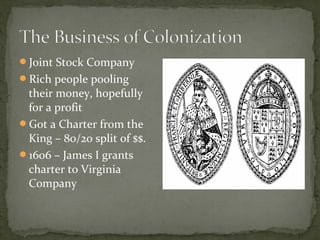
Joint Stock Company
Rich people pooling
their money, hopefully
for a profit
Got a Charter from the
King – 80/20 split of $$.
1606 – James I grants
charter to Virginia
Company
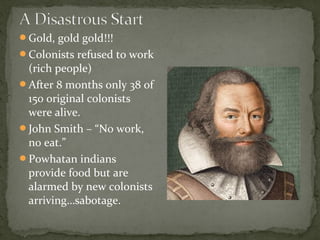
Gold, gold gold!!!
Colonists refused to work
(rich people)
After 8 months only 38 of
150 original colonists
were alive.
John Smith – “No work,
no eat.”
Powhatan indians
provide food but are
alarmed by new colonists
arriving…sabotage.
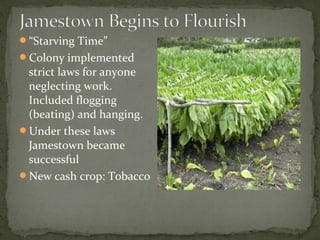
“Starving Time”
Colony implemented
strict laws for anyone
neglecting work.
Included flogging
(beating) and hanging.
Under these laws
Jamestown became
successful
New cash crop: Tobacco
Late 1620’s 1.5 million pounds of tobacco were
exported to Europe.
Headright System: Pay your own way to colonies or
someone else’s…50 acres per person.
Indentured Servants: Someone pays your way to
colonies…you work for them for a period of time (4-7
years)…Usually from lower class in England.
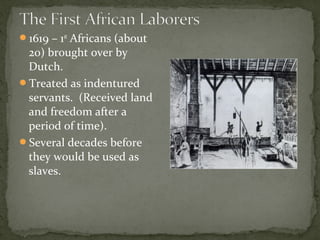
1619 – 1st
Africans (about
20) brought over by
Dutch.
Treated as indentured
servants. (Received land
and freedom after a
period of time).
Several decades before
they would be used as
slaves.
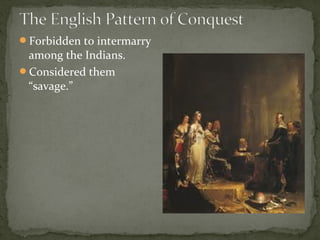
Forbidden to intermarry
among the Indians.
Considered them
“savage.”
Jamestown leaders
demanded corn and
labor from Indians
because of Powhatan
violence during
“Starving Time.”
Pocahontas/John Rolfe
marry 1614…half hearted
peace.
Colonists continued to
take more land.
Powhatan attack kill 340
colonists.
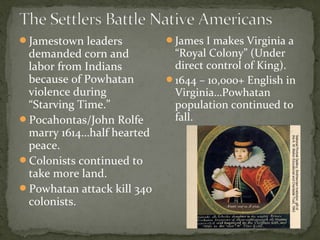
James I makes Virginia a
“Royal Colony” (Under
direct control of King).
1644 – 10,000+ English in
Virginia…Powhatan
population continued to
fall.
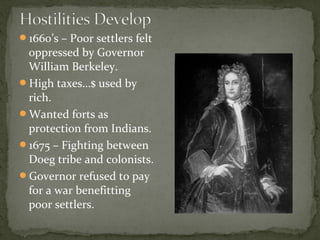
1660’s – Poor settlers felt
oppressed by Governor
William Berkeley.
High taxes…$ used by
rich.
Wanted forts as
protection from Indians.
1675 – Fighting between
Doeg tribe and colonists.
Governor refused to pay
for a war benefitting
poor settlers.
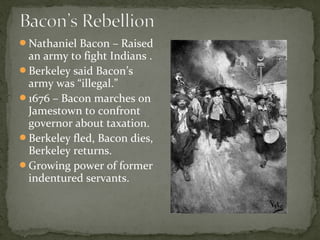
Nathaniel Bacon – Raised
an army to fight Indians .
Berkeley said Bacon’s
army was “illegal.”
1676 – Bacon marches on
Jamestown to confront
governor about taxation.
Berkeley fled, Bacon dies,
Berkeley returns.
Growing power of former
indentured servants.
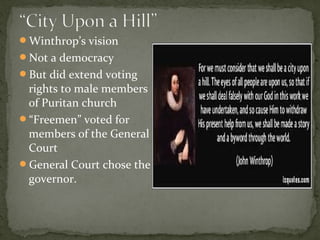
Puritans did not immigrate for profit, they immigrated to create a
model new society. John Winthrop (1st
Governor) referred to it as a
“City upon a Hill.”
1530’s: Henry VIII breaks
with Catholic Church.
Elizabeth I formed
Anglican Church
Some felt it had kept too
much Catholic ritual
Wanted to “purify”
Anglican Church
Some Puritans formed
independent
congregations –
“Separatists” (Pilgrims)
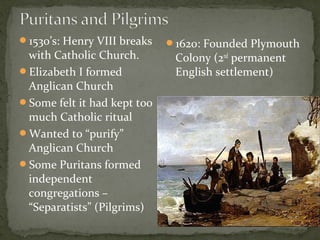
1620: Founded Plymouth
Colony (2nd
permanent
English settlement)
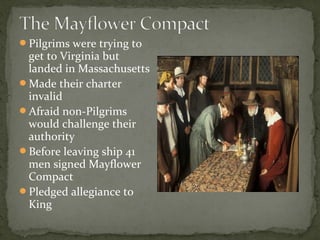
Pilgrims were trying to
get to Virginia but
landed in Massachusetts
Made their charter
invalid
Afraid non-Pilgrims
would challenge their
authority
Before leaving ship 41
men signed Mayflower
Compact
Pledged allegiance to
King
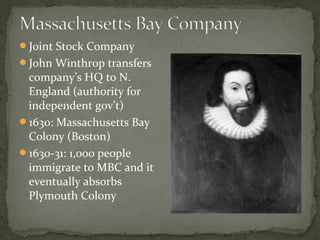
Joint Stock Company
John Winthrop transfers
company’s HQ to N.
England (authority for
independent gov’t)
1630: Massachusetts Bay
Colony (Boston)
1630-31: 1,000 people
immigrate to MBC and it
eventually absorbs
Plymouth Colony
Winthrop’s vision
Not a democracy
But did extend voting
rights to male members
of Puritan church
“Freemen” voted for
members of the General
Court
General Court chose the
governor.
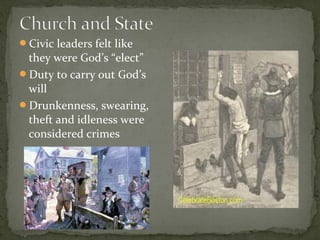
Civic leaders felt like
they were God’s “elect”
Duty to carry out God’s
will
Drunkenness, swearing,
theft and idleness were
considered crimes
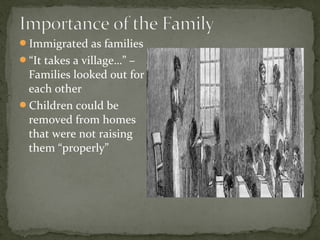
Immigrated as families
“It takes a village…” –
Families looked out for
each other
Children could be
removed from homes
that were not raising
them “properly”
Roger Williams –
Extreme Separatist
Settlers had no right to
take Indian lands unless
purchased
Gov’t officials had no
right to punish for
religious beliefs
General Court wanted
him sent back to
England
Williams flees and
purchases land from
Narragansett tribe
Sets up Providence
Colony (later Rhode
Island)
Guarantees separation of
church and state and
religious freedom
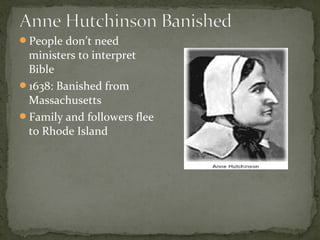
People don’t need
ministers to interpret
Bible
1638: Banished from
Massachusetts
Family and followers flee
to Rhode Island
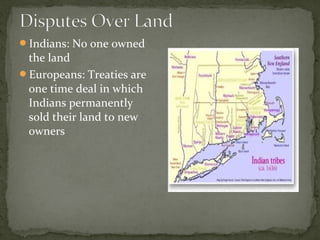
Indians: No one owned
the land
Europeans: Treaties are
one time deal in which
Indians permanently
sold their land to new
owners
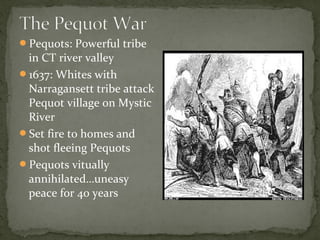
Pequots: Powerful tribe
in CT river valley
1637: Whites with
Narragansett tribe attack
Pequot village on Mystic
River
Set fire to homes and
shot fleeing Pequots
Pequots vitually
annihilated…uneasy
peace for 40 years
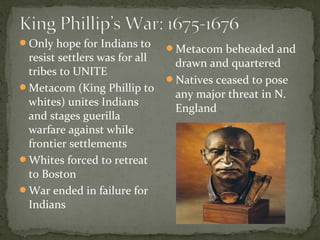
Only hope for Indians to
resist settlers was for all
tribes to UNITE
Metacom (King Phillip to
whites) unites Indians
and stages guerilla
warfare against while
frontier settlements
Whites forced to retreat
to Boston
War ended in failure for
Indians
Metacom beheaded and
drawn and quartered
Natives ceased to pose
any major threat in N.
England
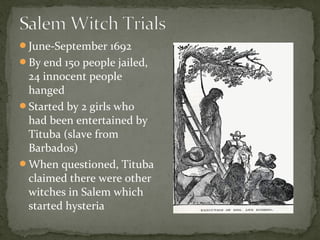
June-September 1692
By end 150 people jailed,
24 innocent people
hanged
Started by 2 girls who
had been entertained by
Tituba (slave from
Barbados)
When questioned, Tituba
claimed there were other
witches in Salem which
started hysteria
• William Penn
• New Netherland
• Proprietor
• Quakers
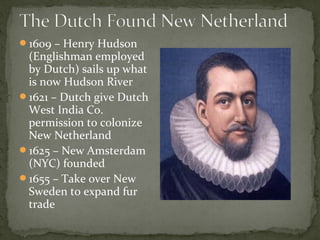
1609 – Henry Hudson
(Englishman employed
by Dutch) sails up what
is now Hudson River
1621 – Dutch give Dutch
West India Co.
permission to colonize
New Netherland
1625 – New Amsterdam
(NYC) founded
1655 – Take over New
Sweden to expand fur
trade
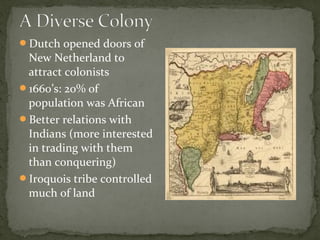
Dutch opened doors of
New Netherland to
attract colonists
1660’s: 20% of
population was African
Better relations with
Indians (more interested
in trading with them
than conquering)
Iroquois tribe controlled
much of land
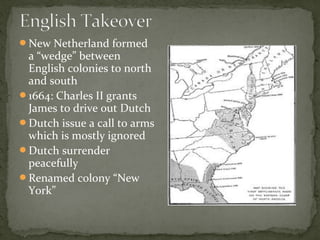
New Netherland formed
a “wedge” between
English colonies to north
and south
1664: Charles II grants
James to drive out Dutch
Dutch issue a call to arms
which is mostly ignored
Dutch surrender
peacefully
Renamed colony “New
York”
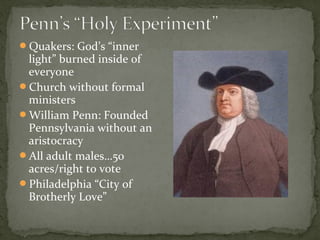
Quakers: God’s “inner
light” burned inside of
everyone
Church without formal
ministers
William Penn: Founded
Pennsylvania without an
aristocracy
All adult males…50
acres/right to vote
Philadelphia “City of
Brotherly Love”
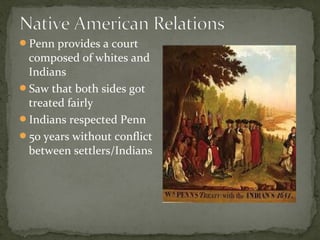
Penn provides a court
composed of whites and
Indians
Saw that both sides got
treated fairly
Indians respected Penn
50 years without conflict
between settlers/Indians
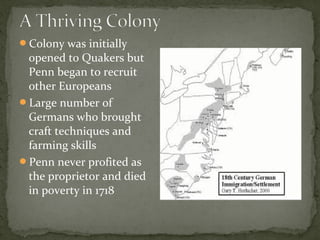
Colony was initially
opened to Quakers but
Penn began to recruit
other Europeans
Large number of
Germans who brought
craft techniques and
farming skills
Penn never profited as
the proprietor and died
in poverty in 1718
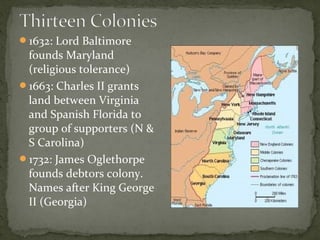
1632: Lord Baltimore
founds Maryland
(religious tolerance)
1663: Charles II grants
land between Virginia
and Spanish Florida to
group of supporters (N &
S Carolina)
1732: James Oglethorpe
founds debtors colony.
Names after King George
II (Georgia)
•Mercantilism
•Parliament
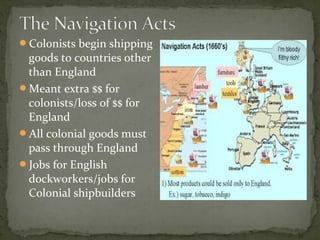
•Navigation Acts
•Dominion of New England
•Sir Edmond Andros
•Glorious Revolution
•Salutary Neglect
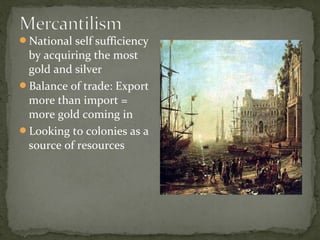
National self sufficiency
by acquiring the most
gold and silver
Balance of trade: Export
more than import =
more gold coming in
Looking to colonies as a
source of resources
Colonists begin shipping
goods to countries other
than England
Meant extra $$ for
colonists/loss of $$ for
England
All colonial goods must
pass through England
Jobs for English
dockworkers/jobs for
Colonial shipbuilders
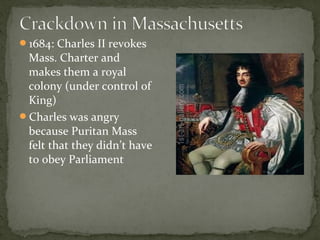
1684: Charles II revokes
Mass. Charter and
makes them a royal
colony (under control of
King)
Charles was angry
because Puritan Mass
felt that they didn’t have
to obey Parliament
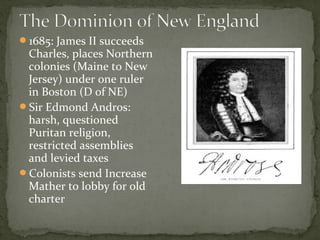
1685: James II succeeds
Charles, places Northern
colonies (Maine to New
Jersey) under one ruler
in Boston (D of NE)
Sir Edmond Andros:
harsh, questioned
Puritan religion,
restricted assemblies
and levied taxes
Colonists send Increase
Mather to lobby for old
charter
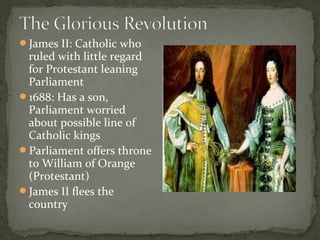
James II: Catholic who
ruled with little regard
for Protestant leaning
Parliament
1688: Has a son,
Parliament worried
about possible line of
Catholic kings
Parliament offers throne
to William of Orange
(Protestant)
James II flees the
country
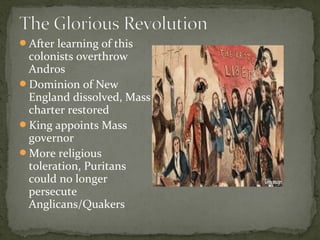
After learning of this
colonists overthrow
Andros
Dominion of New
England dissolved, Mass
charter restored
King appoints Mass
governor
More religious
toleration, Puritans
could no longer
persecute
Anglicans/Quakers
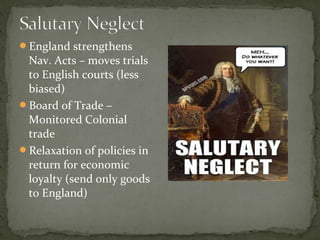
England strengthens
Nav. Acts – moves trials
to English courts (less
biased)
Board of Trade –
Monitored Colonial
trade
Relaxation of policies in
return for economic
loyalty (send only goods
to England)
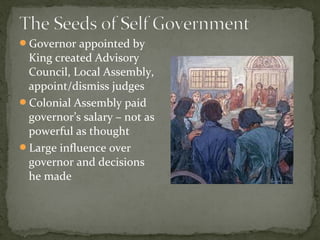
Governor appointed by
King created Advisory
Council, Local Assembly,
appoint/dismiss judges
Colonial Assembly paid
governor’s salary – not as
powerful as thought
Large influence over
governor and decisions
he made
Key Terms
•Cash Crop
•Slave
•Triangular Trade
•Middle Passage
•Stono Rebellion
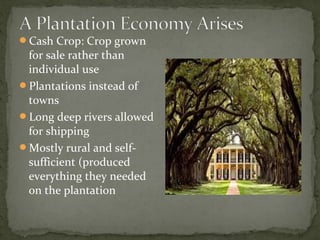
Cash Crop: Crop grown
for sale rather than
individual use
Plantations instead of
towns
Long deep rivers allowed
for shipping
Mostly rural and self-
sufficient (produced
everything they needed
on the plantation
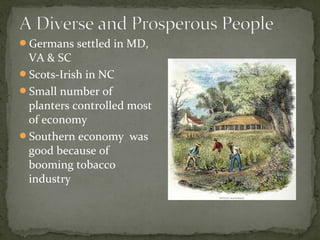
Germans settled in MD,
VA & SC
Scots-Irish in NC
Small number of
planters controlled most
of economy
Southern economy was
good because of
booming tobacco
industry
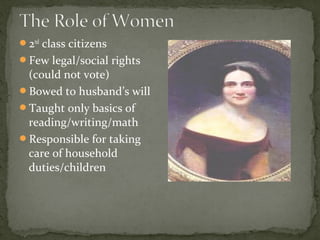
2nd
class citizens
Few legal/social rights
(could not vote)
Bowed to husband’s will
Taught only basics of
reading/writing/math
Responsible for taking
care of household
duties/children
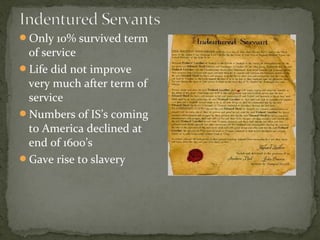
Only 10% survived term
of service
Life did not improve
very much after term of
service
Numbers of IS’s coming
to America declined at
end of 1600’s
Gave rise to slavery
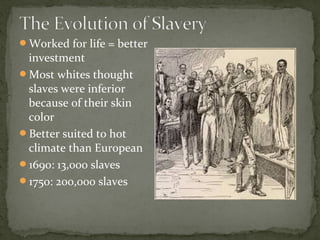
Worked for life = better
investment
Most whites thought
slaves were inferior
because of their skin
color
Better suited to hot
climate than European
1690: 13,000 slaves
1750: 200,000 slaves
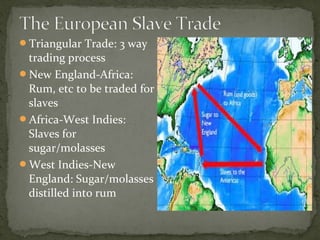
Triangular Trade: 3 way
trading process
New England-Africa:
Rum, etc to be traded for
slaves
Africa-West Indies:
Slaves for
sugar/molasses
West Indies-New
England: Sugar/molasses
distilled into rum
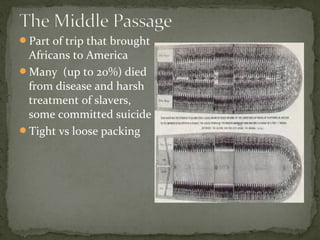
Part of trip that brought
Africans to America
Many (up to 20%) died
from disease and harsh
treatment of slavers,
some committed suicide
Tight vs loose packing
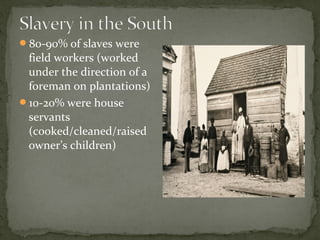
80-90% of slaves were
field workers (worked
under the direction of a
foreman on plantations)
10-20% were house
servants
(cooked/cleaned/raised
owner’s children)
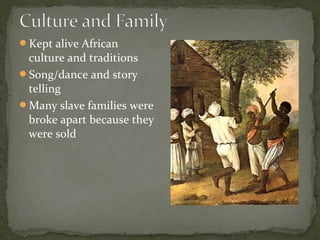
Kept alive African
culture and traditions
Song/dance and story
telling
Many slave families were
broke apart because they
were sold
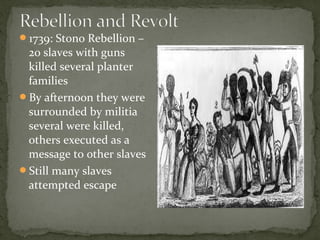
1739: Stono Rebellion –
20 slaves with guns
killed several planter
families
By afternoon they were
surrounded by militia
several were killed,
others executed as a
message to other slaves
Still many slaves
attempted escape
• Enlightenment
• Benjamin Franklin
• Jonathan Edwards
• Great Awakening
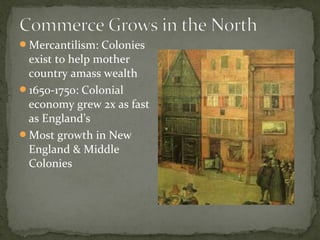
Mercantilism: Colonies
exist to help mother
country amass wealth
1650-1750: Colonial
economy grew 2x as fast
as England’s
Most growth in New
England & Middle
Colonies
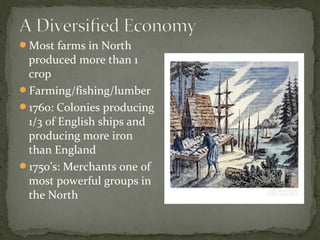
Most farms in North
produced more than 1
crop
Farming/fishing/lumber
1760: Colonies producing
1/3 of English ships and
producing more iron
than England
1750’s: Merchants one of
most powerful groups in
the North
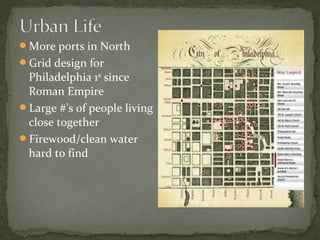
More ports in North
Grid design for
Philadelphia 1st
since
Roman Empire
Large #’s of people living
close together
Firewood/clean water
hard to find
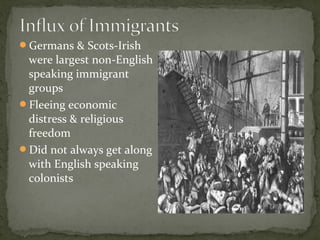
Germans & Scots-Irish
were largest non-English
speaking immigrant
groups
Fleeing economic
distress & religious
freedom
Did not always get along
with English speaking
colonists
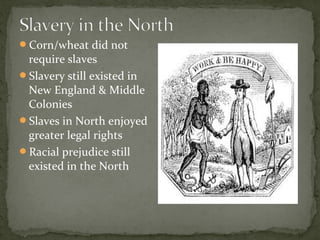
Corn/wheat did not
require slaves
Slavery still existed in
New England & Middle
Colonies
Slaves in North enjoyed
greater legal rights
Racial prejudice still
existed in the North
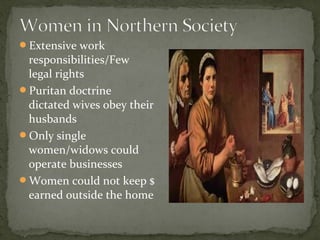
Extensive work
responsibilities/Few
legal rights
Puritan doctrine
dictated wives obey their
husbands
Only single
women/widows could
operate businesses
Women could not keep $
earned outside the home
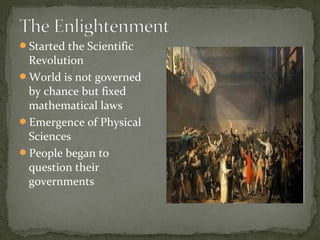
Started the Scientific
Revolution
World is not governed
by chance but fixed
mathematical laws
Emergence of Physical
Sciences
People began to
question their
governments
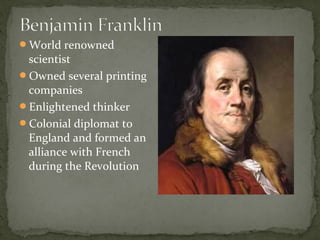
World renowned
scientist
Owned several printing
companies
Enlightened thinker
Colonial diplomat to
England and formed an
alliance with French
during the Revolution
Emotion over Rational
thought
As wealth grew, church
attendance suffered
Puritans feared loss of
culture
Jonathan Edwards began
to preach about hell and
damnation…idea was to
scare people back in to
church
Caused people to
question authority
Built many churches in
the South that became
social meeting places
Emphasized the
individual
Helped question British
authority and Anglican
church in the colonies
•New France
•George Washington
•French & Indian War
•William Pitt
•Pontiac
•Proclamation of 1763
•George Grenville
•Sugar Act
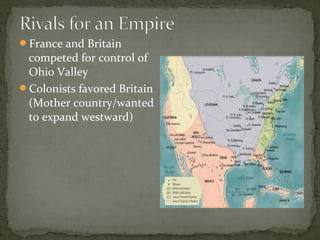
France and Britain
competed for control of
Ohio Valley
Colonists favored Britain
(Mother country/wanted
to expand westward)
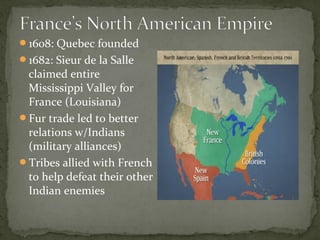
1608: Quebec founded
1682: Sieur de la Salle
claimed entire
Mississippi Valley for
France (Louisiana)
Fur trade led to better
relations w/Indians
(military alliances)
Tribes allied with French
to help defeat their other
Indian enemies
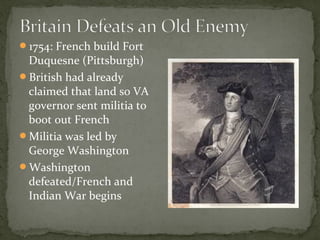
1754: French build Fort
Duquesne (Pittsburgh)
British had already
claimed that land so VA
governor sent militia to
boot out French
Militia was led by
George Washington
Washington
defeated/French and
Indian War begins
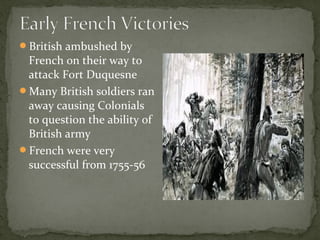
British ambushed by
French on their way to
attack Fort Duquesne
Many British soldiers ran
away causing Colonials
to question the ability of
British army
French were very
successful from 1755-56
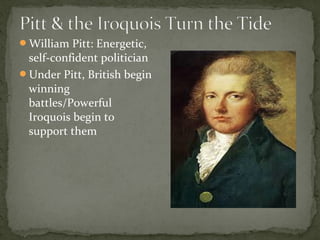
William Pitt: Energetic,
self-confident politician
Under Pitt, British begin
winning
battles/Powerful
Iroquois begin to
support them
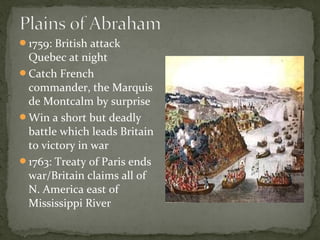
1759: British attack
Quebec at night
Catch French
commander, the Marquis
de Montcalm by surprise
Win a short but deadly
battle which leads Britain
to victory in war
1763: Treaty of Paris ends
war/Britain claims all of
N. America east of
Mississippi River
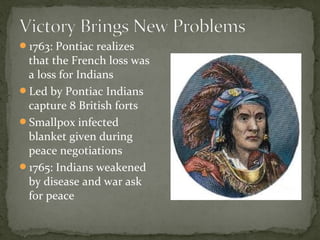
1763: Pontiac realizes
that the French loss was
a loss for Indians
Led by Pontiac Indians
capture 8 British forts
Smallpox infected
blanket given during
peace negotiations
1765: Indians weakened
by disease and war ask
for peace
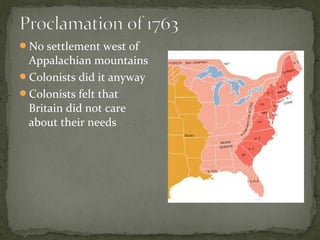
No settlement west of
Appalachian mountains
Colonists did it anyway
Colonists felt that
Britain did not care
about their needs
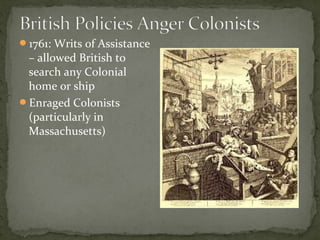
1761: Writs of Assistance
– allowed British to
search any Colonial
home or ship
Enraged Colonists
(particularly in
Massachusetts)
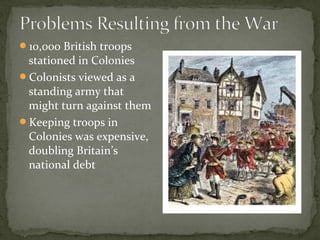
10,000 British troops
stationed in Colonies
Colonists viewed as a
standing army that
might turn against them
Keeping troops in
Colonies was expensive,
doubling Britain’s
national debt
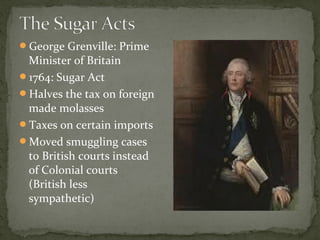
George Grenville: Prime
Minister of Britain
1764: Sugar Act
Halves the tax on foreign
made molasses
Taxes on certain imports
Moved smuggling cases
to British courts instead
of Colonial courts
(British less
sympathetic)

Cp1 The Colonial Period

  • 1.
    John Smith NathanielBacon Joint-Stock Companies Jamestown Powhatan Headright System Indentured Servant Royal Colony
  • 2.
    Joint Stock Company Richpeople pooling their money, hopefully for a profit Got a Charter from the King – 80/20 split of $$. 1606 – James I grants charter to Virginia Company
  • 3.
    Gold, gold gold!!! Colonistsrefused to work (rich people) After 8 months only 38 of 150 original colonists were alive. John Smith – “No work, no eat.” Powhatan indians provide food but are alarmed by new colonists arriving…sabotage.
  • 4.
    “Starving Time” Colony implemented strictlaws for anyone neglecting work. Included flogging (beating) and hanging. Under these laws Jamestown became successful New cash crop: Tobacco
  • 5.
    Late 1620’s 1.5million pounds of tobacco were exported to Europe. Headright System: Pay your own way to colonies or someone else’s…50 acres per person. Indentured Servants: Someone pays your way to colonies…you work for them for a period of time (4-7 years)…Usually from lower class in England.
  • 6.
    1619 – 1st Africans(about 20) brought over by Dutch. Treated as indentured servants. (Received land and freedom after a period of time). Several decades before they would be used as slaves.
  • 7.
    Forbidden to intermarry amongthe Indians. Considered them “savage.”
  • 8.
    Jamestown leaders demanded cornand labor from Indians because of Powhatan violence during “Starving Time.” Pocahontas/John Rolfe marry 1614…half hearted peace. Colonists continued to take more land. Powhatan attack kill 340 colonists. James I makes Virginia a “Royal Colony” (Under direct control of King). 1644 – 10,000+ English in Virginia…Powhatan population continued to fall.
  • 9.
    1660’s – Poorsettlers felt oppressed by Governor William Berkeley. High taxes…$ used by rich. Wanted forts as protection from Indians. 1675 – Fighting between Doeg tribe and colonists. Governor refused to pay for a war benefitting poor settlers.
  • 10.
    Nathaniel Bacon –Raised an army to fight Indians . Berkeley said Bacon’s army was “illegal.” 1676 – Bacon marches on Jamestown to confront governor about taxation. Berkeley fled, Bacon dies, Berkeley returns. Growing power of former indentured servants.
  • 11.
    Puritans did notimmigrate for profit, they immigrated to create a model new society. John Winthrop (1st Governor) referred to it as a “City upon a Hill.”
  • 12.
    1530’s: Henry VIIIbreaks with Catholic Church. Elizabeth I formed Anglican Church Some felt it had kept too much Catholic ritual Wanted to “purify” Anglican Church Some Puritans formed independent congregations – “Separatists” (Pilgrims) 1620: Founded Plymouth Colony (2nd permanent English settlement)
  • 13.
    Pilgrims were tryingto get to Virginia but landed in Massachusetts Made their charter invalid Afraid non-Pilgrims would challenge their authority Before leaving ship 41 men signed Mayflower Compact Pledged allegiance to King
  • 14.
    Joint Stock Company JohnWinthrop transfers company’s HQ to N. England (authority for independent gov’t) 1630: Massachusetts Bay Colony (Boston) 1630-31: 1,000 people immigrate to MBC and it eventually absorbs Plymouth Colony
  • 15.
    Winthrop’s vision Not ademocracy But did extend voting rights to male members of Puritan church “Freemen” voted for members of the General Court General Court chose the governor.
  • 16.
    Civic leaders feltlike they were God’s “elect” Duty to carry out God’s will Drunkenness, swearing, theft and idleness were considered crimes
  • 17.
    Immigrated as families “Ittakes a village…” – Families looked out for each other Children could be removed from homes that were not raising them “properly”
  • 18.
    Roger Williams – ExtremeSeparatist Settlers had no right to take Indian lands unless purchased Gov’t officials had no right to punish for religious beliefs General Court wanted him sent back to England Williams flees and purchases land from Narragansett tribe Sets up Providence Colony (later Rhode Island) Guarantees separation of church and state and religious freedom
  • 19.
    People don’t need ministersto interpret Bible 1638: Banished from Massachusetts Family and followers flee to Rhode Island
  • 20.
    Indians: No oneowned the land Europeans: Treaties are one time deal in which Indians permanently sold their land to new owners
  • 21.
    Pequots: Powerful tribe inCT river valley 1637: Whites with Narragansett tribe attack Pequot village on Mystic River Set fire to homes and shot fleeing Pequots Pequots vitually annihilated…uneasy peace for 40 years
  • 22.
    Only hope forIndians to resist settlers was for all tribes to UNITE Metacom (King Phillip to whites) unites Indians and stages guerilla warfare against while frontier settlements Whites forced to retreat to Boston War ended in failure for Indians Metacom beheaded and drawn and quartered Natives ceased to pose any major threat in N. England
  • 23.
    June-September 1692 By end150 people jailed, 24 innocent people hanged Started by 2 girls who had been entertained by Tituba (slave from Barbados) When questioned, Tituba claimed there were other witches in Salem which started hysteria
  • 24.
    • William Penn •New Netherland • Proprietor • Quakers
  • 25.
    1609 – HenryHudson (Englishman employed by Dutch) sails up what is now Hudson River 1621 – Dutch give Dutch West India Co. permission to colonize New Netherland 1625 – New Amsterdam (NYC) founded 1655 – Take over New Sweden to expand fur trade
  • 26.
    Dutch opened doorsof New Netherland to attract colonists 1660’s: 20% of population was African Better relations with Indians (more interested in trading with them than conquering) Iroquois tribe controlled much of land
  • 27.
    New Netherland formed a“wedge” between English colonies to north and south 1664: Charles II grants James to drive out Dutch Dutch issue a call to arms which is mostly ignored Dutch surrender peacefully Renamed colony “New York”
  • 28.
    Quakers: God’s “inner light”burned inside of everyone Church without formal ministers William Penn: Founded Pennsylvania without an aristocracy All adult males…50 acres/right to vote Philadelphia “City of Brotherly Love”
  • 29.
    Penn provides acourt composed of whites and Indians Saw that both sides got treated fairly Indians respected Penn 50 years without conflict between settlers/Indians
  • 30.
    Colony was initially openedto Quakers but Penn began to recruit other Europeans Large number of Germans who brought craft techniques and farming skills Penn never profited as the proprietor and died in poverty in 1718
  • 31.
    1632: Lord Baltimore foundsMaryland (religious tolerance) 1663: Charles II grants land between Virginia and Spanish Florida to group of supporters (N & S Carolina) 1732: James Oglethorpe founds debtors colony. Names after King George II (Georgia)
  • 32.
    •Mercantilism •Parliament •Navigation Acts •Dominion ofNew England •Sir Edmond Andros •Glorious Revolution •Salutary Neglect
  • 33.
    National self sufficiency byacquiring the most gold and silver Balance of trade: Export more than import = more gold coming in Looking to colonies as a source of resources
  • 34.
    Colonists begin shipping goodsto countries other than England Meant extra $$ for colonists/loss of $$ for England All colonial goods must pass through England Jobs for English dockworkers/jobs for Colonial shipbuilders
  • 35.
    1684: Charles IIrevokes Mass. Charter and makes them a royal colony (under control of King) Charles was angry because Puritan Mass felt that they didn’t have to obey Parliament
  • 36.
    1685: James IIsucceeds Charles, places Northern colonies (Maine to New Jersey) under one ruler in Boston (D of NE) Sir Edmond Andros: harsh, questioned Puritan religion, restricted assemblies and levied taxes Colonists send Increase Mather to lobby for old charter
  • 37.
    James II: Catholicwho ruled with little regard for Protestant leaning Parliament 1688: Has a son, Parliament worried about possible line of Catholic kings Parliament offers throne to William of Orange (Protestant) James II flees the country
  • 38.
    After learning ofthis colonists overthrow Andros Dominion of New England dissolved, Mass charter restored King appoints Mass governor More religious toleration, Puritans could no longer persecute Anglicans/Quakers
  • 39.
    England strengthens Nav. Acts– moves trials to English courts (less biased) Board of Trade – Monitored Colonial trade Relaxation of policies in return for economic loyalty (send only goods to England)
  • 40.
    Governor appointed by Kingcreated Advisory Council, Local Assembly, appoint/dismiss judges Colonial Assembly paid governor’s salary – not as powerful as thought Large influence over governor and decisions he made
  • 41.
    Key Terms •Cash Crop •Slave •TriangularTrade •Middle Passage •Stono Rebellion
  • 42.
    Cash Crop: Cropgrown for sale rather than individual use Plantations instead of towns Long deep rivers allowed for shipping Mostly rural and self- sufficient (produced everything they needed on the plantation
  • 43.
    Germans settled inMD, VA & SC Scots-Irish in NC Small number of planters controlled most of economy Southern economy was good because of booming tobacco industry
  • 44.
    2nd class citizens Few legal/socialrights (could not vote) Bowed to husband’s will Taught only basics of reading/writing/math Responsible for taking care of household duties/children
  • 45.
    Only 10% survivedterm of service Life did not improve very much after term of service Numbers of IS’s coming to America declined at end of 1600’s Gave rise to slavery
  • 46.
    Worked for life= better investment Most whites thought slaves were inferior because of their skin color Better suited to hot climate than European 1690: 13,000 slaves 1750: 200,000 slaves
  • 47.
    Triangular Trade: 3way trading process New England-Africa: Rum, etc to be traded for slaves Africa-West Indies: Slaves for sugar/molasses West Indies-New England: Sugar/molasses distilled into rum
  • 48.
    Part of tripthat brought Africans to America Many (up to 20%) died from disease and harsh treatment of slavers, some committed suicide Tight vs loose packing
  • 49.
    80-90% of slaveswere field workers (worked under the direction of a foreman on plantations) 10-20% were house servants (cooked/cleaned/raised owner’s children)
  • 50.
    Kept alive African cultureand traditions Song/dance and story telling Many slave families were broke apart because they were sold
  • 51.
    1739: Stono Rebellion– 20 slaves with guns killed several planter families By afternoon they were surrounded by militia several were killed, others executed as a message to other slaves Still many slaves attempted escape
  • 52.
    • Enlightenment • BenjaminFranklin • Jonathan Edwards • Great Awakening
  • 53.
    Mercantilism: Colonies exist tohelp mother country amass wealth 1650-1750: Colonial economy grew 2x as fast as England’s Most growth in New England & Middle Colonies
  • 54.
    Most farms inNorth produced more than 1 crop Farming/fishing/lumber 1760: Colonies producing 1/3 of English ships and producing more iron than England 1750’s: Merchants one of most powerful groups in the North
  • 55.
    More ports inNorth Grid design for Philadelphia 1st since Roman Empire Large #’s of people living close together Firewood/clean water hard to find
  • 56.
    Germans & Scots-Irish werelargest non-English speaking immigrant groups Fleeing economic distress & religious freedom Did not always get along with English speaking colonists
  • 57.
    Corn/wheat did not requireslaves Slavery still existed in New England & Middle Colonies Slaves in North enjoyed greater legal rights Racial prejudice still existed in the North
  • 58.
    Extensive work responsibilities/Few legal rights Puritandoctrine dictated wives obey their husbands Only single women/widows could operate businesses Women could not keep $ earned outside the home
  • 59.
    Started the Scientific Revolution Worldis not governed by chance but fixed mathematical laws Emergence of Physical Sciences People began to question their governments
  • 60.
    World renowned scientist Owned severalprinting companies Enlightened thinker Colonial diplomat to England and formed an alliance with French during the Revolution
  • 61.
    Emotion over Rational thought Aswealth grew, church attendance suffered Puritans feared loss of culture Jonathan Edwards began to preach about hell and damnation…idea was to scare people back in to church Caused people to question authority Built many churches in the South that became social meeting places Emphasized the individual Helped question British authority and Anglican church in the colonies
  • 62.
    •New France •George Washington •French& Indian War •William Pitt •Pontiac •Proclamation of 1763 •George Grenville •Sugar Act
  • 63.
    France and Britain competedfor control of Ohio Valley Colonists favored Britain (Mother country/wanted to expand westward)
  • 64.
    1608: Quebec founded 1682:Sieur de la Salle claimed entire Mississippi Valley for France (Louisiana) Fur trade led to better relations w/Indians (military alliances) Tribes allied with French to help defeat their other Indian enemies
  • 65.
    1754: French buildFort Duquesne (Pittsburgh) British had already claimed that land so VA governor sent militia to boot out French Militia was led by George Washington Washington defeated/French and Indian War begins
  • 66.
    British ambushed by Frenchon their way to attack Fort Duquesne Many British soldiers ran away causing Colonials to question the ability of British army French were very successful from 1755-56
  • 67.
    William Pitt: Energetic, self-confidentpolitician Under Pitt, British begin winning battles/Powerful Iroquois begin to support them
  • 68.
    1759: British attack Quebecat night Catch French commander, the Marquis de Montcalm by surprise Win a short but deadly battle which leads Britain to victory in war 1763: Treaty of Paris ends war/Britain claims all of N. America east of Mississippi River
  • 69.
    1763: Pontiac realizes thatthe French loss was a loss for Indians Led by Pontiac Indians capture 8 British forts Smallpox infected blanket given during peace negotiations 1765: Indians weakened by disease and war ask for peace
  • 70.
    No settlement westof Appalachian mountains Colonists did it anyway Colonists felt that Britain did not care about their needs
  • 71.
    1761: Writs ofAssistance – allowed British to search any Colonial home or ship Enraged Colonists (particularly in Massachusetts)
  • 72.
    10,000 British troops stationedin Colonies Colonists viewed as a standing army that might turn against them Keeping troops in Colonies was expensive, doubling Britain’s national debt
  • 73.
    George Grenville: Prime Ministerof Britain 1764: Sugar Act Halves the tax on foreign made molasses Taxes on certain imports Moved smuggling cases to British courts instead of Colonial courts (British less sympathetic)