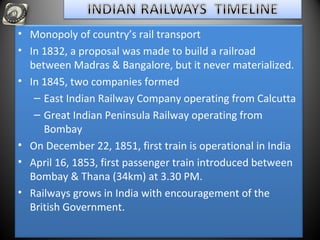
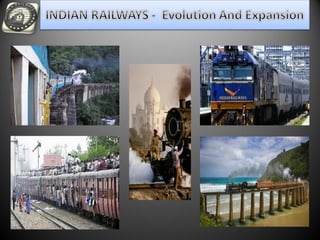

• Monopoly of country’s rail transport
• In 1832, a proposal was made to build a railroad
between Madras & Bangalore, but it never materialized.
• In 1845, two companies formed
– East Indian Railway Company operating from Calcutta
– Great Indian Peninsula Railway operating from
Bombay
• On December 22, 1851, first train is operational in India
• April 16, 1853, first passenger train introduced between
Bombay & Thana (34km) at 3.30 PM.
• Railways grows in India with encouragement of the
British Government.
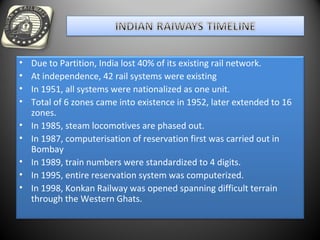
• Due to Partition, India lost 40% of its existing rail network.
• At independence, 42 rail systems were existing
• In 1951, all systems were nationalized as one unit.
• Total of 6 zones came into existence in 1952, later extended to 16
zones.
• In 1985, steam locomotives are phased out.
• In 1987, computerisation of reservation first was carried out in
Bombay
• In 1989, train numbers were standardized to 4 digits.
• In 1995, entire reservation system was computerized.
• In 1998, Konkan Railway was opened spanning difficult terrain
through the Western Ghats.
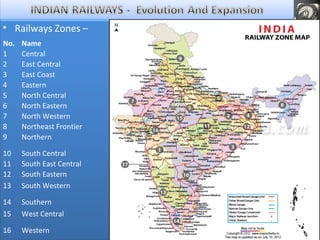
• Railways Zones –
No. Name
1 Central
2 East Central
3 East Coast
4 Eastern
5 North Central
6 North Eastern
7 North Western
8 Northeast Frontier
9 Northern
10 South Central
11 South East Central
12 South Eastern
13 South Western
14 Southern
15 West Central
16 Western
• Passenger Services
– Operates over 9000 trains and transports over 5
billion annually across India.
– Preferred mode of transport in most of the
country.
– Overcrowding is a widely faced problem
– Ticket-less travel is also an additional problem
faced.
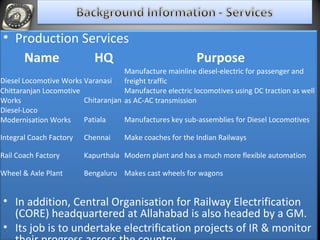
• Production Services
• In addition, Central Organisation for Railway Electrification
(CORE) headquartered at Allahabad is also headed by a GM.
• Its job is to undertake electrification projects of IR & monitor
Name HQ Purpose
Diesel Locomotive Works Varanasi
Manufacture mainline diesel-electric for passenger and
freight traffic
Chittaranjan Locomotive
Works Chitaranjan
Manufacture electric locomotives using DC traction as well
as AC-AC transmission
Diesel-Loco
Modernisation Works Patiala Manufactures key sub-assemblies for Diesel Locomotives
Integral Coach Factory Chennai Make coaches for the Indian Railways
Rail Coach Factory Kapurthala Modern plant and has a much more flexible automation
Wheel & Axle Plant Bengaluru Makes cast wheels for wagons
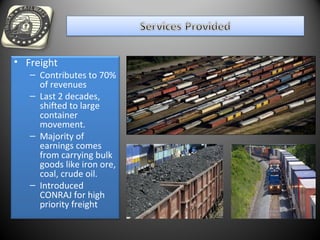
• Freight
– Contributes to 70%
of revenues
– Last 2 decades,
shifted to large
container
movement.
– Majority of
earnings comes
from carrying bulk
goods like iron ore,
coal, crude oil.
– Introduced
CONRAJ for high
priority freight
• Suburban Rail
– Many cities have dedicated suburban networks.
– Cities include Mumbai, Chennai, Delhi, Hyderabad,
Kolkata, Lucknow & Pune.
– Only Mumbai, Pune & Hyderabad share tracks with long
distance trains.
– Trains are mostly electric multiple units.
– Only in Mumbai trains run on Direct Current, rest run on
Alternating Current.
• Other PSU’s under the control of Ministry of Railways
– Indian Railways Catering and Tourism Corporation
– Konkan Railway Corporation
– Indian Railway Finance Corporation
– Mumbai Rail Vikas Corporation
– Railtel Corporation of India – Telecommunication Networks
– RITES Ltd. – Consulting Division of Indian Railways
– IRCON International Ltd. – Construction Division
– Rail Vikas Nigam Limited
• Centre for Railway Information Systems is an autonomous
society under Railway Board, which is responsible for
developing the major software required by Indian Railways
for its operations.
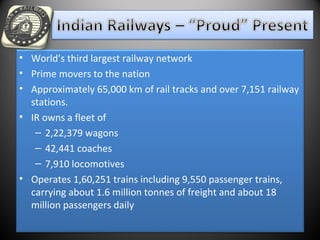
• World’s third largest railway network
• Prime movers to the nation
• Approximately 65,000 km of rail tracks and over 7,151 railway
stations.
• IR owns a fleet of
– 2,22,379 wagons
– 42,441 coaches
– 7,910 locomotives
• Operates 1,60,251 trains including 9,550 passenger trains,
carrying about 1.6 million tonnes of freight and about 18
million passengers daily
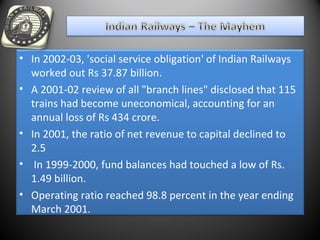
• In 2002-03, 'social service obligation' of Indian Railways
worked out Rs 37.87 billion.
• A 2001-02 review of all "branch lines" disclosed that 115
trains had become uneconomical, accounting for an
annual loss of Rs 434 crore.
• In 2001, the ratio of net revenue to capital declined to
2.5
• In 1999-2000, fund balances had touched a low of Rs.
1.49 billion.
• Operating ratio reached 98.8 percent in the year ending
March 2001.
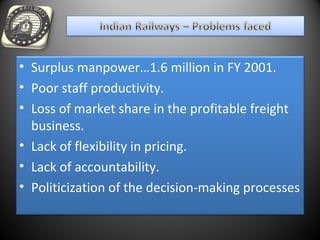
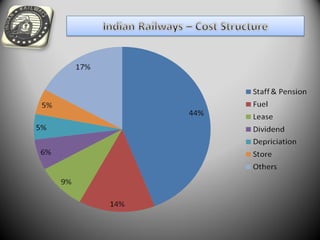
• Surplus manpower…1.6 million in FY 2001.
• Poor staff productivity.
• Loss of market share in the profitable freight
business.
• Lack of flexibility in pricing.
• Lack of accountability.
• Politicization of the decision-making processes
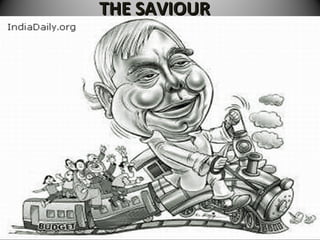
THE SAVIOURTHE SAVIOUR
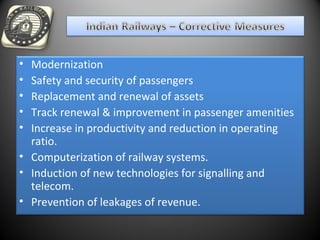
• Modernization
• Safety and security of passengers
• Replacement and renewal of assets
• Track renewal & improvement in passenger amenities
• Increase in productivity and reduction in operating
ratio.
• Computerization of railway systems.
• Induction of new technologies for signalling and
telecom.
• Prevention of leakages of revenue.
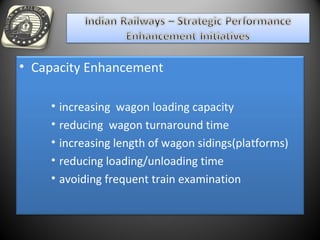
• Capacity Enhancement
• increasing wagon loading capacity
• reducing wagon turnaround time
• increasing length of wagon sidings(platforms)
• reducing loading/unloading time
• avoiding frequent train examination
• Capacity Utilization
• Dynamic pricing policy
• Tariff Rationalization
• Non-peak Season Incremental Freight Discount
• Loyalty Discount Scheme
• Long-term Freight Discount Scheme
• Multiple Unloading
• Revenue Enhancement
• Focusing on low-cost high-volume operations
• Revision in freight rates
• Increasing number of coaches in popular trains
• Reducing AC class fares
• Introducing Garib Raths to attract volumes
• Change in the macro-economic conditions
• Rise in demand
• Change in the legal position
• Changes in organisational culture
• Human resources initiatives
• Downsizing
• Decentralising
• In FY 2006-2007, IR registered profits of Rs. 200 billion.
• As of 2007, IR was India's second largest profit making PSU
after ONGC.
• Revenue per staff witnessed a rise by 68 percent (2001–
2006).
• Operating Ratio was brought down to 78.7 percent by 2007.
• Enhanced axle load and reduction in turnaround time of
wagons increased by 14%
• IR increased wagon capacity available per day by 36 %
• The number of employees reduced to 1.412 million by 2006 .
• The number of accidents have been more than halved from
473 (2001) to 200 (2007)
• Increase in the volume of passengers by approx 29 percent
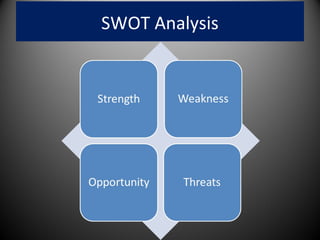
SWOT Analysis
S-STRENGTH
• The ‘Biggest Organization’ in the world under one
roof.
• Luxuries & affordable to ‘Aam adami’.
• Connects different cities and states.
• Technological advancement.
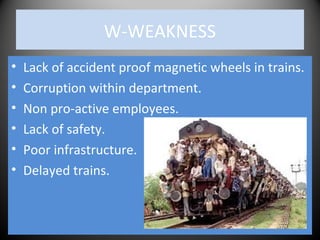
W-WEAKNESS
• Lack of accident proof magnetic wheels in trains.
• Corruption within department.
• Non pro-active employees.
• Lack of safety.
• Poor infrastructure.
• Delayed trains.
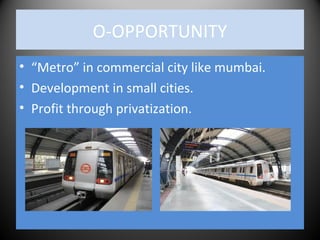
O-OPPORTUNITY
• “Metro” in commercial city like mumbai.
• Development in small cities.
• Profit through privatization.
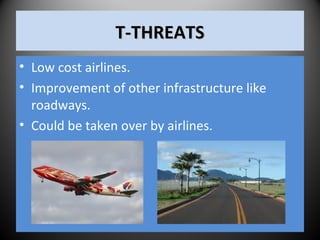
T-THREATST-THREATS
• Low cost airlines.
• Improvement of other infrastructure like
roadways.
• Could be taken over by airlines.
• The XIIth Plan (20013-17) lays ambitious
targets for
1. Freight and passenger business transportation
2. Capacity augmentation
3. Technological up gradation.
4. Sustained improvement of services .
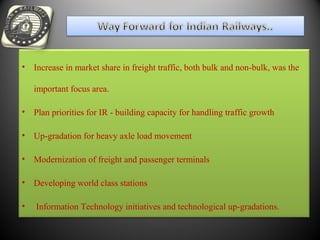
• Increase in market share in freight traffic, both bulk and non-bulk, was the
important focus area.
• Plan priorities for IR - building capacity for handling traffic growth
• Up-gradation for heavy axle load movement
• Modernization of freight and passenger terminals
• Developing world class stations
• Information Technology initiatives and technological up-gradations.
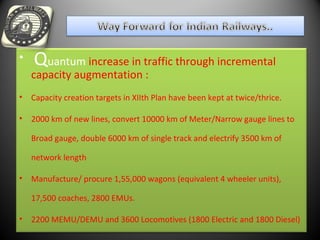
• Quantum increase in traffic through incremental
capacity augmentation :
• Capacity creation targets in XIIth Plan have been kept at twice/thrice.
• 2000 km of new lines, convert 10000 km of Meter/Narrow gauge lines to
Broad gauge, double 6000 km of single track and electrify 3500 km of
network length
• Manufacture/ procure 1,55,000 wagons (equivalent 4 wheeler units),
17,500 coaches, 2800 EMUs.
• 2200 MEMU/DEMU and 3600 Locomotives (1800 Electric and 1800 Diesel)
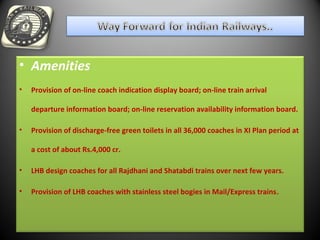
• Amenities
• Provision of on-line coach indication display board; on-line train arrival
departure information board; on-line reservation availability information board.
• Provision of discharge-free green toilets in all 36,000 coaches in XI Plan period at
a cost of about Rs.4,000 cr.
• LHB design coaches for all Rajdhani and Shatabdi trains over next few years.
• Provision of LHB coaches with stainless steel bogies in Mail/Express trains.
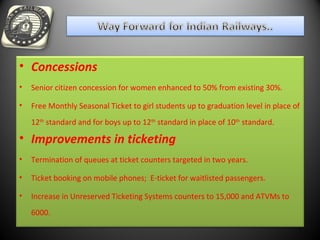
• Concessions
• Senior citizen concession for women enhanced to 50% from existing 30%.
• Free Monthly Seasonal Ticket to girl students up to graduation level in place of
12th
standard and for boys up to 12th
standard in place of 10th
standard.
• Improvements in ticketing
• Termination of queues at ticket counters targeted in two years.
• Ticket booking on mobile phones; E-ticket for waitlisted passengers.
• Increase in Unreserved Ticketing Systems counters to 15,000 and ATVMs to
6000.
• Freight Business
• Reductions & Concessions
• 30% discount on entire traffic in place of
incremental traffic booked from goods shed.
• Increase in discount on incremental traffic
booked from private sidings from 30% to 40%.
• 6% freight concession for traffic booked from
other States for stations in North Eastern
States.
• Safety & Security
• Multi-pronged scheme to strengthen railway safety through various
automatic devices like anti-collision device etc.
• Rail accidents have reduced remarkably despite substantial increase in
gross traffic volumes.
• Fire resistant material to be used in coaches.
• Unmanned level crossings at busy sections to be manned on a fast track
basis.
• Integrated security plan drawn up through installation of CCTVs, metal
detectors etc.
• Staff Welfare
• A new divisional hospital at Ranchi and an OPD block at Integral
Coach Factory to be constructed.
• Employees who joined Railways from other agencies/PSUs etc and
are eligible for pensioner benefits, would now be eligible for post
retirement complimentary passes as per the norms being set.
• Vision 2020
• Aims at setting the roadmap for coming 17 years – customer centric
and market responsive strategic initiatives.
• Information Technology Vision 2012 aims at radical changes in IT
applications ,improvement in operational efficiency, transparency in
working ad better services to the customers.
• Multi-Departmental Innovation Promotion Group at Apex Level.
• Vision 2020
• Public-Private Partnership schemes to be launched for attracting an
investment of Rs.1,00,000 cr over the next five years for developing
world class stations, rolling stock ad other logistics.
• Commercial use of Railway land by Rail Land Development
Authority to give a boost to Railway Revenues.
Time for Fun: Facts and FiguresTime for Fun: Facts and Figures
• IR has of more than 7,500 railway stations in
its periphery and route of railway track more
than 62000 km which is 4th in the world.
• IR's Fastest Train: Bhopal- Shatabdi (runs at a
speed up to 140 Km/hr)
• IR's Highest Station: Ghum, Darjeeling(2,257
m from M.S.L)
• Longest Run (Time): Dibrugarh Town -
Kanyakumari Vivek Express (4286km in 82:30
hours)
• Longest Run for Daily Train: Kerala Express (3054 km in 42.5
hrs)
• Longest Railway Platform in the World: Kharagpur in west
bengal(2,733 ft in length)
• Busiest Railway Station: Lucknow (64 trains everyday)
• IR Daily Runs: About 14,000 trains
• Railway Station with all the Three Gauges: Siliguri Railway
Station
• The total distance covered by the 14,300 trains on the Indian
Railways every day , equals three & half times the distance
to moon.
Time for Fun: Facts and FiguresTime for Fun: Facts and Figures
Innovations: Acceptable :P
• Improve average speed of IR by Reducing
speed restriction and permitting higher speed
• Improve power transmission in Electric
locomotives
• Improvising in Services provided
• Improvising standards of online registration
system
• Better maintenance
Innovations: Acceptable :P
• Innovation should be done in the suspension
system ,joints of two wagons so that comfort
level of the passenger can be increased.
• Sensors should be provided for the track at
certain distance so that problems related
track should be rectify immediately.
• Improving Riding Comfort by installing better
braking system, providing more spaces,
better amenities.
Questions
THANK YOU !!

Indian railways by Meet Patel

  • 3.
    • Monopoly ofcountry’s rail transport • In 1832, a proposal was made to build a railroad between Madras & Bangalore, but it never materialized. • In 1845, two companies formed – East Indian Railway Company operating from Calcutta – Great Indian Peninsula Railway operating from Bombay • On December 22, 1851, first train is operational in India • April 16, 1853, first passenger train introduced between Bombay & Thana (34km) at 3.30 PM. • Railways grows in India with encouragement of the British Government.
  • 4.
    • Due toPartition, India lost 40% of its existing rail network. • At independence, 42 rail systems were existing • In 1951, all systems were nationalized as one unit. • Total of 6 zones came into existence in 1952, later extended to 16 zones. • In 1985, steam locomotives are phased out. • In 1987, computerisation of reservation first was carried out in Bombay • In 1989, train numbers were standardized to 4 digits. • In 1995, entire reservation system was computerized. • In 1998, Konkan Railway was opened spanning difficult terrain through the Western Ghats.
  • 6.
    • Railways Zones– No. Name 1 Central 2 East Central 3 East Coast 4 Eastern 5 North Central 6 North Eastern 7 North Western 8 Northeast Frontier 9 Northern 10 South Central 11 South East Central 12 South Eastern 13 South Western 14 Southern 15 West Central 16 Western
  • 7.
    • Passenger Services –Operates over 9000 trains and transports over 5 billion annually across India. – Preferred mode of transport in most of the country. – Overcrowding is a widely faced problem – Ticket-less travel is also an additional problem faced.
  • 8.
    • Production Services •In addition, Central Organisation for Railway Electrification (CORE) headquartered at Allahabad is also headed by a GM. • Its job is to undertake electrification projects of IR & monitor Name HQ Purpose Diesel Locomotive Works Varanasi Manufacture mainline diesel-electric for passenger and freight traffic Chittaranjan Locomotive Works Chitaranjan Manufacture electric locomotives using DC traction as well as AC-AC transmission Diesel-Loco Modernisation Works Patiala Manufactures key sub-assemblies for Diesel Locomotives Integral Coach Factory Chennai Make coaches for the Indian Railways Rail Coach Factory Kapurthala Modern plant and has a much more flexible automation Wheel & Axle Plant Bengaluru Makes cast wheels for wagons
  • 9.
    • Freight – Contributesto 70% of revenues – Last 2 decades, shifted to large container movement. – Majority of earnings comes from carrying bulk goods like iron ore, coal, crude oil. – Introduced CONRAJ for high priority freight
  • 10.
    • Suburban Rail –Many cities have dedicated suburban networks. – Cities include Mumbai, Chennai, Delhi, Hyderabad, Kolkata, Lucknow & Pune. – Only Mumbai, Pune & Hyderabad share tracks with long distance trains. – Trains are mostly electric multiple units. – Only in Mumbai trains run on Direct Current, rest run on Alternating Current.
  • 12.
    • Other PSU’sunder the control of Ministry of Railways – Indian Railways Catering and Tourism Corporation – Konkan Railway Corporation – Indian Railway Finance Corporation – Mumbai Rail Vikas Corporation – Railtel Corporation of India – Telecommunication Networks – RITES Ltd. – Consulting Division of Indian Railways – IRCON International Ltd. – Construction Division – Rail Vikas Nigam Limited • Centre for Railway Information Systems is an autonomous society under Railway Board, which is responsible for developing the major software required by Indian Railways for its operations.
  • 13.
    • World’s thirdlargest railway network • Prime movers to the nation • Approximately 65,000 km of rail tracks and over 7,151 railway stations. • IR owns a fleet of – 2,22,379 wagons – 42,441 coaches – 7,910 locomotives • Operates 1,60,251 trains including 9,550 passenger trains, carrying about 1.6 million tonnes of freight and about 18 million passengers daily
  • 15.
    • In 2002-03,'social service obligation' of Indian Railways worked out Rs 37.87 billion. • A 2001-02 review of all "branch lines" disclosed that 115 trains had become uneconomical, accounting for an annual loss of Rs 434 crore. • In 2001, the ratio of net revenue to capital declined to 2.5 • In 1999-2000, fund balances had touched a low of Rs. 1.49 billion. • Operating ratio reached 98.8 percent in the year ending March 2001.
  • 16.
    • Surplus manpower…1.6million in FY 2001. • Poor staff productivity. • Loss of market share in the profitable freight business. • Lack of flexibility in pricing. • Lack of accountability. • Politicization of the decision-making processes
  • 18.
  • 19.
    • Modernization • Safetyand security of passengers • Replacement and renewal of assets • Track renewal & improvement in passenger amenities • Increase in productivity and reduction in operating ratio. • Computerization of railway systems. • Induction of new technologies for signalling and telecom. • Prevention of leakages of revenue.
  • 20.
    • Capacity Enhancement •increasing wagon loading capacity • reducing wagon turnaround time • increasing length of wagon sidings(platforms) • reducing loading/unloading time • avoiding frequent train examination
  • 21.
    • Capacity Utilization •Dynamic pricing policy • Tariff Rationalization • Non-peak Season Incremental Freight Discount • Loyalty Discount Scheme • Long-term Freight Discount Scheme • Multiple Unloading
  • 22.
    • Revenue Enhancement •Focusing on low-cost high-volume operations • Revision in freight rates • Increasing number of coaches in popular trains • Reducing AC class fares • Introducing Garib Raths to attract volumes
  • 23.
    • Change inthe macro-economic conditions • Rise in demand • Change in the legal position • Changes in organisational culture • Human resources initiatives • Downsizing • Decentralising
  • 24.
    • In FY2006-2007, IR registered profits of Rs. 200 billion. • As of 2007, IR was India's second largest profit making PSU after ONGC. • Revenue per staff witnessed a rise by 68 percent (2001– 2006). • Operating Ratio was brought down to 78.7 percent by 2007. • Enhanced axle load and reduction in turnaround time of wagons increased by 14% • IR increased wagon capacity available per day by 36 % • The number of employees reduced to 1.412 million by 2006 . • The number of accidents have been more than halved from 473 (2001) to 200 (2007) • Increase in the volume of passengers by approx 29 percent
  • 25.
  • 26.
    S-STRENGTH • The ‘BiggestOrganization’ in the world under one roof. • Luxuries & affordable to ‘Aam adami’. • Connects different cities and states. • Technological advancement.
  • 27.
    W-WEAKNESS • Lack ofaccident proof magnetic wheels in trains. • Corruption within department. • Non pro-active employees. • Lack of safety. • Poor infrastructure. • Delayed trains.
  • 28.
    O-OPPORTUNITY • “Metro” incommercial city like mumbai. • Development in small cities. • Profit through privatization.
  • 29.
    T-THREATST-THREATS • Low costairlines. • Improvement of other infrastructure like roadways. • Could be taken over by airlines.
  • 31.
    • The XIIthPlan (20013-17) lays ambitious targets for 1. Freight and passenger business transportation 2. Capacity augmentation 3. Technological up gradation. 4. Sustained improvement of services .
  • 33.
    • Increase inmarket share in freight traffic, both bulk and non-bulk, was the important focus area. • Plan priorities for IR - building capacity for handling traffic growth • Up-gradation for heavy axle load movement • Modernization of freight and passenger terminals • Developing world class stations • Information Technology initiatives and technological up-gradations.
  • 34.
    • Quantum increasein traffic through incremental capacity augmentation : • Capacity creation targets in XIIth Plan have been kept at twice/thrice. • 2000 km of new lines, convert 10000 km of Meter/Narrow gauge lines to Broad gauge, double 6000 km of single track and electrify 3500 km of network length • Manufacture/ procure 1,55,000 wagons (equivalent 4 wheeler units), 17,500 coaches, 2800 EMUs. • 2200 MEMU/DEMU and 3600 Locomotives (1800 Electric and 1800 Diesel)
  • 35.
    • Amenities • Provisionof on-line coach indication display board; on-line train arrival departure information board; on-line reservation availability information board. • Provision of discharge-free green toilets in all 36,000 coaches in XI Plan period at a cost of about Rs.4,000 cr. • LHB design coaches for all Rajdhani and Shatabdi trains over next few years. • Provision of LHB coaches with stainless steel bogies in Mail/Express trains.
  • 36.
    • Concessions • Seniorcitizen concession for women enhanced to 50% from existing 30%. • Free Monthly Seasonal Ticket to girl students up to graduation level in place of 12th standard and for boys up to 12th standard in place of 10th standard. • Improvements in ticketing • Termination of queues at ticket counters targeted in two years. • Ticket booking on mobile phones; E-ticket for waitlisted passengers. • Increase in Unreserved Ticketing Systems counters to 15,000 and ATVMs to 6000.
  • 37.
    • Freight Business •Reductions & Concessions • 30% discount on entire traffic in place of incremental traffic booked from goods shed. • Increase in discount on incremental traffic booked from private sidings from 30% to 40%. • 6% freight concession for traffic booked from other States for stations in North Eastern States.
  • 38.
    • Safety &Security • Multi-pronged scheme to strengthen railway safety through various automatic devices like anti-collision device etc. • Rail accidents have reduced remarkably despite substantial increase in gross traffic volumes. • Fire resistant material to be used in coaches. • Unmanned level crossings at busy sections to be manned on a fast track basis. • Integrated security plan drawn up through installation of CCTVs, metal detectors etc.
  • 39.
    • Staff Welfare •A new divisional hospital at Ranchi and an OPD block at Integral Coach Factory to be constructed. • Employees who joined Railways from other agencies/PSUs etc and are eligible for pensioner benefits, would now be eligible for post retirement complimentary passes as per the norms being set.
  • 40.
    • Vision 2020 •Aims at setting the roadmap for coming 17 years – customer centric and market responsive strategic initiatives. • Information Technology Vision 2012 aims at radical changes in IT applications ,improvement in operational efficiency, transparency in working ad better services to the customers. • Multi-Departmental Innovation Promotion Group at Apex Level.
  • 41.
    • Vision 2020 •Public-Private Partnership schemes to be launched for attracting an investment of Rs.1,00,000 cr over the next five years for developing world class stations, rolling stock ad other logistics. • Commercial use of Railway land by Rail Land Development Authority to give a boost to Railway Revenues.
  • 42.
    Time for Fun:Facts and FiguresTime for Fun: Facts and Figures • IR has of more than 7,500 railway stations in its periphery and route of railway track more than 62000 km which is 4th in the world. • IR's Fastest Train: Bhopal- Shatabdi (runs at a speed up to 140 Km/hr) • IR's Highest Station: Ghum, Darjeeling(2,257 m from M.S.L) • Longest Run (Time): Dibrugarh Town - Kanyakumari Vivek Express (4286km in 82:30 hours)
  • 43.
    • Longest Runfor Daily Train: Kerala Express (3054 km in 42.5 hrs) • Longest Railway Platform in the World: Kharagpur in west bengal(2,733 ft in length) • Busiest Railway Station: Lucknow (64 trains everyday) • IR Daily Runs: About 14,000 trains • Railway Station with all the Three Gauges: Siliguri Railway Station • The total distance covered by the 14,300 trains on the Indian Railways every day , equals three & half times the distance to moon. Time for Fun: Facts and FiguresTime for Fun: Facts and Figures
  • 44.
    Innovations: Acceptable :P •Improve average speed of IR by Reducing speed restriction and permitting higher speed • Improve power transmission in Electric locomotives • Improvising in Services provided • Improvising standards of online registration system • Better maintenance
  • 45.
    Innovations: Acceptable :P •Innovation should be done in the suspension system ,joints of two wagons so that comfort level of the passenger can be increased. • Sensors should be provided for the track at certain distance so that problems related track should be rectify immediately. • Improving Riding Comfort by installing better braking system, providing more spaces, better amenities.
  • 46.
  • 47.