Incepting Enterprise
Applications
Introduction to Inception
Incepting an enterprise application is the first life cycle
phase of raising enterprise applications that primarily
consists of the following activities:
Enterprise analysis
Business modeling
Requirements elicitation & analysis
Requirements validation
Planning and estimation
Enterprise Analysis
Enterprise analysis is a holistic analysis of business
enterprise that is typically done by business analysts,
and comprise of following key activities:
Identification of business opportunities and business
changes.
Identification of various stakeholders across business
units.
Collection of business requirements and prioritizing
them.
Define business roadmap with scope and exclusions.
Contd….
Enterprise Analysis (Contd…)
 Conduct risk analysis and competitive analysis.
 Create RoI business cases with proper justification
and getting the necessary approvals from the
sponsors.
Business Modeling
 Business modeling helps one to understand the
business information and the business processes
which an enterprise uses to fulfill its business goals.
 Enterprise analysis could lead to two forms of
programs/projects:
• Creating something new/development project
• Extension/change to something which already
exists/re-engineering project
 Business modeling is done by business analysts.
Contd….
Business Modeling (Contd…)
 To understand the business problem at hand it’s
essential to have AS-IS and TO-BE modeling of the
business processes
• AS-IS business process model reflects the existing
business process.
• TO-BE business process model reflects the desired
business process.
Introduction to Case Study-EM Bank
 Easy Money Bank(EM Bank) is a leading bank with
its headquarters in Europe and offices and
presence in another 50 countries.
 Some of the services offered by the EM bank are
core banking , investment banking , mortgage and
wealth management to name a few.
 To keep up with the market competition, the
bank’s management has decided to expand the
loan offerings and to reach out to more number of
customers (both existing and new).
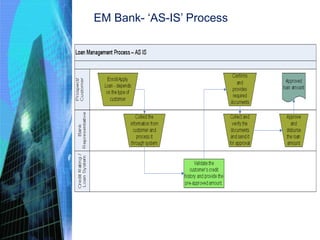
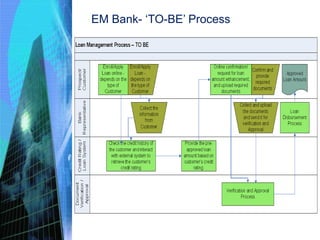
 Business Analyst has performed the task of
business modeling and has come out with the AS-
IS and TO-BE processes depicted in the two
diagrams shown next.
EM Bank- ‘AS-IS’ Process
EM Bank- ‘TO-BE’ Process
 Text.
 Text.
Requirement Elicitation and Analysis
 Requirements elicitation and analysis is a systematic
approach of capturing client requirements, analyzing
them and documenting the problem domain.
 There are various kinds of requirements which need
to be elicited and are broadly divided into two
categories:
• Functional Requirements: capture what the system is
expected to do - mechanisms such as Use cases and
prototypes are used to depict functional
requirements.
• Non Functional Requirements(NFR): NFRs capture
how the system does what it is expected to do with
respect to its constraints and expected qualities of
service (QoS) such as reliability, scalability, portability,
usability, availability, security and performance.
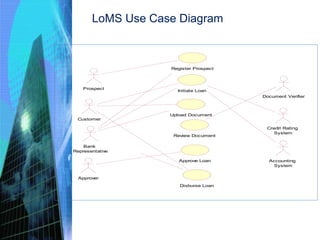
LoMS Use Case Diagram
Upload Document
Approve Loan
Review Document
Document Verifier
Approver
Prospect
Register Prospect
Customer
Credit Rating
System
Initiate Loan
Accounting
System
Bank
Representative
Disburse Loan
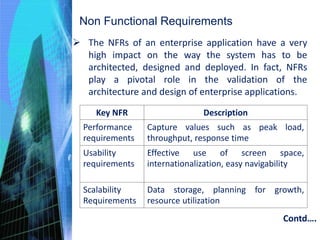
Non Functional Requirements
 The NFRs of an enterprise application have a very
high impact on the way the system has to be
architected, designed and deployed. In fact, NFRs
play a pivotal role in the validation of the
architecture and design of enterprise applications.
Key NFR Description
Performance
requirements
Capture values such as peak load,
throughput, response time
Usability
requirements
Effective use of screen space,
internationalization, easy navigability
Scalability
Requirements
Data storage, planning for growth,
resource utilization
Contd….
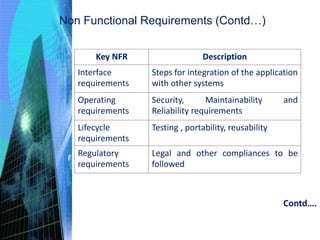
Non Functional Requirements (Contd…)
Key NFR Description
Interface
requirements
Steps for integration of the application
with other systems
Operating
requirements
Security, Maintainability and
Reliability requirements
Lifecycle
requirements
Testing , portability, reusability
Regulatory
requirements
Legal and other compliances to be
followed
Contd….
Non Functional Requirements (Contd…)
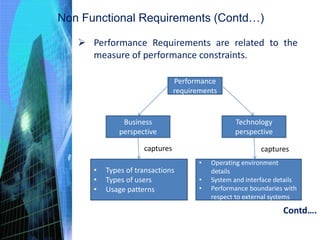
 Performance Requirements are related to the
measure of performance constraints.
Performance
requirements
Business
perspective
Technology
perspective
• Types of transactions
• Types of users
• Usage patterns
captures
• Operating environment
details
• System and interface details
• Performance boundaries with
respect to external systems
captures
Contd….
Non Functional Requirements (Contd…)
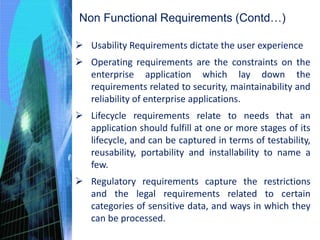
 Usability Requirements dictate the user experience
 Operating requirements are the constraints on the
enterprise application which lay down the
requirements related to security, maintainability and
reliability of enterprise applications.
 Lifecycle requirements relate to needs that an
application should fulfill at one or more stages of its
lifecycle, and can be captured in terms of testability,
reusability, portability and installability to name a
few.
 Regulatory requirements capture the restrictions
and the legal requirements related to certain
categories of sensitive data, and ways in which they
can be processed.
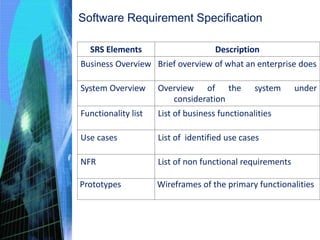
Software Requirement Specification
SRS Elements Description
Business Overview Brief overview of what an enterprise does
System Overview Overview of the system under
consideration
Functionality list List of business functionalities
Use cases List of identified use cases
NFR List of non functional requirements
Prototypes Wireframes of the primary functionalities
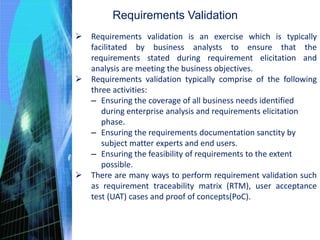
Requirements Validation
 Requirements validation is an exercise which is typically
facilitated by business analysts to ensure that the
requirements stated during requirement elicitation and
analysis are meeting the business objectives.
 Requirements validation typically comprise of the following
three activities:
– Ensuring the coverage of all business needs identified
during enterprise analysis and requirements elicitation
phase.
– Ensuring the requirements documentation sanctity by
subject matter experts and end users.
– Ensuring the feasibility of requirements to the extent
possible.
 There are many ways to perform requirement validation such
as requirement traceability matrix (RTM), user acceptance
test (UAT) cases and proof of concepts(PoC).
Planning and Estimation
 The business case acts as the primary input for
preparing the highest level planning document
called Project Charter.
 Once the Project Charter is realized, detailed
planning is done followed by the process of
“estimation”, taking care of cost, schedule, size and
effort required to build the enterprise application.
 A few of the popular estimation techniques are :
• Ballpark Estimation: involves decisions based on
heuristics. Data available in the organization from
similar projects, similar domains or industry
standards are used for estimation.
Planning and Estimation
 Use Case Point Estimation: The target functionality
which is depicted in the form of Use case models is
the basis for doing Use Case Point estimation.
 Function Point Estimation: A function point or FP is
the unit to measure the functional size of the
software under measurement. To perform FP
estimation, a fully documented functional
specification of the target software solution is
needed.
THANK YOU

Incepting Enterprise Applications

  • 1.
  • 2.
    Introduction to Inception Inceptingan enterprise application is the first life cycle phase of raising enterprise applications that primarily consists of the following activities: Enterprise analysis Business modeling Requirements elicitation & analysis Requirements validation Planning and estimation
  • 3.
    Enterprise Analysis Enterprise analysisis a holistic analysis of business enterprise that is typically done by business analysts, and comprise of following key activities: Identification of business opportunities and business changes. Identification of various stakeholders across business units. Collection of business requirements and prioritizing them. Define business roadmap with scope and exclusions. Contd….
  • 4.
    Enterprise Analysis (Contd…) Conduct risk analysis and competitive analysis.  Create RoI business cases with proper justification and getting the necessary approvals from the sponsors.
  • 5.
    Business Modeling  Businessmodeling helps one to understand the business information and the business processes which an enterprise uses to fulfill its business goals.  Enterprise analysis could lead to two forms of programs/projects: • Creating something new/development project • Extension/change to something which already exists/re-engineering project  Business modeling is done by business analysts. Contd….
  • 6.
    Business Modeling (Contd…) To understand the business problem at hand it’s essential to have AS-IS and TO-BE modeling of the business processes • AS-IS business process model reflects the existing business process. • TO-BE business process model reflects the desired business process.
  • 7.
    Introduction to CaseStudy-EM Bank  Easy Money Bank(EM Bank) is a leading bank with its headquarters in Europe and offices and presence in another 50 countries.  Some of the services offered by the EM bank are core banking , investment banking , mortgage and wealth management to name a few.  To keep up with the market competition, the bank’s management has decided to expand the loan offerings and to reach out to more number of customers (both existing and new).  Business Analyst has performed the task of business modeling and has come out with the AS- IS and TO-BE processes depicted in the two diagrams shown next.
  • 8.
  • 9.
    EM Bank- ‘TO-BE’Process  Text.  Text.
  • 10.
    Requirement Elicitation andAnalysis  Requirements elicitation and analysis is a systematic approach of capturing client requirements, analyzing them and documenting the problem domain.  There are various kinds of requirements which need to be elicited and are broadly divided into two categories: • Functional Requirements: capture what the system is expected to do - mechanisms such as Use cases and prototypes are used to depict functional requirements. • Non Functional Requirements(NFR): NFRs capture how the system does what it is expected to do with respect to its constraints and expected qualities of service (QoS) such as reliability, scalability, portability, usability, availability, security and performance.
  • 11.
    LoMS Use CaseDiagram Upload Document Approve Loan Review Document Document Verifier Approver Prospect Register Prospect Customer Credit Rating System Initiate Loan Accounting System Bank Representative Disburse Loan
  • 12.
    Non Functional Requirements The NFRs of an enterprise application have a very high impact on the way the system has to be architected, designed and deployed. In fact, NFRs play a pivotal role in the validation of the architecture and design of enterprise applications. Key NFR Description Performance requirements Capture values such as peak load, throughput, response time Usability requirements Effective use of screen space, internationalization, easy navigability Scalability Requirements Data storage, planning for growth, resource utilization Contd….
  • 13.
    Non Functional Requirements(Contd…) Key NFR Description Interface requirements Steps for integration of the application with other systems Operating requirements Security, Maintainability and Reliability requirements Lifecycle requirements Testing , portability, reusability Regulatory requirements Legal and other compliances to be followed Contd….
  • 14.
    Non Functional Requirements(Contd…)  Performance Requirements are related to the measure of performance constraints. Performance requirements Business perspective Technology perspective • Types of transactions • Types of users • Usage patterns captures • Operating environment details • System and interface details • Performance boundaries with respect to external systems captures Contd….
  • 15.
    Non Functional Requirements(Contd…)  Usability Requirements dictate the user experience  Operating requirements are the constraints on the enterprise application which lay down the requirements related to security, maintainability and reliability of enterprise applications.  Lifecycle requirements relate to needs that an application should fulfill at one or more stages of its lifecycle, and can be captured in terms of testability, reusability, portability and installability to name a few.  Regulatory requirements capture the restrictions and the legal requirements related to certain categories of sensitive data, and ways in which they can be processed.
  • 16.
    Software Requirement Specification SRSElements Description Business Overview Brief overview of what an enterprise does System Overview Overview of the system under consideration Functionality list List of business functionalities Use cases List of identified use cases NFR List of non functional requirements Prototypes Wireframes of the primary functionalities
  • 17.
    Requirements Validation  Requirementsvalidation is an exercise which is typically facilitated by business analysts to ensure that the requirements stated during requirement elicitation and analysis are meeting the business objectives.  Requirements validation typically comprise of the following three activities: – Ensuring the coverage of all business needs identified during enterprise analysis and requirements elicitation phase. – Ensuring the requirements documentation sanctity by subject matter experts and end users. – Ensuring the feasibility of requirements to the extent possible.  There are many ways to perform requirement validation such as requirement traceability matrix (RTM), user acceptance test (UAT) cases and proof of concepts(PoC).
  • 18.
    Planning and Estimation The business case acts as the primary input for preparing the highest level planning document called Project Charter.  Once the Project Charter is realized, detailed planning is done followed by the process of “estimation”, taking care of cost, schedule, size and effort required to build the enterprise application.  A few of the popular estimation techniques are : • Ballpark Estimation: involves decisions based on heuristics. Data available in the organization from similar projects, similar domains or industry standards are used for estimation.
  • 19.
    Planning and Estimation Use Case Point Estimation: The target functionality which is depicted in the form of Use case models is the basis for doing Use Case Point estimation.  Function Point Estimation: A function point or FP is the unit to measure the functional size of the software under measurement. To perform FP estimation, a fully documented functional specification of the target software solution is needed.
  • 20.