

Introduction
What is an Enterprise Application
 There is a thin line of demarcation which separates
whether an application can be termed as Enterprise
Application or not.
 Typically an Application which satisfies the business
functionalities (functional requirements) of an
organization and also take care of factors such as
efficiency, scalability, security etc (non functional
requirements) is termed as Enterprise Application.
 An organization or enterprise may have several
enterprise applications in its application landscape.
They can be categorized from various perspectives.
Categorization of Enterprise Applications
Visibility to end user:
 Upstream: Customers facing enterprise applications
or front-end systems of an organization.
 Downstream: Back-end enterprise applications
working behind the scenes in an organization to fulfill
the customers’ or end users’ needs.
 Business Enabler: Applications which fulfill the
general organizational needs.
Contd….
 Industry domain specific application.
 Type of processing supported: Enterprise applications
may fall under categories such as batch processing,
online transaction processing (OLTP) or online
analytical processing (OLAP) applications, or decision
support systems (DSS).
 Custom built or readymade application.
Categorization of Enterprise Applications
(contd…)
Challenges in Raising Enterprise Applications
With changing market dynamics, customer needs and
technology, Enterprise applications face many challenges
to stand out from the crowd. Below are the key
challenges:
 Business Process Automation
 Data Harmonization - combine data from different
sources and provide users with a comparable view
of data from different studies.
 Application Integration
 Application Security
 Transaction Management
 Quality of Service(QoS) Contd….
Challenges in Raising Enterprise Applications
(Contd…)
 Rich User Experience
 Internationalization
 Technology Selection
Software Engineering Methodologies
 Iterative methodologies
• IBM RUP: RUP has assembled the iterations in four
phases: inception, elaboration, construction and
transition.
• Agile software development: an extension to the
iterative approach to build applications in a nimble
fashion with a light weight process.
 Waterfall methodology
• Traditional approach of software development that
typically comprises of a sequence of phases —
requirements, analysis, design, build and testing —
wherein each phase output acts as input to the next
phase.
Life Cycle of Raising an Enterprise Application
Development of an enterprise application follows a life
cycle with the following stages:
 Inception
• Typically starts as a result of enterprise analysis and
business modeling activities.
• Requirements engineering is the key activity
• Elicitation of requirements (Collecting)
– Done using use cases prototypes or user stories
• Analysis of requirements
– Validated wrt to various factors – Business requirements, budget,
technology, etc.,
• Concludes with casting the plan and project
estimation.
Life Cycle of Raising an Enterprise Application
Development of an enterprise application follows a life
cycle with the following stages:
 Architecting and Designing
• Takes key inputs from the enterprise architecture
initiatives of an organization
• Defines overall business architecture, data
architecture, applications architecture and technology
architecture of an organization
• Architecture laid out from various perspectives:
Logical, integration, solution, data , technology and
security.,
• Perspectives boiled down to detailed design using
design patterns, frameworks, technologies and tools.
• Application architecture and software designing are
the key activities.
 Construction
• starts with building the application framework
components;
• followed by construction of application components;
• concludes with unit testing and code review and
analysis.
 Testing
• includes integration testing, system testing and user
acceptance testing;
• successful user acceptance test leads to application
rollout.
Life Cycle of Raising an Enterprise Application
(Contd…)
 Business case readiness
 Strategy to execute
 Excellence in execution
 Business case readiness
 Supported by organizational objectives, vision and strategy
 Supported from the financial perspective
 Acceptance of all the key stakeholders
 Well-defined parameters derived from business case
 Strategy to execute
 Comprehensive plan required to manifest budget, resources,
timelines and availability of subject matter experts (SMEs) in
a consistent manner
Three Key Determinants of Successful Enterprise
Applications
 Excellence in execution
 Warrant substantial time to get completed and during which
business objectives, circumstances and environments may
change
 Continuous assessment of objectives is required
 Robust traceability is required to make sure the objectives
are met
 Success of EA
 Ongoing communications to create stable baselines
 Sign off or formal handshaking among stakeholders
 Reverse feedback mechanism
Three Key Determinants of Successful Enterprise
Applications
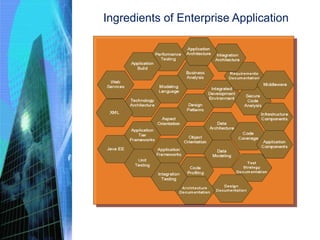
Ingredients of Enterprise Application
Skill Requirements to Raise an Enterprise
Application
Following are the key skill sets required to develop an
enterprise application:
 Knowledge of organizational dynamics: understand
the organizational business and business needs of end
users.
 Domain knowledge: comes handy especially during
inception, architecting and design and testing phase
of applications.
 Business analysis skills: conglomeration of domain
knowledge, technical knowledge, use of business
analysis related tools and practice of soft skills.
Contd….
 Program management skills: includes planning,
estimation, budgeting, talent management, change
management, positive communication and many
more
 Architecting and designing skills: includes the
knowledge of architecture views and view points,
architectural patterns, design patterns, design
paradigms like object orientation, aspect orientation
and service orientation, usage of design tools,
architectural and design best practices, technical
frameworks, knowledge of modeling languages like
Unified Modeling Language, etc.
Skill Requirements to Raise an Enterprise
Application (Contd…)
Contd….
 Programming skills: includes knowledge of a
programming language ,knowledge of the underlying
platform, knowledge of an Integrated Development
Environment (IDE) tool, programming best practices,
code review skills, knowledge of unit testing tools,
configuration management and build tools, static code
analysis tools and dynamic code analysis tools etc.
 Testing skills: includes skills for performing integration
testing, performance testing, load testing, stress
testing, application security testing, interface testing
and user acceptance testing.
 Knowledge of tools
Skill Requirements to Raise an Enterprise
Application (Contd…)
Measuring the Success of Enterprise
Applications
 Once we are done with raising an enterprise
application , we need to measure its success based on
different parameters.
 Measuring the business process automation gain and
the gain in terms of the ease with which end user can
carry out the same process.
 Quality of application in terms of non functional
requirements.
 Time to production - faster the time to market , better
for the organization.
Contd….
 Adherence to budget and timeliness.
 Cost effectiveness of application.
 Productivity of development teams.
Measuring the Success of Enterprise
Applications (Contd…)
THANK
YOU

Introduction to BEA

  • 1.
  • 2.
    What is anEnterprise Application  There is a thin line of demarcation which separates whether an application can be termed as Enterprise Application or not.  Typically an Application which satisfies the business functionalities (functional requirements) of an organization and also take care of factors such as efficiency, scalability, security etc (non functional requirements) is termed as Enterprise Application.  An organization or enterprise may have several enterprise applications in its application landscape. They can be categorized from various perspectives.
  • 3.
    Categorization of EnterpriseApplications Visibility to end user:  Upstream: Customers facing enterprise applications or front-end systems of an organization.  Downstream: Back-end enterprise applications working behind the scenes in an organization to fulfill the customers’ or end users’ needs.  Business Enabler: Applications which fulfill the general organizational needs. Contd….
  • 4.
     Industry domainspecific application.  Type of processing supported: Enterprise applications may fall under categories such as batch processing, online transaction processing (OLTP) or online analytical processing (OLAP) applications, or decision support systems (DSS).  Custom built or readymade application. Categorization of Enterprise Applications (contd…)
  • 5.
    Challenges in RaisingEnterprise Applications With changing market dynamics, customer needs and technology, Enterprise applications face many challenges to stand out from the crowd. Below are the key challenges:  Business Process Automation  Data Harmonization - combine data from different sources and provide users with a comparable view of data from different studies.  Application Integration  Application Security  Transaction Management  Quality of Service(QoS) Contd….
  • 6.
    Challenges in RaisingEnterprise Applications (Contd…)  Rich User Experience  Internationalization  Technology Selection
  • 7.
    Software Engineering Methodologies Iterative methodologies • IBM RUP: RUP has assembled the iterations in four phases: inception, elaboration, construction and transition. • Agile software development: an extension to the iterative approach to build applications in a nimble fashion with a light weight process.  Waterfall methodology • Traditional approach of software development that typically comprises of a sequence of phases — requirements, analysis, design, build and testing — wherein each phase output acts as input to the next phase.
  • 8.
    Life Cycle ofRaising an Enterprise Application Development of an enterprise application follows a life cycle with the following stages:  Inception • Typically starts as a result of enterprise analysis and business modeling activities. • Requirements engineering is the key activity • Elicitation of requirements (Collecting) – Done using use cases prototypes or user stories • Analysis of requirements – Validated wrt to various factors – Business requirements, budget, technology, etc., • Concludes with casting the plan and project estimation.
  • 9.
    Life Cycle ofRaising an Enterprise Application Development of an enterprise application follows a life cycle with the following stages:  Architecting and Designing • Takes key inputs from the enterprise architecture initiatives of an organization • Defines overall business architecture, data architecture, applications architecture and technology architecture of an organization • Architecture laid out from various perspectives: Logical, integration, solution, data , technology and security., • Perspectives boiled down to detailed design using design patterns, frameworks, technologies and tools.
  • 10.
    • Application architectureand software designing are the key activities.  Construction • starts with building the application framework components; • followed by construction of application components; • concludes with unit testing and code review and analysis.  Testing • includes integration testing, system testing and user acceptance testing; • successful user acceptance test leads to application rollout. Life Cycle of Raising an Enterprise Application (Contd…)
  • 11.
     Business casereadiness  Strategy to execute  Excellence in execution  Business case readiness  Supported by organizational objectives, vision and strategy  Supported from the financial perspective  Acceptance of all the key stakeholders  Well-defined parameters derived from business case  Strategy to execute  Comprehensive plan required to manifest budget, resources, timelines and availability of subject matter experts (SMEs) in a consistent manner Three Key Determinants of Successful Enterprise Applications
  • 12.
     Excellence inexecution  Warrant substantial time to get completed and during which business objectives, circumstances and environments may change  Continuous assessment of objectives is required  Robust traceability is required to make sure the objectives are met  Success of EA  Ongoing communications to create stable baselines  Sign off or formal handshaking among stakeholders  Reverse feedback mechanism Three Key Determinants of Successful Enterprise Applications
  • 13.
  • 14.
    Skill Requirements toRaise an Enterprise Application Following are the key skill sets required to develop an enterprise application:  Knowledge of organizational dynamics: understand the organizational business and business needs of end users.  Domain knowledge: comes handy especially during inception, architecting and design and testing phase of applications.  Business analysis skills: conglomeration of domain knowledge, technical knowledge, use of business analysis related tools and practice of soft skills. Contd….
  • 15.
     Program managementskills: includes planning, estimation, budgeting, talent management, change management, positive communication and many more  Architecting and designing skills: includes the knowledge of architecture views and view points, architectural patterns, design patterns, design paradigms like object orientation, aspect orientation and service orientation, usage of design tools, architectural and design best practices, technical frameworks, knowledge of modeling languages like Unified Modeling Language, etc. Skill Requirements to Raise an Enterprise Application (Contd…) Contd….
  • 16.
     Programming skills:includes knowledge of a programming language ,knowledge of the underlying platform, knowledge of an Integrated Development Environment (IDE) tool, programming best practices, code review skills, knowledge of unit testing tools, configuration management and build tools, static code analysis tools and dynamic code analysis tools etc.  Testing skills: includes skills for performing integration testing, performance testing, load testing, stress testing, application security testing, interface testing and user acceptance testing.  Knowledge of tools Skill Requirements to Raise an Enterprise Application (Contd…)
  • 17.
    Measuring the Successof Enterprise Applications  Once we are done with raising an enterprise application , we need to measure its success based on different parameters.  Measuring the business process automation gain and the gain in terms of the ease with which end user can carry out the same process.  Quality of application in terms of non functional requirements.  Time to production - faster the time to market , better for the organization. Contd….
  • 18.
     Adherence tobudget and timeliness.  Cost effectiveness of application.  Productivity of development teams. Measuring the Success of Enterprise Applications (Contd…)
  • 19.