Systems Analysis and Design
5th Edition
Chapter 7. Moving into Design
Alan Dennis, Barbara Haley Wixom, and Roberta Roth
Chapter 7 Outline
ď‚§Transition from requirements to design.
ď‚§System acquisition strategies.
- Custom development.
- Packaged software.
- Outsourcing.
ď‚§Influences on the acquisition strategies.
ď‚§Selecting an acquisition strategy.
INTRODUCTION
ď‚§The design phase decides how the new
system will operate.
ď‚§The design phase develops the system
requirements that describe details for
building the system.
ď‚§We also describe three alternative
strategies for acquiring the system.
TRANSITION FROM REQUIREMENT TO
DESIGN
ď‚§The purpose of the analysis phase is to figure out what the business needs. The
purpose of the design phase is to decide how to build it.
ď‚§During the initial part of design, the business requirements are converted into system
requirements that describe the technical details for building the system.
ď‚§System requirements are communicated through a collection of design documents and
physical process and data models.
(cont’d)
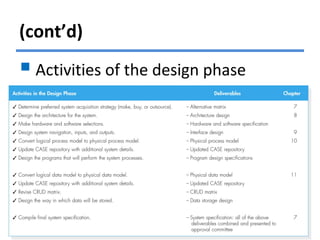
ď‚§ Activities of the design phase
(cont’d)
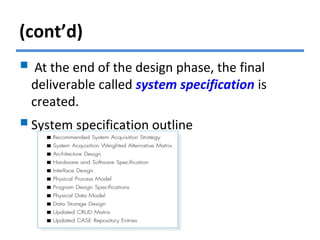
ď‚§ At the end of the design phase, the final
deliverable called system specification is
created.
ď‚§System specification outline
SYSTEM ACQUISITION STRATEGIES
ď‚§There are three primary ways to approach the creation of a
new system:
1. Develop a custom application in-house.
2. Buy a packaged system and (possibly) customize it; and
3. Rely on an external vendor, developer, or service provider to
build or provide the system.
Custom Development
Custom development – building a new system from scratch.
ď‚§Pros of custom development:
- It allows developers to be flexible and creative in the way they
solve business problems.
- It allows to take advantage of current technologies that can
support strategic efforts.
- It builds technical skills and functional knowledge within the
organization.
(cont’d)
ď‚§Cons of custom development:
- It requires a dedicated effort that include long
hours and hard work.
- It requires a variety of skills, but high skilled IS
professionals are difficult to hire and retain.
- The risks associated with building a system
from the ground up can be quite high.
Packaged Software
ď‚§ Many organizations buy packaged software that has
been written for common business needs.
ď‚§ It can be much more efficient to buy programs that have
already been created and tested, and a packaged system
can be bought and installed quickly compared with a
custom system.
ď‚§ Packaged software can range from small single-function
tools to huge all-encompassing system such as ERP
(enterprise resource planning) applications.
(cont’d)
ď‚§One problem of packaged software is that companies utilizing packaged
software must accept the functionality that is provided by the system.
ď‚§Most packaged applications allow for customization or the manipulation of
system parameters to change the way certain features work.
ď‚§A custom-built add-on program that interfaces with the packaged application,
called a workaround, can be created to handle special needs.
(cont’d)
ď‚§Systems Integration refers to the process of
building new systems by combining packaged
software, existing legacy systems, and new
software written to integrate them.
ď‚§The key challenge in systems integration is
finding ways to integrate the data produced
by the different packages and legacy systems.
Outsourcing
ď‚§Outsourcing means hiring an external vendor,
developer, or service provider to create or supply the
system.
ď‚§Outsourcing firms called application service providers
(ASPs) supply software applications and/or services
over the Internet.
ď‚§Software as a service (SaaS) is an extension of the
ASP model.
ď‚§Outsourcing has many advantages such as a low cost
of entry and a short setup time.
(cont’d)
ď‚§Risks of outsourcing:
–Compromising confidential information
–Losing control over future development
–Losing important skills of in-house professionals.
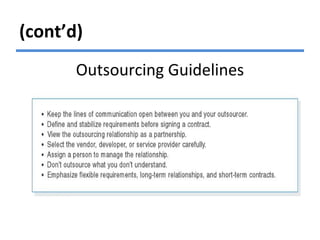
ď‚§You should never outsource what you do not
understand.
ď‚§ Carefully choose an outsourcing firm with a
proven track record.
(cont’d)
ď‚§Three types of outsourcing contracts:
- Time and arrangements: pay for whatever
time and expenses are needed to get the job
done.
- Fixed-price contract
- Value-added contract: the outsourcer
reaps some percentage of the completed
system’s benefits.
(cont’d)
Outsourcing Guidelines
INFLUENCES ON THE ACQUISTION STRATEGY
Project characteristics that influence the choice
of acquisition strategy
Business Need
ď‚§ If the business need for the system is
common and the technical solutions already
exist, packaged software is a solution.
ď‚§A custom solution should be explored when
the business need is unique.
ď‚§Outsourcing is used in situations where the
business need is not a critical element of
company strategy.
In-House Experience
ď‚§If in-house experience exists for all the
functional and technical needs of the
system, it will be easier to build a
custom application.
ď‚§A packaged system may be a better
alternative for companies that do not
have the technical skills to build the
desired system.
Project Skills
ď‚§The skills that are applied during projects
are either technical (e.g., SQL) or
functional (e.g., e-commerce).
ď‚§Different design alternatives are more
viable, depending on how important the
skills are to the company’s strategy.
Project Management
ď‚§Custom applications require excellent
project management and a proven
methodology.
ď‚§There are so many things that can
push a project off track, such as
funding obstacles, staffing, and overly
demanding business users.
(cont’d)
ď‚§The project team should choose to develop a custom
application only if it is certain that the underlying
coordination and control mechanisms will be in place.
ď‚§Packaged and outsourcing alternatives also must be
managed; however, they are more shielded from internal
obstacles.
Time Frame
ď‚§When time is a factor, the project team should
probably start looking for a system that is
already built and tested.
ď‚§If a custom alternative is chosen, and the time
frame is very short, consider using techniques
like timeboxing to manage the problem.
ď‚§An outsourcing solution could take as long a
custom development initiative.
SELECTING AN ACQUISITION STRATEGY
ď‚§To implement the strategies, additional information is
needed.
- What tools and technologies are needed for a custom development project?
- What vendors make products that address the project needs?
- What service providers would be able to build this application if outsourced?
ď‚§One helpful tool is the request for proposal (RFP), a
document that solicits a formal proposal from a potential
vendor, developer, or service provider.
(cont’d)
ď‚§RFPs describe in detail the system or service that is needed, and vendor respond by describing in detail how they could supply those needs.
ď‚§For smaller projects with smaller budgets, a request for information (RFI) may be sufficient, as it is shorter and less detailed.
ď‚§When a list of equipment is so complete that the vendor needs only provide a price, a request for quote (RFQ) may be used.
Developing an Alternative Matrix
ď‚§The alternative matrix combines several
feasibility analyses into one matrix.
ď‚§It contains technical, economical and
organizational feasibilities for each system
candidate, pros and cons, and other
information.
ď‚§The matrix is a grid with alternatives across
the top and different criteria along the side.
(cont’d)
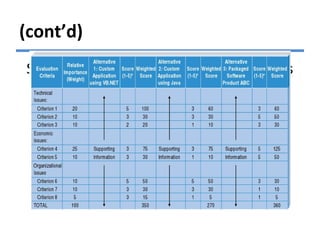
ď‚§Sometimes, weights and scores are added to
create a weighted alternative matrix.
ď‚§The score assigned is a subjective assignment.
ď‚§To avoid a biased analysis, each analyst develops
ratings independently.
(cont’d)
Sample Alternative Matrix Using Weights
SUMMARY
ď‚§Transitioning from requirements to design
- The design phase develops the blueprint for the new system.
- The main deliverable from the design phase is the system
specification.
ď‚§System acquisition strategies
- Custom application in-house.
- Packaged system.
- Outsourcing.
(cont’d)
ď‚§Influences on acquisition strategy
- Each acquisition strategy has its strengths and weaknesses.
- Consider such issues as the uniqueness of business need, in-
house experiences, and the importance of project skills.
ď‚§ Selecting a acquisition strategy
- An alternative matrix can help the design team make the decision
regarding the specific acquisition strategy.
- The request for proposal and request for quote are ways to gather
accurate details regarding the alternatives.
Copyright 2011 John Wiley & Sons, Inc.
All rights reserved. Reproduction or translation of this work
beyond that permitted in Section 117 of the 1976 United States
Copyright Act without the express written permission of the
copyright owner is unlawful. Request for further information
should be addressed to the Permissions Department, John Wiley
& Sons, Inc. The purchaser may make back-up copies for his/her
own use only and not for redistribution or resale. The Publisher
assumes no responsibility for errors, omissions, or damages,
caused by the use of these programs or from the use of the
information contained herein.

Ch07-Moving into Design

  • 1.
    Systems Analysis andDesign 5th Edition Chapter 7. Moving into Design Alan Dennis, Barbara Haley Wixom, and Roberta Roth
  • 2.
    Chapter 7 Outline ď‚§Transitionfrom requirements to design. ď‚§System acquisition strategies. - Custom development. - Packaged software. - Outsourcing. ď‚§Influences on the acquisition strategies. ď‚§Selecting an acquisition strategy.
  • 3.
    INTRODUCTION ď‚§The design phasedecides how the new system will operate. ď‚§The design phase develops the system requirements that describe details for building the system. ď‚§We also describe three alternative strategies for acquiring the system.
  • 4.
    TRANSITION FROM REQUIREMENTTO DESIGN ď‚§The purpose of the analysis phase is to figure out what the business needs. The purpose of the design phase is to decide how to build it. ď‚§During the initial part of design, the business requirements are converted into system requirements that describe the technical details for building the system. ď‚§System requirements are communicated through a collection of design documents and physical process and data models.
  • 5.
  • 6.
    (cont’d)  At theend of the design phase, the final deliverable called system specification is created. System specification outline
  • 7.
    SYSTEM ACQUISITION STRATEGIES ď‚§Thereare three primary ways to approach the creation of a new system: 1. Develop a custom application in-house. 2. Buy a packaged system and (possibly) customize it; and 3. Rely on an external vendor, developer, or service provider to build or provide the system.
  • 8.
    Custom Development Custom development– building a new system from scratch. Pros of custom development: - It allows developers to be flexible and creative in the way they solve business problems. - It allows to take advantage of current technologies that can support strategic efforts. - It builds technical skills and functional knowledge within the organization.
  • 9.
    (cont’d) Cons of customdevelopment: - It requires a dedicated effort that include long hours and hard work. - It requires a variety of skills, but high skilled IS professionals are difficult to hire and retain. - The risks associated with building a system from the ground up can be quite high.
  • 10.
    Packaged Software ď‚§ Manyorganizations buy packaged software that has been written for common business needs. ď‚§ It can be much more efficient to buy programs that have already been created and tested, and a packaged system can be bought and installed quickly compared with a custom system. ď‚§ Packaged software can range from small single-function tools to huge all-encompassing system such as ERP (enterprise resource planning) applications.
  • 11.
    (cont’d) One problem ofpackaged software is that companies utilizing packaged software must accept the functionality that is provided by the system. Most packaged applications allow for customization or the manipulation of system parameters to change the way certain features work. A custom-built add-on program that interfaces with the packaged application, called a workaround, can be created to handle special needs.
  • 12.
    (cont’d) Systems Integration refersto the process of building new systems by combining packaged software, existing legacy systems, and new software written to integrate them. The key challenge in systems integration is finding ways to integrate the data produced by the different packages and legacy systems.
  • 13.
    Outsourcing ď‚§Outsourcing means hiringan external vendor, developer, or service provider to create or supply the system. ď‚§Outsourcing firms called application service providers (ASPs) supply software applications and/or services over the Internet. ď‚§Software as a service (SaaS) is an extension of the ASP model. ď‚§Outsourcing has many advantages such as a low cost of entry and a short setup time.
  • 14.
    (cont’d) Risks of outsourcing: –Compromisingconfidential information –Losing control over future development –Losing important skills of in-house professionals. You should never outsource what you do not understand.  Carefully choose an outsourcing firm with a proven track record.
  • 15.
    (cont’d) Three types ofoutsourcing contracts: - Time and arrangements: pay for whatever time and expenses are needed to get the job done. - Fixed-price contract - Value-added contract: the outsourcer reaps some percentage of the completed system’s benefits.
  • 16.
  • 17.
    INFLUENCES ON THEACQUISTION STRATEGY Project characteristics that influence the choice of acquisition strategy
  • 18.
    Business Need ď‚§ Ifthe business need for the system is common and the technical solutions already exist, packaged software is a solution. ď‚§A custom solution should be explored when the business need is unique. ď‚§Outsourcing is used in situations where the business need is not a critical element of company strategy.
  • 19.
    In-House Experience ď‚§If in-houseexperience exists for all the functional and technical needs of the system, it will be easier to build a custom application. ď‚§A packaged system may be a better alternative for companies that do not have the technical skills to build the desired system.
  • 20.
    Project Skills The skillsthat are applied during projects are either technical (e.g., SQL) or functional (e.g., e-commerce). Different design alternatives are more viable, depending on how important the skills are to the company’s strategy.
  • 21.
    Project Management ď‚§Custom applicationsrequire excellent project management and a proven methodology. ď‚§There are so many things that can push a project off track, such as funding obstacles, staffing, and overly demanding business users.
  • 22.
    (cont’d) The project teamshould choose to develop a custom application only if it is certain that the underlying coordination and control mechanisms will be in place. Packaged and outsourcing alternatives also must be managed; however, they are more shielded from internal obstacles.
  • 23.
    Time Frame ď‚§When timeis a factor, the project team should probably start looking for a system that is already built and tested. ď‚§If a custom alternative is chosen, and the time frame is very short, consider using techniques like timeboxing to manage the problem. ď‚§An outsourcing solution could take as long a custom development initiative.
  • 24.
    SELECTING AN ACQUISITIONSTRATEGY ď‚§To implement the strategies, additional information is needed. - What tools and technologies are needed for a custom development project? - What vendors make products that address the project needs? - What service providers would be able to build this application if outsourced? ď‚§One helpful tool is the request for proposal (RFP), a document that solicits a formal proposal from a potential vendor, developer, or service provider.
  • 25.
    (cont’d) RFPs describe indetail the system or service that is needed, and vendor respond by describing in detail how they could supply those needs. For smaller projects with smaller budgets, a request for information (RFI) may be sufficient, as it is shorter and less detailed. When a list of equipment is so complete that the vendor needs only provide a price, a request for quote (RFQ) may be used.
  • 26.
    Developing an AlternativeMatrix ď‚§The alternative matrix combines several feasibility analyses into one matrix. ď‚§It contains technical, economical and organizational feasibilities for each system candidate, pros and cons, and other information. ď‚§The matrix is a grid with alternatives across the top and different criteria along the side.
  • 27.
    (cont’d) Sometimes, weights andscores are added to create a weighted alternative matrix. The score assigned is a subjective assignment. To avoid a biased analysis, each analyst develops ratings independently.
  • 28.
  • 29.
    SUMMARY ď‚§Transitioning from requirementsto design - The design phase develops the blueprint for the new system. - The main deliverable from the design phase is the system specification. ď‚§System acquisition strategies - Custom application in-house. - Packaged system. - Outsourcing.
  • 30.
    (cont’d) Influences on acquisitionstrategy - Each acquisition strategy has its strengths and weaknesses. - Consider such issues as the uniqueness of business need, in- house experiences, and the importance of project skills.  Selecting a acquisition strategy - An alternative matrix can help the design team make the decision regarding the specific acquisition strategy. - The request for proposal and request for quote are ways to gather accurate details regarding the alternatives.
  • 31.
    Copyright 2011 JohnWiley & Sons, Inc. All rights reserved. Reproduction or translation of this work beyond that permitted in Section 117 of the 1976 United States Copyright Act without the express written permission of the copyright owner is unlawful. Request for further information should be addressed to the Permissions Department, John Wiley & Sons, Inc. The purchaser may make back-up copies for his/her own use only and not for redistribution or resale. The Publisher assumes no responsibility for errors, omissions, or damages, caused by the use of these programs or from the use of the information contained herein.

Editor's Notes