


 Pointers point to the address of a function
 A running program is allocated a certain space in the main memory
 The executable compiled program code and the used variables
are both put inside this memory
 Thus a function in the program code has an address.
 Can be declared, assigned values, and then used to access the functions
they point to
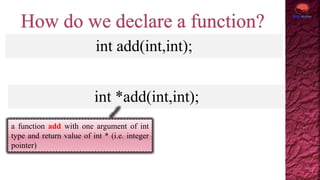
int add(int,int);
int *add(int,int);
a function add with one argument of int
type and return value of int * (i.e. integer
pointer)
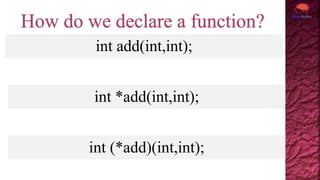
int add(int,int);
int *add(int,int);
int (*add)(int,int);
 Must be initialized prior to use
 Assign the address of a function to a function pointer
Simply uses the name of a function
Optional to use the address operator & in front of the
function’s name
 Must be initialized prior to use
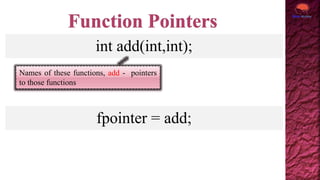
int add(int,int);
fpointer = add;
Names of these functions, add - pointers
to those functions
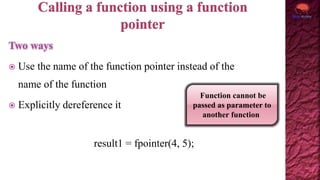
Two ways
 Use the name of the function pointer instead of the
name of the function
 Explicitly dereference it
result1 = fpointer(4, 5);
Function cannot be
passed as parameter to
another function
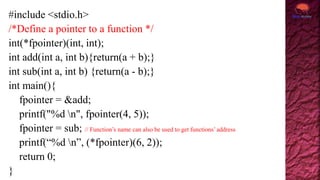
#include <stdio.h>
/*Define a pointer to a function */
int(*fpointer)(int, int);
int add(int a, int b){return(a + b);}
int sub(int a, int b) {return(a - b);}
int main(){
fpointer = &add;
printf("%d n", fpointer(4, 5));
fpointer = sub; // Function’s name can also be used to get functions’address
printf(“%d n”, (*fpointer)(6, 2));
return 0;
}
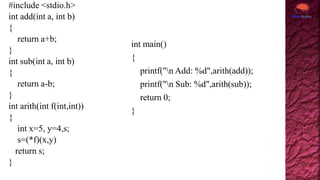
#include <stdio.h>
int add(int a, int b)
{
return a+b;
}
int sub(int a, int b)
{
return a-b;
}
int arith(int f(int,int))
{
int x=5, y=4,s;
s=(*f)(x,y)
return s;
}
int main()
{
printf("n Add: %d",arith(add));
printf("n Sub: %d",arith(sub));
return 0;
}
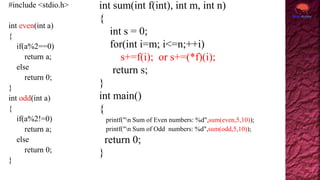
#include <stdio.h>
int even(int a)
{
if(a%2==0)
return a;
else
return 0;
}
int odd(int a)
{
if(a%2!=0)
return a;
else
return 0;
}
int sum(int f(int), int m, int n)
{
int s = 0;
for(int i=m; i<=n;++i)
s+=f(i); or s+=(*f)(i);
return s;
}
int main()
{
printf("n Sum of Even numbers: %d",sum(even,5,10));
printf("n Sum of Odd numbers: %d",sum(odd,5,10));
return 0;
}
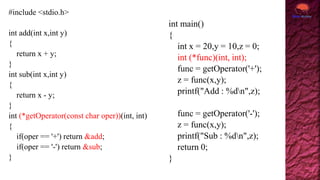
#include <stdio.h>
int add(int x,int y)
{
return x + y;
}
int sub(int x,int y)
{
return x - y;
}
int (*getOperator(const char oper))(int, int)
{
if(oper == '+') return &add;
if(oper == '-') return &sub;
}
int main()
{
int x = 20,y = 10,z = 0;
int (*func)(int, int);
func = getOperator('+');
z = func(x,y);
printf("Add : %dn",z);
func = getOperator('-');
z = func(x,y);
printf("Sub : %dn",z);
return 0;
}
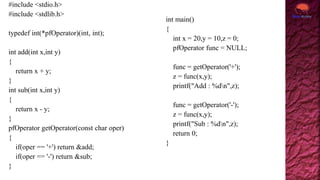
#include <stdio.h>
#include <stdlib.h>
typedef int(*pfOperator)(int, int);
int add(int x,int y)
{
return x + y;
}
int sub(int x,int y)
{
return x - y;
}
pfOperator getOperator(const char oper)
{
if(oper == '+') return &add;
if(oper == '-') return &sub;
}
int main()
{
int x = 20,y = 10,z = 0;
pfOperator func = NULL;
func = getOperator('+');
z = func(x,y);
printf("Add : %dn",z);
func = getOperator('-');
z = func(x,y);
printf("Sub : %dn",z);
return 0;
}
#include <stdio.h>
int(*fpointer[2])(int, int);
int add(int a, int b){return(a + b);}
int sub(int a, int b) {return(a - b);}
int main(){
fpointer[0] = &add;
printf("%d n", (*fpointer[0])(4, 5));
fpointer[1] = sub;
printf(“%d n”, fpointer[1](6, 2));
return 0;}
Function pointer

Function pointer

  • 2.
     Pointers pointto the address of a function  A running program is allocated a certain space in the main memory  The executable compiled program code and the used variables are both put inside this memory  Thus a function in the program code has an address.  Can be declared, assigned values, and then used to access the functions they point to
  • 4.
    int add(int,int); int *add(int,int); afunction add with one argument of int type and return value of int * (i.e. integer pointer)
  • 5.
  • 7.
     Must beinitialized prior to use  Assign the address of a function to a function pointer Simply uses the name of a function Optional to use the address operator & in front of the function’s name
  • 8.
     Must beinitialized prior to use int add(int,int); fpointer = add; Names of these functions, add - pointers to those functions
  • 10.
    Two ways  Usethe name of the function pointer instead of the name of the function  Explicitly dereference it result1 = fpointer(4, 5); Function cannot be passed as parameter to another function
  • 11.
    #include <stdio.h> /*Define apointer to a function */ int(*fpointer)(int, int); int add(int a, int b){return(a + b);} int sub(int a, int b) {return(a - b);} int main(){ fpointer = &add; printf("%d n", fpointer(4, 5)); fpointer = sub; // Function’s name can also be used to get functions’address printf(“%d n”, (*fpointer)(6, 2)); return 0; }
  • 13.
    #include <stdio.h> int add(inta, int b) { return a+b; } int sub(int a, int b) { return a-b; } int arith(int f(int,int)) { int x=5, y=4,s; s=(*f)(x,y) return s; } int main() { printf("n Add: %d",arith(add)); printf("n Sub: %d",arith(sub)); return 0; }
  • 14.
    #include <stdio.h> int even(inta) { if(a%2==0) return a; else return 0; } int odd(int a) { if(a%2!=0) return a; else return 0; } int sum(int f(int), int m, int n) { int s = 0; for(int i=m; i<=n;++i) s+=f(i); or s+=(*f)(i); return s; } int main() { printf("n Sum of Even numbers: %d",sum(even,5,10)); printf("n Sum of Odd numbers: %d",sum(odd,5,10)); return 0; }
  • 16.
    #include <stdio.h> int add(intx,int y) { return x + y; } int sub(int x,int y) { return x - y; } int (*getOperator(const char oper))(int, int) { if(oper == '+') return &add; if(oper == '-') return &sub; } int main() { int x = 20,y = 10,z = 0; int (*func)(int, int); func = getOperator('+'); z = func(x,y); printf("Add : %dn",z); func = getOperator('-'); z = func(x,y); printf("Sub : %dn",z); return 0; }
  • 17.
    #include <stdio.h> #include <stdlib.h> typedefint(*pfOperator)(int, int); int add(int x,int y) { return x + y; } int sub(int x,int y) { return x - y; } pfOperator getOperator(const char oper) { if(oper == '+') return &add; if(oper == '-') return &sub; } int main() { int x = 20,y = 10,z = 0; pfOperator func = NULL; func = getOperator('+'); z = func(x,y); printf("Add : %dn",z); func = getOperator('-'); z = func(x,y); printf("Sub : %dn",z); return 0; }
  • 19.
    #include <stdio.h> int(*fpointer[2])(int, int); intadd(int a, int b){return(a + b);} int sub(int a, int b) {return(a - b);} int main(){ fpointer[0] = &add; printf("%d n", (*fpointer[0])(4, 5)); fpointer[1] = sub; printf(“%d n”, fpointer[1](6, 2)); return 0;}