Click to edit Master title style
Inaugural professorial of Dr Tansy Jessop
Fostering educational change through
research: stories from the field.
15 March 2017
Click to edit Master title style
Welcome
Professor Graham Baldwin
Vice-Chancellor
Southampton Solent University
Fostering change through research:
Stories from the field
Tansy Jessop
Inaugural Lecture
Southampton Solent University
15 March 2017
@tansyjtweets
@solentlearning
The lecture
• Educational change is difficult
• Learning about change in the field
• Bringing about change through TESTA
• Principles of change
Proving is different from improving
“It is incredibly difficult to translate assessment
evidence into improvements in student learning”
“It’s far less risky and complicated to analyze data
than it is to act”
(Blaich & Wise, 2011)
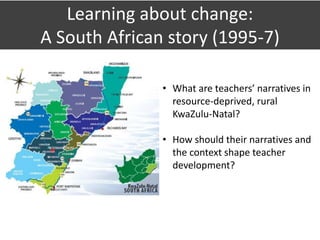
Learning about change:
A South African story (1995-7)
• What are teachers’ narratives in
resource-deprived, rural
KwaZulu-Natal?
• How should their narratives and
the context shape teacher
development?
43:1 pupil teacher ratios?
42% schools
electrified
34% schools
have no water
“I’ve seen nothing”
What did I learn about research and
change?
• It changed me
• Listening is important; making sense of people’s
stories in context vital
• The heart-side of doing research is marginalised
but needs a place in the canon
• It really matters how you tell the story
A story from Kolkata (1998):
The nun with a social justice habit
The Rainbow School, Loreto Sealdah
A school within a school
Elements of change
• Passion drives change
• Shared vision arises from action
• Change builds out of relationships
• Lack of resources is a red herring
• The best change is systemic and multi-dimensional
• Pace of change – chaos, risk, disorder
• Counter-intuitive risks can pay off…
Your thoughts about change
What is the single most important factor in bringing
about change and why? Chat to the person next to
you about it or….
Go to www.menti.com and use the code 79 15 6
Type in words or phrases in answer to the question.
TESTA: a ‘perfect storm’
of educational change principles?
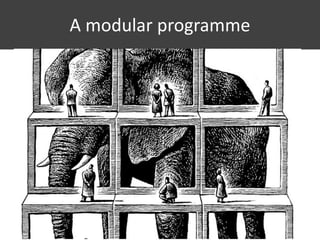
A modular programme
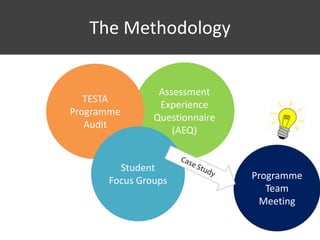
The Methodology
Programme
Team
Meeting
Assessment
Experience
Questionnaire
(AEQ)
TESTA
Programme
Audit
Student
Focus Groups
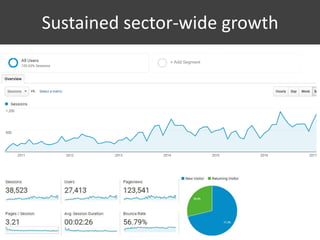
Sustained sector-wide growth
Why is TESTA a convincing change
initiative?
1. It speaks into the context
It was heavy, tons of marking for
the tutor. It was such hard work.
It was criminal.
Media Course Leader
I’m really bad at reading
feedback. I’ll look at the mark
and then be like ‘well stuff it, I
can’t do anything about it’
Student, TESTA focus group
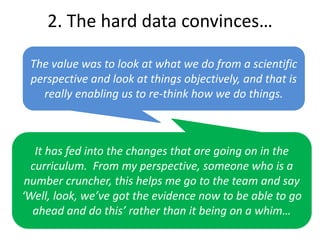
The value was to look at what we do from a scientific
perspective and look at things objectively, and that is
really enabling us to re-think how we do things.
2. The hard data convinces…
It has fed into the changes that are going on in the
curriculum. From my perspective, someone who is a
number cruncher, this helps me go to the team and say
‘Well, look, we’ve got the evidence now to be able to go
ahead and do this’ rather than it being on a whim…
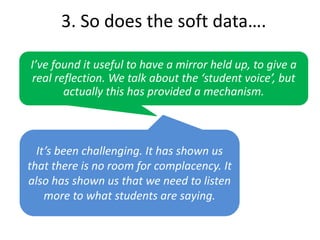
3. So does the soft data….
I’ve found it useful to have a mirror held up, to give a
real reflection. We talk about the ‘student voice’, but
actually this has provided a mechanism.
It’s been challenging. It has shown us
that there is no room for complacency. It
also has shown us that we need to listen
more to what students are saying.
4. But the tools alone are not enough….
I don’t think it’s just the
tools. The tools are
good and they work
really, really well, but
..[the change] comes
through a kind of
collegiality.
It’s been a collaborative
thing. It hasn’t just been
me saying to the team
“We’re going to do this”
It’s “This is what they’ve
found out folks. What
are we going to do
about it? How are we
going to develop it?
It is not top-down!
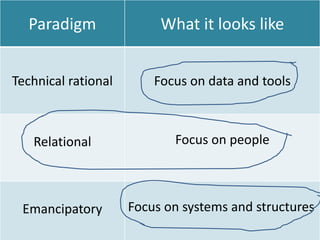
Paradigm What it looks like
Technical rational Focus on data and tools
Relational Focus on people
Emancipatory Focus on systems and structures
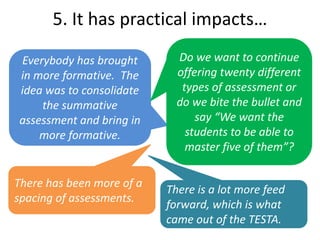
Everybody has brought
in more formative. The
idea was to consolidate
the summative
assessment and bring in
more formative.
Do we want to continue
offering twenty different
types of assessment or
do we bite the bullet and
say “We want the
students to be able to
master five of them”?
There has been more of a
spacing of assessments.
5. It has practical impacts…
There is a lot more feed
forward, which is what
came out of the TESTA.
Quick Pause
Which of these TESTA
change approaches
most resonates for you
and why?
Lessons learnt played out in TESTA
1. Listen to stories and perspectives
2. Develop ownership of the data
3. Work across the organisation with teams
4. Robust data and sound theory are convincing
5. So is the art of telling the research story
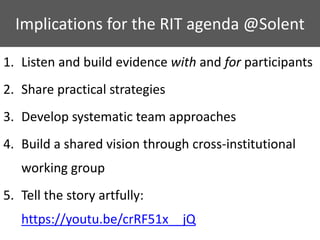
1. Listen and build evidence with and for participants
2. Share practical strategies
3. Develop systematic team approaches
4. Build a shared vision through cross-institutional
working group
5. Tell the story artfully:
https://youtu.be/crRF51x__jQ
Implications for the RIT agenda @Solent
References
Arum, R. and Roksa. J. Academically Adrift: Limited Learning on College Campuses. University of Chicago Press.
Barlow, A. and Jessop, T. (2016) “You can’t write a load of rubbish”: why blogging works as formative assessment. Educational Developments 17(3)
Gibbs, G. & Simpson, C. (2004) Conditions under which assessment supports students' learning. Learning and Teaching in Higher Education. 1(1): 3-31.
Jessop, T. (2017) Inspiring transformation through TESTA’s programme approach. Chapter 4 (49-64) in Scaling up Assessment for Learning in Higher
Education. Singapore. Springer.
Jessop, T. And Tomas, C. (2016) The implications of programme assessment patterns for student learning. Assessment and Evaluation in Higher Education.
Jessop, T. (2016) Seven years and still no itch – why TESTA keeps going. Educational Developments, 17(3) 5-8. SEDA.
Jessop, T. and Maleckar, B. (2014). The Influence of disciplinary assessment patterns on student learning: a comparative study. Studies in Higher Education.
Published Online 27 August 2014
Jessop, T. , El Hakim, Y. and Gibbs, G. (2014) The whole is greater than the sum of its parts: a large-scale study of students’ learning in response to different
assessment patterns. Assessment and Evaluation in Higher Education. 39(1) 73-88.
Jessop, T., El Hakim, Y. and Gibbs, G. TESTA 2014: A way of thinking about assessment and feedback. Educational Developments 14:3.
Jessop, T., El Hakim, Y. and Gibbs, G. 2011. TESTA: Research Inspiring Change. Educational Developments 12(4) 12-16.
Jessop, T. 2001. Key ingredients in the search for social justice: A case study of 'best practice' in a Calcutta school. Catholic Education: A Journal of Inquiry
and Practice, 5 (1). 100-115.
Jessop, T. and Penny, A. 1999. A story behind a story: Developing strategies for making sense of teacher narratives. International Journal of Social
Research Methodology 2 (3). 213-230.
Jessop, T. and Penny, A. 1998. Recovering Teacher Voice and Vision in the Narratives of South African and Gambian Teachers: Implications for Teacher
Development Policy and Practice. International Journal of Education Development, 18. (5). 393-403.
Jessop, T. 1997. Towards a Grounded Theory of Teacher Development: A narrative study of rural primary teachers in KwaZulu-Natal, King Alfred’s College,
accredited by the University of Southampton.
TESTA (2009-17) Transforming the Experience of Students through Assessment (www.testa.ac.uk)

Inaugural lecture

  • 1.
    Click to editMaster title style Inaugural professorial of Dr Tansy Jessop Fostering educational change through research: stories from the field. 15 March 2017
  • 2.
    Click to editMaster title style Welcome Professor Graham Baldwin Vice-Chancellor Southampton Solent University
  • 3.
    Fostering change throughresearch: Stories from the field Tansy Jessop Inaugural Lecture Southampton Solent University 15 March 2017 @tansyjtweets @solentlearning
  • 4.
    The lecture • Educationalchange is difficult • Learning about change in the field • Bringing about change through TESTA • Principles of change
  • 5.
    Proving is differentfrom improving “It is incredibly difficult to translate assessment evidence into improvements in student learning” “It’s far less risky and complicated to analyze data than it is to act” (Blaich & Wise, 2011)
  • 6.
    Learning about change: ASouth African story (1995-7) • What are teachers’ narratives in resource-deprived, rural KwaZulu-Natal? • How should their narratives and the context shape teacher development?
  • 7.
    43:1 pupil teacherratios? 42% schools electrified 34% schools have no water
  • 8.
  • 9.
    What did Ilearn about research and change? • It changed me • Listening is important; making sense of people’s stories in context vital • The heart-side of doing research is marginalised but needs a place in the canon • It really matters how you tell the story
  • 10.
    A story fromKolkata (1998): The nun with a social justice habit
  • 11.
    The Rainbow School,Loreto Sealdah A school within a school
  • 12.
    Elements of change •Passion drives change • Shared vision arises from action • Change builds out of relationships • Lack of resources is a red herring • The best change is systemic and multi-dimensional • Pace of change – chaos, risk, disorder • Counter-intuitive risks can pay off…
  • 13.
    Your thoughts aboutchange What is the single most important factor in bringing about change and why? Chat to the person next to you about it or…. Go to www.menti.com and use the code 79 15 6 Type in words or phrases in answer to the question.
  • 14.
    TESTA: a ‘perfectstorm’ of educational change principles?
  • 16.
  • 17.
  • 18.
  • 19.
    Why is TESTAa convincing change initiative?
  • 20.
    1. It speaksinto the context It was heavy, tons of marking for the tutor. It was such hard work. It was criminal. Media Course Leader I’m really bad at reading feedback. I’ll look at the mark and then be like ‘well stuff it, I can’t do anything about it’ Student, TESTA focus group
  • 21.
    The value wasto look at what we do from a scientific perspective and look at things objectively, and that is really enabling us to re-think how we do things. 2. The hard data convinces… It has fed into the changes that are going on in the curriculum. From my perspective, someone who is a number cruncher, this helps me go to the team and say ‘Well, look, we’ve got the evidence now to be able to go ahead and do this’ rather than it being on a whim…
  • 22.
    3. So doesthe soft data…. I’ve found it useful to have a mirror held up, to give a real reflection. We talk about the ‘student voice’, but actually this has provided a mechanism. It’s been challenging. It has shown us that there is no room for complacency. It also has shown us that we need to listen more to what students are saying.
  • 23.
    4. But thetools alone are not enough…. I don’t think it’s just the tools. The tools are good and they work really, really well, but ..[the change] comes through a kind of collegiality. It’s been a collaborative thing. It hasn’t just been me saying to the team “We’re going to do this” It’s “This is what they’ve found out folks. What are we going to do about it? How are we going to develop it?
  • 24.
    It is nottop-down!
  • 25.
    Paradigm What itlooks like Technical rational Focus on data and tools Relational Focus on people Emancipatory Focus on systems and structures
  • 26.
    Everybody has brought inmore formative. The idea was to consolidate the summative assessment and bring in more formative. Do we want to continue offering twenty different types of assessment or do we bite the bullet and say “We want the students to be able to master five of them”? There has been more of a spacing of assessments. 5. It has practical impacts… There is a lot more feed forward, which is what came out of the TESTA.
  • 27.
    Quick Pause Which ofthese TESTA change approaches most resonates for you and why?
  • 28.
    Lessons learnt playedout in TESTA 1. Listen to stories and perspectives 2. Develop ownership of the data 3. Work across the organisation with teams 4. Robust data and sound theory are convincing 5. So is the art of telling the research story
  • 29.
    1. Listen andbuild evidence with and for participants 2. Share practical strategies 3. Develop systematic team approaches 4. Build a shared vision through cross-institutional working group 5. Tell the story artfully: https://youtu.be/crRF51x__jQ Implications for the RIT agenda @Solent
  • 30.
    References Arum, R. andRoksa. J. Academically Adrift: Limited Learning on College Campuses. University of Chicago Press. Barlow, A. and Jessop, T. (2016) “You can’t write a load of rubbish”: why blogging works as formative assessment. Educational Developments 17(3) Gibbs, G. & Simpson, C. (2004) Conditions under which assessment supports students' learning. Learning and Teaching in Higher Education. 1(1): 3-31. Jessop, T. (2017) Inspiring transformation through TESTA’s programme approach. Chapter 4 (49-64) in Scaling up Assessment for Learning in Higher Education. Singapore. Springer. Jessop, T. And Tomas, C. (2016) The implications of programme assessment patterns for student learning. Assessment and Evaluation in Higher Education. Jessop, T. (2016) Seven years and still no itch – why TESTA keeps going. Educational Developments, 17(3) 5-8. SEDA. Jessop, T. and Maleckar, B. (2014). The Influence of disciplinary assessment patterns on student learning: a comparative study. Studies in Higher Education. Published Online 27 August 2014 Jessop, T. , El Hakim, Y. and Gibbs, G. (2014) The whole is greater than the sum of its parts: a large-scale study of students’ learning in response to different assessment patterns. Assessment and Evaluation in Higher Education. 39(1) 73-88. Jessop, T., El Hakim, Y. and Gibbs, G. TESTA 2014: A way of thinking about assessment and feedback. Educational Developments 14:3. Jessop, T., El Hakim, Y. and Gibbs, G. 2011. TESTA: Research Inspiring Change. Educational Developments 12(4) 12-16. Jessop, T. 2001. Key ingredients in the search for social justice: A case study of 'best practice' in a Calcutta school. Catholic Education: A Journal of Inquiry and Practice, 5 (1). 100-115. Jessop, T. and Penny, A. 1999. A story behind a story: Developing strategies for making sense of teacher narratives. International Journal of Social Research Methodology 2 (3). 213-230. Jessop, T. and Penny, A. 1998. Recovering Teacher Voice and Vision in the Narratives of South African and Gambian Teachers: Implications for Teacher Development Policy and Practice. International Journal of Education Development, 18. (5). 393-403. Jessop, T. 1997. Towards a Grounded Theory of Teacher Development: A narrative study of rural primary teachers in KwaZulu-Natal, King Alfred’s College, accredited by the University of Southampton. TESTA (2009-17) Transforming the Experience of Students through Assessment (www.testa.ac.uk)

Editor's Notes

  • #5 Meta-analysis of change. Learning about change using learning from three projects; applying lessons in bringing about change through TESTA
  • #6 Wabash study – 2005-2011, 17,000 students in 49 American colleges. 60-70 publications Critical thinking, moral reasoning, leadership towards social justice, engagement in diversity, deep intellectual work.
  • #7 Changing professional development of teachers…Why teacher development ‘decided in Pretoria, and telegraphed to the provinces’ may not work?
  • #10 The art of doing research; taking stories to the heart of the problem. Sensory experience – Clifford Geertz – a good interpretation takes you to the heart of what is being experienced
  • #11 The secret ingredient of change is wanting it badly enough (Deborah Meier, East Harlem) – progressive schools
  • #13 Education has a moral dimension; sense of outrage; making compassion compulsory the pace of change: opposite of Fabians! What do we want – incremental change! When do we want it? in due course! 45 schools in India have taken on the Rainbow school model. Seeded other changes; uses existing resources to benefit a wider constituency
  • #14 Think of a change initiative you have been part of.
  • #15 Bringing about change on a large scale. A snapshot of TESTA, but this talk is not mainly about the amazing things people do as a result of TESTA, its’s about why and how change happens.
  • #17 We are all looking at our own modules and it doesn’t add up. Very little knowledge of the whole beast. TESTA helps people see the whole picture, particularly from a student perspective, and helps academics design in more connections, less measurement, and deeper learning. Breaks down walls and silos. Team approach.
  • #21 Feedback: all that effort, but what is the effect? Margaret Price But lots of projects and programmes do….
  • #26 TESTA has done the data and that’s been useful. Ideological compromises. Mixed methods approaches. Critical pedagogy sleeping with the enemy. Democratic, participatory, liberating curriculum and pedagogy. Teachers and students shape and change education. Resist managerialism and the market. Risky pedagogies.
  • #27 Root, branch, ecological changes – Hargreaves and Fullan
  • #30 through curriculum design, PGCLTHE vanguard, and CPD