Rebuilding the broken feedback
relationship through TESTA’s
programme approach
Tansy Jessop
Enhancing Feedback in Y1 Symposium
Maynooth University, Dublin
#y1feedback @tansyjtweets
Powerful feedback
• Think of a time you received powerful feedback.
• What three words spring to mind about that
feedback?
• Go to www.menti.com and use the code 48 01 25
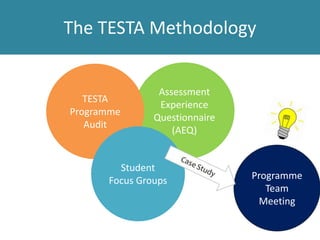
The TESTA Methodology
Programme
Team
Meeting
Assessment
Experience
Questionnaire
(AEQ)
TESTA
Programme
Audit
Student
Focus Groups
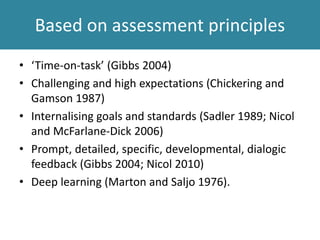
Based on assessment principles
• ‘Time-on-task’ (Gibbs 2004)
• Challenging and high expectations (Chickering and
Gamson 1987)
• Internalising goals and standards (Sadler 1989; Nicol
and McFarlane-Dick 2006)
• Prompt, detailed, specific, developmental, dialogic
feedback (Gibbs 2004; Nicol 2010)
• Deep learning (Marton and Saljo 1976).
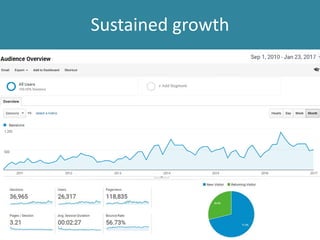
Sustained growth
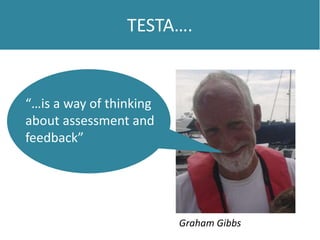
TESTA….
“…is a way of thinking
about assessment and
feedback”
Graham Gibbs
TESTA reveals the whole elephant…
Key findings from TESTA
1. Modular design makes feedback less
effective
2. Modules squeeze out formative tasks and
feedback
3. There is a missing relational dimension
Defining the terms
• Summative assessment carries a grade which
counts toward the degree classification.
• Formative assessment does not count
towards the degree (either pass/fail or a
grade), elicits comments and is required to be
done by all students.
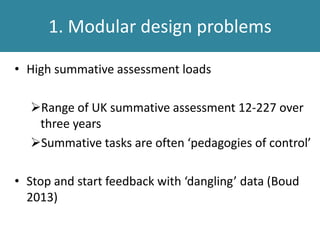
Modular design problems
• High summative assessment loads
Range of UK summative assessment 12-227 over
three years
• Trivialises feedback for students
• Burdensome for lecturers
1. Modular design problems
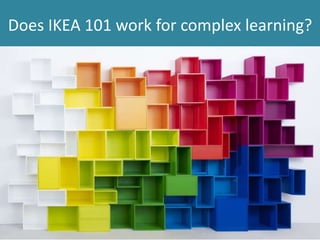
Does IKEA 101 work for complex learning?
Content Vs Concepts?
The best approach from the student’s perspective is to focus
on concepts. I’m sorry to break it to you, but your students are
not going to remember 90 per cent – possibly 99 per cent – of
what you teach them unless it’s conceptual…. when broad,
over-arching connections are made, education occurs. Most
details are only a necessary means to that end.
http://www.timeshighereducation.co.uk/features/a-students-
lecture-to-rofessors/2013238.fullarticle#.U3orx_f9xWc.twitter
A Student’s lecture to her professor
Take five: in pairs
• Choose a student quote
that strikes you.
• What is the key issue?
• What strategies might
address this issue?
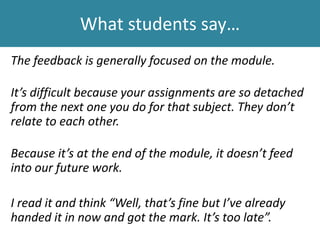
What students say…
The feedback is generally focused on the module.
It’s difficult because your assignments are so detached
from the next one you do for that subject. They don’t
relate to each other.
Because it’s at the end of the module, it doesn’t feed
into our future work.
I read it and think “Well, that’s fine but I’ve already
handed it in now and got the mark. It’s too late”.
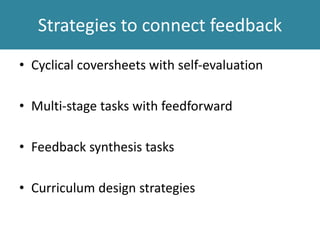
Strategies to connect feedback
• Cyclical coversheets with self-evaluation
• Multi-stage tasks with feedforward
• Feedback synthesis tasks
• Curriculum design strategies
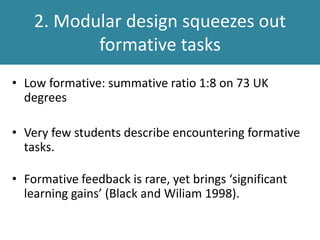
• Low formative: summative ratio 1:8 on 73 UK
degrees
• Very few students describe encountering formative
tasks.
• Formative feedback is rare, yet brings ‘significant
learning gains’ (Black and Wiliam 1998).
2. Modules squeezes out formative
tasks
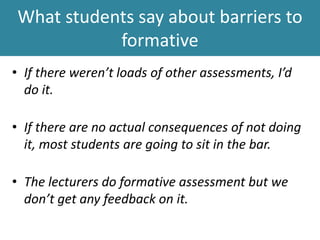
What students say about barriers to
formative
• If there weren’t loads of other assessments, I’d
do it.
• If there are no actual consequences of not doing
it, most students are going to sit in the bar.
• The lecturers do formative assessment but we
don’t get any feedback on it.
What TESTA programmes have done…
• Rebalance formative and summative
• Formative as required gateway tasks
• Multi-stage linked formative-summative
• Public domain tasks
• Authentic tasks
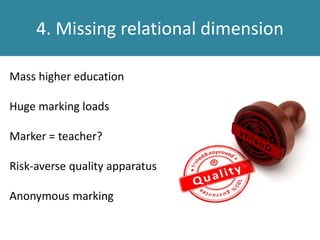
3. Missing relational dimension
Mass higher education
Huge marking loads
Marker = teacher?
Risk-averse quality apparatus
Anonymous marking
What students say
Because they have to mark so many that our essay
becomes lost in the sea that they have to mark.
It was like ‘Who’s Holly?’ It’s that relationship
where you’re just a student.
Here they say ‘Oh yes, I don’t know who you are.
Got too many to remember, don’t really care, I’ll
mark you on your assignment’.
Take five: in pairs
• What is your view of
giving personal
feedback?
• What challenges does it
pose?
A quick case study
I’m baffled.
Students love my
feedback but
they are a voice
in the
wilderness…
TESTA programme strategies
• Formative feedback – informal, immediate,
conversational
• Peer feedback
• Audio and screencast feedback
• Blogging on academic texts with informal threads
• Developmental feedback (measuring performance
against past performance)
Shifting the educational paradigm
from…
Transmission Model
Social Constructivist Model
References
Arum, R. and Roksa. J. Academically Adrift: Limited Learning on College Campuses. University of Chicago Press.
Barlow, A. and Jessop, T. (2016) “You can’t write a load of rubbish”: why blogging works as formative assessment. Educational Developments 17(3)
Boud, D. and Molloy, E (2013) Rethinking models of feedback for learning: the challenge of design Assessment & Evaluation in Higher Education, 38:6, 698-
712
Boud, D. and Molloy, E (2013) Feedback in Higher and Professional Education. Understanding it and doing it better. Abingdon. Routledge.
Boud, D. and Falchikov, N. (2007) Rethinking Assessment in Higher Education. Abingdon. Routledge.
Dweck, C. (2006) Mindset: How can fulfil your potential. Robinson.
Gibbs, G. & Simpson, C. (2004) Conditions under which assessment supports students' learning. Learning and Teaching in Higher Education. 1(1): 3-31.
Hattie, J. (2007) The Power of Feedback. Review of Educational Research. 77(1) 81-112.
Hughes, G. (2014) Ipsative Assessment. Basingstoke. Palgrave MacMillan.
Jessop, T. (2017) Inspiring transformation through TESTA’s programme approach. Scaling up Assessment for Learning in Higher Education. Singapore.
Springer.
Jessop, T. And Tomas, C. (2016) The implications of programme assessment patterns for student learning. Assessment and Evaluation in Higher Education.
Jessop, T. and Maleckar, B. (2014). The Influence of disciplinary assessment patterns on student learning: a comparative study. Studies in Higher Education.
Published Online 27 August 2014
Jessop, T. , El Hakim, Y. and Gibbs, G. (2014) The whole is greater than the sum of its parts: a large-scale study of students’ learning in response to different
assessment patterns. Assessment and Evaluation in Higher Education. 39(1) 73-88.
Nicol, D. (2010) From monologue to dialogue: improving written feedback processes in mass higher education.
Assessment & Evaluation in Higher Education, 35: 5, 501 – 517.
Nicol, D. and McFarlane-Dick D. (2006) Formative Assessment and Self-Regulated Learning: A Model and Seven Principles of Good Feedback Practice. Studies
in Higher Education. 31(2): 199-218.
Sadler, D.R. (1989) Formative assessment and the design of instructional systems. Instructional Science, 18, 119-144.
TESTA (2009-16) Transforming the Experience of Students through Assessment (www.testa.ac.uk)

Y1 Feedback Project, Maynooth Ireland

  • 1.
    Rebuilding the brokenfeedback relationship through TESTA’s programme approach Tansy Jessop Enhancing Feedback in Y1 Symposium Maynooth University, Dublin #y1feedback @tansyjtweets
  • 2.
    Powerful feedback • Thinkof a time you received powerful feedback. • What three words spring to mind about that feedback? • Go to www.menti.com and use the code 48 01 25
  • 4.
  • 5.
    Based on assessmentprinciples • ‘Time-on-task’ (Gibbs 2004) • Challenging and high expectations (Chickering and Gamson 1987) • Internalising goals and standards (Sadler 1989; Nicol and McFarlane-Dick 2006) • Prompt, detailed, specific, developmental, dialogic feedback (Gibbs 2004; Nicol 2010) • Deep learning (Marton and Saljo 1976).
  • 6.
  • 7.
    TESTA…. “…is a wayof thinking about assessment and feedback” Graham Gibbs
  • 8.
    TESTA reveals thewhole elephant…
  • 9.
    Key findings fromTESTA 1. Modular design makes feedback less effective 2. Modules squeeze out formative tasks and feedback 3. There is a missing relational dimension
  • 10.
    Defining the terms •Summative assessment carries a grade which counts toward the degree classification. • Formative assessment does not count towards the degree (either pass/fail or a grade), elicits comments and is required to be done by all students.
  • 11.
    Modular design problems •High summative assessment loads Range of UK summative assessment 12-227 over three years • Trivialises feedback for students • Burdensome for lecturers 1. Modular design problems
  • 12.
    Does IKEA 101work for complex learning?
  • 13.
  • 14.
    The best approachfrom the student’s perspective is to focus on concepts. I’m sorry to break it to you, but your students are not going to remember 90 per cent – possibly 99 per cent – of what you teach them unless it’s conceptual…. when broad, over-arching connections are made, education occurs. Most details are only a necessary means to that end. http://www.timeshighereducation.co.uk/features/a-students- lecture-to-rofessors/2013238.fullarticle#.U3orx_f9xWc.twitter A Student’s lecture to her professor
  • 15.
    Take five: inpairs • Choose a student quote that strikes you. • What is the key issue? • What strategies might address this issue?
  • 16.
    What students say… Thefeedback is generally focused on the module. It’s difficult because your assignments are so detached from the next one you do for that subject. They don’t relate to each other. Because it’s at the end of the module, it doesn’t feed into our future work. I read it and think “Well, that’s fine but I’ve already handed it in now and got the mark. It’s too late”.
  • 17.
    Strategies to connectfeedback • Cyclical coversheets with self-evaluation • Multi-stage tasks with feedforward • Feedback synthesis tasks • Curriculum design strategies
  • 18.
    • Low formative:summative ratio 1:8 on 73 UK degrees • Very few students describe encountering formative tasks. • Formative feedback is rare, yet brings ‘significant learning gains’ (Black and Wiliam 1998). 2. Modules squeezes out formative tasks
  • 19.
    What students sayabout barriers to formative • If there weren’t loads of other assessments, I’d do it. • If there are no actual consequences of not doing it, most students are going to sit in the bar. • The lecturers do formative assessment but we don’t get any feedback on it.
  • 20.
    What TESTA programmeshave done… • Rebalance formative and summative • Formative as required gateway tasks • Multi-stage linked formative-summative • Public domain tasks • Authentic tasks
  • 21.
    3. Missing relationaldimension Mass higher education Huge marking loads Marker = teacher? Risk-averse quality apparatus Anonymous marking
  • 22.
    What students say Becausethey have to mark so many that our essay becomes lost in the sea that they have to mark. It was like ‘Who’s Holly?’ It’s that relationship where you’re just a student. Here they say ‘Oh yes, I don’t know who you are. Got too many to remember, don’t really care, I’ll mark you on your assignment’.
  • 23.
    Take five: inpairs • What is your view of giving personal feedback? • What challenges does it pose?
  • 24.
    A quick casestudy I’m baffled. Students love my feedback but they are a voice in the wilderness…
  • 25.
    TESTA programme strategies •Formative feedback – informal, immediate, conversational • Peer feedback • Audio and screencast feedback • Blogging on academic texts with informal threads • Developmental feedback (measuring performance against past performance)
  • 26.
    Shifting the educationalparadigm from…
  • 27.
  • 28.
  • 29.
    References Arum, R. andRoksa. J. Academically Adrift: Limited Learning on College Campuses. University of Chicago Press. Barlow, A. and Jessop, T. (2016) “You can’t write a load of rubbish”: why blogging works as formative assessment. Educational Developments 17(3) Boud, D. and Molloy, E (2013) Rethinking models of feedback for learning: the challenge of design Assessment & Evaluation in Higher Education, 38:6, 698- 712 Boud, D. and Molloy, E (2013) Feedback in Higher and Professional Education. Understanding it and doing it better. Abingdon. Routledge. Boud, D. and Falchikov, N. (2007) Rethinking Assessment in Higher Education. Abingdon. Routledge. Dweck, C. (2006) Mindset: How can fulfil your potential. Robinson. Gibbs, G. & Simpson, C. (2004) Conditions under which assessment supports students' learning. Learning and Teaching in Higher Education. 1(1): 3-31. Hattie, J. (2007) The Power of Feedback. Review of Educational Research. 77(1) 81-112. Hughes, G. (2014) Ipsative Assessment. Basingstoke. Palgrave MacMillan. Jessop, T. (2017) Inspiring transformation through TESTA’s programme approach. Scaling up Assessment for Learning in Higher Education. Singapore. Springer. Jessop, T. And Tomas, C. (2016) The implications of programme assessment patterns for student learning. Assessment and Evaluation in Higher Education. Jessop, T. and Maleckar, B. (2014). The Influence of disciplinary assessment patterns on student learning: a comparative study. Studies in Higher Education. Published Online 27 August 2014 Jessop, T. , El Hakim, Y. and Gibbs, G. (2014) The whole is greater than the sum of its parts: a large-scale study of students’ learning in response to different assessment patterns. Assessment and Evaluation in Higher Education. 39(1) 73-88. Nicol, D. (2010) From monologue to dialogue: improving written feedback processes in mass higher education. Assessment & Evaluation in Higher Education, 35: 5, 501 – 517. Nicol, D. and McFarlane-Dick D. (2006) Formative Assessment and Self-Regulated Learning: A Model and Seven Principles of Good Feedback Practice. Studies in Higher Education. 31(2): 199-218. Sadler, D.R. (1989) Formative assessment and the design of instructional systems. Instructional Science, 18, 119-144. TESTA (2009-16) Transforming the Experience of Students through Assessment (www.testa.ac.uk)

Editor's Notes

  • #14 Language of ‘covering material’ Should we be surprised?