Curriculum as counter-narrative: co-constructing
a framework for ‘personal knowing’
Tansy Jessop and Claire Saunders
SEDA, Birmingham 16 October 2018
Who
am I?
How do I
know
this is
true?
What is truth?
Any evidence
to back it up?
This is costing
me a fortune –
do I care about
truth claims?
2
• Our context: who we are
• Your thoughts about curriculum (and a card game)
• Developing our framework: the process (more cards!)
• The theory behind the framework
• Bringing about culture change
• Tensions and how we might overcome them
The workshop
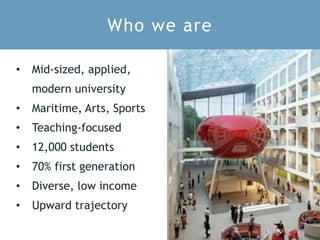
Who we are
• Mid-sized, applied,
modern university
• Maritime, Arts, Sports
• Teaching-focused
• 12,000 students
• 70% first generation
• Diverse, low income
• Upward trajectory
4
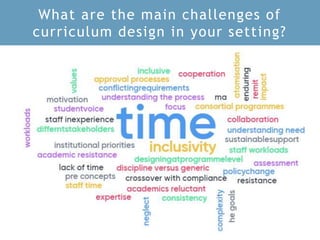
What are the main challenges of
curriculum design in your setting?
Go to www.menti.com and use the code 98 53 96
Thinking about your context, write down three
words or phrases which sum up the curriculum
design challenges for you.
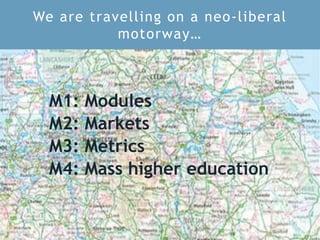
We are travelling on a neo-liberal
motorway…
M1: Modules
M2: Markets
M3: Metrics
M4: Mass higher education
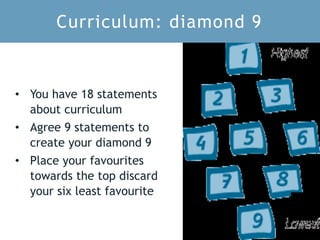
• You have 18 statements
about curriculum
• Agree 9 statements to
create your diamond 9
• Place your favourites
towards the top discard
your six least favourite
Curriculum: diamond 9
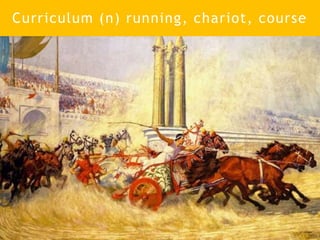
Curriculum (n) running, chariot, course
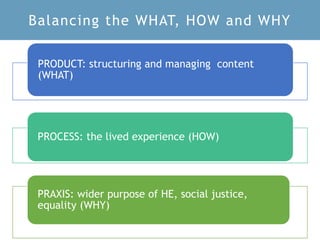
Balancing the WHAT, HOW and WHY
PRODUCT: structuring and managing content
(WHAT)
PROCESS: the lived experience (HOW)
PRAXIS: wider purpose of HE, social justice,
equality (WHY)
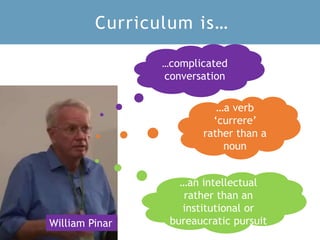
Curriculum is…
…complicated
conversation
…a verb
‘currere’
rather than a
noun
…an intellectual
rather than an
institutional or
bureaucratic pursuitWilliam Pinar
So why a curriculum framework?
• Make a difference to the student experience
• …in a consistent and systematic way
• …but not in a strait-jacket
• Articulate shared educational purpose
• Identify what makes us special and how we want
to grow and develop
• Develop a more thoughtful and theoretical
approach to curriculum design
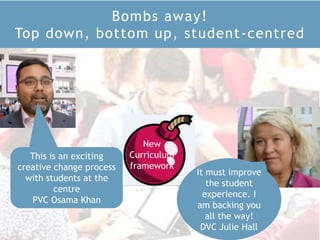
Bombs away!
Top down, bottom up, student-centred
This is an exciting
creative change process
with students at the
centre
PVC Osama Khan
It must improve
the student
experience. I
am backing you
all the way!
DVC Julie Hall
New
Curriculum
framework
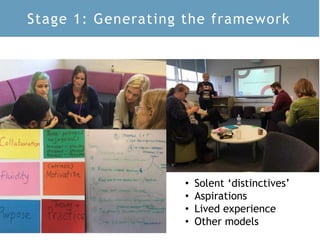
Stage 1: Generating the framework
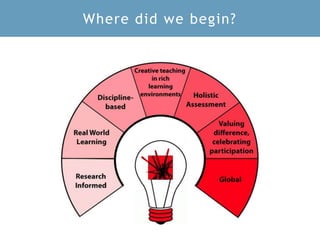
• Solent ‘distinctives’
• Aspirations
• Lived experience
• Other models
Where did we begin?
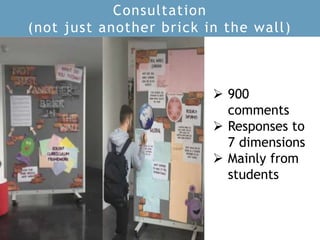
Consultation
(not just another brick in the wall)
 900
comments
 Responses to
7 dimensions
 Mainly from
students
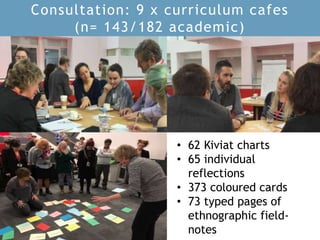
Consultation: 9 x curriculum cafes
(n= 143/182 academic)
• 62 Kiviat charts
• 65 individual
reflections
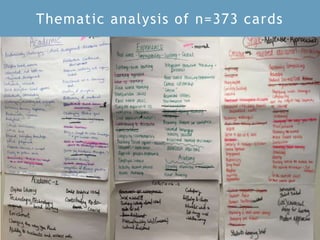
• 373 coloured cards
• 73 typed pages of
ethnographic field-
notes
1 6
• What would you want to see in a curriculum
framework at your university?
• Write down three crucial things: one per card
• Thematically analyse responses
Card activity
S L T C C 2 0 1 8 1 7
So, I’ve been thinking about all this data we have so helpfully generated for
ourselves. I think we have the following:
• a few hundred Curriculum Wall quotes
• more pieces of coloured card than I’ve ever seen in my life
• a whole bunch of kiviat charts with pretty shapes on them
• half the professional services and a few academics’ thoughts about the
new curriculum framework
• less completed online questionnaires than we might have hoped for
• a set of random images of diamond nines (on various people’s portable
devices)
• pages…and pages…and pages…and pages…of ethnographic field notes
The analysis should be a piece of cake, eh (or, more accurately, will require the
consumption of large amounts of cake along the way).
A lot of data
Thematic analysis of n=373 cards
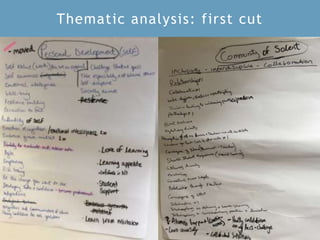
Thematic analysis: first cut
Theory behind the framework
• Balancing knowing, acting and being (Barnett
and Coate 2004)
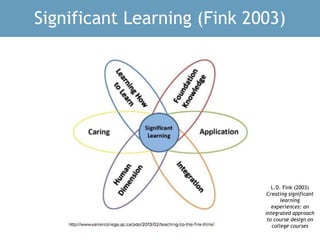
• Significant learning (Fink 2003)
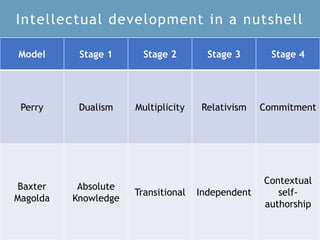
• Intellectual journeys (Perry 1998; Baxter-
Magolda 2001)
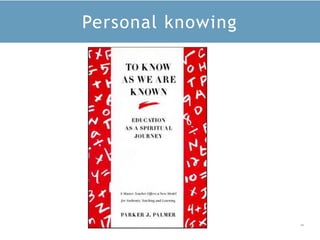
• Personal knowing (Polanyi 1954;1966; Palmer
1983)
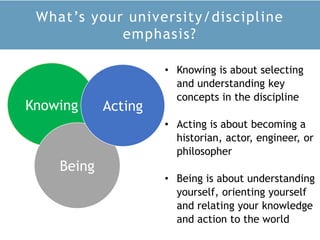
What’s your university/discipline
emphasis?
• Knowing is about selecting
and understanding key
concepts in the discipline
• Acting is about becoming a
historian, actor, engineer, or
philosopher
• Being is about understanding
yourself, orienting yourself
and relating your knowledge
and action to the world
Knowing
Being
Acting
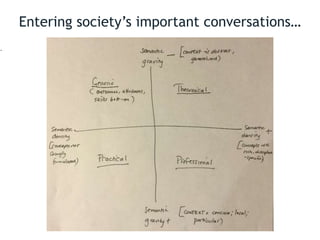
Entering society’s important conversations…
.
L.D. Fink (2003)
Creating significant
learning
experiences: an
integrated approach
to course design on
college courses
Significant Learning (Fink 2003)
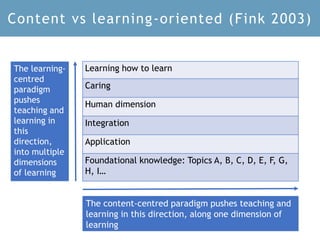
Learning how to learn
Caring
Human dimension
Integration
Application
Foundational knowledge: Topics A, B, C, D, E, F, G,
H, I…
The learning-
centred
paradigm
pushes
teaching and
learning in
this
direction,
into multiple
dimensions
of learning
The content-centred paradigm pushes teaching and
learning in this direction, along one dimension of
learning
Content vs learning-oriented (Fink 2003)
Intellectual development in a nutshell
Model Stage 1 Stage 2 Stage 3 Stage 4
Perry Dualism Multiplicity Relativism Commitment
Baxter
Magolda
Absolute
Knowledge
Transitional Independent
Contextual
self-
authorship
2 6
Personal knowing
2 7
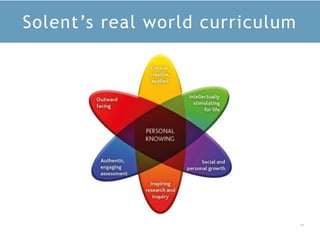
Solent’s real world curriculum
2 8
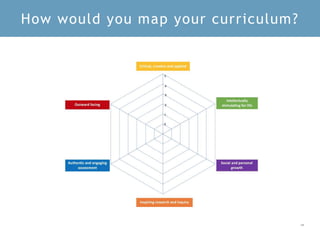
How would you map your curriculum?
2 9
Chatting time
Talk to a partner:
Which one of the dimensions:
a. excites you?
b. puzzles you?
c. what might this look like in your discipline?
P R E S E N T A T I O N T I T L E – G O T O I N S E R T > H E A D E R & F O O T E R T O E D I T T H I S T E X T 3 0
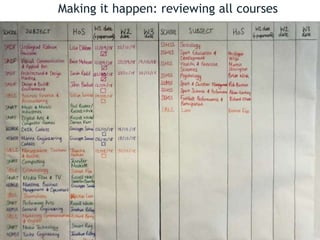
Making it happen: reviewing all courses
P R E S E N T A T I O N T I T L E – G O T O I N S E R T > H E A D E R & F O O T E R T O E D I T T H I S T E X T 3 1
Work with quality
Flow chart!
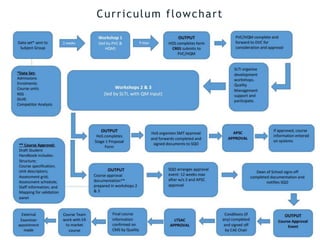
Curriculum flowchart
P R E S E N T A T I O N T I T L E – G O T O I N S E R T > H E A D E R & F O O T E R T O E D I T T H I S T E X T 3 2
Curriculum Framework
Workshop 2:
Vision, ideas,
philosophy
P R E S E N T A T I O N T I T L E – G O T O I N S E R T > H E A D E R & F O O T E R T O E D I T T H I S T E X T 3 3
CURRICULUM FRAMEWORK
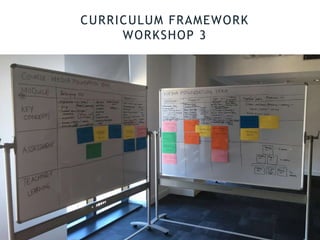
WORKSHOP 3
Listen and write
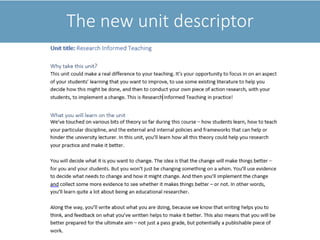
Talk to a partner about your unit, as if they are a student. Tell
them:
• What is novel and exciting and significant about the unit
• What they will learn and become through the unit
• How they will learn and be assessed
• What knowledge and capability they will take away from it
• How it links to industry and to other units on the degree
PARTNER: Please jot down key words while they talk.
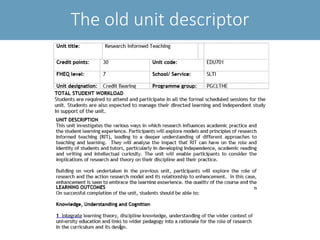
The old unit descriptor
The new unit descriptor
Are we there yet?
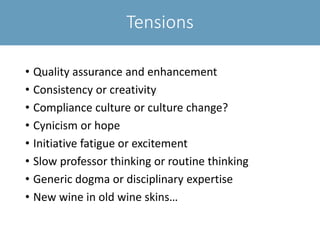
Tensions
• Quality assurance and enhancement
• Consistency or creativity
• Compliance culture or culture change?
• Cynicism or hope
• Initiative fatigue or excitement
• Slow professor thinking or routine thinking
• Generic dogma or disciplinary expertise
• New wine in old wine skins…
Can the caged bird fly?
References
Barnett, R. and Coate, K. 2004. Engaging the curriculum in higher education.
Maidenhead: Society for Research into Higher Education & Open University
Press.
Baxter-Magolda, M. 2001. Making their own way: Narratives for
transforming Higher Education to promote self-development.
Davies, Mark 2017. Developing 'A Personal Knowing': A Grounded Theory
Study. PhD. University of South Wales.
Fink, L. Dee 2013. Creating significant learning experiences: an integrated
approach to course design on college courses.
Palmer, P. 1983. To know as we are known: Education as a Spiritual Journey.
HarperOne.
Perry, W. 1998. Forms of Ethical Intellectual Development in the College
Years: A Scheme.
Polanyi, M. 1966. The Tacit Dimension. Chicago. University of Chicago Press.
Polanyi, M. 1958. Personal Knowledge: towards a post-critical philosophy.

Curriculum as counter narrative

  • 1.
    Curriculum as counter-narrative:co-constructing a framework for ‘personal knowing’ Tansy Jessop and Claire Saunders SEDA, Birmingham 16 October 2018 Who am I? How do I know this is true? What is truth? Any evidence to back it up? This is costing me a fortune – do I care about truth claims?
  • 2.
    2 • Our context:who we are • Your thoughts about curriculum (and a card game) • Developing our framework: the process (more cards!) • The theory behind the framework • Bringing about culture change • Tensions and how we might overcome them The workshop
  • 3.
    Who we are •Mid-sized, applied, modern university • Maritime, Arts, Sports • Teaching-focused • 12,000 students • 70% first generation • Diverse, low income • Upward trajectory
  • 4.
    4 What are themain challenges of curriculum design in your setting? Go to www.menti.com and use the code 98 53 96 Thinking about your context, write down three words or phrases which sum up the curriculum design challenges for you.
  • 5.
    We are travellingon a neo-liberal motorway… M1: Modules M2: Markets M3: Metrics M4: Mass higher education
  • 6.
    • You have18 statements about curriculum • Agree 9 statements to create your diamond 9 • Place your favourites towards the top discard your six least favourite Curriculum: diamond 9
  • 7.
    Curriculum (n) running,chariot, course
  • 8.
    Balancing the WHAT,HOW and WHY PRODUCT: structuring and managing content (WHAT) PROCESS: the lived experience (HOW) PRAXIS: wider purpose of HE, social justice, equality (WHY)
  • 9.
    Curriculum is… …complicated conversation …a verb ‘currere’ ratherthan a noun …an intellectual rather than an institutional or bureaucratic pursuitWilliam Pinar
  • 10.
    So why acurriculum framework? • Make a difference to the student experience • …in a consistent and systematic way • …but not in a strait-jacket • Articulate shared educational purpose • Identify what makes us special and how we want to grow and develop • Develop a more thoughtful and theoretical approach to curriculum design
  • 11.
    Bombs away! Top down,bottom up, student-centred This is an exciting creative change process with students at the centre PVC Osama Khan It must improve the student experience. I am backing you all the way! DVC Julie Hall New Curriculum framework
  • 12.
    Stage 1: Generatingthe framework • Solent ‘distinctives’ • Aspirations • Lived experience • Other models
  • 13.
  • 14.
    Consultation (not just anotherbrick in the wall)  900 comments  Responses to 7 dimensions  Mainly from students
  • 15.
    Consultation: 9 xcurriculum cafes (n= 143/182 academic) • 62 Kiviat charts • 65 individual reflections • 373 coloured cards • 73 typed pages of ethnographic field- notes
  • 16.
    1 6 • Whatwould you want to see in a curriculum framework at your university? • Write down three crucial things: one per card • Thematically analyse responses Card activity
  • 17.
    S L TC C 2 0 1 8 1 7 So, I’ve been thinking about all this data we have so helpfully generated for ourselves. I think we have the following: • a few hundred Curriculum Wall quotes • more pieces of coloured card than I’ve ever seen in my life • a whole bunch of kiviat charts with pretty shapes on them • half the professional services and a few academics’ thoughts about the new curriculum framework • less completed online questionnaires than we might have hoped for • a set of random images of diamond nines (on various people’s portable devices) • pages…and pages…and pages…and pages…of ethnographic field notes The analysis should be a piece of cake, eh (or, more accurately, will require the consumption of large amounts of cake along the way). A lot of data
  • 18.
  • 19.
  • 20.
    Theory behind theframework • Balancing knowing, acting and being (Barnett and Coate 2004) • Significant learning (Fink 2003) • Intellectual journeys (Perry 1998; Baxter- Magolda 2001) • Personal knowing (Polanyi 1954;1966; Palmer 1983)
  • 21.
    What’s your university/discipline emphasis? •Knowing is about selecting and understanding key concepts in the discipline • Acting is about becoming a historian, actor, engineer, or philosopher • Being is about understanding yourself, orienting yourself and relating your knowledge and action to the world Knowing Being Acting
  • 22.
  • 23.
    L.D. Fink (2003) Creatingsignificant learning experiences: an integrated approach to course design on college courses Significant Learning (Fink 2003)
  • 24.
    Learning how tolearn Caring Human dimension Integration Application Foundational knowledge: Topics A, B, C, D, E, F, G, H, I… The learning- centred paradigm pushes teaching and learning in this direction, into multiple dimensions of learning The content-centred paradigm pushes teaching and learning in this direction, along one dimension of learning Content vs learning-oriented (Fink 2003)
  • 25.
    Intellectual development ina nutshell Model Stage 1 Stage 2 Stage 3 Stage 4 Perry Dualism Multiplicity Relativism Commitment Baxter Magolda Absolute Knowledge Transitional Independent Contextual self- authorship
  • 26.
  • 27.
    2 7 Solent’s realworld curriculum
  • 28.
    2 8 How wouldyou map your curriculum?
  • 29.
    2 9 Chatting time Talkto a partner: Which one of the dimensions: a. excites you? b. puzzles you? c. what might this look like in your discipline?
  • 30.
    P R ES E N T A T I O N T I T L E – G O T O I N S E R T > H E A D E R & F O O T E R T O E D I T T H I S T E X T 3 0 Making it happen: reviewing all courses
  • 31.
    P R ES E N T A T I O N T I T L E – G O T O I N S E R T > H E A D E R & F O O T E R T O E D I T T H I S T E X T 3 1 Work with quality Flow chart! Curriculum flowchart
  • 32.
    P R ES E N T A T I O N T I T L E – G O T O I N S E R T > H E A D E R & F O O T E R T O E D I T T H I S T E X T 3 2 Curriculum Framework Workshop 2: Vision, ideas, philosophy
  • 33.
    P R ES E N T A T I O N T I T L E – G O T O I N S E R T > H E A D E R & F O O T E R T O E D I T T H I S T E X T 3 3 CURRICULUM FRAMEWORK WORKSHOP 3
  • 34.
    Listen and write Talkto a partner about your unit, as if they are a student. Tell them: • What is novel and exciting and significant about the unit • What they will learn and become through the unit • How they will learn and be assessed • What knowledge and capability they will take away from it • How it links to industry and to other units on the degree PARTNER: Please jot down key words while they talk.
  • 35.
    The old unitdescriptor
  • 36.
    The new unitdescriptor
  • 37.
  • 38.
    Tensions • Quality assuranceand enhancement • Consistency or creativity • Compliance culture or culture change? • Cynicism or hope • Initiative fatigue or excitement • Slow professor thinking or routine thinking • Generic dogma or disciplinary expertise • New wine in old wine skins…
  • 39.
    Can the cagedbird fly?
  • 40.
    References Barnett, R. andCoate, K. 2004. Engaging the curriculum in higher education. Maidenhead: Society for Research into Higher Education & Open University Press. Baxter-Magolda, M. 2001. Making their own way: Narratives for transforming Higher Education to promote self-development. Davies, Mark 2017. Developing 'A Personal Knowing': A Grounded Theory Study. PhD. University of South Wales. Fink, L. Dee 2013. Creating significant learning experiences: an integrated approach to course design on college courses. Palmer, P. 1983. To know as we are known: Education as a Spiritual Journey. HarperOne. Perry, W. 1998. Forms of Ethical Intellectual Development in the College Years: A Scheme. Polanyi, M. 1966. The Tacit Dimension. Chicago. University of Chicago Press. Polanyi, M. 1958. Personal Knowledge: towards a post-critical philosophy.

Editor's Notes

  • #5 We had some ideas about a curriculum framework from the word go – but we wanted this to be a truly collaborative exercise. In the main talk this afternoon, you will hear much more about this process, but we wanted to focus on two key parts of the data in this talk to show you how they contributed to the final framework.
  • #7 Resources: a set of curriculum cards for each group.
  • #29 Resources: Kiviat chart handout
  • #30 Resources: Handout with framework graphic and full text explaining each of the dimensions.