




Making Teacher Goal 
Setting More Powerful 
Andy Hegedus, Ed. D. 
Sr. Research Manager 
November 2014
Agenda 
• Why should we care about 
goal setting in education? 
• What does the research say 
about it? 
• What are typical policies? 
• Suggestions for applying 
research findings to your 
work
One note 
• This presentation talks about teacher goal 
setting 
• The research is about human beings 
– Applies to adults universally 
– Some of the points should apply to students 
equally well
Why should we care about goal 
setting in education? 
Because we want students 
to learn more! 
• Policy view 
–Evaluating teachers in rigorous ways 
will improve teaching 
• Reward, support, remove
Why should we care about goal 
setting in education? 
Because we want students 
to learn more! 
• Research view 
–Setting goals improves performance
How do we know 
students learn more? 
• K-12 research very thin 
• Two studies specific to this issue by CTAC 
– Denver ProComp Study – 2004 
– Charlotte-Mecklenburg TIF-LEAP Study – 2013 
• Findings: 
– Teachers who set a high quality goal were associated 
with increased student achievement 
– Teachers who set and met goals were associated with 
increased student achievement 
– Implementation of SLOs can make a 12-13% difference 
in student achievement growth rate 
Catalyst for change (2004), Community Training and Assistance Center, retrieved 10-2-13, http://www.ctacusa.com/PDFs/Rpt-CatalystChangeFull-2004.pdf 
It’s more than money (2013), Community Training and Assistance Center, retrieved 10-2-13, http://www.ctacusa.com/PDFs/MoreThanMoney-report.pdf
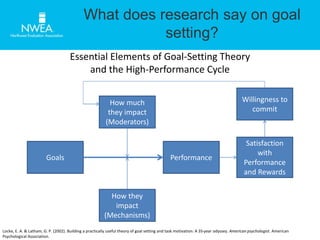
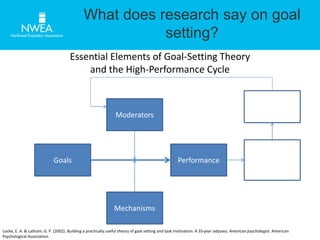
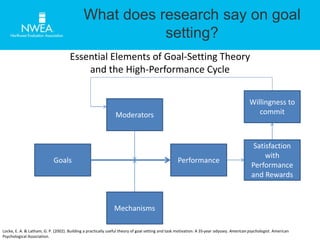
What does research say on goal 
setting? 
Goals 
Essential Elements of Goal-Setting Theory 
and the High-Performance Cycle 
How much 
they impact 
(Moderators) 
How they 
impact 
(Mechanisms) 
Performance 
Willingness to 
commit 
Satisfaction 
with 
Performance 
and Rewards 
Locke, E. A. & Latham, G. P. (2002). Building a practically useful theory of goal setting and task motivation: A 35-year odyssey. American psychologist. American 
Psychological Association.
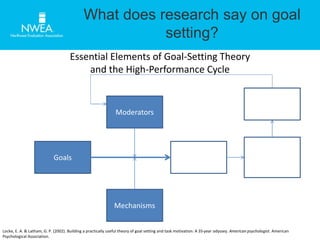
What does research say on goal 
setting? 
Essential Elements of Goal-Setting Theory 
Goals 
and the High-Performance Cycle 
Moderators 
Mechanisms 
Performance 
Willingness to 
commit 
Satisfaction 
with 
Performance 
and Rewards 
Locke, E. A. & Latham, G. P. (2002). Building a practically useful theory of goal setting and task motivation: A 35-year odyssey. American psychologist. American 
Psychological Association.
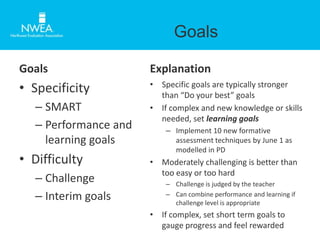
Goals 
• Specificity 
– SMART 
– Performance and 
learning goals 
• Difficulty 
– Challenge 
– Interim goals 
Goals 
Explanation 
• Specific goals are typically stronger 
than “Do your best” goals 
• If complex and new knowledge or skills 
needed, set learning goals 
– Implement 10 new formative 
assessment techniques by June 1 as 
modelled in PD 
• Moderately challenging is better than 
too easy or too hard 
– Challenge is judged by the teacher 
– Can combine performance and learning if 
challenge level is appropriate 
• If complex, set short term goals to 
gauge progress and feel rewarded
What does research say on goal 
setting? 
Essential Elements of Goal-Setting Theory 
Goals 
and the High-Performance Cycle 
Moderators 
Mechanisms 
Performance 
Willingness to 
commit 
Satisfaction 
with 
Performance 
and Rewards 
Locke, E. A. & Latham, G. P. (2002). Building a practically useful theory of goal setting and task motivation: A 35-year odyssey. American psychologist. American 
Psychological Association.
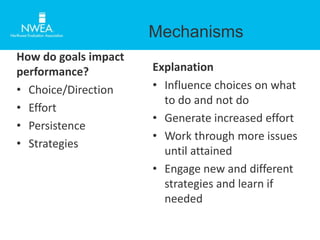
How do goals impact 
performance? 
• Choice/Direction 
• Effort 
• Persistence 
• Strategies 
Mechanisms 
Explanation 
• Influence choices on what 
to do and not do 
• Generate increased effort 
• Work through more issues 
until attained 
• Engage new and different 
strategies and learn if 
needed
What does research say on goal 
setting? 
Essential Elements of Goal-Setting Theory 
Goals 
and the High-Performance Cycle 
Moderators 
Mechanisms 
Performance 
Willingness to 
commit 
Satisfaction 
with 
Performance 
and Rewards 
Locke, E. A. & Latham, G. P. (2002). Building a practically useful theory of goal setting and task motivation: A 35-year odyssey. American psychologist. American 
Psychological Association.
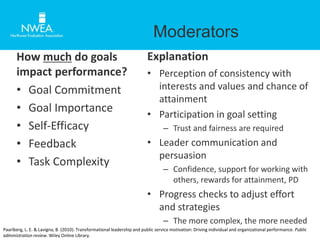
How much do goals 
impact performance? 
• Goal Commitment 
• Goal Importance 
• Self-Efficacy 
• Feedback 
• Task Complexity 
Moderators 
Explanation 
• Perception of consistency with 
interests and values and chance of 
attainment 
• Participation in goal setting 
– Trust and fairness are required 
• Leader communication and 
persuasion 
– Confidence, support for working with 
others, rewards for attainment, PD 
• Progress checks to adjust effort 
and strategies 
– The more complex, the more needed 
Paarlberg, L. E. & Lavigna, B. (2010). Transformational leadership and public service motivation: Driving individual and organizational performance. Public 
administration review. Wiley Online Library.
• Autonomy 
Essential Elements of 
Motivation 
– The desire to direct our own lives 
• Mastery 
. 
– The urge to get better and better at something 
that matters 
• Purpose 
– The yearning to do what we do in the service of 
something larger than ourselves 
Pink, D. H. (2009). Drive: The surprising truth about what motivates us. New York, NY: Riverhead Books.
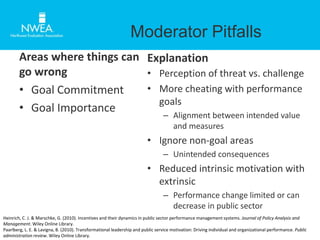
Moderator Pitfalls 
Areas where things can 
go wrong 
• Goal Commitment 
• Goal Importance 
Explanation 
• Perception of threat vs. challenge 
• More cheating with performance 
goals 
– Alignment between intended value 
and measures 
• Ignore non-goal areas 
– Unintended consequences 
• Reduced intrinsic motivation with 
extrinsic 
– Performance change limited or can 
decrease in public sector 
Heinrich, C. J. & Marschke, G. (2010). Incentives and their dynamics in public sector performance management systems. Journal of Policy Analysis and 
Management. Wiley Online Library. 
Paarlberg, L. E. & Lavigna, B. (2010). Transformational leadership and public service motivation: Driving individual and organizational performance. Public 
administration review. Wiley Online Library.
What does research say on goal 
setting? 
Essential Elements of Goal-Setting Theory 
Goals 
and the High-Performance Cycle 
Moderators 
Mechanisms 
Performance 
Willingness to 
commit 
Satisfaction 
with 
Performance 
and Rewards 
Locke, E. A. & Latham, G. P. (2002). Building a practically useful theory of goal setting and task motivation: A 35-year odyssey. American psychologist. American 
Psychological Association.
What changes in 
performance can be 
expected? 
• Productivity 
• Cost improvement 
Performance 
Explanation 
• Varies with task complexity 
– More complex = less 
improvement 
– 8% to 16% improvement 
from most to least complex 
• Consistent with CTAC study 
• In financial terms, these 
improvements are huge 
– Each person, year after year 
Wegge, J. & Haslem, S. A. (2013). When Group Goal Setting Fails: The Impact of Task Difficulty and Supervisor Fairness. Creativity, Talent and 
Excellence (pp. 165–184). Springer.
What does research say on goal 
setting? 
Essential Elements of Goal-Setting Theory 
Goals 
and the High-Performance Cycle 
Moderators 
Mechanisms 
Performance 
Willingness to 
commit 
Satisfaction 
with 
Performance 
and Rewards 
Locke, E. A. & Latham, G. P. (2002). Building a practically useful theory of goal setting and task motivation: A 35-year odyssey. American psychologist. American 
Psychological Association.
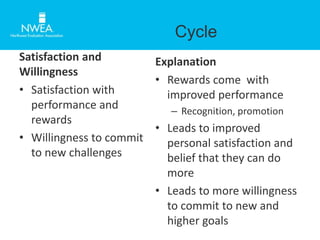
Satisfaction and 
Willingness 
• Satisfaction with 
performance and 
rewards 
• Willingness to commit 
to new challenges 
Cycle 
Explanation 
• Rewards come with 
improved performance 
– Recognition, promotion 
• Leads to improved 
personal satisfaction and 
belief that they can do 
more 
• Leads to more willingness 
to commit to new and 
higher goals
Think-Pair-Share? 
• What are two things you think 
are important that we should 
consider in education and why? 
• Is there any part of this theory 
that you can apply now?
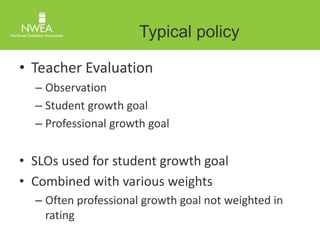
Typical policy 
• Teacher Evaluation 
– Observation 
– Student growth goal 
– Professional growth goal 
• SLOs used for student growth goal 
• Combined with various weights 
– Often professional growth goal not weighted in 
rating
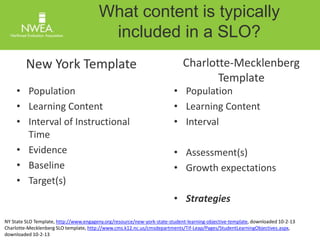
• Population 
• Learning Content 
• Interval of Instructional 
Time 
• Evidence 
• Baseline 
• Target(s) 
What content is typically 
included in a SLO? 
New York Template Charlotte-Mecklenberg 
Template 
• Population 
• Learning Content 
• Interval 
• Assessment(s) 
• Growth expectations 
• Strategies 
NY State SLO Template, http://www.engageny.org/resource/new-york-state-student-learning-objective-template, downloaded 10-2-13 
Charlotte-Mecklenberg SLO template, http://www.cms.k12.nc.us/cmsdepartments/Tif-Leap/Pages/StudentLearningObjectives.aspx, 
downloaded 10-2-13
Population 
• All students should be “in play” relative to the 
goal 
– Set another for a sub-group if warranted
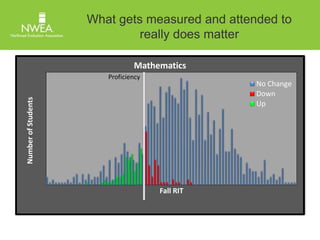
Number of Students 
What gets measured and attended to 
Mathematics 
Fall RIT 
No Change 
Down 
Up 
really does matter 
Proficiency 
One district’s change in 5th grade mathematics performance 
relative to the KY proficiency cut scores
Number of Students 
Changing from Proficiency to Growth 
means all kids matter 
Mathematics 
Student’s score in fall 
Below projected 
growth 
Met or above 
projected growth 
Number of 5th grade students meeting projected
Evidence 
• There should always be multiple data sources 
and metrics 
• Data should be triangulated 
– Classroom assessment data to standardized test 
data 
– Domain data (mathematics) to sub-domain data 
(fractions and decimals) to granular data (division 
with fractions)
9 
8 
7 
6 
5 
4 
3 
2 
1 
0 
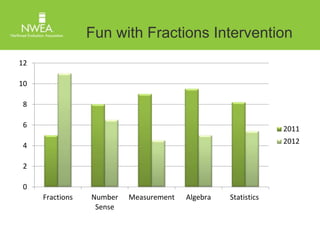
Fun with Fractions Intervention 
Overall Math Growth 
2011 
2012
12 
10 
8 
6 
4 
2 
0 
Fun with Fractions Intervention 
Fractions Number 
Sense 
Measurement Algebra Statistics 
2011 
2012
Context matters 
• Lack of a historical context 
– What has this teacher and these students done in 
the past? 
• Lack of comparison groups 
– What have other teachers done in the past? 
• What is the objective? 
– Is the objective to meet a standard of 
performance or demonstrate improvement? 
• Do you set safe goals or challenging goals?
Suggestions 
• Goals and targets themselves 
– Specific SLOs with appropriate information 
included 
• MUST have learning goals 
• Can have growth or achievement targets 
• Combination of elements needs to be moderately 
challenging 
– Set additional learning goals if complex and 
new
Suggestions 
• Goals and targets themselves (cont.) 
– Appropriately balance moderately 
challenging goals with consequences 
• Only use “Stretch” goals for the organization to 
stimulate creativity and create unconventional 
solutions 
– Professional growth goal leads to 
attainment of student growth goal 
• Weight as much as possible within policy 
Locke, E. A., & Latham, G. P. (2013). New developments in goal setting and task performance.
Suggestions 
• Goals and targets themselves (cont.) 
– Set interim benchmarks for progress 
monitoring 
– Carefully consider what will not happen to 
attain the goal 
• Can you live with the consequences? 
• How will you look for other unintended ones? 
Locke, E. A., & Latham, G. P. (2013). New developments in goal setting and task performance.
8.00 
6.00 
4.00 
2.00 
0.00 
-2.00 
-4.00 
-6.00 
New phenomenon when used as part of 
a compensation program 
Mean value-added growth by school 
1 3 5 7 9 11 13 15 17 19 21 23 25 27 29 31 33 35 37 39 41 43 45 47 49 51 53 55 57 59 61 63 65 67 69 71 
Students taking 10+ minutes longer spring than fall All other students
• Leadership 
Suggestions 
– Be fair and trustworthy 
• If goal is assigned, explain the logic behind it 
– Communicate and support teachers in their learning 
• Encourage teamwork on strategies 
• Emphasize the positive and the impact on others 
– Importance to students to attain goal 
• Provide PD, models, coaching 
– Sincerely and specifically praise progress 
Sholihin, M., Pike, R., Mangena, M. & Li, J. (2011). Goal-setting participation and goal commitment: Examining the mediating roles of procedural fairness and 
interpersonal trust in a UK financial services organisation. The British Accounting Review. Elsevier. 
Locke, E. A., & Latham, G. P. (2013). New developments in goal setting and task performance. 
Porter, R. L. & Latham, G. P. (2013). The Effect of Employee Learning Goals and Goal Commitment on Departmental Performance. Journal of Leadership & 
Organizational Studies. SAGE Publications.
Goal Setting 
Will benefit students if 
done wisely!
Questions or 
thoughts to share? 
Andy Hegedus 
andy.hegedus@nwea.org 
302-275-3448

Teacher goal setting in texas

  • 1.
    Making Teacher Goal Setting More Powerful Andy Hegedus, Ed. D. Sr. Research Manager November 2014
  • 2.
    Agenda • Whyshould we care about goal setting in education? • What does the research say about it? • What are typical policies? • Suggestions for applying research findings to your work
  • 3.
    One note •This presentation talks about teacher goal setting • The research is about human beings – Applies to adults universally – Some of the points should apply to students equally well
  • 4.
    Why should wecare about goal setting in education? Because we want students to learn more! • Policy view –Evaluating teachers in rigorous ways will improve teaching • Reward, support, remove
  • 5.
    Why should wecare about goal setting in education? Because we want students to learn more! • Research view –Setting goals improves performance
  • 6.
    How do weknow students learn more? • K-12 research very thin • Two studies specific to this issue by CTAC – Denver ProComp Study – 2004 – Charlotte-Mecklenburg TIF-LEAP Study – 2013 • Findings: – Teachers who set a high quality goal were associated with increased student achievement – Teachers who set and met goals were associated with increased student achievement – Implementation of SLOs can make a 12-13% difference in student achievement growth rate Catalyst for change (2004), Community Training and Assistance Center, retrieved 10-2-13, http://www.ctacusa.com/PDFs/Rpt-CatalystChangeFull-2004.pdf It’s more than money (2013), Community Training and Assistance Center, retrieved 10-2-13, http://www.ctacusa.com/PDFs/MoreThanMoney-report.pdf
  • 7.
    What does researchsay on goal setting? Goals Essential Elements of Goal-Setting Theory and the High-Performance Cycle How much they impact (Moderators) How they impact (Mechanisms) Performance Willingness to commit Satisfaction with Performance and Rewards Locke, E. A. & Latham, G. P. (2002). Building a practically useful theory of goal setting and task motivation: A 35-year odyssey. American psychologist. American Psychological Association.
  • 8.
    What does researchsay on goal setting? Essential Elements of Goal-Setting Theory Goals and the High-Performance Cycle Moderators Mechanisms Performance Willingness to commit Satisfaction with Performance and Rewards Locke, E. A. & Latham, G. P. (2002). Building a practically useful theory of goal setting and task motivation: A 35-year odyssey. American psychologist. American Psychological Association.
  • 9.
    Goals • Specificity – SMART – Performance and learning goals • Difficulty – Challenge – Interim goals Goals Explanation • Specific goals are typically stronger than “Do your best” goals • If complex and new knowledge or skills needed, set learning goals – Implement 10 new formative assessment techniques by June 1 as modelled in PD • Moderately challenging is better than too easy or too hard – Challenge is judged by the teacher – Can combine performance and learning if challenge level is appropriate • If complex, set short term goals to gauge progress and feel rewarded
  • 10.
    What does researchsay on goal setting? Essential Elements of Goal-Setting Theory Goals and the High-Performance Cycle Moderators Mechanisms Performance Willingness to commit Satisfaction with Performance and Rewards Locke, E. A. & Latham, G. P. (2002). Building a practically useful theory of goal setting and task motivation: A 35-year odyssey. American psychologist. American Psychological Association.
  • 11.
    How do goalsimpact performance? • Choice/Direction • Effort • Persistence • Strategies Mechanisms Explanation • Influence choices on what to do and not do • Generate increased effort • Work through more issues until attained • Engage new and different strategies and learn if needed
  • 12.
    What does researchsay on goal setting? Essential Elements of Goal-Setting Theory Goals and the High-Performance Cycle Moderators Mechanisms Performance Willingness to commit Satisfaction with Performance and Rewards Locke, E. A. & Latham, G. P. (2002). Building a practically useful theory of goal setting and task motivation: A 35-year odyssey. American psychologist. American Psychological Association.
  • 13.
    How much dogoals impact performance? • Goal Commitment • Goal Importance • Self-Efficacy • Feedback • Task Complexity Moderators Explanation • Perception of consistency with interests and values and chance of attainment • Participation in goal setting – Trust and fairness are required • Leader communication and persuasion – Confidence, support for working with others, rewards for attainment, PD • Progress checks to adjust effort and strategies – The more complex, the more needed Paarlberg, L. E. & Lavigna, B. (2010). Transformational leadership and public service motivation: Driving individual and organizational performance. Public administration review. Wiley Online Library.
  • 14.
    • Autonomy EssentialElements of Motivation – The desire to direct our own lives • Mastery . – The urge to get better and better at something that matters • Purpose – The yearning to do what we do in the service of something larger than ourselves Pink, D. H. (2009). Drive: The surprising truth about what motivates us. New York, NY: Riverhead Books.
  • 15.
    Moderator Pitfalls Areaswhere things can go wrong • Goal Commitment • Goal Importance Explanation • Perception of threat vs. challenge • More cheating with performance goals – Alignment between intended value and measures • Ignore non-goal areas – Unintended consequences • Reduced intrinsic motivation with extrinsic – Performance change limited or can decrease in public sector Heinrich, C. J. & Marschke, G. (2010). Incentives and their dynamics in public sector performance management systems. Journal of Policy Analysis and Management. Wiley Online Library. Paarlberg, L. E. & Lavigna, B. (2010). Transformational leadership and public service motivation: Driving individual and organizational performance. Public administration review. Wiley Online Library.
  • 16.
    What does researchsay on goal setting? Essential Elements of Goal-Setting Theory Goals and the High-Performance Cycle Moderators Mechanisms Performance Willingness to commit Satisfaction with Performance and Rewards Locke, E. A. & Latham, G. P. (2002). Building a practically useful theory of goal setting and task motivation: A 35-year odyssey. American psychologist. American Psychological Association.
  • 17.
    What changes in performance can be expected? • Productivity • Cost improvement Performance Explanation • Varies with task complexity – More complex = less improvement – 8% to 16% improvement from most to least complex • Consistent with CTAC study • In financial terms, these improvements are huge – Each person, year after year Wegge, J. & Haslem, S. A. (2013). When Group Goal Setting Fails: The Impact of Task Difficulty and Supervisor Fairness. Creativity, Talent and Excellence (pp. 165–184). Springer.
  • 18.
    What does researchsay on goal setting? Essential Elements of Goal-Setting Theory Goals and the High-Performance Cycle Moderators Mechanisms Performance Willingness to commit Satisfaction with Performance and Rewards Locke, E. A. & Latham, G. P. (2002). Building a practically useful theory of goal setting and task motivation: A 35-year odyssey. American psychologist. American Psychological Association.
  • 19.
    Satisfaction and Willingness • Satisfaction with performance and rewards • Willingness to commit to new challenges Cycle Explanation • Rewards come with improved performance – Recognition, promotion • Leads to improved personal satisfaction and belief that they can do more • Leads to more willingness to commit to new and higher goals
  • 20.
    Think-Pair-Share? • Whatare two things you think are important that we should consider in education and why? • Is there any part of this theory that you can apply now?
  • 21.
    Typical policy •Teacher Evaluation – Observation – Student growth goal – Professional growth goal • SLOs used for student growth goal • Combined with various weights – Often professional growth goal not weighted in rating
  • 22.
    • Population •Learning Content • Interval of Instructional Time • Evidence • Baseline • Target(s) What content is typically included in a SLO? New York Template Charlotte-Mecklenberg Template • Population • Learning Content • Interval • Assessment(s) • Growth expectations • Strategies NY State SLO Template, http://www.engageny.org/resource/new-york-state-student-learning-objective-template, downloaded 10-2-13 Charlotte-Mecklenberg SLO template, http://www.cms.k12.nc.us/cmsdepartments/Tif-Leap/Pages/StudentLearningObjectives.aspx, downloaded 10-2-13
  • 23.
    Population • Allstudents should be “in play” relative to the goal – Set another for a sub-group if warranted
  • 24.
    Number of Students What gets measured and attended to Mathematics Fall RIT No Change Down Up really does matter Proficiency One district’s change in 5th grade mathematics performance relative to the KY proficiency cut scores
  • 25.
    Number of Students Changing from Proficiency to Growth means all kids matter Mathematics Student’s score in fall Below projected growth Met or above projected growth Number of 5th grade students meeting projected
  • 26.
    Evidence • Thereshould always be multiple data sources and metrics • Data should be triangulated – Classroom assessment data to standardized test data – Domain data (mathematics) to sub-domain data (fractions and decimals) to granular data (division with fractions)
  • 27.
    9 8 7 6 5 4 3 2 1 0 Fun with Fractions Intervention Overall Math Growth 2011 2012
  • 28.
    12 10 8 6 4 2 0 Fun with Fractions Intervention Fractions Number Sense Measurement Algebra Statistics 2011 2012
  • 29.
    Context matters •Lack of a historical context – What has this teacher and these students done in the past? • Lack of comparison groups – What have other teachers done in the past? • What is the objective? – Is the objective to meet a standard of performance or demonstrate improvement? • Do you set safe goals or challenging goals?
  • 30.
    Suggestions • Goalsand targets themselves – Specific SLOs with appropriate information included • MUST have learning goals • Can have growth or achievement targets • Combination of elements needs to be moderately challenging – Set additional learning goals if complex and new
  • 31.
    Suggestions • Goalsand targets themselves (cont.) – Appropriately balance moderately challenging goals with consequences • Only use “Stretch” goals for the organization to stimulate creativity and create unconventional solutions – Professional growth goal leads to attainment of student growth goal • Weight as much as possible within policy Locke, E. A., & Latham, G. P. (2013). New developments in goal setting and task performance.
  • 32.
    Suggestions • Goalsand targets themselves (cont.) – Set interim benchmarks for progress monitoring – Carefully consider what will not happen to attain the goal • Can you live with the consequences? • How will you look for other unintended ones? Locke, E. A., & Latham, G. P. (2013). New developments in goal setting and task performance.
  • 33.
    8.00 6.00 4.00 2.00 0.00 -2.00 -4.00 -6.00 New phenomenon when used as part of a compensation program Mean value-added growth by school 1 3 5 7 9 11 13 15 17 19 21 23 25 27 29 31 33 35 37 39 41 43 45 47 49 51 53 55 57 59 61 63 65 67 69 71 Students taking 10+ minutes longer spring than fall All other students
  • 34.
    • Leadership Suggestions – Be fair and trustworthy • If goal is assigned, explain the logic behind it – Communicate and support teachers in their learning • Encourage teamwork on strategies • Emphasize the positive and the impact on others – Importance to students to attain goal • Provide PD, models, coaching – Sincerely and specifically praise progress Sholihin, M., Pike, R., Mangena, M. & Li, J. (2011). Goal-setting participation and goal commitment: Examining the mediating roles of procedural fairness and interpersonal trust in a UK financial services organisation. The British Accounting Review. Elsevier. Locke, E. A., & Latham, G. P. (2013). New developments in goal setting and task performance. Porter, R. L. & Latham, G. P. (2013). The Effect of Employee Learning Goals and Goal Commitment on Departmental Performance. Journal of Leadership & Organizational Studies. SAGE Publications.
  • 35.
    Goal Setting Willbenefit students if done wisely!
  • 36.
    Questions or thoughtsto share? Andy Hegedus andy.hegedus@nwea.org 302-275-3448

Editor's Notes

  • #25 Dramatic differences between standards based vs growth KY 5th grade mathematics Sample of students from a large school system X-axis Fall score, Y number of kids Blue are the kids who did not change status between the fall and the spring on the state test Red are the kids who declined in performance over spring – Decender Green are kids who moved above it in performance over the spring – Ascender – Bubble kids About 10% based on the total number of kids Accountability plans are made typically based on these red and green kids
  • #26 Same district as before Yellow – did not meet target growth – spread over the entire range of kids Green – did meet growth targets 60% vs 40% is doing well – This is a high performing district with high growth Must attend to all kids – this is a good thing – ones in the middle and at both extremes Old one was discriminatory – focus on some in lieu of others Teachers who teach really hard at the standard for years – Teachers need to be able to reach them all This does a lot to move the accountability system to parents and our desires.
  • #28 Measure over two years. 2011 – 8 pts, 2012 – slightly lower On the face it slipped in its effectiveness
  • #29 Let’s look at fractions specifically. Overall score went down. Other strands declined. Something in the way the intervention was delivered caused other areas to decline. This year we will work on computation skills and measure by that goal area. No improvement in mathematics. Could be so much focus on intervention, rather than other areas. If only working on one piece of the domain, the remainder of the curriculum may suffer. You want to evaluate the intended impact is seen and look more broadly for unintended consequences in the broader domain.
  • #32 No solid research on learning and performance goals at the same time. For complex situations where learning is required, learning goals work best, then “Do your best” goals, then performance goals. Focus should be on mastering skills rather than reaching a desired level of performance. That will come later. Performance goals distract from the learning that is needed. Learning goals help moderate cheating as opposed to performance goal
  • #33 No solid research on learning and performance goals at the same time. For complex situations where learning is required, learning goals work best, then “Do your best” goals, then performance goals. Focus should be on mastering skills rather than reaching a desired level of performance. That will come later. Performance goals distract from the learning that is needed. Learning goals help moderate cheating as opposed to performance goal