SHILPA SINGH
SHIVANGI DAS
SHIVANI SHAKTI RAO
SHIVANI VISHWAKARMA
SHREEPARNA DAS
SHREOSEE MUKHERJEE
SHRUTI AGGARWAL
SHWETA BISHT
SHWETA SHASTRI
SONAL JAIN
SONALI TAGGAR
l
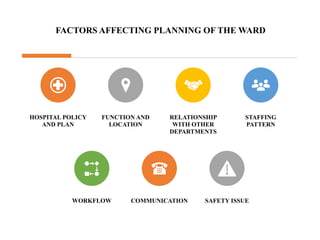
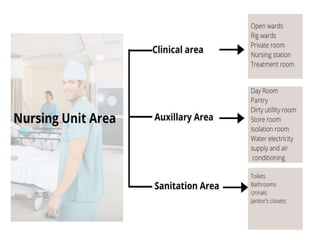
FACTORS AFFECTING PLANNING OF THE WARD
HOSPITAL POLICY
AND PLAN
FUNCTION AND
LOCATION
RELATIONSHIP
WITH OTHER
DEPARTMENTS
STAFFING
PATTERN
WORKFLOW COMMUNICATION SAFETY ISSUE
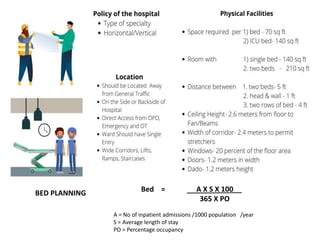
Bed = A X S X 100​
365 X PO
A = No of inpatient admissions /1000 population /year​
​S = Average length of stay​
PO = Percentage occupancy
BED PLANNING
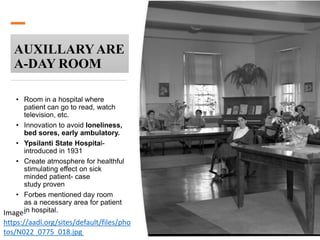
AUXILLARYARE
A-DAY ROOM
• Room in a hospital where
patient can go to read, watch
television, etc.
• Innovation to avoid loneliness,
bed sores, early ambulatory.
• Ypsilanti State Hospital-
introduced in 1931
• Create atmosphere for healthful
stimulating effect on sick
minded patient- case
study proven
• Forbes mentioned day room
as a necessary area for patient
in hospital.Image-
https://aadl.org/sites/default/files/pho
tos/N022_0775_018.jpg
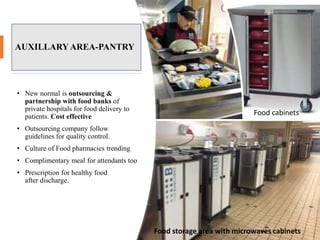
AUXILLARYAREA-PANTRY
• New normal is outsourcing &
partnership with food banks of
private hospitals for food delivery to
patients. Cost effective
• Outsourcing company follow
guidelines for quality control.
• Culture of Food pharmacies trending
• Complimentary meal for attendants too
• Prescription for healthy food
after discharge.
Food cabinets
Food storage area with microwaves cabinets
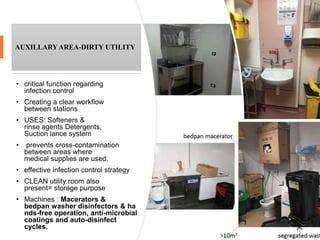
AUXILLARYAREA-DIRTY UTILITY
• critical function regarding
infection control
• Creating a clear workflow
between stations
• USES: Softeners &
rinse agents Detergents,
Suction lance system
• prevents cross-contamination
between areas where
medical supplies are used.
• effective infection control strategy
• CLEAN utility room also
present= storage purpose
• Machines : Macerators &
bedpan washer disinfectors & ha
nds-free operation, anti-microbial
coatings and auto-disinfect
cycles.
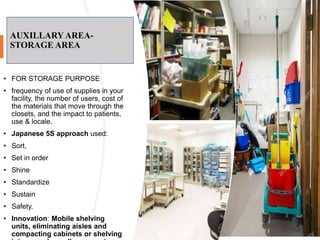
AUXILLARYAREA-
STORAGE AREA
• FOR STORAGE PURPOSE
• frequency of use of supplies in your
facility, the number of users, cost of
the materials that move through the
closets, and the impact to patients,
use & locale.
• Japanese 5S approach used:
• Sort,
• Set in order
• Shine
• Standardize
• Sustain
• Safety.
• Innovation: Mobile shelving
units, eliminating aisles and
compacting cabinets or shelving
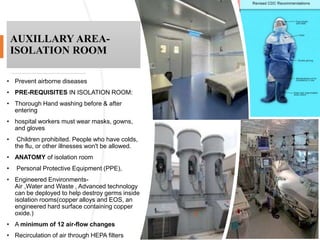
AUXILLARY AREA-
ISOLATION ROOM
• Prevent airborne diseases
• PRE-REQUISITES IN ISOLATION ROOM:
• Thorough Hand washing before & after
entering
• hospital workers must wear masks, gowns,
and gloves
• Children prohibited. People who have colds,
the flu, or other illnesses won't be allowed.
• ANATOMY of isolation room
• Personal Protective Equipment (PPE),
• Engineered Environments-
Air ,Water and Waste , Advanced technology
can be deployed to help destroy germs inside
isolation rooms(copper alloys and EOS, an
engineered hard surface containing copper
oxide.)
• A minimum of 12 air-flow changes
• Recirculation of air through HEPA filters
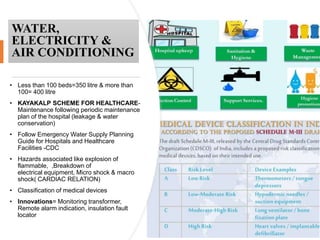
WATER,
ELECTRICITY &
AIR CONDITIONING
• Less than 100 beds=350 litre & more than
100= 400 litre
• KAYAKALP SCHEME FOR HEALTHCARE-
Maintenance following periodic maintenance
plan of the hospital (leakage & water
conservation)
• Follow Emergency Water Supply Planning
Guide for Hospitals and Healthcare
Facilities -CDC
• Hazards associated like explosion of
flammable, ,Breakdown of
electrical equipment, Micro shock & macro
shock( CARDIAC RELATION)
• Classification of medical devices
• Innovations= Monitoring transformer,
Remote alarm indication, insulation fault
locator
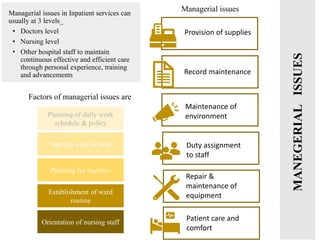
Managerial issues in Inpatient services can
usually at 3 levels_
• Doctors level
• Nursing level
• Other hospital staff to maintain
continuous effective and efficient care
through personal experience, training
and advancements
MANEGERIALISSUES
Factors of managerial issues are
Planning of daily work
schedule & policy
Starting work in time
Planning for logistics
Establishment of ward
routine
Orientation of nursing staff
Managerial issues
Provision of supplies
Record maintenance
Maintenance of
environment
Duty assignment
to staff
Repair &
maintenance of
equipment
Patient care and
comfort
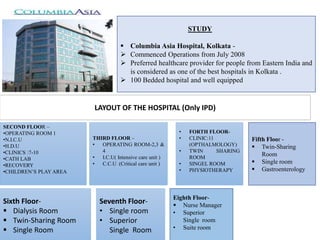
STUDY
 Columbia Asia Hospital, Kolkata -
 Commenced Operations from July 2008
 Preferred healthcare provider for people from Eastern India and
is considered as one of the best hospitals in Kolkata .
 100 Bedded hospital and well equipped
LAYOUT OF THE HOSPITAL (Only IPD)
SECOND FLOOR –
•OPERATING ROOM 1
•N.I.C.U
•H.D.U
•CLINICS :7-10
•CATH LAB
•RECOVERY
•CHILDREN’S PLAY AREA
THIRD FLOOR –
• OPERATING ROOM-2,3 &
4
• I.C.U( Intensive care unit )
• C.C.U (Critical care unit )
• FORTH FLOOR-
• CLINIC:11
(OPTHALMOLOGY)
• TWIN SHARING
ROOM
• SINGEL ROOM
• PHYSIOTHERAPY
Fifth Floor -
 Twin-Sharing
Room
 Single room
 Gastroenterology
Sixth Floor-
 Dialysis Room
 Twin-Sharing Room
 Single Room
Seventh Floor-
• Single room
• Superior
Single Room
Eighth Floor-
 Nurse Manager
• Superior
Single room
• Suite room
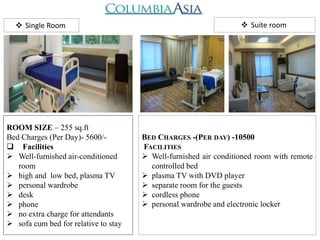
 Single Room
ROOM SIZE – 255 sq.ft
Bed Charges (Per Day)- 5600/-
 Facilities
 Well-furnished air-conditioned
room
 high and low bed, plasma TV
 personal wardrobe
 desk
 phone
 no extra charge for attendants
 sofa cum bed for relative to stay
 Suite room
BED CHARGES -(PER DAY) -10500
FACILITIES
 Well-furnished air conditioned room with remote
controlled bed
 plasma TV with DVD player
 separate room for the guests
 cordless phone
 personal wardrobe and electronic locker
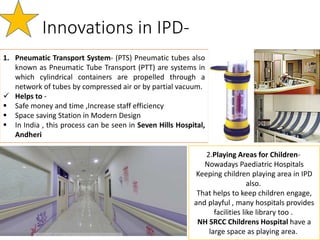
Innovations in IPD-
1. Pneumatic Transport System- (PTS) Pneumatic tubes also
known as Pneumatic Tube Transport (PTT) are systems in
which cylindrical containers are propelled through a
network of tubes by compressed air or by partial vacuum.
 Helps to -
 Safe money and time ,Increase staff efficiency
 Space saving Station in Modern Design
 In India , this process can be seen in Seven Hills Hospital,
Andheri
2.Playing Areas for Children-
Nowadays Paediatric Hospitals
Keeping children playing area in IPD
also.
That helps to keep children engage,
and playful , many hospitals provides
facilities like library too .
NH SRCC Childrens Hospital have a
large space as playing area.
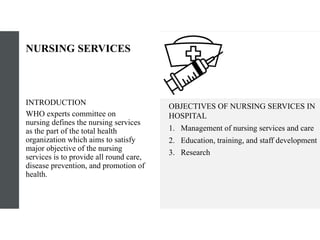
NURSING SERVICES
INTRODUCTION​
WHO experts committee on
nursing defines the nursing services
as the part of the total health
organization which aims to satisfy
major objective of the nursing
services is to provide all round care,
disease prevention, and promotion of
health.
OBJECTIVES OF NURSING SERVICES IN
HOSPITAL
1. Management of nursing services and care
2. Education, training, and staff development
3. Research
FACTORS TO BE
CONSIDERED IN
PLANNING HOSPITAL
NURSING SERVICES
• Number and type of patients
• Number of beds and type of wards
• The services required
• Procedures and techniques necessary for
care
• Number and type of personnel needed to
perform care effectively
• Physical facilities
• Provision of equipment and supplies
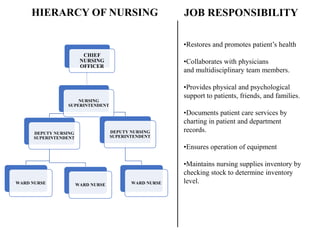
HIERARCY OF NURSING
NURSING
SUPERINTENDENT
DEPUTY NURSING
SUPERINTENDENT
WARD NURSE WARD NURSE
DEPUTY NURSING
SUPERINTENDENT
WARD NURSE
CHIEF
NURSING
OFFICER
•Restores and promotes patient’s health
•Collaborates with physicians
and multidisciplinary team members.​
•Provides physical and psychological
support to patients, friends, and families.​
•Documents patient care services by
charting in patient and department
records.
•Ensures operation of equipment
•Maintains nursing supplies inventory by
checking stock to determine inventory
level.
JOB RESPONSIBILITY
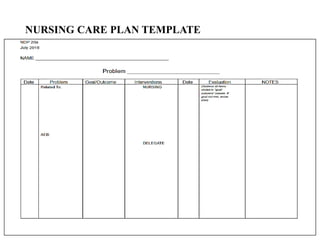
NURSING CARE PLAN TEMPLATE
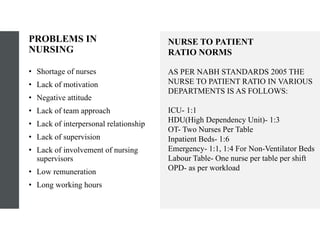
PROBLEMS IN
NURSING
• Shortage of nurses
• Lack of motivation
• Negative attitude
• Lack of team approach
• Lack of interpersonal relationship
• Lack of supervision
• Lack of involvement of nursing
supervisors
• Low remuneration
• Long working hours
AS PER NABH STANDARDS 2005 THE
NURSE TO PATIENT RATIO IN VARIOUS
DEPARTMENTS IS AS FOLLOWS:
ICU- 1:1
HDU(High Dependency Unit)- 1:3
OT- Two Nurses Per Table
Inpatient Beds- 1:6
Emergency- 1:1, 1:4 For Non-Ventilator Beds
Labour Table- One nurse per table per shift
OPD- as per workload
NURSE TO PATIENT
RATIO NORMS
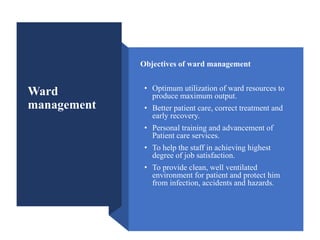
Ward
management
Objectives of ward management
• Optimum utilization of ward resources to
produce maximum output.
• Better patient care, correct treatment and
early recovery.
• Personal training and advancement of
Patient care services.
• To help the staff in achieving highest
degree of job satisfaction.
• To provide clean, well ventilated
environment for patient and protect him
from infection, accidents and hazards.
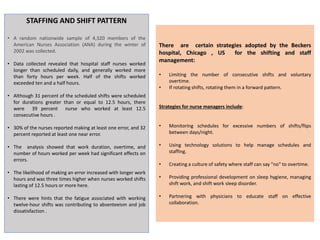
There are certain strategies adopted by the Beckers
hospital, Chicago , US for the shifting and staff
management:
• Limiting the number of consecutive shifts and voluntary
overtime.
• If rotating shifts, rotating them in a forward pattern.
Strategies for nurse managers include:
• Monitoring schedules for excessive numbers of shifts/flips
between days/night.
• Using technology solutions to help manage schedules and
staffing.
• Creating a culture of safety where staff can say "no" to overtime.
• Providing professional development on sleep hygiene, managing
shift work, and shift work sleep disorder.
• Partnering with physicians to educate staff on effective
collaboration.
STAFFING AND SHIFT PATTERN
• A random nationwide sample of 4,320 members of the
American Nurses Association (ANA) during the winter of
2002 was collected.
• Data collected revealed that hospital staff nurses worked
longer than scheduled daily, and generally worked more
than forty hours per week. Half of the shifts worked
exceeded ten and a half hours.
• Although 31 percent of the scheduled shifts were scheduled
for durations greater than or equal to 12.5 hours, there
were 39 percent nurse who worked at least 12.5
consecutive hours .
• 30% of the nurses reported making at least one error, and 32
percent reported at least one near error.
• The analysis showed that work duration, overtime, and
number of hours worked per week had significant effects on
errors.
• The likelihood of making an error increased with longer work
hours and was three times higher when nurses worked shifts
lasting of 12.5 hours or more here.
• There were hints that the fatigue associated with working
twelve-hour shifts was contributing to absenteeism and job
dissatisfaction .
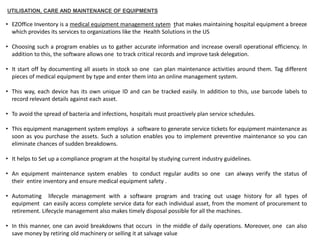
UTILISATION, CARE AND MAINTENANCE OF EQUIPMENTS
• EZOffice Inventory is a medical equipment management sytem that makes maintaining hospital equipment a breeze
which provides its services to organizations like the Health Solutions in the US
• Choosing such a program enables us to gather accurate information and increase overall operational efficiency. In
addition to this, the software allows one to track critical records and improve task delegation.
• It start off by documenting all assets in stock so one can plan maintenance activities around them. Tag different
pieces of medical equipment by type and enter them into an online management system.
• This way, each device has its own unique ID and can be tracked easily. In addition to this, use barcode labels to
record relevant details against each asset.
• To avoid the spread of bacteria and infections, hospitals must proactively plan service schedules.
• This equipment management system employs a software to generate service tickets for equipment maintenance as
soon as you purchase the assets. Such a solution enables you to implement preventive maintenance so you can
eliminate chances of sudden breakdowns.
• It helps to Set up a compliance program at the hospital by studying current industry guidelines.
• An equipment maintenance system enables to conduct regular audits so one can always verify the status of
their entire inventory and ensure medical equipment safety .
• Automating lifecycle management with a software program and tracing out usage history for all types of
equipment can easily access complete service data for each individual asset, from the moment of procurement to
retirement. Lifecycle management also makes timely disposal possible for all the machines.
• In this manner, one can avoid breakdowns that occurs in the middle of daily operations. Moreover, one can also
save money by retiring old machinery or selling it at salvage value
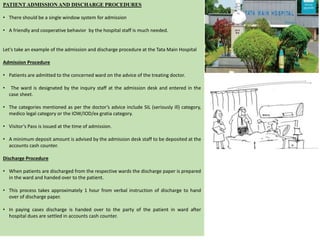
PATIENT ADMISSION AND DISCHARGE PROCEDURES
• There should be a single window system for admission
• A friendly and cooperative behavior by the hospital staff is much needed.
Let's take an example of the admission and discharge procedure at the Tata Main Hospital
Admission Procedure
• Patients are admitted to the concerned ward on the advice of the treating doctor.
• The ward is designated by the inquiry staff at the admission desk and entered in the
case sheet.
• The categories mentioned as per the doctor’s advice include SIL (seriously ill) category,
medico legal category or the IOW/IOD/ex gratia category.
• Visitor’s Pass is issued at the time of admission.
• A minimum deposit amount is advised by the admission desk staff to be deposited at the
accounts cash counter.
Discharge Procedure
• When patients are discharged from the respective wards the discharge paper is prepared
in the ward and handed over to the patient.
• This process takes approximately 1 hour from verbal instruction of discharge to hand
over of discharge paper.
• In paying cases discharge is handed over to the party of the patient in ward after
hospital dues are settled in accounts cash counter.
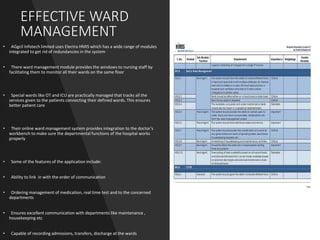
EFFECTIVE WARD
MANAGEMENT
• AGgcil Infotech limited uses Electra HMIS which has a wide range of modules
integrated to get rid of redundancies in the system
• There ward management module provides the windows to nursing staff by
facilitating them to monitor all their wards on the same floor
• Special wards like OT and ICU are practically managed that tracks all the
services given to the patients connecting their defined wards. This ensures
better patient care
• Their online ward management system provides integration to the doctor's
workbench to make sure the departmental functions of the hospital works
properly
• Some of the features of the application include:
• Ability to link in with the order of communication
• Ordering management of medication, real time test and to the concerned
departments
• Ensures excellent communication with departments like maintenance ,
housekeeping etc
• Capable of recording admissions, transfers, discharge at the wards
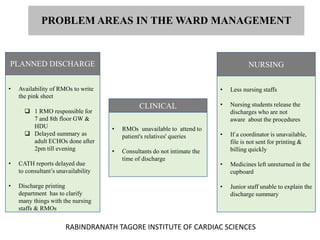
PROBLEM AREAS IN THE WARD MANAGEMENT
• Availability of RMOs to write
the pink sheet
 1 RMO responsible for
7 and 8th floor GW &
HDU
 Delayed summary as
adult ECHOs done after
2pm till evening
• CATH reports delayed due
to consultant’s unavailability
• Discharge printing
department has to clarify
many things with the nursing
staffs & RMOs
PLANNED DISCHARGE
• RMOs unavailable to attend to
patient's relatives' queries
• Consultants do not intimate the
time of discharge
CLINICAL
• Less nursing staffs
• Nursing students release the
discharges who are not
aware about the procedures
• If a coordinator is unavailable,
file is not sent for printing &
billing quickly
• Medicines left unreturned in the
cupboard
• Junior staff unable to explain the
discharge summary
NURSING
RABINDRANATH TAGORE INTERNATIONAL INSTITUTE of CARDIAC SCIENCES
RABINDRANATH TAGORE INSTITUTE OF CARDIAC SCIENCES
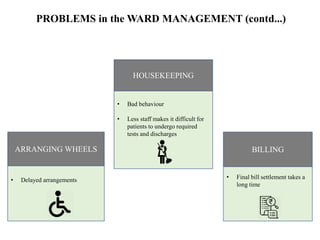
PROBLEMS in the WARD MANAGEMENT (contd...)
• Delayed arrangements
ARRANGING WHEELS
• Final bill settlement takes a
long time
BILLING
• Bad behaviour
• Less staff makes it difficult for
patients to undergo required
tests and discharges
HOUSEKEEPING
Inpatient Department

Inpatient Department

  • 1.
    SHILPA SINGH SHIVANGI DAS SHIVANISHAKTI RAO SHIVANI VISHWAKARMA SHREEPARNA DAS SHREOSEE MUKHERJEE SHRUTI AGGARWAL SHWETA BISHT SHWETA SHASTRI SONAL JAIN SONALI TAGGAR
  • 2.
  • 3.
    FACTORS AFFECTING PLANNINGOF THE WARD HOSPITAL POLICY AND PLAN FUNCTION AND LOCATION RELATIONSHIP WITH OTHER DEPARTMENTS STAFFING PATTERN WORKFLOW COMMUNICATION SAFETY ISSUE
  • 4.
    Bed = AX S X 100​ 365 X PO A = No of inpatient admissions /1000 population /year​ ​S = Average length of stay​ PO = Percentage occupancy BED PLANNING
  • 7.
    AUXILLARYARE A-DAY ROOM • Roomin a hospital where patient can go to read, watch television, etc. • Innovation to avoid loneliness, bed sores, early ambulatory. • Ypsilanti State Hospital- introduced in 1931 • Create atmosphere for healthful stimulating effect on sick minded patient- case study proven • Forbes mentioned day room as a necessary area for patient in hospital.Image- https://aadl.org/sites/default/files/pho tos/N022_0775_018.jpg
  • 8.
    AUXILLARYAREA-PANTRY • New normalis outsourcing & partnership with food banks of private hospitals for food delivery to patients. Cost effective • Outsourcing company follow guidelines for quality control. • Culture of Food pharmacies trending • Complimentary meal for attendants too • Prescription for healthy food after discharge. Food cabinets Food storage area with microwaves cabinets
  • 9.
    AUXILLARYAREA-DIRTY UTILITY • criticalfunction regarding infection control • Creating a clear workflow between stations • USES: Softeners & rinse agents Detergents, Suction lance system • prevents cross-contamination between areas where medical supplies are used. • effective infection control strategy • CLEAN utility room also present= storage purpose • Machines : Macerators & bedpan washer disinfectors & ha nds-free operation, anti-microbial coatings and auto-disinfect cycles.
  • 10.
    AUXILLARYAREA- STORAGE AREA • FORSTORAGE PURPOSE • frequency of use of supplies in your facility, the number of users, cost of the materials that move through the closets, and the impact to patients, use & locale. • Japanese 5S approach used: • Sort, • Set in order • Shine • Standardize • Sustain • Safety. • Innovation: Mobile shelving units, eliminating aisles and compacting cabinets or shelving
  • 11.
    AUXILLARY AREA- ISOLATION ROOM •Prevent airborne diseases • PRE-REQUISITES IN ISOLATION ROOM: • Thorough Hand washing before & after entering • hospital workers must wear masks, gowns, and gloves • Children prohibited. People who have colds, the flu, or other illnesses won't be allowed. • ANATOMY of isolation room • Personal Protective Equipment (PPE), • Engineered Environments- Air ,Water and Waste , Advanced technology can be deployed to help destroy germs inside isolation rooms(copper alloys and EOS, an engineered hard surface containing copper oxide.) • A minimum of 12 air-flow changes • Recirculation of air through HEPA filters
  • 12.
    WATER, ELECTRICITY & AIR CONDITIONING •Less than 100 beds=350 litre & more than 100= 400 litre • KAYAKALP SCHEME FOR HEALTHCARE- Maintenance following periodic maintenance plan of the hospital (leakage & water conservation) • Follow Emergency Water Supply Planning Guide for Hospitals and Healthcare Facilities -CDC • Hazards associated like explosion of flammable, ,Breakdown of electrical equipment, Micro shock & macro shock( CARDIAC RELATION) • Classification of medical devices • Innovations= Monitoring transformer, Remote alarm indication, insulation fault locator
  • 13.
    Managerial issues inInpatient services can usually at 3 levels_ • Doctors level • Nursing level • Other hospital staff to maintain continuous effective and efficient care through personal experience, training and advancements MANEGERIALISSUES Factors of managerial issues are Planning of daily work schedule & policy Starting work in time Planning for logistics Establishment of ward routine Orientation of nursing staff Managerial issues Provision of supplies Record maintenance Maintenance of environment Duty assignment to staff Repair & maintenance of equipment Patient care and comfort
  • 14.
    STUDY  Columbia AsiaHospital, Kolkata -  Commenced Operations from July 2008  Preferred healthcare provider for people from Eastern India and is considered as one of the best hospitals in Kolkata .  100 Bedded hospital and well equipped LAYOUT OF THE HOSPITAL (Only IPD) SECOND FLOOR – •OPERATING ROOM 1 •N.I.C.U •H.D.U •CLINICS :7-10 •CATH LAB •RECOVERY •CHILDREN’S PLAY AREA THIRD FLOOR – • OPERATING ROOM-2,3 & 4 • I.C.U( Intensive care unit ) • C.C.U (Critical care unit ) • FORTH FLOOR- • CLINIC:11 (OPTHALMOLOGY) • TWIN SHARING ROOM • SINGEL ROOM • PHYSIOTHERAPY Fifth Floor -  Twin-Sharing Room  Single room  Gastroenterology Sixth Floor-  Dialysis Room  Twin-Sharing Room  Single Room Seventh Floor- • Single room • Superior Single Room Eighth Floor-  Nurse Manager • Superior Single room • Suite room
  • 15.
     Single Room ROOMSIZE – 255 sq.ft Bed Charges (Per Day)- 5600/-  Facilities  Well-furnished air-conditioned room  high and low bed, plasma TV  personal wardrobe  desk  phone  no extra charge for attendants  sofa cum bed for relative to stay  Suite room BED CHARGES -(PER DAY) -10500 FACILITIES  Well-furnished air conditioned room with remote controlled bed  plasma TV with DVD player  separate room for the guests  cordless phone  personal wardrobe and electronic locker
  • 16.
    Innovations in IPD- 1.Pneumatic Transport System- (PTS) Pneumatic tubes also known as Pneumatic Tube Transport (PTT) are systems in which cylindrical containers are propelled through a network of tubes by compressed air or by partial vacuum.  Helps to -  Safe money and time ,Increase staff efficiency  Space saving Station in Modern Design  In India , this process can be seen in Seven Hills Hospital, Andheri 2.Playing Areas for Children- Nowadays Paediatric Hospitals Keeping children playing area in IPD also. That helps to keep children engage, and playful , many hospitals provides facilities like library too . NH SRCC Childrens Hospital have a large space as playing area.
  • 17.
    NURSING SERVICES INTRODUCTION​ WHO expertscommittee on nursing defines the nursing services as the part of the total health organization which aims to satisfy major objective of the nursing services is to provide all round care, disease prevention, and promotion of health. OBJECTIVES OF NURSING SERVICES IN HOSPITAL 1. Management of nursing services and care 2. Education, training, and staff development 3. Research
  • 18.
    FACTORS TO BE CONSIDEREDIN PLANNING HOSPITAL NURSING SERVICES • Number and type of patients • Number of beds and type of wards • The services required • Procedures and techniques necessary for care • Number and type of personnel needed to perform care effectively • Physical facilities • Provision of equipment and supplies
  • 19.
    HIERARCY OF NURSING NURSING SUPERINTENDENT DEPUTYNURSING SUPERINTENDENT WARD NURSE WARD NURSE DEPUTY NURSING SUPERINTENDENT WARD NURSE CHIEF NURSING OFFICER •Restores and promotes patient’s health •Collaborates with physicians and multidisciplinary team members.​ •Provides physical and psychological support to patients, friends, and families.​ •Documents patient care services by charting in patient and department records. •Ensures operation of equipment •Maintains nursing supplies inventory by checking stock to determine inventory level. JOB RESPONSIBILITY
  • 20.
  • 21.
    PROBLEMS IN NURSING • Shortageof nurses • Lack of motivation • Negative attitude • Lack of team approach • Lack of interpersonal relationship • Lack of supervision • Lack of involvement of nursing supervisors • Low remuneration • Long working hours AS PER NABH STANDARDS 2005 THE NURSE TO PATIENT RATIO IN VARIOUS DEPARTMENTS IS AS FOLLOWS: ICU- 1:1 HDU(High Dependency Unit)- 1:3 OT- Two Nurses Per Table Inpatient Beds- 1:6 Emergency- 1:1, 1:4 For Non-Ventilator Beds Labour Table- One nurse per table per shift OPD- as per workload NURSE TO PATIENT RATIO NORMS
  • 22.
    Ward management Objectives of wardmanagement • Optimum utilization of ward resources to produce maximum output. • Better patient care, correct treatment and early recovery. • Personal training and advancement of Patient care services. • To help the staff in achieving highest degree of job satisfaction. • To provide clean, well ventilated environment for patient and protect him from infection, accidents and hazards.
  • 23.
    There are certainstrategies adopted by the Beckers hospital, Chicago , US for the shifting and staff management: • Limiting the number of consecutive shifts and voluntary overtime. • If rotating shifts, rotating them in a forward pattern. Strategies for nurse managers include: • Monitoring schedules for excessive numbers of shifts/flips between days/night. • Using technology solutions to help manage schedules and staffing. • Creating a culture of safety where staff can say "no" to overtime. • Providing professional development on sleep hygiene, managing shift work, and shift work sleep disorder. • Partnering with physicians to educate staff on effective collaboration. STAFFING AND SHIFT PATTERN • A random nationwide sample of 4,320 members of the American Nurses Association (ANA) during the winter of 2002 was collected. • Data collected revealed that hospital staff nurses worked longer than scheduled daily, and generally worked more than forty hours per week. Half of the shifts worked exceeded ten and a half hours. • Although 31 percent of the scheduled shifts were scheduled for durations greater than or equal to 12.5 hours, there were 39 percent nurse who worked at least 12.5 consecutive hours . • 30% of the nurses reported making at least one error, and 32 percent reported at least one near error. • The analysis showed that work duration, overtime, and number of hours worked per week had significant effects on errors. • The likelihood of making an error increased with longer work hours and was three times higher when nurses worked shifts lasting of 12.5 hours or more here. • There were hints that the fatigue associated with working twelve-hour shifts was contributing to absenteeism and job dissatisfaction .
  • 24.
    UTILISATION, CARE ANDMAINTENANCE OF EQUIPMENTS • EZOffice Inventory is a medical equipment management sytem that makes maintaining hospital equipment a breeze which provides its services to organizations like the Health Solutions in the US • Choosing such a program enables us to gather accurate information and increase overall operational efficiency. In addition to this, the software allows one to track critical records and improve task delegation. • It start off by documenting all assets in stock so one can plan maintenance activities around them. Tag different pieces of medical equipment by type and enter them into an online management system. • This way, each device has its own unique ID and can be tracked easily. In addition to this, use barcode labels to record relevant details against each asset. • To avoid the spread of bacteria and infections, hospitals must proactively plan service schedules. • This equipment management system employs a software to generate service tickets for equipment maintenance as soon as you purchase the assets. Such a solution enables you to implement preventive maintenance so you can eliminate chances of sudden breakdowns. • It helps to Set up a compliance program at the hospital by studying current industry guidelines. • An equipment maintenance system enables to conduct regular audits so one can always verify the status of their entire inventory and ensure medical equipment safety . • Automating lifecycle management with a software program and tracing out usage history for all types of equipment can easily access complete service data for each individual asset, from the moment of procurement to retirement. Lifecycle management also makes timely disposal possible for all the machines. • In this manner, one can avoid breakdowns that occurs in the middle of daily operations. Moreover, one can also save money by retiring old machinery or selling it at salvage value
  • 25.
    PATIENT ADMISSION ANDDISCHARGE PROCEDURES • There should be a single window system for admission • A friendly and cooperative behavior by the hospital staff is much needed. Let's take an example of the admission and discharge procedure at the Tata Main Hospital Admission Procedure • Patients are admitted to the concerned ward on the advice of the treating doctor. • The ward is designated by the inquiry staff at the admission desk and entered in the case sheet. • The categories mentioned as per the doctor’s advice include SIL (seriously ill) category, medico legal category or the IOW/IOD/ex gratia category. • Visitor’s Pass is issued at the time of admission. • A minimum deposit amount is advised by the admission desk staff to be deposited at the accounts cash counter. Discharge Procedure • When patients are discharged from the respective wards the discharge paper is prepared in the ward and handed over to the patient. • This process takes approximately 1 hour from verbal instruction of discharge to hand over of discharge paper. • In paying cases discharge is handed over to the party of the patient in ward after hospital dues are settled in accounts cash counter.
  • 26.
    EFFECTIVE WARD MANAGEMENT • AGgcilInfotech limited uses Electra HMIS which has a wide range of modules integrated to get rid of redundancies in the system • There ward management module provides the windows to nursing staff by facilitating them to monitor all their wards on the same floor • Special wards like OT and ICU are practically managed that tracks all the services given to the patients connecting their defined wards. This ensures better patient care • Their online ward management system provides integration to the doctor's workbench to make sure the departmental functions of the hospital works properly • Some of the features of the application include: • Ability to link in with the order of communication • Ordering management of medication, real time test and to the concerned departments • Ensures excellent communication with departments like maintenance , housekeeping etc • Capable of recording admissions, transfers, discharge at the wards
  • 27.
    PROBLEM AREAS INTHE WARD MANAGEMENT • Availability of RMOs to write the pink sheet  1 RMO responsible for 7 and 8th floor GW & HDU  Delayed summary as adult ECHOs done after 2pm till evening • CATH reports delayed due to consultant’s unavailability • Discharge printing department has to clarify many things with the nursing staffs & RMOs PLANNED DISCHARGE • RMOs unavailable to attend to patient's relatives' queries • Consultants do not intimate the time of discharge CLINICAL • Less nursing staffs • Nursing students release the discharges who are not aware about the procedures • If a coordinator is unavailable, file is not sent for printing & billing quickly • Medicines left unreturned in the cupboard • Junior staff unable to explain the discharge summary NURSING RABINDRANATH TAGORE INTERNATIONAL INSTITUTE of CARDIAC SCIENCES RABINDRANATH TAGORE INSTITUTE OF CARDIAC SCIENCES
  • 28.
    PROBLEMS in theWARD MANAGEMENT (contd...) • Delayed arrangements ARRANGING WHEELS • Final bill settlement takes a long time BILLING • Bad behaviour • Less staff makes it difficult for patients to undergo required tests and discharges HOUSEKEEPING