

OPD & IPD
PRESENTED BY
AWANTIKA DIWAN
MBA(HA&HC)
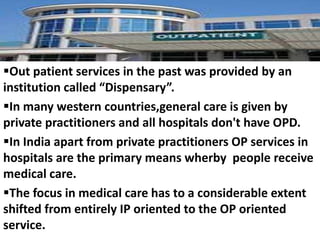
Out patient services in the past was provided by an
institution called “Dispensary”.
In many western countries,general care is given by
private practitioners and all hospitals don't have OPD.
In India apart from private practitioners OP services in
hospitals are the primary means wherby people receive
medical care.
The focus in medical care has to a considerable extent
shifted from entirely IP oriented to the OP oriented
service.
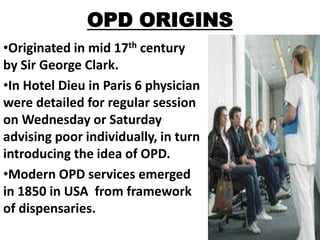
OPD ORIGINS
•Originated in mid 17th century
by Sir George Clark.
•In Hotel Dieu in Paris 6 physician
were detailed for regular session
on Wednesday or Saturday
advising poor individually, in turn
introducing the idea of OPD.
•Modern OPD services emerged
in 1850 in USA from framework
of dispensaries.
OPD-ALL ABOUT
•Definition-
Ambulatory medical care provided to
patients who are not confined to bed can be
provided at a general practitioner’s clinic,a specialist
clinic,a health centre or a hospital.
•To provide care for patients who are not registered
as in patients while receiving health services.
•Section of hospitals with allotted physical facilities.
IMPORTANCE
•First point of contact.
•It is the shop window of the hospital.
•Makes or mars the image of the hospital.
•A good OPD services can reduce the load on IPD
services.
•It is the place for implementing preventive and
primitive health activities.
•It is a stepping stone for health promotion and
disease prevention.
FUNCTIONS
•Early diagnosis,curative,preventive & rehabilitative
care on ambulatory basis.
•Screening for admission to hospital.
•Follow up care and &care after discharge.
•Promotion of health by health education program.
TYPES
•Two types of OP services-
1. Centralized outpatient services
2. Decentralized outpatient services
• Based on type of patients-
1. General out patient
2. Emergency out patient
3. Referred out patient
PLANNING CONSIDERATION
LOCATION-
•Separate entrance
•Easily accessible
•Should have approach from main road
•Adjacent to supportive facilities:x-ray,laboratory
•Amenable for expansion
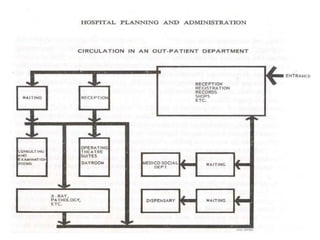
PHYSICAL FACILITIES
PUBLIC AREAS-
1.Entrance
2.Reception
3.Registration
4.Waiting area
5.Public toilets
6.Snack bar
CLINICAL AREAS-
1.Surgical,Dental,
Opthalmic,ENT
2.Obstetric &
Gynecologist
3.Pediatric,Medical,
Psychiatric
4.Dermatology
&Venerology
5.Ortho & Emergency
6.NEURO,CARDIO,
UROLOGY
CONT…
ADMINISTRATIVE
AREAS-
1.Adm office
2.Business office
3.House keeping
4.Storage facility
CIRCULATION
AREAS-
1.Corridors,Stairs,Lifts
2.Easy accessibility of
elevator
3.Corridor-1.8m wide
4.Security check post at
strategic point
5.Availability of STD/ISD
facility
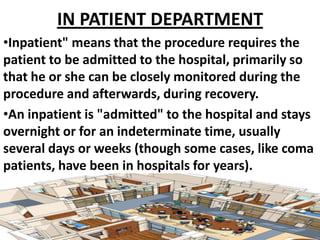
IN PATIENT DEPARTMENT
•Inpatient" means that the procedure requires the
patient to be admitted to the hospital, primarily so
that he or she can be closely monitored during the
procedure and afterwards, during recovery.
•An inpatient is "admitted" to the hospital and stays
overnight or for an indeterminate time, usually
several days or weeks (though some cases, like coma
patients, have been in hospitals for years).
1.To provide the highest possible quality of medical
and nursing care for the patients.
2.To provide necessary equipment,essential drugs
and all other stores required for patient in an
organized manner.
3.To furnish most desirable environment substituting
as temporary home for the patients.
4.To provide facilities to meet the needs of the
visitors and attendants.
5.To provide highest degree of job satisfaction for the
nursing & medical staff including training & research.
FUNCTIONS
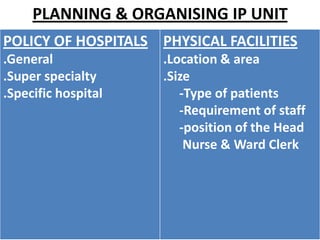
PLANNING & ORGANISING IP UNIT
POLICY OF HOSPITALS
.General
.Super specialty
.Specific hospital
PHYSICAL FACILITIES
.Location & area
.Size
-Type of patients
-Requirement of staff
-position of the Head
Nurse & Ward Clerk
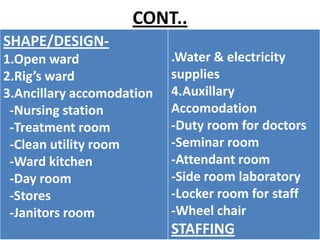
CONT..
SHAPE/DESIGN-
1.Open ward
2.Rig’s ward
3.Ancillary accomodation
-Nursing station
-Treatment room
-Clean utility room
-Ward kitchen
-Day room
-Stores
-Janitors room
.Water & electricity
supplies
4.Auxillary
Accomodation
-Duty room for doctors
-Seminar room
-Attendant room
-Side room laboratory
-Locker room for staff
-Wheel chair
STAFFING
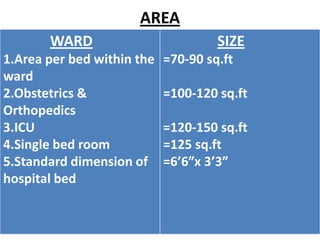
AREA
WARD
1.Area per bed within the
ward
2.Obstetrics &
Orthopedics
3.ICU
4.Single bed room
5.Standard dimension of
hospital bed
SIZE
=70-90 sq.ft
=100-120 sq.ft
=120-150 sq.ft
=125 sq.ft
=6’6”x 3’3”
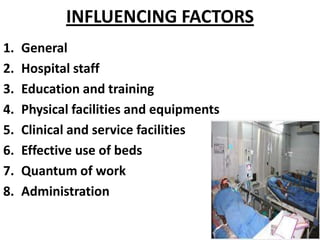
INFLUENCING FACTORS
1. General
2. Hospital staff
3. Education and training
4. Physical facilities and equipments
5. Clinical and service facilities
6. Effective use of beds
7. Quantum of work
8. Administration
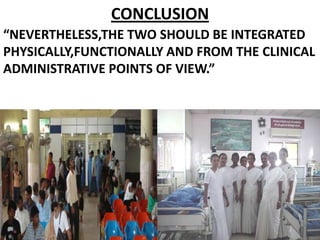
CONCLUSION
“NEVERTHELESS,THE TWO SHOULD BE INTEGRATED
PHYSICALLY,FUNCTIONALLY AND FROM THE CLINICAL
ADMINISTRATIVE POINTS OF VIEW.”
Opd  & ipd

Opd & ipd

  • 1.
    OPD & IPD PRESENTEDBY AWANTIKA DIWAN MBA(HA&HC)
  • 2.
    Out patient servicesin the past was provided by an institution called “Dispensary”. In many western countries,general care is given by private practitioners and all hospitals don't have OPD. In India apart from private practitioners OP services in hospitals are the primary means wherby people receive medical care. The focus in medical care has to a considerable extent shifted from entirely IP oriented to the OP oriented service.
  • 3.
    OPD ORIGINS •Originated inmid 17th century by Sir George Clark. •In Hotel Dieu in Paris 6 physician were detailed for regular session on Wednesday or Saturday advising poor individually, in turn introducing the idea of OPD. •Modern OPD services emerged in 1850 in USA from framework of dispensaries.
  • 4.
    OPD-ALL ABOUT •Definition- Ambulatory medicalcare provided to patients who are not confined to bed can be provided at a general practitioner’s clinic,a specialist clinic,a health centre or a hospital. •To provide care for patients who are not registered as in patients while receiving health services. •Section of hospitals with allotted physical facilities.
  • 5.
    IMPORTANCE •First point ofcontact. •It is the shop window of the hospital. •Makes or mars the image of the hospital. •A good OPD services can reduce the load on IPD services. •It is the place for implementing preventive and primitive health activities. •It is a stepping stone for health promotion and disease prevention.
  • 6.
    FUNCTIONS •Early diagnosis,curative,preventive &rehabilitative care on ambulatory basis. •Screening for admission to hospital. •Follow up care and &care after discharge. •Promotion of health by health education program.
  • 7.
    TYPES •Two types ofOP services- 1. Centralized outpatient services 2. Decentralized outpatient services • Based on type of patients- 1. General out patient 2. Emergency out patient 3. Referred out patient
  • 8.
    PLANNING CONSIDERATION LOCATION- •Separate entrance •Easilyaccessible •Should have approach from main road •Adjacent to supportive facilities:x-ray,laboratory •Amenable for expansion
  • 10.
    PHYSICAL FACILITIES PUBLIC AREAS- 1.Entrance 2.Reception 3.Registration 4.Waitingarea 5.Public toilets 6.Snack bar CLINICAL AREAS- 1.Surgical,Dental, Opthalmic,ENT 2.Obstetric & Gynecologist 3.Pediatric,Medical, Psychiatric 4.Dermatology &Venerology 5.Ortho & Emergency 6.NEURO,CARDIO, UROLOGY
  • 11.
    CONT… ADMINISTRATIVE AREAS- 1.Adm office 2.Business office 3.Housekeeping 4.Storage facility CIRCULATION AREAS- 1.Corridors,Stairs,Lifts 2.Easy accessibility of elevator 3.Corridor-1.8m wide 4.Security check post at strategic point 5.Availability of STD/ISD facility
  • 12.
    IN PATIENT DEPARTMENT •Inpatient"means that the procedure requires the patient to be admitted to the hospital, primarily so that he or she can be closely monitored during the procedure and afterwards, during recovery. •An inpatient is "admitted" to the hospital and stays overnight or for an indeterminate time, usually several days or weeks (though some cases, like coma patients, have been in hospitals for years).
  • 13.
    1.To provide thehighest possible quality of medical and nursing care for the patients. 2.To provide necessary equipment,essential drugs and all other stores required for patient in an organized manner. 3.To furnish most desirable environment substituting as temporary home for the patients. 4.To provide facilities to meet the needs of the visitors and attendants. 5.To provide highest degree of job satisfaction for the nursing & medical staff including training & research. FUNCTIONS
  • 14.
    PLANNING & ORGANISINGIP UNIT POLICY OF HOSPITALS .General .Super specialty .Specific hospital PHYSICAL FACILITIES .Location & area .Size -Type of patients -Requirement of staff -position of the Head Nurse & Ward Clerk
  • 15.
    CONT.. SHAPE/DESIGN- 1.Open ward 2.Rig’s ward 3.Ancillaryaccomodation -Nursing station -Treatment room -Clean utility room -Ward kitchen -Day room -Stores -Janitors room .Water & electricity supplies 4.Auxillary Accomodation -Duty room for doctors -Seminar room -Attendant room -Side room laboratory -Locker room for staff -Wheel chair STAFFING
  • 16.
    AREA WARD 1.Area per bedwithin the ward 2.Obstetrics & Orthopedics 3.ICU 4.Single bed room 5.Standard dimension of hospital bed SIZE =70-90 sq.ft =100-120 sq.ft =120-150 sq.ft =125 sq.ft =6’6”x 3’3”
  • 17.
    INFLUENCING FACTORS 1. General 2.Hospital staff 3. Education and training 4. Physical facilities and equipments 5. Clinical and service facilities 6. Effective use of beds 7. Quantum of work 8. Administration
  • 18.
    CONCLUSION “NEVERTHELESS,THE TWO SHOULDBE INTEGRATED PHYSICALLY,FUNCTIONALLY AND FROM THE CLINICAL ADMINISTRATIVE POINTS OF VIEW.”